Showing posts with label General Gardening. Show all posts

Tuesday, October 23, 2018

Book Time: A NEW GARDEN ETHIC

Quite a few years ago now, I started "talking" with my books by underlining passages that spoke to me and by writing comments in the margins.  It was hard to do at first, but once I got over my good-girl habits of keeping my books pristine, I found that it really helps when I go back to a book to review and refresh myself about what it said.  Most importantly, doing this provides a conversation to join when I reread the book.  I can see what captured my attention originally and compare those ideas to what strikes me now, making my understanding of the book deeper with each reading.  Occasionally I've even shared a book with a friend and invited her to comment (in a different color ink), which adds yet another level of interaction with the written words.

Because of this habit I have of physically talking with my books in written form, one of my easiest "sorts" for which books I want to keep and which ones just need to be passed along is a simple look to see whether or not I've underlined and commented in the book in question.  If it wasn't interesting enough to mark up, it's not interesting enough to keep.  Maybe someone else needs that book more than I do.

A New Garden Ethic, by Benjamin Vogt, New Society Publishers, BC Canada, 2017, passed my "Do I keep this?" sorting question with flying colors.  It's marked up all over the place.  It's marked up so much that my big question for this post is, "How can I possibly do this book justice in a simple, short review of it?"

As I sat down this afternoon to start thinking about writing this review, I began to thumb through the pages.  An entire paragraph highlighted here.  Exclamation point there.  "Great series of questions...." on one page.  Lots of "Wow!" and "Yes!" comments in the margin.  Ideas for blog posts.  Books to read.  More underlining.  Asterisks.  Occasional notes asking about sources for certain claims.  There is so much to digest here that I've become convinced A New Garden Ethic would make a wonderful book for a gardening book club to read and discuss - probably over a long weekend, as a single hour or two wouldn't be nearly long enough.

One interesting twist to this ecological gardening book is its author, Benjamin Vogt.  Dr. Vogt has a PhD, but it's in creative writing, not in biology or ecology or horticulture or landscape architecture or any of the myriad fields that one would normally associate with a book of this nature.  That said, prairie and ecological garden design are obviously deep passions for Vogt and he's educated himself accordingly.  Coming from a creative background, his writing has a vibrancy that can sometimes be lacking in more scientific tomes.

I'll be up front, though:  to me, Vogt's lack of scientific training shows up rather glaringly here as a lack of citations for some of his specific facts.  It is not enough to say Scientist Y did a study in which she found xyz.  I want to know where to find that study - what journal was it published in?  when and where was the study performed?  what were the parameters?  I want to be able to delve into some of those studies more closely to see if the findings are being accurately reported in what was written.  I may want to use those statistics in something I write, too, but I'm not going to quote statistics without knowing where they come from, even in a simple blog post.  A revised edition with this major flaw remedied would strengthen this book significantly, in my opinion.

Beyond that flaw, though, there's an incredible amount of substance in this book that captures my spirit and that doesn't rely on specific studies or individual facts.  Take this wonderful passage that I've seen others pull from the book as a quote, "We live in a world of perfectly spaced plants that mimic headstones aligned in exact intervals.  Wood mulch is more important to us than flowers.  We clean up our gardens like they are living rooms after the children have gone to bed."  With 3 lines, Vogt has given us several iconic images that capture the lack of real life in so many modern gardens.

In the first chapter of this book, Vogt gives us a basic framework about what he sees as being right and wrong about most gardens, yards, and natural areas in our current day and age.  This framework leads him to a statement of a new garden ethic that he believes we need to live by if we want to have our gardens function as more than just a pretty fashion accessory...and Vogt is compelling as he shows us why we want our gardens to function so richly.

With native plants being integral to ecological function in any landscape, Chapter 2 is generally a discussion of native plants, their importance, and the pushback against their use in many circles.  There's a small, fascinating section on the politics and culture of using native plants:  is it "fair" or "democratic" to say that gardeners should only use native plants?  "When we step in and impose our ideals of democracy on a landscape, we disrupt and destroy the landscape, altering life processes that have worked long before we created human democracy...."  Vogt notes that plant culture should not be mistaken for human culture, that nature and ecosystem function have little to do with patriotism or freedom or other political concepts.

In the remaining 3 chapters of the book, Vogt discusses a wide variety of topics ranging from cognitive dissonance and the value of anger and hopelessness to the impact of the Enlightenment on where we are today, all with the object of moving us towards developing and being willing to utilize the defiant compassion that he believes we need to bring to our relationship with our landscapes and gardens.

A New Garden Ethic is a call to action, a call to enrich our own lives and the world immediately around us by connecting deeply to our specific physical environs.  By answering this call, Vogt believes we can each help to save the planet's living fabric, one garden at a time.

Tuesday, November 14, 2017

Slow Gardening

With all of the angst over politics these days, I haven't been hearing much about the "Slow" movement - Slow Food, Slow Money, Slow Living...Slow Gardening.

But Slow Gardening is what I've come to consider my own method of gardening.

It's slow gardening because I don't use inorganic fertilizers to speed up plant growth or to boost the size of fruits or flowers.

It's slow gardening because I prefer to hand weed and then mulch to keep the soil free of weeds, rather than sprinkle my beds and lawn with some pre-emergent or other herbicide. As I've written about before, hand weeding helps me hear bird songs, see unusual insects, and generally experience my yard and garden in ways I wouldn't be able to without being quietly bent over and relatively still.

It's slow gardening because I prefer hand tools to power tools, whenever possible.  Greg, who keeps the lawn mowed and trimmed, has switched now to a battery powered electric mower and a battery powered edger which are wonderfully quiet and efficient.

It's slow gardening because I plant a variety of plants, including plants that are known as slow growers.  This is, truth to tell, rather problematic for me, since we move every few years and I rarely get to see said slow-growing plants reach anything approaching maturity.  However, gardeners are nothing if  not hopeful and forward-looking people.

Felder Rushing wrote a book, Slow Gardening, which was released in 2011, and he maintains a page where he outlines his version of the Slow Gardening concept.  I generally agree with his outline of principles, although I am, perhaps, even more of a slow gardener than he is.

Sometimes most gardening seems like it's slow.  After all, you can plant and mow and fertilize and weed, but it just takes time for plants to grow.

Monday, October 03, 2016

Learning My Garden Through Weeding

Anybody else out there enjoy weeding?

While I don't like to be outside for any length of time if the weather is abysmal - which is how I define most of the hot, humid summer down here in the panhandle of Florida - once the weather starts cooling off, I actually find that I like to weed.  It's meditative...and I learn A LOT about the nuts and bolts of daily life going on at ground level in my garden.

My latest weeding project is/was a large, new bed that I halfheartedly started last spring, before I got chased inside by heat and humidity.  The photo above shows about half of the area, which continues on to the right another 10 feet or so.  Taken fairly early in the weeding process, this shows the approximate height and thickness of the weeds I was removing. 

I chose to hand weed this new bed for two basic reasons, one of them related to poor planning.  First of all, I knew there were several small seedling plants located in the area that I wanted to save and, probably, relocate.  Secondly, when I started to make the bed last spring, I put in a few plants that I didn't want to lose.  There were 3 clumps of pink rain lilies (Zephyranthes grandiflora) and, more problematically, several wild strawberry plants (Fragaria virginiana) that had spent the summer putting out runners and baby plants.  If I smothered the area with newspaper and mulch, it would be relatively easy, but I'd lose ALL of the plants in the area, including the ones I wanted to keep.

So I sat down on my rear and I weeded.  The weeds were primarily a mix of an 18" tall, rather airy plant with wiry stems that I haven't identified, doveweed (Murdannia nudiflora), chamberbitters (Phyllanthus urinaria, a.k.a. gripeweed, for my Mobile friends), Asiatic hawksbeard (Youngia japonica), mock strawberry (Duchesnea  indica), Florida pusley (Richardia scabra), and Virginia buttonweed (Diodia virginiana).  For seasoning, there was a little bit of dollarweed (Hydrocotyle umbellata), the dainty Carolina ponysfoot (Dichondra carolinensis), and a variety of sedges (Carex spp.) thrown in.

The photo above is a single stem of Virginia buttonweed, surrounded by lots of doveweed.  Lovely, isn't it?  (Yes, that's sarcasm.)  At least it was mostly green.  Anyway, of all the weeds, only about half the species were native:  Virginia buttonweed, Florida pusley, dollarweed, Carolina ponysfoot, and probably most of the sedges.  I don't know about the unidentified, 18" "wiry" weed.  Most of the biomass was doveweed, the wiry unknown, and Virginia buttonweed.

Anyway, as I sat there on the ground, hour after hour, I not only got to know the plants quite well, but I also got to see some of the "denizens of the dirt", those little creatures who live their entire lives in our gardens but that we rarely see or notice.  A few of these little creatures sat still long enough for me to photograph, so I thought I'd share them with you....

First off, I am going to cheat just a little.  I saw one skink in this area as I was working, but I didn't get a photograph of that particular individual.  I did get a photo of another one of the same species a few days earlier, so I'll share the photo that I have.

This is a ground skink (Scincella lateralis) and it was probably about 5" long, which is about as large as ground skinks get.  Apparently they are the commonest skink in Florida gardens, but they are rather hard to see, as they move very rapidly through the undergrowth and leaf litter.  When I am working in an established bed, I often catch a glimpse of a little brown lizard skittering away.  I assume those are other ground skinks, exhibiting their getaway skills.

A toad was the only other vertebrate that I flushed out as I weeded, although certainly birds and other vertebrates must have foraged in the area from time to time.  This little guy...


...seemed to be missing his right rear leg.  An injury?  Some sort of genetic defect?  Hard to tell.  Surprisingly to me, there are only 4 species of toads in Florida.  I think this is a southern toad (Bufo terrestris), the most common species, but I am not completely certain.


Rather unexpectedly, there were two large caterpillars amidst this unprepossessing mass of vegetation.  The first one was an odd looking "woolly bear" type, with coal black hair and bright red segments that showed when it curled up in its defensive position.  I've seen lots of woolly bears before, but never one colored like this.

According to BugGuide, this is the caterpillar for the giant leopard moth (Hypercompe scribonia).  I've never seen an adult, but the BugGuide photos look stunning and I will certainly be looking for one now that I know it obviously occurs in our yard.

The second large caterpillar fell out of a handful of weeds that I had pulled, but by observing it for a couple minutes as it got back to eating, I believe it was munching determinedly on Virginia buttonwood.

Despite this guy's 3-4 inch long size and distinctive markings, he was a little hard to identify.  Nothing seemed to fit when I scanned the hornworm photos at BugGuide, so I eventually turned to Caterpillars of Eastern North America, by David L. Wagner, where I was able to figure out what I was seeing.  This is the caterpillar of the Tersa Sphinx (Xylophanes tersa), another striking moth species that I've never seen before.  The link is to the node at BugGuide, where you can see photos of both the caterpillars and the adults.

I photographed two other caterpillars, both much smaller.  One was a hairy individual that I haven't tried to identify yet....

while the other was an early instar of yet another sphinx moth, about an inch long, also currently unidentified.

There were lots of little, round snails, maybe 1/4" in diameter...

...and one large, conical snail whose shell was at least an inch in length.


While I saw many green stinkbug nymphs, I only saw this one adult stinkbug.


While I'm not completely sure, I think this is Euschistus crenator, a species that feeds on sedges.  Probably the green nymphs were of a different species.

There were several small, longhorned grasshoppers, ....

but no shorthorned grasshoppers of any size, which is a major change from gardening in Kansas.

There were also a lot of small spiders.  I only took the time to photograph this one, which was slightly larger than most.  I think it is a wolf spider, but I don't know the species yet.

Last, but hardly least, there were a lot of roaches running around.  I didn't try to photograph any of them, assuming they were wood roaches which help to decompose organic matter.  I saw this one, though, that was different and obviously an adult.  It was trying to get away through the grass and "posing", so I did take a couple minutes to get a few photos.  Imagine my dismay just now as I worked to identify it and realized it is probably a non-native, Surinam Cockroach (Pycnoscelus surinamensis) .  If so, according to BugGuide, it has the interesting characteristic of reproducing entirely by parthenogenesis in the U.S. - no males have ever been found.

As I worked and noted all of the small creatures living among the weeds I was pulling out, I found myself feeling guilty for destroying the habitat that was obviously providing food and shelter for such a large variety of little animals.  I'm trying to placate myself by remembering that I will be planting a variety of native perennials and shrubs in the area this fall, all tucked in with a nice layer of leaf and wood chip mulch...but the dismay is still there, simmering in the background.  Forgive me, little ones.  I really AM trying to create a healthy habitat for all in our yard and gardens.


Friday, January 22, 2016

Time for a New Beginning


As I sit down to write a new blog post - the first in many months - the joyful screams of laughter coming from our grandson, Connor, are ringing through the room.  Grandpa is rough-housing with him, and 7 month old Connor loves it!

Life has changed a lot since last I wrote.  We're fairly well settled in Ft. Walton Beach, Florida, now.  Every week day we care for Connor, generally for 8 or 9 hours a day, sometimes for as long as 11 hours.  Greg hasn't gone back to work; he will probably start working part time soon, but for now he is deeply enjoying this time with Connor.  Thanks to long hours during training, Greg missed much of our children's early years.  Even for me, who stayed home and raised our kids, there are new observations and opportunities.  I'm getting a chance to notice things I was too busy or too stressed to notice when our kids were young:  the development of smaller muscle control, the personal preferences that show up almost from the first day, and the changing patterns of babble, to name a few.

Between settling in and caring for Connor, what I haven't done in the last several months is garden much or blog at all.  With the holidays behind us and spring looming soon, the gardening juices are finally beginning to flow again through my veins.

I have no idea where this new garden will take me yet.  I definitely plan on using mostly natives, but I'm floundering a bit for a central theme, like "restoring prairie" was for our land and garden in Kansas.

This is a completely different situation, not too surprisingly.  We're in an older, suburban subdivision, developed in the late 1960's, about 4 miles inland from the Gulf of Mexico.  Located on a small, man-made, freshwater lake, our lot is about 0.4 acres in an area of sand hills.  In the neighborhood, there is an overstory of sand live oaks, live oaks, and southern magnolias.  I suspect there were longleaf pines originally, too, but most of them have been removed.

While the neighborhood has a great deal of landscape personality, our lot is fairly bland.  There is a large live oak (Quercus virginiana) and a large southern magnolia (Magnolia grandiflora) in the front yard, with some foundation shrubs and a few non-native plants under the magnolia.  The rest of the front yard could euphemistically be called "lawn."

The back yard is fairly similar, with a younger southern magnolia, 3 pignut hickories (Carya glabra), a sand live oak (Quercus geminata), a healthy live oak, and 4 unhealthy live oaks.  There are foundation shrubs along the back of the house, a tangle of azaleas and undergrowth along the west side (a city right-of-way over a drainage pipe), and a lot of open "lawn" dominated by dollar weed and assorted other nongrass species.  Next to the lake, two sea walls have been put in to terrace the hill, with an area of bare sand in between them that sits about 3' above the level of the lake.

The post I did last June, "A New Chapter Begins "Down South"," while we were here on "baby watch" shows our yard in its "virgin" state.  I've made a few changes - and, of course, it's winter now - but the basics are unchanged.  Since writing that post, I have realized that we actually only have one sand live oak - the others are live oaks, a similar but larger species.  Also, the hickories in our backyard are pignut hickories (Carya glabra), not bitternut hickories, as I originally thought.

I know that I want to add sand live oaks and maybe a few longleaf pines (Pinus palustris) to start restoring the yard's canopy.  I know that I want to add some shrubs, both for wildlife habitat and for privacy from across the lake.  I know that I want to add flower gardens for color and pollinator habitat.

And there my mind just sort of stops.  How much lawn should I leave?  How big should the perennial and shrub beds be, and how should they be shaped?  We want a vegetable garden (probably raised beds) - where should it be located?  How should we lay out the path leading to the dock and lower deck?  I feel like I can't place trees or shrubs until I have the answers to these and similar questions.

Winter is the best time of year to plant woody plant material here, so it's (past) time to begin.  Have suggestions?  I'd love to hear them!  Have other design ideas?  The more, the merrier!  It's a new beginning, for us...and for the garden.  There's new territory to chart and discover, so we'd best get on our way....

Thursday, April 09, 2015

Maintenance in the Native Plant Garden

As I've given talks about utilizing native plants in our landscapes, I've become aware that many people are scared of "losing control" in their gardens by using native plants and by following organic gardening methods.  So I thought folks might be interested in a blow by blow account of how I maintain my native plant landscape.  I actually think that my garden chores are significantly less onerous than those of more traditional gardeners.

To start with (or, perhaps, to end with), I don't cut back my perennials in the fall or winter.  Many insects overwinter in or on dead plant stems, including some of our native bees;  other insect species overwinter in the leaf litter.  Predators are particularly likely to be among the insects overwintering this way.  The leaf litter also provides great foraging habitat for winter birds, as do the standing seedheads.  Watching the birds forage and seeing the patterns of the plant stems adds winter interest to the landscape.  When you add in the fact that standing vegetation holds snow (moisture) in place better than "clean" beds, you definitely have a winning winter combination for the garden.

Winter, then, is pretty basic.  Enjoy the scenery!

As the plants begin to green up in the early spring, it's time to do the first chore of the year:  cut back last summer's dead plant material.  I consider this the main "work" in the organic, native plant garden.  Otherwise, the garden takes very good care of itself.  The timing of the spring cutback is always a balancing act for me.  I prefer to wait long enough that there aren't many late freezes left, although that's not always possible on the prairie.  Since I have planted a variety of crocus, daffodil, tulip, hyacinth, and grape hyacinth bulbs, I've started using their early blooming as my signal.  Darn it - I planted them, so I want to see them!

This year my spring clean up has been particularly protracted, but that's okay.  This is gardening, not a precision dance routine or an accounting balance sheet.

So that I could see the petite daffodils which had begun to bloom in the front beds, I started the spring clean up on March 18th this year.  This photo was taken on the 20th, the day after we burned the front tallgrass (which you can see in the distance).  All I had done so far was cut back the asters at the very front left of the photo...and, if I remember correctly, a few perennials along the sides of the path itself.

Here is a slightly different view, taken at the same time.  Overall, this is what the front garden looked like for most of the winter.  When I looked out the front windows, it was a rare time that I didn't see birds poking around. When we had some snow, the patterns could be stunning.

By the 26th of March, about a week later, I had cut back about half of the stems in this bed, starting at the driveway.  Of course, a few more things were blooming, too, including the Callery (Bradford) pear.  It always amazes me to see how quickly plants green up in the spring!  Several more types of daffodils had opened, and the blue heirloom hyacinths by the driveway were putting on their annual show.  (You can always click on the photos to enlarge them and see more detail.)

Just 5 days later, on the 31st, you can even see how much the daylilies right by the foundation had sprouted up.  I hadn't done any more cleanup in the garden yet, though, because our kids were visiting for the last bit of March and the first week of April.

In fact, I didn't get more cleanup done until 2 days ago, when I noticed the Peach Blossom tulips in full bloom amidst the cacophony of last year's ironweed and Echinacea stems.  So I did a bit more work that day....

...quitting when I'd cleared everything to the south of the little brick access path...except for the aster stems under the redbud clump.  (See?  I told you this wasn't a remotely frantic process!) 

You can see the newly exposed Peach Blossom tulips a few feet in front of the wheelbarrow. The wheel barrow has the last load of stems for that day, which I take to the brush pile out back, while the yellow bucket holds deadheaded daffodil stems and other non-seedfilled detritus that can be put in the compost pile.   Right now there is a lot more for the brush pile than for the compost pile - but that ratio changes throughout the growing season.

This morning, I finished cutting off the last of the aster stems under the redbuds and took this photo of the bed between the house and the walkway....

...and this photo of the bed between the walkway and the buffalo grass, both looking south.  Although cutting back the stems took me bits and pieces of 3 weeks to accomplish, that was due to MY lack of stick-to-it-iveness, not due to this process taking any huge amount of time overall.  Now that my native flower beds are established, this is the primary job that I need to do in any of  these beds all year.  Period.  It's really pretty simple.

That said, the beds do look better if I follow up this tidying chore with some editing, which is best done at this time of year.  I'll discuss that in the next post.

Oh, by the way, I found 4 Carolina (praying) mantis egg cases and 2 black and yellow garden spider egg sacs among the plant stems as I cut them back.  If you look closely, you can see one of the mantid egg clusters at the base of this grass clump.

I saved the plant stalks with the egg cases on them and placed them strategically in the trimmed areas of the garden, so the young could hatch out and do their thing without further interference.  Last year was obviously a good year for predators in my garden!


Thursday, July 24, 2014

What's the Point of Gardening? A Gardening Ethic for Our Times

Why do you garden?

If you're like me at all (and I suspect that many gardeners are), you probably have several reasons you garden - several passions that gardening feeds - several functions that gardening performs in your life....

I garden because it makes me feel good to see flowers blooming around my home.

I garden because it's a form of exercise that I enjoy and it gets me outside, in the fresh air.

I garden to increase our property value (I hope).

I garden to provide some good, chemical free food for us to enjoy.

I garden because plants and animals fascinate me in their infinite variety.

Most of all, though, I garden because it's my way of doing something very concrete, very local, and very specific to make the world healthier and more ALIVE.  I garden, and I garden the way I do, because it's my way of helping to heal the life force on our planet, which seems to be in serious danger from the increasing human assaults on it over the last 100 years or so.

"Okay, Cynth, " I can almost hear you sigh.  "What brought this up?  Can't we just look at pretty pictures and move on?"

Well, of course you can.  But I read something the other day that really got me thinking about my role as a gardener.  Ben Vogt of Nebraska, who blogs at The Deep Middle, posted a commentary that struck a deep chord with me:  "Is There Any Difference Between a Land Ethic and a Garden Ethic?"
Hmmm.  Is there?  Why DO I garden?  Why do most people garden?

Ben started his thought-provoking post by quoting bits and pieces from Aldo Leopold's wonderful statement about developing a land ethic, as written in A Sand County Almanac.  Leopold finished writing this small, but important, three part book in 1948, just before he died.  The book was published a year later.  I think the most concise statement of Leopold's land ethic is actually written in Leopold's own forward to this book, "We abuse land because we regard it as a commodity belonging to us.  When we see land as a community to which we belong, we may begin to use it with love and respect."  (My italics)

Filling the last 25 pages of A Sand County Almanac, the entirety of Leopold's "The Land Ethic" is certainly too long for me to quote here, but it's well worth reading...and rereading.  In it, he moves from showing how we humans have developed our ethical codes, first working on the relationships between individual humans and later developing codes such as the Golden Rule and democracy for how the individual relates to society as a whole and how society relates back to the individual.  Now, Leopold believed, it had become necessary to develop another layer to our ethical codes to govern how humans related to the land and to the plants and animals that shared it with them.  Otherwise, in Leopold's words, "There is no other way for land to survive the impact of mechanized man...."

Aldo Leopold wrote in 1948 and presumably developed his ideas even earlier.  What would he say about the way we treat the land, and the plants and animals on it, now?  I'm rather glad he's not around to see what we've done and, even worse, what we're in the process of doing.

Because I am around to see what we've done and what we're currently doing, I try to treat our little 10 acres according to Leopold's Land Ethic, adopting this ethical code, to the best of my ability, as my gardening ethic.  I try to treat our land, with its associated plants and animals, with love and respect, thinking of it as a community that I belong to rather than as a resource to maximize.  Realizing that communities - like most complex things - are healthier when they have all of the parts that they should have, I am trying to reintroduce plants that have disappeared over the last 150 years while this parcel of land was being extensively and intensively farmed.  I'm hoping that, as the plants reestablish, many of the smaller animals will find their way back too.

My goal is to have as stable, as healthily functioning, a prairie community on our 10 acres as I possibly can.  Someday, perhaps, the plants and animals that remain on this tiny piece of land will serve as a source to move back out into the wider landscape as a whole, helping to heal it as well.

Towards the end of "The Land Ethic," Leopold talked about a schism among folks who work with and on the land - he called it a cleavage - that divided people into 2 camps which deeply affected their relationship to the land they worked with:

In all of these cleavages, we see repeated the same basic paradoxes:  man the conqueror versus man the biotic citizen;  science the sharpener of his sword versus science the searchlight on his universe; land the slave and servant versus land the collective organism.  Robinson's injunction to Tristram may well be applied, at this juncture, to Homo sapiens as a species in gelogical time:
Whether you will or not
You are a King, Tristram, for you are one
Of the time-tested few that leave the world,
When they are gone, not the same place it was.
Mark what you leave.

As a gardener, which cleavage do you belong to:  the conqueror or the citizen?  Is your garden your slave and servant or a community that you belong to?  When you are gone from your garden, what will you leave for the future?  What mark will you have made?


Sunday, June 08, 2014

Jungle on the Prairie

A week ago yesterday, our daughter was married.  In Florida.  Needless to say, we traveled down there, both to help out ahead of time and to attend the wedding.  Rather than hurry back, we decided to stay a few extra days and relax, which was...relaxing.

There was one big problem with this agenda.  After months of almost no rain, it rained here the day after we left and then again several more times while we were gone.  In fact, we received more rain in the 2 weeks we were gone than we'd received since the start of the new year until the day we left.

Not too surprisingly, then, we came home to a jungle - or as close to a jungle as it gets on the Kansas prairie.

Including the driveway, the only area that didn't look overgrown was the buffalo grass!  (Have I told you recently how much I'm coming to enjoy buffalo grass?!)

The vegetable garden looked particularly disastrous - the spinach, lettuce and many of the broccoli and cauliflower plants had bolted and the weeds had literally appeared as if by magic.  Pigweed - which I hadn't even noticed germinating before we left - was over a foot tall.  Crabgrass - which had barely started to germinate - was a 4" tall carpet of green in areas.

So we started working yesterday morning.  Greg put in about 8 hours of weeding and mulching (for the second time this spring) in the vegetable garden.  I put in about 3 hours of vegetable garden weeding, then a couple more hours, off and on, weeding in the flower gardens and lawn.  After he got too tired to weed any more, Greg mowed.

Things are looking a little better, but far from where we want them yet.

Meanwhile, we discovered that we'd had a MAJOR hatch of grasshoppers while we were gone.  There are grasshopper nymphs everywhere.


This little merry band was on one of the older cauliflower leaves....

...while this more mixed assortment was brazenly staking out one of the broccoli plants.

But wait!  One of those isn't a grasshopper!

Good eyes.  It's not a grasshopper, it's a wheel bug nymph.  With a grasshopper meal on its mind!

The wheel bug nymphs are everywhere and, much to my delight, I found a couple of them snacking on baby grasshoppers.

This one was on lamb's quarters in the vegetable garden,...

...while this one was hiding under a Jerusalem artichoke leaf.

Obviously even an army of wheel bugs won't be able to handle the hordes of grasshopper nymphs that we are currently hosting.  I'm keeping my fingers crossed that continued wet and cool will help with that problem, but meanwhile the wheel bugs are giving me great pleasure as I notice them skulking throughout the yard.   Terminators, baby!

Saturday, April 26, 2014

The Garden in the Third Part: Fitting In to the Greater World Around Us

Spring starts slowly on the prairie.  With the mid-continental weather tending towards extremes, plants are suitably cautious about putting forth too much green, too early.

As a gardener, I'm itching for green by mid February.  For ANY color, actually, other than brown and tan and and gray and cedar green.  I'm itching for gentle breezes and softness.  The prairie doesn't provide much of any of that in February.  In March, either, to be honest.

Feeding the birds helps.  Cardinals flash such vivid red that I can't help but feel cheered up as I watch them.  Songs start noticeably increasing by early March - and the return of the male red-winged blackbirds triumphantly declaring, "O-Ga-LEEEEE!" from every conceivable perch lets me know that spring truly is on its way.

Of course, giving in to the pull of non-native spring bulbs helps, too!

But I find a particular excitement stirring when I start seeing signs of spring in the native plant life.  On March 12th, this was my first real sign of spring in the native plants....

Do you see it?  Those fuzzy shoots pushing upwards?  Those are the shoots of pasqueflower (Pulsatilla patens).   The hairs help protect the leaves and stems and even the petals against cold temperatures, as does the plant's short stature, hugging the warm earth.  We're actually a bit far south to be in pasqueflower's native range, but I enjoy the fuzzy purple fluffiness of this diminutive charmer anyway.

By March 29th, the blooms were up and fully open.

Now, in late April, the seed heads have already formed and I'm enjoying their soft texture too.  How quickly the season of the pasqueflower passes.

But back to March 12th....  I leave my perennials uncut over the winter to provide seeds and shelter for the birds, overwintering sites for the insects, and protection for the soil from winter's harsh winds.  With spring definitely starting to arrive, I undertook one of the biggest projects of my native garden calendar year - cutting back last year's growth.

On March 12th, here's what the front flower bed looked like after the vagaries of winter this year.

After taking a quick series of photos, I put the camera down, picked the clippers up, and got to work.  After a relatively quiet winter spent sitting more than I probably should, I try not to become a "weekend warrior" with the attendant injuries of doing too much, too fast.  So I work at this first big task of the gardening year a bit at a time, hauling all of the debris off to the brush pile where overwintering insects can emerge at their leisure.  If I remember correctly, this bed alone produced about 15 compacted wheelbarrow loads of detritus.

A bit less than 2 weeks later, on March 29th, the front flower bed looked like this, my "mechanical burn" having cleared off the remnants of last year's exuberance, opening up the soil for the sun's warmth and for the emergence of this year's fresh, new growth....

There's not a lot more green yet, but there's a whole lot less brown!  It always amazes me to see how easy it is to brush away the layers of life that make up the prairie landscape.  In some ways, it is such a fragile world.

Meanwhile, in the back courtyard where shade simulates more of a prairie woodland environment, the woodland flowers were just beginning to emerge.  Well, actually, the Bloodroot (Sanguinaria canadensis) had already emerged and was almost done blooming.  Woodland plants are often small, easily overlooked among large, showy clumps of daffodils and bright, shining clusters of purple crocus.  I almost missed the bloodroot blossoms!

Just two days later, all of the petals were gone and the leaves had emerged more fully.  I really enjoy the bloodroot leaves, with their odd lobes, their gray green color, and their softly rounded shapes.

Bloodroot gets its name from its red sap, most easily seen in its roots.  The sap was used as a dye by some of the Native American tribes.  It is poisonous if ingested in sufficient quantities.  Like many woodland forbs, bloodroot leaves will go dormant in mid-summer, reducing the plant's need for water in traditionally dry times.

In another area of the back courtyard beds, two little rue anemones (Thalictrum thalictroides) were emerging.

Nearby, a clump of liverleaf (Hepatica americana) was pushing up out of the ground, flowers first.  The leaves come later - around 2 weeks later, in fact!

It always amazes me that so many of these woodland flowers essentially emerge with their flower buds opening at the same time - or even before - their leaves unfurl.  "Time's a-wasting, folks!  Got to get this seed production started NOW!"

I am going to have to stop here for now - it's late and I need to get to bed.  The upcoming week is going to be full and I'm not likely to be able to blog again for a while - but don't forget the native wildflowers!  I've only managed to bring you up to the end of March so far.  In the chronology of the spring garden, the daffodils and hyacinths have just started blooming, the purple crocuses are in their full glory, and the spinach is just starting to germinate in the glass light shade "cold frames".

We'll resume our springtime travels through time in the native plant garden when next we meet!  In the meantime, happy gardening!

Friday, April 25, 2014

The Garden in the First Part: Heirlooms and Memories

Early spring in Kansas is spring bulb time.  Little else can take the roller coaster weather and still be willing to "put it all out there" in the way of blooms and leaves.  This year seemed like a particularly beautiful spring for bulbs.

To me, spring started in mid February this year.  The first yellow crocus blooms shine out among my other photos on February 21st.....

Generally speaking, I prefer heirloom plant varieties for non-native plant species.  There's just something that nourishes my romantic spirit in thinking that I might be saving an old variety of plant, almost lost to horticulture, for future generations.

I have a few heirloom crocus varieties, but I can't say that I can tell a lot of difference between them and more modern varieties.   Greg has been very interested in scattering crocuses throughout the grass in the yard, which makes labeling an heirloom variety impossible, so crocuses are one species in which I have tended to just go with "cheap and cheerful" modern bulbs.

Heirloom or modern, crocuses seem to bloom in the same basic order:  yellow first, then white and finally purple. This cluster of 5 clumps illustrates that fairly well:  the yellow clumps (helped along by munching rabbits) are essentially done, the white clump is in full bloom, and the purple clumps (also rabbit-pruned) are just beginning to open fully. 

The entire process is slow but steady - the second photo was taken on March 20th, fully a month after the first photo.  Crocuses certainly brighten the late winter landscape for a long time...in what seems like a time period that lasts forever.

As the crocuses pass their peak, the daffodils begin.  Tete-a-Tete, a cute, perky, little, bright yellow daffodil is one of the first varieties to open.  I have my first daffodil photos on March 20th, the same day as the crocuses above.  By 9 days later, multiple daffodils have opened, as have the hellebores and the first of the hyacinths.  Looking across the landscape, though, things still seem pretty sere, even 2 days later on March 31st.

By April 4th there is a little more color, as the lilac leaves start to burst their buds and a few more flowers bloom.....

...and by April 10-11th there is much, much more color.  This was one small area of the courtyard bed on April 10th, showing 2 varieties of daffodils, my wine purple hellebore, blue hyacinths, deep pink hyacinths and grape hyacinths.

Taking a photo down the length of the bed shows a different angle to the same plants, just one day later.  It's rather amazing how different the bed looks from these 2 different angles.

Snow before dawn on April 14th literally dumped ice water on the party and dampened the colors, at least briefly.

Luckily the temperatures were just above freezing when the snow came down, so it actually did little damage.  We had a harder freeze the next night, after the insulating snow had all melted off, but even that didn't seem to harm too many plants.

By the 18th, the back courtyard bed was looking pretty spring-ish again.

I've been fighting a debilitating chest cold all this week, and the back courtyard bed has quieted down for now, so I haven't taken any photos of it in the last week.  If the weather cooperates, I'll try to get a shot in the morning.

Meanwhile, here are a few highlights from the spring bulbs and other non-native garden plants so far this spring....

Having specifically mentioned the Tete-a-Tete daffodils, it seems like I ought to include a photo of them!  This was taken on March 31st, but these cuties had started opening by March 20th and continued blooming for at least another week after this photo was taken.

I took this picture of my wine purple hellebore plant on March 29th, but I have a shot of its new leaves and flower buds just beginning to emerge on March 12th.  This plant put on a lot of growth in just over 2 weeks!

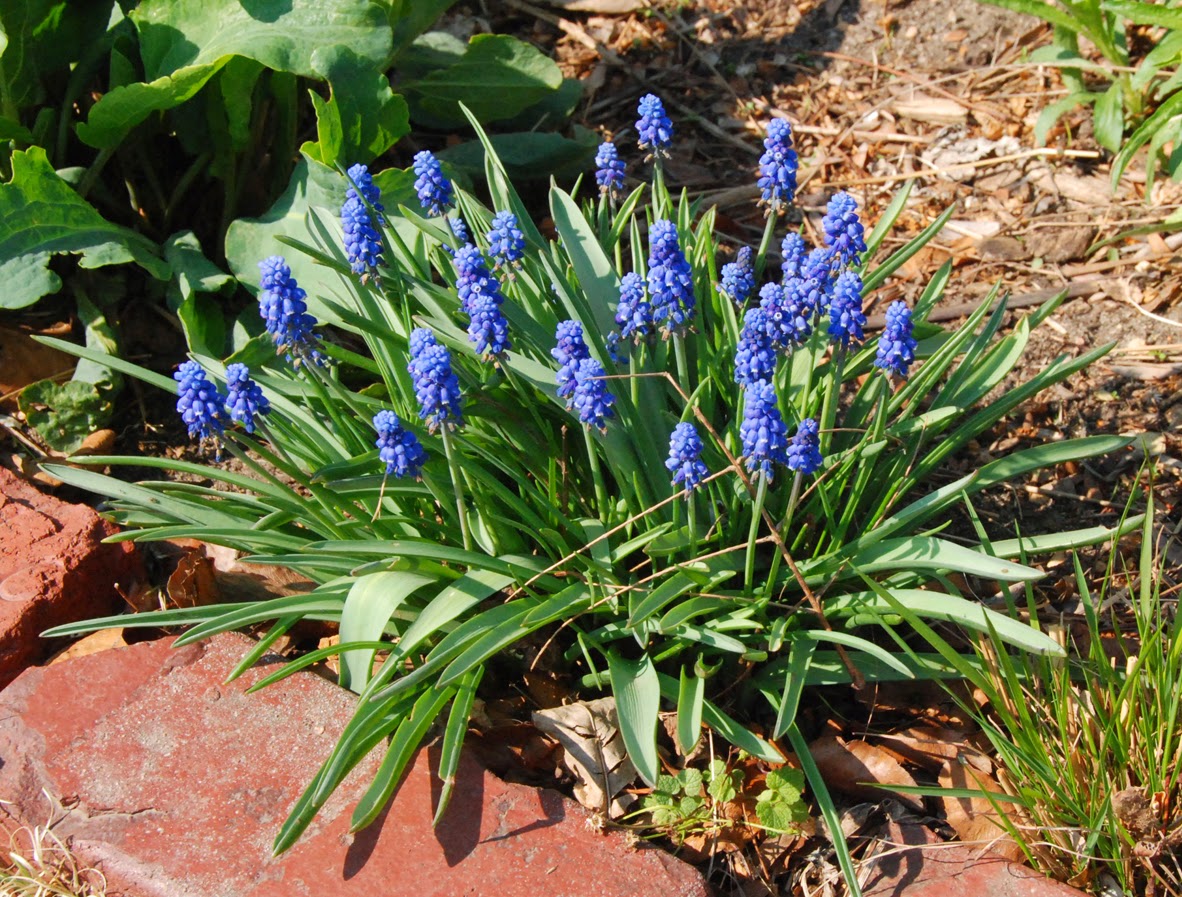
One of my favorite spring bulbs has always been grape hyacinth - the deep blue is SO satisfying!  When we first started planting bulbs the fall after we moved in, 7 1/2 years ago, I got the only grape hyacinths I could find and planted them, even though the photo didn't look quite right for the blooms that I remembered so vividly.  I was rather disappointed when they came up in the spring.  They looked like their photo.

Well, I've since learned that "modern" grape hyacinths are Armenian Grape Hyacinths, Muscari armeniacum.  They don't seem to multiply like the old fashioned grape hyacinths do, which may be why modern growers and gardeners prefer them.  This is one "clump" of those modern grape hyacinths, 7 springs later, with spotted geranium (Geranium maculatum) coming up behind it.

Now, granted, I haven't given these grape hyacinths any special care, above and beyond what I've given to the rest of the bed.  No extra fertilizer.  No extra watering.  Still, I suspect I planted 7 bulbs originally in this group...and there are still 7 individual plants.

Thanks to Old House Gardens, I was able to find both heirloom Southern Grape Hyacinths and heirloom Northern Grape Hyacinths a year or two later.  I figured that one of those two species must be the plant I remembered.

I like both of the heirlooms better than the modern species.  Added to the official plant roster in 1629, this pictures the Southern Grape Hyacinth, Muscari neglectum.  It has the deep blue blooms that I love, but the foliage is rather limp and formless.  It also tends to reseed a fair amount, which I actually like, but others might not be so excited about.

My favorite of the three, though, is the Original or Northern Grape Hyacinth, Muscari botryoides.  It was first introduced to horticulture in 1576 (!), which just amazes me.  It creates full clusters of neat foliage with soul-satisfying blue blooms.  I truly don't understand why this plant isn't widely available any more - I'd love to have all my beds edged with it!

Moving on, my daffodils range from bright yellow to almost pure white, tall to short, early to late, single to incredibly double, fragrant to odorless - but I find it hard to remember which varieties I've planted and where they are in the beds.  I labeled them all when they were planted, but their labels have suffered the same fate as most, and I can't read or can't find most of them.  I have, though, kept all my old receipts, so I know I could figure it out...but it seems like too much trouble tonight.  If anyone is interested in more about the daffodils I'm growing, let me know and I can do a post about them, specifically - or at least about my favorites.

Last but not least in this lineup of highlights, I've got 2 different hyacinth varieties that I particularly love:  Dreadnought (1899) and Double Hollyhock (1936).
 
With a double bloom of an intense, luscious, deep blue, I've had Dreadnought in the ground for several years now, in an area where I do absolutely NO extra watering.  It has returned stronger each year.  This is Dreadnought Hyacinth on April 11th....
A newbie to our garden (planted last fall), Double Hollyhock Hyacinth has double blooms of intense, magenta pink which were just beginning to open up on April 11th....
This, then, is Double Hollyhock Hyacinth covered with snow on April 14th!

Luckily all of the plants recovered, suffering no lasting ill effects, as evidenced by this rather over-exposed photo from April 18th.

Enough now.  Bulbs are great fun, but it's time to wrap up this section and move on to the next part of our great garden experiment, the vegetable garden.  I'll meet you over there in a bit.