Showing posts with label Spring Bulbs. Show all posts

Thursday, April 09, 2015

Maintenance in the Native Plant Garden

As I've given talks about utilizing native plants in our landscapes, I've become aware that many people are scared of "losing control" in their gardens by using native plants and by following organic gardening methods.  So I thought folks might be interested in a blow by blow account of how I maintain my native plant landscape.  I actually think that my garden chores are significantly less onerous than those of more traditional gardeners.

To start with (or, perhaps, to end with), I don't cut back my perennials in the fall or winter.  Many insects overwinter in or on dead plant stems, including some of our native bees;  other insect species overwinter in the leaf litter.  Predators are particularly likely to be among the insects overwintering this way.  The leaf litter also provides great foraging habitat for winter birds, as do the standing seedheads.  Watching the birds forage and seeing the patterns of the plant stems adds winter interest to the landscape.  When you add in the fact that standing vegetation holds snow (moisture) in place better than "clean" beds, you definitely have a winning winter combination for the garden.

Winter, then, is pretty basic.  Enjoy the scenery!

As the plants begin to green up in the early spring, it's time to do the first chore of the year:  cut back last summer's dead plant material.  I consider this the main "work" in the organic, native plant garden.  Otherwise, the garden takes very good care of itself.  The timing of the spring cutback is always a balancing act for me.  I prefer to wait long enough that there aren't many late freezes left, although that's not always possible on the prairie.  Since I have planted a variety of crocus, daffodil, tulip, hyacinth, and grape hyacinth bulbs, I've started using their early blooming as my signal.  Darn it - I planted them, so I want to see them!

This year my spring clean up has been particularly protracted, but that's okay.  This is gardening, not a precision dance routine or an accounting balance sheet.

So that I could see the petite daffodils which had begun to bloom in the front beds, I started the spring clean up on March 18th this year.  This photo was taken on the 20th, the day after we burned the front tallgrass (which you can see in the distance).  All I had done so far was cut back the asters at the very front left of the photo...and, if I remember correctly, a few perennials along the sides of the path itself.

Here is a slightly different view, taken at the same time.  Overall, this is what the front garden looked like for most of the winter.  When I looked out the front windows, it was a rare time that I didn't see birds poking around. When we had some snow, the patterns could be stunning.

By the 26th of March, about a week later, I had cut back about half of the stems in this bed, starting at the driveway.  Of course, a few more things were blooming, too, including the Callery (Bradford) pear.  It always amazes me to see how quickly plants green up in the spring!  Several more types of daffodils had opened, and the blue heirloom hyacinths by the driveway were putting on their annual show.  (You can always click on the photos to enlarge them and see more detail.)

Just 5 days later, on the 31st, you can even see how much the daylilies right by the foundation had sprouted up.  I hadn't done any more cleanup in the garden yet, though, because our kids were visiting for the last bit of March and the first week of April.

In fact, I didn't get more cleanup done until 2 days ago, when I noticed the Peach Blossom tulips in full bloom amidst the cacophony of last year's ironweed and Echinacea stems.  So I did a bit more work that day....

...quitting when I'd cleared everything to the south of the little brick access path...except for the aster stems under the redbud clump.  (See?  I told you this wasn't a remotely frantic process!) 

You can see the newly exposed Peach Blossom tulips a few feet in front of the wheelbarrow. The wheel barrow has the last load of stems for that day, which I take to the brush pile out back, while the yellow bucket holds deadheaded daffodil stems and other non-seedfilled detritus that can be put in the compost pile.   Right now there is a lot more for the brush pile than for the compost pile - but that ratio changes throughout the growing season.

This morning, I finished cutting off the last of the aster stems under the redbuds and took this photo of the bed between the house and the walkway....

...and this photo of the bed between the walkway and the buffalo grass, both looking south.  Although cutting back the stems took me bits and pieces of 3 weeks to accomplish, that was due to MY lack of stick-to-it-iveness, not due to this process taking any huge amount of time overall.  Now that my native flower beds are established, this is the primary job that I need to do in any of  these beds all year.  Period.  It's really pretty simple.

That said, the beds do look better if I follow up this tidying chore with some editing, which is best done at this time of year.  I'll discuss that in the next post.

Oh, by the way, I found 4 Carolina (praying) mantis egg cases and 2 black and yellow garden spider egg sacs among the plant stems as I cut them back.  If you look closely, you can see one of the mantid egg clusters at the base of this grass clump.

I saved the plant stalks with the egg cases on them and placed them strategically in the trimmed areas of the garden, so the young could hatch out and do their thing without further interference.  Last year was obviously a good year for predators in my garden!


Saturday, March 21, 2015

First Day of Spring

Just for kicks and giggles, I went around the yard yesterday and took a few photos which I thought I'd share.  Nothing particularly exciting, but just a few quick peaks at how the garden was looking on the first official day of spring....

Most interestingly, the bloodroot (Sanguinaria canadensis) is blooming gorgeously this year.  It's really taken off in the last year or two, after a rather slow start. Bloodroot, a native that is one of the first wildflowers to bloom in the spring, gets its name from the blood red sap in its rhizomes.  Native Americans used this latexy sap as a face paint and to dye or color various different articles.  Bloodroot was also used medicinally.

Next to the bloodroot, I have a small group of heirloom purple crocuses being protected by an old egg basket.  This has become my favorite rabbit protection method for small plants.  Plus it lets me recycle and reuse old egg baskets (and thus justify my love of antiquing).

Not too far away was another group of purple crocuses showing WHY I use the egg basket over the heirloom crocuses.....

The cottontail(s) in my yard really love purple crocuses.  They'll eat other colors, but purple seems to be their favorite.  The "nibbling" almost destroyed those heirloom purple crocuses that I now protect so picturesquely.

Further down this same flower bed is a nice clump of daffodils in full bloom...facing AWAY from the house and the front of the bed.  It seems like this happens almost every year with this clump, but I'm darned if I know why.  I can't think of any reason why daffodil blooms would face one way or another on a regular basis.  It's not like the bloom faces the same direction the bulb points or something.....

Anyway, this year I decided to sneak around behind the bed to get a shot from the back.  They look much nicer from that angle.

In the "stump bed" (I've GOT to get a better name for that bed!) the Cloth of Gold heirloom crocuses were finished and the pasque flowers not blooming yet, but I got a good photo of the one of the "prairie pinecones", a local name for the seed pods of the Stemless Evening Primrose (Oenothera triloba).  They are really cool little features that add a fun textural touch to the winter garden.

Up front, the burn still looked pretty stark, although a few small sprigs of green are beginning to poke through.

From the front steps, however, the burn looks less overwhelming.  It forms an interesting contrast with the (uncut) front garden and the buffalo grass lawn, currently looking totally tan.

Looking at the front garden more specifically, by yesterday morning I had only cut back the very front little area in the bottom left of the photo below, where the bright yellow, Tete A Tete daffodils poke up in this photo.  I started seriously working on the garden cut back today, focusing on freeing other clumps of daffodils first, so we could enjoy their bloom if I got distracted from finishing my task. When I get done with the cut back, I'll post another photo for comparison.

I'll leave you with this pair of daffodil clumps....  First this small group of daffodils buried in last year's aster stems.  (I actually liberated this little clump this afternoon.)

And, finally, this nice group of Tete A Tete daffodils - one of my longtime favorite daffodil varieties.  They are so cute and tiny and early.  Perfect bellweathers signalling that spring has actually sprung!


Friday, April 25, 2014

The Garden in the First Part: Heirlooms and Memories

Early spring in Kansas is spring bulb time.  Little else can take the roller coaster weather and still be willing to "put it all out there" in the way of blooms and leaves.  This year seemed like a particularly beautiful spring for bulbs.

To me, spring started in mid February this year.  The first yellow crocus blooms shine out among my other photos on February 21st.....

Generally speaking, I prefer heirloom plant varieties for non-native plant species.  There's just something that nourishes my romantic spirit in thinking that I might be saving an old variety of plant, almost lost to horticulture, for future generations.

I have a few heirloom crocus varieties, but I can't say that I can tell a lot of difference between them and more modern varieties.   Greg has been very interested in scattering crocuses throughout the grass in the yard, which makes labeling an heirloom variety impossible, so crocuses are one species in which I have tended to just go with "cheap and cheerful" modern bulbs.

Heirloom or modern, crocuses seem to bloom in the same basic order:  yellow first, then white and finally purple. This cluster of 5 clumps illustrates that fairly well:  the yellow clumps (helped along by munching rabbits) are essentially done, the white clump is in full bloom, and the purple clumps (also rabbit-pruned) are just beginning to open fully. 

The entire process is slow but steady - the second photo was taken on March 20th, fully a month after the first photo.  Crocuses certainly brighten the late winter landscape for a long time...in what seems like a time period that lasts forever.

As the crocuses pass their peak, the daffodils begin.  Tete-a-Tete, a cute, perky, little, bright yellow daffodil is one of the first varieties to open.  I have my first daffodil photos on March 20th, the same day as the crocuses above.  By 9 days later, multiple daffodils have opened, as have the hellebores and the first of the hyacinths.  Looking across the landscape, though, things still seem pretty sere, even 2 days later on March 31st.

By April 4th there is a little more color, as the lilac leaves start to burst their buds and a few more flowers bloom.....

...and by April 10-11th there is much, much more color.  This was one small area of the courtyard bed on April 10th, showing 2 varieties of daffodils, my wine purple hellebore, blue hyacinths, deep pink hyacinths and grape hyacinths.

Taking a photo down the length of the bed shows a different angle to the same plants, just one day later.  It's rather amazing how different the bed looks from these 2 different angles.

Snow before dawn on April 14th literally dumped ice water on the party and dampened the colors, at least briefly.

Luckily the temperatures were just above freezing when the snow came down, so it actually did little damage.  We had a harder freeze the next night, after the insulating snow had all melted off, but even that didn't seem to harm too many plants.

By the 18th, the back courtyard bed was looking pretty spring-ish again.

I've been fighting a debilitating chest cold all this week, and the back courtyard bed has quieted down for now, so I haven't taken any photos of it in the last week.  If the weather cooperates, I'll try to get a shot in the morning.

Meanwhile, here are a few highlights from the spring bulbs and other non-native garden plants so far this spring....

Having specifically mentioned the Tete-a-Tete daffodils, it seems like I ought to include a photo of them!  This was taken on March 31st, but these cuties had started opening by March 20th and continued blooming for at least another week after this photo was taken.

I took this picture of my wine purple hellebore plant on March 29th, but I have a shot of its new leaves and flower buds just beginning to emerge on March 12th.  This plant put on a lot of growth in just over 2 weeks!

One of my favorite spring bulbs has always been grape hyacinth - the deep blue is SO satisfying!  When we first started planting bulbs the fall after we moved in, 7 1/2 years ago, I got the only grape hyacinths I could find and planted them, even though the photo didn't look quite right for the blooms that I remembered so vividly.  I was rather disappointed when they came up in the spring.  They looked like their photo.

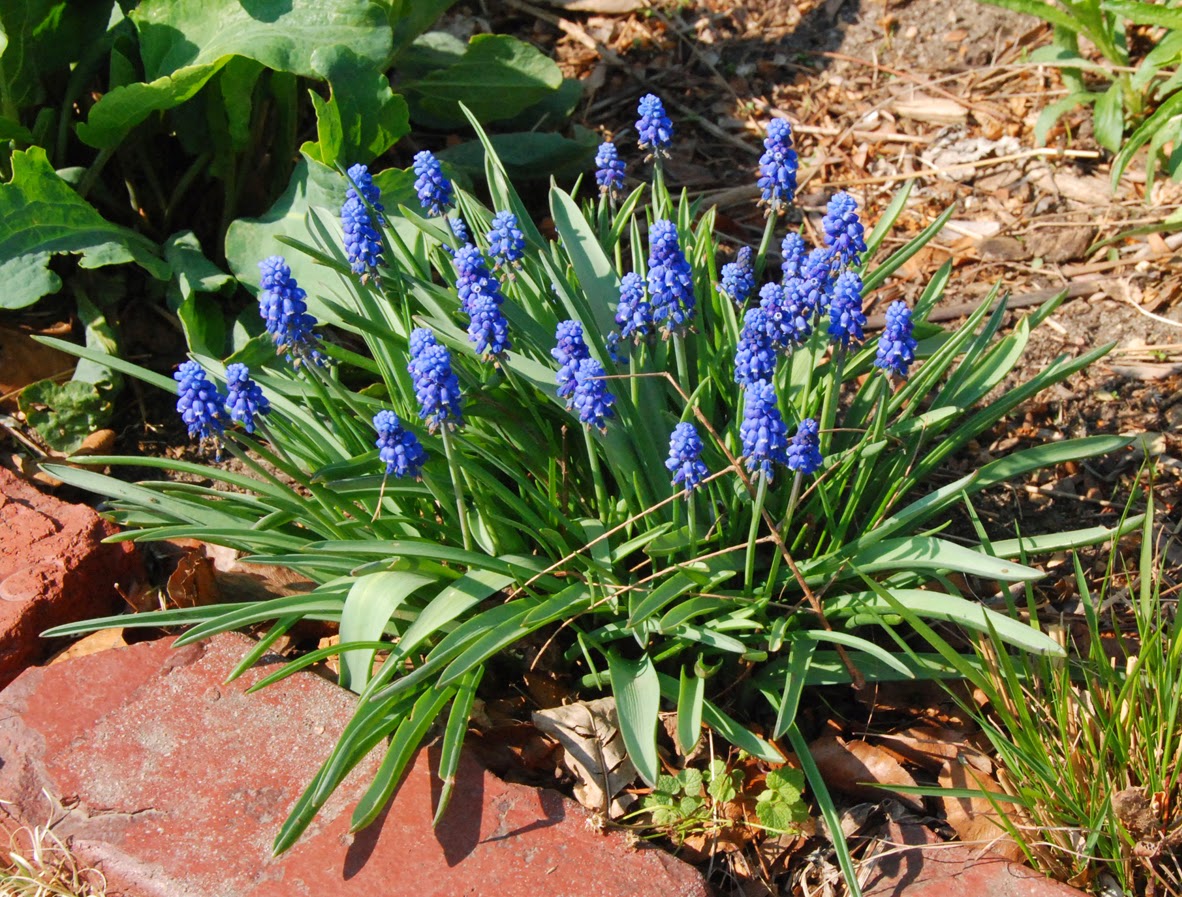
Well, I've since learned that "modern" grape hyacinths are Armenian Grape Hyacinths, Muscari armeniacum.  They don't seem to multiply like the old fashioned grape hyacinths do, which may be why modern growers and gardeners prefer them.  This is one "clump" of those modern grape hyacinths, 7 springs later, with spotted geranium (Geranium maculatum) coming up behind it.

Now, granted, I haven't given these grape hyacinths any special care, above and beyond what I've given to the rest of the bed.  No extra fertilizer.  No extra watering.  Still, I suspect I planted 7 bulbs originally in this group...and there are still 7 individual plants.

Thanks to Old House Gardens, I was able to find both heirloom Southern Grape Hyacinths and heirloom Northern Grape Hyacinths a year or two later.  I figured that one of those two species must be the plant I remembered.

I like both of the heirlooms better than the modern species.  Added to the official plant roster in 1629, this pictures the Southern Grape Hyacinth, Muscari neglectum.  It has the deep blue blooms that I love, but the foliage is rather limp and formless.  It also tends to reseed a fair amount, which I actually like, but others might not be so excited about.

My favorite of the three, though, is the Original or Northern Grape Hyacinth, Muscari botryoides.  It was first introduced to horticulture in 1576 (!), which just amazes me.  It creates full clusters of neat foliage with soul-satisfying blue blooms.  I truly don't understand why this plant isn't widely available any more - I'd love to have all my beds edged with it!

Moving on, my daffodils range from bright yellow to almost pure white, tall to short, early to late, single to incredibly double, fragrant to odorless - but I find it hard to remember which varieties I've planted and where they are in the beds.  I labeled them all when they were planted, but their labels have suffered the same fate as most, and I can't read or can't find most of them.  I have, though, kept all my old receipts, so I know I could figure it out...but it seems like too much trouble tonight.  If anyone is interested in more about the daffodils I'm growing, let me know and I can do a post about them, specifically - or at least about my favorites.

Last but not least in this lineup of highlights, I've got 2 different hyacinth varieties that I particularly love:  Dreadnought (1899) and Double Hollyhock (1936).
 
With a double bloom of an intense, luscious, deep blue, I've had Dreadnought in the ground for several years now, in an area where I do absolutely NO extra watering.  It has returned stronger each year.  This is Dreadnought Hyacinth on April 11th....
A newbie to our garden (planted last fall), Double Hollyhock Hyacinth has double blooms of intense, magenta pink which were just beginning to open up on April 11th....
This, then, is Double Hollyhock Hyacinth covered with snow on April 14th!

Luckily all of the plants recovered, suffering no lasting ill effects, as evidenced by this rather over-exposed photo from April 18th.

Enough now.  Bulbs are great fun, but it's time to wrap up this section and move on to the next part of our great garden experiment, the vegetable garden.  I'll meet you over there in a bit.

Three in One: Gardening for Different Purposes in One Landscape

I've been wanting to share posts of how great the garden is looking this spring, but I haven't been able to decide what to emphasize or what other gardeners might be interested in.  After starting several posts that fizzled from a severe lack of focus, I realized that I actually have 3 separate gardens, all combined into one overarching landscape.  It's easiest and most rational, then, to post about each garden separately.

However, I even get myself into trouble when I try to list the three separate types of gardens I have!  Which is the most important or the biggest - and therefore entitled to be showcased first and talked about the most?  Which is nearest and dearest to my heart?  Yikes!  I sure manage to create problematic mountains out of non-problematic molehills!

Okay, so here goes....

I'm going to start with my decorative/heirloom/memory gardens - these are plants that I inherited when we purchased our house, that I've rescued from gardens about to be lost, that I've chosen because they are heirloom varieties that appeal to me, that have been given to me, and so forth.  These are not native plants - they hail from Japan, Turkey, China, and many other parts of the world.  They are "traditional" garden plants.  (Yes, I DO grow non-natives!)

Right now the heirloom garden plants are the showiest, probably because native prairie plants tend to green up late, knowing that the weather is likely to be fickle well through April.

Here, for example, is a portion of my back courtyard bed from about two weeks ago.....

The flowers that are making a splash in this photo are a beautiful hellebore, as well as heirloom daffodils and hyacinths.  More on the specifics in the next post.

Next on my list is the vegetable garden.  This is pretty straight-forward, although I do mix it up a bit by utilizing raised beds to raise some perennials and natives in until I know where I want to put them in the flower beds.  Doing this not only helps me place things more rationally in the garden, but also brings in pollinators for the vegetables when the flowers bloom.  Greg experimented with different kinds of cold frames over the winter this year, which makes the vegetable garden look significantly messier.  The messy look has been well worth it, though because we've been reaping rewards as far as early greens and a head start on broccoli and cauliflower this spring.

Finally I end up at my beloved native plants.  Yes, these are the plants I hold closest to my heart.  Not only do they bring a lot of botanical beauty into the landscape, but they provide food and shelter for a myriad of animals that enliven the landscape with their presence and their activities.

I speak of the native plants as separate from the heirloom gardens and vegetable gardens, but in reality, I have all 3 combined throughout most of the garden.  It just seems easier to talk about them separately, since I grow them for such different reasons.

So now I've set the framework - in my own mind at least - for a quick look at 3 different "gardens" around our yard this spring.  Rather than make one exhaustively long post, I'm going to summarize what's been happening in 3 separate posts.   It will be interesting to see which different "gardens" appeal to more people and why!


Friday, February 21, 2014

Signs of Spring

The boys and I took a walk this morning, our first in several weeks.  We saw 2 major signs that spring is almost here, but I'm not sure which surprised me most on this sunny February 21st....

Which surprises you the most?

The crocuses in full bloom in the courtyard...

...or the garter snake that I found stretched out, sunning, on the path through the draw?

The garter snake definitely votes for him- (or her-?) self!

Basically most of the rest of the discoveries the boys and I made today were more typical of mid-February.  There were wheel bug egg clusters along the undersides of almost every honeylocust branch I examined, and a few clusters on the green ash, redbud, and Amur maple branches.  There was even a lone cluster of wheel bug eggs on the Bradford pear.

Judging from the number of clusters I saw, it should be a jackpot year for wheel bugs!

The eggs look like little urns, all clustered together in their geometric pattern, awaiting the uncapping that will come with warmer weather.  They make me smile every time I notice a new cluster.

Late last summer, I found a little mantis egg cluster in one of the honeylocusts.

I looked for it again today...and found it, looking much more desolate but somehow impregnable.

Near the compost piles, where I had 5 different black and yellow garden spiders feeding off the plentiful insects last summer, I found 6 egg sacs stalwartly holding steady against the winter weather.  This sac was easy to see, hanging from the pallet that forms one side of the cluster of compost piles.

These two egg sacs were a little more camouflaged, nestled in the chainlink fence among remains of last summer's grass and weeds.

Speaking of remains, I heard the coyotes singing to our west last night and wondered if they were in the Back 5.  As the boys and I walked around that area this morning, I saw something that looked a little odd....

Getting closer, I realized it was the carcass of a possum that had obviously been providing a meal for somebody.

The coyotes were eating last night, I presume.

Coming back to the house, I stopped to see if I could get a reasonable shot of one of the rabbit trails that cross the path periodically.  I first noticed this particular trail shortly after we moved in, over 7 years ago now.  It still looks much the same and travels almost exactly the same route as it did when I first saw it.

I've tried to photograph this trail before, but today's photo (which I took from a much lower angle) is probably my favorite so far.  For the first time, I was able to capture the true sense of the trail through the grass.  I wonder how many years the rabbits have been traveling along this same path?

The days go by and the seasons cycle onward.  It's winter now, but obviously spring will be here before we realize.

The seasons go by and the years cycle onward.  Individual rabbits are born, travel that trail, and die.  This land has seen many people come and go; in recent decades, it has been owned by different people.  They come, they watch over the land, and then they move on or die.  We are the owners who have come most recently and we are now traveling the trails here and watching over the plants and animals who share the land with us.

The seasons cycle on....