Showing posts with label Caterpillars. Show all posts

Sunday, February 10, 2019

Insects Using Gaillardia in My Gardens

Another staple of my (native) pollinator plants is Indian blanket or Gaillardia, Gaillardia pulchella to be precise.   This widespread, short-lived perennial blooms for months and months;  the colorful blossoms almost always seem to have some sort of insect on them. 

Interestingly, though, as I went through my photos, the variety of insects utilizing Gaillardia was not as great as it was for fogfruit.  For 2018, I have photos of only 6 different species using Gaillardia in my gardens. 

By far the most frequent visitor to my Indian blanket flowers was Poey's Furrow Bee (Halictus poeyi), one of the small, somewhat nondescript, native bees. 

I saw this little bee a lot, from early June through the end of October, and it could well have been present before or after I have it documented photographically.  As I understand it, the hook on the back, lower corner of the head, which you can see in this photo, is "diagnostic" of this species.  Even in photographs, though, it can be hard to see this feature due to the diminutive size of this bee and the fact that it tends to round its back and tuck its head a bit as it feeds.

This is typical of what I usually see, even through the camera lens, when looking at Poey's Furrow Bee.

Throughout the summer months, the Brown-winged Striped Sweat Bees (Agapostemon splendens) visited regularly.  I love these vivid little green jewels.  The females are solid green, while the males have black and yellow striped abdomens and a green "jacket" on the thorax. 

In the photo above, the male is probably more interested in the female than in the flower.

Here is a closer view of a different female, giving you a bit more of a feel for the vivid coloration of these little sweethearts.  What a disappointment the common name of this bee is - "Brown-Winged Striped Sweat Bee".  The "A. splendens" of the Latin name much more closely describes how I feel about them!

An insect that I've seen on several different plants around the yard, this Camouflaged Looper, a.k.a. the caterpillar of the Wavy Emerald Moth (Synchlora aerata), looks a bit different depending on which bloom it's raiding for its wardrobe.

What looks like a large, brightly colored piece of debris hanging from the underside of the flower is, in fact, the caterpillar with bits of petal attached.   

Yes, the bloom this little guy raided looks rather tattered, but I personally think it's well worth the less than perfect blossom to see how the flower finery has been used!  In 2018, I photographed camouflaged loopers on Gaillardia blooms on June 23 and again on August 5.

Getting back to native bees, one of my favorite groups is the leafcutter bees.   Females in this group are easy to recognize because they carry pollen in hairs on the underside of their abdomen, giving them a potbellied appearance.
This cute little female (Megachile sp.) demonstrates that trait perfectly.

The only insect I photographed utilizing something besides the bloom of Gaillardia was this paper wasp, which I saw on July 18th.

Truthfully, I don't know if I just didn't notice other insects on the stems and leaves, or if few insects actually utilize the foliage of this plant.

The final insect in my Gaillardia roundup is this flower beetle, the Pygmy Chafer (Strigoderma pygmaea).


In conclusion, I enjoy having Gaillardia in my gardens a lot, finding that it brings in a reasonable number of insects and provides a nice pop of color throughout most of the growing season.  Loving full sun and tolerating pretty dry conditions, it's usually very easy to grow.  The only downside I've found to Gaillardia pulchella is that each individual plant lasts for 2-3 years at most.  It will reseed a bit and, if I watch for seedlings, I can usually keep it as a garden presence without having to buy it again each year.  If you live within its (wide) native range, I'd definitely recommend it for your pollinator garden.

Friday, August 17, 2018

Monarch Caterpillars, Chrysallises, and Wasps: Sometimes Things Go Wrong

Two days ago, as I came back into the house after dumping my coffee grounds in the garden, I noticed a small black and white wasp sitting on top of something on the swamp milkweed.  Looking closer, I saw what I thought was a discolored monarch caterpillar, about the size of a 2nd or 3rd instar.  "Damn.  Oh, well, her babies have to eat, too," I thought to myself.

Of course I grabbed my camera to capture some photos, but it was early morning and the humidity was high, so I was only able to take a couple frames before the lens fogged up and became too opaque for me to continue.  By the time the lens cleared, the wasp with her payload had disappeared.

Well, my garden is definitely a place for nature to "do its thing", so I made no attempt to intervene.  In the late afternoon, I noticed what looked like the same female wasp working at the entrance to a hollow tube in my bee house which is above and behind the swamp milkweed.  Obviously that was where her nest was.

When I downloaded my photos, I was relieved to see that the caterpillar the little wasp had was NOT a monarch caterpillar.  If I had to guess, I'd say it was a cutworm of some sort, actually.  Much as I love insects, that's not a caterpillar I'm sorry to see feed some baby wasps.

Yesterday, when I went back out to take photos, the nest tube this little wasp was working on had been completely closed off.  It's the right hand tube near the center of this photo.  Inside it, I am sure that a wasp egg is developing into a larva that will use this hapless caterpillar to create the next generation of mason wasps.  As horrific as that seems in one sense, at the same time it seems pretty amazing.

I see these little wasps hunting in my gardens frequently.  It would be fascinating to know how many caterpillars they remove over the course of each growing season - and what species get "harvested".

In other caterpillar news, I was thrilled a few days ago to notice a monarch cat hanging upside down in the classic "J" position as it started the transition from caterpillar to pupa/chrysalis.  Because we've been watching Youtube videos about metamorphosis, I carefully pointed it out to our oldest grandson, Connor, who is 3.

We were both ecstatic to see that the caterpillar had completed its change the next morning...

...but by the following day, I began to suspect that something was seriously wrong.

Two days after it had formed, I removed the remnants of the chrysalis, as well as the leaf it was attached to, fearing for bacterial contamination.  It was probably too little, too late, but I figured it was worth a try to keep further contamination from spreading to other monarch caterpillars in the area.

Does anyone with more specialized knowledge of monarch/butterfly metamorphosis know more precisely what caused the demise of this pupating monarch?

Once again, as with bird nests, if I find it, I'm beginning to assume that the chrysalis/pupa is not likely to have a positive outcome.  Sometimes I have to be content with letting exciting events happen "off stage" in the garden.  If the result is more baby birds and more adult butterflies, then it's all good and my curiosity will just have to go unsatisfied.  Thank goodness for Youtube videos!

Saturday, August 11, 2018

Tolerate the Uglies!!!

After carefully watching my larval plants for several months (which felt like years!), I'm finally seeing caterpillars on them. 

There are monarch caterpillars on the milkweed,

black swallowtail caterpillars on the parsley,

gulf fritillary caterpillars on the maypop vines,

and - based on the foliage - probably phaon crescent caterpillars on the fogfruit. 

YEAH!!! My plants are starting to get ugly!  They are making butterflies!!!

As much as I love seeing the caterpillars, though, I find that I do cringe at how ragged my plants start to look at this point of the summer.  Not only is the heat taking a toll, the plants are so large that any dry spells can cause wilting and brown edges, even partial leaf drop.  By the time the caterpillars show up and start eating the leaves, the plants can start looking like I should yank them out of the garden at the first possible moment.

Of course I don't pull them out.  I chose and planted these plants especially as butterfly food.  Why would I pull them out just as they are starting to actually produce butterflies?  Even if I do "mentally hear" my neighbors gossiping about how ragged my garden is looking these days.

Honestly, couldn't these plants be a little NEATER and PRETTIER while they go through this stage of their life cycle?!

My own phrase for this is "Tolerate the uglies!"  Benjamin Vogt of Monarch Gardens shares the same concept with his phrase of "Redefine pretty."  In a world saturated with television ads showing happy, beautiful people in manicured yards that don't have a single tattered leaf or brown spot in the lawn, it feels subversive to allow caterpillars to actually eat the leaves on your plants.  Seriously, shouldn't this be done behind closed doors, people?!

To be even more subversive, this summer I've noticed that my monarch caterpillars seemed to purposefully deflower the milkweed they are feeding upon. 

First, mama monarch laid quite a few eggs underneath flower bud clusters, so the caterpillars have been eating the flowers and buds from the moment they hatched.

Secondly, as the caterpillars reached one of their later, larger instars, I noticed that 3 of them had cut the stem of the entire flower cluster partway through, resulting in the entire bloom head hanging upside down and dying.  Seriously, what's up with that?!  The only thing I can figure out is that, evolutionarily, this decreases the chances of parasites being attracted to the plant for nectar and thereby finding the caterpillar(s) nearby to host their offspring on.  I've never heard of this as a "thing" before, though, so I don't know if my imagination is just running away with me - or if, maybe, I'm on to something.  Any monarch researchers out there that might want to look into this idea?

Along the same lines, is it coincidence that the eggs were laid shortly after the buds started opening and the plants started blooming?  Evolutionarily, could it be that so many eggs were laid on these newly opening flower buds to decrease the overall numbers of blooms, decreasing the seed production, and thus moving the plant energies into leaf production, thereby providing more food for more baby monarchs?

Or is this egg placement just a way to hide the caterpillars until they get a little bigger and less attractive to wasps and other caterpillar parasites who might not care that they don't taste good?  See how well that monarch caterpillar is hidden?

Can you see it now???

How about now?  Pretty safe hiding place, isn't it?

WHY the timing and placement for egg laying?  Coincidence or evolutionary plan?  Inquiring minds want to know.

While I contemplate these possibilities, I meander my garden enjoying the new life chomping hungrily on my plants and try not to cringe at the blooms being cut short and the leaves disappearing in the process.  Life is a balance - and never more so than in a garden.

Friday, July 27, 2018

This Week in Pest-Controlling and Pollinating Wasps

While I'd love to be seeing more insect life in our yard, I have to admit that I AM seeing some interesting insects - including a few that are totally new to me.  So I thought it would be fun to share what I'm seeing as well as the blooms that are bringing them in.

How to organize this????  By day?  By bloom?  By type of insect?  I'll just have to see what flows best.....

I started out to make this post an overview of all the pollinators I've seen over the week, but it quickly became apparent that would be overwhelming, so I decided to focus this post just on wasps.

Wasps have been quite prominent recently, especially solitary wasps.  Last Friday, July 20th, was when I first noticed some unusual ones -3 in a row, in fact, over the course of about 10 minutes, on the clustered mountain mint (Pycnanthemum muticum).

The first was a large scarab hunter wasp that has no common name so I've nicknamed it the fuzzy scarab hunter wasp (Campsomeris plumipes).  Like other scarab hunters, this wasp flies low above the ground, searching for (buried) scarab beetle larvae, a.k.a. beetle grubs.  When she finds one, she digs down to it, paralyzes it, lays an egg on it, and flies away.  The egg hatches out and the wasp larva consumes the beetle grub.  One wasp egg on one beetle grub, so every one of these you see means that a scarab beetle of some sort - say a June bug or green June beetle - didn't make it to adulthood.

As you can see, the adult wasp actually eats nectar to sustain itself, as is true for most of these solitary wasps.  Also as solitary wasps, they are not aggressive and they will not sting unless you actively try to handle them or they get caught in your clothing, stepped on in bare feet, etc.  You can assume this is true for all solitary wasps unless someone mentions otherwise.  It's a nice change from the more problematic social wasps.

As an aside, all the solitary wasps I'm familiar with have only one generation each year, so if you take them out (for example, by spraying insecticides), it may be several years before their population numbers can rebuild by migrating in from surrounding areas.  Given how well they function as both pollinators and, probably more importantly, as pest control, that would seem to be extremely short sighted to me.

Back to my magic 10 minutes by the mountain mint, the next insect to fly in, while I was photographing the fuzzy scarab hunter wasp, was the great golden digger wasp (Sphex ichneumoneus).  This is a species I've seen before, both here and in Kansas, and I love its fiery color and large size.  You just can't mistake this distinctive wasp with its red legs and black-tipped red abdomen for any other species.  Look, too, at the golden glow created by the gold hair on its head and thorax.  That's something you almost have to take a picture of to appreciate, although I've seen it highlighted occasionally as one of these beauties nectars. 

Another solitary wasp, great golden digger wasps hunt for and paralyze grasshoppers and crickets as food for their larvae.  The female digs a burrow in sandy soil, with a central, almost vertical, main burrow and individual cells radiating out from this primary burrow.  She places one paralyzed grasshopper or cricket in each cell, lays an egg on it, then seals up the cell.

As I was finishing up my "photo session" with the great golden digger wasp and taking a few last photos of the fuzzy scarab hunter wasp, I noticed more movement in the air space around the mountain mint - a thread waisted wasp had come in to feed, too. 

This rather bizarre looking wasp not only held its abdomen up at a strange angle as it flew, but the sun caught metallic glimmers of color on its otherwise black body and wings.  Researching on BugGuide.net, I identified this species as Eremnophila aureonotata.  Again there is no common name, so I've nicknamed it the gold-marked thread-waisted wasp, "aureonotata" meaning "gold-marked" in Latin.  This solitary wasp species feeds its larvae on a wide variety of (paralyzed) moth caterpillars, utilizing a burrow in the ground, as far as I can tell.

So, according to the time stamps on my photos, in just over 10 minutes my mountain mint had nurtured predators working to control beetle grubs, grasshoppers and mole crickets, and moth caterpillars in my gardens.  Not too shabby!!!  And it didn't cost me a dime beyond the initial cost of a very pretty perennial plant.

I've seen a couple other wasps this week, too.  One I've been seeing frequently for several weeks now is less than half the size of the big guys above.  It's a cute little black mason wasp with 2 white stripes on its abdomen (Euodynerus sp.).  When I grabbed its picture above, I think it was hunting for caterpillars among the ferns.  Again, there is no common name for this wasp, so my description above ("cute little black mason wasp") will have to suffice.  Mason and potter wasps feed their larvae primarily on moth caterpillars, although some species also use the larvae of leaf-eating beetles.  If you see smallish wasps using mud to fill up small holes (for example in brick, where your hurricane shutters have gone up in the past), it may well be one of these mason wasps.  They build cells out of mud in hollow tubes, provisioning each cell with a paralyzed caterpillar or beetle larvae on which they lay an egg before closing up the cell and moving on. 

Do you sense a pattern among the solitary wasps here?! They've found a good gig in paralyzing prey to keep it fresh for their young to eat after hatching, then tweaked the process in a myriad of different ways so that each species has its own spin...and ecological niche.

I've seen these little black and white mason wasps nectaring on blossoms as well as hunting in my gardens.  I've found small holes filled with dried mud, which I presume are their nest cells.  These are enjoyable little creatures for me to notice as I go out and about weeding, planting, transplanting, watering, and photographing.  Just in the last week I have photographs of this species hunting in these ferns, shown above, as well as in camphorweed and in and out of leaves and mulch at the base of phlox and lyreleaf sage.  Front yard, back yard.  Sun, shade.  This little wasp is a "busy bee" in its work habits.

At the other end of the size spectrum from the cute little mason wasp is the gigantic 4-spotted scarab hunter wasp (Campsomeris quadrimaculata) that I've seen a couple times now.  Boy, am I ever glad that these guys aren't at all aggressive, because they are HUGE and they give me pause even though I know they won't bother me.  The photo above shows this big black beauty all coated with pollen from nectaring at maypop flowers (Passiflora incarnata).

Here is a photo I took about 2 weeks ago of a "clean" 4 spotted scarab hunter wasp, nectaring on sweet pepperbush blooms (Clethra alnifolia).   See how much pollen the individual nectaring at the passion vine is wearing in comparison?!  That's what I call a pollinator!

For the sake of clarity, again I've made up a nickname for this wasp as, again, it has not been given an official common name.  Its specific Latin name, "quadrimaculata", means "4-spotted", while the entire genus is known as scarab hunter wasps, hence the "4-spotted scarab hunter wasp".   This is another great predator in the garden, paralyzing and laying eggs in scarab beetle grubs.

Big and little, I've got wasps sharing my gardens that are making life easier - and much more interesting - for me.  I used to hate wasps, but now I smile whenever I see one.  I hope you're seeing some great solitary wasps in your gardens, too.


Wednesday, July 25, 2018

A Passion for Life

The fragrances of the earth enjoin and
blossom in my nostrils and
sinus -
breath is what we
share with the world.
                    - Gavin Geoffrey Dillard, Graybeard Abbey

Hmmmm.  Seems like a good month to participate in Wildflower Wednesday, but what flower should I pick? 

The spotted beebalm (Monarda punctata) that just started blooming? 

The clustered mountain mint (Pycnanthemum muticum) that has become a new favorite of mine, with its frosty cool garden presence and its outstanding ability to pull in the pollinators - and their predators? 

The turkey tangle fogfruit (Phyla nodiflora) that I concurrently both love and simply dislike?

The Devil's grandmother (Elephantopus tomentosus) that also just started to bloom and which is actually looking like a garden plant this summer since I finally got around to transplanting some into a bed this spring?

The "Eveready bunny" of my garden, the old sturdy standby Indian blanket (Gaillardia pulchella) that just keeps going and going and going and going?

The swamp milkweed (Asclepias incarnata) that I'm relying on to attract some monarchs to my gardens one of these days?

The trailing pineland lantana (Lantana depressa) out by the front sidewalk, with its lemonade colored blossoms covering tidy mounds of vibrantly bright green leaves?

Nope.  Those are all cool and wonderful plants in my gardens, ...

...but I think I'm going for the maypop this time, a.k.a. passion vine (Passiflora incarnata).  Every time I walk down on the deck or dock this summer, the rich fragrance of these impossibly glamorous blossoms startles my senses with its complex allure.  Is it possible that the aroma of these blooms has given rise to the name "passion vine"?  I know that's not the commonly told history, which involves some rather convoluted symbolism about the "passion of Christ", but passion vine fragrance is every bit as romantic as gardenia to me.  This has been the first year that I've really processed how deeply fragrant these flowers are.  To my nose, I think the smell of maypop flowers is richer even than that of roses - and I love the fragrance of roses.

I wish there was a way to put a scratch & sniff app into this blog post.....

I'm obviously not the only living creature that thinks maypop flowers smell appealing, as I frequently see pollinators on them.  These big blooms seem built for BIG pollinators.  Recently, for example, I've seen both...

carpenter bees (Xylocopa virginica)...

and this huge scarab hunter wasp (Campsomeris quadrimaculata) acting almost drunk with the richness of the nectar they are drinking.  Note that the back and head of this wasp are actually coal black without pollen on them.  Yes, this wasp has accidentally gathered THAT MUCH pollen!

As this photo with the blurry carpenter bee shows, there is a horizontal space between the stigmas (curved, long and white with greenish tips) and anthers (yellowish rectangles) and the nectary (reddish purple fuzzy area at the base of the central stalk) that seems expressly designed for such big floral visitors.  If you look back at the photos above, you can see how absolutely covered with pollen the backs of these large insects are!  A smaller bee or wasp wouldn't be anywhere close to as efficient in transferring pollen as these big guys are.

A consequence of such efficient pollination is, of course, the production of seeds.  In the case of passion vine, the seeds are housed in the passion fruit.  For years I've heard that these tennis ball sized fruits are edible, but I've never tried one before because, quite frankly, they just didn't look that appealing to me.  I've decided that this year I'm going to be a bit more adventurous.  According to the web, the fruits are ripe when they start to turn yellow, get wrinkled, and fall off the vine, so I'm keeping my eyes open.  If these fruits taste at all like their fans online say, the taste may rival the fragrance of the flowers.

Humans, bees, and wasps aren't the only animals that love passion vines.  As almost anyone who has planted one knows, gulf fritillaries (Agraulis vanillae) use them as their larval plants and the fritillary caterpillars can quickly reduce a vine to tatters.  In fact, during most growing seasons I have to remind myself to "tolerate the uglies" so that my vine(s) can send many more gorgeously glowing, orange, floating "flowers" off into the breezes.  Luckily, no matter how thoroughly the passion vines are eaten, they always seem to survive and thrive the following year.

This year, however, has been different.  I saw 4 gulf fritillary caterpillars about 2 months ago, but I haven't seen another one since then...until yesterday.  Meanwhile my vines have grown huge, luxurious, almost rampant.  As passionvines do, new vines are sprouting up a dozen feet or more from the parent plant in every direction and they are now even starting to impinge on the deck stairs.  There are plenty of blossoms and a burgeoning crop of that intriguing fruit is developing.  A myriad of flower buds promise ever increasing numbers of blooms still to come.  Truth to tell, it's all beginning to get a little over-the-top, but I don't want to cut it back.  I'm waiting for the caterpillars to come and do that for me.

Finally, yesterday, I found 2 little gulf fritillary cats determinedly munching away.  Then, this afternoon, another 3 more.  Hopefully at least a couple of these tiny orange babies will make it to adulthood, providing some much needed pruning along the way.  Meanwhile, I'm joyously sharing the breath of the world with every deep inhalation of that glorious passion vine fragrance.

Sunday, April 02, 2017

Using It Up - Common Buckeye Caterpillars

In early spring, lawns around here sprout a pretty little native wildflower known as old field toadflax (Nuttullanthus canadensis).  An annual, it is here and gone almost before you realize it, but it is considered a "lawn weed" and, as such, it is not considered desirable by most homeowners.

I find this dainty little flower enchanting.

Old field toadflax is related to snapdragons, which you can see in the shape of the bloom...if you take the time to look closely at it before you mow it down.  Perched on the ends of long, slender stems, the tiny blossoms would really have to occur in huge numbers to make a show of any sort, but my "selective wildflower vision" zeroes in on them and magnifies their attractiveness to enjoyable size.

Given my propensity to enjoy what shows up without any effort on my part, I've let the toadflax grow where they appeared in my front flowerbeds, rather than weeding them out with the oak seedlings and dewberry.

When I went out to do my occasional bed weedout on Saturday morning, I noted that the toadflax were done blooming and I thought that perhaps it was time to pull them out to "neaten up" the bed.  On the other hand, if I let them remain a bit longer, I could more reliably count on new plants next spring....

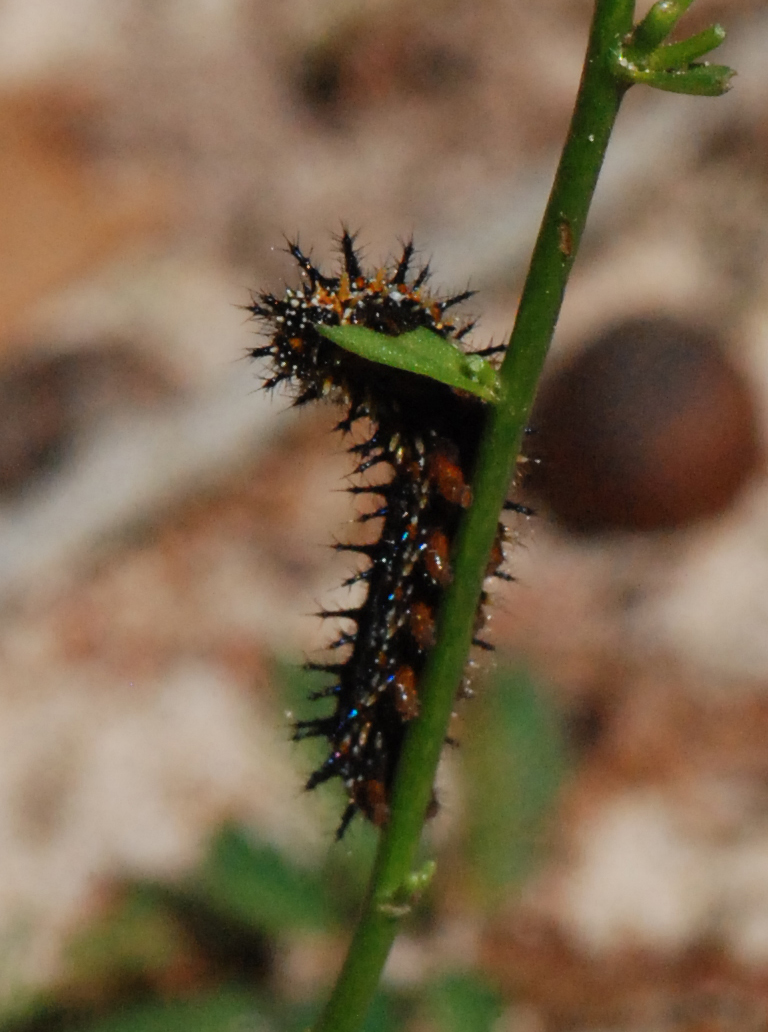
As I was weeding and debating this weighty question with myself, I noticed a black caterpillar on the ground near one of the plants.  Hmmmm.  Another, larger caterpillar was on a nearby plant.  Looking a bit further, I noticed a third caterpillar munching away....

By the time I looked at all the plants, I'd found 7 caterpillars! 

They were all the same species and they were all either on or right beside the old field toadflax.

Looking at the flower spikes, I noticed that the lower flowers had set seed, dried and were releasing seed.  The remains of the upper blooms were still green, but obviously seed was forming.  Since these are annual plants, as soon as all the seed is set, the plants will basically dry up and wither away.

When I went inside and looked up the caterpillars in my handy-dandy caterpillar guide, I decided that these were probably common buckeye cats (Junonia coenia), a highly variable species of (butterfly) caterpillar that is known to feed on plants in the snapdragon family, including toadflax.

This discovery lifted up my spirits all weekend long.  Isn't nature simply amazing?!  This relatively small annual plant blooms, sets seed, and then dies.  Rather than waste all that great plant material by simply having it dry up and blow away, Mother Nature arranges to have mama buckeye butterfly stop by and leave a couple eggs.  The eggs hatch into tiny caterpillars who, just as the plant is finishing with the foliage, eat up all the leaves and change the plant material into butterflies.

Beauty in flower form turns into beauty in butterfly form.  I call that pretty amazing.