What do you think about while you weed?
As relaxing and enjoyable as I find it to weed, you'd think I'd be thinking elevated, beautiful thoughts that calmed my spirit and elevated my soul.
You would be grossly wrong. A few days ago, I found myself "listening" to my thoughts and here's what I heard:
1) a series of theme songs running through my head from Winnie-the-Pooh, "I'm so rumbly, in my tumbly, time for something SWEET, to eat!" and "Winnie-the-Pooh, Winnie-the-Pooh, scrubby little tubby all stuffed with fluff! He's Winnie-the-Pooh, Winnie-the-Pooh, willy, little silly, old bear!" and "Up, do-own, up! Up, do-own, up! When I up, down, and touch the ground, it puts me in the mood. Up, down, and touch the ground, in the mood for food! I am short, round, and I have found, speaking poundage-wise, I improve my appetite, when I exercise!"
2) more somber thoughts about our family friend who, at 55, was diagnosed recently with a very malignant form of cancer,
3) and, of course, some political angst mixed in with the more pressing comical and tragic elements.
At other times as I weed, I find myself composing gardening blog posts. Understand, please, that the vast majority of these garden-composed posts have long since escaped my mind by the time I actually sit down in front of the computer. Nonetheless, I go on, mentally "writing."
As I weed, sometimes I dwell on transplanting that needs to be done or on other changes to my "landscape designs". ("Landscape designs", in my garden, is a euphemism for the "plop 'em there" design pattern that I generally follow when I bring home a carload of fantastic plants that I've just discovered at my local nursery or plant sale.)
Most importantly, I think, I talk to the creatures that I see while I'm weeding, like this recently de-tailed ground skink,
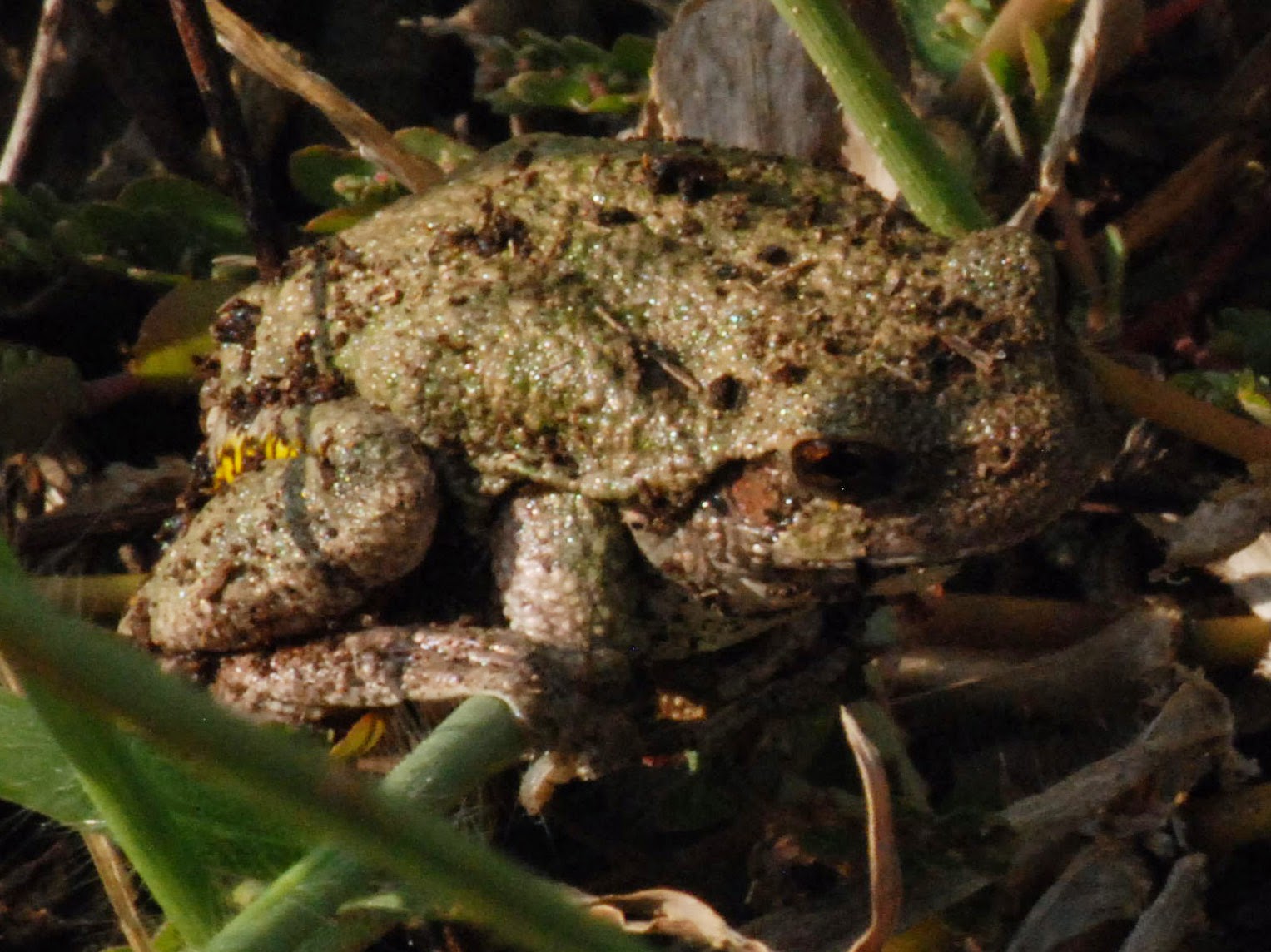
this red-faced little southern toad I disturbed, buried in the soil,
or the red-shouldered hawk that haughtily surveyed the landscape while "hidden" right above me.
All of these guys joined me in the garden recently, even though it's still early February. They are among the living creatures with whom Greg and I share our landscape, so it seems only polite (and politic) to discuss the changes I'm making with them when I see them.
What do you think about while you weed?
Showing posts with label Toads. Show all posts
Thursday, February 16, 2017
Monday, October 03, 2016
Learning My Garden Through Weeding
Anybody else out there enjoy weeding?
While I don't like to be outside for any length of time if the weather is abysmal - which is how I define most of the hot, humid summer down here in the panhandle of Florida - once the weather starts cooling off, I actually find that I like to weed. It's meditative...and I learn A LOT about the nuts and bolts of daily life going on at ground level in my garden.
My latest weeding project is/was a large, new bed that I halfheartedly started last spring, before I got chased inside by heat and humidity. The photo above shows about half of the area, which continues on to the right another 10 feet or so. Taken fairly early in the weeding process, this shows the approximate height and thickness of the weeds I was removing.
I chose to hand weed this new bed for two basic reasons, one of them related to poor planning. First of all, I knew there were several small seedling plants located in the area that I wanted to save and, probably, relocate. Secondly, when I started to make the bed last spring, I put in a few plants that I didn't want to lose. There were 3 clumps of pink rain lilies (Zephyranthes grandiflora) and, more problematically, several wild strawberry plants (Fragaria virginiana) that had spent the summer putting out runners and baby plants. If I smothered the area with newspaper and mulch, it would be relatively easy, but I'd lose ALL of the plants in the area, including the ones I wanted to keep.
So I sat down on my rear and I weeded. The weeds were primarily a mix of an 18" tall, rather airy plant with wiry stems that I haven't identified, doveweed (Murdannia nudiflora), chamberbitters (Phyllanthus urinaria, a.k.a. gripeweed, for my Mobile friends), Asiatic hawksbeard (Youngia japonica), mock strawberry (Duchesnea indica), Florida pusley (Richardia scabra), and Virginia buttonweed (Diodia virginiana). For seasoning, there was a little bit of dollarweed (Hydrocotyle umbellata), the dainty Carolina ponysfoot (Dichondra carolinensis), and a variety of sedges (Carex spp.) thrown in.
The photo above is a single stem of Virginia buttonweed, surrounded by lots of doveweed. Lovely, isn't it? (Yes, that's sarcasm.) At least it was mostly green. Anyway, of all the weeds, only about half the species were native: Virginia buttonweed, Florida pusley, dollarweed, Carolina ponysfoot, and probably most of the sedges. I don't know about the unidentified, 18" "wiry" weed. Most of the biomass was doveweed, the wiry unknown, and Virginia buttonweed.
Anyway, as I sat there on the ground, hour after hour, I not only got to know the plants quite well, but I also got to see some of the "denizens of the dirt", those little creatures who live their entire lives in our gardens but that we rarely see or notice. A few of these little creatures sat still long enough for me to photograph, so I thought I'd share them with you....
First off, I am going to cheat just a little. I saw one skink in this area as I was working, but I didn't get a photograph of that particular individual. I did get a photo of another one of the same species a few days earlier, so I'll share the photo that I have.
This is a ground skink (Scincella lateralis) and it was probably about 5" long, which is about as large as ground skinks get. Apparently they are the commonest skink in Florida gardens, but they are rather hard to see, as they move very rapidly through the undergrowth and leaf litter. When I am working in an established bed, I often catch a glimpse of a little brown lizard skittering away. I assume those are other ground skinks, exhibiting their getaway skills.
A toad was the only other vertebrate that I flushed out as I weeded, although certainly birds and other vertebrates must have foraged in the area from time to time. This little guy...
...seemed to be missing his right rear leg. An injury? Some sort of genetic defect? Hard to tell. Surprisingly to me, there are only 4 species of toads in Florida. I think this is a southern toad (Bufo terrestris), the most common species, but I am not completely certain.
Rather unexpectedly, there were two large caterpillars amidst this unprepossessing mass of vegetation. The first one was an odd looking "woolly bear" type, with coal black hair and bright red segments that showed when it curled up in its defensive position. I've seen lots of woolly bears before, but never one colored like this.
According to BugGuide, this is the caterpillar for the giant leopard moth (Hypercompe scribonia). I've never seen an adult, but the BugGuide photos look stunning and I will certainly be looking for one now that I know it obviously occurs in our yard.
The second large caterpillar fell out of a handful of weeds that I had pulled, but by observing it for a couple minutes as it got back to eating, I believe it was munching determinedly on Virginia buttonwood.
Despite this guy's 3-4 inch long size and distinctive markings, he was a little hard to identify. Nothing seemed to fit when I scanned the hornworm photos at BugGuide, so I eventually turned to Caterpillars of Eastern North America, by David L. Wagner, where I was able to figure out what I was seeing. This is the caterpillar of the Tersa Sphinx (Xylophanes tersa), another striking moth species that I've never seen before. The link is to the node at BugGuide, where you can see photos of both the caterpillars and the adults.
I photographed two other caterpillars, both much smaller. One was a hairy individual that I haven't tried to identify yet....
while the other was an early instar of yet another sphinx moth, about an inch long, also currently unidentified.
There were lots of little, round snails, maybe 1/4" in diameter...
...and one large, conical snail whose shell was at least an inch in length.
While I saw many green stinkbug nymphs, I only saw this one adult stinkbug.
While I'm not completely sure, I think this is Euschistus crenator, a species that feeds on sedges. Probably the green nymphs were of a different species.
There were several small, longhorned grasshoppers, ....
but no shorthorned grasshoppers of any size, which is a major change from gardening in Kansas.
There were also a lot of small spiders. I only took the time to photograph this one, which was slightly larger than most. I think it is a wolf spider, but I don't know the species yet.
Last, but hardly least, there were a lot of roaches running around. I didn't try to photograph any of them, assuming they were wood roaches which help to decompose organic matter. I saw this one, though, that was different and obviously an adult. It was trying to get away through the grass and "posing", so I did take a couple minutes to get a few photos. Imagine my dismay just now as I worked to identify it and realized it is probably a non-native, Surinam Cockroach (Pycnoscelus surinamensis) . If so, according to BugGuide, it has the interesting characteristic of reproducing entirely by parthenogenesis in the U.S. - no males have ever been found.
As I worked and noted all of the small creatures living among the weeds I was pulling out, I found myself feeling guilty for destroying the habitat that was obviously providing food and shelter for such a large variety of little animals. I'm trying to placate myself by remembering that I will be planting a variety of native perennials and shrubs in the area this fall, all tucked in with a nice layer of leaf and wood chip mulch...but the dismay is still there, simmering in the background. Forgive me, little ones. I really AM trying to create a healthy habitat for all in our yard and gardens.
While I don't like to be outside for any length of time if the weather is abysmal - which is how I define most of the hot, humid summer down here in the panhandle of Florida - once the weather starts cooling off, I actually find that I like to weed. It's meditative...and I learn A LOT about the nuts and bolts of daily life going on at ground level in my garden.
My latest weeding project is/was a large, new bed that I halfheartedly started last spring, before I got chased inside by heat and humidity. The photo above shows about half of the area, which continues on to the right another 10 feet or so. Taken fairly early in the weeding process, this shows the approximate height and thickness of the weeds I was removing.
I chose to hand weed this new bed for two basic reasons, one of them related to poor planning. First of all, I knew there were several small seedling plants located in the area that I wanted to save and, probably, relocate. Secondly, when I started to make the bed last spring, I put in a few plants that I didn't want to lose. There were 3 clumps of pink rain lilies (Zephyranthes grandiflora) and, more problematically, several wild strawberry plants (Fragaria virginiana) that had spent the summer putting out runners and baby plants. If I smothered the area with newspaper and mulch, it would be relatively easy, but I'd lose ALL of the plants in the area, including the ones I wanted to keep.
So I sat down on my rear and I weeded. The weeds were primarily a mix of an 18" tall, rather airy plant with wiry stems that I haven't identified, doveweed (Murdannia nudiflora), chamberbitters (Phyllanthus urinaria, a.k.a. gripeweed, for my Mobile friends), Asiatic hawksbeard (Youngia japonica), mock strawberry (Duchesnea indica), Florida pusley (Richardia scabra), and Virginia buttonweed (Diodia virginiana). For seasoning, there was a little bit of dollarweed (Hydrocotyle umbellata), the dainty Carolina ponysfoot (Dichondra carolinensis), and a variety of sedges (Carex spp.) thrown in.
The photo above is a single stem of Virginia buttonweed, surrounded by lots of doveweed. Lovely, isn't it? (Yes, that's sarcasm.) At least it was mostly green. Anyway, of all the weeds, only about half the species were native: Virginia buttonweed, Florida pusley, dollarweed, Carolina ponysfoot, and probably most of the sedges. I don't know about the unidentified, 18" "wiry" weed. Most of the biomass was doveweed, the wiry unknown, and Virginia buttonweed.
Anyway, as I sat there on the ground, hour after hour, I not only got to know the plants quite well, but I also got to see some of the "denizens of the dirt", those little creatures who live their entire lives in our gardens but that we rarely see or notice. A few of these little creatures sat still long enough for me to photograph, so I thought I'd share them with you....
First off, I am going to cheat just a little. I saw one skink in this area as I was working, but I didn't get a photograph of that particular individual. I did get a photo of another one of the same species a few days earlier, so I'll share the photo that I have.
This is a ground skink (Scincella lateralis) and it was probably about 5" long, which is about as large as ground skinks get. Apparently they are the commonest skink in Florida gardens, but they are rather hard to see, as they move very rapidly through the undergrowth and leaf litter. When I am working in an established bed, I often catch a glimpse of a little brown lizard skittering away. I assume those are other ground skinks, exhibiting their getaway skills.
A toad was the only other vertebrate that I flushed out as I weeded, although certainly birds and other vertebrates must have foraged in the area from time to time. This little guy...
...seemed to be missing his right rear leg. An injury? Some sort of genetic defect? Hard to tell. Surprisingly to me, there are only 4 species of toads in Florida. I think this is a southern toad (Bufo terrestris), the most common species, but I am not completely certain.
Rather unexpectedly, there were two large caterpillars amidst this unprepossessing mass of vegetation. The first one was an odd looking "woolly bear" type, with coal black hair and bright red segments that showed when it curled up in its defensive position. I've seen lots of woolly bears before, but never one colored like this.
According to BugGuide, this is the caterpillar for the giant leopard moth (Hypercompe scribonia). I've never seen an adult, but the BugGuide photos look stunning and I will certainly be looking for one now that I know it obviously occurs in our yard.
The second large caterpillar fell out of a handful of weeds that I had pulled, but by observing it for a couple minutes as it got back to eating, I believe it was munching determinedly on Virginia buttonwood.
Despite this guy's 3-4 inch long size and distinctive markings, he was a little hard to identify. Nothing seemed to fit when I scanned the hornworm photos at BugGuide, so I eventually turned to Caterpillars of Eastern North America, by David L. Wagner, where I was able to figure out what I was seeing. This is the caterpillar of the Tersa Sphinx (Xylophanes tersa), another striking moth species that I've never seen before. The link is to the node at BugGuide, where you can see photos of both the caterpillars and the adults.
I photographed two other caterpillars, both much smaller. One was a hairy individual that I haven't tried to identify yet....
while the other was an early instar of yet another sphinx moth, about an inch long, also currently unidentified.
There were lots of little, round snails, maybe 1/4" in diameter...
...and one large, conical snail whose shell was at least an inch in length.
While I saw many green stinkbug nymphs, I only saw this one adult stinkbug.
While I'm not completely sure, I think this is Euschistus crenator, a species that feeds on sedges. Probably the green nymphs were of a different species.
There were several small, longhorned grasshoppers, ....
but no shorthorned grasshoppers of any size, which is a major change from gardening in Kansas.
There were also a lot of small spiders. I only took the time to photograph this one, which was slightly larger than most. I think it is a wolf spider, but I don't know the species yet.
As I worked and noted all of the small creatures living among the weeds I was pulling out, I found myself feeling guilty for destroying the habitat that was obviously providing food and shelter for such a large variety of little animals. I'm trying to placate myself by remembering that I will be planting a variety of native perennials and shrubs in the area this fall, all tucked in with a nice layer of leaf and wood chip mulch...but the dismay is still there, simmering in the background. Forgive me, little ones. I really AM trying to create a healthy habitat for all in our yard and gardens.
Wednesday, December 31, 2014
2014: A Retrospective from the Wilds of South Central Kansas, Part 2
From grasshopper-eating turtles to omnipresent praying mantises, there were so many interesting sightings in the yard and gardens this year that I hardly know where to begin. I've shared some of those sightings through posts throughout the year, but tonight it feels like those posts just skimmed the surface of what I observed. I've got a ve-e-e-ery long post drafted that is relatively complete...but it's way too long already and I'm just now looking at September's photos.
So I'm rebooting and sharing just a select few highlights.
We'll start our trip through 2014 in the yard/garden with a photo of the possum that showed up, snuffling through the birdseed leftovers, one day in early March. Its tail was stubby and bloody, so something had been after it fairly recently; I doubt it was feeling too good, which probably explains why it was willing to come in to birdfeeders in the middle of the day.
Incidentally, I have come to really appreciate possums. First, they rarely carry rabies. I believe it has to do with their low normal body temperature. Secondly, they act as supreme "tick sweepers" - they keep their fur almost entirely free of parasites such as ticks, presumably by eating any they find when they groom themselves. Thus possums will help reduce the population of ticks in an area, rather than increase it.
Amphibians were relatively common this year, which was so good to see. In the gardens around the house, I observed at least 5 or 6 different Woodhouse Toads (Anaxyrus woodhousii) over the course of the summer, ranging in size from a little over an inch to several inches long.
I also noted at least 3 Great Plains Toads (Anaxyrus cognatus) throughout the summer. On June 15th, I saw 3 different toads in one day: 2 Great Plains (one big and one little) and 1 Woodhouse!
On April 2nd, I went out one night to find this Plains Leopard Frog (Lithobates blairi) on the front porch, evidently enjoying an early feast on the insects that were being drawn to the porch light. I've seen toads and tree frogs do that, but I've never seen a leopard frog come to lights before.
The gardening year wrapped up with a new-to-the-yard amphibian species, a gray treefrog (Hyla sp.), who showed up in the vegetable garden on October 19th. It amazes me how animals that need water as much as amphibians do can survive the droughts we've had over the last several years.
My next highlight wasn't technically in our yard, although we do hear barred owls calling frequently in the evenings and at night. Coming home from the grocery store on April 17th, we noted this individual on a fence post by the road, about a mile south of our house. I have no idea what the size of a pair of barred owls' home range is, but perhaps it's possible that this is one of the birds we hear calling? Or maybe this bird is one of "our" owls' offspring? At any rate, it's a cool photo to have captured and I wanted to share it with you. (Actually, I think Greg took this photo, since the bird was on his side of the car. I want to give credit where credit is due.)
Compared to amphibians, reptiles weren't seen much during 2014. I was able to get photos of a couple different garter snakes and 3 ornate box turtles.
The best turtle photo of 2014, I guess, is this one of the turtle munching down on a grasshopper. She was quite nervous about the boys and me being so close, but she sure wasn't going to give up her tasty meal! Good protein!
Of course, many, many of my photos are of insects, but I'm going to save those for some other time.
Have a wonderful 2015, both in the garden and out of it!
Labels:
Barred Owl,
Birds,
Ornate Box Turtle,
Possum,
Toads,
Treefrogs,
Turtles
Saturday, July 19, 2014
After-The-Fact Discoveries Through the Camera Lens
I can't decide if I'm blind or just too single focused....
Take this photo, for example. When I took the photo, I was focusing on the cicada that is positioned vertically on the green ash suckers and on the empty "shells" that are located above and to the right of it, one of which I presume it emerged from. ... Until I looked through my recent photos after downloading them to my computer (the next day), I literally didn't see the second cicada in this photo, located on the horizontal stem above and to the left of the first cicada. Of course, by then, both cicadas were long gone, so any chance to focus more tightly or to change my framing had disappeared along with them.
Luckily, in this case I did take this second photo, which gave me a little better look at the second cicada...
...and this third photo, which allowed me to incorporate another, newly emerged cicada I had noticed about a foot away, which you can see at the bottom left in this photo. The original one...er, two are at the top right.
How did I miss that third, newly emerged cicada?! I wish I knew, because then I might not miss other "minor details" as I'm out and about....
As I did in this next photo, which I took one night earlier this week....
To explain, I'm seeing at least 4 different toads (I think) around the house this summer, but I've been wanting to verify if they are all the same species. This toad, which is the same size as one I'd seen earlier in the day, had different markings, so I wanted to catch a photo of it. I was so focused on the toad, however, that I totally missed the click beetle just in front of it on the ground. I don't recall seeing a click beetle of that size around here before, so I'm really curious as to what species it might be - but it, too, is long gone...although whether it flew away to live for another day or disappeared down the gullet of the toad, I'm not sure!
Oh,in case you're curious, this toad is a Great Plains Toad (Anaxyrus cognatus), while most of the others I see are Woodhouse's Toads (Anaxyrus woodhousii). I was right to notice the different pattern of spots.
Do you ever make discoveries of this sort in your photos, after you bring them up on your computer screen, or are you a good enough observer that this never happens to you? I'd sure love to hone my skills of observation enough that this quit happening! I wonder what else I'm missing when I'm NOT taking photographs?!
Thursday, October 03, 2013
Baby Jabba - There's at Least a Little Amphibian Reproduction Occuring Around Here!
Busy times lately: dear friends came in for a nice, long visit and my uncle & aunt from Norway were also in town for a week! Needless to say, although I did get some pictures taken, I didn't get to any blogging - either reading or writing.
Then, too, there's the government shutdown. I wanted to take my uncle & aunt to the Tallgrass Prairie National Preserve, but by the time our schedules coincided, the shutdown had shuttered the Preserve. Their loss for not being able to experience the tallgrass prairie; Strong City's & Cottonwood Fall's loss because we were planning to spend the day, complete with visits to local restaurants and galleries.
We won't get into the fact that my husband is an "essential" civilian employee on McConnell AFB....
Last but not least, I'm bummed because the shutdown has also shuttered the USDA's Plant Profile site, which I love to visit. I check out the ranges of native plants, as well as exploring the variety of species found within certain genera. I feel half blind right now, without this reliable resources to go to.
Now, having wasted more than enough time on Facebook sharing my opinion of the government shutdown (as well as contacting all of my elected representatives about the issue), I've decided it's time to catch up a little on editing, organizing and sharing some of the photos I've been taking.
This summer I've been excited to see and hear about quite a few, different, small amphibians making their appearance. It's been many years since anyone around here has seen the large emergences of tiny frogs and toads that used to occur annually when my family first moved here in the early 1970's. It's even been rare to see a single small toad or frog in recent years, although larger ones are not uncommon.
This summer, though, I've seen a couple small toads in the garden - mainly at night - and even a small frog or two. Usually these sightings are quick glimpses, but last week I had small toad with a death defying wish to be seen, trying valiently to share the mulched path to the trashcans with me for a day or two. To my knowledge, he/she survived the experience, although I haven't seen him recently.
As well as wanting to be seen, he also apparently wanted to have his picture taken. I had to go back inside to get the camera, but he was still waiting for me when I came back out.
In fact, he struck several different poses for me.
Based on my Amphibians, Reptiles, and Turtles in Kansas, I believe this guy to be a young Woodhouse's Toad, Anaxyrus woodhousii. This is, like so many toads, a species that is normally active at night, so I don't know why I was seeing this little one so often during the day, but I appreciate making his acquaintance.
A last note, especially for those of you who have swimming pools. Check your filters regularly! A month ago, a friend asked me to clean out their pool filter while they were away for a while. The first time I cleaned it out, I found about 10 living, and many more dead, baby narrowmouth toads. I rescued the living and put them in the shrubbery around a nearby fish pond. Several days later, when I cleaned the filter out again, I found 2 adult frogs, as well as innumerable small frogs and toads again caught in the well of the filter. Luckily, this time most of them were alive and I was again able to rescue them. I don't know what the answer is to this problem, but I sincerely doubt this was an isolated incident, especially as dry as our area has been in the past few years. With more and more pools being built, I suspect this is an increasingly large cause of mortality in our local amphibian populations.
How is the amphibian reproduction going in your part of the country?
Monday, May 07, 2012
A Toad Unburied...or Jabba the Hutt Comes to Life
Seriously, doesn't this guy (gal?) look like the perfect actor to play a young Jabba the Hutt as he "expands" in a "Star Wars: The Empire Strikes Back" prequel? In fact, in honor of the well-rounded figure, I will refer to this individual toad as Ms. Jabba from here on out.
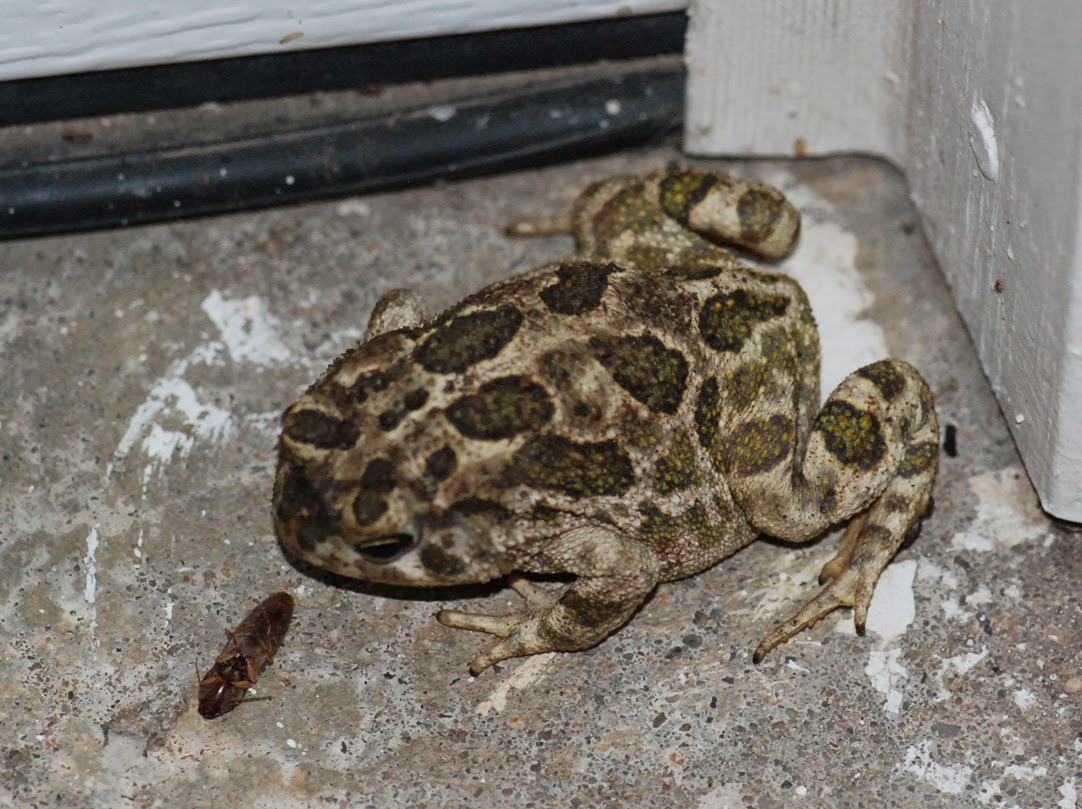
I discovered Ms. Jabba, a Great Plains toad, while hand weeding yesterday to clear out one of my new flower beds in the front yard. (On a side note, have I told you how much I enjoy hand weeding?!) She was buried below ground in a newly moistened area where a young shrub had been planted the day before. Luckily, as I stuck my trowel in the ground to root out some partially buried little barley, I disturbed her but didn't seem to harm her. She irritatedly hopped off a foot or so, then sat still to figure out what in the world had disrupted her quiet day's rest and what she was going to do about the interruption. (Incidentally, I recognized and was able to interpret her bleary look based on my own, pre-coffee, morning moments.)
By sitting still, Ms. Jabba inadvertently posed quite nicely for several photographs, allowing me to take shots from several different angles. One of the most important photos turned out to be of her back, as she started squiggling herself downwards into the wet soil, beginning the process of burying herself again to resume her daytime beauty sleep.
This angle shows the large, paired spots on her back, outlined in cream or light brown. It is these large pairs of warty dark blotches that identify her as a Great Plains toad rather than a Woodhouse's toad, one of the only two other toad species found in south central Kansas.
Of course, a true photographer always goes for a profile picture too, so in the interest of completeness, here is Ms. Jabba's charming silhouette, taken early in the sequence while she was still sporting the moist soil remnants of her daytime sleep ensemble.
After identifying her this evening by her glamor shots, I looked up Great Plains toads to learn a little bit more about this co-inhabitant of our homestead.
Scientifically labeled Bufo cognatus, Great Plains toads spend their days burrowed into the soil, coming out at night to feed on insects. They seldom emerge during the day (unless some careless gardener accidentally tries to skewer them with a trowel). This toad species is considered a prairie dweller, most commonly found in mixed grass or short grass prairies throughout much of the Great Plains and southwest.
The call of these toads is mentioned as being especially loud, long and shrill, lasting for as much as a full minute. If you visit the Great Plains toad page on the Kansas Herpetofaunal Atlas site, you can hear a recording of the call. They are considered "opportunistic breeders," breeding in seasonal wet areas such as ditches, ponds or flooded fields whenever conditions are right, from late March to early August. Only the males call, serenading loudly to entice the females in for a night of amorous activity. Females, at least in central Oklahoma, can apparently lay as many as 45,000 eggs. (Wouldn't you love to be the grad student who got to count those?!) Kansas references mention 20,000 eggs as the maximum number of eggs laid per female. Whatever the ultimate number each female lays, the eggs are produced in long strings which the male retains for several minutes in a "basket" formed by his hind legs, ensuring fertilization by his sperm. The eggs hatch in about a week, and from then it only takes the tadpoles 3-4 weeks to become tiny toadlets.
My favorite tidbit of information about Great Plains toads came from the above-mentioned Kansas Herpetofaunal Atlas site: these toads are apparently voracious cutworm eaters. Given the large number of cutworms I have seen as I've weeded in my yard this spring, I can only hope that Ms. Jabba expands to twice her current size as she eats her way steadily through the bounty that my yard is so thoughtfully providing her. May The Force be with her (and her appetite).
Subscribe to:
Posts (Atom)