Showing posts with label Environmental Issues. Show all posts

Wednesday, January 08, 2025

Books That Enlarged My Outlook in 2024

Thanks to an annual challenge published by the reading challenge group, The 52 Book Club, I have started reading a LOT more in the last several years.  While most of the books I've read have been fiction, I have also read some interesting non-fiction along the way - and, of course, some of my favorite non-fiction books have to do with the environment,  I thought I'd share my favorite environmental reads from 2024.


The Nation of Plants, by Stefano Mancuso, Other Press LLC, New York, 2019/2021.  

    Sometimes I read a book that completely shifts a facet of how I understand the world.  This small book created such a shift in me.  I've always considered animals to be "more advanced" than plants, and thus "more important" somehow.  However, recent research has certainly been expanding our understanding of plants significantly.  Going a step further, this book posits, successfully in my view, that plants are by far the most important living beings on Earth.  "We exist thanks to plants, and we will continue to be able to exist only in their company.  It behooves us to keep this idea clear at all times."  Mancuso starts from that premise and goes on to create a Constitution for The Nation of Plants, imaginatively raising environmental truths to the level of international law.  (Note: Mancuso is a plant neurobiologist at the University of Florence, Italy.)

What did I gain from reading this book?  Reading this book changed my fundamental understanding of the importance of plants compared to animals.


The Insect Crisis, by Oliver Milman, W. W. Norton & Company, 2022.  

    Starting with a brief vision of what would (will?) happen to humans if all insects disappear, Milman goes on to look at the research studies behind recent dire headlines about the significant insect declines being observed.  He shares stories and studies from across the planet.  Then Milman examines the threats that are causing those insect declines, from farming practices to light pollution to global warming, pointing out that many of these threats are voluntary choices we make, so different choices could be made that would be less destructive.  The importance of making those different choices is Milman's ultimate point, a message we should all take to heart.  (Note:  Milman is a British journalist who specializes in the environment.)

What did I gain from reading this book?  In reading this book, I increased my knowledge about the ongoing decline of insects, giving me a deeper commitment to supporting insects and other species in my home's landscape.

    The Silent Earth, by Dave Goulson, was also written about the precipitous decline of insects.  I read this excellent book in 2023 and will discuss it in a post about the books I read that year.


Wilding: Returning Nature to Our Farm, by Isabella Tree, New York Review Books, 2018.

    I've seen this book recommended for years, but it was about an estate in Britain, so I resisted reading it.  What insights could it have that would be of benefit to backyards in the States?  Well, it turns out that this book is chock full of new understandings of ecological processes!  It was amazing.  I'll never look at an ancient tree in the same way again, and I have a much deeper appreciation for the variety of roles that such beings play.  There was information I won't be able to personally use for rewilding (reintroducing large herbivores into the landscape comes to mind) but I found the necessity for their presence and how they impacted the ecosystem to be fascinating.  I highly recommend this book.  (Note:  Isabella Tree is a writer and conservationist who, along with her husband Charlie Burrell, manages the Knepp Estate/Knepp Wildland Project.)

What did I gain from reading this book?  This book probably gave me my single biggest leap forward in understanding ecological processes since Doug Tallamy's Bringing Nature Home.


The Weight of Nature:  How a Changing Climate Changes Our Brains, by Clayton Page Aldern, Dutton (PenguinRandomHouse), 2024.

    We like to think that climate change, a.k.a. global warming, is "out there" and that we can insulate ourselves from it if we're thoughtful and careful...or simply don't give it credence or attention.  Aldern tells us exactly how wrong we are.  He shows us how global warming is changing (all of) our brains, making it harder to think and remember accurately, affecting the decisions we make, making us more prone to violence, giving many of us PTSD, and increasing our exposures to vectors of brain disease.  Climate change is also changing human cultures and language.  (Note:  Aldern is a neuroscientist turned environmental journalist.)

What did I gain from reading this book?  Aldern helped me to understand how ALL of us are already being affected by global warming, mentally and physically.


The Light Eaters:  How the Unseen World of Plant Intelligence Offers a New Understanding of Life on Earth, by Zoe Schlanger, Harper (HarperCollins Publishers), 2024.

    As I mentioned above when talking about The Nation of Plants, botany has been making huge leaps forward in our understanding of plants.  Schlanger's book takes a deeper look at some of these new discoveries and understandings.  Plants can communicate with each other and with some animals - not in the same way we communicate, but in important ways nonetheless.  Plants can feel when things happen to their bodies.  Plants treat their relatives differently than they treat less closely related individuals.  Plants even have memories.  A lot of these discoveries have the potential to significantly change how we relate with plants, which is a sobering thought indeed.  (Note:  Zoe Schlanger is a staff writer at the Atlantic, where she covers climate change.)

What did I gain from reading this book?  From this book, I gained a clearer knowledge of the recent advances in botany that are changing our fundamental understanding of plants.


How to Love a Forest:  The Bittersweet Work of Tending a Changing World, by Ethan Tapper, Broadleaf Books, Minneapolis, 2024.

    Tapper, a forester, bought a "worn out" forest of 175 acres and is working to restore it to ecological health.  In this book, he discusses the sorts of decisions he has to make to help heal his land, some straightforward, but many nuanced and full of compromise.  Because of all the changes that have been made in our landscape over the last 400 years, restoring a forest is no longer as simple as just leaving it alone to restore itself.  Invasive species must be removed, deer populations managed through careful hunting, and other sometimes hard decisions have to be made.  Tapper talks of the necrosphere, the world of dead and dying organisms, and how vital it is to the health of the forest.  His writing is evocative and haunting.

What did I gain from reading this book?  With a wooded yard, I was excited to find this book and read Tapper's advice about forest management, but I came away with many insights into far more than just forestry.


What If We Get It Right?:  Visions of Climate Futures
, by Ayana Elizabeth Johnson, One World (Penguin Random House), 2024.

What would our lives - and our childrens' and our grandchildren's lives - be like in the future if we were able to stop, even repair, global warming?  These days we hear almost no visions of the future that aren't apocalyptic.  Most of these depressing visions are being encouraged by people who want all of us to give up and to accept the status quo so that they can continue to rake in profits.  What If We Get It Right? takes a brief, but thorough, look at where we are and at where we're headed if we make no meaningful change.   Then Johnson talks with 20 people fighting to guide us to a brighter future.  The book ends with a detailed look at a potential future where we're successfully fighting global warming as well as making other changes to provide a cleaner, healthier, more just future.

What did I gain from reading this book?  I gained hope from reading this book.  Hope, and knowledge of the work being done in many different fields to move us forward into a brighter, but not a warmer, future.


There are so many fascinating books being published.  These are the few that I read in 2024.  What books have you been reading, and what have you been learning from them?  I'd love to hear about them in your comments.


Sunday, October 28, 2018

Book Time: CLIMATE-WISE LANDSCAPING

After reading this review, you can heave a big sigh of relief -I will have caught up with all my gardening related book reviews!

Having just finished Climate-Wise Landscaping, I feel very au courant in writing this review!

I'm not sure what I was expecting, but somehow this book seemed different from what the title suggested it was going to be - different in a good way, more important, filling a gap that's been existing in gardening literature.

Climate-Wise Landscaping:  Practical Actions for a Sustainable Future, by Sue Reed and Ginny Stibolt, New Society Publishers, British Columbia, Canada, 2018, is a perfect guide for people who are worried about our planet's future and are looking for something that they, personally, can do to help lessen climate change and to make our ecosystems healthier.

Every single piece of land can help heal our planet.

There are ten sections in this book, each section dealing with an area of the landscape around a typical home, wherever it is located, starting with the lawn.  Why do Reed and Stibolt begin with the lawn?  As they put it, "...[C]hanging the way we think about and deal with our lawns might be the easiest and most significant step we can take to help the planet."  How much lawn do you think there is in the continental U.S.?  According to the International Society for Photogrammetry and Remote Sensing, as quoted in this book, there is about 63,000 square miles of lawn, an area approximately the size of the state of West Virginia.  That's a lot of lawn - and most of it gets mowed weekly, inundated with fertilizers and pesticides, and irrigated.  Despite all those inputs, lawn produces no food, for people or even for wildlife.  It's essentially a sterile wasteland.

Reed and Stibolt go on to cover many other ways we can help the climate by changing the way we use our landscape.  For example, planting trees sequesters a lot of carbon, as does, surprisingly to me, increasing the health of soils and decreasing the disturbance to them.  Did you know that soils sequester more than 4 times the amount of carbon as forests?  I didn't.  Apparently they are the second largest carbon dioxide absorbing system on our planet, after oceans.  I also didn't know that every time you disturb the soil - through digging, for example - you release carbon dioxide.  So switching from planting annuals, which have to be replanted regularly, to planting perennials actually helps the planet by sequestering carbon!

I'm all for minimizing digging, so that's what I call a win-win.

There's a section on how good planning and design of a landscape can help decrease energy use (and thus carbon dioxide emissions), as well as a section specifically devoted to urban issues.  Each section contains an introductory explanation, followed by a series of "Action Topics", specific ways you can make your landscape work to help stabilize Earth's climate and often to help yourself and other living things at the same time.

Last, but hardly least, the final section covers materials that are commonly used in landscaping and evaluates their carbon footprint, helping us choose rationally among such options as concrete, brick, stone, even asphalt.  This is the first time I've ever seen a carbon analysis of landscaping materials and I really appreciate finding it included in this book.

This is an excellent resource to start with if you're interested in personally doing something specific to help the future of our species and of our planet.  It's a broad overview of the topics covered;  for specific details, you will probably want to explore the areas that interest you further, with further reading or study.  Most of all, Climate-Wise Landscaping examines a broad array of possibilities - and possibilities are a great starting point for building a better future. 

Monday, April 02, 2018

Spreading the Wild(life) News

About a week ago I took a deep breath and plunged into a new "platform" for me:  a Nextdoor neighborhood group I've belonged to for a couple years now.  I've posted briefly on it once or twice before, with little response, but this time I decided to be a bit more blunt and opinionated.  The results have been interesting.

Here along the Gulf Coast, early spring is the biggest season for leaf fall as the evergreen oaks push off last year's leaves before they put out a new flush of leaves for this growing season.  First the laurel oaks drop their leaves, then the sand live oaks drop their leaves, and finally the live oaks drop their leaves.  It's about 6 weeks of constantly falling, relatively small, brown leaves.  In our neighborhood, these oaks are almost all BIG trees and the leaves that get dropped in this relatively short period of time rival the leaf drop of autumn in essentially any other forested area of the country.  Except there's no pretty color, I have to note.

So the leaf blowers have been working overtime for the month around here and there have literally been mountains of leaves pushed to the curb for the city to come by and pick up.  It saddens me to see all this beautiful mulch getting thrown away, so I posted:

"As I watch oak leaves being raked and put out by the curb for the city to pick up, I'd like to suggest that everyone consider blowing them into shrub and flower beds instead. They make great mulch and look as nice or nicer than anything you can buy. The birds love to rustle through them looking for food, and the leaves decompose easily to make your soil much richer and healthier."

Within a day, 8 different people had responded to my post.  After 10 days, 14 different people had responded in total.  A total of 14 people had thanked me.

Six of the comments were negative, with most people concerned about all the animals that would live and breed in the mulch.  Mentioned by name were roaches, fleas, termites, and mosquitoes.  I assured everyone that the roaches in leaves were not the same roaches that get into kitchens, that termites need wood rather than leaves (although I didn't recommend deep piles of leaves directly against the side of a house either), and that fleas were more likely in a lawn than in a mulched bed.  Another person got on to say that mosquitoes needed standing water to breed, although they might hang out in leaf mulch, and that they were unlikely to have enough water to breed in oak leaves, as compared to magnolia leaves.

Other concerns mentioned by negative commenters were the "lack of nutrition in oak leaves" (which I responded to by noting the importance of organic matter in our sandy soil), the tannins that would leach and kill plants (which I said weren't a problem according to experts who'd studied the issue), and the leaves blowing out of the flower/shrub beds (at which point I suggested that any leaves that blew out of the beds could be mulched mowed into the grass to provide organic matter there).

A couple comments were neutral.  One person said she thought using leaves as mulch was a great idea, but she was terrified of birds, so she wouldn't be doing it at her house.  I wasn't quite sure HOW to respond to her.  Yet another individual was thankful people don't burn leaves any more because now she could breath.  One woman tried to send me a link to an article which she said proved that mulching leaves into lawns was harmful, but the link to which she sent me said that it was beneficial.

Another man said I seemed knowledgeable about plants and asked me if I designed landscapes.  Laughing to myself, I thanked him for the compliment and said, no, I definitely did not.  After another person recommended her husband's lawn care and landscape service to him, the gentleman said he wanted an area around his pool landscaped with a "nice tropical design".  So much for someone interested in wildlife!

Not surprisingly, my favorite 3 comments were the ones which said they already used their leaves as mulch or they composted them.  Those 3 commenters and the gal who said mosquitoes needed standing water to breed restored my faith in other local gardeners, at least a little!

Which is, perhaps, a bit of a harsh judgement on my part, since a further 11 people thanked me for my original post, but did not comment.

So 25 people responded altogether: 6 actively negative, 4 actively neutral, 4 actively positive, and 11 passively positive.

I've gone on to make three further posts on this neighborhood site in the last 2 weeks:  one post warning people about buying plants that have been treated with neonics for butterfly and pollinator gardens;  another post offering wild strawberry plants if anyone wanted to come by and pick them up; and a third post simply talking about the birds I was seeing in my yard and how they preferred foraging in the wilder, less manicured areas of the landscape.  All 3 posts elicited at least a dozen comments and the same number or more "thanks".

I've been trying to keep Mother Teresa's comment in mind lately, "I alone cannot change the world, but I can cast a stone across the waters to create many ripples."  I feel like these neighborhood posts are creating a few quiet ripples in our local waters, and that makes me happy.


Sunday, February 04, 2018

Slut Shamed, Homeowner Style

Pardon my French, but "slut shamed" rather perfectly describes what I feel like about this....

I came home last Wednesday night to this unsolicited message, gathered up with the mail and lying on our dining room table:

Presumably Greg found this tag, a "lawn report card", if you will, hanging on the handle of our front door.

Apparently, a total stranger happened to come by our house and felt compelled to stop and leave a written note for us, telling us that our lawn needs weed control, fertilization, pre-emergent treatment and pest control.  Our lawn is also apparently suffering from freeze burn.  This stranger repeated that our lawn needed pre-emergent and weed control.  Evidently the situation is dire because he exclaimed about how badly it needed these things.  He also told us that grass plugs would be available soon.

Call, he said.  It was underlined to underscore the urgency.

I am rather amused by the depth of my angst about this.  Of course I understand that this is purely a marketing ploy, done to drum up business, but it still really bothered me when I read it.

Because I consciously and conscientiously garden to provide habitat for pollinators, birds, and other wild creatures, I don't use commercial pest control or pre-emergents or weed control.  Insecticides, herbicides, and even standard fertilizers work against my goal.  After all, "-cide" means "-killer" and there is no pesticide, herbicide or insecticide that can differentiate between "good" and "bad".  They just kill what they are designed to kill:  "pests", broad-leaved plants, grasses, insects, etc., depending on the chemical formulation of the -cide being used.


Taken yesterday, this is a photo of our front lawn, 4 days after our failing report card was hand delivered to us.  We have done nothing to the lawn or to the gardens in those intervening days.  To be honest, we really haven't done anything in our yard or gardens in several months now, and there IS obviously work that needs to be done as spring begins to sneak up on us.  There is also lots more gardening, planting, and growing that I want to accomplish.  However, given all that, I am comfortable with the general appearance of our lawn.  It seems to balance reasonably well between looking rationally maintained and providing healthy habitat.

Here is our front lawn in early October, while it is still green.  Far from perfect, but it still seems acceptable to me.

Truthfully, I am rather astounded by how unsettled having this "report card" left on my door actually made me feel.   If receiving this little "reminder" upset ME this much, when I am knowingly making the choices I am making for reasons that are very important to me, what does an unsolicited report like this do to the average homeowner, who is just worried about property values and neighbors' approval? 

I KNOW our lawn is full of non-grass plants, also known as weeds.  Some of these plants are native, most are not.  I remove the really problematic ones by hand, but if the non-grass plants will handle being mowed, I generally don't worry too much about their inclusion in our lawn.

What I DO manage for - and worry about providing - is a healthy mix of plants and animals in our yard overall, a mix that includes pollinators, predators, and a good selection of native plants to feed leaf and seed eaters, as well as pollinators, birds, toads, anoles, and all the other wonderful life forms that I've observed just in our little 0.4 acre lot over the last 2 2/3 years.

Is our yard "pristine"?  No.  I don't want our yard pristine, I want it ALIVE. 

Is our yard alive?  Yes, it is.  Our yard is alive with chattering chickadees and flitting yellow-rumped warblers, with brilliant gulf fritillary butterflies and little solitary bees, with stalking preying mantids and shimmering long-tailed skippers, with watchful green anoles and fat saucy toads. 

That's worth a bit of lawn shaming any day.

Friday, January 30, 2015

So How Did a 1990 Prediction for 2010 Actually Work Out?

I've been cleaning out old files recently and I ran across an article from February 1, 1990, that I had pulled out of Family Circle magazine.  The article, by Sharon Begley, was about things we could do to "make a difference" and "save the Earth."   Along with 101 specific suggestions for individuals to take, there was a prediction of what life would be like in 2010.  I thought it was rather interesting to see how reality in 2015 compares with the prediction for 2010, actually made in 1990...

"7:30 A.M.:  After serving an organic breakfast to her 8-year-old son, Mark, Jessica scrapes the leftovers into the compost chute next to the sink and drops the empty glass juice-bottle into one of the five recycling bins stored in her kitchen closet.  She reminds Mark to throw his cloth napkin into the laundry hamper, then adds an apple to his school lunch box.  (Jessica doesn't mind the fruit's brown spot because it shows the apple hasn't been treated with pesticides.)  Time for school.  She applies No. 30 sunblock to herself and Mark.  (Because so many ultraviolet rays are reaching the earth through the thinning ozone layer, no one ventures outside without being well-protected.)  On her way out the door Jessica grabs the empty floor-cleaner jug and nail-polish bottle to return for refills. Then she unplugs the electric car, which has been recharging overnight, adjusts Mark's seat belt, and away they go."

Jessica - check.  Our daughter's name.
Organic breakfast - check.  She tries to eat organically whenever possible (and so do we).  So eating organically is possible...but hardly something a preponderance of people try to do.
 
Compost chute in the house?!  Fantasy.  Both we and Jess do compost, but we scrape stuff into a compost crock that we carry out to the compost pile when it gets full.  No automatic composters in the basement.

Glass juice bottle?  Fantasy.  It's all plastic packaging these days.
5 recycling bins?  Thankfully we've moved beyond that and have single stream recycling now!  (Although we do have to pay extra for it.)

Cloth napkin?  Check.  I've been doing that for decades now...and Jess does as well.
No grandkids yet, though, so I don't know about school lunches.  I suspect Jess wouldn't be fixing any;  she'd be paying for school lunches.

Mandatory No. 30 sunblock?  Mixed.  Sun screen is available in SPF 30 and even higher.  (Was it available in SPF 30 in 1990?  I don't remember.)
HAVING to use No. 30 sunblock every time we go outside because of a thinning ozone layer?  Not even.  YEAH!  Something we acted upon and partially solved!  Because the nations got together and banned CFCs (chlorofluorocarbons), the ozone layer is doing better than predicted, especially compared to predictions back several decades ago.  Yes, it is recommended that we wear sun screen, but we don't have to be paranoid about wearing it every minute we are outside.

Empty floor-cleaner and nail-polish bottles that get refilled?  Ah, no.

An electric car?  Yup.  Jess and Kyle actually have one! And we have 2 Prii.  At least, culturally, we have higher mileage vehicle options available, although not that many people, percentage wise, are using them.

Going further.....

"As Mom always said, "Waste not, want not."  Those words of wisdom will again be the rule for our famlies to follow 20 years from now when we'll have made significant changes in every aspect of our lives - from how we eat and keep warm to how we shop and drive - to insure that our world becomes, and remains, environmentally sound."

Well, THAT didn't happen.  In fact, we waste a lot more now (and a lot more waste is being done consciously), from driving Hummers and big SUVs just to make the point that we can to buying amazing amounts of new clothing to changing our furniture out on a whim so that we can keep our homes looking up to date to buying new electronics every couple years. 

"Reforms are already under way.  As required by environmental legislation expected to pass Congress this year, utilities will cut emissions of sulfur dioxide 40% by the year 2000 in order to reduce acid rain.  Factories may have to capture toxic fumes before they escape up smokestacks.  Newspapers may be required to print on recycled paper to preserve virgin timber.  Few of us will notice." 

Well, I can honestly say that I don't know whether those initiatives went through.  Newspapers are dying, although they have been printed on recycled paper with biodegradable inks for a long time now.  Sulfur dioxide emissions cut by 40%?  I don't know.  Capturing toxic fumes before they go up smokestacks?  I don't know.  Even though I'm pretty environmentally aware, I have to admit to being part of the great masses who haven't noticed about whether these specific things passed.  Certainly many similar regulations did pass...and now many of these regulations are being revoked in the name of "freedom".

"...other new laws will hit close to home.  Gasoline-powered lawn mowers and lighter fluid for outdoor grills may be banned by 2010 because of the air pollution they generate;  instead, we'll plant drought-tolerant ground-covers that don't need mowing and ignite our charcoal with electric starters."

No.  Not even close.  I don't think they've even worked to make gasoline-powered lawn mowers more energy efficient and less polluting than they were in 1990.  Most of us use propane grills now instead of charcoal grills, with or without using lighter fluid.  (Is that an improvement or not?  I honestly don't know.)   And drought-tolerant ground-covers?  Ha!  People are putting more chemicals than ever on their lawns, they've put in irrigation systems to keep them watered, and many folks now hire services to keep their lawns mowed perfectly.  Yeah, we've gone backwards in most of these areas.

"Because almost all of our nation's landfills will be full by the mid-1990's (more than two-thirds have closed since the late 1970's), many throwaway conveniences of today may of necessity be banned by 2010.  Say goodbye to disposable razors, plastic microwave-food trays and plastic utensils and cups.  Overpackaged products like single-serving cereal boxes wrapped in plastic, and laundry products in elaborate plastic bottles, will also become distant memories.  Instead, we will buy one big jug of detergent, then purchase concentrated refills in pouches.  Rather than discarding an empty nail-polish bottle, we will carry it back to the store and get a refill.  Paper products will come in just one color - brown - but they will be dioxin-free."

Okay, almost none of this has occurred.  Dioxin-free paper products?  I think that has occurred, because I haven't heard about dioxin in ages.  Otherwise, almost everything is the same or worse than it was 1990.  More single serving foods.  More plastic trays and utensils.  More disposable everything.

The major divergence between predicted 2010 and real 2015 continues for the next several sections....

"...virtually all household waste will be recyclable, reusable or compostable..."   Ah, ... no.

"The need to make less trash will become the driving force of the 21st-century marketplace."  We're moving into the world of farce with this one.

"Farmers too will do their part, and trade in carcinogenic pesticides for such organic remedies as microorganisms and flowers that exude pest-killing chemicals. ...No longer will pesticides running off farmlands pollute [our rivers and lakes]."  Cue the maniacal laugh of irony.  (At least there IS a growing farmers' market sector developing, much of which is organic.)

But then the divergence starts to get smaller again....

"Chemicals called chlorofluorocarbons (CFC's) will be outlawed because they are responsible for our thinning ozone layer (a band of gas about 15 miles up that blocks skin-cancer-causing ultraviolet rays from the sun).  This will mean that egg cartons and trays in meat packages will be made of recycled paper and not foam.  We'll also do without typewriter correction fluid and liquid spot remover, which contain ozone-depleting chlorine.  To insulate our homes, we will use cellulose foam from recycled wood fiber rather than blown plastic foam.  Our home air conditioners will operate on a new, costly chemical that will make staying cool on the road an expensive luxury."

Yup.  We nailed this one, although thankfully the "new, costly chemical" for automobile air conditioners wasn't as prohibitively expensive as feared.

"We'll be sacrificing other frills as well to slow the greenhouse effect (the gradual warming of the planet caused by carbon dioxide released when oil, natural gas, wood and coal are burned).  To conserve energy and reduce carbon-dioxide emissions, we will install super-efficient three-pane windows with special coatings and fillings of krypton and argon gas that collect more heat during the day than leaks out at night.  We will screw in compact-fluorescent lightbulbs that give off the same amount of light as 60-watt incandescents but use only 18 watts of power."

Well, we have much more efficient windows than we did in 1990 and we utilize compact-fluorescent lightbulbs, too.  So, good forward motion in these areas.

"Thirty percent of the electricity we'll use to run our energy-efficient appliances in 2010 will be drawn from solar and wind power.  To collect sunshine, 1% of our nation's land -a total area about half the size of Arizona - will be covered by solar panels."

Well, we have much more energy efficient appliances than we did in 1990, but we don't get 30% of our electricity from solar and wind yet.  On the plus side, 5 years past the predicted day, we're finally moving in the right direction with both these renewable, carbon free, energy sources.

"Even our cars will plug into the sun.  (Methanol and natural gas may serve as transitional fuels in the 1990's, but since both contribute to the greenhouse effect, they will not suffice for long.)  "We don't have electric cars today because we haven't developed a battery powerful enough to let a car go more than 50 miles or so on a charge," says Dick Klimisch, Ph.D., executive director of environmental activities at General Motors.  "By 2010 we might." "

Only now, in 2015, is battery technology starting to move forward.  It took an auto industry outsider, Tesla, to move us forward in that regard.  Unless the currently cheap gas prices derail the research and new technology, our fleet mileage should be increasing significantly in the next decade or so.

The article concludes with a paragraph that still rings true, if you adjust the decades a bit.  (We keep hoping we'll avoid the pain...but, as most of us know deep inside, usually you have to just go through the painful times to come out okay on the other side.)

"Yet for all we do, we can't reverse some of the abuse we've waged on this earth.  There is no way to stop chemicals already emitted from eating away at the ozone layer.  Greenhouse gases already aloft will warm the world, so storms like last year's Hurricane Hugo will be more intense, as will torrid summers like the sweltering one of 1988.  "No matter what we do," say EDF's Oppenheimer, "we're in for about a decade of acid rain, serious air pollution, additional warming and ozone depletion."  But if we can survive the 1990's, the 21st century might be livable. We can shape the future, IF we start today."

Oh, we're shaping the future, all right.  For the most part, we're too scared of moving through the necessary pain to shape the future in a way we'll be happy about in the next 20 years.  What will 2035 bring?


Saturday, December 27, 2014

"A Sting in the Tale" by Dave Goulson

When I was 9 or 10, my Uncle Ted came to the States after a couple years in Africa, where he had served with the Peace Corps.  He stayed with us for a while as he searched for and found a teaching job, then was able to find his own home (and eventually a wife, Maja!)  Uncle Ted brought with him a VW bug, tales of crashing his motorcycle into a lion basking on the road, and a book that he thought I'd enjoy reading, My Family and Other Animals by Gerald Durrell.

While I was glad when Uncle Ted found his own place (since he'd been given MY bedroom during his sojourn with us, while I had to bunk with my 2 younger brothers), I was always glad that he'd stayed with us.  I was especially glad that he'd shared My Family and Other Animals with me. I loved that book and I've reread it multiple times.  For those of you who are unfamiliar with this magical story, it's the autobiographical tale - told from an adult's perspective - of a young English boy's years living with his mother and siblings on the Greek island of Corfu.  As a boy in this magical place, Durrell spent most of his days observing and collecting animals, bringing many of them home (alive) so that he could study them closely and learn their habits.  Not surprisingly, his family didn't share his love of animals.  They particularly disliked sharing their home with his menagerie and many humorous incidents resulted.  The book ends up as an engrossing combination of slapstick humor and natural history information.  Being the grasshopper-catching, toad-racing kid that I was, I loved it...and I learned an incredible amount about a wide variety of animals from reading it.

For several years afterward, I aspired to be a young, female, Gerald Durrell, even going so far as to make a series of "aquariums" out of cardboard milk cartons so that I could bring home unfortunate animals from the beach, then try to keep them alive in my bedroom.  My success ratio was abysmal, but my enthusiasm for animals and the environment never waned.

There's still a strong streak of that "young, female, Gerald Durrell" in me, so you'll understand how special I think a recently published book is when I say that it reminds me of My Family and Other Animals.

The book I'm referring to is Dave Goulson's A Sting in the Tale, which was published in 2013.  However, Dave Goulson isn't just a kid who loved animals, he is now a professor of biological and environmental sciences at the University of Sussex...and he founded the Bumblebee Conservation Trust in 2006.  This book is that wonderful mix of natural history and human saga that I came to love in Durrell's work, only this time the natural history tales revolve primarily around bumblebees and the human characters are apt to be graduate students or Dr. Goulson himself.

The prologue of A Sting in the Tale briefly describes Goulson's childhood, including some almost grisly (but still humorous) tales of learning about animals the hard way.  The body of the book covers a wide-ranging array of tales such as why (and how) Britain's population of short-haired bumblebees came to be re-established by way of New Zealand, why biologists can sometimes be found snipping toes off bumblebees, and how bumblebees find their way home to the right nest.

Bumblebees are important native pollinators.  They are often some of the earliest insects flying to pollinate spring flowers;  they can be among the latest insects pollinating in the fall as well.  There are species of plants - some of them quite important in our food supply - that rely heavily on the services of bumblebees for pollination, so the fact that bumblebees aren't doing well overall is important to know.  Goulson and his students have been doing much of the recent research learning about bumblebees and trying to determine what's been messing with their life cycles and causing their populations to decline so precipitously.

For any person interested in native pollinators or just interested in how the natural world works, the stories and discoveries in this book are fascinating.  For gardeners, they are likely to be especially intriguing.  I highly recommend reading this book - you'll never look at those fat, hairy, black and yellow bumblers quite the same way again!

P.S.  I would especially like to thank my friend Joan for recommending this book to me...and for almost forcing it onto me!  She was exactly right - it's excellent and I'm so glad that I didn't miss it.


Thursday, February 20, 2014

Pieces and Parts of Our Gardens...and Our World

"The last word in ignorance is the man who says of an animal or plant, 'What good is it?' " 
                                                                    ...Aldo Leopold

This quote, which I noted in my Facebook feed the other day, caught my eye.  It made me remember old jokes in the 1970's about "useless" research being funded by the government - things like the mating habits of crayfish.  Why would anyone care about that, let alone plunk down good money to support that sort of foolish, nonsensical research?!

Well, I care.  I cared then, simply because I loved animals, and now I care even more, because I realize how little I know about the plants and animals around me and about how they interact with each other.

Most importantly, all of us should care.  As a society, WE KNOW SO blasted LITTLE ABOUT THE NATURAL WORLD OF WHICH WE ARE BUT ONE PART.  What conditions DO crayfish/crawdads require to reproduce?  How about pollinating insects?  How about natural predatory insects?  What harm will we do if we do away with this species?  or that one?

You're a gardener.  Here's a quick test for you:  How many natural predators of insects can you identify?

It's okay.  Take your time.  I'm patiently waiting  - and humming the Jeopardy tune - while you make your tally.....

I'm guessing you thought of ladybugs,...

praying mantises,...

and, if you're really thinking, maybe flycatchers.

Well, did you think of all the various different types of spiders - garden spiders, crab spiders, grass spiders, funnel spiders, hunting spiders and so forth?  They eat oodles of insects every day.

How about all the different kinds of birds?  Almost all birds feed their young exclusively insects as they grow, even if the species eats seeds when it reaches adulthood.

Did you list wasps?  Most young wasps grow up on a diet of insects or spiders, too.

Are toads on your list?  They're completely carnivorous, eating primarily insects.

Frogs are completely carnivorous, too.

Garter snakes manage to chow down on quite a few insects as they prowl along the ground.

If you've listened to one of my talks, you know that one of my favorite insect predators is the wheel bug.  In my gardens, wheel bugs probably eat more insects than praying mantises and ladybugs combined.

Flower flies.  In this species of syrphid fly, for example, every adult you see nectaring at a flower ate an average of 250 aphids to reach adulthood.

The list goes on and on and on and on.  Blister beetle grubs feed on grasshopper eggs.  Coyotes eat insects as part of their varied diet; their pups often practice hunting on grasshoppers.  Even my German shepherds can't get enough cicadas every summer - talk about a buzzy, tasty, crunchy dog treat!

The quote with which I began this post is taken from a much longer paragraph in Aldo Leopold's Round River essay:
The last word in ignorance is the man who says of an animal or plant, "What good is it?" If the land mechanism as a whole is good, then every part is good, whether we understand it or not. If the biota, in the course of aeons, has built something we like but do not understand, then who but a fool would discard seemingly useless parts? To keep every cog and wheel is the first precaution of intelligent tinkering.
We treat many parts of our world as if they were totally unimportant, killing plants and animals indiscriminately, feeling a flush of power as we prove that WE are dominant.

Sooner rather than later, to use another classic metaphor, we are going to loosen and throw away the last remaining bolt that was holding our aircraft together. 

But we're gardeners, you and I.  We know that we are not dominant over nature - nature manages to humble us time and time again, year after year.  Still, each spring, we feel the thrill of nurturing life.  That's part of the challenge of gardening.  So, as gardeners, let's take a pledge to learn about the natural world around us, so that we can share our knowledge with others.  In doing so, we'll help to repair the web of life to which we belong, hopefully saving the last few bolts from loosening and even tightening many more in their proper places so that they keep our world together, functional, and flying.

There's another quote, this one by John Muir, that seems appropriate to close with:  "When one tugs at a single thing in nature, he finds it attached to the rest of the world."  It's OUR world.  Let's take care of it.

Thursday, October 03, 2013

Baby Jabba - There's at Least a Little Amphibian Reproduction Occuring Around Here!

Busy times lately:  dear friends came in for a nice, long visit and my uncle & aunt from Norway were also in town for a week!  Needless to say, although I did get some pictures taken, I didn't get to any blogging - either reading or writing.

Then, too, there's the government shutdown.  I wanted to take my uncle & aunt to the Tallgrass Prairie National Preserve, but by the time our schedules coincided, the shutdown had shuttered the Preserve.  Their loss for not being able to experience the tallgrass prairie;  Strong City's & Cottonwood Fall's loss because we were planning to spend the day, complete with visits to local restaurants and galleries.

We won't get into the fact that my husband is an "essential" civilian employee on McConnell AFB....

Last but not least, I'm bummed because the shutdown has also shuttered the USDA's Plant Profile site, which I love to visit.  I check out the ranges of native plants, as well as exploring the variety of species found within certain genera.  I feel half blind right now, without this reliable resources to go to.

Now, having wasted more than enough time on Facebook sharing my opinion of the government shutdown (as well as contacting all of my elected representatives about the issue), I've decided it's time to catch up a little on editing, organizing and sharing some of the photos I've been taking.

This summer I've been excited to see and hear about quite a few, different, small amphibians making their appearance.  It's been many years since anyone around here has seen the large emergences of tiny frogs and toads that used to occur annually when my family first moved here in the early 1970's.  It's even been rare to see a single small toad or frog in recent years, although larger ones are not uncommon.

This summer, though, I've seen a couple small toads in the garden - mainly at night - and even a small frog or two.  Usually these sightings are quick glimpses, but last week I had small toad with a death defying wish to be seen, trying valiently to share the mulched path to the trashcans with me for a day or two.  To my knowledge, he/she survived the experience, although I haven't seen him recently.

As well as wanting to be seen, he also apparently wanted to have his picture taken.  I had to go back inside to get the camera, but he was still waiting for me when I came back out.

In fact, he struck several different poses for me.

Based on my Amphibians, Reptiles, and Turtles in Kansas, I believe this guy to be a young Woodhouse's Toad, Anaxyrus woodhousii.  This is, like so many toads, a species that is normally active at night, so I don't know why I was seeing this little one so often during the day, but I appreciate making his acquaintance.

A last note, especially for those of you who have swimming pools.  Check your filters regularly!  A month ago, a friend asked me to clean out their pool filter while they were away for a while.  The first time I cleaned it out, I found about 10 living, and many more dead, baby narrowmouth toads.  I rescued the living and put them in the shrubbery around a nearby fish pond.  Several days later, when I cleaned the filter out again, I found 2 adult frogs, as well as innumerable small frogs and toads again caught in the well of the filter.  Luckily, this time most of them were alive and I was again able to rescue them.  I don't know what the answer is to this problem, but I sincerely doubt this was an isolated incident, especially as dry as our area has been in the past few years.  With more and more pools being built, I suspect this is an increasingly large cause of mortality in our local amphibian populations.

How is the amphibian reproduction going in your part of the country?

Friday, July 26, 2013

Mystery Treefrog - A Stowaway?

As I was walking around my yard and gardens yesterday morning, I happened to notice this odd, little blob of gray-green on a clump of Spanish needles (Bidens bipinnata) that I've come to enjoy under my downspout.

Looking a little more closely, I realized that it was a treefrog.  So I took a photo, aiming for a side view so I could see its markings a little more clearly.

I've seen treefrogs like this before, so I didn't think much of it...

...until I tried to identify it this afternoon, so that I could include it in a post about yesterday's walkabout.  Things turned out to be a little more complicated than I expected.

None of the treefrog species were looking right when I compared my photos to the possibilities shown in the most recent Amphibians, Reptiles, and Turtles in Kansas.  So I took down a nationwide reference I had, The Frogs and Toads of North America, thinking that this might be a more southern species that had expanded its range a bit north with all our recent heat and the mild winter.

Well, even in that reference, the only species that looks even remotely similar is the Pine Barrens Treefrog, Hyla andersonii.  My little treefrog wasn't "similar" to a Pine Barrens Treefrog, he was a dead ringer for one.  According to the range maps shown in the above book, this species is found in 3 rather limited locations in our country:  southern New Jersey, the coastal plains of the Carolinas, and an area in the panhandle of Florida.

I presumably didn't think anything of seeing this little tree frog, because we lived down in Mobile, Alabama, for 6 years and have visited my brother in Pensacola, Florida, many times during that time and since then.  I must have seen this species at some point, or even many times, while we lived and/or visited down there.

But, we don't live down there now - and we haven't lived in the area for over 6 years.  Why am I seeing it in my yard, here and now?  Well, we haven't been to or received visitors from either New Jersey or the Carolinas in years and years...but, we WERE down visiting our daughter in Fort Walton Beach, Florida, at the end of May.  We didn't bring back any plant material or anything that I can think of that might have harbored a stowaway...except for our car itself.

The only explanation I can think of is that this little tree frog chose to sleep under our car, parked in front of Jess's home, when morning came on the day we were due to drive back to Kansas.  He must have been somewhere on the underside of our car (perhaps in a wheel well?) and came with us all the way back from Florida to Clearwater, Kansas.  That was a 17 hour drive, involving an overnight stay at a hotel - but here he is.

I haven't seen him since I took the photo although, truthfully, I haven't looked very hard.  Even I am not enough of a WEE (wild-eyed environmentalist) to drive him back to Florida, if I were to find him.  Nor can I imagine that he'd do too well being sent through the mail or by UPS.  I can't imagine that he'll survive the winter here.  Even if he does, there will be no mate to discover conjugal happiness with.  And even if, by chance, both Mr. and Mrs. Pine Barrens Treefrog made the trip together, I really can't imagine that the prairies of south central Kansas will provide a suitable habitat for this species to get established.

So I'm not too worried that I've unleashed biological Armageddon here.

However, this does highlight a very real problem that does occur with distressing frequency:  when we travel, insects and other small animals stowaway in our vehicles or anything else that accompanies us.  Serious pests can be  - and have been - accidentally brought into an area because of unintentional stowaways.  Right now plant people here in Kansas are keeping their eyes peeled for any sign of emerald ash borer, a small wood-boring beetle that kills basically all ash trees.  These beetles were unintentionally introduced from Asia into southeast Michigan in 2002 and have spread widely from there.  They were sighted in Johnson County, Kansas, just a couple months ago. 

Many other examples of biological stowaways creating big time havoc are well known:  zebra mussels, Dutch elm disease, and Japanese beetles, to name just a few.

We certainly didn't plan on bringing back any stowaways - and if I hadn't tried to identify this little treefrog, I would be blissfully unaware that we actually did - but that didn't keep it from happening.  I guess the moral here is to be careful and try not to translocate any wildlife when you travel...although that's obviously no guarantee that it won't happen anyway.

Thursday, April 11, 2013

Facing Into the Sun

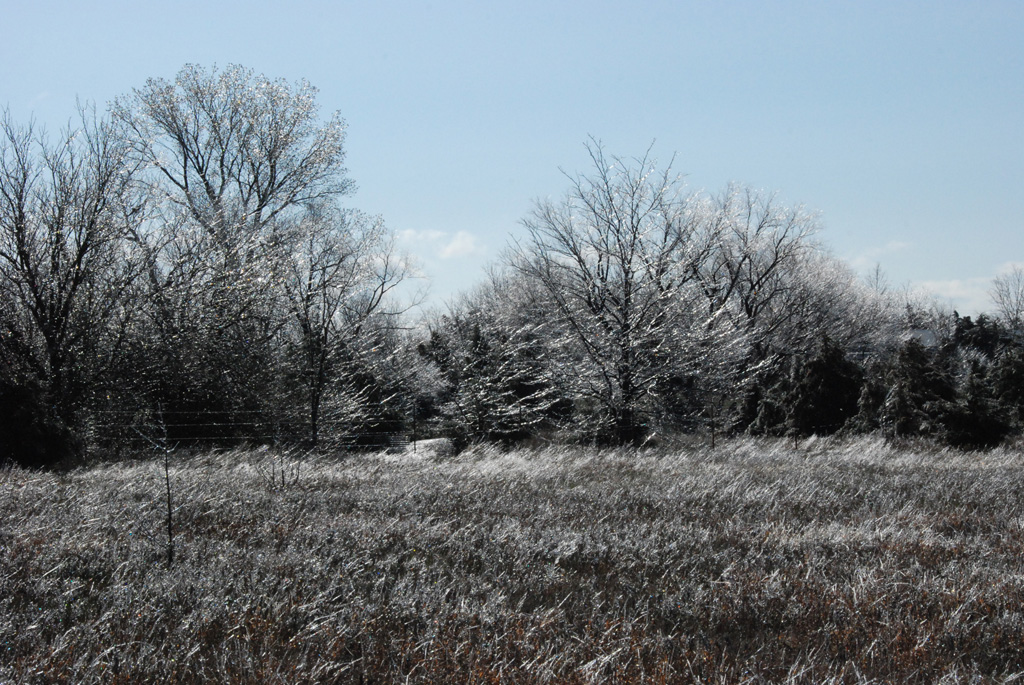
This morning's exercise in photography - trying to capture the beauty of a world encased in ice - provided a philosophical lesson as well as an artistic one:  sometimes the only way to see the real truth of a situation is to look directly into the light.

Looking directly at the light can be painful.  In fact, it can be blinding. Done correctly, though, it can show us exactly what's going on.

Looking away from the light can be misleading, making us miss the reality of a situation.  The above two photos were taken less than a minute apart, simply by changing the direction that I was aiming the camera.  The first picture shows the reality of the ice coating everything.  The second photo looks basically normal - you have to look hard to see any evidence that anything is different from a regular spring day.

Moving from ice storms to a broader view of life, this metaphor works well for a "controversial" issue facing our society today:  climate change.  Truly, there is no scientific controversy concerning this issue.  The scientific community is shining the light of their research and knowledge, showing us the reality of climate change.  However, too many people are turning away from the information the scientists are providing because it hurts - and, truthfully, it's pretty scary too.

Looking away from the sun this morning, I could hardly tell this wasn't a perfect spring morning but, looking towards the light of the day, I could see that there was a hard layer that was affecting everything.

The Union of Concerned Scientists has been addressing the issue of climate change for some time.  Here is an article they shared on Facebook this morning, giving a specific example of how the truth about climate change is being hidden for political reasons:  What South Carolinians Deserve to Know About Climate Change.

The National Center for Science Education is another group that has picked up the job of getting scientific information about climate change into the public arena.  They, too, had a good article that they shared this morning addressing the issue of climate change, A Denver TV Meteorologist...in His Own Words.  This article was actually originally posted by The Yale Forum on Climate Change & The Media.

There are many other groups and individuals trying to share scientific facts, as well as the predictions based upon those facts and upon the best scientific knowledge we currently have about how our Earth's atmosphere works. 

There are also those groups and individuals who are afraid they will lose a great deal of economic and political power if climate change is acknowledged and if, as a country, we start to work to keep the worst of those scientific predictions from occurring.  Because these latter folks currently DO have a great deal of economic and political power - and money - their views are getting much more attention than they should.

Too many people are looking away from the light of knowledge, into the "pretty picture" that distorts the reality of the situation.

On this issue, as on so many other issues, be very careful where you get your "knowledge".  All information is not created equal.  Even if it hurts and is frightening, we all need to look at the world through the best light we have available to us, instead of turning our backs to the truth.

Tuesday, March 26, 2013

Monarch Waystations: Planning for Monarchs

Last night, at Dyck Arboretum in Hesston, KS,  I had the privilege of attending a talk given by Chip Taylor, of KU's Monarch Watch program.  Dr. Taylor is an insect ecologist and Professor of Ecology and Evolutionary Biology.  He began the Monarch Watch program in 1992.  Monarch Watch is an outreach educational and research program designed to use citizen scientists to learn about and aid monarch butterflies.

It turns out that almost all of the monarchs in the central and eastern portions of North America migrate each fall to one small area in central Mexico's mountains to overwinter.  (The actual site was only discovered by scientists in the mid 1970's.)  There the monarchs cluster on trees at higher elevations, where the temperatures are traditionally cool enough to let them almost hibernate, reducing their need to feed.  In essence, they doze away the winter, then return north in the spring to lay eggs and repopulate our summer meadows and gardens.   

At that important overwintering site, scientists are able to estimate the monarch population simply by measuring the acreage that their dense clusters cover.  Since Monarch Watch began, the highest wintering population was in 1996/1997.  That winter, the butterflies covered almost 21 hectares (over 51.5 acres).  This winter (2012/3) the area covered by wintering monarchs was the lowest yet seen:  1.19 hectares (a little less than 3 acres).


There are lots of reasons for this decline, but a major cause has been the decrease in milkweeds available as larval food for monarchs.  This decrease in milkweeds has occurred primarily because of increased use of herbicides - in crop fields, pastures and along roadsides. 

As gardeners, this is where we can make a difference.  Monarch Watch is encouraging all interested parties to develop Monarch Waystations - gardens specifically geared to provide habitat to help monarchs produce more caterpillars as well as to provide them with good nectar sources to fuel their southward migration in the fall.

What would a Monarch Waystation entail?  Area-appropriate milkweeds (there are over 70 species in the U.S.), fall blooms for nectar sources, and NO INSECTICIDES.  (Insecticide will kill the monarch caterpillars, as well as the adult butterfly.)  Spots for puddling and other niceties can be added, of course, but the primary focus is on larval food (milkweeds), fall nectar sources, and freedom from pesticides.

This seems like such a simple thing to do - so I'm going to do it, and encourage others to do the same.  As I learn more, I'll share my journey here on Gaia Garden...and I hope that others who are interested in helping monarchs maintain a stable population will do the same.

Monday, September 17, 2012

Rachel Carson Still Has Lessons to Teach

This month is the 50th anniversary of the publication of Silent Spring, Rachel Carson's seminal book about pesticides.  This single book is often credited with jump-starting the environmental movement during the 1960's.  Less than 2 years after Silent Spring was published, Carson herself was dead at the age of 56 from breast cancer.  I was 6 when the book was published, and not quite 8 when she died.  I'm 56 now....

Last week, I finished reading a lengthy biography about this important woman, Rachel Carson: Witness for Nature, written by Linda Lear and published in 1997.  I'd been gnawing away at this fairly hefty book for several weeks.  It wasn't a particularly easy read, and parts of it were downright dripping with details that I really didn't think needed to be included.  However, over and over again as I read it, I found myself riveted by the path of her life: by her frequent troubles, by her dogged determination, by certain "silver linings" that serendipitously encouraged her along her way.  By those who supported her...and by those whom she supported, literally and figuratively.  (Note:  All information discussed/mentioned below about Rachel Carson and her life was provided by this biography.)

A little personal back story:  my 9th grade physical science teacher, Mr. Jack Pylant, encouraged a small cadre of his students to form an Ecology Club during the 1970-1971 school year.  We had a blast, making a Super 8 movie about "Captain Ecology:  He's Everywhere!  He's Everywhere!" that showcased one of our classmates in tights and a cape jumping out of bathtubs and garbage cans, helping teach people how not to pollute in their every day life.  We made posters and picketed the local grocery store on the first anniversary of Earth Day.  And, during that year, Mr. Pylant had me read Silent Spring. 

I'd always been a kid who loved bugs and animals and plants, but this book opened up my eyes to the longterm damage that people were doing to those same bugs and animals and plants - and also to us humans.  I never again had a mentor who encouraged my interest in the environment in the way that Jack Pylant did, but I've never forgotten those early lessons in human short-sightedness either.

As I raised our children, I came across Carson's wonderful book, A Sense of Wonder, published (I learned when I read this biography) posthumously.  To me, this short book is almost a prayer, asking that all children have at least one adult in their life who has retained their sense of wonder in nature and who will take the time to share the child's delight in the natural world around them.  Unfortunately, I think fewer and fewer children have such an adult these days.

So why did I pick up this biography?  And what insights did I gain from the life story of a woman who died almost 50 years ago?

I'd bought Linda Lear's biography of Carson shortly after it came out, following my tendency to pick up books of interest when I see them.  The problem is that my interests are broader than my time to read about them is long - so, in this case, as in many other cases, I put the book on a bookshelf and left it there, intending to read it "some day."

"Some day" came about in August when I volunteered to give a program about "an influential woman in my life" for my small town sorority's monthly meeting.  For some reason, my mind grabbed onto the unread biography sitting on my bookshelf, I announced my intention, and I picked up the book and started to read.  Almost a month later, here are the insights (in italics) that are still rattling around in my head....

Rachel Carson didn't have a particularly easy or happy childhood.  Her mother Maria was intelligent and well educated for her time, from a family that valued both.  Maria was in danger of becoming "an old maid" when she married a man who turned out to be relatively sickly, unlucky, and a poor provider.  There is no evidence that Robert Carson valued Maria for her intelligence or her education.  Within a few years of marriage, they had two children, a girl and a boy.  Eventually moved to a pretty, but hilly, piece of property along the Allegheny River near the burgeoning town of Pittsburgh, Pennsylvania.  Soon after the move, and 7 years after the birth of their younger child, Maria had a 3rd child, a little girl they named Rachel.  With both of her older children in school, Maria devoted herself to her youngest, roaming the woods of their farm, exploring the natural world together.  Maria also shared her love of reading with her children, but it was her youngest, Rachel, who most shared their mother's interests. 

At the end of the 1800's and start of the 1900's, there was a large cadre of amateur naturalists, many of them educated, middle class women.  Keenly interested in natural history, Maria Carson was part of this cadre.  Many of these well educated women wrote books about nature, creating a nature study movement nationwide.  In 1911, the Handbook of Nature Study was published by Cornell University that provided methods and actual study guides and lesson plans for non-scientists to teach children about nature.  This was a perfect fit for Maria Carson and her young daughter Rachel.

So Rachel grew up loving and knowing nature.  She read a great deal and, by age 11, was writing pieces that were accepted by a children's magazine, St. Nicholas, for publication in their monthly children's writing contests.

Rachel had an adult close to her who shared her delight in nature and who encouraged her to read, instilling in Rachel twin passions that would enrich and shape her entire life.

The Carson family farm was rather removed from town and Rachel grew up playing by herself most of the time.  Her mother being the overprotective sort, Rachel was also frequently kept home from school if illnesses threatened in town.  With her frequent absences, strong love of reading and nature, poor economic situation, rather solitary nature and her close relationship with her mother, Rachel did not fit in very well at school;  she had few friends of her own age.

College only emphasized her singularity.  Her parents scraped and scraped to send her to college, so the need to do well academically was deeply impressed upon Rachel.  Her mother Maria, starved for intellectual stimulation, visited Rachel almost every weekend, staying with her and studying alongside her.  This could not have helped her social life in college.  Meanwhile, Rachel's 2 older siblings were enjoying a less academic entrance to adult life.  Both became rather wild and eventually married young; neither marriage working out well.  Rachel's older sister Marion was left with 2 young girls to raise on her own.  She moved back in with her parents and Rachel, adding 3 more mouths to an already economically stressed family.  Rachel's brother moved in and out of the family home for many years, but never seemed to contribute money or emotional support to the larger family unit.  With her parents and her siblings serving as her examples of married life, it is no great wonder that Rachel Carson did not aspire to marriage herself.

Rachel only dated one young man in college, and that was briefly.  While she was active socially in her all women's institution, her primary concern was learning.  She started in English, planning to be an author, but switched halfway through to science, especially biological sciences.  Luckily, Rachel had strong mentors, especially one of her biology professors, who guided her during college and helped her find appropriate work after college, their teacher-student relationship strengthening to a strong friendship that lasted their entire lives.

Although Carson tried hard to continue on with her education after college, enrolling in graduate work at Johns Hopkins, eventually national economic realities interfered.  It was the Depression.  Rachel's father was ill and couldn't support his wife, eldest daughter and 2 granddaughters adequately.  Rachel ended up moving her entire family to be near her in Maryland and took part time work to both help her family economically as well as pay for her graduate work.  There seems to have been no regret in leaving the family farm near Pittsburgh.  By this time, the pollution generated in that large industrial city had decimated the natural environment of the area.  For a lover of nature like Rachel, this rapid destruction of her home's surroundings would have been a tragedy of major proportions, a personal environmental tragedy that would thereafter color her awareness of natural process with an understanding of just how fragile the environment could be in relation to human interference.

Once again living with her family, sharing bills and housekeeping with them, maintaining stable finances continued to be difficult for Rachel, her parents and her sister.  However, one of Rachel's part time jobs turned out to be writing radio program scripts for the U.S. Bureau of Fisheries...which eventually morphed into a full time position writing, and eventually into editing.   Before she got the full time position with the Bureau, though, her father died, leaving Rachel as the primary economic support for the rest of the household.

Except for the brief 9 month period between college and bringing her family to Silver Springs, Rachel Carson lived with her mother for her entire life, until her mother's death 5 years before her own.  Until the last few years, Maria took care of running the household for Rachel, as well as occasionally helping her with her work.

While working part time, Rachel had started freelance writing articles about nature for newspapers and magazines, including the Baltimore Sun and, eventually, the Atlantic Monthly.  She was exposed to the most current fisheries research in her job and, loving the sea, would share the information she was learning with the non-scientific public.  Eventually she was encouraged to write a book, Under the Sea-Wind, which was released in November, 1941.  The critics raved about the book.  Carson had found the perfect union of her talents and passions, uniting her love of writing and biology in a career of nature writing.

Once again, however, national events strongly effected her life.  With the U.S. being drawn into World War II, there was little money to promote the book of a relatively unknown author.   Very few copies of the book sold, its time in bookstores overlapping so thoroughly with a war that completely sapped the time, energy and resources of our entire nation.

Carson, however, persevered.  Still working in her spare time, she started work on another book, which eventually became The Sea Around Us, published almost 10 years after Under the Sea-Wind was released.  In the intervening 10 years, Carson had widened her circle of friends and professional acquaintances.  She had also hired a literary agent.  Last, but far from least, Carson had also learned from her previous experience.  This book was promoted much more professionally - and it made quite a splash, making it onto the best-seller list and remaining there for 86 weeks.

The popularity of The Sea Around Us was partially due to Rachel Carson's poetic ability to interpret science for the non-scientific reader, but it was also because this was the right book for its time.  At a point in history when a great chasm was opening up between most people and the natural world, Carson helped to bridge that chasm in understandable, enjoyable prose.  She presented her information in a format that took a long view of time, helping ease people's fears about current events.

Interestingly to those of us used to current standards, Carson's success created a maelstrom of criticism based entirely on her gender.  A FEMALE writing a successful, scientific book?  Her looks and her persona were the subject of much speculation.  At least one high profile interview with Carson, after her book was a strong success, talked more about how she was dressed and what makeup she wore than it did about her academic background or her interest in the sea.  This was just 60 years ago.  Perhaps it's not surprising that there is still a strong element espousing this view of the world - and frantically trying to recreate their desired reality before it disappears completely into the past.

For the most part, all of this angst simply amused Carson.  This second book had allowed her to do something she'd been wanting to do more and more:  to quit her job with the U.S. Fish and Wildlife Service so that she could concentrate more completely on her writing and on caring for her mother, who still lived with her and was, at this point, over 80 years old.

The next project that Carson undertook was a guide to the sea shore, connecting the world of The Sea Around Us to the land that most people were more familiar with.  Once more Rachel started doing both scientific literature research in libraries and field work along the Atlantic shore to fully understand her topic and to be able to interpret it for her nonscientific audience.  Originally scheduled to be completed in two years, it was actually four years until The Edge of the Sea was published, in 1955.

During this time, Carson had many claims on her time.  Not only was she researching and writing, as well as caring for her mother, she received several major awards that required both travel and well thought out acceptance speeches.   Since she saw these speeches as important opportunities for her to share her love of nature and the environment with others, she always prepared for them carefully.  There were magazine articles to write and even the script to a television show.  Friends came to visit, often staying for a week or more at a time. 

Her family was also claiming more of her time and energy.   Rachel was assuming another family burden - her niece, Marjorie, a fragile diabetic, became pregnant unexpectedly and suffered a complicated and dangerous pregnancy.  The father of the child being unavailable, this family dilemma became, to a great extent, Rachel's responsibility.  Roger was born early in 1952, living with his mother (but both of them spending large amounts of time with Rachel and her mother) until Marjorie died early in 1957, at which time Rachel assumed primary care of the not-quite-5 year old boy.

One of the things Rachel most loved to do on visits with her great-nephew Roger was to explore outside with him, much as her mother had done with her.   In 1956 she wrote an article about their times together for the Woman's Home Companion, "Help Your Child to Wonder."  She always intended to lengthen this essay and publish it as a book, but that was never to be.  The article is the basis for The Sense of Wonder, published posthumously in 1965.

The years of 1956 to 1958 were difficult ones for Rachel Carson, as she tried to combine her writing with caring for her extremely ill niece, her elderly mother, and her young great-nephew.  As mentioned, Marjorie died early in 1957.  Maria, Rachel's mother, passed away at the end of 1958.  Now it was just Rachel and her young grand-nephew left in the household.

Life, of course, rarely gives anyone clear lines of demarcation...or time to grieve.  Shortly after Marjorie died, early in 1957, Rachel learned about a new USDA program, trying to eradicate fire ants in the south, that involved the aerial spraying of powerful pesticides over thousands of acres of land.  There was even some talk, on the part of government scientists, about such spraying being able to eradicate insects altogether.

Back in 1945, Rachel had learned about DDT through her work with the U.S. Fish and Wildlife Service.  The new chemical DDT was used in World War II against lice and insect-borne diseases; after the war, the government and the chemical companies that manufactured DDT were left with large stockpiles of it.  Wanting to use this material up, the government decided to release DDT for non-military use.  Testing of DDT's toxicity to humans was woefully incomplete;  testing of its toxicity in the general environment was even weaker.

The Fish & Wildlife folks decided to run some preliminary tests on DDT's broader effects at their Patuxtent Research facility in Laurel, Maryland.  Rachel learned the results of the early tests through her professional colleagues and by editing some of the reports.  At the time, she wanted to do an article on DDT for Readers' Digest, but the magazine wasn't interested.  Meanwhile, others who learned of the test results likened DDT to the atomic bomb in its ability to create whole scale destruction of "the enemy."

Now, in 1957, not only was this new program to eradicate fire ants being proposed, but DDT mixed with fuel oil was being aerially sprayed over wide areas of the east coast in an attempt to eradicate Dutch elm disease. This lethal mixture was also being widely used in fogging to try to control mosquitoes.  In fact, a group of Long Island residents (including Dr. Bejamin Spock's younger sister, Marjorie) had sued the government to discontinue this spraying of their land, in concern for their own personal health.   At one point, Spock's garden had been aerially sprayed with this mixture 14 times in a single day.  Folks in other areas of the country were watching the Long Island case closely, as their land was being sprayed with the same mixture in an attempt to control gypsy moth and tent caterpillars, as well as mosquitoes.

It wasn't too long before Rachel Carson realized that a book on the subject of these synthetic pesticides and their environmental effects was something tremendously important that she needed to write.  By 1958 she had begun work on this project, which essentially took up the remainder of her life.

Once she started this work, all was not smooth, however.  First of all were her mother's health issues, culminating in her mother's death at the end of 1958.  1959 was a little better, although research for her book had to compete with care of Roger and with other writing obligations.  1960, however, almost immediately brought with it major health problems.  In early January, Rachel was diagnosed with a serious ulcer.  By the end of January, she got hit with a serious viral pneumonia, followed by a sinus infection.  In March she found several "cysts" in her left breast, which turned out to be cancer.  Surgery, which ended up including a radical mastectomy and the removal of multiple lymph nodes, occurred in early April.  Under careful questioning, her surgeon assured her that she didn't need any followup treatment because the lumps and nodes he'd removed weren't actually malignant, but just bordered on malignancy.

Roger, now 8 years old, was starting to act up in school, adding another component of stress to Rachel's life.  Then, in November, her cancer reoccurred in the form of a hard lump on a rib, and she started radiation treatment.  Radiation treatments continued, off and on, for several years, making her feel extremely ill each time.  From here on out, Rachel Carson's life feels like a race between finishing her book and dying of cancer. 

Despite her seriously bad health (about which she swore those near her to secrecy), Rachel continued on with her research and writing.  The invading cancer weakened her body, never truly strong in the first place, bringing a serious Staph infection the following January.  Just as the infection seemed to be responding to antibiotics, one knee and the opposite ankle became extremely painful and swollen, keeping her confined for a long while to a bed or wheelchair and eventually requiring hospitalization.  Radiation treatments brought serious nausea.  The first 5 months of 1961 flew by with little work on the pesticide book getting done.  The summer and early fall were better;  most of the research and the writing were finally complete.  The title, Silent Spring, was finally decided upon.  It was time to revise...and ill health intervened again.  This time Rachel developed a severe inflammation of the iris in November, causing her great pain and making her essentially blind.   

Finally, in January 1962,  Rachel was able to work again for a few hours a day without too much pain.  Now she commenced fact checking, again and again.  Chapters were sent out to scientific experts for editing and to check for factual errors.  Every statement was carefully sourced.  Rachel and her agent discussed the possibility of libel suits, being particularly worried about this possibility because of Rachel's financial vulnerability.  This made Rachel doubly and triply cautious about making sure her statements were true and verifiable. 

The publisher and Rachel's agent began to talk about publicity for the book.  Two friends of Rachel's, who had each been professionally involved in fighting against pesticide use for some time, took the time to prepare her for the industry attacks that they were sure were going to come her way. 

In the midst of all the furor of the upcoming publication, Rachel discovered more lumps.  They were, indeed, further metastases of her cancer.  Radiation began again, with all its side effects, while work continued.  Rachel continued to work hard to hide her illness, buying wigs and getting friends to spread rumors about how wonderful she looked. 

Beginning in May, the public events to publicize Silent Spring began.  First was a luncheon in D.C. where particularly influential women who might be interested in the book were invited.  Next was the White House Conference on Conservation, convened by Stewart Udall at the request of John F. Kennedy, with Rachel as a distinguished guest.  By this time, many of the conference attendees had received advance copies of Silent Spring.  Rachel gave the commencement address at Scripps in California.  Book-of-the-Month Club chose Silent Spring as its October selection.  The New Yorker began its planned serial installments.

And the criticism started...  First out of the box was a letter suggesting that Rachel Carson was a Communist sympathizer and that "We can live without birds and animals, but...we cannot live without business.  As for insects, isn't it just like a woman to be scared to death of a few little bugs?  As long as we have the H-bomb everything will be O.K."

In August, the thalidomide scandal (with the disclosure that the U.S. drug companies had tried to market thalidomide in the U.S. but been blocked by a single - female - scientist at FDA).  Perhaps serendipitously, public interest was focused on the health consequences of using the wrong chemical.

The chemical companies and certain governmental agencies began their response to Carson's soon-to-be-released book.  They could find few errors of fact to attack, so they started by attacking her writing skill and her "one-sided approach."  The  U.S. Dept. of Agriculture, home of the DDT spraying campaigns, issued a bland statement in support of the concerns brought forward by "Miss Carson."  One chemical company threatened legal action against the publisher and suggested that Carson was part of  "a conspiracy" with "sinister influences" at work.  Houghton-Mifflin refused to capitulate to the threat, simply responding that the facts had been thoroughly checked.  When that threat didn't work, the chemical company lawyers talked with National Audubon Society leaders (Audubon having agreed to publish excerpts of Silent Spring in their magazine), suggesting that they had wives and family to care for that might be jeopardized by the publication of the Silent Spring excerpts.  Audubon didn't cave either and, in fact, published excerpts of the chemical company's original letter to Houghton-Mifflin.

Undeterred, publication of Silent Spring occurred on September 27, 1962. 

Letters poured in.  Many were from doctors.  Over half the letters were written by men, a fact that Carson felt was important to mention publicly, in that it showed that men, as well as women, were concerned about the effects of pesticides. 

Public interest and support was high.  So was criticism.  It rapidly became obvious to Carson that few of her critics had actually read her book.  So she pointed this out in her speeches.  She described the liaison that had developed between science and industry, asking, "When the scientific organization speaks, whose voice do we hear, that of science or of the sustaining industry?"

By Christmas, Carson was having to curtail speaking engagements and was back at the hospital daily, enduring more radiation treatments.  She started having severe chest pain.  Although she was trying to keep things normal for Roger's sake, it became increasingly difficult.

Criticism and attacks continued, none substantive against her facts, but all determined to undermine her credibility.  A former Secretary of Agriculture commented, "Why [is] a spinster with no children...so concerned about genetics?"  He postulated that she was "probably a Communist."  Once again, a great deal of focus was placed on Carson's gender and marital status.  Her book was dismissed as overly emotional and "inaccurate" (but no factual errors were actually pointed out).   Because she "only" had a master's degree, she was characterized as being an amateur, not a professional scientist, and therefore too unskilled to truly understand and critique the "scientific" synthetic pesticides.  Carson loved birds and had cats, therefore she was characterized as hysterical and overly sensitive. 

The trade associations for the chemical industry printed brochures and "fact sheets" denouncing Carson's work.  They parodied her opening chapter and sent it to newspapers across the country.  They characterized anyone who believed and/or supported her book as faddists and pseudo-scientists.   They publicly castigated her for "abandoning scientific proof and truth for exaggeration," but they provided no proof of their own.  One industry affiliate rewrote and publicized a nursery rhyme, "Rachel, Rachel, we've been hearing...,"  in which they mocked her and her conclusions.  She was accused of telling half truths, and the public was warned that listening to Carson (and using fewer pesticides) would cause widespread starvation and death.  At one point when she declined an invitation to be on a public panel because of health issues (and before she knew who the other panelists would be), the sponsoring group published a statement saying that she had declined to attend AFTER she found out who the other panelists would be.  (Furious, Carson was able to get the group to admit their fallacy and to retract their statement.)

(Note:  What really made an impact on me about all of this was that these same tactics are still being used on a widespread basis today, in many different public arenas, to protect monied interests and to discredit the work of those who threaten them.) 

Carson herself continued to speak, as much as her ongoing illness allowed her.  She urged people to pay careful attention to what they were hearing about pesticides, being sure to ask themselves who was speaking and what their motivation might be.   She testified to Congress.  She accepted several awards, making a final speech during her last trip to New York City in December, 1963.

On April 14, 1964, Rachel Carson passed away.   Her brother Robert, who had never been supportive, came rampaging through the house within hours of her death to collect things he felt were his (including the TV in Roger's bedroom) and to destroy letters and documents that he didn't like.  Roger, only 12 years old, went to live with Rachel's editor at Houghton-Mifflin. 

Robert also assumed control of her funeral arrangements.  Rachel had wanted a quiet memorial service at All Souls Unitarian Church.  She wished to be cremated and her ashes scattered in the Atlantic Ocean off her beloved Maine coast.  Instead, her brother Robert insisted on an elaborate funeral at the Washington National Cathedral.  On a positive note, her pallbearers were some of her best friends, including Edwin Way Teale, a U.S. senator, and Secretary of Interior Stewart Udall.  Brother Robert also insisted on Rachel's burial alongside her mother, Maria.  Enough friends knew of her desire to be cremated that Robert was forced to compromise, having Rachel's body cremated and half of her ashes interred at the cemetery, while half were given to her good friend in Maine to scatter in the ocean, as Rachel had wished.

Rachel's agent, Marie Rodell, arranged for the desired quiet memorial service at All Soul's Unitarian Church after Robert had left.  Later she spent 2 years sorting through Rachel's letters and papers, returning letters to their senders and requesting them to review them all and return only those they were willing to give permanently to Yale, where Rachel's papers were to find their final home.

Marie Rodell's final two projects for Rachel were to organize a committee of her friends to form The Rachel Carson Trust for the Living Environment, and to posthumously publish The Sense of Wonder.

So....  My final insights from Rachel Carson's life?

1.  Some people truly seem to be born to accomplish an important task.  In Carson's case, this was calling attention to the natural world and to the dangers being arrayed against it by human activity.

2.  As I have come to realize more and more, successful people do not necessarily have happy childhoods.  Often times, the very things that make a person successful later in life serve to isolate them during childhood.

3.   Carson would probably not have been able to accomplish her life's work if she had been married.  Her mother's lifelong support was also very instrumental in helping Rachel's interests and talents to develop and in allowing them to blossom and fruit.

4.  Adversity that forced changes in her early plans actually worked to create the opportunities that Carson needed to do her work.   Going to work for the Bureau of Fisheries, for example, showed her the way to combine her love of science with her writing talent, as well as giving her access to many scientists and their research. 

5.  Like Thoreau and the Concord, MA, transcendentalists, Carson was part of an important cadre of environmentalsts, including Teale, Eiseley, and Beston, who all knew each other and complemented each other's work and philosophy.  Friends, personal and professional, can form an incredible scaffold of aid and support to enrich one's life.

6.  Family can build a person up...or it can tear a person down.  Carson had some of both in her life.

7.  The powers-that-be (monied or influential, political or business) will be ruthless in attacking anything and anyone that threatens them.  Their methods of attack include innuendo, outright lies, ridicule, belittlement, threats, and many other difficult-to-withstand tactics.  They have no compunction about viciously tearing a person down to attain their own goals, and no ethical or moral code that involves telling the truth.

8.  National events can have strong effects on individual lives...whether a person pays attention to politics or current events or history, or not.

I asked my Facebook friends how many of them had read Silent Spring.  No one answered in the affirmative.  I haven't read it since 9th grade, but maybe it's time to revisit it.  I've read The Sense of Wonder many times now, and it never grows old. 

As global climate change seems to be taking strong hold, year by year, and as our use of toxic chemicals continues, seemingly with little thought to the future, I wonder if Rachel Carson's warning to us all has been heeded, or whether it has just been forgotten, buried under the cacophony of everyday life.  She closed Silent Spring with an epigraph, a quote from E. B. White.  It seems very appropriate to close this post with the same quote:
I am pessimistic about the human race because it is too ingenious for its own good.  Our approach to nature is to beat it into submission.  We would stand a better chance of survival if we accommodated ourselves to this planet and viewed it appreciatively instead of skeptically and dictatorially.