When I first saw this good-sized wasp, I thought it looked a lot like a cicada killer. I couldn't get very close to it to get decent photographs, but I was able to get good enough images that I knew it wasn't my old friend from Kansas.
Tonight, after I cropped the photos to more closely see the insect I had "captured", I tabbed over to BugGuide.net and started looking around. After a while, I thought I had probably figured out the identification...but the eye color was wrong and the markings on the thorax were not quite right either. So, I posted the photos and asked for help.
Meanwhile, I continued searching through BugGuide, looking for a better match to my mystery wasp. As I was checking out a particular species, a sand wasp that is known only as Bicyrtes quadrifasciatus, I saw a couple photos that looked remarkably familiar. When I checked my email, I was stunned. My original identification had, indeed, been wrong; the species I was looking at now was the correct species; and - most surprising of all - one of the contributing editors at BugGuide had already made the identification and moved my photos to the correct spot! Those WERE the photos I had just uploaded a few minutes before.
BugGuide for the win!
So why do I try so hard to identify "my" insects to the correct species? This wasp is a good example. By learning the identity of this wasp, peacefully feeding at a flower, I learned that I host a species of solitary wasp that raises its young completely on true bugs, on insects like stink bugs and assassin bugs and maybe even milkweed bugs.
Seriously. This species of wasp finds enough true bugs in the general area of my yard to raise its entire brood of young for the year on the bugs that it finds and paralyzes, drags back to its nest, and lays eggs on. Isn't that incredible? Talk about natural pest control. Talk about the "balance of nature".
To top it all off, as an adult, this wasp acts as a pollinator on flowers in my garden. Before I started learning about the specific identities of the insects in my garden, I had no idea that wasps were such extraordinary predators or that adult wasps generally just ate pollen and nectar. Based on a childhood experience, I was actually quite scared of them. Now wasps fascinate me, and the more I learn, the more fascinated I become.
I am continually stunned by the complex interactions occurring all around me - interactions that I simply don't see or even know to look for. The natural world is truly a marvelous, intricate web of life whose structure we would be wise to cherish, rather than destroy.
Showing posts with label Web of Life. Show all posts
Friday, August 04, 2017
Monday, April 21, 2014
Lousy Photos Still Have Their Value
Having set myself the task, last year, of documenting all of the plants and animals that I can identify on our 10 acres, I have found myself overwhelmed with photos in short order now that spring has arrived.
It's MUCH easier to take photos of insects than it is to identify them. Just in case you wondered.
It's also much easier to take photos of insects than it is to take GOOD photos of insects - good photos being defined as photos where you have a snowball's chance of actually identifying the insect in question based on what you are seeing on the screen in front of you. I learned my basic insect identification skills the "good" old fashioned way, a.k.a. by capturing the insects and killing them, then identifying them at my leisure through the use of various magnifying devices and dichotomous keys.
I prefer trying to identify living insects in blurry photos, even if it means I won't get many of them actually identified. I'm just not into killing living beings of any sort, if I can avoid it. So here are a few of my so-so photos, some of which I've managed to identify and some of which are still mysteries to me....
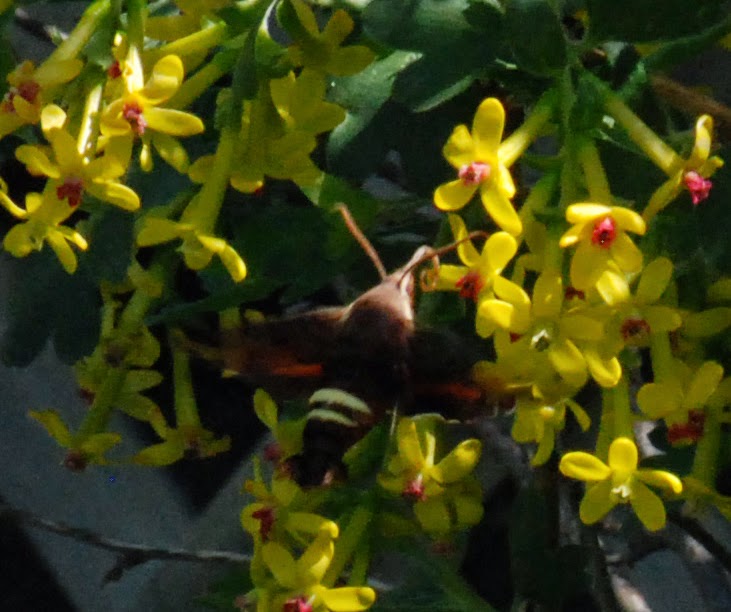
The clove currant (Ribes odoratum) is in sweet, full and glorious bloom right now. On Saturday, when I stopped by it, I noticed a dark hawk moth feeding. The wings blurred rusty brown as the moth moved from bloom to bloom, while the heavy abdomen had a tuft at its end and was encircled by 2 bright yellow bands. I'd never seen this particular hawk moth before, so I tried to take its picture, thinking I could identify it more accurately if I had a good photo. The blasted little beast was definitely camera shy and not very trusting of giant beings standing nearby with big black boxes stuck up near their face. It tended to keep to the far side of the plants, rather than venturing out into the open near to me.
Thank heavens for digital. Fifteen photos later, the moth flew away and I've not seen it since. When I checked out those 15 shots to see what I'd managed to capture, sadly this was the BEST image of the lot.
As lousy as this photo is, I was still able to use it to identify my "dark" hawk moth as a Nessus Sphinx Moth (Amphion floridensis). This species is supposedly one of the more commonly encountered day-flying moths, but I've never seen one before. The larvae/ caterpillars, which are a type of hornworm, feed on grape, Ampelopsis, and Capsicum (bell and hot pepper) plants, all of which are frequent in our yard.
Looking around under one of our green ash trees (Fraxinus pennsylvanica), I noticed some small, gnat-like creatures flying. When one came to rest within my sightline, I decided to snap its picture. Then I noticed a second one nearby. Snap. Snap. Snap. These little creatures were about 1/4" or 3/8" long, colored gray and sitting on gray bark. I have no idea why I thought I could get a good photo. Here's what I managed to capture, 26 photos later, ....
I didn't think this silhouette would show me much at first, but when I zoomed in, I noticed that the "big" fly had a small fly caught underneath it, held in a classic "I'm eating you" sort of position. When I showed it to Greg, he immediately thought the "big fly" was a robber fly of some sort. I can go with that.
Another shot of the same individual accidentally captured a second "big fly" just above it on the bark.
Do you see the 2 of them? The one in the bottom right of the photo is the one shown in silhouette above; the second one is in the top left of the photo. When I zoomed in on the second individual, it also seemed to have some sort of fly prey - with a yellow tipped abdomen - caught.
From the top, there's little evidence of "big fly #1" having prey captured beneath it, but the silhouette shot accidentally revealed the secret.
I haven't decided yet whether I'm going to try to submit these photos to Bug Guide or not - my feel is that they are not good enough for any sort of identification, but maybe I'll chance it anyway. I do think these are tiny robber flies and I'd love to see if anyone can tell me any more about them.
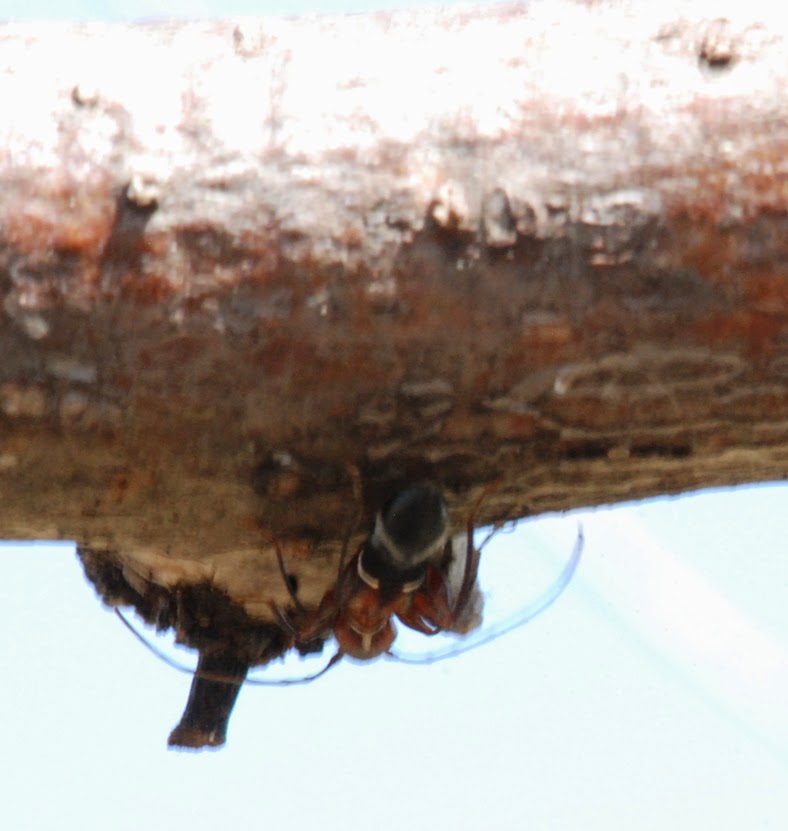
Another lousy picture that nonetheless taught me something new about the creatures in our yard was this one, taken Saturday of some sort of critter on the underside of a small honeylocust branch....
When I took the photo, I thought the mess of moving legs was perhaps an emerging wheel bug. As I took several more shots, I changed my mind to thinking I was looking at a brightly colored ant. As I took the very last picture, something clicked and made me think, "Beetle?" When I looked it up, sure enough, beetle was correct! This is an Antlike Longhorned Beetle (Euderces pini). The larvae of this beetle feed on dead wood in a variety of types of trees; the adults are typically seen nectaring at flowers. The adults mimic ants and are notoriously hard to photograph because they never quit moving. This is another insect that tops out around 3/8" long. As lousy as my photos of this creature are (and this is the best of the lot), I feel lucky that I got a couple shots that allowed me to identify it at all.
As you can tell, I've got a LO-O-O-ONG way to go before I get very decent at taking good insect photos, but I do have fun and I learn a lot, even at the level of (in)competence that I have attained. The natural world seems more wondrous every day.
Labels:
beetles,
Biodiversity,
Flies,
Moths,
native plants,
Organic Gardening,
Photography,
Robber flies,
Trees,
Web of Life
Thursday, February 20, 2014
Pieces and Parts of Our Gardens...and Our World
"The last word in ignorance is the man who says of an animal or plant, 'What good is it?' "
...Aldo Leopold
This quote, which I noted in my Facebook feed the other day, caught my eye. It made me remember old jokes in the 1970's about "useless" research being funded by the government - things like the mating habits of crayfish. Why would anyone care about that, let alone plunk down good money to support that sort of foolish, nonsensical research?!
Well, I care. I cared then, simply because I loved animals, and now I care even more, because I realize how little I know about the plants and animals around me and about how they interact with each other.
Most importantly, all of us should care. As a society, WE KNOW SO blasted LITTLE ABOUT THE NATURAL WORLD OF WHICH WE ARE BUT ONE PART. What conditions DO crayfish/crawdads require to reproduce? How about pollinating insects? How about natural predatory insects? What harm will we do if we do away with this species? or that one?
You're a gardener. Here's a quick test for you: How many natural predators of insects can you identify?
It's okay. Take your time. I'm patiently waiting - and humming the Jeopardy tune - while you make your tally.....
I'm guessing you thought of ladybugs,...
praying mantises,...
and, if you're really thinking, maybe flycatchers.
Well, did you think of all the various different types of spiders - garden spiders, crab spiders, grass spiders, funnel spiders, hunting spiders and so forth? They eat oodles of insects every day.
How about all the different kinds of birds? Almost all birds feed their young exclusively insects as they grow, even if the species eats seeds when it reaches adulthood.
Did you list wasps? Most young wasps grow up on a diet of insects or spiders, too.
Are toads on your list? They're completely carnivorous, eating primarily insects.
Frogs are completely carnivorous, too.
Garter snakes manage to chow down on quite a few insects as they prowl along the ground.
If you've listened to one of my talks, you know that one of my favorite insect predators is the wheel bug. In my gardens, wheel bugs probably eat more insects than praying mantises and ladybugs combined.
Flower flies. In this species of syrphid fly, for example, every adult you see nectaring at a flower ate an average of 250 aphids to reach adulthood.
The list goes on and on and on and on. Blister beetle grubs feed on grasshopper eggs. Coyotes eat insects as part of their varied diet; their pups often practice hunting on grasshoppers. Even my German shepherds can't get enough cicadas every summer - talk about a buzzy, tasty, crunchy dog treat!
The quote with which I began this post is taken from a much longer paragraph in Aldo Leopold's Round River essay:
Sooner rather than later, to use another classic metaphor, we are going to loosen and throw away the last remaining bolt that was holding our aircraft together.
But we're gardeners, you and I. We know that we are not dominant over nature - nature manages to humble us time and time again, year after year. Still, each spring, we feel the thrill of nurturing life. That's part of the challenge of gardening. So, as gardeners, let's take a pledge to learn about the natural world around us, so that we can share our knowledge with others. In doing so, we'll help to repair the web of life to which we belong, hopefully saving the last few bolts from loosening and even tightening many more in their proper places so that they keep our world together, functional, and flying.
There's another quote, this one by John Muir, that seems appropriate to close with: "When one tugs at a single thing in nature, he finds it attached to the rest of the world." It's OUR world. Let's take care of it.
...Aldo Leopold
This quote, which I noted in my Facebook feed the other day, caught my eye. It made me remember old jokes in the 1970's about "useless" research being funded by the government - things like the mating habits of crayfish. Why would anyone care about that, let alone plunk down good money to support that sort of foolish, nonsensical research?!
Well, I care. I cared then, simply because I loved animals, and now I care even more, because I realize how little I know about the plants and animals around me and about how they interact with each other.
Most importantly, all of us should care. As a society, WE KNOW SO blasted LITTLE ABOUT THE NATURAL WORLD OF WHICH WE ARE BUT ONE PART. What conditions DO crayfish/crawdads require to reproduce? How about pollinating insects? How about natural predatory insects? What harm will we do if we do away with this species? or that one?
You're a gardener. Here's a quick test for you: How many natural predators of insects can you identify?
It's okay. Take your time. I'm patiently waiting - and humming the Jeopardy tune - while you make your tally.....
I'm guessing you thought of ladybugs,...
and, if you're really thinking, maybe flycatchers.
Well, did you think of all the various different types of spiders - garden spiders, crab spiders, grass spiders, funnel spiders, hunting spiders and so forth? They eat oodles of insects every day.
How about all the different kinds of birds? Almost all birds feed their young exclusively insects as they grow, even if the species eats seeds when it reaches adulthood.
Did you list wasps? Most young wasps grow up on a diet of insects or spiders, too.
Are toads on your list? They're completely carnivorous, eating primarily insects.
Frogs are completely carnivorous, too.
Garter snakes manage to chow down on quite a few insects as they prowl along the ground.
If you've listened to one of my talks, you know that one of my favorite insect predators is the wheel bug. In my gardens, wheel bugs probably eat more insects than praying mantises and ladybugs combined.
Flower flies. In this species of syrphid fly, for example, every adult you see nectaring at a flower ate an average of 250 aphids to reach adulthood.
The list goes on and on and on and on. Blister beetle grubs feed on grasshopper eggs. Coyotes eat insects as part of their varied diet; their pups often practice hunting on grasshoppers. Even my German shepherds can't get enough cicadas every summer - talk about a buzzy, tasty, crunchy dog treat!
The quote with which I began this post is taken from a much longer paragraph in Aldo Leopold's Round River essay:
The last word in ignorance is the man who says of an animal or plant, "What good is it?" If the land mechanism as a whole is good, then every part is good, whether we understand it or not. If the biota, in the course of aeons, has built something we like but do not understand, then who but a fool would discard seemingly useless parts? To keep every cog and wheel is the first precaution of intelligent tinkering.We treat many parts of our world as if they were totally unimportant, killing plants and animals indiscriminately, feeling a flush of power as we prove that WE are dominant.
Sooner rather than later, to use another classic metaphor, we are going to loosen and throw away the last remaining bolt that was holding our aircraft together.
But we're gardeners, you and I. We know that we are not dominant over nature - nature manages to humble us time and time again, year after year. Still, each spring, we feel the thrill of nurturing life. That's part of the challenge of gardening. So, as gardeners, let's take a pledge to learn about the natural world around us, so that we can share our knowledge with others. In doing so, we'll help to repair the web of life to which we belong, hopefully saving the last few bolts from loosening and even tightening many more in their proper places so that they keep our world together, functional, and flying.
There's another quote, this one by John Muir, that seems appropriate to close with: "When one tugs at a single thing in nature, he finds it attached to the rest of the world." It's OUR world. Let's take care of it.
Saturday, January 11, 2014
Learning Another (Fly) Stitch in the Tapestry of Patchwork Prairie
After all the hoopla of the holidays, I'm finally getting back to my projects, particularly the one where I'm learning to identify the different insects that I've photographed in the yard over the last 7 years.
With that goal in mind, I've started posting some of the insects that I can't identify on bugguide.net. This wonderful site has generous volunteers that identify the insects they can in photos shared by people from all around the country.
The last time I posted any photos on bugguide.net was almost 2 months ago, so I was rather surprised recently to get a message in my e-mail box saying that someone had added comments to one of my submissions. Checking it out, I learned that one of the flies I had posted from early November had been identified as a particular species of tachinid fly, Archyatus marmoratus. Which meant exactly what?
I had been pretty sure that the fly, which I observed feeding on aromatic aster blooms, was a tachinid. And it was. Tachinids are rather large flies that look like very hairy, even bristly, house flies. Despite their homely appearance, they are considered a beneficial insect. In their larval stage, they are parasitoids, because their larvae grow inside a variety of other insects and kill those insects as they grow. Often the species parasitized is specific to the species of tachinid fly, so finding out the species of tachinid fly gave me a good chance of learning how this particular insect fit within the community of plants and animals in our yard.
Googling was in order...and rapidly accomplished.
I didn't find a lot on Archyatus marmoratus during my quick Google search, but what I did find was reassuring, even exciting. This tachinid species is not completely host specific, but it does parasitize caterpillars in a specific group of moths, Noctuids, particularly within a group of caterpillars that includes armyworms, budworms and other pest species. The female fly lays her eggs in the area where host caterpillars are likely to occur and, after the eggs hatch, the young fly larvae hitch onto appropriate host caterpillars when they come by. Each caterpillar that picks up a tiny fly larva eventually gives up its life, producing one adult tachinid fly in the process.
So, for every adult fly I see, an armyworm or budworm gave its life. For every adult A. marmoratus fly I see, an armyworm or budworm didn't make it to adulthood to reproduce. For every adult A. marmoratus I see, a new generation of tachinid flies has a good chance of appearing to help keep next year's armyworm and budworm populations under control. And along the way, my asters get some extra help in pollination.
All in all, it's a mighty sweet deal, despite being all wrapped up in a pretty homely package.
Labels:
Database,
Flies,
Moths,
Native Pollinators,
Organic Gardening,
Parasitism,
Pests,
Pollinators,
Tachinid Flies,
Web of Life
Friday, September 06, 2013
Glimpses Into Other Lives....
It's such a busy time of year outside right now. Oh, not busy for me, the gardener who doesn't like heat, but busy for insects and flowers and birds and so many other living things. I do a walkabout and come back with dozens of photos of interesting glimpses I've been given into other lives.
Of course, much of the time I'm not sure what I've really seen, so I have to research the animal or plant and try to find out. Sometimes I'm successful...and sometimes I'm not. Sometimes what I learn seems worth a share...and sometimes not.
Here are a few glimpses of other lives that I've been privileged to observe recently....
Do you ever wonder where other animals sleep? No safe bed to curl up into.... No obvious shelter from the elements.... No protection from the many, many predators sharing the world with you, night as well as day.... Well, the evening before last, I looked out my kitchen window and saw a dark shape among the leaves of our green ash tree. Binoculars showed me a rather tattered black swallowtail butterfly clinging to a leaf about 15 feet above the ground. It seemed rather exposed from my view in the kitchen, but when I grabbed my camera and went outside to take a photo, I had a hard time getting a clear shot.
Maybe it wasn't so exposed a location after all!
Then yesterday morning, about 9:30 a.m., I started out on a walkabout with the boys. As I went through the back yard, movement fluttering out of the green ash caught my eye. A large, black swallowtail came out of the tree, to rest on one of my rose bushes. I quickly caught the image with my camera.
A well worn, female eastern tiger swallowtail, Papilio glaucus, black form, is what my research told me. To paraphrase the meme currently going around, she looks like she's lived a full life and will slide sideways, screaming "Ya-hooooo!" into her grave!
When I pulled up the images of the sleeping butterfly from the evening before, it was also a female, black form, eastern tiger swallowtail. Is this one I saw yesterday morning the same one I saw sleeping in that green ash the night before? Probably. We don't have that many swallowtails around, let alone worn out, black form, female, eastern tiger swallowtails. Interestingly, as I look outside right now - about the same time I left on my walk yesterday morning - I notice that the spot she chose to rest in overnight is illuminated brightly by the rising sun. It would have warmed her perfectly to start her day's duties of eating and reproducing. Did she pick that spot "consciously" so that she would get a good start the next day, or was it just serendipity that she came to rest there? One of life's tiny mysteries to which I, at least, will probably never know the answer.
Speaking of never knowing, it's common at this time of year to see funnel webs in the grass, but it's uncommon to see the spiders that build and live in them. Not being the sort to tear a web apart to see who made it and lives in it, I looked for years without being granted the gift of seeing a funnel web spider. Then, several years ago, my stubbornness paid off and I started catching glimpses of spiders darting back into their vortical holes. Once or twice, I was cautious enough to even get a photo or two before caution overcame the spider's curiosity and it retreated back into safety.
This year I have several funnel webs in amongst my flower blooms, a foot or two above the ground. They're not particularly beautiful, binding the swaying blossoms and leaves together while catching debris in their sticky matrix of silk, but I leave them be as part of the (literal) web of life keeping its precarious balance in my gardens.
Two mornings ago, I was rewarded for my forbearance with a grand appearance by one of my funnel web spiders, standing guard at the entrance to its home while displaying its daily catch, neating bound in front of it.
I can't tell what poor, hapless creature served as breakfast, but I appreciate finally getting to see (and share) in this facet of garden life.
My final share in this post, to keep it from getting too long, is both a simple joy and a non-mystery with a mysterious component. On my walkabout yesterday morning, I found that the dotted gayfeather, Liatris punctata, have started to bloom out back.
While capturing their luminescent purple spikes, I came across this beautiful bumblebee, busily gorging on fresh nectar or pollen.
I don't recall having seen, around here, a bumblebee with so much rust on it before. I carefully looked through the bumblebee species on Bugguide.net, but found nothing that matched both the rusty hair on the terminal abdominal segments, as well as the patches of rust on the thorax, so I put in an ID request there. Since I did see an American bumblebee, Bombus pennsylvanicus, on their site with the rusty hair on the terminal abdominal segments (but not on the thorax), and that species is common here, I'm suspecting they'll just tell me it's a different color morph of American bumblebee, but maybe not. Now I anxiously await their verdict!
So many thousands of other creatures, busily living their lives while sharing our small acreage.... Actually, I guess, I'm phrasing that incorrectly. In the overall scheme of life on Earth, it's not "our" acreage. I should be saying that we are sharing the world with all these other creatures, while we have the privilege of caring for the small acreage that we and they, both, live on...for now.
And I truly feel privileged for getting this opportunity.
Labels:
Bumblebees,
Butterflies,
Forbs,
Spiders,
Web of Life
Subscribe to:
Posts (Atom)