Showing posts with label Treefrogs. Show all posts

Wednesday, August 01, 2018

A Recent Cast of Characters in My Gardens: Pollinators and Predators

With the initiation of several days of rain, it seems like a good time to share a few garden photos from the plethora I've taken over the last few weeks.  Since I'm obsessed with pollinators and other wildlife, that's what I'll generally be showing you!

Gaillardia (Gaillardia pulchella) brings in a lot of insect activity.  I have several pots of gaillardia on our back patio, as well as a few plants along the street by our mailbox.  Not surprisingly, most of my photos are from the plants I see most often - the ones near my back door.

This is a lousy photo, but I wanted to share the single bumble bee (Bombus sp.) I've seen in my gardens so far this summer.  Gaillardia is the ONLY flower I've seen her on so far.

A female monarch (Danaus plexippus) finally visited the yard for several days last week and she left several eggs behind.  Here's she's ovipositing on a swamp milkweed (Asclepias incarnata) I planted a couple months ago.  I'm a "survival of the fittest" biologist, so I don't collect the eggs and raise the caterpillars inside;  I'm waiting to see if I see any caterpillars - this photo was taken on the 28th, so there should be a couple tiny babies out there munching away, but I haven't gone looking yet.  (Update:  my grandson and I went out in the rain this afternoon and found at least 3 tiny new monarch caterpillars!  Yeah!)

Ms. Blue Dasher (Pachydiplax longipennis) here isn't a pollinator, but I love welcoming her and her relatives into the yard.  Every mosquito this mosquito hawk eats is a mosquito that doesn't bite me! Aren't her eyes particularly gorgeous?  The body of the male blue dasher is a beautiful powdery blue, but I've been seeing almost exclusively females lately.

This green treefrog (Hyla cinerea) seems to have decided that the outside corner of our gutter near the bright lights of the kitchen window makes a perfect home.  Over the past week, I've been seeing her (him?) frequently within just a few inches of this location.   Note:  nothing like a closeup photo to let you know the house badly needs a power washing!

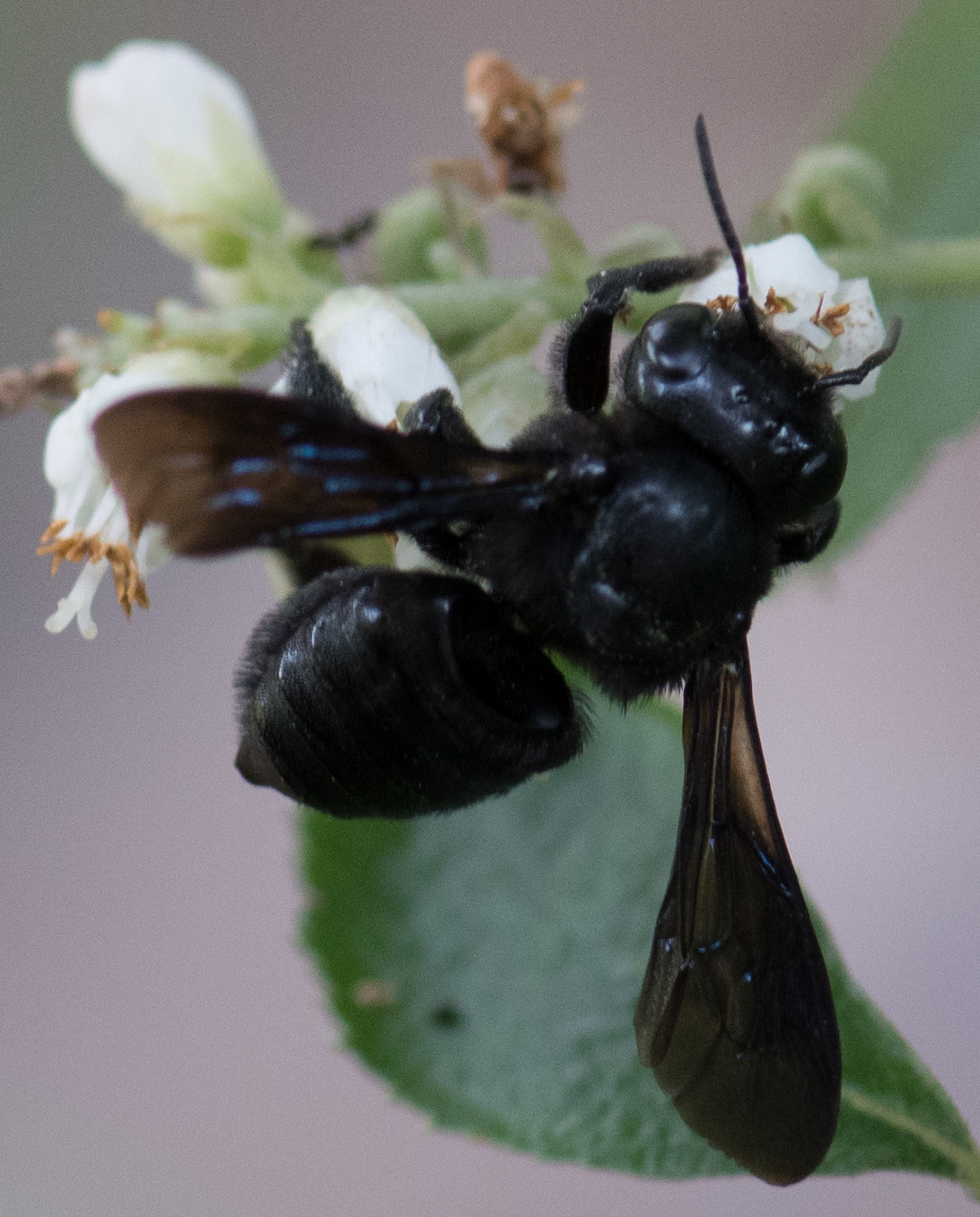
Out front, the newly planted sweet pepperbush (Clethra alnifolia) has excited a lot of pollinator interest.  I shared the potter wasp and the 4 spotted scarab hunter wasp I've seen nectaring here in my recent post;  this is a carpenter-mimic leaf-cutter bee (Megachile xylocopoides) who also has seemed to enjoy the blooms. 

The deep velvet black of this bee's body and the iridescent blue-black of its wings are just stunning.  I wonder if this is the species that has been harvesting circles of dogwood leaves to make their nest cells waterproof?

Another little green treefrog was tucked away inside a Flyr's nemesis (Brickellia cordifolia), hoping against hope that I didn't actually see him as I looked around.  I let him pretend that I hadn't noticed him.....

With the spotted beebalm (Monarda punctata) beginning to bloom, I'm starting to see a little more activity in that section of the garden, including this small green anole (Anolis carolinensis).  I'm still not seeing many insects attracted to the spotted beebalm blossoms, but I did see a hummingbird feeding - even though I didn't have my camera with me so I could visually share with you.

Back to the anole for a moment, I've been seeing many tiny little green anoles for the last several weeks, which just makes me smile.  Obviously it's been a good year for anole love!

Another recent dragonfly visitor was the great blue skimmer (Libellula vibrans), who perched on top of the poles in our tomato pots for a while - and was lucky enough (and good enough) to capture a passing moth shortly after I took the top photo.  Those big, black-spotted blue eyes aren't just for show!

Out front, enjoying the turkey tangle fogfruit (Phyla nodiflora), there's been the phaon crescent (Phyciodes phaon), nectaring - and possibly laying eggs, since fogfruit is their larval plant.  Note:  I don't know if this individual is a male or female.

The fogfruit has also attracted many other insects, including a female blue dasher dragonfly, a carpenter-mimic leaf-cutter bee, several  different species of wasps, bees, and flies.  In fact, the fogfruit is active enough that it's probably worth a post just by itself.  I just wish it looked a little more "gardeny"....

Anoles have been out in the front gardens as well as in the back.  Here was one haunting a summer phlox (Phlox paniculata) blossom.  Sometimes I wonder if I don't see huge numbers of pollinators because I DO see lots and lots of predators around the blooms - and I'm sure it's not a coincidence that they are hanging out there!

Speaking of predators, whether nymphs (like this one) or adults, I'm seeing quite a few milkweed assassin bugs (Zelus longipes) this summer.  I thought they were so-named because they were part of the milkweed community, but recent reading suggests their name comes from their coloration.  I've certainly seen them on many, many plants, not just on milkweed.

The clustered mountain mint (Pycnanthemum muticum) in the back yard has brought in quite a few unusual (for my garden) pollinators.  Besides several wasp species, there is this grapeleaf skeletonizer moth (Harrisina americana) which has both a common name and a color pattern that make it a perfect Halloween animal.

Believe it or not, this small, colorful, Halloween themed moth, also nectaring on the mountain mint, is from the a group of moths known as bird dropping moths.  Yes, that's an actual common name for moths in the subfamily Acontiinae .  This moth goes by the hard-to-remember name of black-dotted spragueia moth (Spragueia onagrus)  and is an animal I've never seen before in my life.  Kudos to the helpful folks at BugGuide.net for helping me identify this one!

Lacewing larvae, looking for all the world like prehistoric monsters or like some less glittery version of Tamatoa, the Crab, on Moana, are hard to see unless you look closely, but they are great allies in garden pest control.  This photo is blurry (the entire "mound" is barely 1/4" across and I wasn't using a tripod) but, if you look carefully, you can see the huge jaws under the front edge as well as a wing from one of its dinners right above the jaws.

In all, this lineup of characters from my garden highlights 6 garden predators (green anole, green treefrog, milkweed assassin bug, lacewing larva, blue dasher dragonfly, great blue skimmer dragonfly) and 6 pollinators (monarch, bumblebee, carpenter-mimic  leaf-cutter bee, phaon crescent butterfly, grapevine skeletonizer moth, and black-spotted spragueia moth).  During the 10 days that I photographed these animals, I saw many other animals, too.  Some, like the 5 species of wasps that I talked about in my last post, I've shared with you.  Others, like bluebirds, cardinals, bluejays, gray squirrels, chickadees, tufted titmice, house finch, mockingbirds, red-shouldered hawk, brown skinks, southern toads, and Eastern box turtle, I haven't shared.

How can anyone be happy with a statically "pretty" landscape, when a garden filled with wildlife changes minute by minute?!  I love the surprise of going out into my yard and meeting a new insect neighbor.  I love the pleasure of looking at a flower cluster and realizing that I'm looking into the eyes of a little lizard or camouflaged frog.  Each new animal I see adds a layer of richness to the world around me that delights and soothes me.  What an honor to be sharing my yard and gardens with all these other forms of life here on Earth.


Thursday, March 01, 2018

A Hawk, A Sapsucker, and A Squirrel Went Into a Yard.....

A hawk, a sapsucker, and a squirrel went into a yard and ... found it appealing enough to stay for a while. 

There is no punchline to this rather pathetic attempt at imitating the old joke.  I'm actually referring to our yard and I get profound pleasure out of sharing it with other animals.  That's no joke, indeed.  It's great fun to see the variety of creatures that peacefully cohabit with us, if not always with each other.

It's even MORE fun when they pose for a picture for me!

So, just for kicks and giggles, here are some of the critters I've been seeing around lately....

About 10 days before Christmas, I was doing laundry and noticed a movement outside the laundry room door.  Imagine my delight at seeing a young yellow-bellied sapsucker female (Sphyrapicus varius) working earnestly on the side of the pignut hickory tree (Carya glabra) that's located nearby.  I got a huge series of shots, but they are all essentially the same, so here's one that shows her classy yellow belly feathers beginning to grow in, as well as her sadly inadequate ability to line up the holes that she was boring into the side of the tree.

A question for anyone who's a serious birder: is this a common phenomenon in young sapsuckers, or is this particular individual just having unusual difficulties with her grasp of horizontality?  Here is an expanded version of how she "lined up" the holes she was drilling.

Speaking of pignut hickory trees, the Eastern Gray Squirrels (Sciurus carolinensis) love the hickory nuts that the trees produce abundantly each fall and they frequent our yard and gardens throughout the winter.  They don't necessarily like to pose, generally being much too busy to wait around that long, but sometimes one will humor me. 

Once I downloaded the photos this guy "sat" for and looked at him a little more closely, he (I'm just guessing at the sex) looked like the squirrel equivalent of a tomcat.  Seriously - do squirrels fight each other?  How else would this guy's ears have gotten so tattered? 

Most often I see the squirrels using our trees as a sort of squirrel highway along the lakeside, but they obviously stop and refill their bellies, too, based on the number of gnawed open, empty nuts I find.

On the same day that Mr. Squirrel posed for me, February 5th, I was able to get a photo or two of what I believe is a question mark butterfly (Polygonia interrogationis).  It didn't let me get very close, so I was glad that the photos turned out as well as they did.

The lavender wing borders are particularly stunning when you can see them as clearly as you can in these photos. 

Question marks, commas, and goatweed butterflies, which all look fairly similar to me, are some of the first butterflies I see each spring, presumably because they overwinter as adults.

Four days later, on February 9th, we had a pair of stately visitors on our lake:  Brown Pelicans (Pelecanus occidentalis).  We don't seem them often on our little body of water, but I sure love it when they grace us with their presence!

I remember when brown pelicans were endangered, thanks to DDT, which made their egg shells so thin that they cracked from the weight of the mother bird incubating.  Because of the Endangered Species Act, the populations of brown pelicans and ospreys and bald eagles and many other animals have come back to healthy levels and it is relatively easy to have a sighting of many of these species now if you look in the right habitat.  It deeply saddens me that the current administration, with the aid of Congress, is doing away with so many important environmental protections that have helped in so many ways during the last 40 years.

But back to more positive thoughts and sightings....

Evidently a timely pattern had developed for me during February, because another 4 days later, on the 13th, I was out photographing again.  This time I captured the first damselfly of spring, a young female Fragile Forktail (Ischnura posita).

One of the ways to sex many dragonfly and damselfly species (for humans, at least) is by their color.  The pale blue of the damselfly above indicates both her age and her sex.  A few days later, I saw and photographed a male fragile forktail in the same general area, identified by his bright green color in the same pattern as the young female.

Fragile forktails are common damselflies of the eastern United States.  Unfortunately, I have not found any information explaining their common name;  it's an interesting enough name to have a fun history or explanation behind it.  Fragile forktails are fairly easy to identify by the colorful interrupted line that forms an "exclamation mark" on the each dorsal side of the thorax.

On the same day that I saw the male fragile forktail, I saw this little treefrog resting on the back porch screen.  I had just come outside when I saw it and snapped this photo;  my camera lens fogged up in the early morning humidity and by the time it unfogged, this little guy had taken shelter in some well hidden lair.

With only one, slightly blurry, photo to go by, I'm not sure as to his full identity, but he sure looks hungry from the winter's lack of insects to me.

Finally, last Saturday I was sitting on the ground and waiting beside a couple ground-dwelling native bee nests.

Call me crazy, but I was hoping to catch a glimpse of a bee coming or going, or better yet to snap a photo of one, so that I could identify the bee species responsible for these cute little "volcanoes" in the yard.  While I didn't see a bee, I sat still for long enough that a Red-shouldered Hawk (Buteo lineatus)flew in and perched in the hickory tree right above me.  He/she let me take several photos, but when I turned the camera sideways to fill the frame better, I'd moved too much for the hawk's comfort and it flew off.

Red-shouldered hawks, along with Cooper's hawks, seem to be the most common hawks in our neighborhood.  I hear them almost every day and see them most days, not infrequently perched in one of our trees. 

While I did get the photo of the hawk, unfortunately I was NOT able to get a look, let alone a photo, of the bee responsible for any of the ground nests in the yard.  One of these days I will be patient enough AND be in the right place at the right time to do that - I just have to keep trying!

Meanwhile, I'm pretty happy with the wildlife menagerie that I've been privileged to see and photograph this winter.  Best of all, the experiences are free and right outside my door!

Wednesday, December 31, 2014

2014: A Retrospective from the Wilds of South Central Kansas, Part 2

From grasshopper-eating turtles to omnipresent praying mantises, there were so many interesting sightings in the yard and gardens this year that I hardly know where to begin.  I've shared some of those sightings through posts throughout the year, but tonight it feels like those posts just skimmed the surface of what I observed.  I've got a ve-e-e-ery long post drafted that is relatively complete...but it's way too long already and I'm just now looking at September's photos.

So I'm rebooting and sharing just a select few highlights.

We'll start our trip through 2014 in the yard/garden with a photo of the possum that showed up, snuffling through the birdseed leftovers, one day in early March.  Its tail was stubby and bloody, so something had been after it fairly recently;  I doubt it was feeling too good, which probably explains why it was willing to come in to birdfeeders in the middle of the day.

Incidentally, I have come to really appreciate possums.  First, they rarely carry rabies.  I believe it has to do with their low normal body temperature.  Secondly, they act as supreme "tick sweepers" - they keep their fur almost entirely free of parasites such as ticks, presumably by eating any they find when they groom themselves.  Thus possums will help reduce the population of ticks in an area, rather than increase it.

Amphibians were relatively common this year, which was so good to see. In the gardens around the house, I observed at least 5 or 6 different Woodhouse Toads (Anaxyrus woodhousii) over the course of the summer, ranging in size from a little over an inch to several inches long. 

I also noted at least 3 Great Plains Toads (Anaxyrus cognatus) throughout the summer.  On June 15th, I saw 3 different toads in one day:  2 Great Plains (one big and one little) and 1 Woodhouse!

On April 2nd, I went out one night to find this Plains Leopard Frog (Lithobates blairi) on the front porch, evidently enjoying an early feast on the insects that were being drawn to the porch light.  I've seen toads and tree frogs do that, but I've never seen a leopard frog come to lights before.

The gardening year wrapped up with a new-to-the-yard amphibian species, a gray treefrog (Hyla sp.), who showed up in the vegetable garden on October 19th.  It amazes me how animals that need water as much as amphibians do can survive the droughts we've had over the last several years.

My next highlight wasn't technically in our yard, although we do hear barred owls calling frequently in the evenings and at night.  Coming home from the grocery store on April 17th, we noted this individual on a fence post by the road, about a mile south of our house.  I have no idea what the size of a pair of barred owls' home range is, but perhaps it's possible that this is one of the birds we hear calling?  Or maybe this bird is one of "our" owls' offspring?  At any rate, it's a cool photo to have captured and I wanted to share it with you.  (Actually, I think Greg took this photo, since the bird was on his side of the car.  I want to give credit where credit is due.)

Compared to amphibians, reptiles weren't seen much during 2014.  I was able to get photos of a couple different garter snakes and 3 ornate box turtles.

The best turtle photo of 2014, I guess, is this one of the turtle munching down on a grasshopper.  She was quite nervous about the boys and me being so close, but she sure wasn't going to give up her tasty meal!  Good protein!


Of course, many, many of my photos are of insects, but I'm going to save those for some other time.

Have a wonderful 2015, both in the garden and out of it!   

Monday, October 20, 2014

Surprise! - A Gray Treefrog in the Garden

We've been away in Boston and Vermont for the past 10 days, so a lot has happened in the garden while we've been gone.  The aromatic asters were just beginning to open as we left and I was afraid that I would miss them, but I didn't need to worry.  They are still in full and glorious bloom!

Greg and I did a walkabout yesterday and I took a huge number of photos, most of which still need to be sorted and studied, edited and identified before I can think about sharing any of them - but I have a couple photos showing one surprise visitor that were easy to quickly focus on and that I thought you might enjoy....

After our walkabout, Greg decided to add some old straw to one of the vegetable garden beds for the winter.  As he picked up the decomposing bale to redistribute it, an amphibian jumped out.  Greg's first impulse was that it was a toad, based on location, general size, and general lack of shine to its skin.  It looked different than most of our toads, though, so he called me over to take a look.

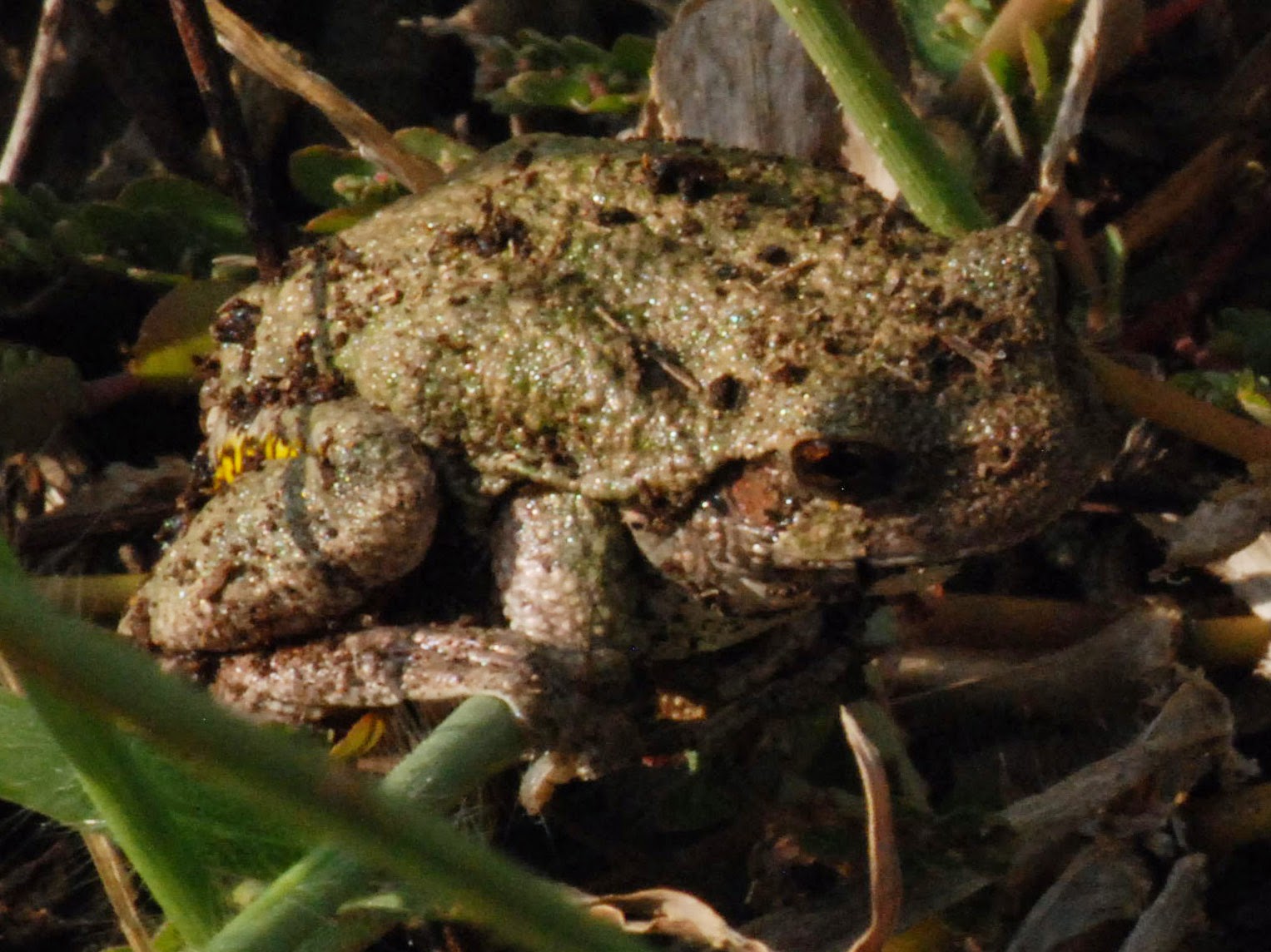
The animal was rather small and it wasn't warty enough for a toad, in my mind,  plus the shape was wrong, so I started thinking about the various kinds of frogs that it might be.  Meanwhile, of course, I took as many photos as I could without disturbing the animal or trying to pick it up.  When it hopped, it flashed the most vivid bright yellow on the lining of its hind legs...but that yellow was very hard to see when it was sitting still.  That HAD to be diagnostic.

Over dinner, I opened my copy of Amphibians, Reptiles, and Turtles in Kansas, by Joseph T. Collins, et al., and turned almost immediately to the page talking about Cope's Gray Treefrog (Hyla chrysoscelis) and Eastern Gray Treefrog (Hyla versicolor).  The two species are apparently only distinguishable from each other based on their chromosome number or the size of their blood cells, so I am simply calling this a Gray Treefrog (Hyla sp.).  Even based on the general natural history given, I'm perplexed - Cope's is said to be more arboreal than the Eastern, but to need less humidity in its environment.  Since we are at the absolute western end of this pair of species' range (and thus in the driest part of their range), but the individual was found under an old hay bale in the garden, I'm still split between the 2 options.

As of the writing of Amphibians, Reptiles, and Turtles in Kansas, which was copyrighted in 2010, the Gray Treefrog species complex was apparently expanding its range westward "along riparian corridors".  The species occurrence map shown in the book does not show any occurrences documented in Sedgwick County, but there are a few in the counties generally south and east of us.  It would seem that our individual may be one of the "pioneer" Gray Treefrogs, expanding their range west. So we may have a new county record!

This is the sort of find that brightens my week and makes me feel that we're on the right track in our land management decisions. 

Friday, July 26, 2013

Mystery Treefrog - A Stowaway?

As I was walking around my yard and gardens yesterday morning, I happened to notice this odd, little blob of gray-green on a clump of Spanish needles (Bidens bipinnata) that I've come to enjoy under my downspout.

Looking a little more closely, I realized that it was a treefrog.  So I took a photo, aiming for a side view so I could see its markings a little more clearly.

I've seen treefrogs like this before, so I didn't think much of it...

...until I tried to identify it this afternoon, so that I could include it in a post about yesterday's walkabout.  Things turned out to be a little more complicated than I expected.

None of the treefrog species were looking right when I compared my photos to the possibilities shown in the most recent Amphibians, Reptiles, and Turtles in Kansas.  So I took down a nationwide reference I had, The Frogs and Toads of North America, thinking that this might be a more southern species that had expanded its range a bit north with all our recent heat and the mild winter.

Well, even in that reference, the only species that looks even remotely similar is the Pine Barrens Treefrog, Hyla andersonii.  My little treefrog wasn't "similar" to a Pine Barrens Treefrog, he was a dead ringer for one.  According to the range maps shown in the above book, this species is found in 3 rather limited locations in our country:  southern New Jersey, the coastal plains of the Carolinas, and an area in the panhandle of Florida.

I presumably didn't think anything of seeing this little tree frog, because we lived down in Mobile, Alabama, for 6 years and have visited my brother in Pensacola, Florida, many times during that time and since then.  I must have seen this species at some point, or even many times, while we lived and/or visited down there.

But, we don't live down there now - and we haven't lived in the area for over 6 years.  Why am I seeing it in my yard, here and now?  Well, we haven't been to or received visitors from either New Jersey or the Carolinas in years and years...but, we WERE down visiting our daughter in Fort Walton Beach, Florida, at the end of May.  We didn't bring back any plant material or anything that I can think of that might have harbored a stowaway...except for our car itself.

The only explanation I can think of is that this little tree frog chose to sleep under our car, parked in front of Jess's home, when morning came on the day we were due to drive back to Kansas.  He must have been somewhere on the underside of our car (perhaps in a wheel well?) and came with us all the way back from Florida to Clearwater, Kansas.  That was a 17 hour drive, involving an overnight stay at a hotel - but here he is.

I haven't seen him since I took the photo although, truthfully, I haven't looked very hard.  Even I am not enough of a WEE (wild-eyed environmentalist) to drive him back to Florida, if I were to find him.  Nor can I imagine that he'd do too well being sent through the mail or by UPS.  I can't imagine that he'll survive the winter here.  Even if he does, there will be no mate to discover conjugal happiness with.  And even if, by chance, both Mr. and Mrs. Pine Barrens Treefrog made the trip together, I really can't imagine that the prairies of south central Kansas will provide a suitable habitat for this species to get established.

So I'm not too worried that I've unleashed biological Armageddon here.

However, this does highlight a very real problem that does occur with distressing frequency:  when we travel, insects and other small animals stowaway in our vehicles or anything else that accompanies us.  Serious pests can be  - and have been - accidentally brought into an area because of unintentional stowaways.  Right now plant people here in Kansas are keeping their eyes peeled for any sign of emerald ash borer, a small wood-boring beetle that kills basically all ash trees.  These beetles were unintentionally introduced from Asia into southeast Michigan in 2002 and have spread widely from there.  They were sighted in Johnson County, Kansas, just a couple months ago. 

Many other examples of biological stowaways creating big time havoc are well known:  zebra mussels, Dutch elm disease, and Japanese beetles, to name just a few.

We certainly didn't plan on bringing back any stowaways - and if I hadn't tried to identify this little treefrog, I would be blissfully unaware that we actually did - but that didn't keep it from happening.  I guess the moral here is to be careful and try not to translocate any wildlife when you travel...although that's obviously no guarantee that it won't happen anyway.