I can't decide if I'm blind or just too single focused....
Take this photo, for example. When I took the photo, I was focusing on the cicada that is positioned vertically on the green ash suckers and on the empty "shells" that are located above and to the right of it, one of which I presume it emerged from. ... Until I looked through my recent photos after downloading them to my computer (the next day), I literally didn't see the second cicada in this photo, located on the horizontal stem above and to the left of the first cicada. Of course, by then, both cicadas were long gone, so any chance to focus more tightly or to change my framing had disappeared along with them.
Luckily, in this case I did take this second photo, which gave me a little better look at the second cicada...
...and this third photo, which allowed me to incorporate another, newly emerged cicada I had noticed about a foot away, which you can see at the bottom left in this photo. The original one...er, two are at the top right.
How did I miss that third, newly emerged cicada?! I wish I knew, because then I might not miss other "minor details" as I'm out and about....
As I did in this next photo, which I took one night earlier this week....
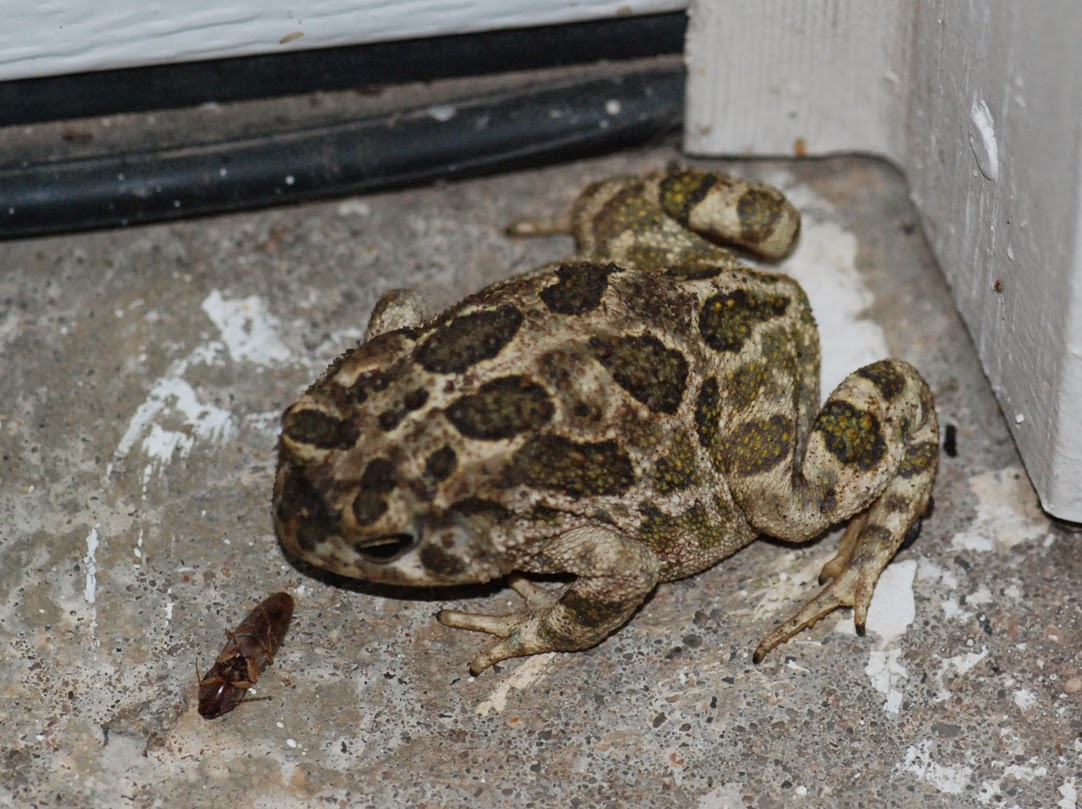
To explain, I'm seeing at least 4 different toads (I think) around the house this summer, but I've been wanting to verify if they are all the same species. This toad, which is the same size as one I'd seen earlier in the day, had different markings, so I wanted to catch a photo of it. I was so focused on the toad, however, that I totally missed the click beetle just in front of it on the ground. I don't recall seeing a click beetle of that size around here before, so I'm really curious as to what species it might be - but it, too, is long gone...although whether it flew away to live for another day or disappeared down the gullet of the toad, I'm not sure!
Oh,in case you're curious, this toad is a Great Plains Toad (Anaxyrus cognatus), while most of the others I see are Woodhouse's Toads (Anaxyrus woodhousii). I was right to notice the different pattern of spots.
Do you ever make discoveries of this sort in your photos, after you bring them up on your computer screen, or are you a good enough observer that this never happens to you? I'd sure love to hone my skills of observation enough that this quit happening! I wonder what else I'm missing when I'm NOT taking photographs?!
Showing posts with label Photography. Show all posts
Saturday, July 19, 2014
Monday, April 21, 2014
Lousy Photos Still Have Their Value
Having set myself the task, last year, of documenting all of the plants and animals that I can identify on our 10 acres, I have found myself overwhelmed with photos in short order now that spring has arrived.
It's MUCH easier to take photos of insects than it is to identify them. Just in case you wondered.
It's also much easier to take photos of insects than it is to take GOOD photos of insects - good photos being defined as photos where you have a snowball's chance of actually identifying the insect in question based on what you are seeing on the screen in front of you. I learned my basic insect identification skills the "good" old fashioned way, a.k.a. by capturing the insects and killing them, then identifying them at my leisure through the use of various magnifying devices and dichotomous keys.
I prefer trying to identify living insects in blurry photos, even if it means I won't get many of them actually identified. I'm just not into killing living beings of any sort, if I can avoid it. So here are a few of my so-so photos, some of which I've managed to identify and some of which are still mysteries to me....
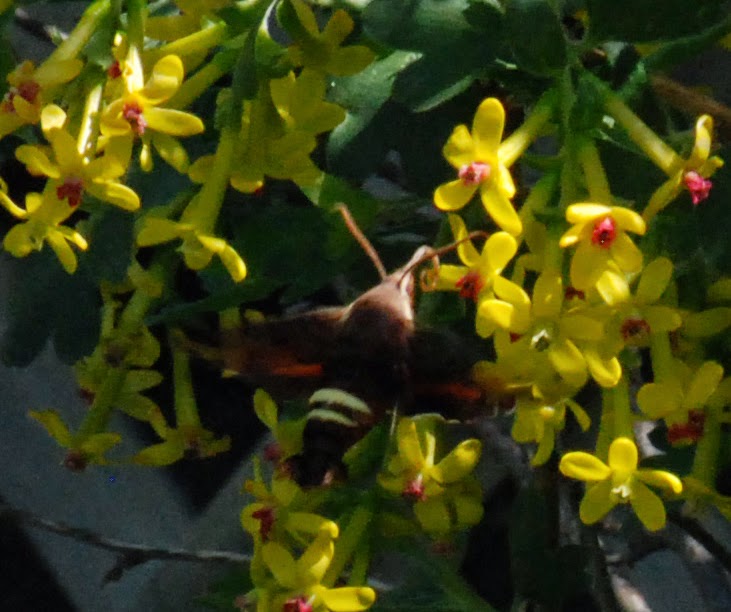
The clove currant (Ribes odoratum) is in sweet, full and glorious bloom right now. On Saturday, when I stopped by it, I noticed a dark hawk moth feeding. The wings blurred rusty brown as the moth moved from bloom to bloom, while the heavy abdomen had a tuft at its end and was encircled by 2 bright yellow bands. I'd never seen this particular hawk moth before, so I tried to take its picture, thinking I could identify it more accurately if I had a good photo. The blasted little beast was definitely camera shy and not very trusting of giant beings standing nearby with big black boxes stuck up near their face. It tended to keep to the far side of the plants, rather than venturing out into the open near to me.
Thank heavens for digital. Fifteen photos later, the moth flew away and I've not seen it since. When I checked out those 15 shots to see what I'd managed to capture, sadly this was the BEST image of the lot.
As lousy as this photo is, I was still able to use it to identify my "dark" hawk moth as a Nessus Sphinx Moth (Amphion floridensis). This species is supposedly one of the more commonly encountered day-flying moths, but I've never seen one before. The larvae/ caterpillars, which are a type of hornworm, feed on grape, Ampelopsis, and Capsicum (bell and hot pepper) plants, all of which are frequent in our yard.
Looking around under one of our green ash trees (Fraxinus pennsylvanica), I noticed some small, gnat-like creatures flying. When one came to rest within my sightline, I decided to snap its picture. Then I noticed a second one nearby. Snap. Snap. Snap. These little creatures were about 1/4" or 3/8" long, colored gray and sitting on gray bark. I have no idea why I thought I could get a good photo. Here's what I managed to capture, 26 photos later, ....
I didn't think this silhouette would show me much at first, but when I zoomed in, I noticed that the "big" fly had a small fly caught underneath it, held in a classic "I'm eating you" sort of position. When I showed it to Greg, he immediately thought the "big fly" was a robber fly of some sort. I can go with that.
Another shot of the same individual accidentally captured a second "big fly" just above it on the bark.
Do you see the 2 of them? The one in the bottom right of the photo is the one shown in silhouette above; the second one is in the top left of the photo. When I zoomed in on the second individual, it also seemed to have some sort of fly prey - with a yellow tipped abdomen - caught.
From the top, there's little evidence of "big fly #1" having prey captured beneath it, but the silhouette shot accidentally revealed the secret.
I haven't decided yet whether I'm going to try to submit these photos to Bug Guide or not - my feel is that they are not good enough for any sort of identification, but maybe I'll chance it anyway. I do think these are tiny robber flies and I'd love to see if anyone can tell me any more about them.
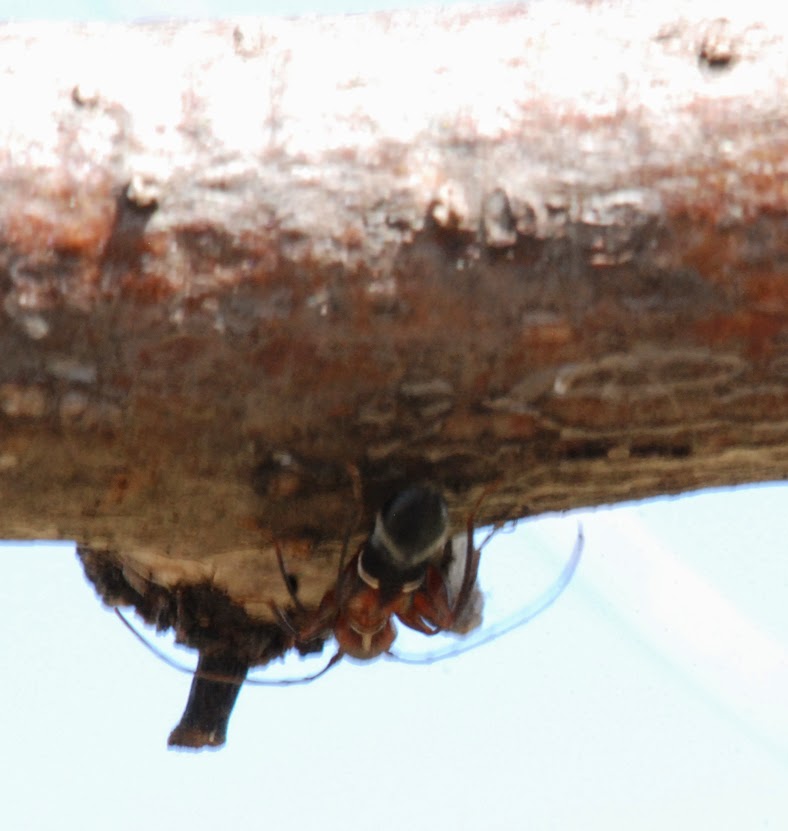
Another lousy picture that nonetheless taught me something new about the creatures in our yard was this one, taken Saturday of some sort of critter on the underside of a small honeylocust branch....
When I took the photo, I thought the mess of moving legs was perhaps an emerging wheel bug. As I took several more shots, I changed my mind to thinking I was looking at a brightly colored ant. As I took the very last picture, something clicked and made me think, "Beetle?" When I looked it up, sure enough, beetle was correct! This is an Antlike Longhorned Beetle (Euderces pini). The larvae of this beetle feed on dead wood in a variety of types of trees; the adults are typically seen nectaring at flowers. The adults mimic ants and are notoriously hard to photograph because they never quit moving. This is another insect that tops out around 3/8" long. As lousy as my photos of this creature are (and this is the best of the lot), I feel lucky that I got a couple shots that allowed me to identify it at all.
As you can tell, I've got a LO-O-O-ONG way to go before I get very decent at taking good insect photos, but I do have fun and I learn a lot, even at the level of (in)competence that I have attained. The natural world seems more wondrous every day.
It's MUCH easier to take photos of insects than it is to identify them. Just in case you wondered.
It's also much easier to take photos of insects than it is to take GOOD photos of insects - good photos being defined as photos where you have a snowball's chance of actually identifying the insect in question based on what you are seeing on the screen in front of you. I learned my basic insect identification skills the "good" old fashioned way, a.k.a. by capturing the insects and killing them, then identifying them at my leisure through the use of various magnifying devices and dichotomous keys.
I prefer trying to identify living insects in blurry photos, even if it means I won't get many of them actually identified. I'm just not into killing living beings of any sort, if I can avoid it. So here are a few of my so-so photos, some of which I've managed to identify and some of which are still mysteries to me....
The clove currant (Ribes odoratum) is in sweet, full and glorious bloom right now. On Saturday, when I stopped by it, I noticed a dark hawk moth feeding. The wings blurred rusty brown as the moth moved from bloom to bloom, while the heavy abdomen had a tuft at its end and was encircled by 2 bright yellow bands. I'd never seen this particular hawk moth before, so I tried to take its picture, thinking I could identify it more accurately if I had a good photo. The blasted little beast was definitely camera shy and not very trusting of giant beings standing nearby with big black boxes stuck up near their face. It tended to keep to the far side of the plants, rather than venturing out into the open near to me.
Thank heavens for digital. Fifteen photos later, the moth flew away and I've not seen it since. When I checked out those 15 shots to see what I'd managed to capture, sadly this was the BEST image of the lot.
As lousy as this photo is, I was still able to use it to identify my "dark" hawk moth as a Nessus Sphinx Moth (Amphion floridensis). This species is supposedly one of the more commonly encountered day-flying moths, but I've never seen one before. The larvae/ caterpillars, which are a type of hornworm, feed on grape, Ampelopsis, and Capsicum (bell and hot pepper) plants, all of which are frequent in our yard.
Looking around under one of our green ash trees (Fraxinus pennsylvanica), I noticed some small, gnat-like creatures flying. When one came to rest within my sightline, I decided to snap its picture. Then I noticed a second one nearby. Snap. Snap. Snap. These little creatures were about 1/4" or 3/8" long, colored gray and sitting on gray bark. I have no idea why I thought I could get a good photo. Here's what I managed to capture, 26 photos later, ....
I didn't think this silhouette would show me much at first, but when I zoomed in, I noticed that the "big" fly had a small fly caught underneath it, held in a classic "I'm eating you" sort of position. When I showed it to Greg, he immediately thought the "big fly" was a robber fly of some sort. I can go with that.
Another shot of the same individual accidentally captured a second "big fly" just above it on the bark.
Do you see the 2 of them? The one in the bottom right of the photo is the one shown in silhouette above; the second one is in the top left of the photo. When I zoomed in on the second individual, it also seemed to have some sort of fly prey - with a yellow tipped abdomen - caught.
From the top, there's little evidence of "big fly #1" having prey captured beneath it, but the silhouette shot accidentally revealed the secret.
I haven't decided yet whether I'm going to try to submit these photos to Bug Guide or not - my feel is that they are not good enough for any sort of identification, but maybe I'll chance it anyway. I do think these are tiny robber flies and I'd love to see if anyone can tell me any more about them.
Another lousy picture that nonetheless taught me something new about the creatures in our yard was this one, taken Saturday of some sort of critter on the underside of a small honeylocust branch....
When I took the photo, I thought the mess of moving legs was perhaps an emerging wheel bug. As I took several more shots, I changed my mind to thinking I was looking at a brightly colored ant. As I took the very last picture, something clicked and made me think, "Beetle?" When I looked it up, sure enough, beetle was correct! This is an Antlike Longhorned Beetle (Euderces pini). The larvae of this beetle feed on dead wood in a variety of types of trees; the adults are typically seen nectaring at flowers. The adults mimic ants and are notoriously hard to photograph because they never quit moving. This is another insect that tops out around 3/8" long. As lousy as my photos of this creature are (and this is the best of the lot), I feel lucky that I got a couple shots that allowed me to identify it at all.
As you can tell, I've got a LO-O-O-ONG way to go before I get very decent at taking good insect photos, but I do have fun and I learn a lot, even at the level of (in)competence that I have attained. The natural world seems more wondrous every day.
Labels:
beetles,
Biodiversity,
Flies,
Moths,
native plants,
Organic Gardening,
Photography,
Robber flies,
Trees,
Web of Life
Thursday, April 11, 2013
Facing Into the Sun
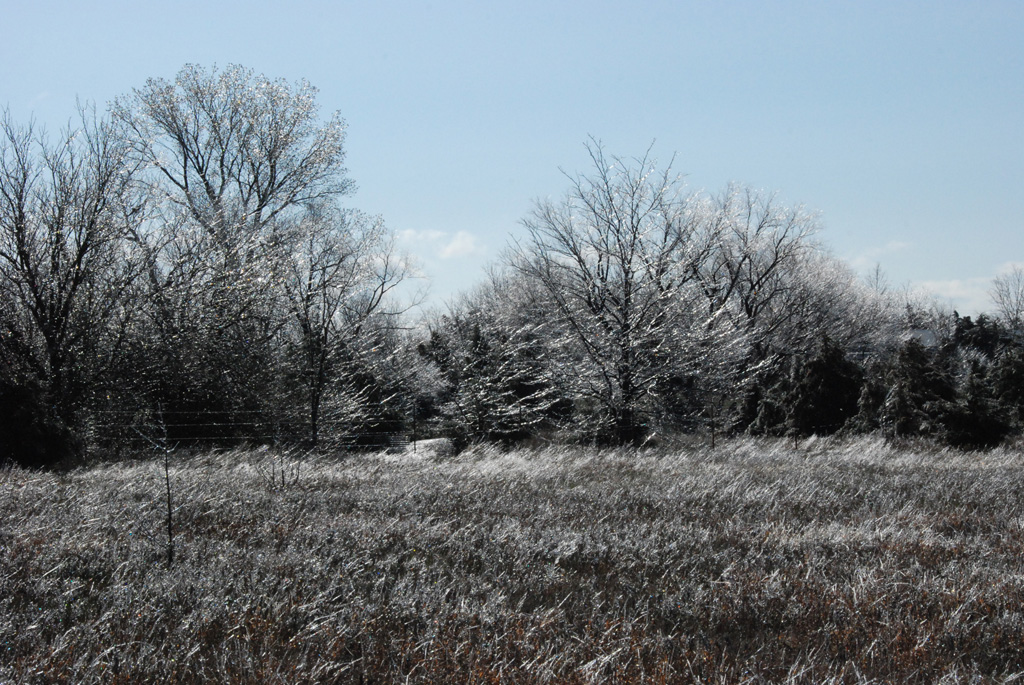
This morning's exercise in photography - trying to capture the beauty of a world encased in ice - provided a philosophical lesson as well as an artistic one: sometimes the only way to see the real truth of a situation is to look directly into the light.
Looking directly at the light can be painful. In fact, it can be blinding. Done correctly, though, it can show us exactly what's going on.
Looking away from the light can be misleading, making us miss the reality of a situation. The above two photos were taken less than a minute apart, simply by changing the direction that I was aiming the camera. The first picture shows the reality of the ice coating everything. The second photo looks basically normal - you have to look hard to see any evidence that anything is different from a regular spring day.
Moving from ice storms to a broader view of life, this metaphor works well for a "controversial" issue facing our society today: climate change. Truly, there is no scientific controversy concerning this issue. The scientific community is shining the light of their research and knowledge, showing us the reality of climate change. However, too many people are turning away from the information the scientists are providing because it hurts - and, truthfully, it's pretty scary too.
Looking away from the sun this morning, I could hardly tell this wasn't a perfect spring morning but, looking towards the light of the day, I could see that there was a hard layer that was affecting everything.
The Union of Concerned Scientists has been addressing the issue of climate change for some time. Here is an article they shared on Facebook this morning, giving a specific example of how the truth about climate change is being hidden for political reasons: What South Carolinians Deserve to Know About Climate Change.
The National Center for Science Education is another group that has picked up the job of getting scientific information about climate change into the public arena. They, too, had a good article that they shared this morning addressing the issue of climate change, A Denver TV Meteorologist...in His Own Words. This article was actually originally posted by The Yale Forum on Climate Change & The Media.
There are many other groups and individuals trying to share scientific facts, as well as the predictions based upon those facts and upon the best scientific knowledge we currently have about how our Earth's atmosphere works.
There are also those groups and individuals who are afraid they will lose a great deal of economic and political power if climate change is acknowledged and if, as a country, we start to work to keep the worst of those scientific predictions from occurring. Because these latter folks currently DO have a great deal of economic and political power - and money - their views are getting much more attention than they should.
Too many people are looking away from the light of knowledge, into the "pretty picture" that distorts the reality of the situation.
On this issue, as on so many other issues, be very careful where you get your "knowledge". All information is not created equal. Even if it hurts and is frightening, we all need to look at the world through the best light we have available to us, instead of turning our backs to the truth.
Looking directly at the light can be painful. In fact, it can be blinding. Done correctly, though, it can show us exactly what's going on.
Looking away from the light can be misleading, making us miss the reality of a situation. The above two photos were taken less than a minute apart, simply by changing the direction that I was aiming the camera. The first picture shows the reality of the ice coating everything. The second photo looks basically normal - you have to look hard to see any evidence that anything is different from a regular spring day.
Moving from ice storms to a broader view of life, this metaphor works well for a "controversial" issue facing our society today: climate change. Truly, there is no scientific controversy concerning this issue. The scientific community is shining the light of their research and knowledge, showing us the reality of climate change. However, too many people are turning away from the information the scientists are providing because it hurts - and, truthfully, it's pretty scary too.
Looking away from the sun this morning, I could hardly tell this wasn't a perfect spring morning but, looking towards the light of the day, I could see that there was a hard layer that was affecting everything.
The Union of Concerned Scientists has been addressing the issue of climate change for some time. Here is an article they shared on Facebook this morning, giving a specific example of how the truth about climate change is being hidden for political reasons: What South Carolinians Deserve to Know About Climate Change.
The National Center for Science Education is another group that has picked up the job of getting scientific information about climate change into the public arena. They, too, had a good article that they shared this morning addressing the issue of climate change, A Denver TV Meteorologist...in His Own Words. This article was actually originally posted by The Yale Forum on Climate Change & The Media.
There are many other groups and individuals trying to share scientific facts, as well as the predictions based upon those facts and upon the best scientific knowledge we currently have about how our Earth's atmosphere works.
There are also those groups and individuals who are afraid they will lose a great deal of economic and political power if climate change is acknowledged and if, as a country, we start to work to keep the worst of those scientific predictions from occurring. Because these latter folks currently DO have a great deal of economic and political power - and money - their views are getting much more attention than they should.
Too many people are looking away from the light of knowledge, into the "pretty picture" that distorts the reality of the situation.
On this issue, as on so many other issues, be very careful where you get your "knowledge". All information is not created equal. Even if it hurts and is frightening, we all need to look at the world through the best light we have available to us, instead of turning our backs to the truth.
Subscribe to:
Posts (Atom)