Showing posts with label beetles. Show all posts

Monday, March 17, 2025

The Life in Dead Wood

In my last post, Dead Wood in the Landscape, I shared the biological benefits of leaving dead wood in our gardens and landscapes.  In this post, I want to get more specific, describiing a sampling of the species that we see in our yard BECAUSE we have left dead wood where we can.

Before I start, I want to share a quote with you from Peter Wohlleben.   In The Hidden Life of Trees, The Illustrated Edition, he writes of a tree that suddenly dies, "For centuries, the tree sucked nutrients from the ground and stored them in its wood and bark.  And now it is a precious resource for its children.  But they don't have direct access to the delicacies contained in their dead parents. To access them, the youngsters need the help of other organisms.  As soon as the snapped trunk hits the ground, the tree and its root system become the site of a culinary relay race for thousands of species of fungi and insects.  Each is specialized for a particular stage of the decomposition process and for a particular part of the tree.  And this is why these species can never pose a danger to a living tree--it would be much too fresh for them.  Soft, woody fibers and moist, moldy cells--these are the things they find delicious. ... In total, a fifth of the animal and plant species in Central European forests--that's about six thousand of the species we know about--depend on dead wood." (p. 78-81)

That same general richness of species depends on dead wood all over the world.  Let's look at some of the ones I see in our yard, here in the eastern deciduous forest of North America.....

Pileated Woodpeckers could serve as the charismatic poster child for an animal that needs dead wood to have a healthy habitat.  These big, beautiful woodpeckers not only nest in dead trees, but they obtain a large portion of their food in dead wood.  Their diet is primarily made up of carpenter ants, along with wood-boring beetle larvae, termites, assorted other insects, and sometimes fruits and nuts.

Pileated Woodpecker foraging on downed wood along the paths
April 26, 2023

Although Pileated Woodpeckers are fairly wary, it is not unusual for us to see them foraging on the dead wood in our yard.  Getting decent photos can be a lot trickier, though, than simply seeing them!

Other woodpeckers use dead wood, too.  Downy Woodpeckers, Red-bellied Woodpeckers, Hairy Woodpeckers, and Northern Flickers all nest in dead wood, sometimes in dead branches in living trees.  Several of these species will also nest in living trees that are infected with heart rot fungus.

Every summer we see juvenile Red-bellied Woodpeckers, 
which means that their parents were able to build a successful nest
in dead wood somewhere nearby.
June 5, 2022

Mom is feeding her daughter (on the left).
We see juvenile Downy Woodpeckers every year 
because they've been able to successfully build their nest
in a large dead branch nearby.
May 22, 2022

One year we even had this beautiful adult Red-headed Woodpecker stop by,
another species that nests in dead wood.
June 20, 2022

Woodpecker nest holes are frequently reused as nest sites by other cavity nesting birds such as Bluebirds, Great-crested flycatchers, Chickadees, Tufted Titmice, Screech Owls, White-breasted Nuthatches, Wrens, Swallows, and even Wood Ducks.  During cold weather, woodpecker nests are often used as roosting sites for protection from the temperatures.

Birds aren't the only animals that reuse woodpecker nest holes. Squirrels, Flying Squirrels, even some species of bats will use these valuable spaces for nesting or winter shelter.

Skinks love to use the logs in our yard as basking sites and as pathways. As I shared in my last post, one pair nested in the rotting roots of the dead black gum tree.

An immature and a mature male Broad-headed Skink
using logs as a basking site and pathway.
May 18, 2023

I haven't found any in our yard yet, but many salamander species are found under or in rotting wood, too.

Many, many insect species spend at least part of their life cycle in dead wood.  (Note:  these insects use dead wood, not living wood, as the fibers are softer and decomposition is already occurring in the dead wood.)

Many beetle species lay their eggs in snags, logs, or dead branches and their larvae eat the decaying wood, then pupate there, all safely protected from prying eyes.  Protected from prying eyes...but not from woodpecker bills and tongues!  Beetle larvae are prime woodpecker food, and the woodpeckers help keep the beetle populations balanced and under control.

Last year I noticed a big jump in beetles feeding at and pollinating flowers in our yard.  It turns out that most of the new species I saw have larval stages that develop in dead wood.  One of my favorites is the uniquely marked Delta Flower Scarab (Trigonopeltastes delta).  I also saw Tumbling Flower Beetles (Mordella sp.) and Emerald Flower Scarabs (Trichiotinus lunulatus).

A Delta Flower Scarab on Meadowsweet (Spiraea alba)
June 11, 2024

An Emerald Flower Scarab and a Tumbling Flower Beetle
on Meadowsweet (Spiraea alba)
June 8, 2024

There are several species of flower longhorn beetles that showed up last year, too, all of whom spend their larval stage in dead wood:  Slender Flower Longhorns ((Strangalia famelica), Red-winged Longhorn Beetles (Brachyleptura rubrica), and Red-shouldered Flower Longhorns (Brachyleptura vagans).

Slender Flower Longhorn on Meadowsweet (Spiraea alba)
June 5, 2024

Red-winged Longhorn Beetle on Meadowsweet (Spiraea alba)
June 5, 2024

Red-shouldered Flower Longhorn on Meadowsweet (Spiraea alba)
June 11, 2024

The larvae of these species are some of insects that woodpeckers and other animals are eating when they feed on snags or logs.

It's not just woodpeckers that prey on beetle grubs, though.  There are other beetle species whose larvae are predators on the wood-boring beetle larvae.  An example of a beetle species with predatory larvae is the Eyed Click Beetle (Alaus oculatus).   

Eyed Click Beetle, whose larvae are predators on the larvae of wood-boring beetles
July 14, 2020

There are also parasitoid wasps that specialize in using the wood-boring beetle larvae as hosts for their developing larvae, including the species pictured below which specializes in laying its eggs in longhorn beetle larvae.  That long ovipositor is designed to pierce decaying wood to reach the beetle larva and lay an egg on it.

An Ichneumon Wasp (Spilopteron occiputale) that lays its eggs
in the larvae of longhorn beetle larvae.
July 2, 2024

Then there are yet other beetles whose larvae develop in dead wood, beetles like False Mealworm Beetles (Alobates pensylvanicus) who are predatory on other insects, or like Horned Passalus Beetles (Odontotaenius disjunctus), who live in small colonies in dead wood and whose adults feed their larvae pre-chewed rotting wood.

False Mealworm Beetle that was living under the bark
in the dead black gum trunk.
August 11, 2023

Horned Passalus Beetle, a species that lives in colonies in dead wood.
June 30, 2022

About 30% of the solitary native bees nest in places like stems or in beetle larvae tunnels in dead wood.  Pure Green Sweat Bees (Augochlora pura) are one of the species that I see in the yard that use beetle galleries in dead wood for their nests and whose fertilized females overwinter under logs.  Seeing these jewel-like pollinators gives me a real lift. 

Pure Green Sweat Bee on Wrinkle-leaf Goldenrod (Solidago rugosa)
October 13, 2023

Eastern Carpenter Bees (Xylocopa virginica), who are fabulous pollinators, excavate their own tunnels in dead wood to use as nest sites.  It's disconcerting to have Eastern Carpenter Bees use a railing or the eave of a house, but they naturally use dead wood in the landscape for their tunnels.  Keeping your wood surfaces well painted can encourage these guys to nest elsewhere.

Eastern Carpenter Bee on
Hairy Elephant's Foot (Elephantopus tomentosus)
August 20, 2023

I really dislike disturbing animals, so I haven't actually broken into or looked under the dead wood, standing or downed, to see what animals I can find by direct observation.  Someday I may.  Meanwhile, throughout the year, I'm enjoying the various species that I see specifically because we have logs and snags in our yard.

I've talked about some of the animals we see in our yard because of dead wood, but there are many fungi, mosses, and lichens we see for the same reason and it's been fascinating to see how many there actually are.  I know little about fungi, so I can't identify most of these, but I still enjoy looking at them.  Learning more about them is definitely on my "to do" list.

The first photo is of a slime mold rather than a fungus.  Slime molds are unique, with some characteristics of fungi and some characteristics, believe it or not, of animals.  I've only seen these "chocolate pom-poms" once, on a decaying stump, but when I looked them up, they are a well known species called Chocolate Tube Slime Mold (Stemonitis splendens).  Although some slime molds can look gross, they are decomposers and are not dangerous.  They disappear when environmental conditions change.

These "chocolate pom-poms" are actually Chocolate Tube Slime Mold
June 19, 2023

On that same stump, about 10 months before the Chocolate Tube Slime Mold appeared, I found a fungus known as Black-staining Polypore (Meripilus sumstinei).  This cluster was young, and I find it very elegant looking, especially from the side.  This species is considered edible, but I'm not good enough at identification to take a chance on eating it.

Black-staining Polypore
August 21, 2022

The same clump of mushrooms, Black-staining Polypore,
photographed from the top.
August 21, 2022

I have no idea what species this fungus is, but I love the lacy texture. Note the bit of lichen at its base.

Unknown lacy fungus with lichen at its base,
found on a dead hardwood branch.
August 8, 2024

To myself, I call the round clusters of fungal structures that are found in the next photo, "fungal roses".  That is, you understand, a totally unscientific name but they remind me of the paper flowers that I used to make when I wanted a pop of color on a table or bookcase. As with the fungus above, I do not know the name of this species.

"Fungal rose" on log
May 29, 2023

I'm including this last photo as much for the moss as for the fungus.  This is another fungus for which I do not know the name, nor do I know the name of the moss, but they both were growing on the same stump where I found the Chocolate Tube Slime Mold and the Black-staining Polypore cluster.  Moss and lichen are both frequently found on dead wood.

"Prickly fungus" in a bed of moss
on a stump by our driveway.
October 25, 2023

When we remove dead wood from the landscape, we are effectively starving the ecosystem.

Why do we instinctively feel that dead wood needs to be removed? Well, probably at least in part because it's "dead" and we generally don't like to be reminded of death as a part of life.  In our phobia about death, we've trained ourselves to think that any dead plant material is "ugly" - and ugly things need to be removed from our surroundings. 

However, dead wood isn't ugly, and it's chock full of nutrients that will feed a broad range of other life forms, including other trees.  Scientists have learned that even dead limbs shed by trees actually decompose into extra food that ends up feeding the tree from which they fell.  If the tree is stressed, shedding limbs can reduce the amount of living tissue it has to support during the stressful time as well as give it that boost of energy and nutrition as the dead wood decomposes.

In Victorian times, "stumperies" became popular in gardens - think of a rock garden, but using stumps and dead wood instead of rocks. Stumperies are making a comeback in some gardens and can be very attractively planted, benefitting both human aesthetic sensibilities and ecological needs.

In whatever way works for your garden aesthetic, I hope that you'll seriously consider adding a snag or some logs to your garden.  In doing so, you'll be adding important habitat for a wide variety of species.


Sunday, February 10, 2019

Insects Using Gaillardia in My Gardens

Another staple of my (native) pollinator plants is Indian blanket or Gaillardia, Gaillardia pulchella to be precise.   This widespread, short-lived perennial blooms for months and months;  the colorful blossoms almost always seem to have some sort of insect on them. 

Interestingly, though, as I went through my photos, the variety of insects utilizing Gaillardia was not as great as it was for fogfruit.  For 2018, I have photos of only 6 different species using Gaillardia in my gardens. 

By far the most frequent visitor to my Indian blanket flowers was Poey's Furrow Bee (Halictus poeyi), one of the small, somewhat nondescript, native bees. 

I saw this little bee a lot, from early June through the end of October, and it could well have been present before or after I have it documented photographically.  As I understand it, the hook on the back, lower corner of the head, which you can see in this photo, is "diagnostic" of this species.  Even in photographs, though, it can be hard to see this feature due to the diminutive size of this bee and the fact that it tends to round its back and tuck its head a bit as it feeds.

This is typical of what I usually see, even through the camera lens, when looking at Poey's Furrow Bee.

Throughout the summer months, the Brown-winged Striped Sweat Bees (Agapostemon splendens) visited regularly.  I love these vivid little green jewels.  The females are solid green, while the males have black and yellow striped abdomens and a green "jacket" on the thorax. 

In the photo above, the male is probably more interested in the female than in the flower.

Here is a closer view of a different female, giving you a bit more of a feel for the vivid coloration of these little sweethearts.  What a disappointment the common name of this bee is - "Brown-Winged Striped Sweat Bee".  The "A. splendens" of the Latin name much more closely describes how I feel about them!

An insect that I've seen on several different plants around the yard, this Camouflaged Looper, a.k.a. the caterpillar of the Wavy Emerald Moth (Synchlora aerata), looks a bit different depending on which bloom it's raiding for its wardrobe.

What looks like a large, brightly colored piece of debris hanging from the underside of the flower is, in fact, the caterpillar with bits of petal attached.   

Yes, the bloom this little guy raided looks rather tattered, but I personally think it's well worth the less than perfect blossom to see how the flower finery has been used!  In 2018, I photographed camouflaged loopers on Gaillardia blooms on June 23 and again on August 5.

Getting back to native bees, one of my favorite groups is the leafcutter bees.   Females in this group are easy to recognize because they carry pollen in hairs on the underside of their abdomen, giving them a potbellied appearance.
This cute little female (Megachile sp.) demonstrates that trait perfectly.

The only insect I photographed utilizing something besides the bloom of Gaillardia was this paper wasp, which I saw on July 18th.

Truthfully, I don't know if I just didn't notice other insects on the stems and leaves, or if few insects actually utilize the foliage of this plant.

The final insect in my Gaillardia roundup is this flower beetle, the Pygmy Chafer (Strigoderma pygmaea).


In conclusion, I enjoy having Gaillardia in my gardens a lot, finding that it brings in a reasonable number of insects and provides a nice pop of color throughout most of the growing season.  Loving full sun and tolerating pretty dry conditions, it's usually very easy to grow.  The only downside I've found to Gaillardia pulchella is that each individual plant lasts for 2-3 years at most.  It will reseed a bit and, if I watch for seedlings, I can usually keep it as a garden presence without having to buy it again each year.  If you live within its (wide) native range, I'd definitely recommend it for your pollinator garden.

Friday, July 27, 2018

This Week in Pest-Controlling and Pollinating Wasps

While I'd love to be seeing more insect life in our yard, I have to admit that I AM seeing some interesting insects - including a few that are totally new to me.  So I thought it would be fun to share what I'm seeing as well as the blooms that are bringing them in.

How to organize this????  By day?  By bloom?  By type of insect?  I'll just have to see what flows best.....

I started out to make this post an overview of all the pollinators I've seen over the week, but it quickly became apparent that would be overwhelming, so I decided to focus this post just on wasps.

Wasps have been quite prominent recently, especially solitary wasps.  Last Friday, July 20th, was when I first noticed some unusual ones -3 in a row, in fact, over the course of about 10 minutes, on the clustered mountain mint (Pycnanthemum muticum).

The first was a large scarab hunter wasp that has no common name so I've nicknamed it the fuzzy scarab hunter wasp (Campsomeris plumipes).  Like other scarab hunters, this wasp flies low above the ground, searching for (buried) scarab beetle larvae, a.k.a. beetle grubs.  When she finds one, she digs down to it, paralyzes it, lays an egg on it, and flies away.  The egg hatches out and the wasp larva consumes the beetle grub.  One wasp egg on one beetle grub, so every one of these you see means that a scarab beetle of some sort - say a June bug or green June beetle - didn't make it to adulthood.

As you can see, the adult wasp actually eats nectar to sustain itself, as is true for most of these solitary wasps.  Also as solitary wasps, they are not aggressive and they will not sting unless you actively try to handle them or they get caught in your clothing, stepped on in bare feet, etc.  You can assume this is true for all solitary wasps unless someone mentions otherwise.  It's a nice change from the more problematic social wasps.

As an aside, all the solitary wasps I'm familiar with have only one generation each year, so if you take them out (for example, by spraying insecticides), it may be several years before their population numbers can rebuild by migrating in from surrounding areas.  Given how well they function as both pollinators and, probably more importantly, as pest control, that would seem to be extremely short sighted to me.

Back to my magic 10 minutes by the mountain mint, the next insect to fly in, while I was photographing the fuzzy scarab hunter wasp, was the great golden digger wasp (Sphex ichneumoneus).  This is a species I've seen before, both here and in Kansas, and I love its fiery color and large size.  You just can't mistake this distinctive wasp with its red legs and black-tipped red abdomen for any other species.  Look, too, at the golden glow created by the gold hair on its head and thorax.  That's something you almost have to take a picture of to appreciate, although I've seen it highlighted occasionally as one of these beauties nectars. 

Another solitary wasp, great golden digger wasps hunt for and paralyze grasshoppers and crickets as food for their larvae.  The female digs a burrow in sandy soil, with a central, almost vertical, main burrow and individual cells radiating out from this primary burrow.  She places one paralyzed grasshopper or cricket in each cell, lays an egg on it, then seals up the cell.

As I was finishing up my "photo session" with the great golden digger wasp and taking a few last photos of the fuzzy scarab hunter wasp, I noticed more movement in the air space around the mountain mint - a thread waisted wasp had come in to feed, too. 

This rather bizarre looking wasp not only held its abdomen up at a strange angle as it flew, but the sun caught metallic glimmers of color on its otherwise black body and wings.  Researching on BugGuide.net, I identified this species as Eremnophila aureonotata.  Again there is no common name, so I've nicknamed it the gold-marked thread-waisted wasp, "aureonotata" meaning "gold-marked" in Latin.  This solitary wasp species feeds its larvae on a wide variety of (paralyzed) moth caterpillars, utilizing a burrow in the ground, as far as I can tell.

So, according to the time stamps on my photos, in just over 10 minutes my mountain mint had nurtured predators working to control beetle grubs, grasshoppers and mole crickets, and moth caterpillars in my gardens.  Not too shabby!!!  And it didn't cost me a dime beyond the initial cost of a very pretty perennial plant.

I've seen a couple other wasps this week, too.  One I've been seeing frequently for several weeks now is less than half the size of the big guys above.  It's a cute little black mason wasp with 2 white stripes on its abdomen (Euodynerus sp.).  When I grabbed its picture above, I think it was hunting for caterpillars among the ferns.  Again, there is no common name for this wasp, so my description above ("cute little black mason wasp") will have to suffice.  Mason and potter wasps feed their larvae primarily on moth caterpillars, although some species also use the larvae of leaf-eating beetles.  If you see smallish wasps using mud to fill up small holes (for example in brick, where your hurricane shutters have gone up in the past), it may well be one of these mason wasps.  They build cells out of mud in hollow tubes, provisioning each cell with a paralyzed caterpillar or beetle larvae on which they lay an egg before closing up the cell and moving on. 

Do you sense a pattern among the solitary wasps here?! They've found a good gig in paralyzing prey to keep it fresh for their young to eat after hatching, then tweaked the process in a myriad of different ways so that each species has its own spin...and ecological niche.

I've seen these little black and white mason wasps nectaring on blossoms as well as hunting in my gardens.  I've found small holes filled with dried mud, which I presume are their nest cells.  These are enjoyable little creatures for me to notice as I go out and about weeding, planting, transplanting, watering, and photographing.  Just in the last week I have photographs of this species hunting in these ferns, shown above, as well as in camphorweed and in and out of leaves and mulch at the base of phlox and lyreleaf sage.  Front yard, back yard.  Sun, shade.  This little wasp is a "busy bee" in its work habits.

At the other end of the size spectrum from the cute little mason wasp is the gigantic 4-spotted scarab hunter wasp (Campsomeris quadrimaculata) that I've seen a couple times now.  Boy, am I ever glad that these guys aren't at all aggressive, because they are HUGE and they give me pause even though I know they won't bother me.  The photo above shows this big black beauty all coated with pollen from nectaring at maypop flowers (Passiflora incarnata).

Here is a photo I took about 2 weeks ago of a "clean" 4 spotted scarab hunter wasp, nectaring on sweet pepperbush blooms (Clethra alnifolia).   See how much pollen the individual nectaring at the passion vine is wearing in comparison?!  That's what I call a pollinator!

For the sake of clarity, again I've made up a nickname for this wasp as, again, it has not been given an official common name.  Its specific Latin name, "quadrimaculata", means "4-spotted", while the entire genus is known as scarab hunter wasps, hence the "4-spotted scarab hunter wasp".   This is another great predator in the garden, paralyzing and laying eggs in scarab beetle grubs.

Big and little, I've got wasps sharing my gardens that are making life easier - and much more interesting - for me.  I used to hate wasps, but now I smile whenever I see one.  I hope you're seeing some great solitary wasps in your gardens, too.


Wednesday, October 22, 2014

Another Worry for Cicadas: Cedar Beetles

Kermit the Frog always said, "It's not easy being green."  Well, I've decided that it's not easy being a cicada either.

My dogs absolutely love to munch cicadas and have been known to catch them in mid-air.  If they find one on the ground, they'll often hold it in their mouth for a little bit to get it to buzz before they chomp down and eat it.  A canine "Fizzy", I guess.

Then there are more "normal" predators like birds and, especially, the huge wasps known as cicada killers.  Female cicada killers hunt down a cicada, sting it to paralyze it (but keep it alive), drag it back to their nest in the ground, carry it below ground, lay an egg on it and seal the brood cell off.  When the egg hatches, the larval wasp eats out the paralyzed, living cicada, pupates, and emerges the next year to repeat the cycle.  An effective population control mechanism for cicadas, although it's extremely unsettling to think about.

I suspect that moles eat a fair number of cicada nymphs, too, as the nymphs feed and mature underground.

Now, I've learned about another animal that feasts on cicadas, specifically on the nymphs while they are still underground - the cedar beetle, Sandalus niger, also descriptively known as the cicada parasite beetle.  I've been observing these large beetles all around the yard over the last few days.  Most often, I'm seeing them on honeylocust trees.


These are fairly large beetles - many are close to an inch in length.  I first noticed one when I saw a big brown beetle being eating by 2 wheelbugs.  I've never seen TWO wheelbugs eating the same beetle before!  I took photos and tried to identify the beetle, but I couldn't quite make it out.  It looked somewhat like a longhorn beetle, but I didn't see long "horns" (antennae) on it.

While I was photographing this interesting vignette, Greg called me over to a nearby lacebark elm, saying that he'd just seen a big black beetle fly into it.  He showed me where she had landed and I took several photos of her;  she appeared to be laying eggs on the underside of a dead limb.

I started to go back to taking photos of pollinators on asters, when I felt something on my shoulder.  Looking down, it was a large black beetle with one of the elytra (thickened wing covers) missing.  I brushed her to the ground, where I photographed her, wondering how she had lost her elytra.  Then I picked her up and put her in the elm tree, thinking she probably got interrupted during egg laying.

Only when I edited the photographs this evening did I notice that all the white "innards" showing were actually larvae(?) or pupae(?) of some other insect that were massed inside her.  I have no idea what they are...but I'm submitting the photo to BugGuide to see if anyone there can help identify what was going on with her.  (Parasites eating parasites.  Sometimes the natural world is really complex in its creepiness.)  Did the larvae have anything to do with how she lost her wing cover?  I have no idea.

Next, I noticed another, similar looking beetle being eaten by a wheelbug on a nearby honeylocust trunk.  As I stood and took photos, I heard and felt yet another big beetle - the 5th one - fly by my head.  It was a male, judging by its smaller size and more slender body, and it landed on the tree trunk right in front of me and starting searching all around.  Its antennae were really interesting, especially when the beetle fanned them all the way out.

While all of these beetles were grabbing my attention, I was also hearing a clicking noise that sounded very much like the rhythmic pattern of a field sparrow, which is often likened to the sound of a bouncing ball.  This noise, however, was more "insect-like" than a bird call, if there is such a thing.  I never did find out what was creating the sound, but I don't recall having heard it before and I wonder if it was some sort of mating call between the cedar beetles.

Before I went in for the evening, I took several more photos of each of the different beetles I'd observed, and  I also found a 6th beetle on the underside of a honeylocust branch. This was another female, based on the size and shape, but I didn't get any clear photos of her.

Looking through Insects in Kansas, by Glenn A. Salsbury and Stephan C. White, I found the tentative identification of my beetles, which I confirmed on BugGuide.net.   They were all the same species, Sandalus niger.  Insects in Kansas had noted that males often had blackish-brown wing-covers, rather than black, and on BugGuide, I saw the difference in antennae between the males and females.  There wasn't a lot of information given about the species on its information page at BugGuide, but it was noted that the adult beetles are very short-lived.

I've gone back and picked up the "empty" beetles discarded by the wheelbugs after they were through eating them so that I could examine them more closely, plus I've been able to find a couple more dead specimens.  Sunday, October 19th, was the only day that I saw so many living individuals, although I've seen one or two more each day since then.  I have not heard the clicking noise again.

I have seen one more instance where two wheelbugs were eating the same cedar beetle.  Do wheelbugs do this with any large insect, or is it only with cedar beetles?  I'll be keeping my eyes open to see what I observe in the future.

Isn't the complexity of life fascinating?! 


Sunday, August 31, 2014

Double-banded Scoliid Wasp

Double-banded Scoliid Wasp.  Scolia bincincta.  What the heck is that?  Won't it sting me?  It looks menacing!

Well, it may look menacing because it's a big, black wasp, but the main animals that scoliid wasps menace are beetle larvae, especially beetle larvae in the ground.  You know, those things in your lawn called grubs?!

Every summer, Double-banded Scoliid Wasps are frequent visitors in my yard, especially to goldenrod and brown-eyed Susan blooms.  I doubt it's a coincidence that I rarely see June bugs any more, no matter what time of year it is.  Apparently, the female scoliid wasps dig down into the soil, sometimes following a grub's own tunnel, find the beetle grub, and then sting the grub to paralyze it.  The female often lays an egg on the grub then - but not always.  Even if the female doesn't lay an egg,  the grub will never recover from being paralyzed and therefore will never mature to reproduce.

Scoliid wasps, it naturally follows, are important predators on June bugs, May beetles, green June bugs, and even Japanese beetles! 

Meanwhile, the adult scoliid wasps feed on nectar and pollen, so they are frequently seen at flowers, which is where I almost always notice them.  Looking at the photo above, you can see the amount of pollen on this wasp.  Not surprisingly, scoliid wasps also act as pollinators, although they are not as efficient at that process as many of the native bees are.

According to BugGuide.net, there are 20 species of scoliid wasps in the U.S., spread among 5 genera, so there's a good chance you, too, can have scoliid wasps in your yard and garden.  Insects in Kansas shows 3 different species, in 2 genera, but there are probably more in our state.

By the way, if this wasp still looks dangerous to you, this is another of the myriad of solitary bees and wasps that won't sting you unless you physically try to hold them in your hand or accidentally step or fall on them.  Scoliid wasps are not aggressive towards humans.

Scoliid wasps are wonderful natural predators.  I hope you discover a species or two of these beautiful animals sharing your garden too!

Monday, April 21, 2014

Lousy Photos Still Have Their Value

Having set myself the task, last year, of documenting all of the plants and animals that I can identify on our 10 acres, I have found myself overwhelmed with photos in short order now that spring has arrived. 

It's MUCH easier to take photos of insects than it is to identify them.  Just in case you wondered.

It's also much easier to take photos of insects than it is to take GOOD photos of insects - good photos being defined as photos where you have a snowball's chance of actually identifying the insect in question based on what you are seeing on the screen in front of you.  I learned my basic insect identification skills the "good" old fashioned way, a.k.a. by capturing the insects and killing them, then identifying them at my leisure through the use of various magnifying devices and dichotomous keys.

I prefer trying to identify living insects in blurry photos, even if it means I won't get many of them actually identified.  I'm just not into killing living beings of any sort, if I can avoid it.  So here are a few of my so-so photos, some of which I've managed to identify and some of which are still mysteries to me....

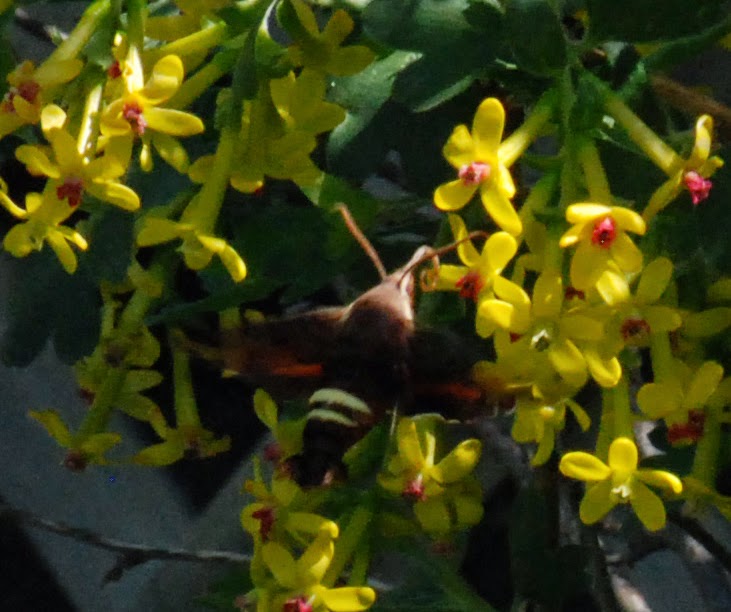
The clove currant (Ribes odoratum) is in sweet, full and glorious bloom right now.  On Saturday, when I stopped by it, I noticed a dark hawk moth feeding.   The wings blurred rusty brown as the moth moved from bloom to bloom, while the heavy abdomen had a tuft at its end and was encircled by 2 bright yellow bands. I'd never seen this particular hawk moth before, so I tried to take its picture, thinking I could identify it more accurately if I had a good photo.  The blasted little beast was definitely camera shy and not very trusting of giant beings standing nearby with big black boxes stuck up near their face.  It tended to keep to the far side of the plants, rather than venturing out into the open near to me.

Thank heavens for digital.  Fifteen photos later, the moth flew away and I've not seen it since.  When I checked out those 15 shots to see what I'd managed to capture, sadly this was the BEST image of the lot.

As lousy as this photo is, I was still able to use it to identify my "dark" hawk moth as a Nessus Sphinx Moth (Amphion floridensis).  This species is supposedly one of the more commonly encountered day-flying moths, but I've never seen one before.  The larvae/ caterpillars, which are a type of hornworm, feed on grape, Ampelopsis, and Capsicum (bell and hot pepper) plants, all of which are frequent in our yard.

Looking around under one of our green ash trees (Fraxinus pennsylvanica), I noticed some small, gnat-like creatures flying.  When one came to rest within my sightline, I decided to snap its picture.  Then I noticed a second one nearby.  Snap.  Snap.  Snap.  These little creatures were about 1/4" or 3/8" long, colored gray and sitting on gray bark.  I have no idea why I thought I could get a good photo.  Here's what I managed to capture, 26 photos later, ....

I didn't think this silhouette would show me much at first, but when I zoomed in, I noticed that the "big" fly had a small fly caught underneath it, held in a classic "I'm eating you" sort of position.  When I showed it to Greg, he immediately thought the "big fly" was a robber fly of some sort.  I can go with that.

Another shot of the same individual accidentally captured a second "big fly" just above it on the bark. 

Do you see the 2 of them?  The one in the bottom right of the photo is the one shown in silhouette above; the second one is in the top left of the photo.  When I zoomed in on the second individual, it also seemed to have some sort of fly prey - with a yellow tipped abdomen - caught.
From the top, there's little evidence of "big fly #1" having prey captured beneath it, but the silhouette shot accidentally revealed the secret.

I haven't decided yet whether I'm going to try to submit these photos to Bug Guide or not - my feel is that they are not good enough for any sort of identification, but maybe I'll chance it anyway.  I do think these are tiny robber flies and I'd love to see if anyone can tell me any more about them.

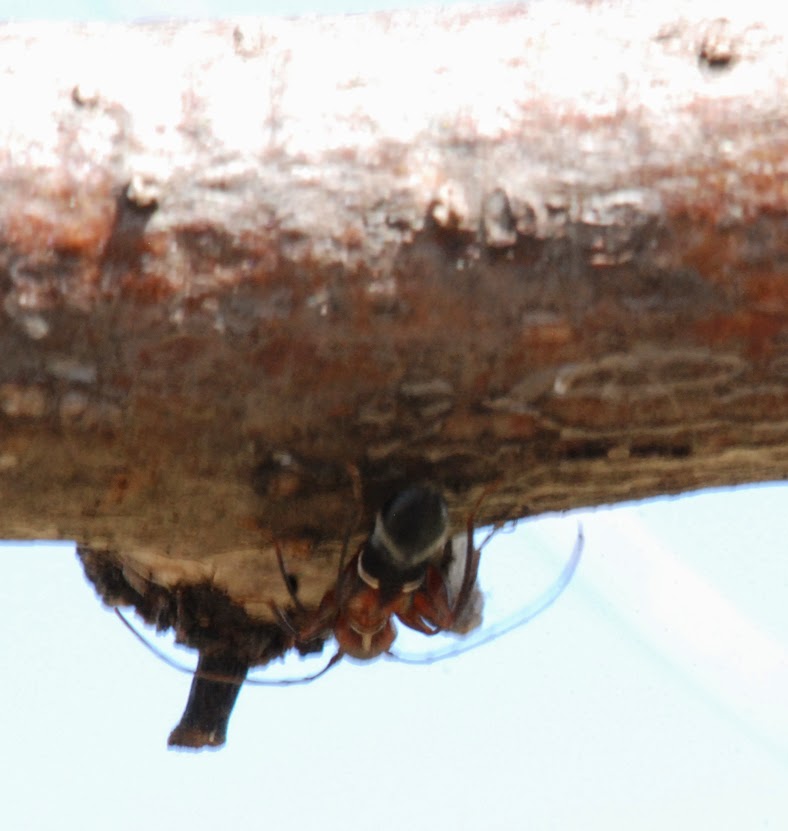
Another lousy picture that nonetheless taught me something new about the creatures in our yard was this one, taken Saturday of some sort of critter on the underside of a small honeylocust branch....

When I took the photo, I thought the mess of moving legs was perhaps an emerging wheel bug.  As I took several more shots, I changed my mind to thinking I was looking at a brightly colored ant.  As I took the very last picture, something clicked and made me think, "Beetle?"  When I looked it up, sure enough, beetle was correct!  This is an Antlike Longhorned Beetle (Euderces pini).  The larvae of this beetle feed on dead wood in a variety of types of trees; the adults are typically seen nectaring at flowers.  The adults mimic ants and are notoriously hard to photograph because they never quit moving.  This is another insect that tops out around 3/8" long.  As lousy as my photos of this creature are (and this is the best of the lot), I feel lucky that I got a couple shots that allowed me to identify it at all.

As you can tell, I've got a LO-O-O-ONG way to go before I get very decent at taking good insect photos, but I do have fun and I learn a lot, even at the level of (in)competence that I have attained.  The natural world seems more wondrous every day.