With the initiation of several days of rain, it seems like a good time to share a few garden photos from the plethora I've taken over the last few weeks. Since I'm obsessed with pollinators and other wildlife, that's what I'll generally be showing you!
Gaillardia (Gaillardia pulchella) brings in a lot of insect activity. I have several pots of gaillardia on our back patio, as well as a few plants along the street by our mailbox. Not surprisingly, most of my photos are from the plants I see most often - the ones near my back door.
This is a lousy photo, but I wanted to share the single bumble bee (Bombus sp.) I've seen in my gardens so far this summer. Gaillardia is the ONLY flower I've seen her on so far.
A female monarch (Danaus plexippus) finally visited the yard for several days last week and she left several eggs behind. Here's she's ovipositing on a swamp milkweed (Asclepias incarnata) I planted a couple months ago. I'm a "survival of the fittest" biologist, so I don't collect the eggs and raise the caterpillars inside; I'm waiting to see if I see any caterpillars - this photo was taken on the 28th, so there should be a couple tiny babies out there munching away, but I haven't gone looking yet. (Update: my grandson and I went out in the rain this afternoon and found at least 3 tiny new monarch caterpillars! Yeah!)
Ms. Blue Dasher (Pachydiplax longipennis) here isn't a pollinator, but I love welcoming her and her relatives into the yard. Every mosquito this mosquito hawk eats is a mosquito that doesn't bite me! Aren't her eyes particularly gorgeous? The body of the male blue dasher is a beautiful powdery blue, but I've been seeing almost exclusively females lately.
This green treefrog (Hyla cinerea) seems to have decided that the outside corner of our gutter near the bright lights of the kitchen window makes a perfect home. Over the past week, I've been seeing her (him?) frequently within just a few inches of this location. Note: nothing like a closeup photo to let you know the house badly needs a power washing!
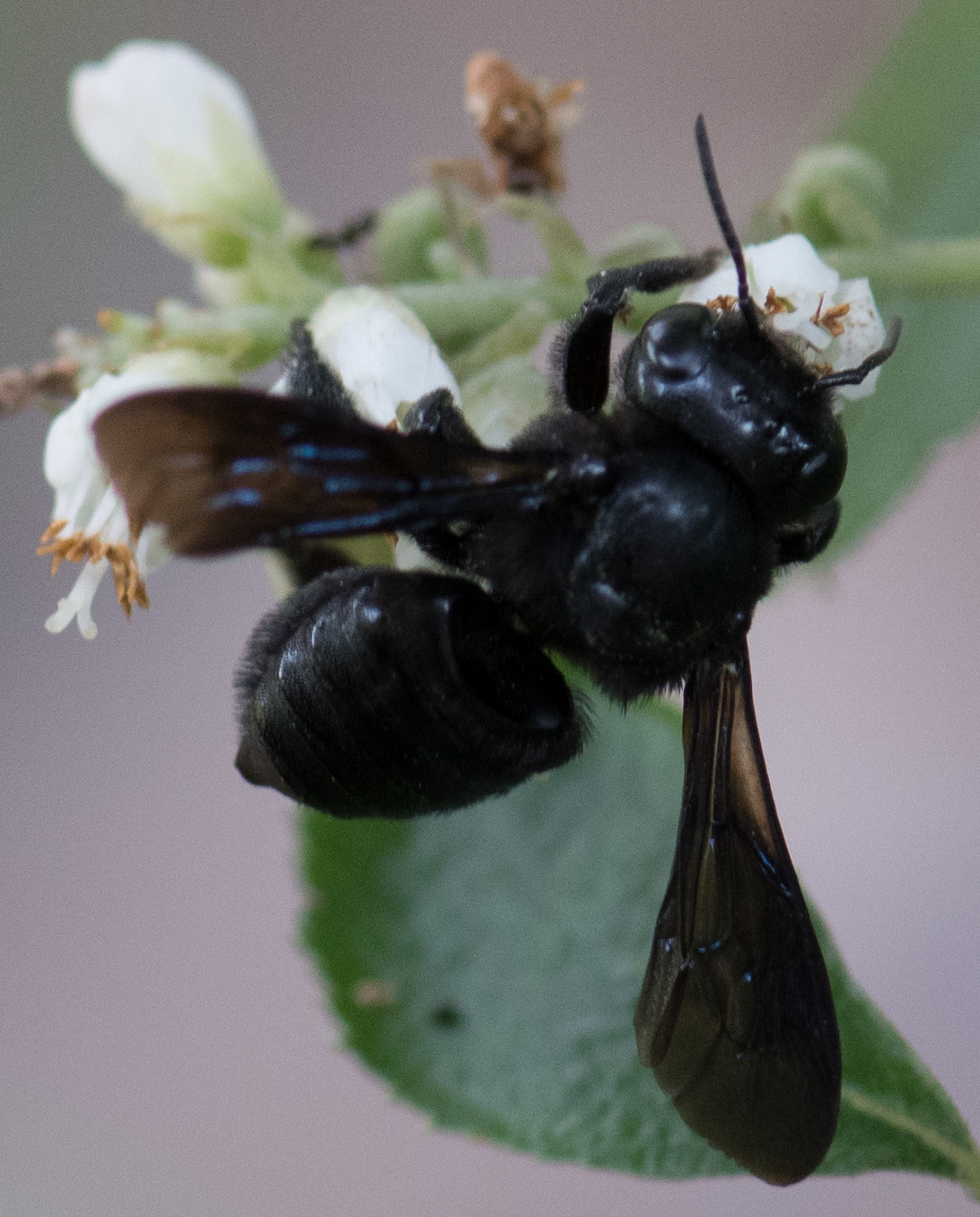
Out front, the newly planted sweet pepperbush (Clethra alnifolia) has excited a lot of pollinator interest. I shared the potter wasp and the 4 spotted scarab hunter wasp I've seen nectaring here in my recent post; this is a carpenter-mimic leaf-cutter bee (Megachile xylocopoides) who also has seemed to enjoy the blooms.
The deep velvet black of this bee's body and the iridescent blue-black of its wings are just stunning. I wonder if this is the species that has been harvesting circles of dogwood leaves to make their nest cells waterproof?
Another little green treefrog was tucked away inside a Flyr's nemesis (Brickellia cordifolia), hoping against hope that I didn't actually see him as I looked around. I let him pretend that I hadn't noticed him.....
With the spotted beebalm (Monarda punctata) beginning to bloom, I'm starting to see a little more activity in that section of the garden, including this small green anole (Anolis carolinensis). I'm still not seeing many insects attracted to the spotted beebalm blossoms, but I did see a hummingbird feeding - even though I didn't have my camera with me so I could visually share with you.
Back to the anole for a moment, I've been seeing many tiny little green anoles for the last several
weeks, which just makes me smile. Obviously it's been a good year for
anole love!
Another recent dragonfly visitor was the great blue skimmer (Libellula vibrans), who perched on top of the poles in our tomato pots for a while - and was lucky enough (and good enough) to capture a passing moth shortly after I took the top photo. Those big, black-spotted blue eyes aren't just for show!
Out front, enjoying the turkey tangle fogfruit (Phyla nodiflora), there's been the phaon crescent (Phyciodes phaon), nectaring - and possibly laying eggs, since fogfruit is their larval plant. Note: I don't know if this individual is a male or female.
The fogfruit has also attracted many other insects, including a female blue dasher dragonfly, a carpenter-mimic leaf-cutter bee, several different species of wasps, bees, and flies. In fact, the fogfruit is active enough that it's probably worth a post just by itself. I just wish it looked a little more "gardeny"....
Anoles have been out in the front gardens as well as in the back. Here was one haunting a summer phlox (Phlox paniculata) blossom. Sometimes I wonder if I don't see huge numbers of pollinators because I DO see lots and lots of predators around the blooms - and I'm sure it's not a coincidence that they are hanging out there!
Speaking of predators, whether nymphs (like this one) or adults, I'm seeing quite a few milkweed assassin bugs (Zelus longipes) this summer. I thought they were so-named because they were part of the milkweed community, but recent reading suggests their name comes from their coloration. I've certainly seen them on many, many plants, not just on milkweed.
The clustered mountain mint (Pycnanthemum muticum) in the back yard has brought in quite a few unusual (for my garden) pollinators. Besides several wasp species, there is this grapeleaf skeletonizer moth (Harrisina americana) which has both a common name and a color pattern that make it a perfect Halloween animal.
Believe it or not, this small, colorful, Halloween themed moth, also nectaring on the mountain mint, is from the a group of moths known as bird dropping moths. Yes, that's an actual common name for moths in the subfamily Acontiinae . This moth goes by the hard-to-remember name of black-dotted spragueia moth (Spragueia onagrus) and is an animal I've never seen before in my life. Kudos to the helpful folks at BugGuide.net for helping me identify this one!
Lacewing larvae, looking for all the world like prehistoric monsters or like some less glittery version of Tamatoa, the Crab, on Moana, are hard to see unless you look closely, but they are great allies in garden pest control. This photo is blurry (the entire "mound" is barely 1/4" across and I wasn't using a tripod) but, if you look carefully, you can see the huge jaws under the front edge as well as a wing from one of its dinners right above the jaws.
In all, this lineup of characters from my garden highlights 6 garden predators (green anole, green treefrog, milkweed assassin bug, lacewing larva, blue dasher dragonfly, great blue skimmer dragonfly) and 6 pollinators (monarch, bumblebee, carpenter-mimic leaf-cutter bee, phaon crescent butterfly, grapevine skeletonizer moth, and black-spotted spragueia moth). During the 10 days that I photographed these animals, I saw many other animals, too. Some, like the 5 species of wasps that I talked about in my last post, I've shared with you. Others, like bluebirds, cardinals, bluejays, gray squirrels, chickadees, tufted titmice, house finch, mockingbirds, red-shouldered hawk, brown skinks, southern toads, and Eastern box turtle, I haven't shared.
How can anyone be happy with a statically "pretty" landscape, when a garden filled with wildlife changes minute by minute?! I love the surprise of going out into my yard and meeting a new insect neighbor. I love the pleasure of looking at a flower cluster and realizing that I'm looking into the eyes of a little lizard or camouflaged frog. Each new animal I see adds a layer of richness to the world around me that delights and soothes me. What an honor to be sharing my yard and gardens with all these other forms of life here on Earth.
Showing posts with label Assassin Bugs. Show all posts
Wednesday, August 01, 2018
Friday, September 29, 2017
One Thing Leads to Another.....
(This post is an expansion on a Facebook post I made yesterday morning. I wanted to share the photos I took - and add a few more comments.)
I love how one thing leads to another.....
I saw an Eastern Giant Swallowtail (Papilio cresphontes) out back nectaring on the Scarlet Sage (Salvia coccinea), so I got my camera and ran outside.
It flew over to a camellia where it sat for a while to bask, allowing me to get fairly close and to take multiple photos.
Then it flew back to the sage and continued nectaring, allowing me to take more photos.
After the swallowtail flew off, I noticed a battered Gulf Fritillary (Agraulis vanillae) basking, so I took photos of it, following as it, ...er,
SHE lifted off and laid an egg or two on the Corky-Stemmed Passionvine (Passiflora suberosa) nearby. It amazes me that this ragged female could still fly - and that she still had the energy to locate passionvine and lay eggs! It makes me think that, perhaps, occasionally handling butterflies won't overly handicap their success after all.
Movement by the milkweed caught my eye and I was able to get a few shots (although I don't know if they turned out) of a syrphid fly laying eggs near aphids on the milkweed. Note: This was the best of the shots I took. It isn't great, but I thought you might enjoy it anyway, and it does serve to keep the narrative going!
More movement made me notice a little tufted titmouse hunting about 20 feet away, so I snagged a couple photos, one of which wasn't too bad....
Still more movement, this time nearby, helped me notice some sort of odd little wasp hunting on the swamp milkweed... When I downloaded the photos, I realized that this isn't a wasp at all, but rather some sort of fly. BugGuide has helped me determine that this is a female syrphid fly in the genus Xylota. These syrphid flies eat pollen from the surface of leaves as adults, which I think you can actually see her doing in the above photo! The larvae feed on sap runs. So, my bare eyes said a small wasp, hunting, but increased magnification and more research revealed a fly, eating pollen!
Close to this unusual little syrphid fly was a Milkweed Assassin Bug nymph (Zelus longipes) that may have actually been hunting - attempting to catch the little syrphid fly unawares.
As an added pleasure, I found all of this activity while I was enjoying the sweet fragrance of the blue curls (Trichostema dichotomum) that are scraggly but blooming, in pots on the back patio!
A fun few minutes. Fifteen minutes, to be exact. And all from the relative privacy of my back patio, while in bare feet and still in pajamas!
As I wrote the original post when I got back inside, I looked out back onto the patio again and saw a male towhee perched proudly on the top of the statue there! Sadly, I wasn't able to get a picture of him, but I did get to enjoy watching him from my spot in the recliner!
Gardening for wildlife is like having a nature preserve right outside my back door!
I love how one thing leads to another.....
I saw an Eastern Giant Swallowtail (Papilio cresphontes) out back nectaring on the Scarlet Sage (Salvia coccinea), so I got my camera and ran outside.
It flew over to a camellia where it sat for a while to bask, allowing me to get fairly close and to take multiple photos.
Then it flew back to the sage and continued nectaring, allowing me to take more photos.
After the swallowtail flew off, I noticed a battered Gulf Fritillary (Agraulis vanillae) basking, so I took photos of it, following as it, ...er,
SHE lifted off and laid an egg or two on the Corky-Stemmed Passionvine (Passiflora suberosa) nearby. It amazes me that this ragged female could still fly - and that she still had the energy to locate passionvine and lay eggs! It makes me think that, perhaps, occasionally handling butterflies won't overly handicap their success after all.
Movement by the milkweed caught my eye and I was able to get a few shots (although I don't know if they turned out) of a syrphid fly laying eggs near aphids on the milkweed. Note: This was the best of the shots I took. It isn't great, but I thought you might enjoy it anyway, and it does serve to keep the narrative going!
More movement made me notice a little tufted titmouse hunting about 20 feet away, so I snagged a couple photos, one of which wasn't too bad....
Still more movement, this time nearby, helped me notice some sort of odd little wasp hunting on the swamp milkweed... When I downloaded the photos, I realized that this isn't a wasp at all, but rather some sort of fly. BugGuide has helped me determine that this is a female syrphid fly in the genus Xylota. These syrphid flies eat pollen from the surface of leaves as adults, which I think you can actually see her doing in the above photo! The larvae feed on sap runs. So, my bare eyes said a small wasp, hunting, but increased magnification and more research revealed a fly, eating pollen!
Close to this unusual little syrphid fly was a Milkweed Assassin Bug nymph (Zelus longipes) that may have actually been hunting - attempting to catch the little syrphid fly unawares.
As an added pleasure, I found all of this activity while I was enjoying the sweet fragrance of the blue curls (Trichostema dichotomum) that are scraggly but blooming, in pots on the back patio!
A fun few minutes. Fifteen minutes, to be exact. And all from the relative privacy of my back patio, while in bare feet and still in pajamas!
As I wrote the original post when I got back inside, I looked out back onto the patio again and saw a male towhee perched proudly on the top of the statue there! Sadly, I wasn't able to get a picture of him, but I did get to enjoy watching him from my spot in the recliner!
Gardening for wildlife is like having a nature preserve right outside my back door!
Friday, September 22, 2017
Secrets of An Assassin Bug's Diet, or Beware of First Impressions!
When I went out with the dog, first thing this morning, I noticed a ladybug on one of my milkweeds, so I went inside and grabbed my camera to photograph it. I just don't see ladybugs very often any more. The ladybug turned out to be a Multi-Colored Asian Lady Beetle (Harmonia axyridis), which is very disappointing but not too surprising. This is the species that is displacing so many of our native ladybugs.
As usually happens when I get my camera out, however, I found a couple other things to photograph while I was outside, and I'd like to share one of them with you tonight.
As I was photographing the ladybug, I noticed another orangish red and black insect nearby, a nymph of a Milkweed Assassin Bug (Zelus longipes). I'm fairly used to seeing these in my garden nowadays, so I didn't pay too much attention to it at first....
Then I noticed the long, small, white insect it was eating. "Damn!" I thought to myself, "It's a tiny monarch caterpillar! No wonder I haven't been seeing any larger monarch caterpillars around."
Since I'm a pretty firm believer in "the circle of life", especially when the life forms involved are native, I did nothing but take a couple pictures. The assassin bug nymph soon finished its meal and started hunting again, but I didn't notice it capture anything else.
Tonight I went through this morning's photos on the computer - and, lo and behold, that wasn't a tiny monarch caterpillar! The Milkweed Assassin Bug nymph was actually eating a newly molted (still white) leafhopper! The leafhopper was just so small that my eyes couldn't make out what it actually was until the magic of photography enlarged it for me.
I have no idea which species of leafhopper this was, but all leafhoppers drink plant sap, so this is a perfect example of a predator keeping a plant-eating insect population under control. (To be brutally honest, of course, the same could be said if the assassin bug HAD actually been eating a monarch caterpillar.)
Once again I had a dope slap moment and had to remind myself not to jump to conclusions when I'm out in the garden, observing. I am continually amazed at the intricate functioning of the web of life...when we humans can avoid mucking around with it.
As usually happens when I get my camera out, however, I found a couple other things to photograph while I was outside, and I'd like to share one of them with you tonight.
As I was photographing the ladybug, I noticed another orangish red and black insect nearby, a nymph of a Milkweed Assassin Bug (Zelus longipes). I'm fairly used to seeing these in my garden nowadays, so I didn't pay too much attention to it at first....
Then I noticed the long, small, white insect it was eating. "Damn!" I thought to myself, "It's a tiny monarch caterpillar! No wonder I haven't been seeing any larger monarch caterpillars around."
Since I'm a pretty firm believer in "the circle of life", especially when the life forms involved are native, I did nothing but take a couple pictures. The assassin bug nymph soon finished its meal and started hunting again, but I didn't notice it capture anything else.
Tonight I went through this morning's photos on the computer - and, lo and behold, that wasn't a tiny monarch caterpillar! The Milkweed Assassin Bug nymph was actually eating a newly molted (still white) leafhopper! The leafhopper was just so small that my eyes couldn't make out what it actually was until the magic of photography enlarged it for me.
I have no idea which species of leafhopper this was, but all leafhoppers drink plant sap, so this is a perfect example of a predator keeping a plant-eating insect population under control. (To be brutally honest, of course, the same could be said if the assassin bug HAD actually been eating a monarch caterpillar.)
Once again I had a dope slap moment and had to remind myself not to jump to conclusions when I'm out in the garden, observing. I am continually amazed at the intricate functioning of the web of life...when we humans can avoid mucking around with it.
Labels:
Assassin Bugs,
Ladybugs,
Milkweed,
Organic Gardening,
Predator-Prey
Thursday, August 03, 2017
Predators and Parasites on Oleander (Milkweed) Aphids
My milkweeds are hopping these days. Sadly, I've only seen one
monarch caterpillar, but I am still fascinated by all the insect life that I am
seeing. Most of my observations have been on tropical milkweed (Asclepias curassavica)
simply because I have several big, healthy plants in pots on my back
patio and they are easy to check on and photograph, but I'm fairly
certain that what I'm seeing isn't unusual for other milkweed species.
The orange-yellow oleander aphids (Aphis nerii) are common on these plants. A week ago, when many of these photos were taken, the aphids covered about 2-3" of the top of every shoot. This week their numbers are much reduced, with just a few hardy individuals remaining where hundreds dined last week. This is at least the second rise and fall of aphid numbers on my plants this summer. I'm sure they will go through at least one more population cycle up and down before frost comes this autumn.
So what's keeping the aphid populations from exploding out of control? If you look closely at the photo above, you can begin to see the answer. Specifically, here are some of the candidates I've been seeing....
Each milkweed shoot with its covering of yellow aphids near the tip seems to also have at least one or more of these blobs of gray and white protoplasm which, I am pretty sure, are actually syrphid fly larvae. Although the blobs are stationary when I usually see them, I have occasionally seen one "hightailing" it from one area to another. Looking on BugGuide.net, this looks like the larva of the syrphid fly, Ocyptamus fuscipennis. I have certainly noticed syrphid flies that look like these adults hovering around the aphid clusters. There is no common name for this little fly that I know of, but the BugGuide link will allow you to see what the adult looks like, so that you can notice if your milkweed aphids are attracting attention from this species, too.
Less common, but still easy to find, are these little bumpy caterpillar-like animals that are also, I believe, syrphid fly larvae. I've not been able to figure out which species or even genus these guys belong to, but I do find it fascinating that two different species of syrphid flies are munching on my oleander aphids! The only way to really tell for certain would be to raise up some of these larvae to adulthood, which sounds like a fun project when the boys get a little older.
If you ever see a piece of trash seeming to move on your plant, look a little more closely....
You may be seeing a green lacewing larva, which hides under a pile of debris that includes its castoff skins from earlier molts.
If you look closely in the photo above, you can easily see the yellow oleander aphid being eaten...by the actual lacewing larva at the bottom of the pile of debris. Lacewings are fierce aphid predators as both larvae and adults.
Not uncommonly among my aphid populations, I will see a dark brown aphid that doesn't move. This is an aphid mummy. Tiny parasitic wasps lay an egg in an individual aphid and the developing wasp larva eats out the insides of the aphid, leaving the aphid a literal shell of itself. Only one baby wasp per aphid, but each female wasp can then go on to lay eggs in many aphids, so aphid mummies are welcome sights on my milkweed plants.
There are other more generalist predators that I'm seeing around my milkweeds, too, which may or may not be preying on the aphids.
I often see tiny, longlegged flies, for example, flying around and landing on milkweed leaves for short periods of time. Longlegged flies (Family Dolichopodidae) are iridescent green or brown and are known to be predators in both the larval and adult forms. Although I have never seen one pay attention to, let alone eat, an aphid, I can still hope. They've got to be eating something!
Clad in the red-orange and black colors of the classic milkweed insect, milkweed assassin bugs (Zelus longipes) are another generalist predator that I see these days, both on milkweeds and on other plants around the yard. I see the milkweed assassin bugs hunting up and down the plants, sometimes hanging out in the flowers, but just as commonly walking up and down the stems or inspecting both sides of each leaf. Their eyesight is superb and it can be hard to sneak up on one to take its picture. At first it will simply duck to the other side of a stem or leaf or flower cluster, but if you persist, it will readily fly away.
The final predator I've been consistently seeing around my milkweeds in recent weeks is a damselfly. Again, I don't know if this dainty creature is eating winged aphids or not, but I doubt it would turn one down.
So, as you look at the aphids on your milkweeds in horror and dismay, look a little closer - there's a good chance you'll see some other, interesting insects drawn in to the feast that they represent in the animal world!
The orange-yellow oleander aphids (Aphis nerii) are common on these plants. A week ago, when many of these photos were taken, the aphids covered about 2-3" of the top of every shoot. This week their numbers are much reduced, with just a few hardy individuals remaining where hundreds dined last week. This is at least the second rise and fall of aphid numbers on my plants this summer. I'm sure they will go through at least one more population cycle up and down before frost comes this autumn.
So what's keeping the aphid populations from exploding out of control? If you look closely at the photo above, you can begin to see the answer. Specifically, here are some of the candidates I've been seeing....
Each milkweed shoot with its covering of yellow aphids near the tip seems to also have at least one or more of these blobs of gray and white protoplasm which, I am pretty sure, are actually syrphid fly larvae. Although the blobs are stationary when I usually see them, I have occasionally seen one "hightailing" it from one area to another. Looking on BugGuide.net, this looks like the larva of the syrphid fly, Ocyptamus fuscipennis. I have certainly noticed syrphid flies that look like these adults hovering around the aphid clusters. There is no common name for this little fly that I know of, but the BugGuide link will allow you to see what the adult looks like, so that you can notice if your milkweed aphids are attracting attention from this species, too.
Less common, but still easy to find, are these little bumpy caterpillar-like animals that are also, I believe, syrphid fly larvae. I've not been able to figure out which species or even genus these guys belong to, but I do find it fascinating that two different species of syrphid flies are munching on my oleander aphids! The only way to really tell for certain would be to raise up some of these larvae to adulthood, which sounds like a fun project when the boys get a little older.
If you ever see a piece of trash seeming to move on your plant, look a little more closely....
You may be seeing a green lacewing larva, which hides under a pile of debris that includes its castoff skins from earlier molts.
If you look closely in the photo above, you can easily see the yellow oleander aphid being eaten...by the actual lacewing larva at the bottom of the pile of debris. Lacewings are fierce aphid predators as both larvae and adults.
Not uncommonly among my aphid populations, I will see a dark brown aphid that doesn't move. This is an aphid mummy. Tiny parasitic wasps lay an egg in an individual aphid and the developing wasp larva eats out the insides of the aphid, leaving the aphid a literal shell of itself. Only one baby wasp per aphid, but each female wasp can then go on to lay eggs in many aphids, so aphid mummies are welcome sights on my milkweed plants.
There are other more generalist predators that I'm seeing around my milkweeds, too, which may or may not be preying on the aphids.
I often see tiny, longlegged flies, for example, flying around and landing on milkweed leaves for short periods of time. Longlegged flies (Family Dolichopodidae) are iridescent green or brown and are known to be predators in both the larval and adult forms. Although I have never seen one pay attention to, let alone eat, an aphid, I can still hope. They've got to be eating something!
Clad in the red-orange and black colors of the classic milkweed insect, milkweed assassin bugs (Zelus longipes) are another generalist predator that I see these days, both on milkweeds and on other plants around the yard. I see the milkweed assassin bugs hunting up and down the plants, sometimes hanging out in the flowers, but just as commonly walking up and down the stems or inspecting both sides of each leaf. Their eyesight is superb and it can be hard to sneak up on one to take its picture. At first it will simply duck to the other side of a stem or leaf or flower cluster, but if you persist, it will readily fly away.
The final predator I've been consistently seeing around my milkweeds in recent weeks is a damselfly. Again, I don't know if this dainty creature is eating winged aphids or not, but I doubt it would turn one down.
So, as you look at the aphids on your milkweeds in horror and dismay, look a little closer - there's a good chance you'll see some other, interesting insects drawn in to the feast that they represent in the animal world!
Subscribe to:
Posts (Atom)