Showing posts with label Fogfruit. Show all posts

Wednesday, January 30, 2019

Turkey Tangle Fogfruit Community

Certain plants seem to create large communities of insects and other wildlife within my garden.  I thought I'd do a series on a couple of these species, starting with Turkey Tangle Fogfruit (Phyla nodiflora).  As I've gone through my photos from last year, I realized I've got pictures from at least 23 different species of animals using this species in 2018 alone - and that's just the number I captured with my camera.  I know there were animals using it that I wasn't able to capture on film (like swallowtail butterflies).  I'm equally certain there were animals using it that I simply didn't see.

Fogfruit is not a showy species to my eye.  Although some people really like its dainty flowers, to be honest, I find this plant rather blah visually.  It is, however, a powerhouse for supporting pollinators and other insects and, as such, has earned a place in my yard whenever possible.

Essentially a groundcover, fogfruit grows around 8" tall.  About 3 years ago, I started out with 2 plants in gallon containers, planted 2' apart.  The fogfruit now covers an area that is about 6' X 8' - and it would be happy to be out in the driveway and into the street, too, if we didn't keep it trimmed back.  On the plus side, fogfruit manages to hold its space fairly well, once established, and doesn't need much of any care.

The first photos I have of the animals it harbored last year are from mid-May.

Here is a small spider that I saw on May 15th, then didn't see again all year.  It's a pretty little thing which the great folks at Antman's Hill on Facebook helped me to identify as an orbweaver, Gea heptagon.

On the same day, I captured a photo of this little syrphid fly (Toxomerus sp.) nectaring at one of the fogfruit blossoms.

Like others in this genus, the larvae of this fly feed on aphids, thrips, and small caterpillars throughout the garden, so it's nice to see the adult visiting.

By June 10th, the action was heating up.  There was this cute little orange "teddy bear" nectaring, a bee fly (Chrysanthrax cypris).

Cute as this guy is, its life cycle is less cuddly.  Flies in the Chrysanthrax genus are external parasitoids on the cocoons of some solitary bees and on the cocoons of tiphiid wasps, which are themselves predators of beetle larvae.  The "balance of nature" is sometimes hard for me to feel comfortable with and gracefully accept, but I do my best.

Throughout June and again in August, I have photos of another bee fly (Exoprosopa fascipennis) nectaring at the fogfruit.

Again, I find this an attractive little creature, but again its life cycle is rather fearsome.  The bee flies in Exoprosopa feed on the cocoons of many different kinds of wasps, including the tiphiid wasps mentioned above, spider wasps, and a group of solitary wasps known as sphecid wasps.

Speaking of wasps, in mid June, this scoliid wasp (Scolia nobilitata) was enjoying the fogfruit nectar, too.

Scoliid wasps are parasitoids of beetle grubs, especially the grubs of May beetles.  The females dig down to the grub, sting it to paralyze it, and deposit on egg. When the egg hatches, the wasp larva eats the perfectly preserved beetle grub.  I like my grub control to be natural (even if it is rather gruesome that way)!

Since both the bee flies and the scoliid wasp were nectaring at the same time on the same plant, it is possible that one or the other of the bee fly species parasitizes this scoliid wasp species, following females as they leave their feeding ground and search for beetle grubs to parasitize.  There is so much about these little guys that we simply don't know, even things as basic as which bee fly species parasitizes which wasp species.  Often these predator/prey relationships with parasitoids are very specific, confined to just one or two species, or perhaps between two particular genuses.

Moving back to less gory lifecycles, a couple days after photographing the pretty wasp above, I started capturing images of butterflies and skippers.  First was this Fiery Skipper (Hylephila phyleus) on June 16th.

 Since the larvae of fiery skippers dine on grasses such as St. Augustine, this species is relatively common.

On June 22nd, I photographed the first Phaon Crescent (Phyciodes phaon) of the year, although these photos are from later in the summer.


These cute little orange butterflies utilize fogfruit as their larval plant, as well as obviously nectaring on it.  Since I see quite a few of them, I'm pretty sure that my little patch of fogfruit is producing phaon crescents, but I've never actutally found one of the caterpillars.

Something sure likes to eat the fogfruit leaves, though!

I spotted this dainty damselfly hanging out around the fogfruit several times last summer. It's the only damselfly or dragonfly species that I photographed on the fogfruit last year, and the folks at Antman's Hill identified it for me as a male Rambur's Forktail (Ischnura ramburii).  That makes sense, as I've seen the (orange) female Rambur's Forktail in the yard multiple times, although I've never photographed one on the fogfruit.

There were several more wasps and bees over the course of the summer, including this potter or mason wasp on July 20th, .....

...and this paper wasp (Polistes metricus) on August 10th.

I actually don't see many paper wasps in the yard - which is fine with me.  Instead, I see lots of solitary wasps, who are generally much easier to share space with. 

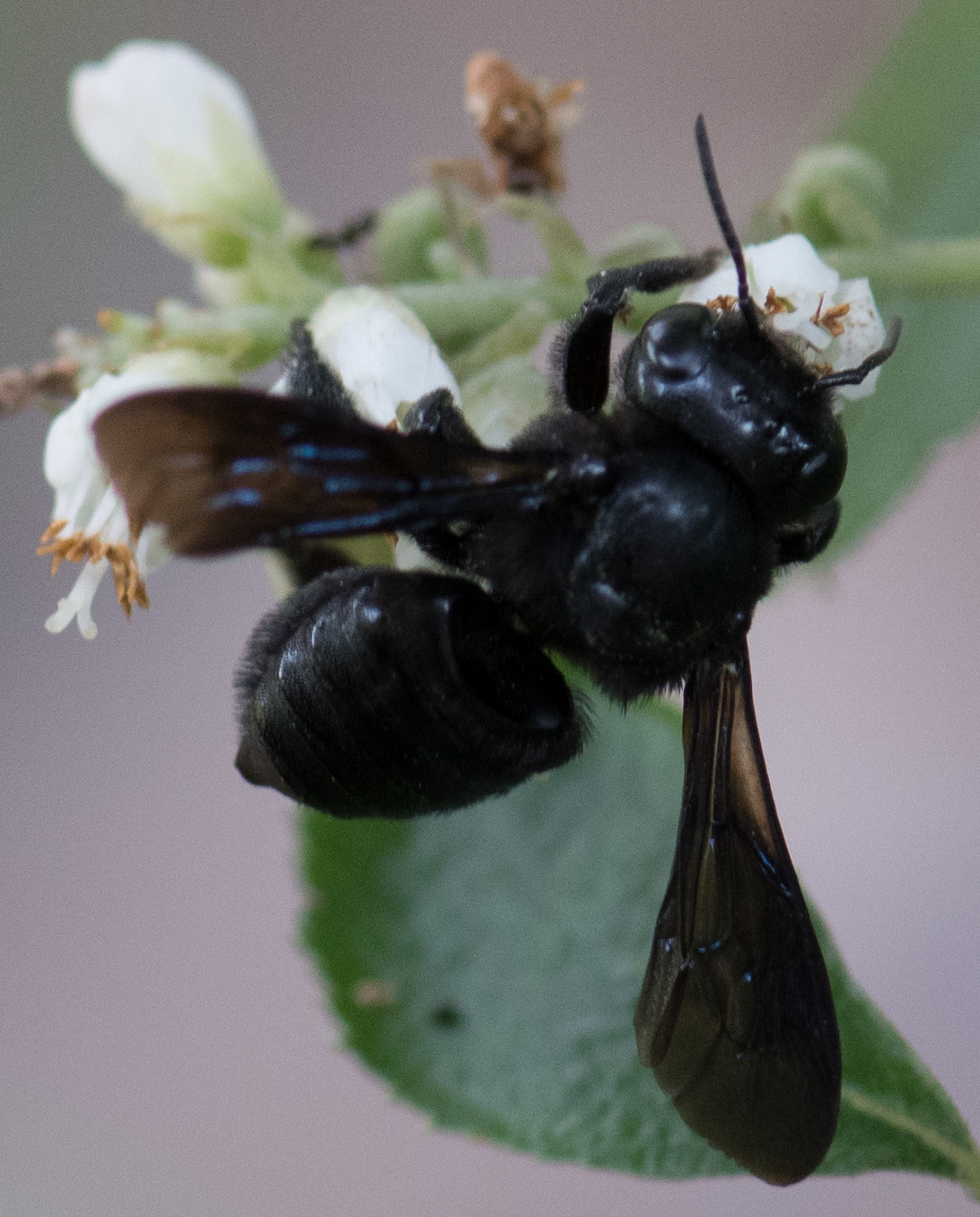
One of my favorite finds was this cute little black leafcutter bee, the Carpenter Mimic Leafcutter Bee (Megachile xylocopoides).  As the name suggests, this stunning black bee with the fluorescent blue shimmer is considered a mimic of larger carpenter bees, specifically the Southern Carpenter Bee, which I also saw in my yard last summer.

Note the long hairs on the underside of the abdomen?  That's how you can tell it's a leafcutter bee - at least if it's a female.  Female leafcutter bees carry pollen in those hairs, often giving them a potbellied appearance.  This gal was apparently feeding herself, not gathering pollen for future offspring.

On August 8th, I was able to capture photos of a Barred Sulfur (Eurema daira) visiting...


...and if you look closely at the stem a few inches below the blossom, you'll see the wad of spittle that signifies a spittlebug nymph feeding - yet another insect species utilizing the fogfruit.

A few days later, I photographed this crisp Checkered Skipper (Pyrgus sp.).


Apparently, most skipper larvae fold and sew leaves together to make tent shelters for themselves, so don't be too quick to destroy any such structures you might come across in your garden.

Of the 23 species I photographed on my Turkey Tangle Fogfruit in 2018, the above photos were the most interesting and/or the insects were the most photogenic.  Rounding out my 23 species were 4 more species of flies, 2-3 species of small beetles, a honeybee, and two other bees I haven't been able to identify yet.

Like the plant they were visiting, most of these animals aren't large or particularly beautiful.  They are the everyday denizens of our gardens, busily living their lives and often feeding other animals in the process.  To me, each of these species has the right to exist, the right to its place on this Earth, just as much as any other species has that same right.  I hope that, someday soon, we humans can learn to coexist with the other plants and animals on this planet, instead of needlessly and carelessly destroying them.

Saturday, August 11, 2018

Tolerate the Uglies!!!

After carefully watching my larval plants for several months (which felt like years!), I'm finally seeing caterpillars on them. 

There are monarch caterpillars on the milkweed,

black swallowtail caterpillars on the parsley,

gulf fritillary caterpillars on the maypop vines,

and - based on the foliage - probably phaon crescent caterpillars on the fogfruit. 

YEAH!!! My plants are starting to get ugly!  They are making butterflies!!!

As much as I love seeing the caterpillars, though, I find that I do cringe at how ragged my plants start to look at this point of the summer.  Not only is the heat taking a toll, the plants are so large that any dry spells can cause wilting and brown edges, even partial leaf drop.  By the time the caterpillars show up and start eating the leaves, the plants can start looking like I should yank them out of the garden at the first possible moment.

Of course I don't pull them out.  I chose and planted these plants especially as butterfly food.  Why would I pull them out just as they are starting to actually produce butterflies?  Even if I do "mentally hear" my neighbors gossiping about how ragged my garden is looking these days.

Honestly, couldn't these plants be a little NEATER and PRETTIER while they go through this stage of their life cycle?!

My own phrase for this is "Tolerate the uglies!"  Benjamin Vogt of Monarch Gardens shares the same concept with his phrase of "Redefine pretty."  In a world saturated with television ads showing happy, beautiful people in manicured yards that don't have a single tattered leaf or brown spot in the lawn, it feels subversive to allow caterpillars to actually eat the leaves on your plants.  Seriously, shouldn't this be done behind closed doors, people?!

To be even more subversive, this summer I've noticed that my monarch caterpillars seemed to purposefully deflower the milkweed they are feeding upon. 

First, mama monarch laid quite a few eggs underneath flower bud clusters, so the caterpillars have been eating the flowers and buds from the moment they hatched.

Secondly, as the caterpillars reached one of their later, larger instars, I noticed that 3 of them had cut the stem of the entire flower cluster partway through, resulting in the entire bloom head hanging upside down and dying.  Seriously, what's up with that?!  The only thing I can figure out is that, evolutionarily, this decreases the chances of parasites being attracted to the plant for nectar and thereby finding the caterpillar(s) nearby to host their offspring on.  I've never heard of this as a "thing" before, though, so I don't know if my imagination is just running away with me - or if, maybe, I'm on to something.  Any monarch researchers out there that might want to look into this idea?

Along the same lines, is it coincidence that the eggs were laid shortly after the buds started opening and the plants started blooming?  Evolutionarily, could it be that so many eggs were laid on these newly opening flower buds to decrease the overall numbers of blooms, decreasing the seed production, and thus moving the plant energies into leaf production, thereby providing more food for more baby monarchs?

Or is this egg placement just a way to hide the caterpillars until they get a little bigger and less attractive to wasps and other caterpillar parasites who might not care that they don't taste good?  See how well that monarch caterpillar is hidden?

Can you see it now???

How about now?  Pretty safe hiding place, isn't it?

WHY the timing and placement for egg laying?  Coincidence or evolutionary plan?  Inquiring minds want to know.

While I contemplate these possibilities, I meander my garden enjoying the new life chomping hungrily on my plants and try not to cringe at the blooms being cut short and the leaves disappearing in the process.  Life is a balance - and never more so than in a garden.

Wednesday, August 01, 2018

A Recent Cast of Characters in My Gardens: Pollinators and Predators

With the initiation of several days of rain, it seems like a good time to share a few garden photos from the plethora I've taken over the last few weeks.  Since I'm obsessed with pollinators and other wildlife, that's what I'll generally be showing you!

Gaillardia (Gaillardia pulchella) brings in a lot of insect activity.  I have several pots of gaillardia on our back patio, as well as a few plants along the street by our mailbox.  Not surprisingly, most of my photos are from the plants I see most often - the ones near my back door.

This is a lousy photo, but I wanted to share the single bumble bee (Bombus sp.) I've seen in my gardens so far this summer.  Gaillardia is the ONLY flower I've seen her on so far.

A female monarch (Danaus plexippus) finally visited the yard for several days last week and she left several eggs behind.  Here's she's ovipositing on a swamp milkweed (Asclepias incarnata) I planted a couple months ago.  I'm a "survival of the fittest" biologist, so I don't collect the eggs and raise the caterpillars inside;  I'm waiting to see if I see any caterpillars - this photo was taken on the 28th, so there should be a couple tiny babies out there munching away, but I haven't gone looking yet.  (Update:  my grandson and I went out in the rain this afternoon and found at least 3 tiny new monarch caterpillars!  Yeah!)

Ms. Blue Dasher (Pachydiplax longipennis) here isn't a pollinator, but I love welcoming her and her relatives into the yard.  Every mosquito this mosquito hawk eats is a mosquito that doesn't bite me! Aren't her eyes particularly gorgeous?  The body of the male blue dasher is a beautiful powdery blue, but I've been seeing almost exclusively females lately.

This green treefrog (Hyla cinerea) seems to have decided that the outside corner of our gutter near the bright lights of the kitchen window makes a perfect home.  Over the past week, I've been seeing her (him?) frequently within just a few inches of this location.   Note:  nothing like a closeup photo to let you know the house badly needs a power washing!

Out front, the newly planted sweet pepperbush (Clethra alnifolia) has excited a lot of pollinator interest.  I shared the potter wasp and the 4 spotted scarab hunter wasp I've seen nectaring here in my recent post;  this is a carpenter-mimic leaf-cutter bee (Megachile xylocopoides) who also has seemed to enjoy the blooms. 

The deep velvet black of this bee's body and the iridescent blue-black of its wings are just stunning.  I wonder if this is the species that has been harvesting circles of dogwood leaves to make their nest cells waterproof?

Another little green treefrog was tucked away inside a Flyr's nemesis (Brickellia cordifolia), hoping against hope that I didn't actually see him as I looked around.  I let him pretend that I hadn't noticed him.....

With the spotted beebalm (Monarda punctata) beginning to bloom, I'm starting to see a little more activity in that section of the garden, including this small green anole (Anolis carolinensis).  I'm still not seeing many insects attracted to the spotted beebalm blossoms, but I did see a hummingbird feeding - even though I didn't have my camera with me so I could visually share with you.

Back to the anole for a moment, I've been seeing many tiny little green anoles for the last several weeks, which just makes me smile.  Obviously it's been a good year for anole love!

Another recent dragonfly visitor was the great blue skimmer (Libellula vibrans), who perched on top of the poles in our tomato pots for a while - and was lucky enough (and good enough) to capture a passing moth shortly after I took the top photo.  Those big, black-spotted blue eyes aren't just for show!

Out front, enjoying the turkey tangle fogfruit (Phyla nodiflora), there's been the phaon crescent (Phyciodes phaon), nectaring - and possibly laying eggs, since fogfruit is their larval plant.  Note:  I don't know if this individual is a male or female.

The fogfruit has also attracted many other insects, including a female blue dasher dragonfly, a carpenter-mimic leaf-cutter bee, several  different species of wasps, bees, and flies.  In fact, the fogfruit is active enough that it's probably worth a post just by itself.  I just wish it looked a little more "gardeny"....

Anoles have been out in the front gardens as well as in the back.  Here was one haunting a summer phlox (Phlox paniculata) blossom.  Sometimes I wonder if I don't see huge numbers of pollinators because I DO see lots and lots of predators around the blooms - and I'm sure it's not a coincidence that they are hanging out there!

Speaking of predators, whether nymphs (like this one) or adults, I'm seeing quite a few milkweed assassin bugs (Zelus longipes) this summer.  I thought they were so-named because they were part of the milkweed community, but recent reading suggests their name comes from their coloration.  I've certainly seen them on many, many plants, not just on milkweed.

The clustered mountain mint (Pycnanthemum muticum) in the back yard has brought in quite a few unusual (for my garden) pollinators.  Besides several wasp species, there is this grapeleaf skeletonizer moth (Harrisina americana) which has both a common name and a color pattern that make it a perfect Halloween animal.

Believe it or not, this small, colorful, Halloween themed moth, also nectaring on the mountain mint, is from the a group of moths known as bird dropping moths.  Yes, that's an actual common name for moths in the subfamily Acontiinae .  This moth goes by the hard-to-remember name of black-dotted spragueia moth (Spragueia onagrus)  and is an animal I've never seen before in my life.  Kudos to the helpful folks at BugGuide.net for helping me identify this one!

Lacewing larvae, looking for all the world like prehistoric monsters or like some less glittery version of Tamatoa, the Crab, on Moana, are hard to see unless you look closely, but they are great allies in garden pest control.  This photo is blurry (the entire "mound" is barely 1/4" across and I wasn't using a tripod) but, if you look carefully, you can see the huge jaws under the front edge as well as a wing from one of its dinners right above the jaws.

In all, this lineup of characters from my garden highlights 6 garden predators (green anole, green treefrog, milkweed assassin bug, lacewing larva, blue dasher dragonfly, great blue skimmer dragonfly) and 6 pollinators (monarch, bumblebee, carpenter-mimic  leaf-cutter bee, phaon crescent butterfly, grapevine skeletonizer moth, and black-spotted spragueia moth).  During the 10 days that I photographed these animals, I saw many other animals, too.  Some, like the 5 species of wasps that I talked about in my last post, I've shared with you.  Others, like bluebirds, cardinals, bluejays, gray squirrels, chickadees, tufted titmice, house finch, mockingbirds, red-shouldered hawk, brown skinks, southern toads, and Eastern box turtle, I haven't shared.

How can anyone be happy with a statically "pretty" landscape, when a garden filled with wildlife changes minute by minute?!  I love the surprise of going out into my yard and meeting a new insect neighbor.  I love the pleasure of looking at a flower cluster and realizing that I'm looking into the eyes of a little lizard or camouflaged frog.  Each new animal I see adds a layer of richness to the world around me that delights and soothes me.  What an honor to be sharing my yard and gardens with all these other forms of life here on Earth.