Showing posts with label Syrphid Flies. Show all posts

Friday, February 07, 2025

The Springtime Glow of Golden Ragwort

Golden Ragwort blooms
March 15, 2024

While there are many spring wildflowers that are stunningly beautiful when viewed from nearby, there aren't many that put on a bright show from afar.  One that does is Golden Ragwort (Packera aurea).


Golden Ragwort blooms
with Eastern Calligrapher (Syrphid Fly)
March 25, 2024

Viewed from near or far, Golden Ragwort is a shining star.  Or, to be more accurate, Golden Ragwort is a cluster of shining stars, often found in drifts of gold, nestled in clouds of glistening emerald green foliage.


Golden Ragwort winter foliage
February 7, 2025

Let's unpack that last statement....  One of the things that really appeals to me about Golden Ragwort is the richly shining, emerald foliage which is at its best in early spring, a time when I'm craving green.  For most of the year, this plant grows as a basal rosette of rounded leaves which can form a beautiful ground cover in mass.  The rosettes stay evergreen through the cold, ready to start growing rapidly as the days lengthen and the weather warms up.


Flower buds developing above ferny foliage
February 26, 2024

As the springtime cues of longer days and warmer temperatures come, the plants start to get "fuller and fluffier" (as my friend Barbie used to say) and, before long, ferny-looking leaves begin to appear.  The ferny leaves signal that the flower stalks are beginning to grow. 


Buds opening on a Golden Ragwort flower cluster
(Very blurry Asian Ladybug on center bud)
March 14, 2024

Soon clusters of green and purple buds are pushing skyward, on stems often suffused with deep purple.  By early-mid March, the buds are breaking open into clear yellowish gold, daisy-shaped flowers that appear in flat-topped clusters held about 12-18" above the ground.


Cluster of Golden Ragworts in bloom
March 15, 2024

A bed of Golden Ragworts in full bloom is breath-taking.  In a woodland setting, clusters of them scattered among trees seem to create their own dappled sunlight in the shade.  Even a single plant in full bloom is a bright accent that inevitably draws the eye.

Which brings me to one of the great characteristics of Golden Ragwort: it grows in a variety of conditions, ranging from full sun to fairly heavy shade, and from moderately dry soil to quite damp conditions.  If you'd ask me where it does best, I'd say moist soil in light shade, but it looks good in a variety of settings. 


Two flower stems munched by deer
March 5, 2024

On top of its ease of siting, Golden Ragwort is also easy to transplant and grow.  Best of all, it is fairly resistant to deer and other critters grazing on it.  I've never noticed signs of rabbits munching and the vole damage I've seen seemed to be almost accidental from their runs running nearby.  There is one time of year when the deer seem to snack on it in our yard: that is when the flower stalks are pushing up, before they bloom.  I've hypothesized that the flower stalks must have less of the defensive chemicals than the foliage has overall.  In any event, if we remember to spray deer deterrent on the plants during this relatively brief period of time, the deer seem to leave the plants strictly alone.  If we forget the deer spray?  Well, the plants bloom anyway, just lower and later in the season.

Besides deer, Golden Ragwort can help with other pests in the garden.  In the native plant community, there is a growing awareness that some native plant species can help keep invasive plants at bay.  Golden Ragwort is one of those species.  Several years ago, Nancy Lawson, the Humane Gardener, wrote a post "How to Fight Plants with Plants" describing how she first observed this happening in her own garden, with Golden Ragwort keeping Garlic Mustard from taking over.  In our garden, I find little or no Japanese Stilt Grass, one of the worst invasives in our yard, in the area where Golden Ragwort grows thickly.


Golden Ragwort seeds
April 22, 2024

What are the downsides of Golden Ragwort?  There are always a few downsides, right?  Well, this plant does like to seed itself around a bit.  It's easy to pull out the seedlings - and they make a great source of new plants to increase your own plantings or to gift to friends - but you will probably find some seedlings around.

Because of its strong growth habits, Golden Ragwort is absolutely capable of overpowering a "shy" or slow-growing plant nearby.  I would not, for example, plant it with bloodroot.  It does do well, however, with several of the fall asters and other such strong growers.


Fading Golden Ragwort blooms juxtaposed
with newly opening Viburnum blossoms
April 18, 2024

The last downside is that this plant's "ugly phase", the time period when it's done blooming, it's forming seeds, and its flower spikes are drying up and turning brown, occurs just as the rest of the garden is swinging into full spring bloom.  While that can be a great thing, because the visual focus moves on to other plants, it can also be disconcerting to have "dead blooms" during peak garden bloom time.  If neatness is important to you, you can always cut the spent flower stalks off, disposing of them or putting them on a brush pile where birds would still have access to the seeds.  The basal rosettes will soon plump up nicely and you'll have a pleasing ground cover for the remainder of the year. 

Next comes my favorite part of talking about any native plant - the animal community it belongs to!  Not surprisingly, given that there aren't a lot of perennials blooming at this time of year, a lot of pollinators and other insects are drawn to Golden Ragwort.  A brief look through the photos I've taken over the last two years shows at least 25 different insect species using this plant - and I know I didn't catch photos of all the insects I saw.  Here are a few highlights, chosen to show the variety of insects drawn to Golden Ragwort.....


Three-cornered Alfalfa Hopper
March 12, 2024

Not all insects that use Golden Ragwort are using the flowers.  One of the first insects I saw last spring was this Three-cornered Alfalfa Hopper (Spissistilus festinus), a species of treehopper that is known to feed on a wide variety of plants.  Treehoppers suck sap to feed, but I saw no sign of any damage to the plant from its feeding actions.  This individual probably overwintered as an adult.


Syrphid fly
March 14, 2024

I commonly see syrphid flies of several species feeding at Golden Ragwort blooms or hovering around the plants.  I don't know the exact species of this individual, but it's in the genus Syrphus, one of many syrphid fly groups whose larvae are voracious aphid predators.  Since this individual is not feeding, it may actually be scouting for a site to lay eggs.  A single syrphid fly larva can consume up to 400 aphids as it grows, so these are great "neighbors" to have in your garden.  Syrphid flies tend to overwinter as pupae either on plants, in the leaf litter, or in the soil.


Syrphid fly laying an egg next to aphids
on Golden Ragwort
March 15, 2024

This syrphid fly, also a Syrphus sp., is almost assuredly laying eggs.  I have a sequence of photos of this individual which I love because, if you zoom in really close, you can see several (green) aphids just to the left of the tip of her abdomen.  Mom's making sure her babies will have their meals served fresh upon their arrival!


Cellophane Bee
March 25, 2024

This photo just makes me smile.  Can you imagine visiting restaurants so replete with food that you end up literally coated with it as you eat?  Well, when I phrase it that way, it sounds rather gross...but this bee looks like she's whole-heartedly enjoying her meal.  This is a cellophane bee (Collettes sp.), one of the native bees that builds a solitary nest in the ground.   Cellophane bees coat the walls of their nests with a polyester secretion to protect their developing young, hence the name cellophane bee.


Blueberry Digger Bee
March 16, 2024

Another native bee I always love to see each spring is the Blueberry Digger Bee (Habropoda laboriosa), a.k.a. the Southeastern Blueberry Bee, which looks like a small bumble bee.  This powerhouse ia a buzz pollinator and a specialist in pollinating blueberry blossoms.  It may, however, nectar at other flowers, as this one is doing.  According to Bugguide, in her adult lifetime, a single female Blueberry Digger Bee may visit around 50,000 blueberry flowers, producing over 6000 blueberries by her actions.  These bees only fly for a few weeks in the spring; their adulthood is timed to coincide with the bloom season of blueberries.  As is common for many of the solitary bees, there is only one generation each year.  Not surprisingly, given their name, this species nests in the ground.


Damselfly, March 20, 2024

Where flowers attract pollinators and other insects, predators will follow.  This damselfly is a good example.  Dragonflies and damselflies have excellent eyesight and can be hard to sneak up on to photograph...which is another way of saying that I'm sorry for the poor quality of this photo!


Greater Bee Fly
March 31, 2023

This cute little teddy-bear of an insect is a bee fly, specifically a Greater Bee Fly (Bombylius major).  Don't let its cute looks deceive you:  bee flies are parasitoids on solitary bee species.  The female Greater Bee Fly flicks her eggs into the nest openings of ground-nesting solitary bees or lays her eggs on the flowers she visits.  When the eggs hatch, the larvae are mobile and either hitch a ride back to the nest on the female bee, or move into the nest from where the egg was laid near the entrance.  Once inside the bee's burrow, the bee fly larvae eat up the stores of pollen and nectar that the mother bee has stored for her larvae, as well as feeding on the bee larvae themselves.  The bee fly then pupates in the bee's nest and emerges in the spring.  This is an example of one of nature's feedback loops that helps keep species in balance with each other and with plant resources.


Path of Phyllocnistis insignis, a leafminer moth, 
on the upper surface of a Golden Ragwort leaf
June 25, 2023


You will frequently see the tracery of a leafminer mine on one of the Golden Ragwort leaves.  Leafminers, which may be tiny moths, flies, or wasps, are very host specific and are often associated with only one or a few species of plants.  Phyllocnistis insignis, a tiny moth with no common name, is the leafminer that uses Golden Ragwort leaves.   It does not harm the plant at all.  If you look closely at the winter foliage photo near the beginning of this post, you'll also see a leafminer mine on one of the leaves.

Although I'm always tempted to bore folks to tears by showing photos of ALL the insects I've seen using a particular plant, I think I'll close with just one more.


Camouflaged Looper
April 5, 2024

Camouflaged Loopers, the caterpillar of the Wavy-lined Emerald (Synchlora aerata), are common in our yard from spring through fall.  They are masters of disguise, covering themselves with bits of petal from the flowers they are eating.  The adult moth is a beautiful light green with delicate white markings, although I see the adults much less frequently than I see the caterpillars.  While these caterpillars do eat petals, they're relatively small and they do only cosmetic damage.  Honestly, I love finding them - I always feel like I've found a little treasure.

Speaking of treasures, that's what I consider Golden Ragwort in my garden.  

Where can you find this beauty if you want to add some to your garden?  Well, I've never seen it at a standard nursery or big box store, but I do see it regularly at native plant nurseries, native plant sales, and online in the inventory of native plant companies.  Because Golden Ragwort reseeds nicely, it may be available at local Master Gardener sales, too.  In fact, if you're really lucky, a friend may share some with you...or you may find a clump growing naturally in your yard.  That's how I got introduced to this plant here in SE Virginia!

Whether you choose to grow this plant in your garden or to just admire it when you see it growing wild, you'll know what a great native plant those golden blooms are signaling when their sunshiny glow catches your eye.


Sunday, July 28, 2024

Hairy Elephant's Foot, A Surprising Pollinator Magnet

At least until you get to know them well, there are some plants that are hard to get excited about.  Often that's because they don't have fascinating foliage or stunning flowers.  Just because a plant isn't classically beautiful, though, that doesn't mean it isn't greatly loved by pollinators and other insects.


Frankly, Hairy Elephant's Foot (Elephantopus tomentosus) is just such a plant.  It is a hard plant to photograph well.  For the first few months of spring and summer, it consists of a few large, hairy leaves lying flat on the ground, all coming from a central point.  Not glamorous, but definitely easy to photograph.

It's in July that the trouble begins.  The plants start to put up their flowering stalks, which rise for 12-15" above the basal leaves.  There is hardly any foliage on these stems at all.  At the top of each stalk, sudden branches stick out awkwardly, each crowned with a trio of small, bright green, hairy, pointy "leaves".  Nestled within those bracts, the small, lavender flowers open, dainty and subtle.  They open in the morning and close in mid afternoon.


These delicate little blooms wash out readily in a photo, especially in any bright light.   Their dainty airiness just looks sparse on "film", even though it looks charming en masse in real life.

A great plant for shade, Hairy Elephant's Foot grows well there, although it tends to be rather widely scattered.  Unexpectedly last year, I had an experiment in our yard when a neighbor cut down several large trees right near our joint property line and turned what had been almost complete shade into full sun, for 5-6 hours each day.

I expected the shade-loving understory plants that grew in that area to frazzle and die, which many of them did.  The Hairy Elephant's Foot, however, had a banner year, blooming prolifically and attracting an amazing number of pollinators and other insects - 21 different species that I was able to photograph!

So how do I best share the amazing number and diversity of insects that I observed?  A simple list, even illustrated with photos and spiced with bits of (hopefully) interesting information, seems overwhelming and ultimately boring.  So I thought I would talk about a few of the "categories" of insects that I observed:  1) Butterflies and Skippers, 2) Pest Control Squad - Solitary Wasps and Syrphid Flies, 3) A Predator and Prey Duo, 4) Native Bees - Pollinators Extraordinaire, 5) Flies, and 6) Passersby.

Two of the species I photographed using Hairy Elephant's Foot last summer are considered somewhat rare or threatened:  the American Bumble Bee and the Yellow-thighed Thick-leg Fly, a form of syrphid fly.  Both are shown below in their appropriate categories.


BUTTERFLIES AND SKIPPERS:

It's always fun to start with "the pretties" - and I've come to think of butterflies and skippers as "flying flowers", the prettiest group of insects overall.

Butterflies and skippers (and moths) are more than just pretty, though.  Their caterpillars are, according to Dr. Doug Tallamy, one of the primary ways that energy, captured by plants from the sun, moves up the food chain.  EVERYTHING seems to eat caterpillars.  For those of us who are birders, that's especially true of most of the songbirds, 95% of whom raise their young on insects, especially caterpillars.  

So in feeding adult butterflies and skippers, Hairy Elephant's Foot is also helping to keep those adults in our yard, thus supporting the production of caterpillars to feed the upcoming generation of birds and other animals here.


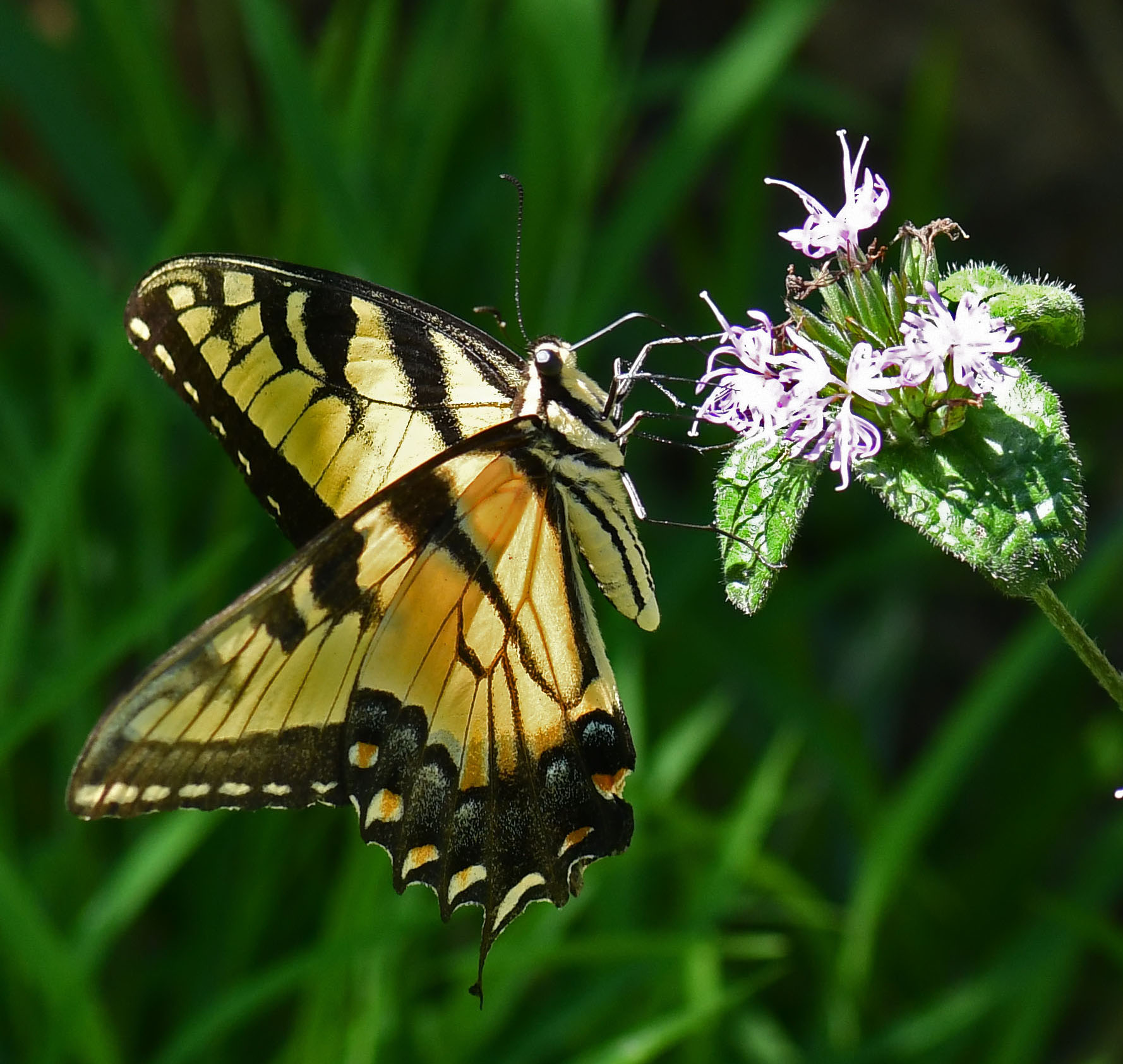
Eastern Tiger Swallowtail (Papilio glaucus), 8/19/23.   With a variety of host plants in the Magnolia and the Rose families, Eastern Tiger Swallowtails are fairly common across a wide range in North America.  In our yard, I'm guessing that they usually spend their larval time on Tulip Poplars, since we have several extremely large specimens of that majestic tree.  It's often easy to overlook the fact that trees can serve as important host and pollinator plants.


Zebra Swallowtail (Eurytides marcellus), 8/19/23).  If you don't have pawpaws, you won't have Zebra Swallowtails.  Our neighborhood has a plethora of pawpaws, in great part because deer don't like it and so it spreads with little competition in our deer-challenged yards.  Consequently, we have a plethora of zebra swallowtails.  Most of the time, these ethereal beauties are just floating through, but Hairy Elephant's Foot got them to stick around for a bit.


Common Buckeye (Junonia coenia), 8/20/23.  This was the first time I had seen a Common Buckeye in our yard.  I've started planting Carolina Petunias (Ruellia caroliniensis) as a "matrix plant" and it turns out that they, along with plantains, are host plants for Common Buckeye caterpillars, along with several other species.  So, was it a coincidence to see this one last summer, a year or two after I started adding Carolina Petunias to the yard?  Or the result of adding yet another native plant species to the local plantscape?


Silver-spotted Skipper (Epargyreus clarus), 8/23/23.  If you look very closely, you can also see a little crab spider under the flowers to the right of the skipper.  The caterpillars of Silver-spotted Skippers feed on many plants in the pea family, from Wisteria to Tick-trefoils, where they build a shelter with silk.  According to iNaturalist, it's unusual to see this species visiting yellow flowers;  they prefer blue, pink, red, purple and even white blooms.


Wavy-lined Emerald Moth caterpillar (Synchlora aerata), 8/23/23.  This is the only species of butterfly or skipper (or moth) that I have seen using Hairy Elephant's Foot as a host plant.  These little guys camouflage themselves by sticking pieces of the flower they are eating to their bodies, so this one has purple bits pasted to it, but the same species will have bright yellow bits on one of the Rudbeckias, white bits on Mountain Mint, etc.  Many times, it's hard to see the caterpillar body at all!  The adult moth is a very pretty light emerald green with wavy lines, as suggested by its name.

Other butterflies that I've observed nectarting on Hairy Elephant's Foot include the Sleepy Orange (Abaeis nicippe) and the Cabbage White (Pieris rapae).  Other skippers that I've observed include Horace's Duskywing (Erynnis horatius), Common Checkered Skipper (Burnsius communis), and Zabulon Skipper (Lon zabulon).


PEST CONTROL SQUAD - SOLITARY WASPS:

Wasps seem scary to many of us, but it's literally a few "bad apples" that have spoiled the barrel of public opinion.  Social wasps (paper wasps and yellowjackets) live in colonies, which they defend vigorously.  Solitary wasps, on the other hand, build nests by themselves and are not at all aggressive.  They will only sting if you attempt to catch them in your bare hands.  I have not observed any social wasps using Hairy Elephant's Foot, but I've observed several solitary wasp species doing so.

All wasps raise their larvae (their "babies") on meat, usually on paralyzed insects, sometimes on paralyzed spiders, and (for social wasps) on chewed up insects.  Because they raise their young on other insects and on spiders, wasps are important predators in our yards and gardens, helping to keep the populations of other species in balance and under control.

Solitary wasps paralyze various species of insect or spider and then lay an egg on the paralyzed prey.   Each different species of wasp preys on a different species of insect or spider.  After being paralyzed, the prey animal lives and provides fresh food for the larva when the wasp egg hatches.  Gruesome, to my mind, but very effective.


Double-banded Scoliid Wasp (Scolia bicincta), 8/20/23.  Scoliid wasps are scarab beetle predators, digging for beetle larvae (a.k.a. grubs) in the soil, paralyzing them, and laying an egg on each.  When the egg hatches, the wasp larva eats the beetle larva, then pupates in the host body.   These wasps are excellent grub control!  About 10 years ago, when we lived in south-central Kansas, I did an entire blog post on this species:  http://gaiagarden.blogspot.com/2014/08/double-banded-scoliid-wasp.html


Blue-winged Scoliid Wasp (Scolia dubia), 8/20/23.  Isn't this a cool looking wasp?!  I had never seen this interesting looking species before last summer.  As a scoliid wasp, it is another species that preys on scarab beetle larvae (white grubs), like the Double-banded Scoliid Wasp above.  It is thought that these species may also parasitize Japanese beetle larvae!  


Gold-marked Thread-waisted Wasp (Eremnophila aureonotata), 8/21-3/23.  I've always wondered how anything - food, blood, etc. - gets through that narrow waist!  Anyway, this interesting looking solitary wasp preys on larger moth larvae, like those of the sphinx moths and owlet & cutworm moths, for food for its larvae.


Fraternal Potter Wasp (Eumenes fraternus), 8/20/23.  There's a reason this little wasp is called a "potter wasp" - the female builds a gorgeous little mud pot in which she stashes the caterpillars that she paralyzes for her young to eat.  She then lays an egg and closes the pot, also with mud, making a perfect little nursery.


Weevil Wasp (Cerceris halone), 8/23/23.  Another solitary wasp, this wasp provisions the cells in her nursery burrows with paralyzed weevils from the genus Curculio.


A PREDATOR AND PREY DUO:

There are bees known as "cuckoo bees" that parasitize the nests of other bees.  Often this happens by the cuckoo bee following the female of its host species back to her nest.  When the host female departs for another load of pollen and nectar to provision her latest brood cell, the female cuckoo bee quickly ducks in and lays an egg.  Generally, when the egg of the cuckoo bee hatches, it either attacks and kills the larva of the host bee, or it hatches first and eats the egg of the host bee before it hatches.  Either way, the cuckoo bee larva then eats the provisions that the mother host bee stored for her own offspring, pupates, and emerges the following year in place of the young of the host bee.

The relationship between the host bee and the cuckoo bee is often very specific, with each cuckoo bee parasitizing only a single species.

How does the cuckoo bee find the host bee?  Well, she hangs out at the same "bar", so to speak.  The life cycles of the host bee and the cuckoo bee are perfectly timed to overlap, and both will be found nectaring at the same flowers.  I found such a pair using the blooms of Hairy Elephant's Foot in our yard:  the Two-spotted Longhorn Bee (host) and the Lunate Longhorn-cuckoo Bee (parasite).


Two-spotted Longhorn Bee (Melissodes bimaculatus), 8/20/23 - host bee.  This almost pure black bee gets its name from the two squarish white spots on either side of its abdomen.  Unfortunately, you can't see those field marks in this photo.


Lunate Longhorn-cuckoo Bee (Triepeolus lunatus), 8/20/23 - cuckoo bee (parasite).


NATIVE BEES - POLLINATORS EXTRAORDINAIRE:

More people are understanding the importance of our native bees for pollination.  The beloved Honey Bee is actually a European import, brought here by colonists who unsurprisingly wanted the honey it produced, as well as its pollination services.  But, for all we hear about honey bees pollinating plants, they are not as efficient at the job as many of our native bees are.

Before the European colonists arrived, there was no problem with pollination in North America.  This continent has almost 4000 species of native bees, often with life cycles exquisitely timed to coincide with those of the plant they evolved to partner with.  Some of these native bees are generalist pollinators, others are specialists who only pollinate one single species, still others pollinate the flowers of just a few plants.

I have not seen honey bees use Hairy Elephant's Foot, although that certainly doesn't mean they don't.  The bees I've seen pollinating this plant all fall under the heading of generalist native bees.  I'll start with two different bumble bee species.....


American Bumble Bee (Bombus pensylvanicus), 8/23/23.  According to iNaturalist, this species used to be one of the most common types of bumble bee, especially in the south, but 90% of its population has been lost in the last 20 years.  It is now considered threatened throughout much of its range.


Common Eastern Bumble Bee (Bombus impatiens), 8/20/23.  As its name implies, this is the bumble bee that I see most commonly in our yard.


Eastern Carpenter Bee (Xylocopa virginica), 8/20/23.  What looks like a bumble bee but has a smooth abdomen?  A carpenter bee.  Great pollinators, they do NOT eat wood...although they do tunnel into it to make their solitary nests.  The females will reuse existing nest tunnels, only taking the time and energy to excavate new tunnels when absolutely necessary.


Pure Green Sweat Bee (Augochlora pura), 8/20/23.  This beautiful little bee nests in rotting logs, a habitat that we have been restoring on our property.  The fertilized females also overwinter underneath rotting logs, waiting until it's time for them to emerge in the spring.


FLIES:

Many flies act as pollinators, although they are not as well known in that role as bees are.  The first species I share here is one of the relatively rare species I've seen on Hairy Elephant's Foot.


Yellow-thighed Thick-leg Fly (Tropidia albistylum), 8/23/23.  This is a relatively rare species of syrphid fly with a very unattractive common name.  As of this writing, there are only 212 observations of this species in iNaturalist, as opposed to 25,000-50,000 observations of two more common syrphid fly species that I've seen in our yard.


Greenbottle Fly (Lucilia sp.), 8/20/23.  This genus of flies (I can't identify this photo below that level) are scavengers, generally speaking.

There were at least 2 other species of flies that I photographed on Hairy Elephant's Foot, but I was unable to identify either of them further.


PASSERSBY:

Of course, in watching any plant or area, there will be some insects that just happen to perch for a while.  Rounding out this line-up of Hairy Elephant's Foot insect fans are a couple of those more incidental visitors....


Blue Dasher (Pachydiplax longipennis), 8/22/23.  This is a dimorphic species, meaning that the male and female look dissimilar.  This individual is a female;  it is the male that has the blue coloration for which the species is named.  Dragonflies are fierce predators of smaller insects.  I'm always hoping the ones I see are living up to their colloquial name of "mosquito hawks".


Eastern Tailed Blue butterflies (Cupido comyntas)  - and a Midge (7/30/23).   Hairy Elephant's Foot can even be used for a bit of canoodling, with or without a voyeuristic midge looking on.

In conclusion, Hairy Elephant's Foot is not a classically "beautiful" plant, but it sure packs a powerful punch for wildlife.  Including insects I've seen but not photographed, I've noticed over 30 different species using this plant - and the deer don't bother it at all.  If you can find a corner somewhere, I highly recommend it.  I've never seen Hairy Elephant's Foot "in the trade", but personal experience tells me that it transplants well.  Mine just showed up on their own.  Keep your eyes peeled or ask if anyone you know has some they'd be willing to share.  You'll be glad you did.  

Wednesday, January 30, 2019

Turkey Tangle Fogfruit Community

Certain plants seem to create large communities of insects and other wildlife within my garden.  I thought I'd do a series on a couple of these species, starting with Turkey Tangle Fogfruit (Phyla nodiflora).  As I've gone through my photos from last year, I realized I've got pictures from at least 23 different species of animals using this species in 2018 alone - and that's just the number I captured with my camera.  I know there were animals using it that I wasn't able to capture on film (like swallowtail butterflies).  I'm equally certain there were animals using it that I simply didn't see.

Fogfruit is not a showy species to my eye.  Although some people really like its dainty flowers, to be honest, I find this plant rather blah visually.  It is, however, a powerhouse for supporting pollinators and other insects and, as such, has earned a place in my yard whenever possible.

Essentially a groundcover, fogfruit grows around 8" tall.  About 3 years ago, I started out with 2 plants in gallon containers, planted 2' apart.  The fogfruit now covers an area that is about 6' X 8' - and it would be happy to be out in the driveway and into the street, too, if we didn't keep it trimmed back.  On the plus side, fogfruit manages to hold its space fairly well, once established, and doesn't need much of any care.

The first photos I have of the animals it harbored last year are from mid-May.

Here is a small spider that I saw on May 15th, then didn't see again all year.  It's a pretty little thing which the great folks at Antman's Hill on Facebook helped me to identify as an orbweaver, Gea heptagon.

On the same day, I captured a photo of this little syrphid fly (Toxomerus sp.) nectaring at one of the fogfruit blossoms.

Like others in this genus, the larvae of this fly feed on aphids, thrips, and small caterpillars throughout the garden, so it's nice to see the adult visiting.

By June 10th, the action was heating up.  There was this cute little orange "teddy bear" nectaring, a bee fly (Chrysanthrax cypris).

Cute as this guy is, its life cycle is less cuddly.  Flies in the Chrysanthrax genus are external parasitoids on the cocoons of some solitary bees and on the cocoons of tiphiid wasps, which are themselves predators of beetle larvae.  The "balance of nature" is sometimes hard for me to feel comfortable with and gracefully accept, but I do my best.

Throughout June and again in August, I have photos of another bee fly (Exoprosopa fascipennis) nectaring at the fogfruit.

Again, I find this an attractive little creature, but again its life cycle is rather fearsome.  The bee flies in Exoprosopa feed on the cocoons of many different kinds of wasps, including the tiphiid wasps mentioned above, spider wasps, and a group of solitary wasps known as sphecid wasps.

Speaking of wasps, in mid June, this scoliid wasp (Scolia nobilitata) was enjoying the fogfruit nectar, too.

Scoliid wasps are parasitoids of beetle grubs, especially the grubs of May beetles.  The females dig down to the grub, sting it to paralyze it, and deposit on egg. When the egg hatches, the wasp larva eats the perfectly preserved beetle grub.  I like my grub control to be natural (even if it is rather gruesome that way)!

Since both the bee flies and the scoliid wasp were nectaring at the same time on the same plant, it is possible that one or the other of the bee fly species parasitizes this scoliid wasp species, following females as they leave their feeding ground and search for beetle grubs to parasitize.  There is so much about these little guys that we simply don't know, even things as basic as which bee fly species parasitizes which wasp species.  Often these predator/prey relationships with parasitoids are very specific, confined to just one or two species, or perhaps between two particular genuses.

Moving back to less gory lifecycles, a couple days after photographing the pretty wasp above, I started capturing images of butterflies and skippers.  First was this Fiery Skipper (Hylephila phyleus) on June 16th.

 Since the larvae of fiery skippers dine on grasses such as St. Augustine, this species is relatively common.

On June 22nd, I photographed the first Phaon Crescent (Phyciodes phaon) of the year, although these photos are from later in the summer.


These cute little orange butterflies utilize fogfruit as their larval plant, as well as obviously nectaring on it.  Since I see quite a few of them, I'm pretty sure that my little patch of fogfruit is producing phaon crescents, but I've never actutally found one of the caterpillars.

Something sure likes to eat the fogfruit leaves, though!

I spotted this dainty damselfly hanging out around the fogfruit several times last summer. It's the only damselfly or dragonfly species that I photographed on the fogfruit last year, and the folks at Antman's Hill identified it for me as a male Rambur's Forktail (Ischnura ramburii).  That makes sense, as I've seen the (orange) female Rambur's Forktail in the yard multiple times, although I've never photographed one on the fogfruit.

There were several more wasps and bees over the course of the summer, including this potter or mason wasp on July 20th, .....

...and this paper wasp (Polistes metricus) on August 10th.

I actually don't see many paper wasps in the yard - which is fine with me.  Instead, I see lots of solitary wasps, who are generally much easier to share space with. 

One of my favorite finds was this cute little black leafcutter bee, the Carpenter Mimic Leafcutter Bee (Megachile xylocopoides).  As the name suggests, this stunning black bee with the fluorescent blue shimmer is considered a mimic of larger carpenter bees, specifically the Southern Carpenter Bee, which I also saw in my yard last summer.

Note the long hairs on the underside of the abdomen?  That's how you can tell it's a leafcutter bee - at least if it's a female.  Female leafcutter bees carry pollen in those hairs, often giving them a potbellied appearance.  This gal was apparently feeding herself, not gathering pollen for future offspring.

On August 8th, I was able to capture photos of a Barred Sulfur (Eurema daira) visiting...


...and if you look closely at the stem a few inches below the blossom, you'll see the wad of spittle that signifies a spittlebug nymph feeding - yet another insect species utilizing the fogfruit.

A few days later, I photographed this crisp Checkered Skipper (Pyrgus sp.).


Apparently, most skipper larvae fold and sew leaves together to make tent shelters for themselves, so don't be too quick to destroy any such structures you might come across in your garden.

Of the 23 species I photographed on my Turkey Tangle Fogfruit in 2018, the above photos were the most interesting and/or the insects were the most photogenic.  Rounding out my 23 species were 4 more species of flies, 2-3 species of small beetles, a honeybee, and two other bees I haven't been able to identify yet.

Like the plant they were visiting, most of these animals aren't large or particularly beautiful.  They are the everyday denizens of our gardens, busily living their lives and often feeding other animals in the process.  To me, each of these species has the right to exist, the right to its place on this Earth, just as much as any other species has that same right.  I hope that, someday soon, we humans can learn to coexist with the other plants and animals on this planet, instead of needlessly and carelessly destroying them.