Saturday, November 05, 2011

And This Year's Survivors & Thrivers Are.....

After a summer like this one, there are times when I am simply amazed that any plants survived. When I find plants that have thrived, they are true cause for celebration! This post is to honor those hardy plants that not only made it through the heat and drought with no special extra care, but those that have bloomed boldly and/or look particularly healthy as we head into the unknown winter.

In the pasture/restoring prairie areas and draw, I first want to give a shout out to the common ragweed (Ambrosia artemesiifolia) and giant ragweed (Ambrosia trifida). The plants aren't as tall as usual, especially the giant ragweed, but they had many blooms and should be loaded with seeds - so important because of the high value of their seed as food for wildlife. (In the photo above, taken in early September, Greg is posing by the giant ragweed in the draw. Normally these plants would be well over his head - as high as 10-12 feet in some years. This year they barely reached his waist.) As harsh as the weather's been through the growing season, I'm so glad that there is at least some plentiful, healthy seed to help the wild animals make it through the winter.

Also out in the pasture/restoring prairie areas, the dotted gayfeather (Liatris punctata) was adorned with many flowers this September - we had more plants, each with more individual bloom spikes, than we've had yet since we lived here!

Not as showy, but still interesting, the false boneset (Brickellia eupatorioides) was also much more prevalent than I've seen it before. The flowers are small and off-white, looking quite a bit like little threads gathered together in a small pom-pom. It doesn't take them long to turn into seed heads, complete with white "feathers," forming larger, round puffs that absolutely shine in the light when backlit by the sun.


Another flower that wasn't wildly showy, but seemed more abundant than in most years, was the heath aster (Symphyotrichum ericoides). The plants and even the flowers seemed smaller than usual, but conversely the plants were more abundant. They formed small white drifts among the grasses that almost looked like light drifts of snow and fed small armies of insect pollinators during the heat of the day when little else was blooming.


Moving out of our yard and into the wider landscape, the sunflowers (Helianthus spp.) were amazing this year. Maybe it was just that so many of the other plants were brown and dry and/or stunted, but the sunflowers seemed to glow even more brightly and golden than in most years. I'm planning on gathering seeds (tomorrow?) to increase the number of sunflowers on our property. They are simply too pretty and too hardy not to establish decent colonies on our property.


In the garden, of course, the aromatic asters (Symphyotrichum oblongifolium) have been astounding, as were the Wichita Mountains goldenrod (Solidago 'Wichita Mountains'). The sand love grass (Eragrostis trichodes) has loved the summer this year, too. (In fact, if anyone would like a seedling or two or ten of the latter, I have plenty to pass around!)

Most of the other natives are doing fine. The rose verbena (Verbena canadensis) required a little extra water during the worst of the heat and drought, as did the summer phlox (Phlox paniculata), but both appear to have survived without any serious problem. Next year, of course, I'll be able to tell a little more certainly about survival rates, but I have reasonable confidence that my prairie flowers will, for the most part, be fine.

It certainly hasn't been the prettiest year in the garden or on the prairie, but there's always next year!

Friday, November 04, 2011

Unsettling Questions This Fall

I'm feeling unsettled and on edge these days. The horrible, blast furnace heat of the summer is gone, but the drought remains. I don't know how best to handle putting my gardens to bed for the winter...or what dreams for next spring and summer are rational to indulge in.

Do I mulch over bare, dry ground? Or do I wait until we get a decent rain before mulching, so I lock in moisture, not dry soil? But if I wait, when will we finally get a good rain?

Maybe I should water well, then mulch? But my experience is that you can NEVER water enough to equal even a moderate rain. And our water is very hard, well water.

On the other hand, bare soil gets even drier, exposing the plant roots to more extremes of temperature, too.... What to do? And when to do it?


Then there's one of our cats, Ranger, a neutered black male. The first winter we had him (and after we finally let him become an indoor/outdoor cat, succumbing to his powerful need to be outside, hunting), I wrote posts about his attempts to hunt birds. He was so patently unequal to the task that it was comical.

Ranger is 2 1/2 years older now, and he has become a hunter extraordinaire, definitely living up to his namesake from Janet Evanovich's Stephanie Plum series. I put out my winter feeders about 2 weeks ago, in preparation for participating in the Cornell FeederWatch program this winter. In that 2 weeks time, he has caught, killed and mostly eaten at least 6 birds - all of them "good" birds. No house sparrows or starlings for this guy. On the worst day, he killed 2 in one day, a male cardinal and a Harris sparrow.


This photo shows Ranger, on the right, and Bella guarding the hummingbird feeder earlier this summer. Bella goes out, but she's not the one bringing the dead or almost dead birds back to the kitchen door on an almost daily basis.

Should I take my feeders down and consider my FeederWatch fee a donation to Cornell Lab of Ornithology? Or should I take a more Darwinian attitude: the fittest will survive? The feeders are all out in the open, so the birds have a fighting chance to see Ranger coming. By providing seed to augment the natural feed around, am I strengthening them...or just luring them in to become cat food?

(I've even put out the word that he would be available to someone who needs a barn cat - he's great at catching rodents, too - but there have been no takers.)

It's a tough autumn for me. I read others' garden posts about how much better their gardens are doing after the summer heat is gone and I'm glad for them, but the drought is still crippling us here. There have been no fall roses, no fall catmint, my hostas are gone....

Then I shake myself. The aromatic asters are lush and have lasted for weeks, despite the heat and drought. The Wichita Mountains goldenrod was spectacular. The gaillardia is vivid. The roses may not be blooming, but they look reasonably healthy. This weather is, after all, why I concentrate on prairie natives.

No matter what this winter and next spring bring, this past year has shaped my gardens significantly. That, however, is the challenge of gardening. This, too, shall pass. I hope.

Meanwhile.... Any suggestions about my mulching dilemma? Or the ongoing case of Ranger vs. the birds? I would greatly appreciate any words of wisdom!

Tuesday, November 01, 2011

Ephemeral - A Year in Review

[I've never done this before, but the word intrigued me, so I'm giving it a try. Garden Walk, Garden Talk has a Word 4 Wednesday in Photos challenge, and the word this week is "ephemeral." I came across the challenge in Gardens Eye View on Monday. Here goes....]

Ephemeral. Fleeting. Impermanent. Passing. Transitory. A Year in Review....

A dragonfly lived here....


A cottonwood leaf returned to the soil that nourished its growth....


Movement patterns were momentarily mapped in the water....


Blooms rapidly changed to seed (false boneset)....


For a brief moment, the sideoats grama blooms gleamed....


A baby (leaf miner) grew, highlighted in graphic form....


Golden blooms burst forth for a night and part of a day (on Missouri evening primrose)....


A yellow jacket comb melted back into the grassland it came from....


Frost created hieroglyphics on a wooden step one morning....


Birds left traces of their passage in the snow....


Winter sunlight, through lace, shone bravely on the wall....


How swiftly the year passed - ephemeral moments leaving long-lasting memories for the future.

Sunday, October 30, 2011

Aromatic Aster - The Most Popular Plant in the Fall (Butterfly Edition)

Two frosts now, but my aromatic asters are still going strong. (I LOVE native plants!!!)

I've been taking photos of many of the insects that have been visiting these asters over the last couple weeks. I'd love to say that this is a true cross-section of all insects that have been using the asters, but I've definitely been attracted to the prettier ones, had more luck photographing some of the less wary ones, and generally not paid much attention to the tiny ones. So, all in all, it's a pretty biased sample. That said, here goes.... (Speaking of "pretty ones," I thought that I'd start with the butterflies I've seen.)

I figured that I couldn't go wrong starting with everybody's favorite butterfly, the monarch. I haven't seen huge numbers of monarchs at any one time on the asters, but I've seen them come through, one at a time, almost daily. I even saw one as late as Friday! (Most of the monarchs came through a month ago now, though.)

As I mentioned a few days ago in an earlier post, I've also seen a new-to-me butterfly on the asters this fall, the western pygmy-blue. I've just seen the one individual on one day, although I've kept my eyes open for others every day since then. (A perfect example of the concept that, "the more you get outside and look, the more you'll see.")

Most folks will probably recognize this butterfly too - the painted lady. In past years, I've had up to a dozen or more painted ladies feeding at any one time on the aromatic asters. This fall their numbers seem to be much lower. There's almost always one in the garden, but I've never seen more than 2 at one time. On the plus side, I've been seeing lots of honey bees! (Note the honeybee, almost side by side with the painted lady in this photo.)

According to A Photographic Field Guide to the Butterflies in the Kansas City Region, a new field guide that I'm finding very useful, the painted lady is the most widely distributed butterfly in the world!

Another showy butterfly that I've enjoyed seeing regularly on the asters this fall is the common buckeye. Like the painted lady, buckeyes are a butterfly species that moves in and out of our area, generally moving northward in the spring and southward in the fall. In fact, they are unable to successfully overwinter in this area, so any we see here in south central Kansas are considered immigrants rather than residents.

Something else I find interesting about common buckeyes is that the underside of the wings is colored differently in fall individuals than in the spring individuals! The fall individuals, like the one shown here, have a distinct reddish tinge to the underside of the hind wing, while earlier individuals show almost no red tint at all.

In fact, different coloring in the spring and fall individuals of butterfly species turns out to be relatively common. The dainty sulfur, which I'm seeing more frequently this fall than ever before, is another of the seasonally patterned species and is the smallest of the sulfurs we'll see in this area. The darker color on the underside of its wings (dusty greenish-brown compared to bright yellow) allows fall individuals to absorb heat from the sunlight more efficiently than those that live earlier in the summer. Dainty sulfurs, too, are immigrant butterflies here; they are unable to successfully overwinter in our area.

I haven't seen any hairstreaks on my aromatic asters at home, but on my mother's in west Wichita, I found this gray hairstreak busily feeding away. These resident butterflies are generalists, even in the larval stages, and are thus very widely distributed across North America.

The upper surface of a hairstreak is very different looking from the underside, a not uncommon butterfly characteristic. In this case, to tell male from female, you have to see the upper surface of the abdomen, which has orange in a male and is gray in a female. This individual, therefore, appears to be female.

This pearl crescent is another generalist that is fairly widely distributed across the country. A resident butterfly, these guys actually overwinter in caterpillar form! (It amazes me that a caterpillar could survive the winters here.)


The last butterfly in my aster lineup this fall is the orange sulfur. This female is in flight and is therefore rather blurry, but you can still see her spotted "cloudy" wing margins and orangish yellow coloring. (The coloring on the male of this species actually has a UV component, which helps the females choose the right male compared to the similar, non-UV-reflecting clouded sulfur. We, of course, can't see that!)

As a further note about this last photo, the awkwardness of butterflies photographed in flight always seems odd to me, compared with their gracefulness and beauty when seen with the "naked" eye. Seen in stop-motion, flight actually looks like quite a chore for them.

The butterflies are actually a relatively minor component of the insect population flitting from flower to flower among the asters this fall, but they certainly capture my eye. Next on my aster-visitor recording session will be the pollinator workhorses, the bees.

Friday, October 28, 2011

What Do You Do To Care for Nature? I Leaf Rustle!

Last night I attended a focus group about climate change, presented by a group based at K-State. We had a great moderator, a retired political science professor, which was a good thing, because this is a topic that has a great propensity to get testy.

The point of the focus group wasn't to decide if climate change was occurring or not (although it was very hard to stay away from that argument!), but rather to brainstorm ways that folks could be educated about climate change.

One of the ideas that came up over and over again was how important it was for people to learn about small, doable, inexpensive or free, ideas - things they could do without feeling like they had to completely change or rearrange their lives. Things they could do without spending a lot of money, too.

Another point that came up was how almost everyone lit up over the idea of wildlife and nature. There was basically no disagreement that helping nature was a positive thing to do.

It struck me this morning that many, many people - whether they "believe in" climate change or not - already do things to help care for nature. So I thought it might be interesting to share some of those ideas, looking for ideas that we can "steal" from each other to make the world a little healthier for us as well as for animals.

I'll start the ball (hopefully) rolling: I pick up bags of leaves left out for the trash and bring them home to make mulch for my flowerbeds. By doing this, I hope to keep some trash out of the landfill and to make the soil in my beds moister and healthier. It's also essentially free! And the flowerbeds look really nice with a fresh layer of chopped leaf mulch on them.

So that's my first idea. What do YOU do???

Sunday, October 23, 2011

My Not-So-Big [Bird] Year

In honor of The Big Year, a surprisingly good movie that Greg and I went to see last Friday, I thought I'd post a few bird shots from 2011.

This is my most recent bird photo, taken this morning when a hungry white-crowned sparrow forgot that I was less than 10' away and flew in to grab a bite while I was photographing insects on the aromatic asters. White-crowned sparrows are only here during the colder months - the way this guy was eating, he was a new arrival needing to fill up after a long migration.


These next two are from our recent trip to the east coast, both taken at a beach in Acadia National Park. The first one is of a semipalmated sandpiper....


and the second one is of a semipalmated plover. Greg took both of these shots! And although the photos were taken in Maine, these two species migrate through Kansas as well.


The next photo is of a highly irritated Carolina wren who was indignant at my lengthier-than-usual trespass into his/her territory while I was trying to photograph a ground-nesting wasp in the front garden on August 1st.. He/she had babies to feed!


While we were on the spring garden tour on May 21, I noticed this pair of turkeys who seemed really curious about all the fuss and bother going on in their normal feeding grounds.


Photographed in our front yard on April 16th, the male red-winged blackbird at the top of this next picture wasn't satisfied with just red and gold wing epaulets - he was sporting a light gold and pink necklace as well! His more normally clad relative is at the bottom of the picture.


And, lest we forget that seasons change dramatically in Kansas, here is a photo of a female red-bellied woodpecker on the leeward side of a tree trunk last February, taking shelter from the bitterly cold wind.


If these photos intrigued you at all, be sure to see The Big Year. It's a fun movie with appealing human-interest story lines and some pretty decent shots of scenery and birds around the country. Who knows? Maybe you'll decide that birding isn't so odd after all, and feel inspired to do a little binocular time yourself!

The Aster and the Pollinators - A Love Story for All Time


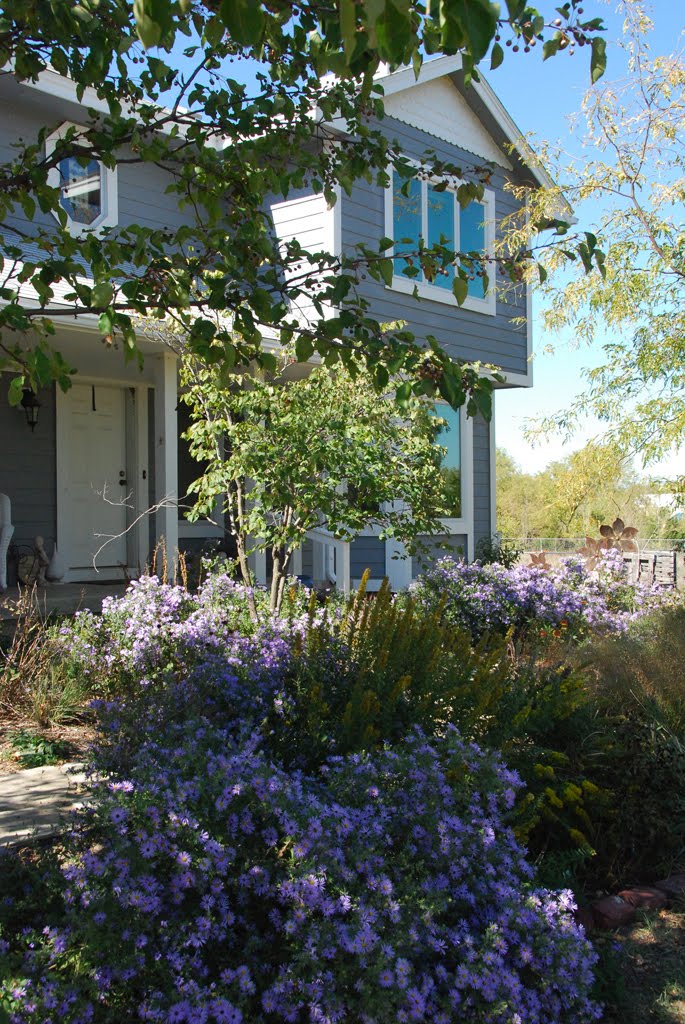
This time of year gives me a smile on my face and a warm, buzzy feeling - make that a warm, buzzy sound in my ears - every time I step out the front door during the day. The aromatic asters are in full bloom and, when the sun is shining, you can hear the contented sound of bees and flies from across the yard. The view above, taken today, is looking across my very summer-tattered front garden; most of the aromatic asters that you see blooming here are (probably) Radon's Favorite or seedlings.

If I walk near one of the lavender-coated mounds, a cloud of insects briefly swirls up into the air, before settling back down to the serious business of feeding on nectar and pollen.

Combined with a bright blue sky and a light breeze, it feels like my own little piece of heaven here on Earth.

Aromatic aster (Symphyotrichum oblongifolium) is native to Kansas, although the varieties that I have planted in my front garden are, I believe, from Texas (Radon's Favorite), Texas via southwestern Pennsylvania (October Sky) and ?South Dakota? (Dream of Beauty). Be that as it may, they are all thriving and providing a wonderful fall feast for the local insect tribe.


At about 12" tall and shown above, on September 26th, Dream of Beauty is the shortest of the 3 varieties that I have, blooming the earliest for me. Instead of the purplish-blue (or lavender) of the other varieties, its flowers are actually a very pretty, light pink. These finished blooming 2-3 weeks ago now. They are my newest aromatic aster additions, having just been planted within the last 18 months. I bought them from High Country Gardens. (It amazes me that the newest little one, planted just this spring, survived the summer and actually BLOOMED this fall!)

At about 2' tall, October Sky is supposed to be the next tallest variety. Truthfully, I lost the labels to my October Sky and Radon's Favorite aromatic asters within a year of planting them, so I'm just guessing about which is which in my garden, based solely on height. Other than height, the plants and blossoms of these 2 varieties look identical to me. My 2' tall aromatic asters, which are therefore presumably October Sky, are just beginning to come into bloom now.

Radon's Favorite is the tallest variety I have planted, reaching about 2 1/2' tall. Time-wise, they seem to be blooming "in the middle" this year, after the shorter Dream of Beauty but before the 2' tall October Sky. That is, of course, assuming that the tallest aromatic asters I have in the garden are actually Radon's Favorite!


Here is a photo of aromatic aster in front of Wichita Mountains goldenrod, taken about a week ago. The lighting isn't very good, but it's one of my favorite plant combinations for both color and form. Last year, with a lot more water during the early part of the summer, the Wichita Mountains goldenrod was a little floppy and developed rust. This year, as dry as it's been, they are much more upright and their foliage is clean.

All of my aromatic asters survived this blistering hot, dry summer with almost no supplemental water. A few of them received a little extra water as we tried to establish the buffalo grass, but I never had to water any bed because these guys looked stressed.

If I faced the old conundrum of taking only one species of plant to a desert island, aromatic aster would be one of the finalists for me...but even as I write that, I realize what a stupid concept that would be. If I were stranded on a desert island, I'd want to try to figure out what was native there and garden with it!

So scratch that idea and just know that, if you garden anywhere this plant is native, I would HIGHLY recommend it for color, pollinator attraction, hardiness and just plain beauty. Give it a try, if you haven't already.

Saturday, October 22, 2011

A Dainty Blue

Yesterday I pulled one of my "see-if-I-can-photograph-all-the-various-insects-that-are-feeding-at-my-aromatic-asters" marathons. I'll be sharing quite a few of those with you over the next couple posts (Yeah! for native plants!!!), but I wanted to post this one right away.


This is the western pygmy-blue butterfly - the first one I've seen in my yard. (In truth, it's the first one that I've ever seen where I paid enough attention to it to identify it.) There are apparently 2 pygmy-blues, an eastern and a western species. They are the smallest North American butterflies! Note that the aromatic aster blossoms are generally about 1 1/4" in diameter, from petal tip to petal tip....


In this second photo, you can see a little bit of the underside of the wings, which looks very different from the topside, but is quite pretty in a more understated sort of way. The blurry thing to the right of the pygmy-blue is a honeybee on a nearby bloom.

According to Kaufman's butterfly guide, the western pygmy-blues are common in salt marshes, desert salt flats, and disturbed alkaline areas. We are a little east of their normal range, which corresponds fairly well with the dryer regions of the southwest - I guess our summer from hell made them feel right at home.

Tuesday, October 18, 2011

"What We Did On Our [October] Vacation"

We toddled off to Boston about 2 weeks ago for a long overdue visit with our son, Sean. I was finishing David Abram's interesting book, Becoming Animal, at the time and I fully expected to feel a little "out of place" when we first landed...but, truthfully, I didn't.

After we'd been there for a few days, I started noticing things that surprised me. We walked a lot and used public transportation almost exclusively while we were in Boston itself. I loved it (despite my bad knees). In fact, by the 4th or 5th day, my knees were doing somewhat better, which seemed counter-intuitive since the pain is caused, at least in part, from disappearing cartilage. I noticed, too, that the people who walked and used public transportation seemed to have a much lower incidence of obesity than is standard for our country. (It was actually a rather glaring difference.)

Locally sourced foods were rather easy to find in the restaurants - many restaurants even listed "their" local farms by name. The selections in these restaurants were always fresh and delicious and often served in unusual ways.

Sunday brunch at Henrietta's Table in Harvard Square, a gustatory extravaganza that Sean was eager for us to experience, was particularly spectacular. I have to say that getting the chance to sample all of the local foods was really exciting and enjoyable, as I only know one restaurant here in the Wichita area that works with local foods (Lotus Leaf in Delano - which is excellent, by the way).

On the natural front, though, things were a little less rosy. I didn't hear the wind rustling the leaves in the trees there, and it's a constant accompaniment to life here. I missed it. There were few birds around and even fewer bird songs...and I didn't see any bird feeders set up at all. At one point near the Boston Museum of Science, we heard a mockingbird in a small group of Bradford pears and stopped to try to see it, but it had hidden itself craftily out of sight. Yes, Boston is a city, but it still seemed light on bird life in comparison to other cities I've visited. Maybe it was just the season.

There were more honeylocusts being used as street trees than I expected. Somehow I think of this species as a plains tree rather than as an eastern deciduous woodland tree. Occasionally the honeylocusts were used particular effectively. This photo is of an allee of honeylocusts leading from Harvard Square down to the riverside park. I'd never thought of using them in this manner, but it created a distinct sense-of-place with a pleasant, lacy effect...if not the gravitas that I might have expected for a path coming off of Harvard Square!


We were able to make it a little ways up the coast of Maine during the middle of the week while Sean was working. The Rachel Carson National Wildlife Refuge called to us and we enjoyed the opportunity to learn a bit about how the salt marshes along the coast work, as well as enjoying some very pretty fall foliage (photo above). The office had binoculars and a bird guide available to borrow, so I was even able to do a little birding. It was early afternoon, which is hardly a grandly productive time to bird, but I managed to see several fun species: a male black-throated blue warbler (the first I've seen in a long time!), a small flotilla of green-winged teal, and several white-throated sparrows.

Although this last has little to do with nature, we stopped for the night in Camden, Maine, and went down to the harbor to look around. Both of us were rather amazed and amused at the way they now winterize some of the boats, including fairly large sailing vessels - they shrinkwrap them! One had been completed and 2 more were in the process of being "put to bed" in this way. I can only imagine the comments that the ghosts of sailors past are making!


Although I'll spare you further descriptions, we had many other interesting and enjoyable experiences while we were there - a great tour guide on the Freedom Trail, lunch at the Green Dragon pub where the Sons of Liberty often met, the chance to see an excellent exhibit on Pompeii at the Science Museum, and, of course (and foremost!), the chance to enjoy a wonderful visit with Sean and Tina. All in all, a great getaway.

Sunday, October 16, 2011

Marching for A Principle

I did something last weekend that I never dreamed I would ever do: I marched in a protest.

We were in Boston, visiting Sean, and we decided to go to the Boston Commons on Monday, Columbus Day, to see what the Occupy Boston rally was doing. It seemed so appropriate - we had just walked the Freedom Trail a few days before and we were going to get a chance to see freedom of speech in action...and on the Boston Commons, no less! This first photo shows people beginning to gather on the Commons for the march.


This was primarily a day for students to protest, but others were joining in too. As a true grass-roots movement, the messages were mixed and most were not professionally choreographed. Signs were on everything from cloth banners to posterboard to scraps of recycled cardboard. Some were well done, most were emotionally hand-lettered, only a few were distracting and definitely just attention seeking. The sign below captured the mood quite well.


Although the topics ranged from wanting better support for education... to anger at the bank bailouts...


to the need for decent health- care... to pleas for more jobs, most signs were (in one way or another) firmly against any more money being concentrated in the hands of a few rich people at the expense of the vast majority of Americans. Only a couple anti-capitalists or anarchists seemed to be in attendance; definitely a relatively minor note overall.


There were student groups from several of the big universities attending - this group from Tufts, for example, marched in together, proudly proclaiming their school affiliation. Several other similar groups did the same, but I didn't get a chance to see their signs. Sean had heard that Harvard, MIT, Boston University, and others were all sending contingents.

There were teachers' groups there too, like this one from Cambridge. Greg even noticed a cluster of medical students!


As you would expect from academics, some of the signs were more textbook chart or English paper quote than rabble-rousing rhetoric. (Note the citations at the bottom of the charts!)


Those of you who knew me long ago will realize that I'm generally not a very public-protest sort of person. Those of you who know me now will realize that I sympathize much more with the Occupy Boston marchers than with the uber-rich who are currently controlling our country for their own benefit. Those two sides of my personality were definitely vying for supremacy as we watched the marchers gather and I began to think about joining in the march.


Ultimately, though, I simply decided that if a principle was worth believing in, it was worth standing up for - so Greg and I joined the marchers as we walked from the Boston Commons, through the narrow city streets, and down to Dewey Square. Many folks stood along the sidewalks or at the windows above and watched as we went by. Quite a lot of them took photos. A few gave us a thumbs' up sign or a victory "V". Some watched impassively. Greg only saw one old man who gave a thumbs' down signal, and I didn't see anyone who was overtly negative.


Did the march cause any particular change? Probably not. But I'm glad I was there, and I'm glad I decided to march along. Democracy only works if citizens get involved. When we convince ourselves we're "too good" for politics, I'm more and more convinced that we give away control of our country's destiny into the hands of those who will mine it for their own personal gain. And that's not something I want to sit quietly by and let happen.