Some day I'll laugh about this....
About 11:15 a.m., I heard my German shepherd start barking like he meant business, so I rushed to the laundry room door and started outside to check it out. He was right there on the breezeway, barking at something in the corner. Our oldest English setter was there too, scrambling out of the same corner.
So I looked to the left, into the corner...and started saying some VERY unlady-like words as I hurriedly backed back into the laundryroom. The young skunk, who was itself backed into the corner 5' away from me, immediately squirmed its rear sideways and sprayed right at my face and chest.
It was one of those slow motion moments in life. I could see the droplets coming, but I couldn't get out of the way fast enough. The spray droplets were not small, but rather large. Interestingly, skunk spray up close and personal smells different...and it seemed to take a little while to really get fully fragrant.
I won't bore you with the rest of my activities today, but suffice it to say that most of them revolved around de-aromatizing myself, my clothes, the dogs, the breezeway, etc. etc. I found a recipe that worked fairly well, but it still took time and a lot of work. Unfortunately, too, I had to walk around the kitchen putting together the ingredients and now I find that every drawer handle and every surface I touched has to be decontaminated. Based on my mother's nose, I'm now skunk-free, but both dogs still have a little around their muzzles and the breezeway is better, but not totally skunk-free. I get small whiffs throughout the kitchen, too. More fun tomorrow, I guess.
Someday I'll laugh....
Wednesday, May 30, 2007

Friday, May 25, 2007
Fungus Amung Us
Okay. Yes, that title is really bad. But, for better or for worse, that's what pops up into my head whenever I see interesting mushrooms or other forms of fungi growing in my yard.
 We cut down the cottonwood that had died from beetle infestation earlier this spring. With all of this damp weather, there has been an interesting crop of mushrooms growing on the remaining stump and above the roots underground. This photo to the right is of the mushrooms growing above the dead cottonwood roots, taken in early May.
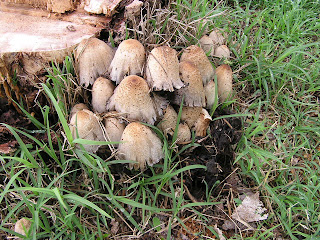 I know almost nothing about mushrooms, but these mushrooms growing immediately adjacent to the stump appear to be a different species than the ones pictured above, which grow further away from the stump, out in the grass. The photos were taken on the same day.
 The third variety of fungus that caught my eye earlier this month was a series of these interesting red jobbies. As far as I can tell, they are some form of stinkhorn, although the head of the species pictured in "A Guide to Kansas Mushrooms" does not look much like the "head" of the ones that I found in my yard.
 We cut down the cottonwood that had died from beetle infestation earlier this spring. With all of this damp weather, there has been an interesting crop of mushrooms growing on the remaining stump and above the roots underground. This photo to the right is of the mushrooms growing above the dead cottonwood roots, taken in early May.
 I know almost nothing about mushrooms, but these mushrooms growing immediately adjacent to the stump appear to be a different species than the ones pictured above, which grow further away from the stump, out in the grass. The photos were taken on the same day.
 The third variety of fungus that caught my eye earlier this month was a series of these interesting red jobbies. As far as I can tell, they are some form of stinkhorn, although the head of the species pictured in "A Guide to Kansas Mushrooms" does not look much like the "head" of the ones that I found in my yard.
With all of the cool moisture over the last two days, it's probably time to look for some more interesting fungi. Maybe I can even teach myself a thing or two about what I'm looking at!
Vertebrate Co-Inhabitants
On the last post, I shared a few invertebrate compatriots from our property. This time I thought I'd share photos of a few vertebrates that I've met this month (and that allowed me to photograph them).
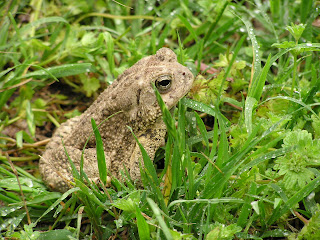 Back on May 2nd, we'd just had our large, deep window well covered with a fancy "hat" when Prairiewolf noticed a toad in the newly sealed off area. So I climbed out through the window into the well to perform a rescue. When I got in there, I actually found 4 very large, very healthy specimens that I proceeded to liberate, getting to try out our new escape hatch in the process. By the time that I got back up to the outside, only 2 of the toads had stuck around, but I managed to get fairly good photos of both of them. This is the most photogenic of the two, mainly because of the setting. (The other was on gravel, next to our not-very-exciting-or-colorful foundation.)
 The next day, I noticed our German shepherd and English setter puppy interestedly nosing something in the grass. When I went to investigate, I found this turtle. I don't remember seeing this species before, and since I am still without my guidebooks, I'm simply posting the picture without further identification. The turtle did reek, which makes me wonder whether it is a stinkpot. Incidentally, I immediately rescued it from the attentions of the dogs. It did the normal turtle thing of waiting for a bit in its shell, then hightailing it for wherever it had been heading originally. Once it got going, it actually moved fairly rapidly.
 About a week later, I was able to get a couple shots of the fox squirrels that have finally learned about the bird seed smorgasbord in our courtyard. They'd visited from the swale a few times before, but now they are regular customers...which I have mixed emotions about. Fox squirrels are so much more destructive than gray squirrels around homes that I'm a little nervous about luring them up this close to the house.
+in+the+mud,+11+May+2007.JPG) Finally, I have evidence of a big bird in the Beyond, but I'm not sure what the bird is. The tracks are almost as long as our 110 lb. German shepherd's paws are broad, but there is no sign of a 4th toe. Does that make them likely to be turkey or great blue heron? Or maybe great egret? Any one of them would be a new yard bird.
Finally, I have evidence of a big bird in the Beyond, but I'm not sure what the bird is. The tracks are almost as long as our 110 lb. German shepherd's paws are broad, but there is no sign of a 4th toe. Does that make them likely to be turkey or great blue heron? Or maybe great egret? Any one of them would be a new yard bird.
 Back on May 2nd, we'd just had our large, deep window well covered with a fancy "hat" when Prairiewolf noticed a toad in the newly sealed off area. So I climbed out through the window into the well to perform a rescue. When I got in there, I actually found 4 very large, very healthy specimens that I proceeded to liberate, getting to try out our new escape hatch in the process. By the time that I got back up to the outside, only 2 of the toads had stuck around, but I managed to get fairly good photos of both of them. This is the most photogenic of the two, mainly because of the setting. (The other was on gravel, next to our not-very-exciting-or-colorful foundation.)
  The next day, I noticed our German shepherd and English setter puppy interestedly nosing something in the grass. When I went to investigate, I found this turtle. I don't remember seeing this species before, and since I am still without my guidebooks, I'm simply posting the picture without further identification. The turtle did reek, which makes me wonder whether it is a stinkpot. Incidentally, I immediately rescued it from the attentions of the dogs. It did the normal turtle thing of waiting for a bit in its shell, then hightailing it for wherever it had been heading originally. Once it got going, it actually moved fairly rapidly.
  About a week later, I was able to get a couple shots of the fox squirrels that have finally learned about the bird seed smorgasbord in our courtyard. They'd visited from the swale a few times before, but now they are regular customers...which I have mixed emotions about. Fox squirrels are so much more destructive than gray squirrels around homes that I'm a little nervous about luring them up this close to the house.
+in+the+mud,+11+May+2007.JPG) Finally, I have evidence of a big bird in the Beyond, but I'm not sure what the bird is. The tracks are almost as long as our 110 lb. German shepherd's paws are broad, but there is no sign of a 4th toe. Does that make them likely to be turkey or great blue heron? Or maybe great egret? Any one of them would be a new yard bird.
Finally, I have evidence of a big bird in the Beyond, but I'm not sure what the bird is. The tracks are almost as long as our 110 lb. German shepherd's paws are broad, but there is no sign of a 4th toe. Does that make them likely to be turkey or great blue heron? Or maybe great egret? Any one of them would be a new yard bird. Monday, May 21, 2007
Invertebrate Neighbors
One of the things that I most enjoy about gardening and living out in the country is the wildlife with which I get to share my life and the yard. I've gotten way behind the power curve in sharing photos of some of these creatures, but I'll try to catch up a little today.
 Early May has been a busy time in the yard. I went out to get the paper early in the morning on my birthday (May 3) and found this imposing edifice which had been constructed in the middle of the driveway overnight. If you look very closely, you can see the reddish brown ants who are still busily working on it. I put the dandelion bloom in the picture for scale, but the photo still doesn't do their castle walls justice: these walls were about 1 1/2" high and cliff-like in their design. By later that day, the hill was gone..or at least flattened into an ordinary and unrecognizable state. The fleeting nature of even impressive architecture....
 Milkweeds have always fascinated me, in part because of the invertebrate communities that thrive in and on them. Currently the milkweed in bloom in our yard is green antelopehorn, Asclepias viridis. It's not a colorful bloom, but it fascinates me...and definitely attracts quite a few insects as well.
 In the Back of Beyond, I found this caterpillar also enjoying life on green antelopehorn. It's obviously not a monarch caterpillar, but my guidebooks are still packed and I have no way to identify it right now. At any rate, it's an interesting and rather pretty beastie.
 About a week ago, I was in the right place at the right time and was able to catch this hawkmoth feeding on dandelions in the front yard. The dandelions have been especially "productive" this spring: I saw the first, tattered monarchs nectaring at them in late April. The monarchs have been continuing to enjoy their bounty, as have numerous swallowtails and other butterflies.
 Early May has been a busy time in the yard. I went out to get the paper early in the morning on my birthday (May 3) and found this imposing edifice which had been constructed in the middle of the driveway overnight. If you look very closely, you can see the reddish brown ants who are still busily working on it. I put the dandelion bloom in the picture for scale, but the photo still doesn't do their castle walls justice: these walls were about 1 1/2" high and cliff-like in their design. By later that day, the hill was gone..or at least flattened into an ordinary and unrecognizable state. The fleeting nature of even impressive architecture....
  Milkweeds have always fascinated me, in part because of the invertebrate communities that thrive in and on them. Currently the milkweed in bloom in our yard is green antelopehorn, Asclepias viridis. It's not a colorful bloom, but it fascinates me...and definitely attracts quite a few insects as well.
 In the Back of Beyond, I found this caterpillar also enjoying life on green antelopehorn. It's obviously not a monarch caterpillar, but my guidebooks are still packed and I have no way to identify it right now. At any rate, it's an interesting and rather pretty beastie.
 About a week ago, I was in the right place at the right time and was able to catch this hawkmoth feeding on dandelions in the front yard. The dandelions have been especially "productive" this spring: I saw the first, tattered monarchs nectaring at them in late April. The monarchs have been continuing to enjoy their bounty, as have numerous swallowtails and other butterflies.
 Dandelions are not necessarily my favorite plant, but I have to admire the lacy, mathematical perfection of their seedheads and the bright sunny freshness of their blossoms. When I add their obvious benefit as an early source of nectar, I think the balance tips in their favor.
Single species grass lawns are so monotonous anyway. How much more exciting a yard is with the bright color and life of dandelions!
The Restoration of a Degree of Faith
I'm feeling much more optimistic this afternoon. My faith is being restored, or at least part of it. I called the plumbing company this morning about the water softener bill and the owner was appalled that we'd been billed like that. He promised a revised bill for the originally agreed upon amount and even volunteered to come by personally to help trouble shoot the softener since his employees hadn't looked too hard trying to find the problem. Then we proceeded to have a very enjoyable conversation, with topics ranging from why he ran for city council to whether TV is good for us. Now THAT's why I tend to enjoy life in small town America.
No news yet about either the heat pump or Westar's "trimming" of Mom & Dad's trees.
No news yet about either the heat pump or Westar's "trimming" of Mom & Dad's trees.
Sunday, May 20, 2007
Sour Grapes
It's 12:45 a.m. and I'm normally sound asleep at this hour. But tonight my mind is circling over several frustrations with the local business community that are unfortunately souring my outlook...and obviously interrupting my sleep.
The most recent is a plumbing company that agreed to come out for $100 trip charge to look at our water softener and see if it could be repaired, since it doesn't seem to be consistently putting out soft water. When the guys got here, they quickly peeked into the brine tank, then briefly glanced "under the hood" and asked me to explain what it was doing. They did not test the water for hardness. They did not actually open the gauge section to see what the meter was set on as far as gallons/recharge or to see how the recharge cycle was set. They left in less than 10 minutes, after telling me that they figured we just ought to put in a new water softener, to the tune of $1000. The bill for this cavalier treatment came yesterday. It wasn't for the $100, which I'd been quoted and therefore expected, although that seemed extremely excessive for the non-job they did. No, it was for $240 - including 2 hours labor for 2 men each, plus a $40 trip charge. They charged me for time going to and from another job, which was between me and their home base, and for the fact that the other job required 2 men, so that an extra person was along for the ride when they stopped by my house. To say that I feel cheated is putting it lightly.
This is on top of on ongoing problem with our geothermal heat pump. We've been without any functional heating/air conditioning except for emergency electrical backup heat since April 12. I hesitate to go into detail, but suffice it to say that I'm not positively impressed with the company we're having to deal with. They've got a long way to go to regain my trust...if they ever had it.
Last but hardly least, I've spent quite a few hours over the past several months trying to help my parents salvage some beautiful trees along the back part of their property. After years and years of not bothering to trim them at all, despite several requests from my parents as a tree limb grew around an electric wire, this spring Westar decided it was time to do a 5+ year trim. (The tree limb around the wire issue was solved by an Oklahoma Power & Light crew during the ice storm clean up several years ago.) We looked into the option of burying the electrical lines but, as far as I could tell from the marginal assistance I could get out of Westar, that option would be over $10,000 and therefore too expensive when all was said and done.
So we waited and hoped for a bearable outcome. The process has dragged out interminably. They finally came and did their drastic cuts this week and we thought they were done. We were mourning the loss of beauty and grace, but learning to live with the new reality. The original cuts were not easy or enjoyable to watch, but we're not stupid and we know that they were necessary for safety...even if the 12' radius in all directions seemed excessive. However, we appreciated the fact that the crew did a professional and careful job, leaving no stubs and only getting into the bark collar on a few cuts.
Now they've come back and say that they want to cut out even more. The cuts they are planning will take out the center of the trees down to the ground and will destroy any hope of the trees ever recovering any beauty and function in the landscape. These are 40 year old trees in the prime of their life, with an expected lifespan of 75 years. They've made my parents' yard unique and special in a prairie state. These next cuts planned are just plain meanness.
I can't think of a good thing to say about the business community right now. I know in my head that they are not all greedy, lazy, and mean - I've met many very nice, helpful business folks over the years - but it sure seems that many of the ones I've been dealing with lately have been unethical, incompetent, and/or nasty. What ever happened to providing a service, taking care of the customer, and taking pride in a good job well done? And whatever has happened to consumer protections and watching out for the little guy? Is a hardnosed scramble for money all that we've left ourselves in this country?
The most recent is a plumbing company that agreed to come out for $100 trip charge to look at our water softener and see if it could be repaired, since it doesn't seem to be consistently putting out soft water. When the guys got here, they quickly peeked into the brine tank, then briefly glanced "under the hood" and asked me to explain what it was doing. They did not test the water for hardness. They did not actually open the gauge section to see what the meter was set on as far as gallons/recharge or to see how the recharge cycle was set. They left in less than 10 minutes, after telling me that they figured we just ought to put in a new water softener, to the tune of $1000. The bill for this cavalier treatment came yesterday. It wasn't for the $100, which I'd been quoted and therefore expected, although that seemed extremely excessive for the non-job they did. No, it was for $240 - including 2 hours labor for 2 men each, plus a $40 trip charge. They charged me for time going to and from another job, which was between me and their home base, and for the fact that the other job required 2 men, so that an extra person was along for the ride when they stopped by my house. To say that I feel cheated is putting it lightly.
This is on top of on ongoing problem with our geothermal heat pump. We've been without any functional heating/air conditioning except for emergency electrical backup heat since April 12. I hesitate to go into detail, but suffice it to say that I'm not positively impressed with the company we're having to deal with. They've got a long way to go to regain my trust...if they ever had it.
Last but hardly least, I've spent quite a few hours over the past several months trying to help my parents salvage some beautiful trees along the back part of their property. After years and years of not bothering to trim them at all, despite several requests from my parents as a tree limb grew around an electric wire, this spring Westar decided it was time to do a 5+ year trim. (The tree limb around the wire issue was solved by an Oklahoma Power & Light crew during the ice storm clean up several years ago.) We looked into the option of burying the electrical lines but, as far as I could tell from the marginal assistance I could get out of Westar, that option would be over $10,000 and therefore too expensive when all was said and done.
So we waited and hoped for a bearable outcome. The process has dragged out interminably. They finally came and did their drastic cuts this week and we thought they were done. We were mourning the loss of beauty and grace, but learning to live with the new reality. The original cuts were not easy or enjoyable to watch, but we're not stupid and we know that they were necessary for safety...even if the 12' radius in all directions seemed excessive. However, we appreciated the fact that the crew did a professional and careful job, leaving no stubs and only getting into the bark collar on a few cuts.
Now they've come back and say that they want to cut out even more. The cuts they are planning will take out the center of the trees down to the ground and will destroy any hope of the trees ever recovering any beauty and function in the landscape. These are 40 year old trees in the prime of their life, with an expected lifespan of 75 years. They've made my parents' yard unique and special in a prairie state. These next cuts planned are just plain meanness.
I can't think of a good thing to say about the business community right now. I know in my head that they are not all greedy, lazy, and mean - I've met many very nice, helpful business folks over the years - but it sure seems that many of the ones I've been dealing with lately have been unethical, incompetent, and/or nasty. What ever happened to providing a service, taking care of the customer, and taking pride in a good job well done? And whatever has happened to consumer protections and watching out for the little guy? Is a hardnosed scramble for money all that we've left ourselves in this country?
Tuesday, May 08, 2007
The Weather "Gods" Are Stirring
The sun is finally out, playing peek-a-boo between the clouds. It feels wonderful, like a reprieve from a punishment that we knew we were getting, but didn't understand why.
It's been an odd year, weatherwise, here in south central Kansas. At least, it seems that way to me. We've had 80 degree weather in February, 6-8" of snow bracketed by ice that stayed on the ground for weeks, several 3" rains, and now a seemingly endless series of strong storms, rain and, most scarily, major tornadoes. Many schools have even been shut down across the state, due to flooding. I can't ever remember hearing about that occurring on such a widespread basis before.
My brother called me on Sunday to tease me about carrying the bad weather from the Gulf Coast to the Central Plains when we moved. Sometimes it feels like he's right.
I know that any one of these events - warm weather in mid-February, snow & ice, strong storms, floods, tornadoes - is quite normal for Kansas. Even a couple of them in the same year wouldn't be unusual. That's what makes living in a prairie state such a challenge. But the continuous assault this year feels abnormal. Then again, maybe I just got soft, living on the Gulf Coast.
Somehow I feel like I should be able to find some philosophical truth in all of this, but I can't. Certainly my heart goes out to the victims of the tornado in Greensburg - and to the victims of all the other tornadoes and flooding in the past few days...and to the victims of the horrible western Kansas snow storms this past winter. It seems like there's a developing class of weather refugees in this country - people displaced from their homes and livelihoods by extreme weather events, beginning with the hurricanes of the past few years.
As I'm writing this, there are more storms and flooding occurring in Oklahoma, Texas, and Missouri. In Missouri, I've heard they're expecting floods in some areas to rival those of 1993. There is a low sitting off the eastern seaboard that developed in cold water, but has now taken on sub-tropical storm characteristics. It's creating high winds and pounding surf. Will it develop further and/or bring major havoc when it comes ashore?
The weather "gods" are stirring. For decades, now, I've heard that global warming is predicted to unsettle the weather. Is that what we're beginning to experience, or is this just a normal fluctuation? I wish I knew. It might be easier to know how and what to plan for, if I did.
It's been an odd year, weatherwise, here in south central Kansas. At least, it seems that way to me. We've had 80 degree weather in February, 6-8" of snow bracketed by ice that stayed on the ground for weeks, several 3" rains, and now a seemingly endless series of strong storms, rain and, most scarily, major tornadoes. Many schools have even been shut down across the state, due to flooding. I can't ever remember hearing about that occurring on such a widespread basis before.
My brother called me on Sunday to tease me about carrying the bad weather from the Gulf Coast to the Central Plains when we moved. Sometimes it feels like he's right.
I know that any one of these events - warm weather in mid-February, snow & ice, strong storms, floods, tornadoes - is quite normal for Kansas. Even a couple of them in the same year wouldn't be unusual. That's what makes living in a prairie state such a challenge. But the continuous assault this year feels abnormal. Then again, maybe I just got soft, living on the Gulf Coast.
Somehow I feel like I should be able to find some philosophical truth in all of this, but I can't. Certainly my heart goes out to the victims of the tornado in Greensburg - and to the victims of all the other tornadoes and flooding in the past few days...and to the victims of the horrible western Kansas snow storms this past winter. It seems like there's a developing class of weather refugees in this country - people displaced from their homes and livelihoods by extreme weather events, beginning with the hurricanes of the past few years.
As I'm writing this, there are more storms and flooding occurring in Oklahoma, Texas, and Missouri. In Missouri, I've heard they're expecting floods in some areas to rival those of 1993. There is a low sitting off the eastern seaboard that developed in cold water, but has now taken on sub-tropical storm characteristics. It's creating high winds and pounding surf. Will it develop further and/or bring major havoc when it comes ashore?
The weather "gods" are stirring. For decades, now, I've heard that global warming is predicted to unsettle the weather. Is that what we're beginning to experience, or is this just a normal fluctuation? I wish I knew. It might be easier to know how and what to plan for, if I did.
Changing of the Avian Seasonal Guard
I've been watching the summer birds slowly move into the yard over the last several weeks and months, and it suddenly hit me this morning that the change from winter birds to summer birds is almost complete.
The goldfinch seemed to totally disappear for a few weeks; now I have maybe 2 pairs in full breeding plumage. They suddenly appeared about a week ago, presumably from points further south.
Looking back at my notes, I had 83 Harris sparrows at the feeders on February 15th. Even 2 weeks ago, I regularly had a dozen or so chowing down. I have 2 this morning, and any day I expect them to be gone as they move north. Also on February 15th, I had 14 cardinals - now I'm estimating that 2 pairs are nesting somewhere in the yard, but I rarely see more than a single male or female at the feeders at any one time.
These days I have a pair of brown thrashers that comes to the feeders, as well as a regular pair of chickadees, the goldfinch and cardinals mentioned above, and several house sparrows, grackles, and cowbirds. I still see woodpeckers, although mainly just downies and red-bellieds. I haven't seen the flickers or hairies for several weeks now.
It's the time of year when I start wondering if I should take the feeders down, since I really don't want to swell the numbers of brown-headed cowbirds, grackles, and house sparrows unnecessarily. Not yet, though. Maybe not at all this year. I'm still pretty evenly mixed between "good" and "bad" birds.
Meanwhile, both Prairiewolf and I are enjoying the mockingbirds who are (literally) calling our yard home. There has been a pair of blue-winged teal hanging out on the lagoon for the past week (although I haven't seen them in a couple days), and I saw a northern waterthrush in the swale last week. I've seen "butter butts" (yellow-rumped warblers) several times, and we've seen phoebes, barn swallows, and purple martins checking us out. I keep hoping that a few of them will decide this would be a good place to settle down and raise a family. We'll see what the summer brings.
The goldfinch seemed to totally disappear for a few weeks; now I have maybe 2 pairs in full breeding plumage. They suddenly appeared about a week ago, presumably from points further south.
Looking back at my notes, I had 83 Harris sparrows at the feeders on February 15th. Even 2 weeks ago, I regularly had a dozen or so chowing down. I have 2 this morning, and any day I expect them to be gone as they move north. Also on February 15th, I had 14 cardinals - now I'm estimating that 2 pairs are nesting somewhere in the yard, but I rarely see more than a single male or female at the feeders at any one time.
These days I have a pair of brown thrashers that comes to the feeders, as well as a regular pair of chickadees, the goldfinch and cardinals mentioned above, and several house sparrows, grackles, and cowbirds. I still see woodpeckers, although mainly just downies and red-bellieds. I haven't seen the flickers or hairies for several weeks now.
It's the time of year when I start wondering if I should take the feeders down, since I really don't want to swell the numbers of brown-headed cowbirds, grackles, and house sparrows unnecessarily. Not yet, though. Maybe not at all this year. I'm still pretty evenly mixed between "good" and "bad" birds.
Meanwhile, both Prairiewolf and I are enjoying the mockingbirds who are (literally) calling our yard home. There has been a pair of blue-winged teal hanging out on the lagoon for the past week (although I haven't seen them in a couple days), and I saw a northern waterthrush in the swale last week. I've seen "butter butts" (yellow-rumped warblers) several times, and we've seen phoebes, barn swallows, and purple martins checking us out. I keep hoping that a few of them will decide this would be a good place to settle down and raise a family. We'll see what the summer brings.
Thursday, May 03, 2007
Birthday Buddies
As I was starting my day today, I heard Garrison Keillor's "Writers' Almanac" segment on NPR. I always enjoy the segment, but since today is my birthday, I paid special attention.
Keillor had four (or was it five?) people highlighted: William Inge, May Sarton, Machiavelli, and one of the co-writers of the songs in Singin' In the Rain. (James Brown was also mentioned, but I can't remember if that was by Keillor, or at another point in the broadcast.)
The combination of talents born today struck me as rather humorous: from Singin' in the Rain to The Prince. Now that's a breadth of inspiration!
So I did a quick Google search and came up with a few more birthday buddies: Bing Crosby, Golda Meir, Pete Seeger, Frankie Vallie, Richard D'Oyly Carte, and Sugar Ray Robinson. An interesting combination of characters to share my date-of-origin with.
Rather interestingly, I didn't recognize anyone in particular who had died on this day. Which makes me think of the poem "On the Anniversary of My Death" (or something like that - I haven't unpacked my books yet, so I can't give you the exact title...or the author). We celebrate birthdays, but never do know our deathdays. Would we live life differently if we did?
Keillor had four (or was it five?) people highlighted: William Inge, May Sarton, Machiavelli, and one of the co-writers of the songs in Singin' In the Rain. (James Brown was also mentioned, but I can't remember if that was by Keillor, or at another point in the broadcast.)
The combination of talents born today struck me as rather humorous: from Singin' in the Rain to The Prince. Now that's a breadth of inspiration!
So I did a quick Google search and came up with a few more birthday buddies: Bing Crosby, Golda Meir, Pete Seeger, Frankie Vallie, Richard D'Oyly Carte, and Sugar Ray Robinson. An interesting combination of characters to share my date-of-origin with.
Rather interestingly, I didn't recognize anyone in particular who had died on this day. Which makes me think of the poem "On the Anniversary of My Death" (or something like that - I haven't unpacked my books yet, so I can't give you the exact title...or the author). We celebrate birthdays, but never do know our deathdays. Would we live life differently if we did?
Tuesday, May 01, 2007
The Weight of Memories
Our things are here and I've begun the long, slow slog of puzzling them into our new surroundings. We've been fairly lucky so far - a lot of bad rubs (unfortunately many on our new furniture pieces), but only one desk was actually destroyed in the move.
Not unexpectedly, I'm having to downsize a lot as I unpack. In some ways I'm welcoming the discipline enforced by smaller cabinets; in other ways, it's hard to set things aside to pass along to others.
This move has added a new layer to the decision-making: having lived here for 4 months, we've accumulated a few duplicate things and now I have to decide whether to keep those duplicates or pass them along too.
For example.... Rather than using paper plates, I bought a few cheap but pretty ceramic plates at Dillons shortly after we arrived. They've given me a little lift as I've used them for the past few months; now I have to decide whether to keep them or pass them along. With cupboards in short supply, passing them along has won, but I'm feeling a pang as I let them go.
An even more difficult decision involved our silverware. When we first got here and I was scrounging for temporary household goods, my mother magically produced the old silverplate set that my paternal grandparents used for most of their married life. She said that I could have it permanently, if I wanted, as none of my siblings were interested and she wasn't going to use it. I was actually quite excited, as it turned out that the pattern was the same as a special spoon, the "D" spoon, that we kids had fought over using during childhood.
It's been so much fun to use the set, incomplete and worn as it is. It's brought back memories of my childhood and prompted speculation as to how my grandparents got the set and where the set has been. (These grandparents were missionaries in Arabia for many years.)
Now our things are here. And with those things is OUR set of flatware, a wonderful set that we've had since we got married many years ago and that has many, many memories of our own associated with it.
I've thought somewhat about switching out and using my grandparents' silverplate as our everyday flatware, but I've decided against it. There are good memories associated with both sets, but MY main memories are associated with our own set. I'm keeping their old set for now, hoping that one of our children will want it.
Memories are wonderful things, but they make this process of settling in more difficult. "Which memory-piece should I keep and which should I pass along?" "How much should I store and how much should I give away?" "Should I give this to Goodwill or should I save it for the family?" When added on top of the simpler but seemingly never-ending question, "Which cabinet can I fit these into?", the memories complicate the process immensely and wear me out rapidly.
But I wouldn't have it any other way.
Not unexpectedly, I'm having to downsize a lot as I unpack. In some ways I'm welcoming the discipline enforced by smaller cabinets; in other ways, it's hard to set things aside to pass along to others.
This move has added a new layer to the decision-making: having lived here for 4 months, we've accumulated a few duplicate things and now I have to decide whether to keep those duplicates or pass them along too.
For example.... Rather than using paper plates, I bought a few cheap but pretty ceramic plates at Dillons shortly after we arrived. They've given me a little lift as I've used them for the past few months; now I have to decide whether to keep them or pass them along. With cupboards in short supply, passing them along has won, but I'm feeling a pang as I let them go.
An even more difficult decision involved our silverware. When we first got here and I was scrounging for temporary household goods, my mother magically produced the old silverplate set that my paternal grandparents used for most of their married life. She said that I could have it permanently, if I wanted, as none of my siblings were interested and she wasn't going to use it. I was actually quite excited, as it turned out that the pattern was the same as a special spoon, the "D" spoon, that we kids had fought over using during childhood.
It's been so much fun to use the set, incomplete and worn as it is. It's brought back memories of my childhood and prompted speculation as to how my grandparents got the set and where the set has been. (These grandparents were missionaries in Arabia for many years.)
Now our things are here. And with those things is OUR set of flatware, a wonderful set that we've had since we got married many years ago and that has many, many memories of our own associated with it.
I've thought somewhat about switching out and using my grandparents' silverplate as our everyday flatware, but I've decided against it. There are good memories associated with both sets, but MY main memories are associated with our own set. I'm keeping their old set for now, hoping that one of our children will want it.
Memories are wonderful things, but they make this process of settling in more difficult. "Which memory-piece should I keep and which should I pass along?" "How much should I store and how much should I give away?" "Should I give this to Goodwill or should I save it for the family?" When added on top of the simpler but seemingly never-ending question, "Which cabinet can I fit these into?", the memories complicate the process immensely and wear me out rapidly.
But I wouldn't have it any other way.
Thursday, April 26, 2007
More Settling In - Paths Through The Beyond
Since it gets extremely tiresome to always be saying "the back half of the front 5 acres" or "the back 5 acres", I've decided to find names for the various locations around our property - sort of Anne of Green Gables' inspired labels.


This photo is of The Beyond itself. Last weekend, Prairiewolf mowed paths for me through it, which is wonderful, because it allows me to meander through without always having to douse myself in anti-chigger chemicals. (Chiggers absolutely love me, and my body seems to overreact to the relationship.) In exploring the new network, we discovered a big male box turtle, a couple small "prairie potholes", a clump of fragrant sumac (Rhus aromatica), an abandoned circle of barbed wire under an osage orange (Maclura pomifera) and fresh leaves on the poison ivy (Toxicodendron radicans).

So for starters, I'm trying on the name "The Beyond" for the area behind the swale that bisects our front 5 acres. This will allow me to call the back 5 acres, "The Back of Beyond." Yeah, I know, rather silly, but it makes me smile a bit, so I don't care.
This is a photo of the gateway from our backyard "Courtyard" to the wilder areas behind, including The Beyond.
This photo is of The Beyond itself. Last weekend, Prairiewolf mowed paths for me through it, which is wonderful, because it allows me to meander through without always having to douse myself in anti-chigger chemicals. (Chiggers absolutely love me, and my body seems to overreact to the relationship.) In exploring the new network, we discovered a big male box turtle, a couple small "prairie potholes", a clump of fragrant sumac (Rhus aromatica), an abandoned circle of barbed wire under an osage orange (Maclura pomifera) and fresh leaves on the poison ivy (Toxicodendron radicans).
I also enjoyed a marvelous sunset. When the house gets frustrating in its continuous need for repairs and updates, the land calms me down and makes me remember why we moved out here in the first place.
Twenty-four Hours (More or Less) Until Chaos
After almost 4 months of sleeping on foam mats, eating at a folding table, and having lawn chairs for living room furniture, OUR FURNITURE COMES TOMORROW!!!!
Okay, despite that moment of excitement, I'm amusing myself because I actually have mixed emotions about this. In some ways, I've rather enjoyed living so sparsely - there's a lot less housework to do and less clutter to conquer (although Prairiewolf and I have managed an amazing amount of clutter, nonetheless, primarily due to our normal influx of mail, junk and otherwise). It feels like there's been a lot of psychic as well as physical space.
On the other hand, these aching bones (and muscles and ligaments) are looking forward to a real mattress, and it will be ever-so-nice to drink coffee in the morning without worrying about a dog bumping the table and spilling it. I am also very tired of finding that we need something we already own but can't access, and therefore having to go out and buy a duplicate. I've done that as little as possible, but in some cases I've had to for the sake of my own sanity. (For example, child gates to keep puppy-dearest on the kitchen floor and off the new carpet.)
It will be nice to have music again, and my library. My gardening equipment. Our "artwork," such as it is. Enough dishes and chairs to have friends over.
And as I start listing the possessions I'm looking forward to regaining, I'm getting nervous about the condition they'll arrive in. (We had the packers from hell when we left Mobile. One gal was really good; the other two were horrible.)
Oh, well. The joys of moving. I'm looking forward to truly settling in, though, and getting on with life.
Okay, despite that moment of excitement, I'm amusing myself because I actually have mixed emotions about this. In some ways, I've rather enjoyed living so sparsely - there's a lot less housework to do and less clutter to conquer (although Prairiewolf and I have managed an amazing amount of clutter, nonetheless, primarily due to our normal influx of mail, junk and otherwise). It feels like there's been a lot of psychic as well as physical space.
On the other hand, these aching bones (and muscles and ligaments) are looking forward to a real mattress, and it will be ever-so-nice to drink coffee in the morning without worrying about a dog bumping the table and spilling it. I am also very tired of finding that we need something we already own but can't access, and therefore having to go out and buy a duplicate. I've done that as little as possible, but in some cases I've had to for the sake of my own sanity. (For example, child gates to keep puppy-dearest on the kitchen floor and off the new carpet.)
It will be nice to have music again, and my library. My gardening equipment. Our "artwork," such as it is. Enough dishes and chairs to have friends over.
And as I start listing the possessions I'm looking forward to regaining, I'm getting nervous about the condition they'll arrive in. (We had the packers from hell when we left Mobile. One gal was really good; the other two were horrible.)
Oh, well. The joys of moving. I'm looking forward to truly settling in, though, and getting on with life.
Tuesday, April 24, 2007
Nerves
How to make me nervous in one easy lesson....
Be living in a house built on a site cleared by a major tornado 16 years ago and read in this morning's paper, "...the storm system [predicted for today] is similar to the conditions that spawned the massive tornado that struck Haysville, Wichita and Andover on April 26, 1991...." So, although logic tells me in no uncertain terms that a tornado is no more likely to strike this spot than any other in the area, I wait and wonder....
Be living in a house built on a site cleared by a major tornado 16 years ago and read in this morning's paper, "...the storm system [predicted for today] is similar to the conditions that spawned the massive tornado that struck Haysville, Wichita and Andover on April 26, 1991...." So, although logic tells me in no uncertain terms that a tornado is no more likely to strike this spot than any other in the area, I wait and wonder....
Monday, April 23, 2007
Spring Interrupted
Three weeks ago we were in the midst of a beautiful, lush, early spring. Lilacs and crabapples were in full bloom, redbuds were past prime with their blooms, and even the later-leafing prairie trees like honeylocust and green ash were throwing caution to the wind with fresh, young leaves. The wheat, likewise throwing off damage from cold in January and February, was vivid green and lush, 6" deep and full of promise.
 The lilacs actually came through with minimal damage. The damage that did occur was confined to those branches that were exposed to the worst of the northern winds. In the sheltered areas, they looked amazingly good.

Then I went to San Antonio to visit our daughter for a few days. While I was gone, Old Man Winter decided that it was time to crash this party and descended with rather a vengeance. Two nights in a row it got down to 25 degrees, followed a day or two later by an inch or so of snow. (We were actually lucky it was only 25 degrees, since the forecast was for 17. And areas north of us reportedly received as much as 8" of snow.)
I came home to a sickly yellow-green world, with little color remaining. It's been 2 1/2 weeks and the plants are only now beginning to recover.
The wheat still looks awful, ranging from yellow-green to pure yellow, where water has been standing. (This sure has spotlighted sites of old prairie potholes, though, showing vividly where farmers have plowed through traditional ephemeral wetlands.)
 The lilacs actually came through with minimal damage. The damage that did occur was confined to those branches that were exposed to the worst of the northern winds. In the sheltered areas, they looked amazingly good.
The honeylocust is finally releafing, albeit sparsely and without the healthy color of before.

And, unfortunately, the only green ash leafing out is the one that hadn't started leafing out at all yet. The others are still simply full of crispy, brown, dead "new" leaves. I know they'll make it, they'll just be very late this year.
I started to ask why the death or disruption of young life seems particularly harsh...but realized that death and disruption at any time is difficult to accept, even if it is part of life's natural cycle. Maybe our language is just too poor to capture the nuances of our dismay over the loss of life at different stages - perhaps we should coin separate words for the loss of potential for more life that occurs when something young is killed or maimed as opposed to the loss of the current reality that occurs when something fully mature is injured or dies.
Trees, fruit, flowers...people. Of course, I'm extrapolating to human life here too. And at the moment I'm mourning for all the potential that has been lost: fruits and flowers that will not appear as expected throughout this spring, summer and fall; adult people who will grow up warped and twisted because of harm that occurred when they were young...or who will never be able to grow up at all.
We can just hope that at least some of the current young who have been harmed will survive despite that harm, and that they will be able to develop strong, healthy lives. They may not be the most gorgeous of specimens, but they will certainly have a special beauty all their own.
One Mystery Solved
The internet can be a great resource. (Take note of that admission, please, Qkslvrwolf and Prairiewolf!) I've posted before about my psycho woodpecker holes in one of our cottonwood trees out front (http://gaiagarden.blogspot.com/2007/03/psycho-woodpeckers.html). We knew that another of the cottonwoods was dead (and have since cut it down). As they are leafing out, we've learned that the remaining 2 are half dead - literally. Through all of these discoveries, I haven't been sure what the causative agent was.

Because of some rather large holes in the trunks and branches, as well as the woodpecker holes, I've been relatively sure that the problem was a wood-boring insect of some sort, presumably a beetle, but the descriptions of cottonwood borer damage just didn't fit. The damage was too high up in the tree. When we cut the dead cottonwood down, we discovered large, deep galleries throughout the heartwood of the tree, not just confined to the layer immediately below the bark, which didn't fit with the descriptions of cottonwood borer damage either.

Last week I found the definitive clue: wood shavings collected in a fork of the tree, directly below one of the holes into the tree. When I looked closer, I saw similar shavings ("boring dust", I've since learned it is called) in most of the other holes.

That identified my mystery insect as a poplar borer, another large, long-horned (Cerambycid) beetle in the same family as the cottonwood borer. 

As I dug around a little more, I learned that these beetles typically have a 3-4 year life cycle, most of it as larvae within the tree. They actually maintain those holes to the outside as they grow, so that they can push the boring dust outside, unlike many other wood-boring beetles who only make holes as they exit or prepare to exit as adults. During the spring of their last year, the larvae pupate and then emerge as adults, who feed on foliage and twig bark.
I've looked for adults, but haven't seen any - which is apparently not unusual, as poplar borers reportedly don't come to lights at night and fly away readily when approached. However, I think it may still be too early in the spring for any to have emerged.
One interesting comment on one site was that poplar borers begin to cause the death of cottonwood trees when the trees reach 15 years of age. Coincidentally, that is the approximate age of these trees, based on the age of the house.
I'm pretty sure that these are cottonless hort varieties of cottonwood, because all of the cottonless cottonwood trees that I have seen die at about this size and level of maturity. Which leads me to ask, "Are the cottonless cottonwood hort variety clones particularly sensitive to poplar borers? Or are there other causes of mortality because they are just not resistant in general?" At any rate, give me a seedling grown cottonwood anyday, despite the 50% (or whatever) chance of it being female and producing cotton.
In all of my stumbling around to figure out what was going on, my only gritch is that all of the information I could find came from Canada and parts north, so I'm not sure what the length of the life cycle is here in Kansas. Indeed, there may be other variabilities because of the longer growing seasons too. Even Insects of Kansas didn't have the poplar borer listed, which was particularly disappointing, as they are listed as occurring everywhere that eastern cottonwood, Populus deltoides, occurs.
At least I know what's happening now. My curiosity, for now, is assuaged.
Wednesday, April 18, 2007
Global Warming & Junk Science
Recently, a blog from a fellow Kansan had a piece on Gore's An Inconvenient Truth (http://musementparking.blogspot.com/2007/04/inconvenienttruth.html).
I wrote a comment, remarking that he had dissed folks who seemed to believe what Gore said without actually offering any useful critique of the movie itself or the content therein. Then I asked for his thoughts on global warming - if he had any serious faults with the information provided.
He wrote back, directing me to a site, http://www.junkscience.com/Greenhouse/.
My response is below. I think it's important to start challenging the junk science being passed out by corporate interests in the name of "safe science".
"To quote your post, "...when money's involved, sniff for sincerity."
The site that you sent me to is not a credible source of information.
When I did a Google search for Steven Milloy, who runs junkscience.com, I found several interesting links, including the following two:
http://en.wikipedia.org/wiki/Steven_Milloy
http://www.sourcewatch.org/index.php?title=Steven_J._Milloy
The concensus seems to be that he's a paid advocate (to quote SourceWatch) for Phillip Morris, ExxonMobil and other similar corporations. He's also been closely affiliated with the Cato Institute.
These affiliations hardly make him an unbiased source of information on global warming or much of any other topic that might endanger corporate profits.
I would suggest that you check out a couple actual scientific sources. For example, the American Association for the Advancement of Science (AAAS), the parent organization for Science magazine. Its Board of Directors issued this statement regarding global warming/climate change in February 2007:
"The scientific evidence is clear: global climate change caused by human activities is occurring now, and it is a growing threat to society...."
http://www.aaas.org/news/press_room/climate_change/mtg_200702/aaas_climate_statement.pdf
Their general information on global warming is at http://www.aaas.org/climate.
Another good site is the Union of Concerned Scientists. They have a section about global warming at http://www.ucsusa.org/global_warming/.
The Union of Concerned Scientists has also released a very interesting report entitled "Smoke, Mirrors and Hot Air: How ExxonMobil Uses Big Tobacco's Tactics to Manufacture Uncertainty on Climate Science." This is posted at www.ucsusa.org/assets/documents/global_warming/exxon_report.pdf.
One other site you might be interested in visiting is Woods Hole Research Center. They have an online guide to global warming at http://whrc.org/resources/online_publications/warming_earth/index.htm.
Last, but certainly not least, it's instructive to look at the segments of society that are beginning to act on global warming. The insurance industry was one of the first. Now a group of retired admirals and generals has come out with a report that states that global warming is a serious threat to our national security. The CNN article is here...
http://www.cnn.com/2007/US/04/15/warming.military.ap/index.html?eref=rss_topstories.
Hope these help."
I wrote a comment, remarking that he had dissed folks who seemed to believe what Gore said without actually offering any useful critique of the movie itself or the content therein. Then I asked for his thoughts on global warming - if he had any serious faults with the information provided.
He wrote back, directing me to a site, http://www.junkscience.com/Greenhouse/.
My response is below. I think it's important to start challenging the junk science being passed out by corporate interests in the name of "safe science".
"To quote your post, "...when money's involved, sniff for sincerity."
The site that you sent me to is not a credible source of information.
When I did a Google search for Steven Milloy, who runs junkscience.com, I found several interesting links, including the following two:
http://en.wikipedia.org/wiki/Steven_Milloy
http://www.sourcewatch.org/index.php?title=Steven_J._Milloy
The concensus seems to be that he's a paid advocate (to quote SourceWatch) for Phillip Morris, ExxonMobil and other similar corporations. He's also been closely affiliated with the Cato Institute.
These affiliations hardly make him an unbiased source of information on global warming or much of any other topic that might endanger corporate profits.
I would suggest that you check out a couple actual scientific sources. For example, the American Association for the Advancement of Science (AAAS), the parent organization for Science magazine. Its Board of Directors issued this statement regarding global warming/climate change in February 2007:
"The scientific evidence is clear: global climate change caused by human activities is occurring now, and it is a growing threat to society...."
http://www.aaas.org/news/press_room/climate_change/mtg_200702/aaas_climate_statement.pdf
Their general information on global warming is at http://www.aaas.org/climate.
Another good site is the Union of Concerned Scientists. They have a section about global warming at http://www.ucsusa.org/global_warming/.
The Union of Concerned Scientists has also released a very interesting report entitled "Smoke, Mirrors and Hot Air: How ExxonMobil Uses Big Tobacco's Tactics to Manufacture Uncertainty on Climate Science." This is posted at www.ucsusa.org/assets/documents/global_warming/exxon_report.pdf.
One other site you might be interested in visiting is Woods Hole Research Center. They have an online guide to global warming at http://whrc.org/resources/online_publications/warming_earth/index.htm.
Last, but certainly not least, it's instructive to look at the segments of society that are beginning to act on global warming. The insurance industry was one of the first. Now a group of retired admirals and generals has come out with a report that states that global warming is a serious threat to our national security. The CNN article is here...
http://www.cnn.com/2007/US/04/15/warming.military.ap/index.html?eref=rss_topstories.
Hope these help."
Tuesday, April 17, 2007
Notes Gleaned from The American Gardener, the Am. Horticultural Society's Magazine
From pages 46-48 of the March/April 2007 issue of The American Gardener, the official magazine for the American Horticultural Society....
The Arbor Day Foundation has taken climate data for the U.S. from 1990 to 2004 and reworked the Plant Hardiness Zone Map. Go to their site, http://www.arborday.org/media/mapchanges.cfm, to view the newly released map and to check out what your current zone is. Note that this page starts with the 1990 map, based on 1974 to 1986 data. If you hit the "Play" button, it will morph into their new 2006 map. Then, if you hit "Differences", you can see the areas that have changed designations. Here in Clearwater, our zone has gone from 6 to 7, based on this data. (Can you say "global warming"?)
Along these same lines, research reports some of the changes in plant life that we can expect with increased CO2 levels:
1) Plants with short life cycles will adapt more readily than plants with long life cycles. Thus, annual weeds are actually expected to benefit from climate change.
2) Poison ivy grows 3 times larger and more vigorously when exposed to the expected 2050 levels of CO2 than it does at current levels. The oil, urushiol, that produces the allergic reaction and rash in humans is also much more potent at these CO2 levels.
3) Higher levels of CO2 may have already doubled the amount of ragweed pollen produced within the last 50 years or so. At the expected rate of CO2 increase, it is expected to double again by 2100. (Ragweed pollen is, of course, highly allergenic, affecting some 85% of the U.S.'s allergy sufferers.)
Last, but certainly not least, apparently research from several universities is linking Parkinson's Disease to pesticide exposure. The Harvard School of Public Health reported that chronic, low level exposure to pesticides increased the incidence of Parkinson's by 70%. Another study (from Mayo Clinic) reports that estrogen seems to provide some protection from this process, so pesticide exposure is more likely to produce Parkinson's in men than in women. Several other studies cited link Parkinson's to dieldrin, maneb, and organochlorine pesticides in general.
Gaia's comment: Just because we hide our head in the sand and yell, "More research!" doesn't mean that environmental changes detrimental to human life are not occurring. It's long past time that we take responsibility for our actions and start proactively addressing the situation.
The Arbor Day Foundation has taken climate data for the U.S. from 1990 to 2004 and reworked the Plant Hardiness Zone Map. Go to their site, http://www.arborday.org/media/mapchanges.cfm, to view the newly released map and to check out what your current zone is. Note that this page starts with the 1990 map, based on 1974 to 1986 data. If you hit the "Play" button, it will morph into their new 2006 map. Then, if you hit "Differences", you can see the areas that have changed designations. Here in Clearwater, our zone has gone from 6 to 7, based on this data. (Can you say "global warming"?)
Along these same lines, research reports some of the changes in plant life that we can expect with increased CO2 levels:
1) Plants with short life cycles will adapt more readily than plants with long life cycles. Thus, annual weeds are actually expected to benefit from climate change.
2) Poison ivy grows 3 times larger and more vigorously when exposed to the expected 2050 levels of CO2 than it does at current levels. The oil, urushiol, that produces the allergic reaction and rash in humans is also much more potent at these CO2 levels.
3) Higher levels of CO2 may have already doubled the amount of ragweed pollen produced within the last 50 years or so. At the expected rate of CO2 increase, it is expected to double again by 2100. (Ragweed pollen is, of course, highly allergenic, affecting some 85% of the U.S.'s allergy sufferers.)
Last, but certainly not least, apparently research from several universities is linking Parkinson's Disease to pesticide exposure. The Harvard School of Public Health reported that chronic, low level exposure to pesticides increased the incidence of Parkinson's by 70%. Another study (from Mayo Clinic) reports that estrogen seems to provide some protection from this process, so pesticide exposure is more likely to produce Parkinson's in men than in women. Several other studies cited link Parkinson's to dieldrin, maneb, and organochlorine pesticides in general.
Gaia's comment: Just because we hide our head in the sand and yell, "More research!" doesn't mean that environmental changes detrimental to human life are not occurring. It's long past time that we take responsibility for our actions and start proactively addressing the situation.
What Do We Really Value?
Sunday's Parade magazine had their annual report on what people earn. While this is far from a definitive, scientific study (to the best of my knowledge), I always find it fascinating to look through.
Making the basic assumption that we pay more for what we value more, I actually took pencil to paper and listed out the occupations that our society finds most and least valuable....
Most valuable by far were TV and screen celebrities, well known sports figures, even a NASCAR driver. Also up there were CEOs, including those of Halliburton, Hewlett-Packard, and Sara Lee. Only one real innovator, so to speak, jumped out at me, the co-founder of YouTube, who was listed at being worth $341,000,000. (Is YouTube really worth $341 million x however many co-founders there are?)
Interestingly, we value Katie Couric and a Nascar driver, Jimmie Johnson, almost equally. Both are worth in the vicinity of $15 million.
Then I looked at jobs that I felt were actually the backbone of keeping our society running efficiently: teachers, nurses, Air Force personnel, ministers, letter carriers, engineers, child care workers, police officers, architects, judges, school lunchroom workers, computer techs, etc. etc. etc. As reported in Parade this year, these folks averaged $56,019 in annual compensation.
So, looking at what we feel it's worth to pay them, a big-time NASCAR driver is worth 300 times more than the average U.S. worker who keeps our country functioning. (For driving really, really fast going around a track many, many times? Oh, yeah, THAT's real important.)
Last of all, I looked at the workers that we pay the least. The ones that we feel aren't very important. Some of these I had no trouble with (bartender at $25,000, for example), but some really bothered me. As usual, child care workers are low: only one was listed this time, at $24,000. A taxidermist earned $40,000; a paralegal earned $42,000; an accordionist earned $45,000; and an adult who drives around a track going really, really fast earned $15.8 million. I don't want to hear how much we value our children in this country.
And, of course, a person (male or female) who opts to take care of his/her own family full-time gets paid nothing. Zip. Zilch. No social security benefits. No nothing. You can take care of somebody else's family and get paid, but not your own. You can receive economic security playing the accordion, stuffing dead animals, or going around a track really, really fast, but you don't deserve it if you take care of your own family.
So we value taking care of our own families as worthless.
And we wonder why there are school shootings, an epidemic of depression, as many marriages ending in divorce as staying together, and the host of other fantastic perks that accompanies our magnificent society.
Maybe it's time we took our heads out of the sports pages and turned off the TV and really started looking at what makes our lives worthwhile and happy. I wonder what we'd discover then.
Making the basic assumption that we pay more for what we value more, I actually took pencil to paper and listed out the occupations that our society finds most and least valuable....
Most valuable by far were TV and screen celebrities, well known sports figures, even a NASCAR driver. Also up there were CEOs, including those of Halliburton, Hewlett-Packard, and Sara Lee. Only one real innovator, so to speak, jumped out at me, the co-founder of YouTube, who was listed at being worth $341,000,000. (Is YouTube really worth $341 million x however many co-founders there are?)
Interestingly, we value Katie Couric and a Nascar driver, Jimmie Johnson, almost equally. Both are worth in the vicinity of $15 million.
Then I looked at jobs that I felt were actually the backbone of keeping our society running efficiently: teachers, nurses, Air Force personnel, ministers, letter carriers, engineers, child care workers, police officers, architects, judges, school lunchroom workers, computer techs, etc. etc. etc. As reported in Parade this year, these folks averaged $56,019 in annual compensation.
So, looking at what we feel it's worth to pay them, a big-time NASCAR driver is worth 300 times more than the average U.S. worker who keeps our country functioning. (For driving really, really fast going around a track many, many times? Oh, yeah, THAT's real important.)
Last of all, I looked at the workers that we pay the least. The ones that we feel aren't very important. Some of these I had no trouble with (bartender at $25,000, for example), but some really bothered me. As usual, child care workers are low: only one was listed this time, at $24,000. A taxidermist earned $40,000; a paralegal earned $42,000; an accordionist earned $45,000; and an adult who drives around a track going really, really fast earned $15.8 million. I don't want to hear how much we value our children in this country.
And, of course, a person (male or female) who opts to take care of his/her own family full-time gets paid nothing. Zip. Zilch. No social security benefits. No nothing. You can take care of somebody else's family and get paid, but not your own. You can receive economic security playing the accordion, stuffing dead animals, or going around a track really, really fast, but you don't deserve it if you take care of your own family.
So we value taking care of our own families as worthless.
And we wonder why there are school shootings, an epidemic of depression, as many marriages ending in divorce as staying together, and the host of other fantastic perks that accompanies our magnificent society.
Maybe it's time we took our heads out of the sports pages and turned off the TV and really started looking at what makes our lives worthwhile and happy. I wonder what we'd discover then.
Slightly Odd Weather Trivia
Every night I record the daily high and low temperature wherever I've been. I don't know why, except that my journal has a spot to do it, so I do. I also record the basic weather info (sunny, cloudy, rainy, snowy). Nothing fancy. Truthfully, nothing too terribly accurate. My "stats" are a guess, as often as not.
Last night I decided to check out the wireless weather station gizmo that we bought when we first moved in. Both Prairiewolf and I seemed to recall that it recorded high and low temperatures, and I was hoping to increase my daily weather reporting accuracy, at least here at home.
I found out that our weather station does indeed record minimum and maximum temperatures. Unfortunately for the accuracy of my journal entries, it doesn't reset automatically every 24 hours, but has to be manually reset. Be that as it may, I learned some rather fun weather data by checking out this feature....
We bought the weather station on January 10th, not too long after we moved in here. It has been continuously operating since then. (It's battery operated, so power outages have not affected it.) The minimum temperature it recorded was 7.1 degrees Fahrenheit on February 16 at 3 a.m. That's not terribly surprising. The maximum temperature it has recorded, through this morning, was 81.1 degrees Fahrenheit on February 4th at 5:19 p.m. That one surprised me. Despite all the warm weather we had during March, February 4th actually recorded the highest temperature so far.
Ain't the prairie great? From 81 degrees to 7 degrees in 12 days. One of many reasons this is a challenging place for people AND plants to survive....
Last night I decided to check out the wireless weather station gizmo that we bought when we first moved in. Both Prairiewolf and I seemed to recall that it recorded high and low temperatures, and I was hoping to increase my daily weather reporting accuracy, at least here at home.
I found out that our weather station does indeed record minimum and maximum temperatures. Unfortunately for the accuracy of my journal entries, it doesn't reset automatically every 24 hours, but has to be manually reset. Be that as it may, I learned some rather fun weather data by checking out this feature....
We bought the weather station on January 10th, not too long after we moved in here. It has been continuously operating since then. (It's battery operated, so power outages have not affected it.) The minimum temperature it recorded was 7.1 degrees Fahrenheit on February 16 at 3 a.m. That's not terribly surprising. The maximum temperature it has recorded, through this morning, was 81.1 degrees Fahrenheit on February 4th at 5:19 p.m. That one surprised me. Despite all the warm weather we had during March, February 4th actually recorded the highest temperature so far.
Ain't the prairie great? From 81 degrees to 7 degrees in 12 days. One of many reasons this is a challenging place for people AND plants to survive....
Monday, April 16, 2007
Update on the Bur Oak Bark Incident
A couple months ago I blogged about an unusual phenomenon occuring in the backyard: a pair of downy woodpeckers were systematically pecking away the bark on a young bur oak tree in the yard. I've been watching the tree this spring to see if it will leaf out like usual.
As I was walking about with the puppy this evening, I noticed a large number of small (approx. 1/8"), black flies or wasps on the still unopened leaf buds of the bur oak. I couldn't tell if they were laying eggs, eating sap, or doing something else entirely. It makes me wonder if I was witnessing the reason for the downy woodpeckers pecking so diligently at the bark of this tree over the winter. If so, they didn't begin to get the population under control.
I'm curious now to see if there are signs of problems when the tree finally does leaf out. Bur oaks are late "bloomers", so to speak, so I'm not surprised that the tree still looks dormant. (And I've been checking the bark; it still shows green underneath on the twigs.) I ought to collect a few of the insects and look them over under a loop to see if I can key them out to learn a little more (at least whether they are flies or wasps!). However, with all our furniture, miscellaneous bits and books still in storage, I have no supplies to follow through with this plan in the near future. So I guess I'll just let nature take its course, literally, and see what happens.
If anyone recognizes what I'm seeing, I would still welcome the knowledge.
As I was walking about with the puppy this evening, I noticed a large number of small (approx. 1/8"), black flies or wasps on the still unopened leaf buds of the bur oak. I couldn't tell if they were laying eggs, eating sap, or doing something else entirely. It makes me wonder if I was witnessing the reason for the downy woodpeckers pecking so diligently at the bark of this tree over the winter. If so, they didn't begin to get the population under control.
I'm curious now to see if there are signs of problems when the tree finally does leaf out. Bur oaks are late "bloomers", so to speak, so I'm not surprised that the tree still looks dormant. (And I've been checking the bark; it still shows green underneath on the twigs.) I ought to collect a few of the insects and look them over under a loop to see if I can key them out to learn a little more (at least whether they are flies or wasps!). However, with all our furniture, miscellaneous bits and books still in storage, I have no supplies to follow through with this plan in the near future. So I guess I'll just let nature take its course, literally, and see what happens.
If anyone recognizes what I'm seeing, I would still welcome the knowledge.
Subscribe to:
Posts (Atom)