Okay, so it wasn't midnight actually. It was 2:30 a.m., then 3:50 a.m., and then 4:40 a.m. We came, we saw, we tried to conquer.
The good news is that it's only a single armadillo. The bad news is that he has his main burrow under the shed...and he is extremely persistent.
Waking up at 2:24 a.m. due to normal insomnia (I just quit taking my nightly allergy pills, assuming - corrrectly - that my body would help me in this endeavor without having to set an alarm), I grabbed a flashlight, stuck on my gardening Birks and ventured by myself into the jungle of the garden at night. I couldn't hear the snuffling that the armadillos are reputed to make as they forage, so I simply walked slowly towards the back, listening carefully as I went. About halfway to the back I thought I heard some movement and turned on the flashlight. With very little trouble, my culprit, a full grown armadillo, was caught in the spotlight, which he made no real effort to avoid.
I followed him cautiously for a while, then decided to call out the troops. Back in the house, Becker was alert and ready for action; Prairiewolf took a little more time, but he was game too. In short order, all three of us were back to the chase. Again, it was easy to spotlight Mr. Armadillo; this time we encouraged Becker to go investigate.
As soon as he realized what we wanted him to do, Becker enthusiastically bounded over to take a look...and Mr. Armadillo went running for safety, with Becker in immediate, hot pursuit. Which is how we discovered the burrow under the shed.
I couldn't get back to sleep, so Becker and I went back out 2 more times last night. Both times Mr. Armadillo was busy foraging in my garden beds. Both times Becker enthusiastically gave chase. Since the chase led inevitably through the middle of my ferns and butterfly gingers the second time, and through a thickly planted perennial bed the third time, the cure is potentially as bad or worse than the "disease," but I'm hoping that Mr. Armadillo will get tired of being chased and move on to quieter feeding grounds.
At least we learned that there's only one, and where he has his main burrow. One way or the other, we are going to make this garden a less hospitable environment for him...I don't use a mechanical roto-tiller; I'm darned if I want an out-of-control natural one working in my garden every night either!
By the way, the first cardinal started singing at 5:08 a.m. this morning. It was pitch dark and beautiful.
Monday, June 19, 2006

Sunday, June 18, 2006
Know Your Enemy
Some interesting facts about armadillos that I've learned:
1) Armadillos are mammals, in the same family as anteaters and sloths. They originated in South America.
2) There are actually 20 different species of armadillos, but only one species (the nine-banded armadillo) currently lives in the U.S.
3) Most species of armadillos are threatened or endangered. Currently only the nine-banded armadillo is actually increasing its numbers and range.
4) Nine-banded armadillos always give birth to four identical young (called pups or kits) - which develop from the same egg and share the same placenta. The female armadillos have only 4 mammary glands, one for each pup.
5) Nine-banded armadillos eat primarily small insects, which they slurp up with their long, sticky, saliva-covered tongue. Ants and beetles (including grubs) are their favorites. If pressed due to lack of insects, they will also eat plant material, carrion, and even occasional small mammals, eggs, and/or nestling birds.
6) Prior to about 1850, armadillos were not found north of the Rio Grande. Their range has currently expanded north to Nebraska & Missouri and east to Florida & South Carolina. This range expansion is occurring almost ten times faster than would normally be expected for a mammal species.
7) If startled, an armadillo will often jump 3-4 feet straight up into the air. While this is great for startling its predators, it usually proves to be a fatal response to an oncoming car.
8) The word "armadillo" means "little armored one" in Spanish.
9) Nine-banded armadillos cannot roll up into a tight ball. They usually run to a nearby burrow, dig into the ground or hunker down tight against the ground when faced with a predator. (Except, of course, when they jump straight up into the air - see #7 above.)
10) Armadillos are considered an important part of ecosystems because of their insect-eating (and therefore insect-controlling) habits. If you can stand their hole-digging habits in your yard, there is benefit to be gained by their appetite since they are excellent grub control.
Unfortunately, I'm having real issues with their hole-digging habits....
Sources of information:
1) http://www.msu.edu/~nixonjos/armadillo/
2) http://www.mdc.mo.gov/conmag/1997/03/30.htm
Days (Nights, Really) of Depressing Destruction
I was incredibly naive. After a single day of no armadillo sign, I was hoping that our armadillo had moved on. Prairiewolf proudly (and unknowingly) blew that theory to Hades when he came in Friday evening announcing that he had made a discovery I would be quite excited about: he had just found the location of the armadillo burrow. Sure enough, there it was - well hidden and tucked in beside the Monstera philodendron, at the corner of the deck and house, going underneath the foundation.
So we dug out our livetrap and set it up, next to the burrow, with a concrete paver blocking off any other egress. To make a long story short, that didn't work.
In fact, it seemed to backfire with a vengeance. The next morning almost every bed in the yard had been mutilated, to one degree or another. Damage had never been this severe or widespread before. Several of my more special plants, including my Drimiopsis kirkii (South African hosta) and my Labrador violet, were almost totally uprooted. Everywhere roots were exposed and large holes had been left, thoroughly mixing the mulch with the dirt. I had visions of losing almost every fern and perennial in the yard.
I spent most of the day wondering if I should just quit trying to garden here. After all, we will be moving within the year. There will be no time to reestablish a garden; nor is there any point in spending the money to buy replacement plants. With our current heat and drought, trying to keep the uprooted plants alive, let alone flourishing, is going to be an incredible challenge.
To make me feel even more depressed, another pine tree was showing signs of dieback and my black swallowtail caterpillars appeared to have disappeared. (I can only watch the pine tree and see if the entire crown dies; the caterpillars are probably making new muscle or pinfeathers in two of the many birds, fledgling and adult, currently foraging in the yard.)
By yesterday evening, though, I had recovered enough optimism to fight back. One of the armadillo sites on the Internet mentioned that they don't like pine needles, and that seems to be borne out by the fact that our front yard beds, mulched exclusively with pine straw, haven't been bothered. So I remulched my most vulnerable bed with some chopped up pine straw mulch that I had piled up by the compost pile. We took the trap down, too, to make sure that we didn't force the armadillo into digging a new, undiscovered burrow.
The armadillo was quite active again last night, but at least it wasn't quite as destructive as far as uprooting plants. The pine straw mulch idea didn't work. This morning that bed was just as thoroughly dug up as any of the others. With the new level of damage each night, I'm beginning to suspect that we actually have a litter of young armadillos (they occur 4 at a time) living under the house, with or without their mother.
Despite all that, I'm retaining some optimism. Today we built a partial chute coming out from the burrow; tomorrow we'll complete it and try the livetrap again. If, after a few days, that doesn't work, we'll try harassing them out of the yard through mothballs or ammonia-/vinegar-soaked rags in the burrow, or our large, increasingly territorial, young German shepherd left out for a night or two. I'm keeping my fingers crossed that something will work. At this point, all I can do is keep trying.
Wednesday, June 14, 2006
The Sky is the Same Color....
As I started working through a pile of magazines I've been saving, trying to work towards recycling them in my efforts to clear things out before moving, I couldn't help but dip in and read a bit. This quote jumped out at me:
Wherever you go, the sky is the same color.
Supposedly a Persian saying, it appeared in a list of quotes, "Sunbeams," published in The Sun, June 2004.
I like this saying; it's been resonating with me ever since I read it. It soothes me as I think about starting over again. It encourages me to remember that "we're all in this together." And somehow it makes me remember that the world is not really all that big a place.
Caterpillar Days of Summer
"Wonder of wonders! Miracle of miracles!" This morning was back to the more normal relaxing - and productive - morning walkabouts. In other words, no armadillo signs. Do I dare to hope that he/she has moved on to greener pastures?
Botanically, the garden is slowing down for the summer. The biggest and showiest bloom seasons have basically finished now. The azaleas and spring bulbs are long gone. The wisteria, iris and daylilies are done. Even the hydrangeas are almost over now.
The butterfly garden is still full of blooms, though, and the Knockout roses are continuing to flash their deep fluorescent pink flowers in big, bold clusters. (I've been careful to keep the Knockouts dead-headed, and I think it's paying off.) But most of the rest of the plant life is settling in for the long, hot, quiescent period, when it grows steadily but with no frills.
The animal life is increasing steadily, too. I've seen fledgling blue jays, mourning doves and cardinals in the yard lately, and I'm guessing that a couple of the "female" hummingbirds I've started noticing are actually this year's young.
Speaking of hummingbirds, I noticed an interesting quirk this morning. When a hummingbird stuck its bill into the salvia bloom to start feeding, it would almost always move the bloom up a little, changing the bloom's angle to a little above the horizontal. Does that make the nectar in the salvia blossom a little more accessible? Or is it simply a more convenient angle for feeding, based on the hummingbird's flight pattern and anatomy?
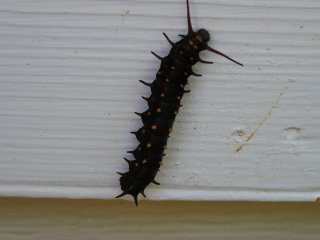
It's the start of serious caterpillar season, too. Last week I found a pipevine swallowtail caterpillar wandering around the deck, presumably looking for a good place to pupate.
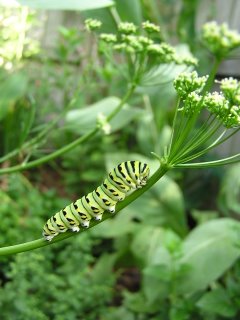
Then this morning I noticed two black swallowtail caterpillars on the volunteer parsley plant in the butterfly garden. The caterpillars are only 1/3 of full size, so I'll get to watch them for quite a while still.
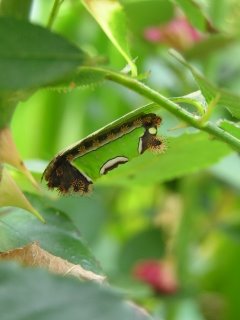
Last but not least, after noticing that one of my rose bushes was looking rather "eaten," I started looking closely and found two saddleback caterpillars hiding on the underside of nearby leaves. These funky looking guys are the larval form of a rather nondescript brown moth. If you see any of these guys, though, be careful. Those cute tufts of "hair" at either end of their bodies are actually stinging spines.
Everytime I go outside, I seem to notice something new or different. It makes it hard to stay inside!
Botanically, the garden is slowing down for the summer. The biggest and showiest bloom seasons have basically finished now. The azaleas and spring bulbs are long gone. The wisteria, iris and daylilies are done. Even the hydrangeas are almost over now.
The butterfly garden is still full of blooms, though, and the Knockout roses are continuing to flash their deep fluorescent pink flowers in big, bold clusters. (I've been careful to keep the Knockouts dead-headed, and I think it's paying off.) But most of the rest of the plant life is settling in for the long, hot, quiescent period, when it grows steadily but with no frills.
The animal life is increasing steadily, too. I've seen fledgling blue jays, mourning doves and cardinals in the yard lately, and I'm guessing that a couple of the "female" hummingbirds I've started noticing are actually this year's young.
Speaking of hummingbirds, I noticed an interesting quirk this morning. When a hummingbird stuck its bill into the salvia bloom to start feeding, it would almost always move the bloom up a little, changing the bloom's angle to a little above the horizontal. Does that make the nectar in the salvia blossom a little more accessible? Or is it simply a more convenient angle for feeding, based on the hummingbird's flight pattern and anatomy?
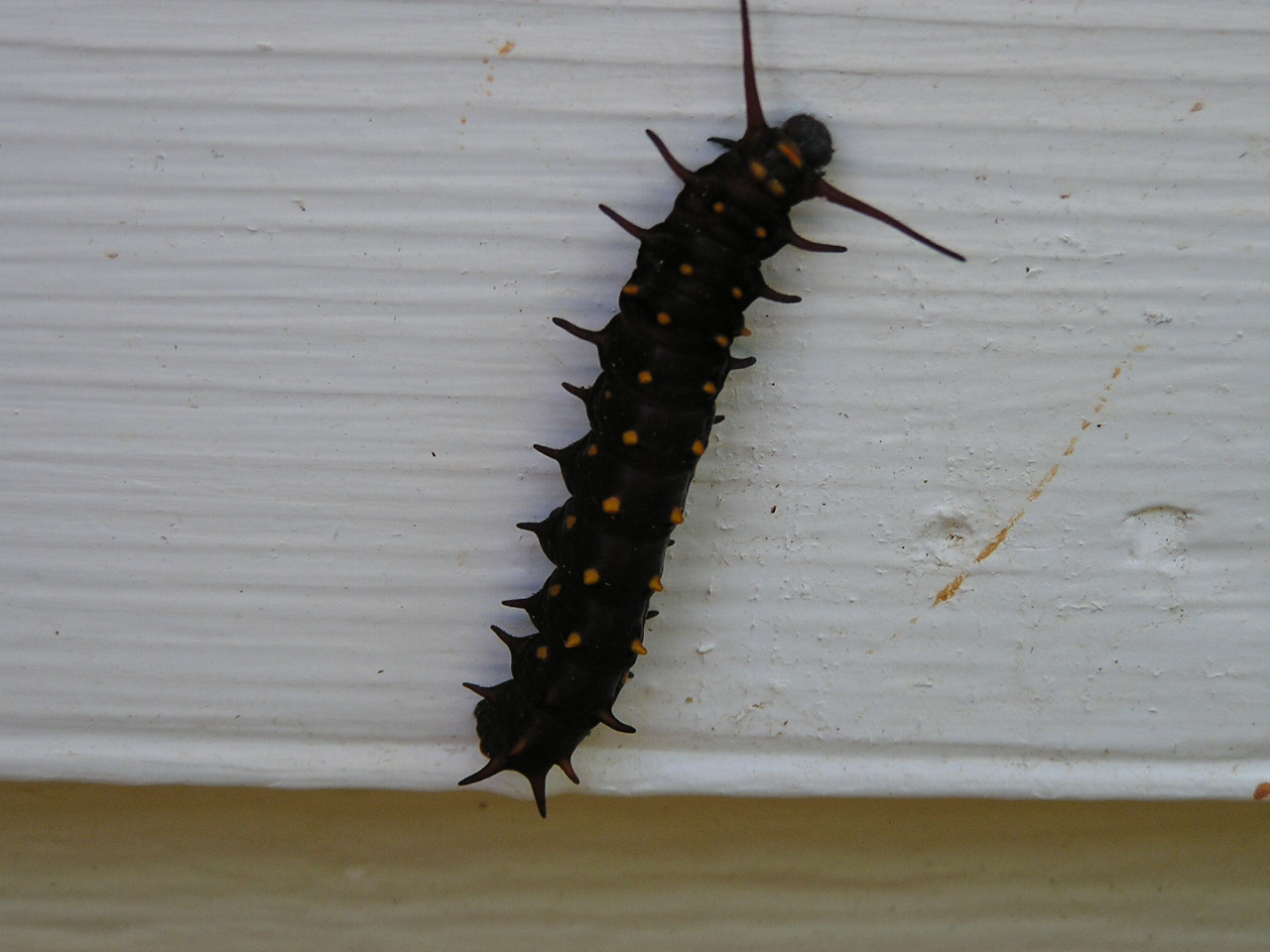
It's the start of serious caterpillar season, too. Last week I found a pipevine swallowtail caterpillar wandering around the deck, presumably looking for a good place to pupate.

Then this morning I noticed two black swallowtail caterpillars on the volunteer parsley plant in the butterfly garden. The caterpillars are only 1/3 of full size, so I'll get to watch them for quite a while still.
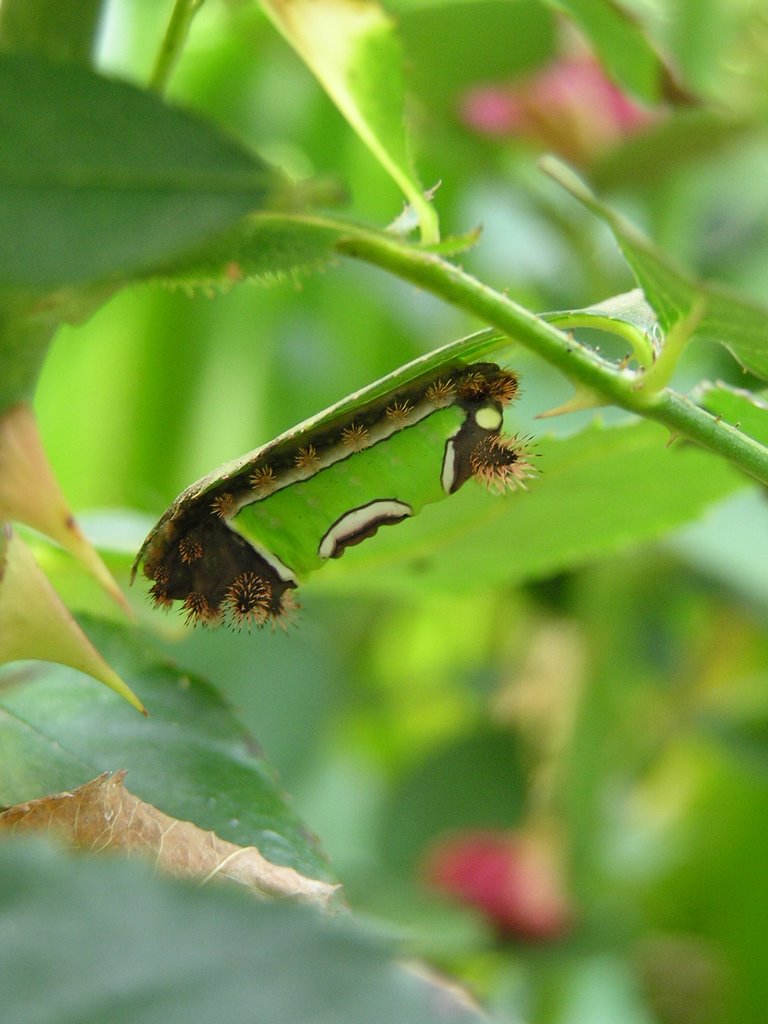
Last but not least, after noticing that one of my rose bushes was looking rather "eaten," I started looking closely and found two saddleback caterpillars hiding on the underside of nearby leaves. These funky looking guys are the larval form of a rather nondescript brown moth. If you see any of these guys, though, be careful. Those cute tufts of "hair" at either end of their bodies are actually stinging spines.
Everytime I go outside, I seem to notice something new or different. It makes it hard to stay inside!
Tuesday, June 13, 2006
Further Armadillo Troubles
I am discouraged this morning. Every day since my "Daily Rituals" post, I have done my morning walkabout and found uprootings and holes dug by an armadillo in the garden beds. Since we blocked off the holes under the fence, I have to assume that this unwelcome guest has taken up residence in the yard, although I have been unable to find his burrow so far.
On one hand, I can't blame him. We have water in the birdbaths, a ready supply of earthworms and other soil organisms, and plenty of bushy undergrowth to shelter his burrow. On the other hand, he's wreaking havoc on my mulch - bringing soil to the top that will put out the welcome mat for a whole variety of weeds - and uprooting at least a few plants almost nightly.
You would think that with FOUR dogs in the yard, at least one of them would make this garden a little less hospitable for him, but it doesn't seem to be working that way.
I've unblocked the holes under the fence and hope that he'll move on to greener pastures on his own. Otherwise this weekend, Prairiewolf and I are going to have to seriously search for his burrow and figure out how we're going to livetrap him and get him out of here. No other solution is, unfortunately, coming to mind.
Meanwhile, our drought is continuing. Just two miles away, they had a huge rain last week that soaked most of the city. And last night one of my in-town friends commented that she'd had rainshowers twice so far that day, probably compliments of Alberto. But we're still bone-dry out here in suburbia. I've had sprinklers going almost nonstop for over 2 weeks now. It's keeping the grass green and the plants from dying, but it's not the same as a good, soaking rain. I hate to see our water bill for this month.
On the other hand, at least we're not dealing with a hurricane. So far. So I'll try not to complain too loudly or too long.
Saturday, June 10, 2006
A Brief History of the Myth and Meaning of Gaia
Recently, a friend who has read this blog asked the question, "What does Gaia mean?" In one of those "Aha!" moments, I realized that many people may not know what I mean by naming this site "Gaia Garden."
So a quick explanation is in order.
For starters, in Greece, one of the earliest goddesses was Gaia, the Earth Mother (or Mother Earth, if you prefer). She was considered to be one of the founding goddesses, born of Chaos, and giving birth to the sky (Uranus) and the sea (Pontus), and sometimes, by some, to the mountains (Ourea). Without going into a great deal of detail, she was basically the original goddess, giving rise through her progeny to essentially the entire pantheon of Greek gods and goddesses. Eventually her progeny became more well known than she was.
Fast forward a LONG, LONG time (in human history) to the mid 1960's. An atmospheric scientist, James Lovelock, proposed that the Earth is a self-regulating organism. He called this "the Gaia hypothesis," after the old Greek concept of "Mother Earth." It took quite a few years and collaboration with Lynn Margulis, a biologist/microbiologist, but this hypothesis has now gained a fair amount of scientific credibility and generates a lot of scientific work in the field of ecological science. In short, now "the Gaia hypothesis" is often used as the more poetic name for current areas of science investigating Earth's homeostatic systems, or ways of maintaining its temperature, atmospheric mixture of gases, and other life-supporting systems.
In less scientifically rigorous ways, the concept of Gaia has come to symbolize the interconnectedness of life and the planet on which we live.
So in naming my site, "Gaia Garden," I'm trying to emphasize the concept of gardening by working WITH nature's processes, rather than by trying to "tame" those processes or "overcome" them. And in a rather idealistic way, I guess I'm trying to explore generally living in an "Earth-centered" way, at an "Earth-centered" pace too. Faster and busier hasn't necessarily proved to be happier or healthier or even more productive for many people. Maybe it's time we remember we're part of Earth, part of Gaia, and start honoring her and living by her guidelines.
Friday, June 09, 2006
Enriching Rituals
As I've gotten older, I've come to cherish the time and ability to enjoy certain daily rituals. Newness and adventure can be exciting and stimulating, but for relaxation, contentment, and the sheer enjoyment of being alive, give me these daily rituals anytime.
I'm not talking about mundane daily rituals like cleaning up the kitchen or brushing my teeth, I'm talking about the rituals that add richness to life. (I was going to include daily showers as mundane, but remembered that it doesn't take more than a day or two of having to go without one to realize what a wonderful daily luxury they really are! The trick there is remembering to be grateful for their simple pleasure.)
When I'm fortunate, I've got three sets of daily rituals that currently punctuate my days.
The first ritual of the day is in the early morning, when I do a leisurely walkabout of the garden, with a cup of coffee in my hand. As I walk, I visit every plant and give it at least a cursory once-over to see if it needs care of any sort. This is when I decide that I really do need to spend some time weeding, or that the hydrangeas desperately need water, or that it's past time to prune the asters back, or that the garden is looking great and I don't need to do anything much except enjoy it. This morning's revelation was that the *#%@!&#* armadilloes got back in the yard last night and, if I didn't want to lose a lot of expensive plants, I'd better repair their damage immediately and block the drainage holes again. Unfortunately, they completely uprooted one of my last 3 dwarf cleomes and, with the heat, I don't think it's going to recover.
The second ritual of the day is in the late afternoon or early evening, whe n I grab my beverage of choice and wander back to the "Outback" to sit and veg or sit and cogitate. Sometimes I do this one by myself while waiting for Prairiewolf to get home, and sometimes I do it with Prairiewolf, if he has gotten home at a reasonable hour and is so inclined. Mainly this is a time for relaxing and letting go of the day's concerns, while watching the birds forage, the leaves dance in the breeze, and the light grow soft and dim. Mosquitoes usually signal the end of this magical time.
The photo here is of the "Outback", complete with my new addition of windchimes, a celebration of age and friendship from our dear friends Flip and Shelley. The chimes are tuned to the notes of the Chicago Jazz Festival, and form a link with far-off friends and places. Note, too, the bright white exclamation points of the bottlebrush buckeye (Aesculus parviflora) blooms, shining beside the Adirondack chairs. Bottlebrush buckeye is one of Michael Dirr's favorite yard shrubs and, as this one gets bigger, I can really see why. When it's in bloom, it lifts my spirit everytime I look at it.
The last enriching ritual of the day occurs as we get into bed for the night. Our cuddly, orange fluffball of a cat suddenly gets a wild, demon-eyed look and leaps upon any movement under the covers, fully intent upon destroying the enemy obviously lurking there. (Needless to say, we keep a heavy quilt on the bed these days!) T.J. stalks and pounces for several minutes, until he's sure that he's made the area safe for the night, then calmly proceeds to curl up for a good night's rest. Not to be left out, our big German Shepherd pup lays his huge head on the bed near our pillows, sincerely requesting a serious and lengthy good-night petting, before he, too, curls up beside us on the floor and goes to sleep.
These routines cost little except time, but how precious they are to me and how lucky I am to be able to enjoy them. Sometimes I think that we, as Americans, get so caught up in making money for more "things" that we lose sight of what really makes us happy.
I'm not talking about mundane daily rituals like cleaning up the kitchen or brushing my teeth, I'm talking about the rituals that add richness to life. (I was going to include daily showers as mundane, but remembered that it doesn't take more than a day or two of having to go without one to realize what a wonderful daily luxury they really are! The trick there is remembering to be grateful for their simple pleasure.)
When I'm fortunate, I've got three sets of daily rituals that currently punctuate my days.
The first ritual of the day is in the early morning, when I do a leisurely walkabout of the garden, with a cup of coffee in my hand. As I walk, I visit every plant and give it at least a cursory once-over to see if it needs care of any sort. This is when I decide that I really do need to spend some time weeding, or that the hydrangeas desperately need water, or that it's past time to prune the asters back, or that the garden is looking great and I don't need to do anything much except enjoy it. This morning's revelation was that the *#%@!&#* armadilloes got back in the yard last night and, if I didn't want to lose a lot of expensive plants, I'd better repair their damage immediately and block the drainage holes again. Unfortunately, they completely uprooted one of my last 3 dwarf cleomes and, with the heat, I don't think it's going to recover.
The second ritual of the day is in the late afternoon or early evening, whe
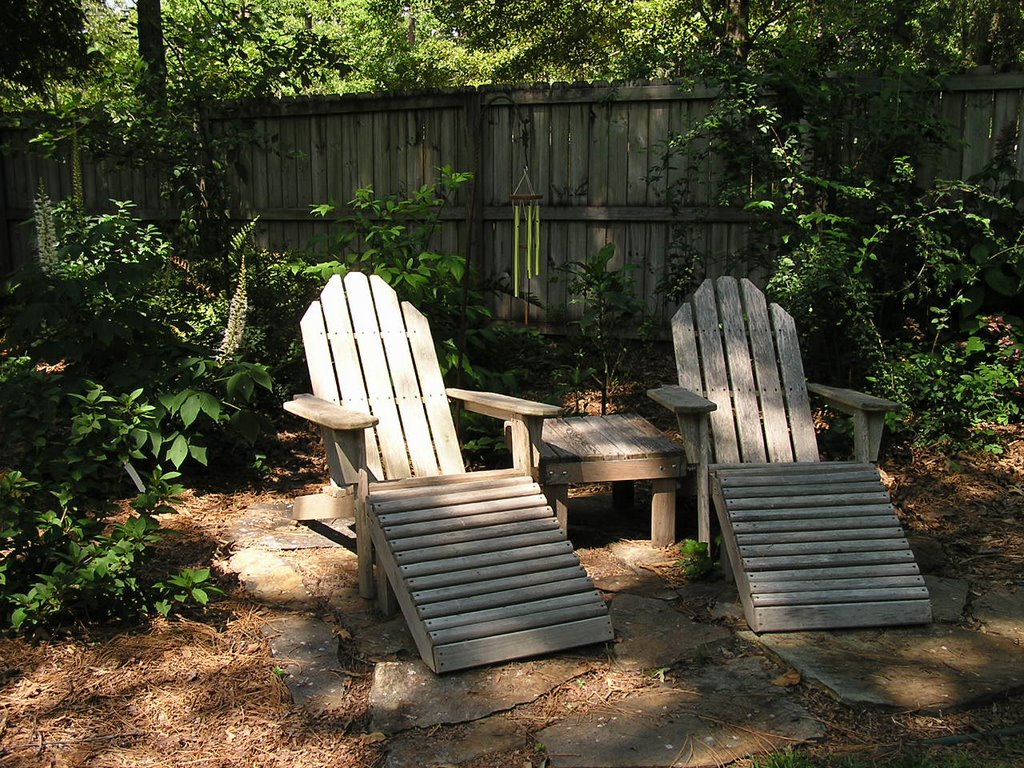 n I grab my beverage of choice and wander back to the "Outback" to sit and veg or sit and cogitate. Sometimes I do this one by myself while waiting for Prairiewolf to get home, and sometimes I do it with Prairiewolf, if he has gotten home at a reasonable hour and is so inclined. Mainly this is a time for relaxing and letting go of the day's concerns, while watching the birds forage, the leaves dance in the breeze, and the light grow soft and dim. Mosquitoes usually signal the end of this magical time.
The photo here is of the "Outback", complete with my new addition of windchimes, a celebration of age and friendship from our dear friends Flip and Shelley. The chimes are tuned to the notes of the Chicago Jazz Festival, and form a link with far-off friends and places. Note, too, the bright white exclamation points of the bottlebrush buckeye (Aesculus parviflora) blooms, shining beside the Adirondack chairs. Bottlebrush buckeye is one of Michael Dirr's favorite yard shrubs and, as this one gets bigger, I can really see why. When it's in bloom, it lifts my spirit everytime I look at it.
The last enriching ritual of the day occurs as we get into bed for the night. Our cuddly, orange fluffball of a cat suddenly gets a wild, demon-eyed look and leaps upon any movement under the covers, fully intent upon destroying the enemy obviously lurking there. (Needless to say, we keep a heavy quilt on the bed these days!) T.J. stalks and pounces for several minutes, until he's sure that he's made the area safe for the night, then calmly proceeds to curl up for a good night's rest. Not to be left out, our big German Shepherd pup lays his huge head on the bed near our pillows, sincerely requesting a serious and lengthy good-night petting, before he, too, curls up beside us on the floor and goes to sleep.
These routines cost little except time, but how precious they are to me and how lucky I am to be able to enjoy them. Sometimes I think that we, as Americans, get so caught up in making money for more "things" that we lose sight of what really makes us happy.
Thursday, June 08, 2006
Oh, What a Beautiful Morning....

The garden is so full of life, light and beauty this morning that it makes my heart ache. As I watch the wind ruffle through the leaves, the chorus of birdsong is so complex that I cannot even tease out all of the different songs being sung. The bees are buzzing contentedly in the beautyberry bush, I got a glimpse of a skink gliding slinkily through the butterfly garden, and the birds are making each tree and shrub seem alive with movement.
The outside is drawing me like a magnet. Bluejays are taking turns flying through the sprinkler for a quick spritzing. Brown thrashers are alternating between foraging through the leaf litter and flying up into the branches to announce their presence. A newly minted tiger swallowtail lightly floated around the yard for a while, checking out the accommodations. The air is marshmallowy, padded with moisture, softly supportive, warm but not yet hot.
Life seems very immediate and vivid this morning. I feel lucky, not only to be alive, but to be so aware of it today.
Monday, June 05, 2006
Life As a Tree
As we think of moving from this place, it has become obvious to me that living here has changed me. In fact, each place we have lived has changed me in one way or another.
Years ago I had a dream that my life was like a patchwork quilt - a crazy quilt, full of rich patches that didn't necessarily match but that, stitched together, made for a beautiful whole.
That dream came at a time when I was trying to decide whether to take on a new responsibility, a rather demanding volunteer commitment. As those of you who know me probably realize, after the dream I decided to accept the position and I have been tilting at windmills through volunteer commitments ever since!
But I digress.
Even if my life seems like a crazy quilt, I personally feel more like a tree. Like a plant of any sort, I've been formed and molded by my environment. Sometimes that has been positive, sometimes negative...and often, it's just been what it was.
Sometimes, to amuse myself, I wonder what species of tree I am most like. Cottonwood has come to mind - quick-growing, easy to transplant, sparkling and graceful (I wish!), but brittle, despite its appearance of strength, and short-lived. I'd love to think I could be classified as a live oak or a bur oak, but I don't have the gravitas for either of those species. Maybe a red oak? Not particularly outstanding, but stalwart and stable and reliable. Able to live and thrive in a variety of habitats.
What pruning and fertilizing has occurred here in this patch of my life? I have become a gardener, and I have found fertile soil for myself in the company of other gardeners. I have learned the regenerative power of a positive focus and the wilting power of a negative one. I have learned the pleasure of a large group of friends getting together to celebrate, and I have come to strongly appreciate the talents of those who can make celebrations happen gracefully and beautifully.
On the more difficult side, I have learned the pain of being too far from most of my family (but also the joy of being reconnected with family members that had grown apart). I have tried to learn the difficult art of doing my best and then just letting life (and Mother Nature) take its course. For better or for worse, I am learning - again - the difficult art of working hard and doing my best, but not being able to ultimately accomplish a deeply desired goal. And along with those last two lessons, I am trying to learn to keep trying without getting discouraged, hoping to have moved ahead two steps for every step that gets taken backwards.
Overall, though, this has been an enriching environment for me, and I hope to take its richness with me as I move into the next habitat patch of my life. Most of all, I hope to have absorbed this richness thoroughly enough to pass it along to others in the future - my life has been made brighter here and I'd love to be able to brighten other people's lives in similar ways.
Pollyanna-ish? Probably. But I'm okay with that.
Buzzing Bees and Baby Spiders
Isn't it cool how a garden engages all of your senses? There are two types of hot spots in my garden right now, based on what I hear as I walk around. The first is the dead pine tree, with its powderpost beetles loudly and rhythmically feeding. The second are the "bee plants" - whole plants that are just vibrating joyously with the sound of the bees feeding at their flowers. Right now I have several of the latter in the garden: the beautyberries, with their small pinkish white flowers, which have little to recommend them to humans but obviously are irresistable to bees, and the Virginia creeper, a vine whose brownish flower clusters are even less appealing to me than the beautyberries', but which are humming with apiarian activity.
Question: Does the word "apiarian" refer to all bees or just to honeybees? These flowers are attracting bumble bees by the dozens as well as many other pollinating insects, but I'm not actually seeing many honeybees. Of course, I don't tend to see many honeybees these days anyway.
Another sign that summer is here are the baby banana spiders. They are only a fraction of the size they will be in a few weeks, but their webs are appearing everywhere and I smile when I see them...unless, of course, I've just plastered a web across my face unexpectedly! Thank goodness they're not aggressive to people.
Saturday, June 03, 2006
Getting back into the swing....
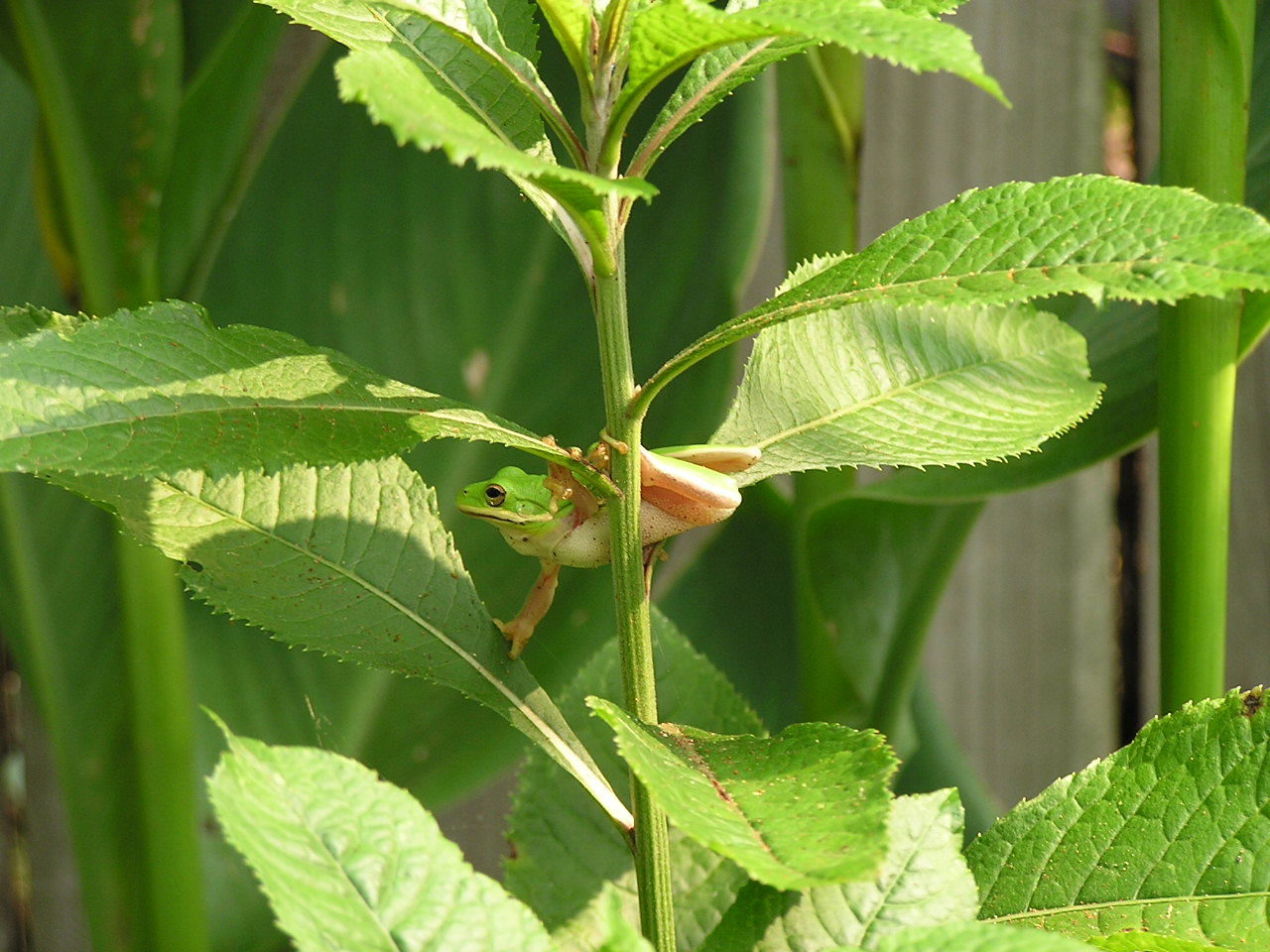 We've been either preoccupied or just flat out of the state for the last 3 weeks, partying with friends and attending our daughter's medical school graduation in Kansas, so I'm only now getting back into the garden.
Luckily my work before we left paid off - having refreshed my mulch, the weeds are minimal (at least in the flower beds) and overall things look pretty decent still, despite my lack of attention. Watering has again become critical, though, as we have had almost no rain in weeks and the hot weather is upon us.
When I did my first real walkabout yesterday, I found two normally shy coinhabitants in the garden who "agreed" to be photographed: a tree frog, who froze in a gymnastic pose hoping that I wouldn't notice him against the green leaves, and an anole, looking a little ragged...or should I say rugged?...as he paused to survey this giant interloper in his territory.
These guys are a critical part of my 24/7 bug patrol, and I love sharing my garden with them. Getting decent photos of them is an extra bonus.
I noticed earlier this spring that the tree frogs were almost silent. I was worried that they might be experiencing a population decline, but they got noisier when we had a brief period of regular rain, so I've thankfully shelved my other, more ominous theories in exchange for a dry weather explanation. It makes seeing this green and gold beauty (you should see the shining lines along his hind legs!) doubly pleasurable.
Bad news, though, when we got back - another of our longleaf pines had succumbed to the stress of the recent storms and drought. My friend and tree expert, Cleve, was kind enough to come out and take a look; he saw no reason for the other longleafs in the yard to follow suit, so he recommended simply taking out the one that had died. And keeping my fingers crossed. (That's my addition to his recommendation.) I've got a company scheduled to remove the dead tree in the next 2-3 weeks. In the interim, I just have to hope there isn't a hurricane to bring it down...while I try to ignore the sound of the powderpost beetles having a feast as they begin the recycling process on the dead wood. It's amazing how loud their feeding sounds - I can hear them from 20 or 30 feet away.
On the positive side, I DID see a red-bellied woodpecker feeding on the trunk this afternoon! In some ways I wish I could leave the dead snag standing, as snags are important feeding and nesting sites, but this particular one could easily take out our roof if it falls, so pragmatism has to prevail.
Tuesday, May 16, 2006
Good Borders Make Good Gardens
Paraphrasing Robert Frost's "Good fences make good neighbors" quote seemed appropriate for today's work in the garden. Greg had made a strong line around the beds with the edger this weekend, so I've been using that line to pull out the extra grass and neaten the border edges.
It's funny, but it's taken me almost all of my life to recognize the importance of neat edges in a garden. We all have our points of rebellion, and for some reason one of mine revolves around keeping things neat. In my wise old age, though, I've come to realize that if I keep the edges neat, the beds and lawn can be downright weedy and/or overgrown and the garden will still look good...especially to the untrained eye.
Speaking of weedy and overgrown, another basic garden chore that I rebelled against for years was weeding. Justifying my reluctance to pull out unwanted plants under the umbrella of "biodiversity is good for any biological system," I kept wondering why my garden plants always looked so stunted and my vegetables produced so poorly. Call me stubborn. Call me stupid. I have learned better, though! It just took me longer than most.
Thursday, May 11, 2006



First Fruits of Summer
 Suddenly it seems like summer is here. As the photo shows, we've had our first tomatoes ripen...and boy, did they taste great! Since the dogs have been "harvesting" the standard tomatoes on the deck as they get to about (green) golf ball size, our first ripe tomatoes were cherry tomatoes planted on the edge of the butterfly garden. The bush is loaded, so we're looking forward to several weeks of fresh tomato flavor.
Along with the cherry tomatoes, we've been able to snag a couple ripe blueberries before the birds and/or squirrels got to them. And I found a patch of big, ripe, sweet-tart dewberries hiding in a corner. I need to pull the dewberry vines out...but I decided I could wait until the vines quit fruiting!
I'm not really ready for summer to be here, but with sweet bribes like these, I'm getting more resigned every day.
Sunday, May 07, 2006
A Fleeting Miniature World

During a slight break in the rain this morning, I ventured outside to do my daily walk-about. Imagine my delight when I came upon this dense tent-village of mushrooms sprouting on a small logpile. This was only one of several concentrations on the pile, all of which carpenter ants were busily examining.
Luckily I braved the gray skies and light rain to take a few photos because when I went back this evening, after the sun had gently come out, almost all of these dainty little umbrellas had melted into a dark charcoal-gray mass of threadlike carcasses.
Note the leaf blades in the bottom of the photo to give you a sense of how small and tightly packed these mushrooms were during their brief heyday.
As I continued around the yard, I noticed a rather interesting anomaly: most of my Salvia guaranitica (anise sage) had several foliage tips hanging down, severed almost completely through the stem. I could see no signs of insects around, but it reminded me of cutworm damage on young seedlings, except that it was a foot or more off the ground. After doing some internet and book research, I've decided that the culprit is climbing cutworms, but I still find it unusual. Salvia is normally a plant used to deter insects from a garden, but these plants - and I have at least 5 of two different cultivars, scattered around the yard - were the only ones showing damage. So they were acting more as a trap crop than as a deterrent.
My last discovery of the day was the realization that my two Chain Ferns or Woodwardias (one of which was totally deciduous this winter, while the other retained a couple anemic fronds) are actually two different species. I'd assumed that they were both Oriental Chain Fern (Woodwardia orientalis), which is what we sell at the Plant Sale. Closer inspection revealed some significant differences in the fronds. When I used my new fern guide, a birthday gift from Jess, I realized that the deciduous one was actually Netted Chain Fern (Woodwardia areolata). Best of all, the Netted Chain Fern is native!
Another daily walk-about and 3 new discoveries, just in my modest yard. It never ceases to amaze me how much changes from day to day.
Saturday, May 06, 2006
Friends Beside Me
It's like a parade of good friends as I walk around and work in my garden:
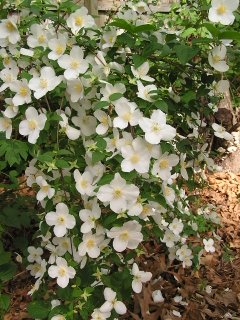

In early April, there was the English dogwood (aka mockorange) that Edna gave me a start of about 4 years ago....

And in late April, there was the Virginia sweetspire, another gift from Edna, bursting into bloom as it gracefully arched over the pathway.
All spring in the fern garden, I have been enjoying the contrast of the Labrador violet (from Allan Armitage on the Atlanta MBG trip) and the dainty upright leaves of the dwarf iris from Patty. And then there's the commanding presence of the Confederate rose from Xanthy at the end of the garden path near my woodland nymph.

Several weeks ago, the first blooms of Miss Lily's peacock ginger, Kaempferia rotunda, peaked up into the light. The contrast of the delicate flowers against the sturdy mulch is a daily paradox, while the emerging leaves add yet another element of excitement to the garden.

Currently, besides the peacock ginger, I'm enjoying the blooms on Shelley's cleome (somehow I've ended up with pure white blooms!) and on Patty's crinum.
There are many more gifts and "pass-alongs" within my garden, but the limits of this blog keep me from displaying too many photos at once. However many I'm able to share visually with you on the web, though, friends are with me everytime I step into my yard. They add color and texture and depth to my garden, just like they add color and texture and depth to my life. I feel rich in all the ways that matter.
Small Daily Steps
My gardening has been mundane lately...some weeding, going back and cleaning out the Artemesia roots, pulling grass runners away from the edge of beds, dead-heading, a little minor transplanting.... The list is uninspiring, but the tasks are essential to keeping the garden functioning as a garden rather than degenerating into an overgrown morass of undifferentiated green. It's taken me years to learn that these tasks can't be skimped...ESPECIALLY if I want to keep gardening organically.
A year of seed; seven years of weed.
And, actually, now that I've learned to accept that I really do need to keep up with these tasks, I find the work rather relaxing. Each morning that I'm going to garden, I take my cup of coffee and meander the yard, looking to see what needs to be done. By the time I finish the caffeine jolt, I'm raring to get started.
Wendell Berry's poem, "The Farm" (from 1991, as published in A Timbered Choir, p.146-147), speaks to me again, this time about the importance of these ongoing small adjustments to the identity of the place I'm "farming":
And so you make the farm,
And so you disappear
Into your days, your days
Into the ground. Before
You start each day, the place
Is as it is, and at
The day's end, it is as
It is, a little changed
By work, but still itself,
Having included you
And everything you've done.
And it is who you are,
And you are what it is.
You will work many days
No one will ever see;
Their record is the place.
Tuesday, May 02, 2006
The Half Century Fountain

Greg bought this beautiful bird bath/fountain in celebration of my half century mark this year! We installed it about 10 days ago, finding the perfect spot just off the deck at the base of the big old dogwood. I can see it from the kitchen door, as well as from every window that overlooks the backyard.
I absolutely love its relaxing, burbling presence and am looking forward to the birds that it will attract.
Dragonfly in the Wind

I'm trying something new. I figured that this blog would be much more interesting with photos, so this is my first attempt at uploading a photo from the garden....
On last Saturday we had a front approaching that had kicked up the wind quite a bit. As I did my normal morning walk-about, I noticed a dragonfly perched on my half-dead yaupon. It seemed to be trying to warm up in the few rays of sun that it could catch and rather obligingly remained still for quite a while as I photographed it.
As I watched, the dragonfly changed from the normal position of flatly outstretched wings to this "tented" wing position, which seemed to help it weather the gusts without getting blown off its branch. There were several strong gusts that caused it to hang on with all 6 legs as it was blown sideways, but for the most part this position kept it quite stable.
It was fascinating to watch the movements of this little guy. At one point a leaf fell to the ground about 8' away, and the dragonfly turned his head up and watched it fall almost all the way to the ground.
As long as my movements were very slow, my proximity didn't seem to bother him at all. Trying to get my camera to focus properly was a real trick, but I managed to get a few shots that weren't too bad.
Let me know what you think!
Subscribe to:
Posts (Atom)