Showing posts with label Spiderwort. Show all posts

Tuesday, April 03, 2018

Acceptable and Unacceptable Changes to the Neighborhood Landscape

At the beginning of June, we will have lived in this house for 3 years, although I didn't start gardening in the yard until the fall of that first year.

This is what the front yard looked like in mid April, 6 weeks before we moved in....

While the yard was neatly trimmed and mowed back then, I found it sterile and boring.  Naturally, when I began gardening, I started adding native plants and removing non-natives.  As usual, I had more of a general idea of what I wanted the garden and yard to be, rather than any firm plan.  Most of all I just wanted my yard to be a small wildlife refuge in the midst of suburbia.  And I wanted it to be pretty, too, if at all possible.

I kept the huge canopy trees, a southern magnolia (Magnolia grandiflora) and a laurel oak (Quercus laurifolia).  They are both native and, while I probably wouldn't have chosen either species to put in their spots, they add gravitas and presence to the yard.  Besides 3 dwarf yaupons (Ilex vomitoria) and a few of the lawn weeds, they were also the only native plants growing in the front.

Since those first days, I've added a laundry list of natives to the front gardens, including shrubs (oakleaf hydrangeas, Virginia sweetspire, sweet pepperbush, dwarf Florida dogwood, wax myrtle, Darrow's blueberry, and a deciduous holly), ferns (southern shield fern, leatherleaf fern, and southern woodfern), perennials (columbine, blue eyed grass, golden ragwort, little brown jug, lyreleaf sage, Indian pinks, Walter's violets, woodland phlox, downy phlox, garden phlox, green and gold, Louisiana iris, mouse-ear coreopsis one, mouse ear coreopsis two, spiderwort, Gaillardia, Florida scrub skullcap, golden zizia, bluestem goldenrod, showy goldenrod, regal catchfly, powderpuff mimosa, dense blazingstar, native lantana, white Baptisia, butterfly milkweed, and fogfruit), and even a grass (Elliott's lovegrass).  I'll spare you all the scientific names - this time!

Here's a recent photo of the front yard....

Only now are the garden beds beginning to show up and look like gardens.  "A year to sleep, a year to creep, a year to leap."  The old maxim holds true yet again.

Having added such a wide variety and large number of plants, it's odd to me what people notice and comment about in my front gardens.  I had a neighbor tell me how much she liked the "yellow flower", golden ragwort (Packera aurea), shortly after I planted it next to the sidewalk, under the magnolia. 

Ironically, I love the foliage of this plant, which is low, dark green, shiny, and rich looking to my eye...but I don't particularly care for the flowers.  I do love their cheerful presence early in the growing season, though.  Golden ragwort are the first native flowers to bloom in my garden. 

Recently, a woman who came by to pick up wild strawberry plants I was giving away commented how much she liked my columbine and blue eyed grass.  That made my day!  She even knew the names!

Here's one clump of the blue-eyed grass (Sisyrinchium angustifolium) she was admiring, by the front porch, ...


...and a closeup of blue-eyed grass blossoms in the shade nearby.

Then here's a picture of the other species she was admiring, eastern red columbine (Aquilegia canadensis), taken a couple weeks ago when it was first starting to bloom.


As much as I love blue-eyed grass and columbine, I am surprised that no one has ever mentioned my downy phlox (Phlox pilosa), which I think is beautiful.  A tidy mound of cotton candy pink at the front of the flower bed, this classy little plant blooms nonstop from December through to the end of May and even into June.  Perhaps to most eyes it just looks like a standard annual bedding plant?

The spiderwort (Tradescantia ohiensis), which is spectacular right now, doesn't get much mention either - although another neighbor has started telling me when he sees it popping up in wild areas around the neighborhood, encouraging me to go dig it up and add it to my gardens.  Since he lives 2 doors down from me, I figure he must like it at least a little or he wouldn't be encouraging me to plant more.

In particular, though, one plant has caused unexpected reactions:  powderpuff mimosa (Mimosa strigillosa), a relative of catclaw sensitive briar, for those of my friends who garden in the prairie.  Greg loves groundcovers, so we thought we'd try putting this low growing plant, with its pretty foliage and its blooms that look like sparkling pink pompoms, up front.  We are encouraging it to spread out and fill in the hell strip between the sidewalk and the street.  To our eyes, it's prettier than weedy grass any day! 

Ironically, no one seems to notice the blossoms (which are, in my opinion, very cute and very hard to miss), but the foliage makes people uncomfortable - superficially it looks too similar to chamberbitter (Phyllanthus urinaria), a.k.a. gripeweed, a common lawn weed down here.

Unfortunately, I inadvertently played into this concern by planting the first two powderpuffs at the base of a newly planted wax myrtle.  I didn't take the time to clear a large, carefully delineated "bed" for the powderpuff to spread into.  I've done my best to keep the grass weeded out of the spreading groundcover, and the powderpuffs have filled in marvelously well...but there isn't a defined edge to help people "read" this part of the landscape easily.  That was a mistake on my part.

I'm going to keep working on the powderpuff, but another element I added to our front landscape is slated for removal:  the small brush pile under the big laurel oak - at the base of its trunk in the photo below. 

Living in such a high humidity environment, many woody branches are covered with fascinating, feathery mini-gardens of lichen.  When several small branches ornamented in lichen "lace" fell in the front yard, I couldn't bear to put them out for the city to pick up.  Instead I used them to construct a small brush pile towards the back of the bed.  Here is a photo of a branch covered in lichen that fell in our yard...

...and here is a closeup of that lichen.

Several people have asked why I'm leaving "that pile" there and I've taken the time to tell them about the benefits of brush piles, but I've decided to move the pile around to the backyard where it's nobody's business but ours.  The pile's been growing a little faster than I was planning, anyway, as more branches have fallen out of the oak.  I still can't bring myself to send those gorgeous lichens off with the city dump trucks!

Despite my occasional misstep, the plants I've put in the front gardens are taking hold and growing well, getting taller and broader, blooming more fully.  I'm far from the world's best landscape or garden designer, so my color and form combinations are rather haphazard, but I get a buzz of pleasure now when I drive up to our house or walk outside.  For example, when I left the house this morning, I noticed a towhee foraging among the skullcaps by the sidewalk, and there are almost always at least a few butterflies, native bees, or honeybees diligently working the flowers.  Little brown skinks commonly rustle through the leaf mulch and green anoles prowl the shrubs and perennials, males puffing out their salmon-colored throats in displays of pride and power during these lengthening spring days.

I hope my human neighbors come to enjoy my wilding landscape.  I love that the wildlife is making itself at home outside my house...and it makes this yard home for me now, too. 

Saturday, February 17, 2018

Sproing!!! Spring Appears to Be Here.....

Given that Valentine's Day just sailed by, it seems a little early for spring to have arrived, but here in the panhandle of Florida, all signs point in that direction.

For the foreseeable future, the weather guessers have us in the mid-70's each day, with lows in the mid-60's at night.

The humidity has been so high lately that we've been turning on the air conditioner at night just to dry out the air inside.  When we wake up in the morning, the windows are fogged over on the outside from all the humidity, even though the inside of the house is less than 5 degrees cooler than the external air temperature.

Not surprisingly, with the temperatures and humidity this high, plants and wildlife are responding exuberantly.  The early daffodils are in full bloom.

Looking at the blooms, I realized just this spring that all my early daffodils are multi-bloom types.  I find I'm craving some big single blossoms, so that'll be on my list for next fall.

Gail Eichelberger's "practically perfect pink phlox", a.k.a. downy phlox (Phlox pilosa), has been blooming since December, as it seems to do every year here. 

I love this plant, but it's getting a little hard to find even in native plant nurseries these days - I think everyone must be catching on to the joy of having this beauty in their gardens.

Under the front magnolia tree, the golden ragwort (Packera aurea) is blooming.

It has really filled in nicely this year.  By next year, I may even be able to transplant a little to other spots in the yard. 

This summer it should be looking like a particularly attractive dark green groundcover in a garden spot that has been especially hard to cover with anything but leaf mulch until now.  Between the heavy shade and the rampant roots, it can be difficult to garden successfully beneath southern magnolias.

Based on a couple recent blog posts I've made, you know, of course, that some of the blueberries are blooming exuberantly already.  The rabbiteyes (Vaccinium ashei) are still dormant, but the highbush blueberries (V. corymbosum) are in full spate and leafing out rapidly.  In my yard, highbush blueberries definitely seem to outperform their rabbiteye cousins;  if I add more blueberries, they'll probably be the highbushes.

Low, down at ground level, violets are starting to open up, too.  I have 3 species in the yard;  two have started blooming.

One of the blooming violet species is, I believe, the classic common blue violet (Viola sororia), but I'm not sure what the other one is.  This mystery violet has purple blooms and lance-shaped leaves.  It came in with the white baptisia as a pleasant little hitchhiker that I've been enjoying quite a lot.

Speaking of the white baptisia (Baptisia alba), my single specimen of this beauty has leapt out of the ground as if being chased by monsters below the soil.  Baptisia is one of those plants whose shoots spring forth so quickly that I feel like I can see them growing if I stand still and watch for a few minutes.

I didn't notice the baptisia shoots at first, because they were being camouflaged by the spiderwort (Tradescantia ohiensis) seedlings growing up around them.  Some friendly crowding isn't likely to hurt, though.  I haven't seen any fully open spiderwort blossoms yet, but I noticed a little blue peeking forth from one of the buds this morning.  I won't be surprised to see a blossom or two tomorrow.  The blue of spiderwort flowers makes my heart sing....

Have you ever heard spiderwort called bluejacket?  I've never heard the term used at all, except in referring to actual clothing, but according to the USDA Plant Database, that is the official common name of T. ohiensis.  I wonder if it's a regional thing?

Speaking of regions, the Florida panhandle is part of a region that is known more for its non-native blooms than for its native flowers.  Believe it or not, I do have a fair number of non-natives in the yard and gardens, too.  As far as the classic non-native plants go, besides the daffodils, there are still several camellias blooming lustily...

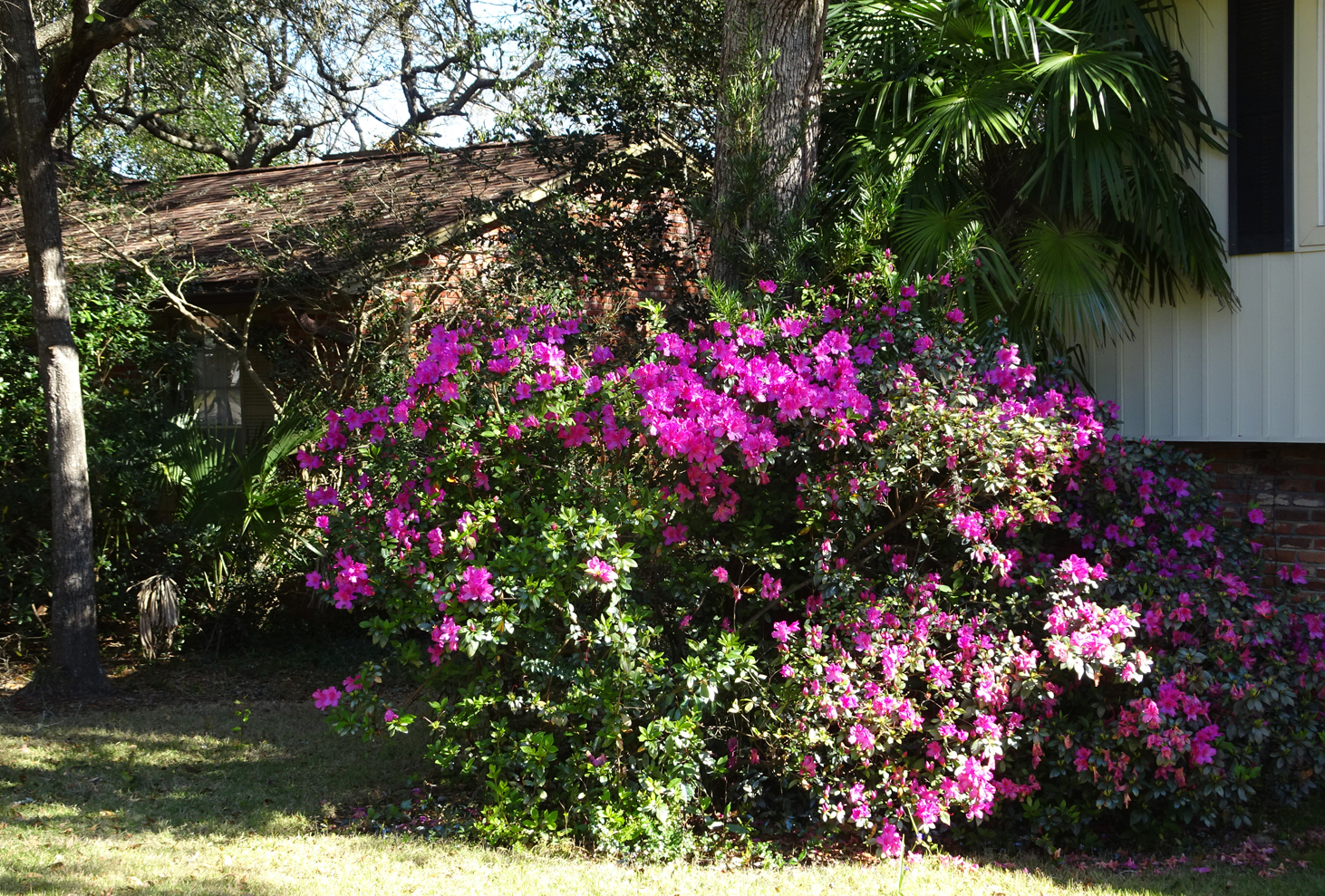
...and the beautiful evergreen azaleas have started opening up their flowers along the west edge of the yard.

With the masses of magenta blossoms mounding throughout the landscape, I have to admit that I love azalea season, .  Those big old southern Indica azaleas are truly spectacular.  They'll be opening up soon and I'm really looking forward to wallowing in their purplish profusion.  Sometimes even this diehard native plant aficionado has to bow down before the overwhelming beauty of certain exotic plants!

Saturday, March 04, 2017

Blooms in the Beginning of March

Sometimes a gardener just wants to share some pretties from their garden...and I guess that's where I am tonight.  So here goes....

In early spring, it's always fun to see the bare branches of red buckeye (Aesculus pavia) transform from sticks to feathery fans, highlighted with big, blowsy, red bloom spikes.  Hummingbirds apparently love red buckeye blooms, which are rumored to open just as hummingbird migration begins, but I rarely seem to plant mine where I have an opportunity to watch that interaction.  I've got my hopes up this year, though, as I just found out today that hummers have been spotted along the Gulf Coast in the last few days.

I have no idea which violet (Viola sp.) this next little guy is, but I really enjoy its plucky blooms.  A small group of these came in as "stowaways" in a pot with the white baptisia that is towering over it.  They've done very well.  The diminutive size and long, narrow, arrow-shaped leaves are quite different from most violets I am familiar with.

Not far from the plucky violet is an Ohio spiderwort (Tradescantia ohiensis), whose richly serene, blue blooms are being regularly visited by the little southeastern blueberry bees (Habropoda laboriosa) these days.

How about a perennial that blooms for 2 1/2 months and counting?  The downy phlox (Phlox pilosa) have been blooming since before Christmas and they show no signs of slowing down.  In fact, I'd say they are prettier now than ever. 

I have 4 of these beauties right now - and I'd really like at least another 3 or 4.  In Kansas this plant ran through the beds quite a bit for me and it didn't last very long.  It seems to be acting quite differently here, staying in place and getting stronger, not weaker, as time goes on.  The foliage is nice, too, even when the plant isn't blooming.

Under the large southern magnolia tree out front, next to the sidewalk, was a bare spot that makes the term "dry shade" seem optimistic.  The magnolia roots are so thick in the area that finding pockets of actual soil was a challenge.  I knew the root competition would be fierce, but still I was hoping to find a plant that would give this garden bed a little more "sidewalk appeal".   The golden ragwort (Packera aurea) has really performed like an ace here. 

The flowers aren't, to be truthful, my favorite, but I love the rounded, shiny, dark green leaves that look good throughout the year.  I'm guessing that within 2-3 years, the 6 individual plants will start growing together, giving a more cohesive feel to this patch.

Azaleas are in full blush and the camellias are just finishing up, but the ones in my yard are rather ordinary, to tell the truth, so I'm not going to share them.  Typical foundation plants, the majority of them are placed - literally - about 18" from the foundation and have, in the not too distant past, been pruned into ungraceful, flat-topped boxes.  I haven't decided what to do about them yet, but will probably begin by giving them a "rejuvenating prune" as soon as they're done blooming this spring.  The azaleas, that is.  I don't think camellias can be chopped back like that and survive.

We put in daffodils last fall;  the early ones bloomed nicely, but they're still at the individual bloom stage, so I think I'll pass on sharing those as well.

There is a blue-eyed grass that has been springing up unbidden in the lawn area and I've been leaving the individual clumps to see what they look like.  They've suddenly spread out and started to bloom, allowing me to identify them as annual blue-eyed grass (Sisyrinchium rosulatum), a distinctly not-blue flower. 

Although the dainty little blooms are rather attractive, the plants have started developing yellowing, spotted leaves, so I've decided to root them all up and just dispose of them.  This is not a native species, so it's only causing me a little bit of angst to be so ruthless.

Many gardeners get upset about wildflowers springing up in their lawns, but I'm not one of them.  I actually enjoy seeing what gifts nature provides.  For example, I've been enjoying this little pink blooming oxalis that appeared, as if by magic, under the magnolia in the back yard. 

I'm not sure whether this is the native violet woodsorrel (Oxalis violacea) or the non-native pink woodsorrel (Oxalis debilis);  I haven't figured out how to tell the difference between the two yet - but I'd always prefer to have the native, of course.

With perennials, it's always nice to have some great foliage for visual interest so that you don't have to rely on just blooms throughout the year.  While I was initially attracted to the light blue flower spikes that lyreleaf sage (Salvia lyrata) has, now that I've grown this plant in my yard, it's the red-veined, hairy leaves with their purplish undersides that I'm finding appeal to me most. 

I'm beginning to think of this plant as a hosta replacement, with the twist that it's native and it grows well down here.  In my mind, the occasional seedlings that spring up in the grass are a perk as they transplant readily and allow me to establish new plants elsewhere in the garden beds, giving some cohesion to my newly evolving plantings.  If I ever get tired of them, they uproot easily and will be no problem to simply weed out.

For now I'll leave you with some blueberry blooms (Vaccinium sp.).

I love the rotund, lacy, little pearls that are blueberry blossoms.  Although it doesn't seem like I have very many on my 7 blueberry bushes, I am seeing a pleasing number of blueberries beginning to swell, so I must have more blooms than I realize.  The blueberry bees are keeping busy, for sure!

Friday, March 03, 2017

Southeastern Blueberry Bees

When you see something like this small mound of sand, with a single, perfectly round hole in the middle of it, in the center of your lawn, what do you think?

How about if you see a group of such structures, scattered throughout your lawn, as in this public area near our house?

I used to puzzle over this type of hole, wondering what made it and what lived in it.  Big ants?  Spiders?  Tiny snakes?  Mole crickets?

Nope.  Not even close.  It was many years before I realized what I was actually seeing.  Mounds like this are the work of solitary bees, those wonderful little pollinators that most of us barely even know about.  As I walk around my neighborhood, I see quite a few of these tiny sand piles right now - but only in the yards where the grass is just so-so.  Thick, lush lawns - which can only be maintained through chemicals down here - have absolutely no little bee mounds.

So, wouldn't ground-nesting bees be a bad thing?  What about the possibility of bee stings?

You don't have to worry at all.  There's really no problem.  The key word is SOLITARY.  Each hole is the work of one little female bee, who visits hundreds of flowers to collect pollen with which she makes little balls of food, one ball per egg.  She will only produce a couple dozen eggs in her lifetime - and she'll work VERY hard to do that and to provision each one with enough food to ensure survival.  This little bee doesn't have time to worry about keeping anything away from her nest.  In fact, you'll rarely catch her there.  If she were to sting you, she'd die - and then there would be no more eggs laid.  She's not going to waste her life that way.

So why do people like these little solitary bees so much?  What makes them special?

Native solitary bees are the pollinator workhorses of this continent.  They evolved with the plants on North America to efficiently pollinate their flowers, producing fruit, nuts, and seeds.  (Honeybees were brought over by European settlers.  The native plants here would survive just fine without honeybees.)

Right now, in very early March, I'm only seeing one species of solitary bee at flowers.  As I look around, I'm also only seeing one type of solitary bee nest, consisting of this dainty mound of fresh sand with a perfectly round hole, about 1/4" in diameter, in the approximate center of it.  I have not yet seen a bee come out of one of these holes, but I am guessing that the two belong together, that these are the nests of the bees that I'm seeing.

It's been a little tough to photograph and identify these small, solitary bees as they zip from flower to flower, though.  They don't stay in one place for very long.  To my "naked" eye, they look like little bumble bees, but they are much faster and warier than bumble bees.  Most of these solitary bees seem to be a bit less than half the size of a typical bumblebee - or carpenter bee.

After several days of stalking these little guys, though, I've been able to come up with enough photographic evidence to identify them, at least to my satisfaction.  I believe they are southeastern blueberry bees, Habropoda laboriosa. 

If you raise blueberries, these guys are superheroes.  They buzz pollinate, which involves buzzing in a special way and at a particular frequency to get the pollen to drop.  Blueberry flowers are rather hard to pollinate, actually, and these guys are specialists at it. 

Apparently a single female southeastern blueberry bee will visit up to 600 blueberry flowers to collect the pollen to make a single ball of food for one of her eggs.  Through her pollination activity, over the course of her lifetime, she is estimated to be responsible for producing an average of 6000 blueberries. That's a lot of blueberries for a little bee like this!

Although these bees are primarily known for "working" blueberry flowers, I am also seeing them at both azalea blooms and at spiderwort blossoms.  Here's a female with legs full of (white) pollen at a spiderwort bloom.

Of course, only the females carry pollen, so if you see a little bee laden with full pollen baskets, it's definitely female.  The males of this species have a large white patch on their face, like the individual in the (blurry) picture below, so it's actually easy to tell the sexes apart, even if there's no pollen to see.

So if you have blueberry bushes in your yard, keep your eyes open for small "bumble bees" working your blueberry flowers.  They are about the best insurance you can have for getting a good crop of berries later in the year.  Best of all, they're free!  Be sure to leave some areas of open soil or scraggly lawn for them to nest in, though, because you can't have southeastern blueberry bees without places for female southeastern blueberry bees to provision and raise their young.

Sunday, February 26, 2017

Winter Walkout 2017

Labeling my walk this morning as a "winter walkout" seems like lying, but the calendar rules, so that's what I'll call it.

Leaving my front door, the first thing I noticed was this American flag.  The flag is not, technically, in my yard, even though it's visible from my front door, so I don't think I'm breaking the winter walkout rules by including this vignette.

Since I see it every time I leave my house, this algae-stained and sadly weathered flag has become symbolic to me.  The folks who display it are staunch conservatives; I'm sure they consider themselves to be displaying their patriotism.  I, however, see many other layers of meaning in its treatment as well.

Passing by their garden this morning, along the sidewalk in front of their house, I noticed a red camellia bloom with multiple centers:  colorful, perfectly imperfect, brightly shining for a few days...and then gone forever.  How's that for reading meaning into the natural world?!

Looking up, Spanish moss draping from the trees silvered the sand live oak canopies, which were silhouetted against the crisp blue sky.  It was truly a gorgeous morning!

Across the street, a painted concrete ball added a touch of whimsy to an otherwise classic, if rather off-kilter, driveway pillar.

Why a soccer ball?  I have visions of sports-mad teenagers living in the house, but I have never actually seen any activity beyond a single parked pickup truck in the driveway.

As I passed under the sand live oaks whose finery of Spanish moss had caught my eye, I looked up into the interior of one of the trees, relishing the texture of the heavy, sinuous branches with their finely textured leaves against the sky.

Live oaks, sand live oaks, burr oaks, cottonwoods, prairie elms - I love statuesque, gnarly trees with character!

Despite the February date, azaleas are in full bloom around here - about 3 weeks earlier than normal.  It always amuses and entertains me to imagine how azaleas mirror the personalities of their owners.  This big, beautiful plant feels like a woman with her hair down, relaxing in the sunlight.

Across the street, however, an azalea hedge separating two houses has a much more "buttoned up" appearance, sacrificing blooms and density for formality and "neatness".

As I pondered the character-predicting capabilities of azalea shrubs, I heard a large bird calling loudly up above me in the tree canopy.  Frustrated by my rude intrusion as I stood stock still on the sidewalk just below her perch, a red-shouldered hawk squawked at me from a tall pine for several minutes before finally flying off, unwilling to tolerate my presence any longer.  As she flew, I mentally thanked her for allowing me to capture her picture, despite her irritation.
Continuing down the sidewalk, I couldn't pass up a picture of this evocative rope swing, taking advantage of a meandering sand live oak branch in someone's front yard.  I just wish there had been several small kids playing on it while I passed by!

Not too far away, another large oak was in obvious decline, being strangled by a rapacious English ivy vine scrambling up its trunk to compete for the light above, while its roots competed for water and nutrients below.

Even as I was aiming the camera, trying to get a good angle on the ivy vine and oak tree, I registered calls from the red-shouldered hawk again.  Looking up, over a house roof and into a back yard, I saw a huge nest with its raucous owner standing guard nearby.

I had known there was a pair of red-shouldered hawks nesting in the area, as I'd seen some of their mating displays from our backyard, but now I know where their nest is!  Even a short walk can uncover some pretty amazing discoveries.

"Hawk Street" ends in a cul-de-sac that borders the local golf course.  I couldn't resist a quick photo of these blooming azalea bushes along the golf course fence, framed by oak trunks and overhung with Spanish moss.

Continuing around the cul-de-sac had me heading back towards home.  As I walked past a quite neglected (but obviously once loved) front yard, I noticed this little concrete cherub.  Nestled down in a mix of variegated English ivy and fern fronds, he was a warm love note amidst the ragged remnants of the overgrown landscape.
As a contrast to the earlier "interior landscape" of the sand live oak tree, I snapped a quick picture looking up into a fairly young southern magnolia.  They are both native trees, but there is such a different quality of light, color and texture in their forms!

Hearing a variety of different bird calls, loudly rattled off in sequence, I wasn't too surprised when this mockingbird flew over to a hedge, then up onto the electric wires.  It was so nice of him to pose for me!

Across the street from the mockingbird, more "buttoned down" neighbors are obviously careful to keep their azaleas from looking too wild and crazy.  These shrubs are probably younger than the earlier hedge, in a sunnier location, and pruned more frequently, so there were more blooms and a thicker appearance overall.  Still, I prefer my azaleas to be free.

Rounding another corner, I was looking at a highly squared off azalea when I noticed the trunk of the southern magnolia shading it.  What causes this braided appearance?  Pruning up of the branches earlier in its life?

Speaking of pruning, why was it necessary to pollard this poor tree, looking like hell in the hell strip?  I didn't recognize the species from just the truncated remains of the branches and the bark alone, so I'll have to keep an eye on it and see what the leaves look like when the poor thing finally manages to push out a few.

As an aside, though, the bark on the trunk had obviously been a favorite place for yellow-bellied sapsuckers to feed over the years, bearing a textural pattern of holes that could almost be used to create a modern art piece.

Now I was completing my small neighborhood loop, looking at the streetscape, ornamented by sand live oak trees, with the light behind me.   Aren't these trees wonderful?  It was the presence of these trees that attracted our daughter to this neighborhood, 5 or 6 years ago.  (Then 2 years ago, she and her husband and our grandbabies attracted us to the same neighborhood!)

In the foreground of the photo above, you can see the soccer plinth and a stump in front of it.  That stump is the remnant of a large popcorn tree, an invasive species (in the Euphorbia family!) that was, thankfully, cut down a year ago.  The stump is beginning to sport an accent of frilly fungus as it starts to decompose, but it was the deep blue of the spiderwort blooms that caught my eye.  I'm a real sucker for blues of this hue.

As I approached the end of my walk, I couldn't resist capturing this quintessentially southern scene, again from the garden across the street from us.  Oak trees provide structure, high shade, and a catch-hold for graceful Spanish moss.  Underneath those picturesque giants, tall, dark green camellias and lower, rounded azaleas bloom brightly, skirted by fallen camellia petals and ferns.  Can't you just hear the whispered southern accents and the clinking of ice in tall drink glasses?

Thank you for coming on my winter walkout with me.  It's been fun to share my regular haunts with you - and I've loved seeing where everyone else is doing their winter walkouts, too.

As I finish, though, I have to wonder what it would be like for different people to walk the same route and share what caught their attention.  Wouldn't that be a fun way to compare and contrast how each of us sees the world differently?!  Another project for another time, I guess.  I hope you're enjoying the world around you, whatever season your weather is bringing these days, wherever you're planted.