Showing posts with label Sand live oak. Show all posts

Sunday, February 26, 2017

Winter Walkout 2017

Labeling my walk this morning as a "winter walkout" seems like lying, but the calendar rules, so that's what I'll call it.

Leaving my front door, the first thing I noticed was this American flag.  The flag is not, technically, in my yard, even though it's visible from my front door, so I don't think I'm breaking the winter walkout rules by including this vignette.

Since I see it every time I leave my house, this algae-stained and sadly weathered flag has become symbolic to me.  The folks who display it are staunch conservatives; I'm sure they consider themselves to be displaying their patriotism.  I, however, see many other layers of meaning in its treatment as well.

Passing by their garden this morning, along the sidewalk in front of their house, I noticed a red camellia bloom with multiple centers:  colorful, perfectly imperfect, brightly shining for a few days...and then gone forever.  How's that for reading meaning into the natural world?!

Looking up, Spanish moss draping from the trees silvered the sand live oak canopies, which were silhouetted against the crisp blue sky.  It was truly a gorgeous morning!

Across the street, a painted concrete ball added a touch of whimsy to an otherwise classic, if rather off-kilter, driveway pillar.

Why a soccer ball?  I have visions of sports-mad teenagers living in the house, but I have never actually seen any activity beyond a single parked pickup truck in the driveway.

As I passed under the sand live oaks whose finery of Spanish moss had caught my eye, I looked up into the interior of one of the trees, relishing the texture of the heavy, sinuous branches with their finely textured leaves against the sky.

Live oaks, sand live oaks, burr oaks, cottonwoods, prairie elms - I love statuesque, gnarly trees with character!

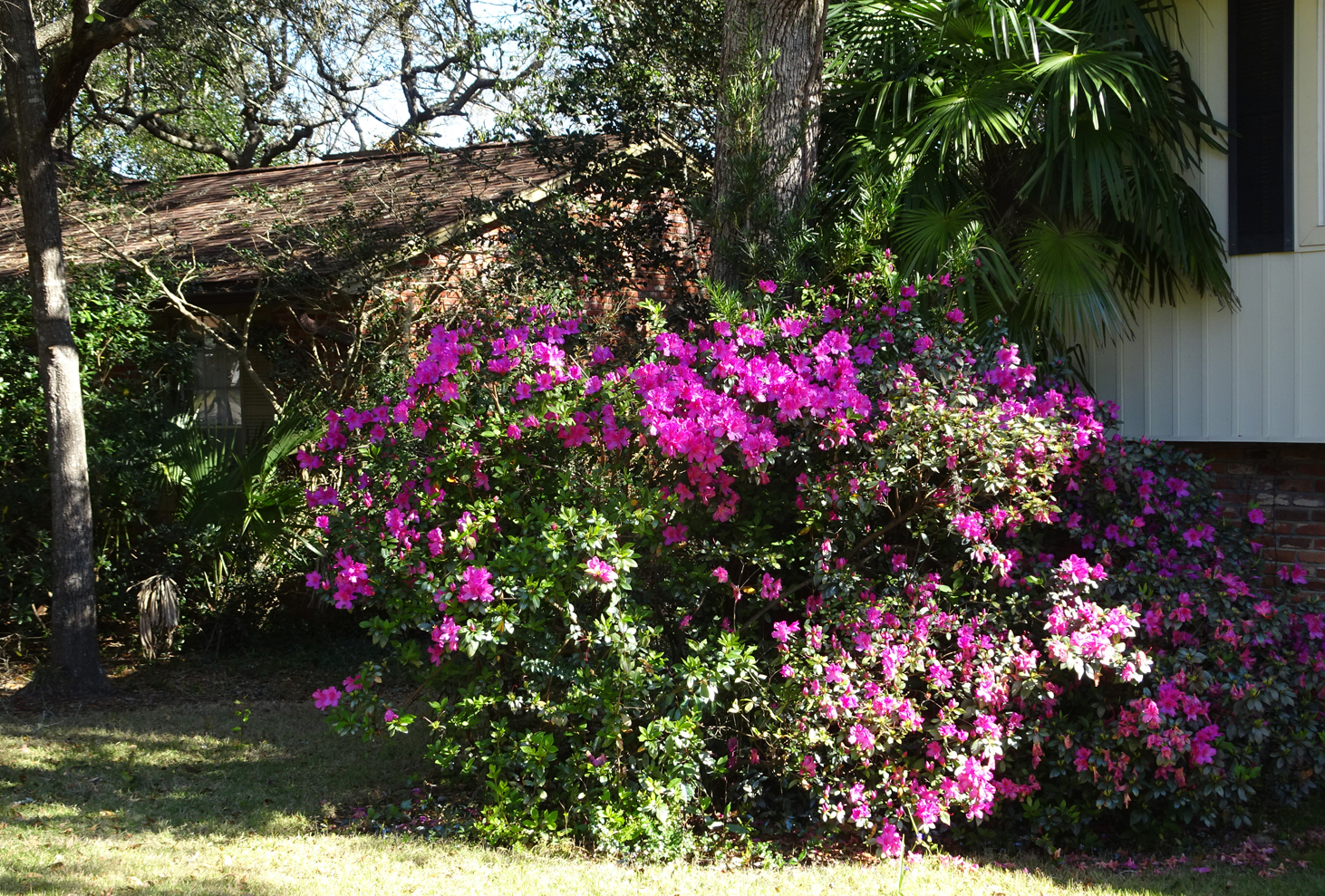
Despite the February date, azaleas are in full bloom around here - about 3 weeks earlier than normal.  It always amuses and entertains me to imagine how azaleas mirror the personalities of their owners.  This big, beautiful plant feels like a woman with her hair down, relaxing in the sunlight.

Across the street, however, an azalea hedge separating two houses has a much more "buttoned up" appearance, sacrificing blooms and density for formality and "neatness".

As I pondered the character-predicting capabilities of azalea shrubs, I heard a large bird calling loudly up above me in the tree canopy.  Frustrated by my rude intrusion as I stood stock still on the sidewalk just below her perch, a red-shouldered hawk squawked at me from a tall pine for several minutes before finally flying off, unwilling to tolerate my presence any longer.  As she flew, I mentally thanked her for allowing me to capture her picture, despite her irritation.
Continuing down the sidewalk, I couldn't pass up a picture of this evocative rope swing, taking advantage of a meandering sand live oak branch in someone's front yard.  I just wish there had been several small kids playing on it while I passed by!

Not too far away, another large oak was in obvious decline, being strangled by a rapacious English ivy vine scrambling up its trunk to compete for the light above, while its roots competed for water and nutrients below.

Even as I was aiming the camera, trying to get a good angle on the ivy vine and oak tree, I registered calls from the red-shouldered hawk again.  Looking up, over a house roof and into a back yard, I saw a huge nest with its raucous owner standing guard nearby.

I had known there was a pair of red-shouldered hawks nesting in the area, as I'd seen some of their mating displays from our backyard, but now I know where their nest is!  Even a short walk can uncover some pretty amazing discoveries.

"Hawk Street" ends in a cul-de-sac that borders the local golf course.  I couldn't resist a quick photo of these blooming azalea bushes along the golf course fence, framed by oak trunks and overhung with Spanish moss.

Continuing around the cul-de-sac had me heading back towards home.  As I walked past a quite neglected (but obviously once loved) front yard, I noticed this little concrete cherub.  Nestled down in a mix of variegated English ivy and fern fronds, he was a warm love note amidst the ragged remnants of the overgrown landscape.
As a contrast to the earlier "interior landscape" of the sand live oak tree, I snapped a quick picture looking up into a fairly young southern magnolia.  They are both native trees, but there is such a different quality of light, color and texture in their forms!

Hearing a variety of different bird calls, loudly rattled off in sequence, I wasn't too surprised when this mockingbird flew over to a hedge, then up onto the electric wires.  It was so nice of him to pose for me!

Across the street from the mockingbird, more "buttoned down" neighbors are obviously careful to keep their azaleas from looking too wild and crazy.  These shrubs are probably younger than the earlier hedge, in a sunnier location, and pruned more frequently, so there were more blooms and a thicker appearance overall.  Still, I prefer my azaleas to be free.

Rounding another corner, I was looking at a highly squared off azalea when I noticed the trunk of the southern magnolia shading it.  What causes this braided appearance?  Pruning up of the branches earlier in its life?

Speaking of pruning, why was it necessary to pollard this poor tree, looking like hell in the hell strip?  I didn't recognize the species from just the truncated remains of the branches and the bark alone, so I'll have to keep an eye on it and see what the leaves look like when the poor thing finally manages to push out a few.

As an aside, though, the bark on the trunk had obviously been a favorite place for yellow-bellied sapsuckers to feed over the years, bearing a textural pattern of holes that could almost be used to create a modern art piece.

Now I was completing my small neighborhood loop, looking at the streetscape, ornamented by sand live oak trees, with the light behind me.   Aren't these trees wonderful?  It was the presence of these trees that attracted our daughter to this neighborhood, 5 or 6 years ago.  (Then 2 years ago, she and her husband and our grandbabies attracted us to the same neighborhood!)

In the foreground of the photo above, you can see the soccer plinth and a stump in front of it.  That stump is the remnant of a large popcorn tree, an invasive species (in the Euphorbia family!) that was, thankfully, cut down a year ago.  The stump is beginning to sport an accent of frilly fungus as it starts to decompose, but it was the deep blue of the spiderwort blooms that caught my eye.  I'm a real sucker for blues of this hue.

As I approached the end of my walk, I couldn't resist capturing this quintessentially southern scene, again from the garden across the street from us.  Oak trees provide structure, high shade, and a catch-hold for graceful Spanish moss.  Underneath those picturesque giants, tall, dark green camellias and lower, rounded azaleas bloom brightly, skirted by fallen camellia petals and ferns.  Can't you just hear the whispered southern accents and the clinking of ice in tall drink glasses?

Thank you for coming on my winter walkout with me.  It's been fun to share my regular haunts with you - and I've loved seeing where everyone else is doing their winter walkouts, too.

As I finish, though, I have to wonder what it would be like for different people to walk the same route and share what caught their attention.  Wouldn't that be a fun way to compare and contrast how each of us sees the world differently?!  Another project for another time, I guess.  I hope you're enjoying the world around you, whatever season your weather is bringing these days, wherever you're planted.

Sunday, February 28, 2016

A Good Book And Some Humble (Oak) Pie

It's such a rookie mistake!  I knew there were several species of evergreen oaks down here.

But let me start again.... 

A while back, I discovered a promising book on Amazon.com, Finding Home in the Sandy Lands of the South: A Naturalist's Journey in Florida, by Francis E. "Jack" Putz.  Despite having absolutely no extra room for books in the house, I convinced myself that I truly needed this addition to my library. After all, we were talking about an author from the north (who was a naturalist!), living in the same general ecosystem we've just moved to, writing about what he's discovered about the plants and animals of the area since he moved here.  Of course I bought it.

Then, equally "logically", Sandy Lands stayed on my bedside bookshelf "maturing" for a while until the time seemed right to read it.  That time came a few days ago, as the weather and my schedule started to coalesce, making gardening seem more possible after our move.

As I delved into the book, I enjoyed Dr. Putz's tales of botanical and other adventures immensely, reading some of them aloud to Greg so that he could share them too.  Both of us decided that we would love to live in an environmentally focused, land trust based, community neighborhood like Flamingo Hammock, the spot near Gainesville that Dr. Putz has called home for many years now.  I know many of the species that were mentioned in his vignettes, so I could accurately picture them as I read, but I learned all sorts of additional, interesting bits and pieces, creating a much fuller understanding of our new habitat.

If you live in the southeastern coastal plain region, this is an enjoyable and informative read - I highly recommend it.  Actually, it's an enjoyable and informative read even if you don't live in this region!

Getting back on topic, I highly recommend this book, in fact, despite the fact that it has made me feel like a total dunce about my basic plant identification skills.  

The problem started when I read the chapter on "Liberating Live Oaks".  Our neighborhood is lucky in having many, many live oak (Quercus virginiana) and sand live oak (Q. geminata) trees, draped with Spanish moss, defining the landscape.  The original developer's daughter apparently loved the trees and convinced her father to save as many as he possibly could when he was building the homes.  Truthfully, the live oak trees were what drew our daughter to the neighborhood, when she moved to Ft. Walton Beach almost 5 years ago.  (She and our grandson were what drew us to the neighborhood...but the live oaks certainly helped clinch the deal.)

Putz, however, was talking about the decline of these beautiful old live oaks due to the encroachment of other hardwood trees, and he listed several species of particular concern that tend to grow fast and tall, overtopping established live oaks and causing their decline.  The problematic trees he mentioned specifically were laurel oak (Q. hemisphaerica), water oak (Q. nigra), and sweetgum (Liquidambar styraciflua).

Suddenly I remembered an earlier essay where he had mentioned that laurel oaks and live oaks could be difficult to tell apart, with similarly sized and shaped leaves.  And he was constantly, constantly talking about having to cut out laurel oaks that freely seeded and grew - fast - to crowd out all sorts of other plants.

Oh, no!  I had thought that the reason the live oaks in our back yard - left, center and right - were dying was because of the construction of the seawall back there, 8 years ago...but what if they weren't actually live oaks at all? With fear and trembling in my heart - but really knowing the answer already - I went outside and looked specifically at the back sides of the leaves of my trees:  shiny and bright green, not dull and whitish from tiny hairs.  Horrors!  Not only were all the "live oak" trees in the back yard actually laurel oaks, but even the big "live oak" in the front yard was a laurel oak!  No wonder they were all beginning to decline.

To add insult to injury, I've been flagging seedling oak trees in the yard, thinking to save a few of the best placed ones but, when I looked, all of the seedlings - every single one - was a laurel oak as well.

I guess the best lesson to take away from this humbling experience is to keep learning and to keep questioning my own assumptions.  I am truly glad that I realized my mistake now, and not 5 years from now, when the young laurel oak seedlings were well established and hard to pull out.  Now I need to decide whether to find tiny live oak seedlings to transplant from neighbors' yards, keeping the local ecotype going, or whether to buy commercially grown young trees for planting.  I want to use live oaks for their longevity and wind resistance, even though we'll be long gone before they mature.

One thing's for sure:  I'm glad I read Jack Putz's book and I'm glad I questioned my original identification.  I'd much rather know the truth than believe in a comfortable lie.  In the long run, as my son says, "It's all good."

Saturday, January 23, 2016

Native Plant Building Blocks

Having moved to a new (to us) house, new (to us) yard, in a different city, in a different state, I've shared that I feel like I'm starting completely from scratch again as I start to garden. This yard feels almost like a blank slate.

However, even a blank slate yard is never totally blank.  A suburban lot surrounding a house that's been lived in for almost 50 years is definitely not blank.  So, I've been watching the yard to see what's already living here, and I thought I'd share some of the native plant species I've found, the native "building blocks" that already exist in the yard for me to utilize.

Trees seem like the place to start.  The first thing I noticed coming up to our house last April was the big southern magnolia (Magnolia grandiflora) by the driveway, dominating the front yard. 

Unfortunately, it's not a good location for this species, since southern magnolias grow way too large for this space.  So, sometime in the past, big branches were pruned out of the tree to allow the electrical lines to go through the canopy.  There is also a southern magnolia in the back yard, although it is younger and smaller than the one in the front.

Next on the current yard list are the oaks, live oak (Quercus virginiana) and sand live oak (Q. geminata).  In the photo above, the big tree to the right of the house is our largest live oak.  Although there are many sand live oaks in the neighborhood, I think we only have one, a relatively small one, in our (back) yard.  On the other hand, we have 5 live oaks, 3 of which are quite unhealthy.  Unfortunately, none of our live oaks are terribly picturesque, having been limbed up to be "proper" trees, judging from their form.

Right now we only have one other tree species in our yard, pignut hickory (Carya glabra), but we have 3 mature specimens of this species in our back yard.  Pignut hickory is the only deciduous tree species we have. 

This photo, of one of the pignut hickories in the back yard, was taken in late June last summer.  I kept waiting for these trees to turn colors this fall, but it was a long wait.  The trees stayed green until December, when they turned a beautiful, bright yellow.  Leaf drop was rapid, once the leaves started to fall, and took place right around Christmas.  Not a traditional yard display for the holiday season!  If my memory serves, these trees are late to leaf out and won't get foliage back until April.

While there is a lot of Spanish moss (Tillandsia usneoides) in the neighborhood, we have very little in our yard - perhaps a result of how open the canopy is.  There IS some, though, and I'm hoping that we get more to grow over the years.

For quite a while, I've been eyeing this little prostrate vine and thinking that I recognized it - and I did. 

It's partridge berry (Mitchella repens), a gorgeous little evergreen groundcover with a wide natural range.  I had started to make the mistake of covering much of this plant up with mulch, but realized what I'd done when I went out to take the photo this morning. 

Here's the full scope of this plant, unearthed from below the mulch.  I'm hoping that this little guy will bloom (white) and maybe even set fruit (a bright red berry) later this year.

If you take a second look at the photo above, you'll notice a bare vine going up the tree trunk.  This vine is crossvine (Bignonia capreolata), a classic native landscaping vine in the south.  Here is a new stem, probably from the same root stock, climbing up a different side of the trunk. 

I'm excited to see this plant naturally in the yard, although this specimen doesn't look particularly luxuriant. Hopefully some better yard management will make it healthier.

Coming up in the middle of an old sand box, along the city storm drain easement, is a dwarf palmetto (Sabal minor). 

These are palm-y shrubs, with the trunk remaining underground.  I'm not very familiar with this species, although now that I know how to identify it, I'm noticing them all around.  This is one of many plant species I want (and need) to learn more about.

Last summer I noticed a rather handsome perennial plant growing at the base of one of the pignut hickories. 

I cordoned it off, so that it wouldn't get mowed, and watched it to see what it was.  Finally, in October, it bloomed a bright yellow. By the time it bloomed, though, the base of the plant had browned out badly.  I've figured out that this is golden aster, probably narrowleaf golden aster (Chrysopsis linearifolia), and the lower leaf brownout is actually listed in the plant descriptions. 

Most interesting is that, even with just a few buds open, there were actually little native bees using it in mid October.  So, now the challenge is how to disguise those lower leaves...and increase the plant population from my current n of 1, without jeopardizing that current, single specimen.

For now, the last plant I'm going to mention is Woolly Elephant's Foot (Elephantopus tomentosus), aka Devil's Grandmother, which I noticed and photographed last June.  I have no idea why it has earned either the name of "elephant's foot" or "devil's grandmother". This is not a showy plant at all, but it is both native and perennial.  I will almost assuredly keep it, but I may not try to expand its presence in the yard. 

I did like the fact that this little damselfly was using the bloom head to perch upon!