Prairiewolf and I just got back from a wonderful weekend in Kansas City, reconnecting with old friends and making new ones. It was PW's 25th class reunion and we had a "date" with one particular couple of good friends who live half a continent away. We had a great time with them and, as a bonus, we ended up reconnecting with several other old friends and acquaintances as well. There actually weren't very many of us that showed up altogether, but those of us who did seemed to have a great time.
My biggest regret, besides the fact that I don't look like I did 25 years ago, was that I didn't get to know some of these folks better back then.
The reunion, however, is only the backdrop for the main subject of this post.
Serendipitously, while we were there, Kansas City staged a new event called Waterfire. This was held Saturday night on Brush Creek as it winds through the Country Club Plaza.
Picture this:
Floating bonfires swaying down the center of the creek, stationed every 50 feet or so, their vivid orange flames reflecting boldly off the smooth dark water just below them. They form a brilliant living chain that twists down the backbone of the creek.
Smoke drifting through the air, cool breezes intermixing with sudden blasts of heat from the nearby fires.
Music filling the night, broadcast from large, well-placed (but unobtrusive) speakers. Classical arias are followed by African chants or celtic melodies, followed by chamber music or jazz. Every so often the recorded music is replaced by a spotlight shining on a classical singer, who sings from his or her heart, poised on the edge of one of the bridges traversing the creek.
The crowd meandering up and down the creek, some staying above on the roads and bridges, others venturing to walk along the creek, with still others resting on the steep, grassy slopes. Occasionally a member of the Vesuvius fire troupe performs amid the people, juggling blazing batons or breathing fire high into the air.
Sounds of laughter and talking interspersing with applause and sometimes just with awed pockets of silence.
It was a mystical evening, capping off a magical weekend.
A friendly stranger, leaning beside me on a bridge railing, avidly watching the fires and the crowd too, mentioned that they were repeating the event on October 13. I haven't verified that fact but if they do, I'd prescribe attendance for anyone who could use an evening's antidote to the humdrum ordinariness of everyday life.
Monday, September 10, 2007

Wednesday, August 29, 2007
Mourning for Roadside Losses
The mowers came yesterday.
As I walk in the morning or drive at any time of day, I enjoy looking at the ever-changing array of plants in the ditches: Illinois bundleflower, big bluestem, silver bluestem, eastern gamagrass, sunflowers, catsclaw sensitive briar, prairie petunia, and many, many more. It's a small tapestry of prairie plants, complete with food and cover for pheasant, quail and many other types of wildlife.
The mowers came yesterday.
Now all I have to look at up close is stubble. Boring, ugly stubble.
At least they waited until nesting season was done.
I worry about the wildlife anyway. At this point in the agricultural cycle, the farmers are all discing their fields, so all of those thousands of acres are being converted back to bare dirt. And now, to add insult to injury, the sanctuary of the roadsides, those narrow bands of habitat that stretch for miles and miles, has been reduced to 4" tall monotony. It's hard to hide from a hawk in 4" of cover.
I know the standard rationale:
"It looks neater this way." (Stubble with exposed trash? Thank you, but no thank you. That may be your idea of better looking, but it sure isn't mine.)
"It's a safety issue. This way cars can get off the road if they break down." (Grass doesn't keep a car from pulling off the road if necessary. And a steep ditch slope will keep someone on the road, whether the grass has been mowed or not. Last but not least, on most of the county roads around here, you can see for miles and there's little traffic, so pulling to the side of the road is all that's needed for safety's sake.)
"If we don't mow, the woody vegetation will grow up and become a problem." (Only one side of the road could be mowed each year, leaving 50% of the habitat available, and reducing mowing costs by 50%. Or, mowing could be delayed until early spring as things start to green up, before nesting occurs. That would leave cover and food for wildlife over the winter, but still set back the woody vegetation.)
"The roadsides are a source of weeds for the farm fields." (If the roadsides are left less disturbed, it allows perennials to dominate there. Most weeds are actually annuals that thrive in disturbed soil and produce massive quantities of seeds, ready to move in and colonize open soil. Annuals can't compete against established perennials, though. And perennials produce many fewer seeds, usually taking years to become well established. So, ironically, disturbing the soil and setting back perennial growth actually increases the weedy plants available to colonize the crop fields.)
I know I'm a lone voice railing against established precedent on this issue, but I'm tired of the tyranny of the "neatnik" crowd. "Neat" isn't always better or healthier, sometimes it's just boring and wasteful. To my mind, this is one of those times.
As I walk in the morning or drive at any time of day, I enjoy looking at the ever-changing array of plants in the ditches: Illinois bundleflower, big bluestem, silver bluestem, eastern gamagrass, sunflowers, catsclaw sensitive briar, prairie petunia, and many, many more. It's a small tapestry of prairie plants, complete with food and cover for pheasant, quail and many other types of wildlife.
The mowers came yesterday.
Now all I have to look at up close is stubble. Boring, ugly stubble.
At least they waited until nesting season was done.
I worry about the wildlife anyway. At this point in the agricultural cycle, the farmers are all discing their fields, so all of those thousands of acres are being converted back to bare dirt. And now, to add insult to injury, the sanctuary of the roadsides, those narrow bands of habitat that stretch for miles and miles, has been reduced to 4" tall monotony. It's hard to hide from a hawk in 4" of cover.
I know the standard rationale:
"It looks neater this way." (Stubble with exposed trash? Thank you, but no thank you. That may be your idea of better looking, but it sure isn't mine.)
"It's a safety issue. This way cars can get off the road if they break down." (Grass doesn't keep a car from pulling off the road if necessary. And a steep ditch slope will keep someone on the road, whether the grass has been mowed or not. Last but not least, on most of the county roads around here, you can see for miles and there's little traffic, so pulling to the side of the road is all that's needed for safety's sake.)
"If we don't mow, the woody vegetation will grow up and become a problem." (Only one side of the road could be mowed each year, leaving 50% of the habitat available, and reducing mowing costs by 50%. Or, mowing could be delayed until early spring as things start to green up, before nesting occurs. That would leave cover and food for wildlife over the winter, but still set back the woody vegetation.)
"The roadsides are a source of weeds for the farm fields." (If the roadsides are left less disturbed, it allows perennials to dominate there. Most weeds are actually annuals that thrive in disturbed soil and produce massive quantities of seeds, ready to move in and colonize open soil. Annuals can't compete against established perennials, though. And perennials produce many fewer seeds, usually taking years to become well established. So, ironically, disturbing the soil and setting back perennial growth actually increases the weedy plants available to colonize the crop fields.)
I know I'm a lone voice railing against established precedent on this issue, but I'm tired of the tyranny of the "neatnik" crowd. "Neat" isn't always better or healthier, sometimes it's just boring and wasteful. To my mind, this is one of those times.
Thursday, August 23, 2007
Thelma Sanders Sweet Potato Squash
I have found a real keeper for our garden line up!
Prairiewolf and I started using heirloom varieties of many vegetables over 10 years ago, in Mayetta, Kansas, after learning about how rapidly these interesting, locally adapted, non-hybrid varieties were disappearing. Tomatoes were our favorites, but we've tried a wide variety of heirlooms over the years.
We didn't really grow vegetables in Mobile, both because the weather was extremely hot and humid and because we didn't really have a good, sunny spot where vegetables could thrive.
So this year, after moving back to Kansas, we found ourselves really excited about putting in a vegetable garden again. Even though we started our garden extremely late and didn't put in a very big one, it seemed important to incorporate at least a few heirlooms.
So we put in 3 different kinds of squash: spaghetti squash (my personal favorite from the grocery store), delicata or sweet dumpling squash (written up as one of the sweetest squash - seemed like a good one to try!), and Thelma Sanders sweet potato squash. The sweet potato squash had two things going for it: I couldn't resist the name, and it came from a woman in Adair County, Missouri, which seemed reasonably close to Kansas agriculturally.
The spaghetti squash wilted away with the first squash bug. All 3 plants, even though several young squash had set already and I got after the squash bugs right away.
Only one delicata squash came up, and it looked very healthy for most of the summer, but it never set any fruit. Finally, when I let my watering and squash bug patrol slip for a couple weeks during a combination of horribly hot weather and a family reunion, it succumbed.
 The Thelma Sanders sweet potato squash, however, took everything that this Kansas summer could dish out and thrived on it. With 2 vines coming up in the single hill we planted, I've got at least a dozen fruit maturing and the vines are scrambling throughout the raised bed, in the path, under the basil, through the real sweet potatoes, and generally running rampant. Based on squash vines winding through the garden, you can't tell anymore that all the other squash plants croaked.
Besides watering, my only care has been to try to control the squash bugs organically. (That translates, for me, as picking off squash bug eggs, crushing nymphs, and drowning adults in soapy water. It's a gross activity to have to do, but it feels better to me than spraying or sprinkling pesticides.) Obviously, I've been in a holding pattern, not trying to wipe out the little beasts.
 This morning, when I picked up a couple of the fruits, 2 of them easily came off the stem, so I took that as a sign that they were ripe.
I fixed the first one for dinner tonight...and it was great. Size-wise, they are rather like a small acorn squash, and the texture of their flesh is very similar too. I baked them with butter, the same way I usually fix acorn squash. The taste is a little different, but it was excellent. Using them up is going to be no problem at all.
I am really excited about finding this great variety: hardy, prolific and tasty. And it's got a great name. I couldn't ask for anything more.
Prairiewolf and I started using heirloom varieties of many vegetables over 10 years ago, in Mayetta, Kansas, after learning about how rapidly these interesting, locally adapted, non-hybrid varieties were disappearing. Tomatoes were our favorites, but we've tried a wide variety of heirlooms over the years.
We didn't really grow vegetables in Mobile, both because the weather was extremely hot and humid and because we didn't really have a good, sunny spot where vegetables could thrive.
So this year, after moving back to Kansas, we found ourselves really excited about putting in a vegetable garden again. Even though we started our garden extremely late and didn't put in a very big one, it seemed important to incorporate at least a few heirlooms.
So we put in 3 different kinds of squash: spaghetti squash (my personal favorite from the grocery store), delicata or sweet dumpling squash (written up as one of the sweetest squash - seemed like a good one to try!), and Thelma Sanders sweet potato squash. The sweet potato squash had two things going for it: I couldn't resist the name, and it came from a woman in Adair County, Missouri, which seemed reasonably close to Kansas agriculturally.
The spaghetti squash wilted away with the first squash bug. All 3 plants, even though several young squash had set already and I got after the squash bugs right away.
Only one delicata squash came up, and it looked very healthy for most of the summer, but it never set any fruit. Finally, when I let my watering and squash bug patrol slip for a couple weeks during a combination of horribly hot weather and a family reunion, it succumbed.
 The Thelma Sanders sweet potato squash, however, took everything that this Kansas summer could dish out and thrived on it. With 2 vines coming up in the single hill we planted, I've got at least a dozen fruit maturing and the vines are scrambling throughout the raised bed, in the path, under the basil, through the real sweet potatoes, and generally running rampant. Based on squash vines winding through the garden, you can't tell anymore that all the other squash plants croaked.
Besides watering, my only care has been to try to control the squash bugs organically. (That translates, for me, as picking off squash bug eggs, crushing nymphs, and drowning adults in soapy water. It's a gross activity to have to do, but it feels better to me than spraying or sprinkling pesticides.) Obviously, I've been in a holding pattern, not trying to wipe out the little beasts.
 This morning, when I picked up a couple of the fruits, 2 of them easily came off the stem, so I took that as a sign that they were ripe.
 I fixed the first one for dinner tonight...and it was great. Size-wise, they are rather like a small acorn squash, and the texture of their flesh is very similar too. I baked them with butter, the same way I usually fix acorn squash. The taste is a little different, but it was excellent. Using them up is going to be no problem at all.
I am really excited about finding this great variety: hardy, prolific and tasty. And it's got a great name. I couldn't ask for anything more.
Wednesday, August 22, 2007
The Sport of Champions?
'Tis the season for recreational mowing.
Moving back after 6 years away, I am struck by how popular this "sport" is here in Kansas.
We looked at numerous houses in the country before deciding on this one. One of our big deciding factors was that I wanted to be able to let some of the grass grow on our acreage. Unfortunately, most of the "country" acreages around here require edge-to-edge mowing that seems much more suited to a postage stamp size lot in the city than to 5 acres or more in the country.
What a waste of time and gasoline. I would think that in this day and age of $3/gallon gasoline, people could find better things to do with their money than burn it up while cutting grass and wildflowers to an unsightly and boring stubble.
Now please understand that I'm ludicrously allergic to chiggers and I therefore fully appreciate the need to have mowed grass to walk on. My compromise is to mow (or have PW mow) a winding path through our acreage. This way I get to walk chigger-free through gracefully waving grasses and colorful interesting wildflowers. Meadowlarks cling to the tops of redcedars, bobwhite quail call from our frontyard, pheasant nest in the grasses. The path becomes our personal, stress-reducing, 3-D, ever-changing nature program.
For those folks who just love to mow, I'm not trying to take all your fun away. It's always a great idea on any prairie homestead to keep a firebreak of 50-100 feet mowed around any combustible structures. That makes a nice mowed lawn around the house, barn and/or garage.
We're a prairie state. Why is everyone so scared of prairie?
Moving back after 6 years away, I am struck by how popular this "sport" is here in Kansas.
We looked at numerous houses in the country before deciding on this one. One of our big deciding factors was that I wanted to be able to let some of the grass grow on our acreage. Unfortunately, most of the "country" acreages around here require edge-to-edge mowing that seems much more suited to a postage stamp size lot in the city than to 5 acres or more in the country.
What a waste of time and gasoline. I would think that in this day and age of $3/gallon gasoline, people could find better things to do with their money than burn it up while cutting grass and wildflowers to an unsightly and boring stubble.
Now please understand that I'm ludicrously allergic to chiggers and I therefore fully appreciate the need to have mowed grass to walk on. My compromise is to mow (or have PW mow) a winding path through our acreage. This way I get to walk chigger-free through gracefully waving grasses and colorful interesting wildflowers. Meadowlarks cling to the tops of redcedars, bobwhite quail call from our frontyard, pheasant nest in the grasses. The path becomes our personal, stress-reducing, 3-D, ever-changing nature program.
For those folks who just love to mow, I'm not trying to take all your fun away. It's always a great idea on any prairie homestead to keep a firebreak of 50-100 feet mowed around any combustible structures. That makes a nice mowed lawn around the house, barn and/or garage.
We're a prairie state. Why is everyone so scared of prairie?
Friday, August 17, 2007
Meditations on Ownership
What do I own - truly own? A chance phrase I read made me start thinking about this basic concept.
According to the normal concept of the word in the United States, I "own" (in conjunction with Prairiewolf) 4 dogs and a cat, a home and 10 acres of land, many books, furniture, 2 cars and a truck, lots of clothes, and so forth.
But as I list all of that, a niggling feeling of doubt arises. Do I really own all of that? What is my real relationship with each of those beings and items?
First of all, there is the classic question: do I own these things or do they own me? Trust me, when I'm feeling the recurrent obligation to dust, vacuum, mend, and otherwise manage inanimate objects, I find myself asking whether my life belongs to me or if it doesn't truly belong to all of this stuff that we've accumulated.
That makes me want to look up the actual definition of "to own".
With some apologies to Merriam-Webster's Collegiate Dictionary, 3rd Edition, for rather sloppily quoting their careful work, the definitions the dictionary gives are:
"belonging to oneself..."
"used to express immediate or direct kinship"
"to have or hold as property"
"to have power over"
"to acknowledge to be true, valid or as claimed".
I'd say that the third definition, with overtones of the fourth definition, comes closest to the standard concept of ownership.
I could, however, definitely say that the dogs and cat "have power over" me, and therefore own me, perhaps almost as much as I own them. (On my 10th time out the door to watch over our blind dog in the yard, it definitely feels like she has more power over me more than I have over her!)
There's another nuance here that's arising today. What is the difference between things I own...and things I really just tend? (Is "tending", for all intents and purposes, the same as "being owned by"?) PW and I technically own this house and land, but they will long outlast us and we are likely just a small part of their history. Truthfully, I think we just tend our house and land rather than truly own it, no matter what it says on the deed.
Does that mean that the house and land actually owns us?
It does feel like I truly own the books and furniture and vehicles. Yes, they exist separately from me and they may very well outlast me, but their value is chiefly the value that they have in my (our) life.
Except for the family history items. Those have a history that began before our "ownership" and that hopefully will outlast that same ownership. I'm back to being simply a "tend-er" again.
In some ways it is as simple as ownership enjoyments vs. ownership responsibilities. Saying that, anything you could actually get rid of by destroying it would be something you truly own.
Transfering responsibility and care to someone else, though, leads me back to the idea of ownership as tending.
So, for me, if I could destroy it without a qualm, I own it. If I would feel obligated to pass responsibility for it on to someone else, I am simply a tend-er.
By those standards, I own very little: some of my books (but not the good ones or the important ones); the everyday accompaniments to modern life like shampoo and cleaning supplies; clothes; cars.
But I tend a lot. Our house and land. The animals. The important books. The family history things.
I own a few things, but most of my "possessions" own me.
I'm not sure how I feel about that state of things.
According to the normal concept of the word in the United States, I "own" (in conjunction with Prairiewolf) 4 dogs and a cat, a home and 10 acres of land, many books, furniture, 2 cars and a truck, lots of clothes, and so forth.
But as I list all of that, a niggling feeling of doubt arises. Do I really own all of that? What is my real relationship with each of those beings and items?
First of all, there is the classic question: do I own these things or do they own me? Trust me, when I'm feeling the recurrent obligation to dust, vacuum, mend, and otherwise manage inanimate objects, I find myself asking whether my life belongs to me or if it doesn't truly belong to all of this stuff that we've accumulated.
That makes me want to look up the actual definition of "to own".
With some apologies to Merriam-Webster's Collegiate Dictionary, 3rd Edition, for rather sloppily quoting their careful work, the definitions the dictionary gives are:
"belonging to oneself..."
"used to express immediate or direct kinship"
"to have or hold as property"
"to have power over"
"to acknowledge to be true, valid or as claimed".
I'd say that the third definition, with overtones of the fourth definition, comes closest to the standard concept of ownership.
I could, however, definitely say that the dogs and cat "have power over" me, and therefore own me, perhaps almost as much as I own them. (On my 10th time out the door to watch over our blind dog in the yard, it definitely feels like she has more power over me more than I have over her!)
There's another nuance here that's arising today. What is the difference between things I own...and things I really just tend? (Is "tending", for all intents and purposes, the same as "being owned by"?) PW and I technically own this house and land, but they will long outlast us and we are likely just a small part of their history. Truthfully, I think we just tend our house and land rather than truly own it, no matter what it says on the deed.
Does that mean that the house and land actually owns us?
It does feel like I truly own the books and furniture and vehicles. Yes, they exist separately from me and they may very well outlast me, but their value is chiefly the value that they have in my (our) life.
Except for the family history items. Those have a history that began before our "ownership" and that hopefully will outlast that same ownership. I'm back to being simply a "tend-er" again.
In some ways it is as simple as ownership enjoyments vs. ownership responsibilities. Saying that, anything you could actually get rid of by destroying it would be something you truly own.
Transfering responsibility and care to someone else, though, leads me back to the idea of ownership as tending.
So, for me, if I could destroy it without a qualm, I own it. If I would feel obligated to pass responsibility for it on to someone else, I am simply a tend-er.
By those standards, I own very little: some of my books (but not the good ones or the important ones); the everyday accompaniments to modern life like shampoo and cleaning supplies; clothes; cars.
But I tend a lot. Our house and land. The animals. The important books. The family history things.
I own a few things, but most of my "possessions" own me.
I'm not sure how I feel about that state of things.
Startling Statistic - Why Does It Bother Me?
As I was reading Mary Pipher's book Writing to Change the World last night, I came across a startling statistic. On page 3, she writes "Tech Tonic, a publication of the Alliance for Childhood, reports that the average American can recognize over a thousand brand names but is unable to identify ten indigenous plants or animals."
Ouch. Could that possibly be true?
Ironically, I don't question in the least that most Americans can recognize over a thousand brand names. What scares me is the thought that most Americans could not identify ten indigenous plants or animals.
(Could this be a language issue: not understanding the meaning of the word "indigenous"? If that word were defined for them by the researcher, would they then be able to come up with ten indigenous plants or animals?)
I can't imagine any Kansan over the age of 10 not being able to identify: bison, blue jay, raccoon, opossum, skunk, bald eagle, meadowlark, box turtle, (fox) squirrel, and turkey.
The plant side is harder, though. Most of the plants people can recognize are weeds...and most of those are not indigenous. (Dandelion springs immediately to mind.) By the age of 10, I'd like to see Kansans able to recognize cottonwood, red cedar, poison ivy, big bluestem, cattails, Indian grass, willows, and a couple prairie wildflowers. Knowing the grasses and wildflowers would help them know when the land they were looking at was relatively undisturbed, and it would help them learn about and understand the ecosystem that formed the landscape they live in. Recognizing cottonwood, willows and cattails would help them understand where the land they're looking at is often wet. Red cedar's the only native evergreen here. And knowing poison ivy might help keep them from inadvertently getting themselves in trouble.
Ultimately, though, I think the problem is that most people don't think understanding the land is important any more. They still "hunt and gather", but now they hunt and gather clothes and CDs and DVDs and cars and other stuff. Stuff to make themselves look powerful or important to their friends and enemies. Stuff to impress the other sex. Occasionally even stuff to help them survive.
In other words, they are still acting as animals, but now their frame of reference is divorced from the environment that actually supports them. Who needs to know plants and animals when you think that everything you need is in a store?
My gut tells me that it's important for people to be able to understand the physical world around them. That our health as living beings depends on the health of the environment we live in. And that if we have absolutely no clue how to "read" our environment, we won't take care of it... and we'll "break" it, perhaps irrevocably as far as its ability to support us.
But I wonder if I'm right to be concerned.... Maybe we really aren't living beings any more.
Ouch. Could that possibly be true?
Ironically, I don't question in the least that most Americans can recognize over a thousand brand names. What scares me is the thought that most Americans could not identify ten indigenous plants or animals.
(Could this be a language issue: not understanding the meaning of the word "indigenous"? If that word were defined for them by the researcher, would they then be able to come up with ten indigenous plants or animals?)
I can't imagine any Kansan over the age of 10 not being able to identify: bison, blue jay, raccoon, opossum, skunk, bald eagle, meadowlark, box turtle, (fox) squirrel, and turkey.
The plant side is harder, though. Most of the plants people can recognize are weeds...and most of those are not indigenous. (Dandelion springs immediately to mind.) By the age of 10, I'd like to see Kansans able to recognize cottonwood, red cedar, poison ivy, big bluestem, cattails, Indian grass, willows, and a couple prairie wildflowers. Knowing the grasses and wildflowers would help them know when the land they were looking at was relatively undisturbed, and it would help them learn about and understand the ecosystem that formed the landscape they live in. Recognizing cottonwood, willows and cattails would help them understand where the land they're looking at is often wet. Red cedar's the only native evergreen here. And knowing poison ivy might help keep them from inadvertently getting themselves in trouble.
Ultimately, though, I think the problem is that most people don't think understanding the land is important any more. They still "hunt and gather", but now they hunt and gather clothes and CDs and DVDs and cars and other stuff. Stuff to make themselves look powerful or important to their friends and enemies. Stuff to impress the other sex. Occasionally even stuff to help them survive.
In other words, they are still acting as animals, but now their frame of reference is divorced from the environment that actually supports them. Who needs to know plants and animals when you think that everything you need is in a store?
My gut tells me that it's important for people to be able to understand the physical world around them. That our health as living beings depends on the health of the environment we live in. And that if we have absolutely no clue how to "read" our environment, we won't take care of it... and we'll "break" it, perhaps irrevocably as far as its ability to support us.
But I wonder if I'm right to be concerned.... Maybe we really aren't living beings any more.
Monday, August 13, 2007
Perseid Meteor Watch
It's the time of year for the Perseid meteor showers.
In Mayetta, we would spend several hours on at least one night each year, lying on our backs on the front lawn, watching the sky for the sudden flash of a streaking meteor. In Mobile, however, we lost the habit. There was too much light pollution there, and the sky was hardly visible due to tall trees and surrounding houses.
I missed my annual sky-watching event.
Last night I got it back. I took a blanket out and spread it on our front lawn, then lay down facing the northeast sky. Pretty soon Lefty, our oldest English setter, staggered out to join me. Then Prairiewolf and Becker, our German shepherd, came out from inside. We all lay on the blanket together, panting softly.
It was a perfect night for star gazing. The air was softly warm with a light breeze. The sky was clear, and the stars were scattered across it like sand on a dark glazed floor.
I didn't get to see too many meteors - only 4 - but I had a wonderfully relaxing time trying. I can't think of a better activity for keeping myself centered in the "now" and for sinking back and enjoying being alive.
Sometimes it's important to smell the roses; last night it was important to watch the stars.
In Mayetta, we would spend several hours on at least one night each year, lying on our backs on the front lawn, watching the sky for the sudden flash of a streaking meteor. In Mobile, however, we lost the habit. There was too much light pollution there, and the sky was hardly visible due to tall trees and surrounding houses.
I missed my annual sky-watching event.
Last night I got it back. I took a blanket out and spread it on our front lawn, then lay down facing the northeast sky. Pretty soon Lefty, our oldest English setter, staggered out to join me. Then Prairiewolf and Becker, our German shepherd, came out from inside. We all lay on the blanket together, panting softly.
It was a perfect night for star gazing. The air was softly warm with a light breeze. The sky was clear, and the stars were scattered across it like sand on a dark glazed floor.
I didn't get to see too many meteors - only 4 - but I had a wonderfully relaxing time trying. I can't think of a better activity for keeping myself centered in the "now" and for sinking back and enjoying being alive.
Sometimes it's important to smell the roses; last night it was important to watch the stars.
Saturday, August 11, 2007
Summertime Haiku
Recently our local paper, The Wichita Eagle, sponsored a little contest at their website, encouraging their readers to submit "hot haiku" about their angst over dealing with summertime heat and humidity.
(For those whose grasp of poetry is as rusty as mine, haiku is a Japanese form of poetry, non-rhyming, where the first line has 5 syllables, the second line has 7 syllables, and the last line has 5 syllables again. )
Last Thursday, they published 12 of the best entries they'd received so far (The Wichita Eagle, 9 August 2007, p. 3A). My favorite two were:
Yes, I do love you
But it's summer in Kansas
Please don't sit so close.
Flowers are wilting
My enthusiasm, too
Only weeds survive.
The contest idea tickled my fancy as something that I had the energy to do, despite temperatures in the upper 90s and low 100s. Since "heat" alone wasn't getting my creative energy flowing very strongly, I expanded my allowable topics to include summer in general. Here are a couple of the summertime haiku that I came up with....
Soaring vulture tilts
Side to side, searching below,
Drifting on the wind.
Shiny leaves waving
As wind rustles through the tree.
Cottonwood music.
Silent shell clings tight
To twig while living locust
Sings shrilly above.
Shimmering heat waves
Ripple through the stifling air.
Summertime Kansas.
The grammar of the locust one still bugs me (no pun intended), but I like the image, so I included it anyway.
I had fun doing this, especially as I drove the country roads doing errands. The biggest problem was that I would find a phrase I liked, but be unable to write it down for miles until I came to the next stop sign. I tried writing against the steering wheel, but ended up honking the horn with the slightest bit of pressure. Finally I decided that it was good mental exercise to either refine the phrase I was thinking of or just commit it to memory. Who knows what literary masterpiece was lost to posterity due to a middle-aged memory!!!
Too bad the kids are all grown up - this would have been a great family road game.
Maybe my next poetic creations should be limericks.... ("There was an old dame from....")
Then again, maybe not.
(For those whose grasp of poetry is as rusty as mine, haiku is a Japanese form of poetry, non-rhyming, where the first line has 5 syllables, the second line has 7 syllables, and the last line has 5 syllables again. )
Last Thursday, they published 12 of the best entries they'd received so far (The Wichita Eagle, 9 August 2007, p. 3A). My favorite two were:
Yes, I do love you
But it's summer in Kansas
Please don't sit so close.
Flowers are wilting
My enthusiasm, too
Only weeds survive.
The contest idea tickled my fancy as something that I had the energy to do, despite temperatures in the upper 90s and low 100s. Since "heat" alone wasn't getting my creative energy flowing very strongly, I expanded my allowable topics to include summer in general. Here are a couple of the summertime haiku that I came up with....
Soaring vulture tilts
Side to side, searching below,
Drifting on the wind.
Shiny leaves waving
As wind rustles through the tree.
Cottonwood music.
Silent shell clings tight
To twig while living locust
Sings shrilly above.
Shimmering heat waves
Ripple through the stifling air.
Summertime Kansas.
The grammar of the locust one still bugs me (no pun intended), but I like the image, so I included it anyway.
I had fun doing this, especially as I drove the country roads doing errands. The biggest problem was that I would find a phrase I liked, but be unable to write it down for miles until I came to the next stop sign. I tried writing against the steering wheel, but ended up honking the horn with the slightest bit of pressure. Finally I decided that it was good mental exercise to either refine the phrase I was thinking of or just commit it to memory. Who knows what literary masterpiece was lost to posterity due to a middle-aged memory!!!
Too bad the kids are all grown up - this would have been a great family road game.
Maybe my next poetic creations should be limericks.... ("There was an old dame from....")
Then again, maybe not.
Thursday, July 19, 2007
My New Personal Trainer
About 6 weeks ago I went to the local family practice physician (at Prairiewolf's request) to have my blood pressure checked out. To make a long story short(er), the doc recommended the typical "walk for 30 minutes every day," which I knew I should be doing but somehow never managed to accomplish on a regular basis. About two weeks ago I finally quit procrastinating and, with our German Shepherd, Becker, as a companion, I hit the road, walking about half an hour each day for a couple mornings in a row.
A couple mornings was all it took. It turns out that Becker is a strong "J" (to use the Meyers-Brigg personality profile terminology). That means he likes his routines...ah, no, that means he craves his routines. Within those "couple" days, he had decided that this morning walk thing was a GREAT addition to his morning rituals.
Becker is an extremely talented nag. Obviously he can't say anything, but his body language is unmistakeable: "Okay, Mom, time to get up" (cold nose nudge in face, whine, whine). "Okay, Mom, time to get dressed" (hopeful look back upstairs, dancing feet if I head even slightly in that direction). "Okay, Mom, time to go outside" (alert stance, whine, whine, dancing feet when I pass near the door). "O boy, Mom! Now you're talking!" (dancing happy dance as we go out the door).
Do you know how hard it is to ignore a 110+ pound German Shepherd?
Any thoughts I now have of occasionally skipping this morning walk are not about to be tolerated...at least not by Becker. It doesn't matter what the weather is. It doesn't matter if I'm feeling groggy from allergy meds or from an interrupted night of sleep. It doesn't matter if my feet hurt because I stood on them all day the day before. We ARE going walking every morning. And we ARE going walking as soon as he can nag me to get out the door. No lolligagging is permitted.
It irritates the living daylights out of me, especially when I've been up half the night and sleep is seductively calling my name after Prairiewolf has left in the morning, but some taskmasters are simply inescapable.
Once I get outside and on the road, though, I'm usually glad we came. Becker settles down right beside me, ears slightly back, nose quivering, eyes scanning, panting as he contentedly pads along the side of the road. I notice the wildflowers blooming in the ditches and the birds singing in the fields. (The dickcissels have been particularly vocal lately.) Becker notices the roadkills. We both do our own versions of neighborhood watch.
Back at home once again, I have to laugh. Some people actually PAY for personal trainers. For better or worse, I've got mine living with me 24/7...and he WILL NOT be ignored.
A couple mornings was all it took. It turns out that Becker is a strong "J" (to use the Meyers-Brigg personality profile terminology). That means he likes his routines...ah, no, that means he craves his routines. Within those "couple" days, he had decided that this morning walk thing was a GREAT addition to his morning rituals.
Becker is an extremely talented nag. Obviously he can't say anything, but his body language is unmistakeable: "Okay, Mom, time to get up" (cold nose nudge in face, whine, whine). "Okay, Mom, time to get dressed" (hopeful look back upstairs, dancing feet if I head even slightly in that direction). "Okay, Mom, time to go outside" (alert stance, whine, whine, dancing feet when I pass near the door). "O boy, Mom! Now you're talking!" (dancing happy dance as we go out the door).
Do you know how hard it is to ignore a 110+ pound German Shepherd?
Any thoughts I now have of occasionally skipping this morning walk are not about to be tolerated...at least not by Becker. It doesn't matter what the weather is. It doesn't matter if I'm feeling groggy from allergy meds or from an interrupted night of sleep. It doesn't matter if my feet hurt because I stood on them all day the day before. We ARE going walking every morning. And we ARE going walking as soon as he can nag me to get out the door. No lolligagging is permitted.
It irritates the living daylights out of me, especially when I've been up half the night and sleep is seductively calling my name after Prairiewolf has left in the morning, but some taskmasters are simply inescapable.
Once I get outside and on the road, though, I'm usually glad we came. Becker settles down right beside me, ears slightly back, nose quivering, eyes scanning, panting as he contentedly pads along the side of the road. I notice the wildflowers blooming in the ditches and the birds singing in the fields. (The dickcissels have been particularly vocal lately.) Becker notices the roadkills. We both do our own versions of neighborhood watch.
Back at home once again, I have to laugh. Some people actually PAY for personal trainers. For better or worse, I've got mine living with me 24/7...and he WILL NOT be ignored.
Monday, July 16, 2007
New Tricks for An Old Dog
You can teach an old dog new tricks! And I taught myself a new trick just today. It feels great!
After years of growing basil (I love the smell as I brush by it in the garden), I finally got myself together enough yesterday and today to harvest some and actually use it.
To be precise, I made basil pesto. It took a lot longer than I expected, mainly because I think I am the most inefficient basil leaf picker known to humankind, but it was wonderful and well worth the effort. (Since my food processor instructions said to be sure that fresh herbs were DRY, I had to first pick fresh basil branches, then wash them and pat them dry, then pick the leaves off individually and blot them dry. It takes a lot of basil leaves to make 2 packed cups of fresh basil leaves!)
Note: When I described how long it took to pick the basil leaves, my mother got concerned about how long I was out in the sun, evidently envisioning me picking off leaf after basil leaf out in the garden. It's nice to have someone who still worries about me.
The pesto turned out excellently! Now I have plans to harvest much more. I have 3 different kinds of basil, so I'm planning to make pesto out of all 3 separately, noting the flavor difference between varieties. I'll also be freezing some. Lots of new experiences ahead.
The last few days have been the beginning of our serious attempt to eat more locally. The pesto is part of this. (The basil was VERY local. The other ingredients, unfortunately, were not. I have some work to do there.) We grilled (local) corn on the cob in its husk for the first time last night. Another new trick for us old dogs. Our chicken tonight was local, free range, hormone and antiobiotic free - and was excellent. And we've been eating tomatoes, cucumbers, cinnamon rolls, and whole wheat bread from local folks too. It's fun, tasty, somewhat of a challenge to learn to plan menus differently, and altogether an excellent adventure.
After years of growing basil (I love the smell as I brush by it in the garden), I finally got myself together enough yesterday and today to harvest some and actually use it.
To be precise, I made basil pesto. It took a lot longer than I expected, mainly because I think I am the most inefficient basil leaf picker known to humankind, but it was wonderful and well worth the effort. (Since my food processor instructions said to be sure that fresh herbs were DRY, I had to first pick fresh basil branches, then wash them and pat them dry, then pick the leaves off individually and blot them dry. It takes a lot of basil leaves to make 2 packed cups of fresh basil leaves!)
Note: When I described how long it took to pick the basil leaves, my mother got concerned about how long I was out in the sun, evidently envisioning me picking off leaf after basil leaf out in the garden. It's nice to have someone who still worries about me.
The pesto turned out excellently! Now I have plans to harvest much more. I have 3 different kinds of basil, so I'm planning to make pesto out of all 3 separately, noting the flavor difference between varieties. I'll also be freezing some. Lots of new experiences ahead.
The last few days have been the beginning of our serious attempt to eat more locally. The pesto is part of this. (The basil was VERY local. The other ingredients, unfortunately, were not. I have some work to do there.) We grilled (local) corn on the cob in its husk for the first time last night. Another new trick for us old dogs. Our chicken tonight was local, free range, hormone and antiobiotic free - and was excellent. And we've been eating tomatoes, cucumbers, cinnamon rolls, and whole wheat bread from local folks too. It's fun, tasty, somewhat of a challenge to learn to plan menus differently, and altogether an excellent adventure.
Friday, July 13, 2007
Past the Tipping Point of Summer
It's barely into double digit days in July, but already it feels like we've passed the tipping point of summer.
Mom mentioned yesterday that she's noticing a few yellow leaves on the cottonwoods, and that the willows are beginning to shed a few early leaves too.
I noticed the first cicadas about 2 weeks ago. They're not omnipresent, like they will be soon, but they are definitely moving into full chorus mode.
When I walk in the morning, I see families of barn swallows sitting on the wires or on the fence near the creek bridge.
Lastly, this morning on my walk I noticed the second and third of the fall flowers and grasses beginning to open up. (I noticed a few sunflowers open several days ago - those were the first of the fall flowers.) Right next to the road, I saw the first turkeyfoot flowerhead of a big bluestem grass clump, and further down the way, an ironweed bloom cluster was beginning to show its brilliant purple color.
The change of seasons is beginning to feel like a rollercoaster ride to me - the ups and downs are thrilling, but come at me amazingly fast and almost take my breath away.
Mom mentioned yesterday that she's noticing a few yellow leaves on the cottonwoods, and that the willows are beginning to shed a few early leaves too.
I noticed the first cicadas about 2 weeks ago. They're not omnipresent, like they will be soon, but they are definitely moving into full chorus mode.
When I walk in the morning, I see families of barn swallows sitting on the wires or on the fence near the creek bridge.
Lastly, this morning on my walk I noticed the second and third of the fall flowers and grasses beginning to open up. (I noticed a few sunflowers open several days ago - those were the first of the fall flowers.) Right next to the road, I saw the first turkeyfoot flowerhead of a big bluestem grass clump, and further down the way, an ironweed bloom cluster was beginning to show its brilliant purple color.
The change of seasons is beginning to feel like a rollercoaster ride to me - the ups and downs are thrilling, but come at me amazingly fast and almost take my breath away.
My Southern Nemesis Reappears
Since we've moved in, both Prairiewolf and I have occasionally seen a hole that looked suspiciously like armadillo work. We've known that they are here, but they don't seem to be present in the numbers found further south, so we've assured ourselves that the hole probably wasn't actually made by an armadillo and moved on with life.
Well, all of those holes probably were made by an armadillo. Proof that we have (had) at least one resident armadillo is currently lying dead in the ditch in front of our house, a victim of a run-in with a car.
I normally mourn when a wild animal tragically meets its end, but in this case I feel more like celebrating. I want to be able to assume that we're done with armadillo damage for a while, but logic tells me, "Where there's one, there's plenty more."
Bah! Humbug! That was one garden scourge I was truly hoping we'd not have to deal with here.
Well, all of those holes probably were made by an armadillo. Proof that we have (had) at least one resident armadillo is currently lying dead in the ditch in front of our house, a victim of a run-in with a car.
I normally mourn when a wild animal tragically meets its end, but in this case I feel more like celebrating. I want to be able to assume that we're done with armadillo damage for a while, but logic tells me, "Where there's one, there's plenty more."
Bah! Humbug! That was one garden scourge I was truly hoping we'd not have to deal with here.
Thursday, July 12, 2007
A Challenge to Become a Locavore
I just finished Barbara Kingsolver's latest book, Animal, Vegetable, Miracle. As I mentioned in an earlier post, it is a book about the year that she and her family (husband, 2 daughters) decided to eat locally. They consciously and carefully tried to make their entire menu out of food produced as close as possible to their home, as well as food produced organically. They grew quite a bit of their food, including eggs, chickens and turkeys, but also relied on area farmers and farmers' markets.
"Why would anyone do that?" I hear people asking. There were several reasons. One was the realization that every calorie they were eating had used many more calories being shipped to them, and in this time of growing environmental concern, that seemed tragically wasteful. Then, too, local food is fresher, tastier, and in buying it you are supporting local farmers rather than soul-less mega-corporations. Eating locally meant becoming more in tune with the natural rhythms around them. And by eating locally and getting to know the local producers, they not only developed a stronger sense of community, but they helped keep that community (and themselves) healthier by supporting organic agriculture.
It's an interesting book, a true family affair. Kingsolver writes the bulk of the story and her narrative voice is casual and fun, but knowledgeable. Her 19 year old daughter Camille writes occasional sections primarily focused around specific recipes and meal plans for taking advantage of seasonal fruits and vegetables. Her husband, a biology professor, writes sidebars that provide more specific scientific information.
While I'm not courageous enough to jump headfirst into a year's contract to eat locally, I've been slowly trying to work more local foods into our diet. We've been eating local eggs (wonderful! with bright orange yellow substantial yolks), hamburger (no hormones or antibiotics - very tasty, but we're still looking for straight pasture fed beef), bread (very good), cinnamon rolls (fantastic, but I'm not sure the ingredients are local for either the bread or the cinnamon rolls) and vegetables. Many of these things we found at the local farmers' market in West Wichita. After reading this book, I'm even more dedicated to that changeover, and I'm specifically looking forward to trying some of the recipes Camille presents.
"Why would anyone do that?" I hear people asking. There were several reasons. One was the realization that every calorie they were eating had used many more calories being shipped to them, and in this time of growing environmental concern, that seemed tragically wasteful. Then, too, local food is fresher, tastier, and in buying it you are supporting local farmers rather than soul-less mega-corporations. Eating locally meant becoming more in tune with the natural rhythms around them. And by eating locally and getting to know the local producers, they not only developed a stronger sense of community, but they helped keep that community (and themselves) healthier by supporting organic agriculture.
It's an interesting book, a true family affair. Kingsolver writes the bulk of the story and her narrative voice is casual and fun, but knowledgeable. Her 19 year old daughter Camille writes occasional sections primarily focused around specific recipes and meal plans for taking advantage of seasonal fruits and vegetables. Her husband, a biology professor, writes sidebars that provide more specific scientific information.
While I'm not courageous enough to jump headfirst into a year's contract to eat locally, I've been slowly trying to work more local foods into our diet. We've been eating local eggs (wonderful! with bright orange yellow substantial yolks), hamburger (no hormones or antibiotics - very tasty, but we're still looking for straight pasture fed beef), bread (very good), cinnamon rolls (fantastic, but I'm not sure the ingredients are local for either the bread or the cinnamon rolls) and vegetables. Many of these things we found at the local farmers' market in West Wichita. After reading this book, I'm even more dedicated to that changeover, and I'm specifically looking forward to trying some of the recipes Camille presents.
Tuesday, July 10, 2007
Smoke Clouds on the Horizon
It's been such a rainy spring and summer here that everything is still bright green. Everything, that is, except the wheat.
By now the wheat should have been harvested and all that should remain is stubble. Instead, field after field still contains its crop...or what remains of its crop. After decades of living in Kansas, I've never seen the wheat look this bad. Instead of golden brown, it's gray and thin and scraggly. As each week passes and more rain comes, keeping it impossible to get into the fields, more and more weeds are poking their heads through and the wheat itself gets grayer and skimpier and sadder.
I've wondered what the farmers will do. It doesn't even look like you could harvest these fields for hay - too much of it is bent and all of it looks like it's rotting in place. However, leaving the wheat standing and eventually plowing it under doesn't seem like a good option either, because that would just leave seeds in place to contaminate next year's crop.
This weekend I got my answer: smoke clouds started appearing in several different directions. Many farmers have made the painful decision to burn the remnants of their wheat as it stands.
Hopefully most of the farmers will have crop insurance and will thus be able to weather this disastrous year. However, there's certainly not much diversity built into farming any more to allow them to weather it the traditional way, through the offset of a different crop thriving under these weather conditions.
In fact, the condition of the wheat is quite ironic, really. So many other plants are thriving this year: the wildflowers have been outstanding, lawns and gardens are lush even without watering, and many trees are putting on strong growth. This year is pointing out the biological vulnerabilities that underlie our country's current agricultural system: the economy of scale (literally putting all our eggs into one or two baskets) provides phenomenal results when the conditions are right...but provides colossal failure when those conditions aren't perfect.
It reminds me of the stock market debacle of several years ago: tech stocks "couldn't fail" for several years...then suddenly they did fail, wiping out entire portfolios of investors who had concentrated on only the "best performing" stocks. It also reminds me of the loss of so many communities' trees when Dutch elm disease wiped out most American elms; many communities had planted little but elms because they were such a "perfect" street tree.
So the smoke clouds send signals to me. They signal me that what works most of the time doesn't work all of the time, and to plan for that. They signal me that, in the midst of plenty, things can still go wrong and be hard for others, and to take that into consideration in my dealings with them. They signal me to celebrate courage, and to cultivate the courage to cut my losses and move on when things don't go well. Most of all, the smoke clouds signal me to celebrate diversity and to work to incorporate it into my life wherever I can.
(Does this mean I've got some loss cutting and diversity increasing that I need to do right now? Hmmm. Much as I hate to admit it, I suspect that it does and that I do. If I'm going to interpret the smoke signals and write about them publicly, the least I can do is actually pay attention to them myself...as irritating as that is!)
By now the wheat should have been harvested and all that should remain is stubble. Instead, field after field still contains its crop...or what remains of its crop. After decades of living in Kansas, I've never seen the wheat look this bad. Instead of golden brown, it's gray and thin and scraggly. As each week passes and more rain comes, keeping it impossible to get into the fields, more and more weeds are poking their heads through and the wheat itself gets grayer and skimpier and sadder.
I've wondered what the farmers will do. It doesn't even look like you could harvest these fields for hay - too much of it is bent and all of it looks like it's rotting in place. However, leaving the wheat standing and eventually plowing it under doesn't seem like a good option either, because that would just leave seeds in place to contaminate next year's crop.
This weekend I got my answer: smoke clouds started appearing in several different directions. Many farmers have made the painful decision to burn the remnants of their wheat as it stands.
Hopefully most of the farmers will have crop insurance and will thus be able to weather this disastrous year. However, there's certainly not much diversity built into farming any more to allow them to weather it the traditional way, through the offset of a different crop thriving under these weather conditions.
In fact, the condition of the wheat is quite ironic, really. So many other plants are thriving this year: the wildflowers have been outstanding, lawns and gardens are lush even without watering, and many trees are putting on strong growth. This year is pointing out the biological vulnerabilities that underlie our country's current agricultural system: the economy of scale (literally putting all our eggs into one or two baskets) provides phenomenal results when the conditions are right...but provides colossal failure when those conditions aren't perfect.
It reminds me of the stock market debacle of several years ago: tech stocks "couldn't fail" for several years...then suddenly they did fail, wiping out entire portfolios of investors who had concentrated on only the "best performing" stocks. It also reminds me of the loss of so many communities' trees when Dutch elm disease wiped out most American elms; many communities had planted little but elms because they were such a "perfect" street tree.
So the smoke clouds send signals to me. They signal me that what works most of the time doesn't work all of the time, and to plan for that. They signal me that, in the midst of plenty, things can still go wrong and be hard for others, and to take that into consideration in my dealings with them. They signal me to celebrate courage, and to cultivate the courage to cut my losses and move on when things don't go well. Most of all, the smoke clouds signal me to celebrate diversity and to work to incorporate it into my life wherever I can.
(Does this mean I've got some loss cutting and diversity increasing that I need to do right now? Hmmm. Much as I hate to admit it, I suspect that it does and that I do. If I'm going to interpret the smoke signals and write about them publicly, the least I can do is actually pay attention to them myself...as irritating as that is!)
Thursday, July 05, 2007
Questioning the Status Quo
Yesterday we went to see Sicko, Michael Moore's new movie about health insurance here in the U.S. It wasn't an unbiased piece of journalism, but it was an interesting look at our country's health care system compared to the health care systems in several other, generally "similar" countries.
If you can temporarily suspend the automatic "our country is always better no matter what" mentality that most of us seem to absorb with the air we breath, the movie definitely raises some difficult questions about whether our current health care system is serving us, as a people, adequately.
For me (and on a more philosophical note), the movie also raised questions about who we, as a people, are becoming. I have to say that I like our IDEA of who we are, rather than the current reality of who we seem to be, based upon how we are acting.
During much of the movie, average people tell their own stories. For the most part, this is specifically a movie about working people who have health insurance. There are definitely many "there but for the grace of God, go I" moments.
Go see it. It's entertaining, not preachy. You get a chance to see life through some other countries' glasses. And, if nothing else, it raises some interesting questions for us to ask ourselves. It's well worth the price of admission and the small time investment...even if it only gives you ammunition for argument!
If you can temporarily suspend the automatic "our country is always better no matter what" mentality that most of us seem to absorb with the air we breath, the movie definitely raises some difficult questions about whether our current health care system is serving us, as a people, adequately.
For me (and on a more philosophical note), the movie also raised questions about who we, as a people, are becoming. I have to say that I like our IDEA of who we are, rather than the current reality of who we seem to be, based upon how we are acting.
During much of the movie, average people tell their own stories. For the most part, this is specifically a movie about working people who have health insurance. There are definitely many "there but for the grace of God, go I" moments.
Go see it. It's entertaining, not preachy. You get a chance to see life through some other countries' glasses. And, if nothing else, it raises some interesting questions for us to ask ourselves. It's well worth the price of admission and the small time investment...even if it only gives you ammunition for argument!
Tuesday, July 03, 2007
Beginning the Rebalancing Process
For the first time since we got our "stuff", I spent much of yesterday outside, continuing the organic process of settling in to our new homestead.
I worked on 3 main tasks I've come to view as critical to maintaining my yard organically: weeding, pest control, and mulching. First, I cleared (by hand) the beginnings of my frontyard perennial garden. As I weeded, I separated the weeds into "not yet seeding out" and "seeding out" piles - the former went into the compost pile; the latter was bagged and put into the trash.
Weeding has become meditative for me. While I'm weeding, I notice things that I would normally miss while I hurry through the yard. It was gray and overcast. And quiet, at least as far as human noise was concerned. When a car came by, I could hear it from at least a mile away before it zoomed past the house. The cottonwood leaves were rustling in the breeze. In the swale, the yellow-billed cuckoo announced its presence with its distinctive, drum-roll song. Cardinals frequently defended their territories with melodious liquid notes. An eastern wood peewee sang its name over and over. The robins nesting in the honeylocust nearby alternated between singing, alarm pips, and silence as they fed their young. And the neighbors cows lowed insistently for at least 15 minutes, presumably quieting once they were fed.
When I got bored and ready for a change, I moved around to the back and cleaned out the little deck-side beds that I started late last winter. Given the time of year and my absence as a gardener, they were choked full of crabgrass just beginning to form seed heads. "A year of seed; 7 years of weed" kept running through my head.
Later, as I was walking out to the mailbox, I noticed a mass of caterpillars on the leaves of a small walnut along the driveway. They had defoliated one moderate branch and were beginning to work on a second. There seemed to be 2 broods: one getting big enough to pupate, and one newly hatched.
So, I got out the big guns: a old peanut butter jar filled with water and a few drops of dishwashing soap. Then I did one of my least favorite tasks of all - I handpicked all of the older brood and most of the younger brood, dropping them into the water where they rapidly drowned. I hate killing anything, but at least this way I'm only killing the insects that are out of balance. Which leads me to why I only killed part of the younger brood: there was a hemipteran nymph feeding on one group of the newly hatched caterpillars. I decided to leave it chowing down, in hopes of increasing the population of predatory insects doing 24/7 guard duty in the yard. I'll keep an eye on that tree and remove the remainder of that brood after he's has his fill and moved on.
An hour later (it was evening now), Prairiewolf came in and said that squash bugs were "running all over" the squash vines. So I got out the big guns again and hunted squash bugs. I probably got 15-20 adults, 2 broods of newly hatched young, and (most importantly) I found and removed at least a dozen batches of eggs on the underside of the leaves. I've kept squash bugs at bay for weeks on end using this somewhat primitive method. Whether it will work here or not, I don't know, but I certainly set the population back a bit last night.
Of course, once I was looking that closely at the vegetable beds, more weeding was in order. (Why do people plant bermuda grass? It is the most awful plant to keep out of gardens.)
Last but not least, before I went in for the evening, I decided to spread some corn gluten on my newly weeded flower beds, then cover it (and them) up with cedar mulch.
Weeding - pest control - mulching. This year will be the most time intensive as I try to establish new biological balances. (Or should I say, reestablish old balances?) Birds and predatory insects should eventually solve most of my plant-eating insect issues. Mulching consistently and keeping weeds from setting seed will decrease weeds in the yard. These aren't quick fixes, but they are satisfying and ultimately richer. It's a recipe I've followed several times before, and the results have always been well worth it.
I worked on 3 main tasks I've come to view as critical to maintaining my yard organically: weeding, pest control, and mulching. First, I cleared (by hand) the beginnings of my frontyard perennial garden. As I weeded, I separated the weeds into "not yet seeding out" and "seeding out" piles - the former went into the compost pile; the latter was bagged and put into the trash.
Weeding has become meditative for me. While I'm weeding, I notice things that I would normally miss while I hurry through the yard. It was gray and overcast. And quiet, at least as far as human noise was concerned. When a car came by, I could hear it from at least a mile away before it zoomed past the house. The cottonwood leaves were rustling in the breeze. In the swale, the yellow-billed cuckoo announced its presence with its distinctive, drum-roll song. Cardinals frequently defended their territories with melodious liquid notes. An eastern wood peewee sang its name over and over. The robins nesting in the honeylocust nearby alternated between singing, alarm pips, and silence as they fed their young. And the neighbors cows lowed insistently for at least 15 minutes, presumably quieting once they were fed.
When I got bored and ready for a change, I moved around to the back and cleaned out the little deck-side beds that I started late last winter. Given the time of year and my absence as a gardener, they were choked full of crabgrass just beginning to form seed heads. "A year of seed; 7 years of weed" kept running through my head.
Later, as I was walking out to the mailbox, I noticed a mass of caterpillars on the leaves of a small walnut along the driveway. They had defoliated one moderate branch and were beginning to work on a second. There seemed to be 2 broods: one getting big enough to pupate, and one newly hatched.
So, I got out the big guns: a old peanut butter jar filled with water and a few drops of dishwashing soap. Then I did one of my least favorite tasks of all - I handpicked all of the older brood and most of the younger brood, dropping them into the water where they rapidly drowned. I hate killing anything, but at least this way I'm only killing the insects that are out of balance. Which leads me to why I only killed part of the younger brood: there was a hemipteran nymph feeding on one group of the newly hatched caterpillars. I decided to leave it chowing down, in hopes of increasing the population of predatory insects doing 24/7 guard duty in the yard. I'll keep an eye on that tree and remove the remainder of that brood after he's has his fill and moved on.
An hour later (it was evening now), Prairiewolf came in and said that squash bugs were "running all over" the squash vines. So I got out the big guns again and hunted squash bugs. I probably got 15-20 adults, 2 broods of newly hatched young, and (most importantly) I found and removed at least a dozen batches of eggs on the underside of the leaves. I've kept squash bugs at bay for weeks on end using this somewhat primitive method. Whether it will work here or not, I don't know, but I certainly set the population back a bit last night.
Of course, once I was looking that closely at the vegetable beds, more weeding was in order. (Why do people plant bermuda grass? It is the most awful plant to keep out of gardens.)
Last but not least, before I went in for the evening, I decided to spread some corn gluten on my newly weeded flower beds, then cover it (and them) up with cedar mulch.
Weeding - pest control - mulching. This year will be the most time intensive as I try to establish new biological balances. (Or should I say, reestablish old balances?) Birds and predatory insects should eventually solve most of my plant-eating insect issues. Mulching consistently and keeping weeds from setting seed will decrease weeds in the yard. These aren't quick fixes, but they are satisfying and ultimately richer. It's a recipe I've followed several times before, and the results have always been well worth it.
Monday, June 18, 2007
Hometurf War Averted
Yesterday I thought I was going to war...so to speak.
It started innocently enough. Yesterday morning, Prairiewolf casually asked me why I wasn't worrying about the goathead plants that were cropping up in the yard, especially over by the dog kennels.
I asked, "What goatheads? I haven't seen any goatheads." (For those of you not familiar with these formidable plants, they are insignificant in appearance but produce a small, strongly thorned seedhead capable of doing significant damage to feet, bicycle tires and even car and truck tires. They are NOT a plant that I want increasing the biodiversity of my yard.)
He replied, "Those plants with the tiny purple flowers. They haven't formed their seed heads yet, but they're goatheads."
"Hmmm. Okay. I never paid attention to what the plant looked like. I've just cussed them out when I've stumbled into them before."
"Oh, yeah, that's them. I can remember my younger brother getting stuck in a 10' wide patch of them when we had just moved out to the campground."
"Well, we'd better get busy then. Let's try pulling them, then switch to Roundup if that doesn't work."
So that was our plan of action. It briefly flashed through my mind that I ought to doublecheck Prairiewolf's identification, but no, he's the Kansas country boy and he's usually very good about plant and animal identifications. I spent 45 minutes pulling the purple flowered plant (and a few other weeds), then we both went back out later yesterday and spent another 30 minutes pulling a bunch more.
This morning I was planning on starting to work on the front flower bed, but noticed several large patches of the infamous plant in the driveway when I went out to get my tools. That led to 2 hours of concentrated weeding in the gravel, until my fingers got so sore that I had to quit. The entire time I worked, I mulled over the post that I would make. "The Goathead Wars Commence" was my working title.
Once I got inside, showered, and poured myself some water, I sat down to start writing. I started out by googling "goathead" to see what I could find out about the plant's origins and biology.
Imagine my surprise when my prewar intelligence turned out to be totally false. The flowers on goatheads are yellow, the leaves are dark green and they rather flatly arranged opposite each other on the vines, which are up to 3' in length. None of the pictures or descriptions matched my infamous enemy, as previously identified.
I called Prairiewolf at work.
"Well, I know they are a sticker of some sort. Maybe they are sandburs," he said.
I googled "sandbur". No dice. It's a grass, and the mystery purple-flowered plant obviously is not.
I tried googling various combinations of small purple-flowered weed in Kansas, but nothing showed up. I tried looking in some of my Kansas wildflower books. I found the thistles I've been wondering about, but not my mystery plant. It looks like a weedy verbena, but I'll have to chase it further.
So I've declared a truce for now, while I try to figure out what this plant is. Until I see it seed out, I'm not willing to declare it a noncombatant, but full out maneuvers against it have been called off.
Thanks goodness I was able to find the good sense to check my facts, and the moral courage to change my plan of action when my original understanding proved faulty...an unnecessary war averted.
P.S. As an act of contrition, Prairiewolf did a more thorough google search than I had done and found the plant's identity: Verbena bracteata, prostrate vervain. It does not form a sticker. It does, however, live in very much the same habitat as the notorious goathead, probably leading to his confusion as a boy.
Prairiewolf also wants me to let everyone know that we managed all of this without any people being accidentally shot, in the face or otherwise.
The goathead war has been cancelled for lack of a true enemy. Wouldn't it be nice if we were certain of all our important facts before we started real wars?
It started innocently enough. Yesterday morning, Prairiewolf casually asked me why I wasn't worrying about the goathead plants that were cropping up in the yard, especially over by the dog kennels.
I asked, "What goatheads? I haven't seen any goatheads." (For those of you not familiar with these formidable plants, they are insignificant in appearance but produce a small, strongly thorned seedhead capable of doing significant damage to feet, bicycle tires and even car and truck tires. They are NOT a plant that I want increasing the biodiversity of my yard.)
He replied, "Those plants with the tiny purple flowers. They haven't formed their seed heads yet, but they're goatheads."
"Hmmm. Okay. I never paid attention to what the plant looked like. I've just cussed them out when I've stumbled into them before."
"Oh, yeah, that's them. I can remember my younger brother getting stuck in a 10' wide patch of them when we had just moved out to the campground."
"Well, we'd better get busy then. Let's try pulling them, then switch to Roundup if that doesn't work."
So that was our plan of action. It briefly flashed through my mind that I ought to doublecheck Prairiewolf's identification, but no, he's the Kansas country boy and he's usually very good about plant and animal identifications. I spent 45 minutes pulling the purple flowered plant (and a few other weeds), then we both went back out later yesterday and spent another 30 minutes pulling a bunch more.
This morning I was planning on starting to work on the front flower bed, but noticed several large patches of the infamous plant in the driveway when I went out to get my tools. That led to 2 hours of concentrated weeding in the gravel, until my fingers got so sore that I had to quit. The entire time I worked, I mulled over the post that I would make. "The Goathead Wars Commence" was my working title.
Once I got inside, showered, and poured myself some water, I sat down to start writing. I started out by googling "goathead" to see what I could find out about the plant's origins and biology.
Imagine my surprise when my prewar intelligence turned out to be totally false. The flowers on goatheads are yellow, the leaves are dark green and they rather flatly arranged opposite each other on the vines, which are up to 3' in length. None of the pictures or descriptions matched my infamous enemy, as previously identified.
I called Prairiewolf at work.
"Well, I know they are a sticker of some sort. Maybe they are sandburs," he said.
I googled "sandbur". No dice. It's a grass, and the mystery purple-flowered plant obviously is not.
I tried googling various combinations of small purple-flowered weed in Kansas, but nothing showed up. I tried looking in some of my Kansas wildflower books. I found the thistles I've been wondering about, but not my mystery plant. It looks like a weedy verbena, but I'll have to chase it further.
So I've declared a truce for now, while I try to figure out what this plant is. Until I see it seed out, I'm not willing to declare it a noncombatant, but full out maneuvers against it have been called off.
Thanks goodness I was able to find the good sense to check my facts, and the moral courage to change my plan of action when my original understanding proved faulty...an unnecessary war averted.
P.S. As an act of contrition, Prairiewolf did a more thorough google search than I had done and found the plant's identity: Verbena bracteata, prostrate vervain. It does not form a sticker. It does, however, live in very much the same habitat as the notorious goathead, probably leading to his confusion as a boy.
Prairiewolf also wants me to let everyone know that we managed all of this without any people being accidentally shot, in the face or otherwise.
The goathead war has been cancelled for lack of a true enemy. Wouldn't it be nice if we were certain of all our important facts before we started real wars?
Saturday, June 16, 2007
Twilight Circlings
Since Prairiewolf isn't feeling well tonight, I took our 5 month old setter pup out for a walk around the yard this evening, circling it 6 times at twilight. (I have slight hopes of sleeping through the night. He took in way more water than he put out.)
It was beautiful. The sky was a dusky turquoise lightening towards gold and mauve near the western horizon. The leaves of the cottonwoods and willows were darkly silhouetted against the remaining light, with a sliver of a moon peaking in and out as I moved around.
Completing the mid-June scene were hundreds of fireflies dancing above the grass. They started out dispersed throughout the yard. By the time I went inside, most seemed to have moved into the swale where they formed an early sparkler show. Magic for my memory.
It was beautiful. The sky was a dusky turquoise lightening towards gold and mauve near the western horizon. The leaves of the cottonwoods and willows were darkly silhouetted against the remaining light, with a sliver of a moon peaking in and out as I moved around.
Completing the mid-June scene were hundreds of fireflies dancing above the grass. They started out dispersed throughout the yard. By the time I went inside, most seemed to have moved into the swale where they formed an early sparkler show. Magic for my memory.
Friday, June 15, 2007
PrairyErth
This past winter, as I sat in an empty house adjusting to our return to the prairie from the longleaf pine forest of the deep south, it became important to me to reacquaint myself with my new surroundings.
I researched our new community, learning the outline of its history.
I read Dying and Living on the Kansas Prairie, by Carol Brunner Rutledge - a diary of the last 3 months of Rutledge's mother's life and how the Kansas landscape supported and comforted her as she drove back and forth from her home to her mother's side.
I visited the local arboretums. Prairiewolf and I took trips through the surrounding counties.
And I read PrairyErth by William Least Heat-Moon, a pointillistic word picture of Chase County, the heart of the tall grass prairie of the Flint Hills. PrairyErth is a long book . Reading it from cover to cover stretched out over weeks, given the short, before-sleep time slot I generally allot to reading books these days. It might not have been the most gripping book I've ever read, but it was sure fascinating and thought-provoking and full of images that transported me mentally through both time and space.
"...a wind blowing steadily as if out of the lungs of the universe." (p. 12)
"What I cherish I've come to slowly, usually blindly, not seeing it for some time...." (p. 81)
"On a rare day of near windlessness, I am sitting on a ridge.... Unlike a forest, a grassland lets sound carry, and I can count distant prairie voices: a harrier, a meadowlark, an upland plover. Each calls in plaintive phrases as if it admitted the prairie solitude into its notes. When the air does move, it pulls from the bending grass around me a soft outrush like a deep breath slowly vented, the wind giving voice to the grass, and it lending a face to the wind." (p. 201)
"The American disease...is forgetfulness. A person or people who cannot recollect their past have little point beyond mere animal existence: it is memory that makes things matter." (p. 266)
"A couple of days ago a man in Cottonwood said to me, Nothing happens anymore in Cedar Pointless. For years I've made a practice of seeing 'nothing' because I believe the American idea of 'something' usually ends up harming our perceptions and use of the land." (p.485)
"It wasn't really so much of a windy day as a day of a hundred winds: puffs, huffs, wafts, drafts, soughs, and murmurs." (p. 593)
Those are just a few of the many lines and quotes that I highlighted as I read. (Did you notice the importance of the wind?! This IS a prairie we're talking about, after all!)
The hardest chapter to get through was a series of excerpts from various historical documents and letters chronicling, in the settlers' own words, the treatment of the Kansa (Kaw) Indians by the white European settlers from 1802 to 1872, when the Kansa were forcibly required to give up what was left of their land and moved to Oklahoma. (Kansas gets its name from this same tribe of Native Americans, an extremely ironic fact given how this tribe was treated.)
Historical vignettes, biographies, wonderful collections of quotes, geography, natural history of the plants and animals, recollections of current countians, inventory lists, and old scandals. There is something for everyone here, and in the process a unique portrait of a unique county in a unique landscape emerges.
I researched our new community, learning the outline of its history.
I read Dying and Living on the Kansas Prairie, by Carol Brunner Rutledge - a diary of the last 3 months of Rutledge's mother's life and how the Kansas landscape supported and comforted her as she drove back and forth from her home to her mother's side.
I visited the local arboretums. Prairiewolf and I took trips through the surrounding counties.
And I read PrairyErth by William Least Heat-Moon, a pointillistic word picture of Chase County, the heart of the tall grass prairie of the Flint Hills. PrairyErth is a long book . Reading it from cover to cover stretched out over weeks, given the short, before-sleep time slot I generally allot to reading books these days. It might not have been the most gripping book I've ever read, but it was sure fascinating and thought-provoking and full of images that transported me mentally through both time and space.
"...a wind blowing steadily as if out of the lungs of the universe." (p. 12)
"What I cherish I've come to slowly, usually blindly, not seeing it for some time...." (p. 81)
"On a rare day of near windlessness, I am sitting on a ridge.... Unlike a forest, a grassland lets sound carry, and I can count distant prairie voices: a harrier, a meadowlark, an upland plover. Each calls in plaintive phrases as if it admitted the prairie solitude into its notes. When the air does move, it pulls from the bending grass around me a soft outrush like a deep breath slowly vented, the wind giving voice to the grass, and it lending a face to the wind." (p. 201)
"The American disease...is forgetfulness. A person or people who cannot recollect their past have little point beyond mere animal existence: it is memory that makes things matter." (p. 266)
"A couple of days ago a man in Cottonwood said to me, Nothing happens anymore in Cedar Pointless. For years I've made a practice of seeing 'nothing' because I believe the American idea of 'something' usually ends up harming our perceptions and use of the land." (p.485)
"It wasn't really so much of a windy day as a day of a hundred winds: puffs, huffs, wafts, drafts, soughs, and murmurs." (p. 593)
Those are just a few of the many lines and quotes that I highlighted as I read. (Did you notice the importance of the wind?! This IS a prairie we're talking about, after all!)
The hardest chapter to get through was a series of excerpts from various historical documents and letters chronicling, in the settlers' own words, the treatment of the Kansa (Kaw) Indians by the white European settlers from 1802 to 1872, when the Kansa were forcibly required to give up what was left of their land and moved to Oklahoma. (Kansas gets its name from this same tribe of Native Americans, an extremely ironic fact given how this tribe was treated.)
Historical vignettes, biographies, wonderful collections of quotes, geography, natural history of the plants and animals, recollections of current countians, inventory lists, and old scandals. There is something for everyone here, and in the process a unique portrait of a unique county in a unique landscape emerges.
Questions About the Job We're Doing Raising Our Kids
Barbara Kingsolver, an author that I've greatly enjoyed in the past, has written a new book, Animal, Vegetable, Miracle, about her family's rather drastic move to a small farm where they have tried to eat locally and produce as much of their own food as possible. I haven't read the book yet (although I'm planning to), but I've read several reviews that have intrigued me enough to put it on my "to read soon" pile.
The most recent review I read contained the following statement by Kingsolver, "The worst thing you can do for your species is raise helpless offspring. And our society is doing that. We've convinced ourselves that being able to manage a Web site is more important than knowing how to grow food or cook it." ("The New Frontier," Rebecca Barry, More, May 2007, p.42.)
That statement is both appealing to me and repellant to me. (For the sake of this post, I am assuming she was quoted accurately.)
The statement appeals to me because I do feel that it is extremely important for all humans to know how to grow and cook their own food, as well as to know many other practical skills. I also feel that it is extremely important that we all know and understand the biological principles behind healthy food and about our position within a (hopefully healthy) ecosystem. Raising competent, knowledgeable offspring is extremely important for the survival of any species. It only takes a generation or two or three for competence and knowledge to be lost, sometimes irretrievably.
On the repellant side, one of my problems with the statement is the concept of "helpless." What constitutes "helpless"? Is "helpless" different in our modern society than in a more primitive society? And what should constitute "competent, knowledgeable"? I know that our definitions of "helpless" are different for our own society than they would be for a "less advanced" society. Should those definitions be different and, if so, in what ways?
However, the biggest problem I have with Kingsolver's statement is the designation "the worst". Is raising helpless offspring "the worst" thing one can do for one's species? It's certainly bad, but is it "the worst"? What would be worse than that?
For some reason that I can't quite fathom, this is bugging me. I've rewritten this post several times, often being drawn into elaborate arguments with myself regarding the above questions, but I think I'm just going to put the questions out into the blogosphere.
Any ideas or thoughts, anyone?
The most recent review I read contained the following statement by Kingsolver, "The worst thing you can do for your species is raise helpless offspring. And our society is doing that. We've convinced ourselves that being able to manage a Web site is more important than knowing how to grow food or cook it." ("The New Frontier," Rebecca Barry, More, May 2007, p.42.)
That statement is both appealing to me and repellant to me. (For the sake of this post, I am assuming she was quoted accurately.)
The statement appeals to me because I do feel that it is extremely important for all humans to know how to grow and cook their own food, as well as to know many other practical skills. I also feel that it is extremely important that we all know and understand the biological principles behind healthy food and about our position within a (hopefully healthy) ecosystem. Raising competent, knowledgeable offspring is extremely important for the survival of any species. It only takes a generation or two or three for competence and knowledge to be lost, sometimes irretrievably.
On the repellant side, one of my problems with the statement is the concept of "helpless." What constitutes "helpless"? Is "helpless" different in our modern society than in a more primitive society? And what should constitute "competent, knowledgeable"? I know that our definitions of "helpless" are different for our own society than they would be for a "less advanced" society. Should those definitions be different and, if so, in what ways?
However, the biggest problem I have with Kingsolver's statement is the designation "the worst". Is raising helpless offspring "the worst" thing one can do for one's species? It's certainly bad, but is it "the worst"? What would be worse than that?
For some reason that I can't quite fathom, this is bugging me. I've rewritten this post several times, often being drawn into elaborate arguments with myself regarding the above questions, but I think I'm just going to put the questions out into the blogosphere.
Any ideas or thoughts, anyone?
Saturday, June 09, 2007
"It's a Wonderful Life"
Since returning to the Wichita area, I've started glancing through the obituaries every time I read a paper. I think it's because, for the first time, I have a chance of actually knowing one of these people from earlier in my life.
As I've worked on my family's history over the years, I've found that what I'm most interested in knowing about someone who lived before me is who they really were - What kind of person were they? What did they enjoy doing? What impact did they have on the lives around them? Would I have enjoyed knowing them? The dates and facts are good frameworks, but they tell me little about who this person really was.
So as I'm reading the community obituaries now, I look at them through my family history filter: What does this obituary tell me about the person who has died, not just as a family member, but also as a person?
It's fascinating. Some people have wonderful obituaries, while others are simply dry recitations of relatives or factual information about their life, and far too many are simply brief, often legal-type announcements.
While today's paper wasn't the most exciting for obituary notices, it did contain a fair variety, including a few that particularly caught my attention.
There was a probable classmate of mine and my brother-in-law's from high school. I didn't know this individual well at all, but it's always a little sobering when anyone you've known dies, especially if they are a similar age to you. The obituary was very brief, although it did tell me age, date of death, occupation, where the services would be, and that someone in the family was very religious.
Another gentleman who passed away was noted for being part of the team that prepared the Enola Gay for its famous mission in WWII. What must it have been like to have been a part of that mission, even simply as ground crew? Did he ever question his role in history? This man enjoyed model railroads and RVing and was married for 65 years, with several children and many grandchildren and great-grandchildren.
Another woman's notice brought a smile to my face. While she was generously lauded as "...fill[ing] her family and friends' lives with love, kindness, and compassion...," it was the following statement that made her life begin to come alive for me, "She was the third youngest born to a family of five boys and at an early age became quite skilled in cooking, sewing, and dealing with her brotherly pranks. She became her brothers' object of affectionate teasing and loved them so...." "She will be greatly missed by all who knew and loved her." I'll bet that's very true.
There was a picture and a brief notice for a retired school teacher who reached the ripe old age of 98. What must she have seen during her life? Amazingly, the obituary states that she is survived by her husband. Assuming that he's anywhere near to her age, that's an incredible accomplishment in and of itself.
Sales people; several homemakers/community volunteers; an aircraft upholsterer, quilter/crocheter, and antique collector; company owners and businessmen; an electrical contractor; a jack-of-all-trades; a school teacher; an aircraft mechanic; a meat packer; an Air Force sergeant; and a former sheriff's officer. What a fascinating cross-section of lives and personal histories.
However, the obituary in today's paper that most captured my imagination was for the man that I labeled as a "jack-of-all-trades" in the occupation list above, although I meant that in a very positive sense. Perhaps I should have said free spirit or "Renaissance Man," but labels are notoriously stereotypical and it's hard to find an appropriate one when I only met this man through his obituary. He was born in 1954 and when he originally went to college, he "experimented in theater productions and majored in psychology. However, his near-encyclopedic musical knowledge and interest, considerable vocal and instrumental talents and a romatic sense of wanderlust led him in the mid-70's to emulate his musical hero, Jimmie Rodgers. Armed only with his guitar and a backpack, he hitchhiked, 'rode the rails' and buskered his way throughout the western United States,..." Later he served in the Army, notably during the Grenada campaign, and returned eventually to Wichita where he finally finished his degree in 1991 and then worked at a variety of jobs. "[He] will be missed by the large extended family of people he befriended, both in Wichita and around the country, and by the many animals he rescued and loved." His was obviously not a conventional life, but it sounds like a rich one.
As each of us goes through life, we leave a legacy, intended or otherwise, behind us. Our own personal version of It's a Wonderful Life. What waves, rippling out from our lives, have touched others' lives? What will our descendants know of us - assuming that we have any descendants - and what will they think of what they know? Have we made the world better for our having been here - or at least more interesting? People have been wrestling with these questions as long as they've been self-aware. The questions are unanswerable, for the most part, but they still intrigue me and, in many ways, fuel my interest in family history.
"The world's a stage..." What a fascinating production we're all involved in.
As I've worked on my family's history over the years, I've found that what I'm most interested in knowing about someone who lived before me is who they really were - What kind of person were they? What did they enjoy doing? What impact did they have on the lives around them? Would I have enjoyed knowing them? The dates and facts are good frameworks, but they tell me little about who this person really was.
So as I'm reading the community obituaries now, I look at them through my family history filter: What does this obituary tell me about the person who has died, not just as a family member, but also as a person?
It's fascinating. Some people have wonderful obituaries, while others are simply dry recitations of relatives or factual information about their life, and far too many are simply brief, often legal-type announcements.
While today's paper wasn't the most exciting for obituary notices, it did contain a fair variety, including a few that particularly caught my attention.
There was a probable classmate of mine and my brother-in-law's from high school. I didn't know this individual well at all, but it's always a little sobering when anyone you've known dies, especially if they are a similar age to you. The obituary was very brief, although it did tell me age, date of death, occupation, where the services would be, and that someone in the family was very religious.
Another gentleman who passed away was noted for being part of the team that prepared the Enola Gay for its famous mission in WWII. What must it have been like to have been a part of that mission, even simply as ground crew? Did he ever question his role in history? This man enjoyed model railroads and RVing and was married for 65 years, with several children and many grandchildren and great-grandchildren.
Another woman's notice brought a smile to my face. While she was generously lauded as "...fill[ing] her family and friends' lives with love, kindness, and compassion...," it was the following statement that made her life begin to come alive for me, "She was the third youngest born to a family of five boys and at an early age became quite skilled in cooking, sewing, and dealing with her brotherly pranks. She became her brothers' object of affectionate teasing and loved them so...." "She will be greatly missed by all who knew and loved her." I'll bet that's very true.
There was a picture and a brief notice for a retired school teacher who reached the ripe old age of 98. What must she have seen during her life? Amazingly, the obituary states that she is survived by her husband. Assuming that he's anywhere near to her age, that's an incredible accomplishment in and of itself.
Sales people; several homemakers/community volunteers; an aircraft upholsterer, quilter/crocheter, and antique collector; company owners and businessmen; an electrical contractor; a jack-of-all-trades; a school teacher; an aircraft mechanic; a meat packer; an Air Force sergeant; and a former sheriff's officer. What a fascinating cross-section of lives and personal histories.
However, the obituary in today's paper that most captured my imagination was for the man that I labeled as a "jack-of-all-trades" in the occupation list above, although I meant that in a very positive sense. Perhaps I should have said free spirit or "Renaissance Man," but labels are notoriously stereotypical and it's hard to find an appropriate one when I only met this man through his obituary. He was born in 1954 and when he originally went to college, he "experimented in theater productions and majored in psychology. However, his near-encyclopedic musical knowledge and interest, considerable vocal and instrumental talents and a romatic sense of wanderlust led him in the mid-70's to emulate his musical hero, Jimmie Rodgers. Armed only with his guitar and a backpack, he hitchhiked, 'rode the rails' and buskered his way throughout the western United States,..." Later he served in the Army, notably during the Grenada campaign, and returned eventually to Wichita where he finally finished his degree in 1991 and then worked at a variety of jobs. "[He] will be missed by the large extended family of people he befriended, both in Wichita and around the country, and by the many animals he rescued and loved." His was obviously not a conventional life, but it sounds like a rich one.
As each of us goes through life, we leave a legacy, intended or otherwise, behind us. Our own personal version of It's a Wonderful Life. What waves, rippling out from our lives, have touched others' lives? What will our descendants know of us - assuming that we have any descendants - and what will they think of what they know? Have we made the world better for our having been here - or at least more interesting? People have been wrestling with these questions as long as they've been self-aware. The questions are unanswerable, for the most part, but they still intrigue me and, in many ways, fuel my interest in family history.
"The world's a stage..." What a fascinating production we're all involved in.
So Is It Nature or Nurture?
Prairiewolf and I have a long-standing, unresolved "argument" with some of our best, oldest friends about which is more important in the development of children: nature or nurture. We've had some wonderful, wine-fueled discussions about the subject, often lasting late into the night.
I had an experience yesterday that amused me and seemed to fall into the nature vs. nurture category...although I can't say with any certainty which side it supports.
Mom asked me to meet her at Lenscrafters to help her pick which frame, out of two she had narrowed her choices down to the day before, fit her face the best. The frames were actually identical, except for color.
When I saw them on her face, there was no contest. The lighter, more gold-toned one looked better.
We chatted a bit, then suddenly she asked which frames I had. These are fairly new glasses - only about 6 months old and I bought them at a Lenscrafters in Mobile - but I couldn't remember what brand or color they were, so we looked inside the legs at the identifying marks. Imagine our amusement when we realized that, out of the several hundred frames available, she had just picked the exact same frame in the exact same color that I have.
Nature? (That frame just looks the best on our face shape, with our coloring.)
Or nurture? (After all, she was the person who first taught me when something looked good or didn't. Our tastes aren't identical, but they are fairly similar.)
Even in this little vignette, I can't tell which is the more powerful force, but it sure is fun to speculate.
I had an experience yesterday that amused me and seemed to fall into the nature vs. nurture category...although I can't say with any certainty which side it supports.
Mom asked me to meet her at Lenscrafters to help her pick which frame, out of two she had narrowed her choices down to the day before, fit her face the best. The frames were actually identical, except for color.
When I saw them on her face, there was no contest. The lighter, more gold-toned one looked better.
We chatted a bit, then suddenly she asked which frames I had. These are fairly new glasses - only about 6 months old and I bought them at a Lenscrafters in Mobile - but I couldn't remember what brand or color they were, so we looked inside the legs at the identifying marks. Imagine our amusement when we realized that, out of the several hundred frames available, she had just picked the exact same frame in the exact same color that I have.
Nature? (That frame just looks the best on our face shape, with our coloring.)
Or nurture? (After all, she was the person who first taught me when something looked good or didn't. Our tastes aren't identical, but they are fairly similar.)
Even in this little vignette, I can't tell which is the more powerful force, but it sure is fun to speculate.
Thursday, June 07, 2007
Windy Days and Windy Nights
The wind has been whipping for the last 2 days. Looking on Weather Underground, it was averaging 36-44 mph yesterday. Those were tropical storm force winds, but there was nary a stormcloud in sight. It's a little calmer today, with speeds of 20-30 mph being regularly recorded.
For years I would get upset about the prairie winds. They made gardening difficult, drying out the soil, drying out plant roots, drying out newly transplanted plants. They made housework difficult, bringing dirt and dust into the house with great efficiency. They yanked car doors and house doors out of my hands, blowing them open or blowing them shut with great force. They made walking and talking outdoors difficult. They grabbed dropped papers and deposited them yards away in a blink of an eye...and kept depositing them farther and farther away, the more you chased after them. And they made looking neat, with well-groomed hair, almost impossible.
Then we moved to Mobile. The air sits still there, full of humidity. At 70 degrees you feel like you are swimming through water. Sweat doesn't get dried off and blown away, it pools on your skin, adding to the heat rather than subtracting from it. When you pull a weed out and place it on the ground, you have to be careful or it will reroot because it takes days for the roots to dry out, if they ever do. For weeks I would feel like I never truly got dry.
So I missed the wind. Oddly enough, it was one of the things that I missed most about the prairie - that, and the enormous vistas and the sunsets and the sight of thunderstorms rolling in across the vast expanses.
Now when the wind blows, I smile a bit. It still makes a mockery of my attempts to keep my hair tidy. It still distributes dirt and dust into every nook and cranny of my house, despite my best efforts to keep things clean. It still sucks the moisture out of plant roots and leaves and skin and soil. And it still blows papers into the next county before you can turn around.
But it feels alive. And fresh. And invigorating. And I think that I will always carry with me, now, a secret glory in its very strength and wildness.
For years I would get upset about the prairie winds. They made gardening difficult, drying out the soil, drying out plant roots, drying out newly transplanted plants. They made housework difficult, bringing dirt and dust into the house with great efficiency. They yanked car doors and house doors out of my hands, blowing them open or blowing them shut with great force. They made walking and talking outdoors difficult. They grabbed dropped papers and deposited them yards away in a blink of an eye...and kept depositing them farther and farther away, the more you chased after them. And they made looking neat, with well-groomed hair, almost impossible.
Then we moved to Mobile. The air sits still there, full of humidity. At 70 degrees you feel like you are swimming through water. Sweat doesn't get dried off and blown away, it pools on your skin, adding to the heat rather than subtracting from it. When you pull a weed out and place it on the ground, you have to be careful or it will reroot because it takes days for the roots to dry out, if they ever do. For weeks I would feel like I never truly got dry.
So I missed the wind. Oddly enough, it was one of the things that I missed most about the prairie - that, and the enormous vistas and the sunsets and the sight of thunderstorms rolling in across the vast expanses.
Now when the wind blows, I smile a bit. It still makes a mockery of my attempts to keep my hair tidy. It still distributes dirt and dust into every nook and cranny of my house, despite my best efforts to keep things clean. It still sucks the moisture out of plant roots and leaves and skin and soil. And it still blows papers into the next county before you can turn around.
But it feels alive. And fresh. And invigorating. And I think that I will always carry with me, now, a secret glory in its very strength and wildness.
Tuesday, June 05, 2007
The "Unpacking a Packrat" Blues
Prairiewolf and I have decided that this week is to be devoted to unpacking, organizing, stowing stuff, and generally trying to do the final "fit" into our new digs. We reached the functional stage of settling in about a week after the furniture arrived - dishes in the kitchen cupboards, clothes to wear hanging in the closets, towels to use in the bathrooms, furniture generally in place. Now it's time to unpack and organize the books and to find places for family history pieces, Christmas decorations, empty stereo boxes, extra linens and towels, gardening supplies, tools, my old shell collection from Panama, and all the other detritus of living for over 50 years and being married for more than 30 of them.
Learning to deal with "stuff" must be part of my life's work this time around. Despite the fact that we had horrible packers on this move, our things seem to have arrived relatively intact. Packers are supposed to put aside and not pack any flammables that they find. However, as I've unpacked, I've found dozens of items that could easily have ignited during moving or storage (boxes of matches, a butane lighter filled with butane, flammable spray cans, for example), yet that didn't happen. Obviously I'm not meant to get out of my "stuff" dilemmas that easily.
I soundly descend from a proud family of packrats, a condition that I've come to believe is wired - or not - into one's genetic structure.
After my grandmother died, I went down to help deal with the remnants of her life that my grandfather did not want to have around anymore. It was incredible. She had shelves around the ceiling in her rooms, full of books. There were shelves in her closet, two shelves deep, floor to ceiling on either side. Stuff was stored under the couch, behind the couch, under the bed, in the storage room. All of it was tidy and very neatly organized, so you never really realized how much stuff was stashed away while she was alive. There was every letter anyone had ever written to her or to my grandfather, books of all sorts, years of National & International Wildlife magazines, knick knacks and artwork from their years spent overseas, sewing supplies, and ... Stuff. My grandmother saved the waxed paper from inside cereal boxes, neatly folded and stored. She saved every styrofoam tray that came her way. Every rubber band. Every TV dinner tray. As a newly married minister's wife during the Depression and later as a missionary's wife, she felt that some day she might need all these things.
My grandmother's youngest sister was even more of a packrat. She lived with her mother, and later her other sister, in a 3 room apartment in New York City. When I last saw this apartment - my great aunt must have been in her early 60's - there was just a small path through towering piles of magazines and newspapers in the only bedroom. The kitchen was tiny and crowded, but still functional. The front room was beginning to fill up with stuff too. I understand that eventually only the kitchen and bathroom were navigable.
Then there's my father. Suffice it to say that the packrat gene is alive and well and running rampant through his life and his house.
So I come by my hoarding instincts honestly, but that doesn't make them any easier to deal with.
Now, as we settle into our new home, I'm ready to buck the trend of my genetics and downsize to fit the house and streamline our lives. There are several big boxes filling rapidly with things that I can't fit in and don't see the need to keep. It's a start, but I need to do even more.
Yesterday's unpacking included lamps, lamp shades, extension cords, books, more towels, Christmas decorations, empty picture frames, and office supplies, to summarize the main categories. What will today unveil?
So often we are our own worst enemies!
Learning to deal with "stuff" must be part of my life's work this time around. Despite the fact that we had horrible packers on this move, our things seem to have arrived relatively intact. Packers are supposed to put aside and not pack any flammables that they find. However, as I've unpacked, I've found dozens of items that could easily have ignited during moving or storage (boxes of matches, a butane lighter filled with butane, flammable spray cans, for example), yet that didn't happen. Obviously I'm not meant to get out of my "stuff" dilemmas that easily.
I soundly descend from a proud family of packrats, a condition that I've come to believe is wired - or not - into one's genetic structure.
After my grandmother died, I went down to help deal with the remnants of her life that my grandfather did not want to have around anymore. It was incredible. She had shelves around the ceiling in her rooms, full of books. There were shelves in her closet, two shelves deep, floor to ceiling on either side. Stuff was stored under the couch, behind the couch, under the bed, in the storage room. All of it was tidy and very neatly organized, so you never really realized how much stuff was stashed away while she was alive. There was every letter anyone had ever written to her or to my grandfather, books of all sorts, years of National & International Wildlife magazines, knick knacks and artwork from their years spent overseas, sewing supplies, and ... Stuff. My grandmother saved the waxed paper from inside cereal boxes, neatly folded and stored. She saved every styrofoam tray that came her way. Every rubber band. Every TV dinner tray. As a newly married minister's wife during the Depression and later as a missionary's wife, she felt that some day she might need all these things.
My grandmother's youngest sister was even more of a packrat. She lived with her mother, and later her other sister, in a 3 room apartment in New York City. When I last saw this apartment - my great aunt must have been in her early 60's - there was just a small path through towering piles of magazines and newspapers in the only bedroom. The kitchen was tiny and crowded, but still functional. The front room was beginning to fill up with stuff too. I understand that eventually only the kitchen and bathroom were navigable.
Then there's my father. Suffice it to say that the packrat gene is alive and well and running rampant through his life and his house.
So I come by my hoarding instincts honestly, but that doesn't make them any easier to deal with.
Now, as we settle into our new home, I'm ready to buck the trend of my genetics and downsize to fit the house and streamline our lives. There are several big boxes filling rapidly with things that I can't fit in and don't see the need to keep. It's a start, but I need to do even more.
Yesterday's unpacking included lamps, lamp shades, extension cords, books, more towels, Christmas decorations, empty picture frames, and office supplies, to summarize the main categories. What will today unveil?
So often we are our own worst enemies!
Monday, June 04, 2007
A Ray of Hope
Counterbalancing my frustration with watching the citizens of this country slide into a lethargy where only sports and enslaving consumerism seem to matter, I read a magazine article the other day that has left me with a persistent ray of hope for the future.
Earlier this spring, as I was battling boredom and house repairs, I succumbed to an ad for a (new-to-me) magazine called Ode. Ode describes itself as being aimed at "intelligent optimists." While I often find myself being pessimistic, I'd much rather find ways and reasons to see the glass as half full, so I was ripe for their advertising copy.
The first 2 issues have come, and I'm really enjoying this magazine. One article in the May 2007 issue particularly captured my attention. It was by Paul Hawken and was titled "The Instinct to Save the Planet." In it, Hawken describes a worldwide, grassroots movement that he's become aware of which consists of small groups of people banding together to try to heal "...the effects of political corruption, economic disease and ecological degradation." He notes that while this movement is huge, it is amorphous and has no name, no overarching structure, and no underlying "-ism."
A metaphor he uses that seems particularly apt is to see these small groups of people as humanity's immune response to the planet's "...life-threatening disease, marked by massive ecological degradation and rapid climate change."
Hawken has launched an open source network, www.wiserearth.org, to help connect the groups that make up this movement throughout the world. He is also launching a "sister" databank of responsible companies, www.wiserbusiness.org, to encourage corporate social responsibility and to help people find socially responsible businesses within their own communities. That second site seems to still be under construction, but I'm excited about its potential. A third site is planned, based on the governmental sector, to be titled WiserGovernment.
This same issue of Ode had another article, "The Power of Many" by Marco Visscher, that crystallized for me some concepts about wikis and the current "bottom-up" participatory movements, which the internet is especially allowing and mediating these days. Our son, Qkslvrwolf, has been trying to communicate the value of wikis and open source, participatory computer culture to us for quite some time now. This article finally helped me understand why he's been so optimistic.
As has so often been noted, change doesn't occur when people feel content and happy, but when they feel threatened and at risk. These two articles (and, indeed, this magazine in general) have given me a sliver of light in times that have seemed increasingly dark to me. It's wonderful to have specific legs under my vague feelings of hope that things just have to get better.
Earlier this spring, as I was battling boredom and house repairs, I succumbed to an ad for a (new-to-me) magazine called Ode. Ode describes itself as being aimed at "intelligent optimists." While I often find myself being pessimistic, I'd much rather find ways and reasons to see the glass as half full, so I was ripe for their advertising copy.
The first 2 issues have come, and I'm really enjoying this magazine. One article in the May 2007 issue particularly captured my attention. It was by Paul Hawken and was titled "The Instinct to Save the Planet." In it, Hawken describes a worldwide, grassroots movement that he's become aware of which consists of small groups of people banding together to try to heal "...the effects of political corruption, economic disease and ecological degradation." He notes that while this movement is huge, it is amorphous and has no name, no overarching structure, and no underlying "-ism."
A metaphor he uses that seems particularly apt is to see these small groups of people as humanity's immune response to the planet's "...life-threatening disease, marked by massive ecological degradation and rapid climate change."
Hawken has launched an open source network, www.wiserearth.org, to help connect the groups that make up this movement throughout the world. He is also launching a "sister" databank of responsible companies, www.wiserbusiness.org, to encourage corporate social responsibility and to help people find socially responsible businesses within their own communities. That second site seems to still be under construction, but I'm excited about its potential. A third site is planned, based on the governmental sector, to be titled WiserGovernment.
This same issue of Ode had another article, "The Power of Many" by Marco Visscher, that crystallized for me some concepts about wikis and the current "bottom-up" participatory movements, which the internet is especially allowing and mediating these days. Our son, Qkslvrwolf, has been trying to communicate the value of wikis and open source, participatory computer culture to us for quite some time now. This article finally helped me understand why he's been so optimistic.
As has so often been noted, change doesn't occur when people feel content and happy, but when they feel threatened and at risk. These two articles (and, indeed, this magazine in general) have given me a sliver of light in times that have seemed increasingly dark to me. It's wonderful to have specific legs under my vague feelings of hope that things just have to get better.
United We Stand
My topic in this post invites the use of cliche. "United we stand, divided we fall." "A house divided against itself cannot stand." You get the picture.
Cliche or not, I've noticed a trend that is really starting to eat away at me. Most of us in this country have to work to make a living. We may work as day laborers, college professors, construction workers, lawyers, homemakers, plumbers, executive assistants, stock brokers, or whatever, but we have to work to pay bills, to put food on the table and to have a roof over our heads.
The working people of this nation are allowing themselves to be divided against each other, which is only going to result in poorer pay, longer hours, and less security for all of us. And the new uber-rich aristocracy will be laughing all the way to the bank and back home again, in their brand new cars that cost more than many of us make in a year.
I'm seeing fault lines worsening between races, between religious groups, between ethnic groups. Folks, we're all in this together, and if we allow ourselves to give in and fight among ourselves, we'll be heading even faster back to the days when most of humanity could barely feed itself, while a few privileged ones lived in castles and believed in their divine superiority.
It's time to wake up and realize that humans have always advanced best when they've worked together for common goals, not allowed themselves to fall into petty squabbling. Which religion, if any, one believes in is not as important as treating others as you would like to be treated (a truth found in basically all religions) and as working to make the world a better, more just and loving place. Which race one belongs to is not as important as treating all races, your own and others, fairly and justly and with respect for the humanity which is in all of us. Which ethnic group one belongs to is not as important as understanding that we are all basically trying to find health and happiness and security, and as working together so that we can all achieve our goals.
If I blame someone else for my problems, I don't solve those problems. In fact, if I keep myself busy worrying about what a victim I am, often I make no effort to solve my problems at all.
As American citizens who work to earn a living, let's quit blaming each other for our problems and work together for livable wages, decent housing, affordable (better public?) transportation, good schooling, civil public discourse, and any other amenity that would make life in this country healthier and more supportive of its citizens. Let's be proud of our work, because it gives us satisfaction and a sense of purpose in life. Let's lead by example, and quit trying to raise ourselves by undercutting others. Let's start being the postive, involved citizens who've made this country great over the years.
We can do it. And it we don't want to lose our country and all it stands for, we have to do it. It's time.
Cliche or not, I've noticed a trend that is really starting to eat away at me. Most of us in this country have to work to make a living. We may work as day laborers, college professors, construction workers, lawyers, homemakers, plumbers, executive assistants, stock brokers, or whatever, but we have to work to pay bills, to put food on the table and to have a roof over our heads.
The working people of this nation are allowing themselves to be divided against each other, which is only going to result in poorer pay, longer hours, and less security for all of us. And the new uber-rich aristocracy will be laughing all the way to the bank and back home again, in their brand new cars that cost more than many of us make in a year.
I'm seeing fault lines worsening between races, between religious groups, between ethnic groups. Folks, we're all in this together, and if we allow ourselves to give in and fight among ourselves, we'll be heading even faster back to the days when most of humanity could barely feed itself, while a few privileged ones lived in castles and believed in their divine superiority.
It's time to wake up and realize that humans have always advanced best when they've worked together for common goals, not allowed themselves to fall into petty squabbling. Which religion, if any, one believes in is not as important as treating others as you would like to be treated (a truth found in basically all religions) and as working to make the world a better, more just and loving place. Which race one belongs to is not as important as treating all races, your own and others, fairly and justly and with respect for the humanity which is in all of us. Which ethnic group one belongs to is not as important as understanding that we are all basically trying to find health and happiness and security, and as working together so that we can all achieve our goals.
If I blame someone else for my problems, I don't solve those problems. In fact, if I keep myself busy worrying about what a victim I am, often I make no effort to solve my problems at all.
As American citizens who work to earn a living, let's quit blaming each other for our problems and work together for livable wages, decent housing, affordable (better public?) transportation, good schooling, civil public discourse, and any other amenity that would make life in this country healthier and more supportive of its citizens. Let's be proud of our work, because it gives us satisfaction and a sense of purpose in life. Let's lead by example, and quit trying to raise ourselves by undercutting others. Let's start being the postive, involved citizens who've made this country great over the years.
We can do it. And it we don't want to lose our country and all it stands for, we have to do it. It's time.
Wednesday, May 30, 2007
Not the Day That I Had Planned For....
Some day I'll laugh about this....
About 11:15 a.m., I heard my German shepherd start barking like he meant business, so I rushed to the laundry room door and started outside to check it out. He was right there on the breezeway, barking at something in the corner. Our oldest English setter was there too, scrambling out of the same corner.
So I looked to the left, into the corner...and started saying some VERY unlady-like words as I hurriedly backed back into the laundryroom. The young skunk, who was itself backed into the corner 5' away from me, immediately squirmed its rear sideways and sprayed right at my face and chest.
It was one of those slow motion moments in life. I could see the droplets coming, but I couldn't get out of the way fast enough. The spray droplets were not small, but rather large. Interestingly, skunk spray up close and personal smells different...and it seemed to take a little while to really get fully fragrant.
I won't bore you with the rest of my activities today, but suffice it to say that most of them revolved around de-aromatizing myself, my clothes, the dogs, the breezeway, etc. etc. I found a recipe that worked fairly well, but it still took time and a lot of work. Unfortunately, too, I had to walk around the kitchen putting together the ingredients and now I find that every drawer handle and every surface I touched has to be decontaminated. Based on my mother's nose, I'm now skunk-free, but both dogs still have a little around their muzzles and the breezeway is better, but not totally skunk-free. I get small whiffs throughout the kitchen, too. More fun tomorrow, I guess.
Someday I'll laugh....
About 11:15 a.m., I heard my German shepherd start barking like he meant business, so I rushed to the laundry room door and started outside to check it out. He was right there on the breezeway, barking at something in the corner. Our oldest English setter was there too, scrambling out of the same corner.
So I looked to the left, into the corner...and started saying some VERY unlady-like words as I hurriedly backed back into the laundryroom. The young skunk, who was itself backed into the corner 5' away from me, immediately squirmed its rear sideways and sprayed right at my face and chest.
It was one of those slow motion moments in life. I could see the droplets coming, but I couldn't get out of the way fast enough. The spray droplets were not small, but rather large. Interestingly, skunk spray up close and personal smells different...and it seemed to take a little while to really get fully fragrant.
I won't bore you with the rest of my activities today, but suffice it to say that most of them revolved around de-aromatizing myself, my clothes, the dogs, the breezeway, etc. etc. I found a recipe that worked fairly well, but it still took time and a lot of work. Unfortunately, too, I had to walk around the kitchen putting together the ingredients and now I find that every drawer handle and every surface I touched has to be decontaminated. Based on my mother's nose, I'm now skunk-free, but both dogs still have a little around their muzzles and the breezeway is better, but not totally skunk-free. I get small whiffs throughout the kitchen, too. More fun tomorrow, I guess.
Someday I'll laugh....
Friday, May 25, 2007
Fungus Amung Us
Okay. Yes, that title is really bad. But, for better or for worse, that's what pops up into my head whenever I see interesting mushrooms or other forms of fungi growing in my yard.
 We cut down the cottonwood that had died from beetle infestation earlier this spring. With all of this damp weather, there has been an interesting crop of mushrooms growing on the remaining stump and above the roots underground. This photo to the right is of the mushrooms growing above the dead cottonwood roots, taken in early May.
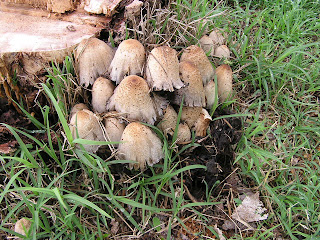 I know almost nothing about mushrooms, but these mushrooms growing immediately adjacent to the stump appear to be a different species than the ones pictured above, which grow further away from the stump, out in the grass. The photos were taken on the same day.
 The third variety of fungus that caught my eye earlier this month was a series of these interesting red jobbies. As far as I can tell, they are some form of stinkhorn, although the head of the species pictured in "A Guide to Kansas Mushrooms" does not look much like the "head" of the ones that I found in my yard.
 We cut down the cottonwood that had died from beetle infestation earlier this spring. With all of this damp weather, there has been an interesting crop of mushrooms growing on the remaining stump and above the roots underground. This photo to the right is of the mushrooms growing above the dead cottonwood roots, taken in early May.
 I know almost nothing about mushrooms, but these mushrooms growing immediately adjacent to the stump appear to be a different species than the ones pictured above, which grow further away from the stump, out in the grass. The photos were taken on the same day.
 The third variety of fungus that caught my eye earlier this month was a series of these interesting red jobbies. As far as I can tell, they are some form of stinkhorn, although the head of the species pictured in "A Guide to Kansas Mushrooms" does not look much like the "head" of the ones that I found in my yard.
With all of the cool moisture over the last two days, it's probably time to look for some more interesting fungi. Maybe I can even teach myself a thing or two about what I'm looking at!
Vertebrate Co-Inhabitants
On the last post, I shared a few invertebrate compatriots from our property. This time I thought I'd share photos of a few vertebrates that I've met this month (and that allowed me to photograph them).
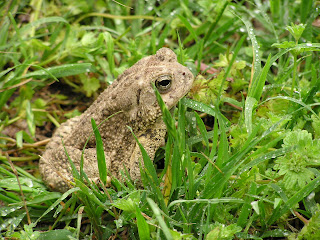 Back on May 2nd, we'd just had our large, deep window well covered with a fancy "hat" when Prairiewolf noticed a toad in the newly sealed off area. So I climbed out through the window into the well to perform a rescue. When I got in there, I actually found 4 very large, very healthy specimens that I proceeded to liberate, getting to try out our new escape hatch in the process. By the time that I got back up to the outside, only 2 of the toads had stuck around, but I managed to get fairly good photos of both of them. This is the most photogenic of the two, mainly because of the setting. (The other was on gravel, next to our not-very-exciting-or-colorful foundation.)
 The next day, I noticed our German shepherd and English setter puppy interestedly nosing something in the grass. When I went to investigate, I found this turtle. I don't remember seeing this species before, and since I am still without my guidebooks, I'm simply posting the picture without further identification. The turtle did reek, which makes me wonder whether it is a stinkpot. Incidentally, I immediately rescued it from the attentions of the dogs. It did the normal turtle thing of waiting for a bit in its shell, then hightailing it for wherever it had been heading originally. Once it got going, it actually moved fairly rapidly.
 About a week later, I was able to get a couple shots of the fox squirrels that have finally learned about the bird seed smorgasbord in our courtyard. They'd visited from the swale a few times before, but now they are regular customers...which I have mixed emotions about. Fox squirrels are so much more destructive than gray squirrels around homes that I'm a little nervous about luring them up this close to the house.
+in+the+mud,+11+May+2007.JPG) Finally, I have evidence of a big bird in the Beyond, but I'm not sure what the bird is. The tracks are almost as long as our 110 lb. German shepherd's paws are broad, but there is no sign of a 4th toe. Does that make them likely to be turkey or great blue heron? Or maybe great egret? Any one of them would be a new yard bird.
Finally, I have evidence of a big bird in the Beyond, but I'm not sure what the bird is. The tracks are almost as long as our 110 lb. German shepherd's paws are broad, but there is no sign of a 4th toe. Does that make them likely to be turkey or great blue heron? Or maybe great egret? Any one of them would be a new yard bird.
 Back on May 2nd, we'd just had our large, deep window well covered with a fancy "hat" when Prairiewolf noticed a toad in the newly sealed off area. So I climbed out through the window into the well to perform a rescue. When I got in there, I actually found 4 very large, very healthy specimens that I proceeded to liberate, getting to try out our new escape hatch in the process. By the time that I got back up to the outside, only 2 of the toads had stuck around, but I managed to get fairly good photos of both of them. This is the most photogenic of the two, mainly because of the setting. (The other was on gravel, next to our not-very-exciting-or-colorful foundation.)
  The next day, I noticed our German shepherd and English setter puppy interestedly nosing something in the grass. When I went to investigate, I found this turtle. I don't remember seeing this species before, and since I am still without my guidebooks, I'm simply posting the picture without further identification. The turtle did reek, which makes me wonder whether it is a stinkpot. Incidentally, I immediately rescued it from the attentions of the dogs. It did the normal turtle thing of waiting for a bit in its shell, then hightailing it for wherever it had been heading originally. Once it got going, it actually moved fairly rapidly.
  About a week later, I was able to get a couple shots of the fox squirrels that have finally learned about the bird seed smorgasbord in our courtyard. They'd visited from the swale a few times before, but now they are regular customers...which I have mixed emotions about. Fox squirrels are so much more destructive than gray squirrels around homes that I'm a little nervous about luring them up this close to the house.
+in+the+mud,+11+May+2007.JPG) Finally, I have evidence of a big bird in the Beyond, but I'm not sure what the bird is. The tracks are almost as long as our 110 lb. German shepherd's paws are broad, but there is no sign of a 4th toe. Does that make them likely to be turkey or great blue heron? Or maybe great egret? Any one of them would be a new yard bird.
Finally, I have evidence of a big bird in the Beyond, but I'm not sure what the bird is. The tracks are almost as long as our 110 lb. German shepherd's paws are broad, but there is no sign of a 4th toe. Does that make them likely to be turkey or great blue heron? Or maybe great egret? Any one of them would be a new yard bird. Monday, May 21, 2007
Invertebrate Neighbors
One of the things that I most enjoy about gardening and living out in the country is the wildlife with which I get to share my life and the yard. I've gotten way behind the power curve in sharing photos of some of these creatures, but I'll try to catch up a little today.
 Early May has been a busy time in the yard. I went out to get the paper early in the morning on my birthday (May 3) and found this imposing edifice which had been constructed in the middle of the driveway overnight. If you look very closely, you can see the reddish brown ants who are still busily working on it. I put the dandelion bloom in the picture for scale, but the photo still doesn't do their castle walls justice: these walls were about 1 1/2" high and cliff-like in their design. By later that day, the hill was gone..or at least flattened into an ordinary and unrecognizable state. The fleeting nature of even impressive architecture....
 Milkweeds have always fascinated me, in part because of the invertebrate communities that thrive in and on them. Currently the milkweed in bloom in our yard is green antelopehorn, Asclepias viridis. It's not a colorful bloom, but it fascinates me...and definitely attracts quite a few insects as well.
 In the Back of Beyond, I found this caterpillar also enjoying life on green antelopehorn. It's obviously not a monarch caterpillar, but my guidebooks are still packed and I have no way to identify it right now. At any rate, it's an interesting and rather pretty beastie.
 About a week ago, I was in the right place at the right time and was able to catch this hawkmoth feeding on dandelions in the front yard. The dandelions have been especially "productive" this spring: I saw the first, tattered monarchs nectaring at them in late April. The monarchs have been continuing to enjoy their bounty, as have numerous swallowtails and other butterflies.
 Early May has been a busy time in the yard. I went out to get the paper early in the morning on my birthday (May 3) and found this imposing edifice which had been constructed in the middle of the driveway overnight. If you look very closely, you can see the reddish brown ants who are still busily working on it. I put the dandelion bloom in the picture for scale, but the photo still doesn't do their castle walls justice: these walls were about 1 1/2" high and cliff-like in their design. By later that day, the hill was gone..or at least flattened into an ordinary and unrecognizable state. The fleeting nature of even impressive architecture....
  Milkweeds have always fascinated me, in part because of the invertebrate communities that thrive in and on them. Currently the milkweed in bloom in our yard is green antelopehorn, Asclepias viridis. It's not a colorful bloom, but it fascinates me...and definitely attracts quite a few insects as well.
 In the Back of Beyond, I found this caterpillar also enjoying life on green antelopehorn. It's obviously not a monarch caterpillar, but my guidebooks are still packed and I have no way to identify it right now. At any rate, it's an interesting and rather pretty beastie.
 About a week ago, I was in the right place at the right time and was able to catch this hawkmoth feeding on dandelions in the front yard. The dandelions have been especially "productive" this spring: I saw the first, tattered monarchs nectaring at them in late April. The monarchs have been continuing to enjoy their bounty, as have numerous swallowtails and other butterflies.
 Dandelions are not necessarily my favorite plant, but I have to admire the lacy, mathematical perfection of their seedheads and the bright sunny freshness of their blossoms. When I add their obvious benefit as an early source of nectar, I think the balance tips in their favor.
Single species grass lawns are so monotonous anyway. How much more exciting a yard is with the bright color and life of dandelions!
The Restoration of a Degree of Faith
I'm feeling much more optimistic this afternoon. My faith is being restored, or at least part of it. I called the plumbing company this morning about the water softener bill and the owner was appalled that we'd been billed like that. He promised a revised bill for the originally agreed upon amount and even volunteered to come by personally to help trouble shoot the softener since his employees hadn't looked too hard trying to find the problem. Then we proceeded to have a very enjoyable conversation, with topics ranging from why he ran for city council to whether TV is good for us. Now THAT's why I tend to enjoy life in small town America.
No news yet about either the heat pump or Westar's "trimming" of Mom & Dad's trees.
No news yet about either the heat pump or Westar's "trimming" of Mom & Dad's trees.
Sunday, May 20, 2007
Sour Grapes
It's 12:45 a.m. and I'm normally sound asleep at this hour. But tonight my mind is circling over several frustrations with the local business community that are unfortunately souring my outlook...and obviously interrupting my sleep.
The most recent is a plumbing company that agreed to come out for $100 trip charge to look at our water softener and see if it could be repaired, since it doesn't seem to be consistently putting out soft water. When the guys got here, they quickly peeked into the brine tank, then briefly glanced "under the hood" and asked me to explain what it was doing. They did not test the water for hardness. They did not actually open the gauge section to see what the meter was set on as far as gallons/recharge or to see how the recharge cycle was set. They left in less than 10 minutes, after telling me that they figured we just ought to put in a new water softener, to the tune of $1000. The bill for this cavalier treatment came yesterday. It wasn't for the $100, which I'd been quoted and therefore expected, although that seemed extremely excessive for the non-job they did. No, it was for $240 - including 2 hours labor for 2 men each, plus a $40 trip charge. They charged me for time going to and from another job, which was between me and their home base, and for the fact that the other job required 2 men, so that an extra person was along for the ride when they stopped by my house. To say that I feel cheated is putting it lightly.
This is on top of on ongoing problem with our geothermal heat pump. We've been without any functional heating/air conditioning except for emergency electrical backup heat since April 12. I hesitate to go into detail, but suffice it to say that I'm not positively impressed with the company we're having to deal with. They've got a long way to go to regain my trust...if they ever had it.
Last but hardly least, I've spent quite a few hours over the past several months trying to help my parents salvage some beautiful trees along the back part of their property. After years and years of not bothering to trim them at all, despite several requests from my parents as a tree limb grew around an electric wire, this spring Westar decided it was time to do a 5+ year trim. (The tree limb around the wire issue was solved by an Oklahoma Power & Light crew during the ice storm clean up several years ago.) We looked into the option of burying the electrical lines but, as far as I could tell from the marginal assistance I could get out of Westar, that option would be over $10,000 and therefore too expensive when all was said and done.
So we waited and hoped for a bearable outcome. The process has dragged out interminably. They finally came and did their drastic cuts this week and we thought they were done. We were mourning the loss of beauty and grace, but learning to live with the new reality. The original cuts were not easy or enjoyable to watch, but we're not stupid and we know that they were necessary for safety...even if the 12' radius in all directions seemed excessive. However, we appreciated the fact that the crew did a professional and careful job, leaving no stubs and only getting into the bark collar on a few cuts.
Now they've come back and say that they want to cut out even more. The cuts they are planning will take out the center of the trees down to the ground and will destroy any hope of the trees ever recovering any beauty and function in the landscape. These are 40 year old trees in the prime of their life, with an expected lifespan of 75 years. They've made my parents' yard unique and special in a prairie state. These next cuts planned are just plain meanness.
I can't think of a good thing to say about the business community right now. I know in my head that they are not all greedy, lazy, and mean - I've met many very nice, helpful business folks over the years - but it sure seems that many of the ones I've been dealing with lately have been unethical, incompetent, and/or nasty. What ever happened to providing a service, taking care of the customer, and taking pride in a good job well done? And whatever has happened to consumer protections and watching out for the little guy? Is a hardnosed scramble for money all that we've left ourselves in this country?
The most recent is a plumbing company that agreed to come out for $100 trip charge to look at our water softener and see if it could be repaired, since it doesn't seem to be consistently putting out soft water. When the guys got here, they quickly peeked into the brine tank, then briefly glanced "under the hood" and asked me to explain what it was doing. They did not test the water for hardness. They did not actually open the gauge section to see what the meter was set on as far as gallons/recharge or to see how the recharge cycle was set. They left in less than 10 minutes, after telling me that they figured we just ought to put in a new water softener, to the tune of $1000. The bill for this cavalier treatment came yesterday. It wasn't for the $100, which I'd been quoted and therefore expected, although that seemed extremely excessive for the non-job they did. No, it was for $240 - including 2 hours labor for 2 men each, plus a $40 trip charge. They charged me for time going to and from another job, which was between me and their home base, and for the fact that the other job required 2 men, so that an extra person was along for the ride when they stopped by my house. To say that I feel cheated is putting it lightly.
This is on top of on ongoing problem with our geothermal heat pump. We've been without any functional heating/air conditioning except for emergency electrical backup heat since April 12. I hesitate to go into detail, but suffice it to say that I'm not positively impressed with the company we're having to deal with. They've got a long way to go to regain my trust...if they ever had it.
Last but hardly least, I've spent quite a few hours over the past several months trying to help my parents salvage some beautiful trees along the back part of their property. After years and years of not bothering to trim them at all, despite several requests from my parents as a tree limb grew around an electric wire, this spring Westar decided it was time to do a 5+ year trim. (The tree limb around the wire issue was solved by an Oklahoma Power & Light crew during the ice storm clean up several years ago.) We looked into the option of burying the electrical lines but, as far as I could tell from the marginal assistance I could get out of Westar, that option would be over $10,000 and therefore too expensive when all was said and done.
So we waited and hoped for a bearable outcome. The process has dragged out interminably. They finally came and did their drastic cuts this week and we thought they were done. We were mourning the loss of beauty and grace, but learning to live with the new reality. The original cuts were not easy or enjoyable to watch, but we're not stupid and we know that they were necessary for safety...even if the 12' radius in all directions seemed excessive. However, we appreciated the fact that the crew did a professional and careful job, leaving no stubs and only getting into the bark collar on a few cuts.
Now they've come back and say that they want to cut out even more. The cuts they are planning will take out the center of the trees down to the ground and will destroy any hope of the trees ever recovering any beauty and function in the landscape. These are 40 year old trees in the prime of their life, with an expected lifespan of 75 years. They've made my parents' yard unique and special in a prairie state. These next cuts planned are just plain meanness.
I can't think of a good thing to say about the business community right now. I know in my head that they are not all greedy, lazy, and mean - I've met many very nice, helpful business folks over the years - but it sure seems that many of the ones I've been dealing with lately have been unethical, incompetent, and/or nasty. What ever happened to providing a service, taking care of the customer, and taking pride in a good job well done? And whatever has happened to consumer protections and watching out for the little guy? Is a hardnosed scramble for money all that we've left ourselves in this country?
Tuesday, May 08, 2007
The Weather "Gods" Are Stirring
The sun is finally out, playing peek-a-boo between the clouds. It feels wonderful, like a reprieve from a punishment that we knew we were getting, but didn't understand why.
It's been an odd year, weatherwise, here in south central Kansas. At least, it seems that way to me. We've had 80 degree weather in February, 6-8" of snow bracketed by ice that stayed on the ground for weeks, several 3" rains, and now a seemingly endless series of strong storms, rain and, most scarily, major tornadoes. Many schools have even been shut down across the state, due to flooding. I can't ever remember hearing about that occurring on such a widespread basis before.
My brother called me on Sunday to tease me about carrying the bad weather from the Gulf Coast to the Central Plains when we moved. Sometimes it feels like he's right.
I know that any one of these events - warm weather in mid-February, snow & ice, strong storms, floods, tornadoes - is quite normal for Kansas. Even a couple of them in the same year wouldn't be unusual. That's what makes living in a prairie state such a challenge. But the continuous assault this year feels abnormal. Then again, maybe I just got soft, living on the Gulf Coast.
Somehow I feel like I should be able to find some philosophical truth in all of this, but I can't. Certainly my heart goes out to the victims of the tornado in Greensburg - and to the victims of all the other tornadoes and flooding in the past few days...and to the victims of the horrible western Kansas snow storms this past winter. It seems like there's a developing class of weather refugees in this country - people displaced from their homes and livelihoods by extreme weather events, beginning with the hurricanes of the past few years.
As I'm writing this, there are more storms and flooding occurring in Oklahoma, Texas, and Missouri. In Missouri, I've heard they're expecting floods in some areas to rival those of 1993. There is a low sitting off the eastern seaboard that developed in cold water, but has now taken on sub-tropical storm characteristics. It's creating high winds and pounding surf. Will it develop further and/or bring major havoc when it comes ashore?
The weather "gods" are stirring. For decades, now, I've heard that global warming is predicted to unsettle the weather. Is that what we're beginning to experience, or is this just a normal fluctuation? I wish I knew. It might be easier to know how and what to plan for, if I did.
It's been an odd year, weatherwise, here in south central Kansas. At least, it seems that way to me. We've had 80 degree weather in February, 6-8" of snow bracketed by ice that stayed on the ground for weeks, several 3" rains, and now a seemingly endless series of strong storms, rain and, most scarily, major tornadoes. Many schools have even been shut down across the state, due to flooding. I can't ever remember hearing about that occurring on such a widespread basis before.
My brother called me on Sunday to tease me about carrying the bad weather from the Gulf Coast to the Central Plains when we moved. Sometimes it feels like he's right.
I know that any one of these events - warm weather in mid-February, snow & ice, strong storms, floods, tornadoes - is quite normal for Kansas. Even a couple of them in the same year wouldn't be unusual. That's what makes living in a prairie state such a challenge. But the continuous assault this year feels abnormal. Then again, maybe I just got soft, living on the Gulf Coast.
Somehow I feel like I should be able to find some philosophical truth in all of this, but I can't. Certainly my heart goes out to the victims of the tornado in Greensburg - and to the victims of all the other tornadoes and flooding in the past few days...and to the victims of the horrible western Kansas snow storms this past winter. It seems like there's a developing class of weather refugees in this country - people displaced from their homes and livelihoods by extreme weather events, beginning with the hurricanes of the past few years.
As I'm writing this, there are more storms and flooding occurring in Oklahoma, Texas, and Missouri. In Missouri, I've heard they're expecting floods in some areas to rival those of 1993. There is a low sitting off the eastern seaboard that developed in cold water, but has now taken on sub-tropical storm characteristics. It's creating high winds and pounding surf. Will it develop further and/or bring major havoc when it comes ashore?
The weather "gods" are stirring. For decades, now, I've heard that global warming is predicted to unsettle the weather. Is that what we're beginning to experience, or is this just a normal fluctuation? I wish I knew. It might be easier to know how and what to plan for, if I did.
Changing of the Avian Seasonal Guard
I've been watching the summer birds slowly move into the yard over the last several weeks and months, and it suddenly hit me this morning that the change from winter birds to summer birds is almost complete.
The goldfinch seemed to totally disappear for a few weeks; now I have maybe 2 pairs in full breeding plumage. They suddenly appeared about a week ago, presumably from points further south.
Looking back at my notes, I had 83 Harris sparrows at the feeders on February 15th. Even 2 weeks ago, I regularly had a dozen or so chowing down. I have 2 this morning, and any day I expect them to be gone as they move north. Also on February 15th, I had 14 cardinals - now I'm estimating that 2 pairs are nesting somewhere in the yard, but I rarely see more than a single male or female at the feeders at any one time.
These days I have a pair of brown thrashers that comes to the feeders, as well as a regular pair of chickadees, the goldfinch and cardinals mentioned above, and several house sparrows, grackles, and cowbirds. I still see woodpeckers, although mainly just downies and red-bellieds. I haven't seen the flickers or hairies for several weeks now.
It's the time of year when I start wondering if I should take the feeders down, since I really don't want to swell the numbers of brown-headed cowbirds, grackles, and house sparrows unnecessarily. Not yet, though. Maybe not at all this year. I'm still pretty evenly mixed between "good" and "bad" birds.
Meanwhile, both Prairiewolf and I are enjoying the mockingbirds who are (literally) calling our yard home. There has been a pair of blue-winged teal hanging out on the lagoon for the past week (although I haven't seen them in a couple days), and I saw a northern waterthrush in the swale last week. I've seen "butter butts" (yellow-rumped warblers) several times, and we've seen phoebes, barn swallows, and purple martins checking us out. I keep hoping that a few of them will decide this would be a good place to settle down and raise a family. We'll see what the summer brings.
The goldfinch seemed to totally disappear for a few weeks; now I have maybe 2 pairs in full breeding plumage. They suddenly appeared about a week ago, presumably from points further south.
Looking back at my notes, I had 83 Harris sparrows at the feeders on February 15th. Even 2 weeks ago, I regularly had a dozen or so chowing down. I have 2 this morning, and any day I expect them to be gone as they move north. Also on February 15th, I had 14 cardinals - now I'm estimating that 2 pairs are nesting somewhere in the yard, but I rarely see more than a single male or female at the feeders at any one time.
These days I have a pair of brown thrashers that comes to the feeders, as well as a regular pair of chickadees, the goldfinch and cardinals mentioned above, and several house sparrows, grackles, and cowbirds. I still see woodpeckers, although mainly just downies and red-bellieds. I haven't seen the flickers or hairies for several weeks now.
It's the time of year when I start wondering if I should take the feeders down, since I really don't want to swell the numbers of brown-headed cowbirds, grackles, and house sparrows unnecessarily. Not yet, though. Maybe not at all this year. I'm still pretty evenly mixed between "good" and "bad" birds.
Meanwhile, both Prairiewolf and I are enjoying the mockingbirds who are (literally) calling our yard home. There has been a pair of blue-winged teal hanging out on the lagoon for the past week (although I haven't seen them in a couple days), and I saw a northern waterthrush in the swale last week. I've seen "butter butts" (yellow-rumped warblers) several times, and we've seen phoebes, barn swallows, and purple martins checking us out. I keep hoping that a few of them will decide this would be a good place to settle down and raise a family. We'll see what the summer brings.
Thursday, May 03, 2007
Birthday Buddies
As I was starting my day today, I heard Garrison Keillor's "Writers' Almanac" segment on NPR. I always enjoy the segment, but since today is my birthday, I paid special attention.
Keillor had four (or was it five?) people highlighted: William Inge, May Sarton, Machiavelli, and one of the co-writers of the songs in Singin' In the Rain. (James Brown was also mentioned, but I can't remember if that was by Keillor, or at another point in the broadcast.)
The combination of talents born today struck me as rather humorous: from Singin' in the Rain to The Prince. Now that's a breadth of inspiration!
So I did a quick Google search and came up with a few more birthday buddies: Bing Crosby, Golda Meir, Pete Seeger, Frankie Vallie, Richard D'Oyly Carte, and Sugar Ray Robinson. An interesting combination of characters to share my date-of-origin with.
Rather interestingly, I didn't recognize anyone in particular who had died on this day. Which makes me think of the poem "On the Anniversary of My Death" (or something like that - I haven't unpacked my books yet, so I can't give you the exact title...or the author). We celebrate birthdays, but never do know our deathdays. Would we live life differently if we did?
Keillor had four (or was it five?) people highlighted: William Inge, May Sarton, Machiavelli, and one of the co-writers of the songs in Singin' In the Rain. (James Brown was also mentioned, but I can't remember if that was by Keillor, or at another point in the broadcast.)
The combination of talents born today struck me as rather humorous: from Singin' in the Rain to The Prince. Now that's a breadth of inspiration!
So I did a quick Google search and came up with a few more birthday buddies: Bing Crosby, Golda Meir, Pete Seeger, Frankie Vallie, Richard D'Oyly Carte, and Sugar Ray Robinson. An interesting combination of characters to share my date-of-origin with.
Rather interestingly, I didn't recognize anyone in particular who had died on this day. Which makes me think of the poem "On the Anniversary of My Death" (or something like that - I haven't unpacked my books yet, so I can't give you the exact title...or the author). We celebrate birthdays, but never do know our deathdays. Would we live life differently if we did?
Tuesday, May 01, 2007
The Weight of Memories
Our things are here and I've begun the long, slow slog of puzzling them into our new surroundings. We've been fairly lucky so far - a lot of bad rubs (unfortunately many on our new furniture pieces), but only one desk was actually destroyed in the move.
Not unexpectedly, I'm having to downsize a lot as I unpack. In some ways I'm welcoming the discipline enforced by smaller cabinets; in other ways, it's hard to set things aside to pass along to others.
This move has added a new layer to the decision-making: having lived here for 4 months, we've accumulated a few duplicate things and now I have to decide whether to keep those duplicates or pass them along too.
For example.... Rather than using paper plates, I bought a few cheap but pretty ceramic plates at Dillons shortly after we arrived. They've given me a little lift as I've used them for the past few months; now I have to decide whether to keep them or pass them along. With cupboards in short supply, passing them along has won, but I'm feeling a pang as I let them go.
An even more difficult decision involved our silverware. When we first got here and I was scrounging for temporary household goods, my mother magically produced the old silverplate set that my paternal grandparents used for most of their married life. She said that I could have it permanently, if I wanted, as none of my siblings were interested and she wasn't going to use it. I was actually quite excited, as it turned out that the pattern was the same as a special spoon, the "D" spoon, that we kids had fought over using during childhood.
It's been so much fun to use the set, incomplete and worn as it is. It's brought back memories of my childhood and prompted speculation as to how my grandparents got the set and where the set has been. (These grandparents were missionaries in Arabia for many years.)
Now our things are here. And with those things is OUR set of flatware, a wonderful set that we've had since we got married many years ago and that has many, many memories of our own associated with it.
I've thought somewhat about switching out and using my grandparents' silverplate as our everyday flatware, but I've decided against it. There are good memories associated with both sets, but MY main memories are associated with our own set. I'm keeping their old set for now, hoping that one of our children will want it.
Memories are wonderful things, but they make this process of settling in more difficult. "Which memory-piece should I keep and which should I pass along?" "How much should I store and how much should I give away?" "Should I give this to Goodwill or should I save it for the family?" When added on top of the simpler but seemingly never-ending question, "Which cabinet can I fit these into?", the memories complicate the process immensely and wear me out rapidly.
But I wouldn't have it any other way.
Not unexpectedly, I'm having to downsize a lot as I unpack. In some ways I'm welcoming the discipline enforced by smaller cabinets; in other ways, it's hard to set things aside to pass along to others.
This move has added a new layer to the decision-making: having lived here for 4 months, we've accumulated a few duplicate things and now I have to decide whether to keep those duplicates or pass them along too.
For example.... Rather than using paper plates, I bought a few cheap but pretty ceramic plates at Dillons shortly after we arrived. They've given me a little lift as I've used them for the past few months; now I have to decide whether to keep them or pass them along. With cupboards in short supply, passing them along has won, but I'm feeling a pang as I let them go.
An even more difficult decision involved our silverware. When we first got here and I was scrounging for temporary household goods, my mother magically produced the old silverplate set that my paternal grandparents used for most of their married life. She said that I could have it permanently, if I wanted, as none of my siblings were interested and she wasn't going to use it. I was actually quite excited, as it turned out that the pattern was the same as a special spoon, the "D" spoon, that we kids had fought over using during childhood.
It's been so much fun to use the set, incomplete and worn as it is. It's brought back memories of my childhood and prompted speculation as to how my grandparents got the set and where the set has been. (These grandparents were missionaries in Arabia for many years.)
Now our things are here. And with those things is OUR set of flatware, a wonderful set that we've had since we got married many years ago and that has many, many memories of our own associated with it.
I've thought somewhat about switching out and using my grandparents' silverplate as our everyday flatware, but I've decided against it. There are good memories associated with both sets, but MY main memories are associated with our own set. I'm keeping their old set for now, hoping that one of our children will want it.
Memories are wonderful things, but they make this process of settling in more difficult. "Which memory-piece should I keep and which should I pass along?" "How much should I store and how much should I give away?" "Should I give this to Goodwill or should I save it for the family?" When added on top of the simpler but seemingly never-ending question, "Which cabinet can I fit these into?", the memories complicate the process immensely and wear me out rapidly.
But I wouldn't have it any other way.
Subscribe to:
Posts (Atom)