Wednesday, January 31, 2007

Birds in Winter Wonderland

Kansas has been out to reacquaint us with winter this year. In the last 2 1/2 weeks, we've had an ice storm with temperatures in the single digits, a 6" snow, and now a 4" snow...which is supposed to be followed by more frigid temperatures. It's been pretty, but I'm ready for warmer temperatures now. It's unusual for Kansas, but the ice from the first storm hasn't even had a chance to melt completely off yet, and much of the snow from the second storm has changed to ice too. Luckily most of the main roads are (or were, before today) in good shape.

I managed to get photos of a few birds, mainly during the 6" snowstorm, which I thought might be fun to post.

Franksparrow, this is especially for you!

During the storm, birds were literally flocking to the feeders. I think that the cardinals look particularly gorgeous against snow-covered trees.


After having the suet feeder totally ignored by all of the birds for almost 2 weeks, this flicker came in and found it. He immediatedly started vigorously defending it (and anything near it) from all comers. I actually had to move the suet feeder away from all the other feeders, to its own separate tree, to keep him from attacking the other birds.


During the first few days following the big (6")
snowstorm, it remained below freezing. With solar heating, the snow on the deck slowly melted anyway, and I noticed quite a few of the birds coming in to drink water. While I noticed a robin, Harris sparrows, white-crowned sparrows, and a house finch, I only managed to get good photos of this mockingbird and junco.


Organic Lawn Care is Finally Going National!

Finally! According to a blurb in The American Gardener, there is a new non-profit organization being launched in March known as SafeLawns. They've got a website up already (www.safelawns.org) with some great information and videoclips on how to care for lawns without all of the insecticides and herbicides and chemical fertilizers normally considered mandatory for a nice-looking lawn.

These guys have been involved in organic gardening on both a personal and professional level for over 20 years, including one who has successfully run an organic lawncare service. It can be done. And it can be done throughout the country.

And I personally know it can be done, because we did it in Mobile, where everybody said it was impossible.. Our lawn may not have always been perfect, but it was just as nice or nicer than all those folks around me who drenched their yards in chemicals.

A couple tips that I picked up as I read the site:

1) To control crabgrass in a lawn, corn gluten should be applied as the forsythia begins to bloom. By the time the forsythia are done blooming, the crabgrass will have germinated and the corn gluten (which has a 9% nitrogen level, according to SafeLawns) will act as a fertilizer for the new young plants instead of killing them. The application rate is 20 lbs./1000 sq ft.

2) They've coined an acronym for weed control: RILE.
Relax.
Identify (the weed).
Listen (to what the weed species is telling you about your lawn conditions).
Eradicate (the problematic lawn conditions, as well as the weeds).

As with so many organic changeovers, the first several years may be more time and energy intensive, but within a couple years you will be spending much less in all categories, as well as watering less and having the satisfaction of knowing that you are not inadvertently poisoning your yard and everything living in it.

And your lawn will look great.

Monday, January 15, 2007

A New Chapter: Windswept Cottage

At the end of December, Prairiewolf and I said a sad good-bye to Mobile, Alabama, and to our beautiful house and garden there. A new gardener has taken over that home, which pleases me intensely. She will, I'm sure, make the garden her own. I hope that she has as much pleasure and as many pleasant surprises there as I had.

In the first week of January, a new home with its own unique yard and garden, in a entirely different ecosystem, entered into Prairiewolf's and my lives. We are now living southwest of Wichita, Kansas, near the little town of Clearwater, on 10 acres of land. Our land was presumably once mid-grass prairie, with a mix of tall and short grass species. There's a dry swale that drains most of the section west and south of us, bisecting our land about 1/3 of the way back. In its protected lowlands, there are black willows, a few large cottonwoods, and lots and lots of shrub-form poison ivy.


In front of the swale is the Yard Proper - about 3 acres of mowed grass with the house, workshop/auxiliary garage, and a wide variety of planted trees and shrubs.

Behind the swale is overgrown pasture, full of brome grass, young cedars, and a few clumps of Indian grass, big bluestem and other prairie species.

The sunsets, which we can enjoy from our kitchen table, are sublime. On dark nights, the stars are breathtaking. And the wind is unceasing. (No surprise there, though. This IS Kansas, after all!) I've tentatively named our new home "Windswept Cottage".


We've set up bird feeders just behind the deck, and the birds are rewarding us by literally flocking to them. We have dozens of juncos and Harris sparrows and white crowned sparrows; about 20 goldfinch; and cardinals, blue jays, red-winged blackbirds, brown headed cowbirds, rufous sided towhees, tree sparrows, black-capped chickadees, and house finch. We've even had a red-bellied woodpecker, a downy woodpecker, a Carolina wren, a song sparrow, a mourning dove, and a Carolina wren.

There have been a pair of red tail hawks visiting regularly (checking out the nesting potential, I hope?!), and a couple mockingbirds are helping me transition from south to "north".

One of the most interesting bird-events occurred on Friday when we put out a bird bath with heated water. We put it out about 1:30 p.m. and watched for a while, noticing that a couple starlings found it fairly rapidly. When we checked it out about 4, almost all the water was gone, which we thought was a little strange. So I refilled it with 2 gallons and watched amazed as about 100 starlings rapidly descended on it, bathing and drinking. Within about 10 minutes, almost all the water was gone...and the starlings drifted off. We repeated the process again, with the same results. By the next morning, we decided that heated water just wasn't going to be on the menu anymore.

The temperature when all this happened was about 17 degrees, and we were amazed at how delighted the starlings were to be bathing in those temperatures. A couple of them seemed to have big gray beards, which turned out to be made of ice when we looked at them through the binoculars. Not my idea of how to cope with subfreezing temperatures!

68 degrees one day and 22 the next. Bearded starlings. Neverending wind. Stunning sunsets. We're back in Kansas, and there are new adventures ahead.

Friday, December 01, 2006

Sharing a Few Last Favorite Fall Experiences

A few last fall impressions:

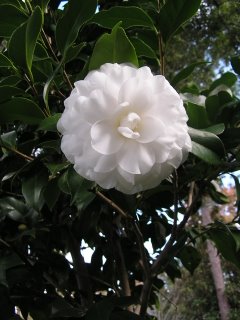
This is the bloom of an 'Alba Plena' camellia. It's one of the oldest of all the named camellia varieties, and I love its stately grace. (For a sense of scale, this blossom is about 4" in diameter.)

In fact, I've become rather a camellia fan after living here for 6 years. Their wildlife value is, of course, negligible, for which reason I doubt that I'll ever go completely nuts about them, but their beauty is undeniable. Their foliage is deep and lustrous, and their blooms are captivating.

One of the many assets of camellias is that they bloom in the late fall, winter and early spring. Alba Plena is one of the first camellias to bloom, so it's another sign that fall is winding down and winter is fast approaching.


I love finding co-inhabitants of my garden...and it's even better when I can photograph them and share those photographs. This captivating guy was hiding out underneath an aster in the wood nymph garden at the beginning of November. I think he was hoping that I didn't see him, as he stayed perfectly still for a long time, inadvertently posing beautifully for me!

I'm assuming that he was there because the asters were absolutely shimmering with insect life, especially bumble bees and skippers, feeding on the nectar. It must have been like an all-you-can-eat buffet!


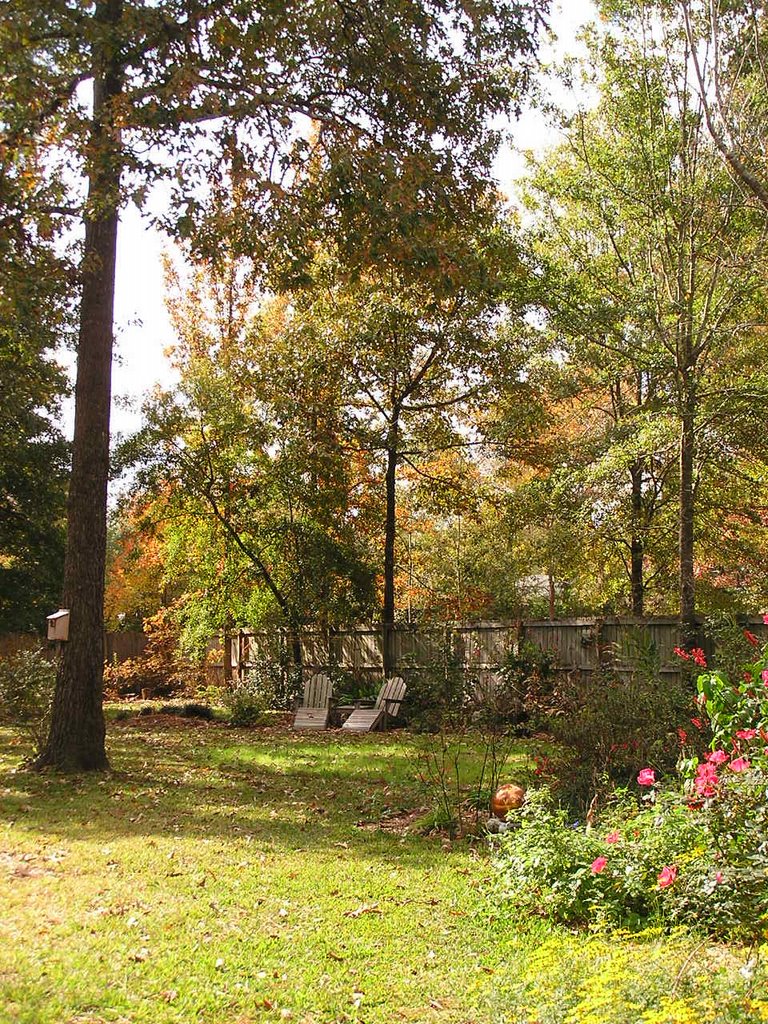
And, finally, here is our "Outback" seating area, surrounded by signs of fall. Maybe it's just that I've spent so many mornings and evenings sitting out there, sipping coffee or some other beverage of choice, journalling or just enjoying the life in the garden, but this vista makes me smile just looking at it.

A sanctuary. And how lucky we are to have it.

A Limestone 'Begging Bowl'

This limestone slab has been fascinating me for the last month or so. We've had it for over a year now, but it had such a blandly smooth surface that I've had a hard time figuring out what to do with it in the garden. It seemed so characterless and unnatural.


Now, however, the falling leaves have literally left their mark on it and it has morphed, almost overnight, from a blank spot to a daily changing canvas of impressions.


My biggest frustration at this point is how to capture it most effectively in a photograph. Lighting and shadows, changing displays of leaves coating its surface, and naturally evolving tannin prints all create its appeal to me. To a great extent, though, it's the fleeting nature of those patterns that fascinates me and, in trying to photograph them, I destroy that very nature that speaks to me.

Whether I ever get the photograph that I want, I now feel that having this blank canvas in the garden is a big plus. In its own way, it's the classic monk's begging bowl - highlighting the day's or the season's offerings.

Looking back a little....

I've been sorting through photos from the garden, putting together an album of how the yard has looked throughout the year. Seeing the months condensed like that, it is amazing how much the garden changes annually...even though it is purely normal and therefore technically not amazing at all.

Just for kicks and grins, here are three vistas of the east side of our garden, over the course of the last year....

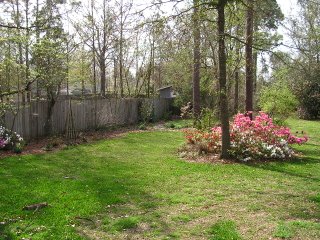
First we have spring - March 12, to be exact. Deciduous plants are just starting to leaf out. The azaleas have been blooming for a week or two and will be in full glory in another week or so. A week before this photo, the yard looked noticeably barer, but I wanted to show the azaleas really starting to ramp up.

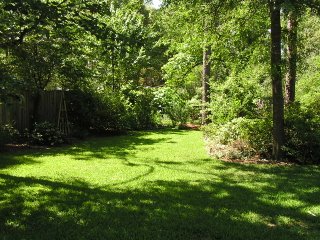
Next is the start of full summer, June 6. The spring flowers are gone and the lushness of summer is setting in. Heat and humidity are almost radiating from this vista.

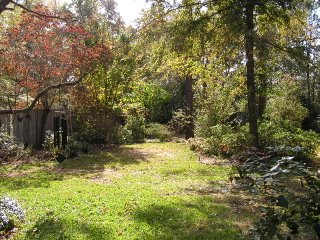
Last in my quick series is fall, November 28. The green is fading out, taken over by bright fall colors. Leaves are falling, and those that remain bear witness to a growing season's worth of life experience: spots from minor diseases, missing sections where insects dined, dessicated edges reminding of dry spells.

Each season has its beauty...and each season has its flaws. Life's rather funny that way, isn't it?

Monday, November 27, 2006

Going to the Source...So To Speak

I just got reminded about why it's better to go directly to the source than to rely on secondhand information. I was able to find the original blurb about the organic farm study in the July/Aug 2006 Audubon magazine online.

In reading it, I realized that the story was misquoted somewhat in Utne. (I am disappointed in Utne. I thought they had better journalistic standards than that.) As summarized in Audubon, the original study was a four year study, not a five year study. And while the percentage increases were correctly reported in Utne for plant species and number of bats (105% and 75% respectively), the percentage increase for winter birds was 62%, and there was actually a 48% increase in spiders. Insect species and/or numbers were still not mentioned.

My junior English teacher in high school had us do a great exercise comparing the same story as reported by several different sources. I have never forgotten how different the story was depending on who reported it.

And it makes me wonder what changes have occurred in the translation between original study and the report in Audubon.

Anyway, despite the discrepancies, the message remains the same.

Now I'm on a quest to find the original study report.

It's Just Better When It's Organic....

According to a 5-year study discussed in Audubon's August 2006 issue (and excerpted in Utne's Nov-Dec 2006 issue, which is where I read about it), organic farms in England have 105% more plant species than their non-organic counterparts. This provides more habitat, leading to 48% more winter birds and 75% more bats.

Not having read the original article in Audubon (let alone the actual study!), I don't know if they tallied the increased number of insect species found, but I'd be willing to bet a fair amount that insects showed similar gains. More importantly, I'd be willing to bet that insect predator species rebounded significantly, working to control insect plant eaters and balance the farms' ecosystems naturally.

If farmers, who have to make their livelihood from their land, can increase habitat and species diversity like this, just think what us homeowners could do if we all decided to go organic!

I need to try to find the Audubon article. Better yet, I'd like to read the original study. But why wasn't this study widely reported in the national news? It seems to me that its conclusions are one more clue pointing us in the direction of a healthier and more balanced lifestyle.

Wednesday, November 01, 2006

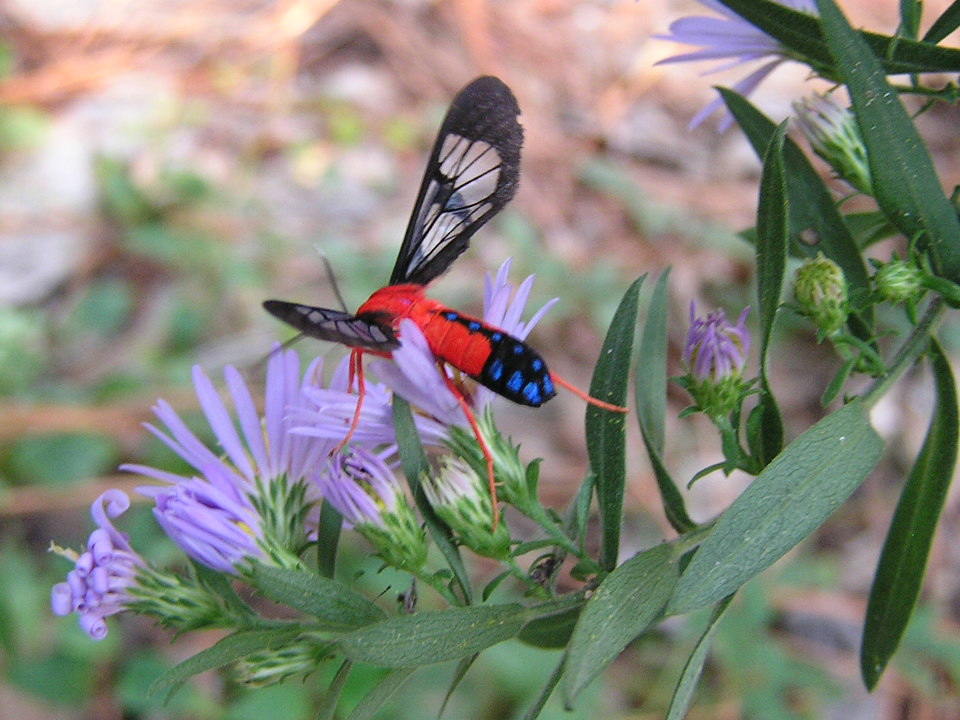
Scarlet Bodied Wasp Moth


Isn't that a cool name? It's a pretty cool moth, too. Not easy to forget, once you've seen one.

I first found one dead on my doorstep, believe it or not, about a week ago. With my eyeglasses needing an update and my fantastic old loop magnifying glass playing a permanent game of hide-and-go-seek with me, I wasn't quite sure what type of insect it was. So I picked it up and saved it on a plate in the refrigerator, hoping to be able to identify it.

Two days ago in the late afternoon, I noticed several dozen of these unknown insects feeding on the asters in the back yard. I'd been enjoying all of the other "bugs" at the asters, but this was the first time I'd seen these creatures in the mix. They were even more dazzling alive than dead. (To give you an idea of scale, their bodies range from 1/2 - 3/4" in length.)

By watching closely, I was able to figure out that these guys were feeding with a proboscis, nailing their identity as a moth. I checked my guides, but the only information I could find out was that clearwing moths, as a family, are borers and can actually cause quite a bit of damage. Peach borers and dogwood borers, for example, are in this family. That caused my heart to sink, and I had visions of these beautiful insects creating untold havoc in their larval stage.

Luckily, a quick Google search set me straight. This is a scarlet bodied wasp moth, and it is indeed in the clearwing moth family. Its host plant, however, is the climbing hempvine - not what you would call an important commercial plant! This moth is considered to be a tropical species, which is why I wasn't able to find it in the guides that I had.

So I can enjoy these little beauties with a clear conscience. I've noticed that I primarily see them in the late afternoon, rather than throughout the day, despite the fact that they are supposed to be diurnal. Who knows what else I can discover about their habits as I watch them making themselves at home in my garden?

Saturday, October 28, 2006

More Signs of Fall

Here are a few more photos celebrating the season.

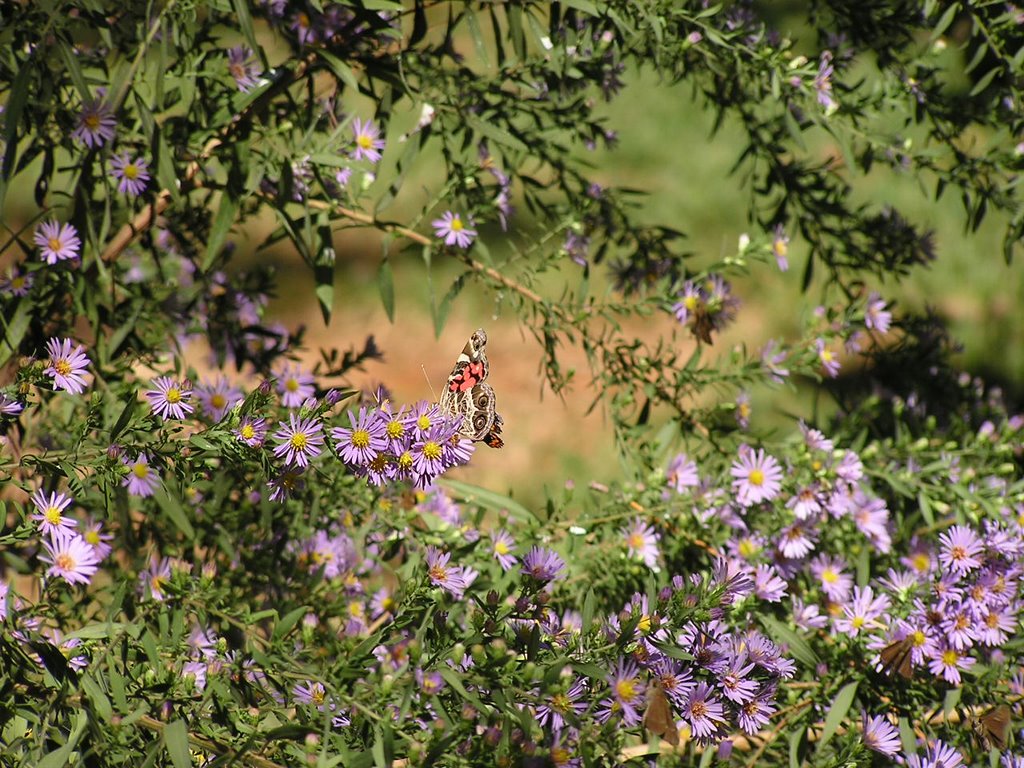
First is this photo of a painted lady feeding on the asters in the wood nymph garden. (It's hard to see because I was fairly far away, but the butterfly is almost exactly in the middle of the frame.) While this isn't the best picture of a painted lady, it commemorates two other neat phenomena. First, this is the first painted lady that I remember seeing in my garden this year, despite all of the other butterflies that have made this yard their home. Second, although I haven't been able to capture it in a photograph, these asters are positively bouncing and humming with insect life right now. There are literally hundreds of bumble bees and skippers moving constantly from flower to flower, with occasional other butterflies and insects joining in the feeding frenzy. It's stunning to watch.

Next is this photo of a native, fall-blooming tickseed, Coreopsis integrifolia 'Chipola River', blooming beside one of the paths in the yard. These coreopsis have proven to be extremely happy in their bed, and I have debated all year long as to whether I should thin them out and rein them in. Now that they are blooming so cheerfully, I'm glad that I resisted the impulse. There's time enough to redefine their limits when cold weather comes.

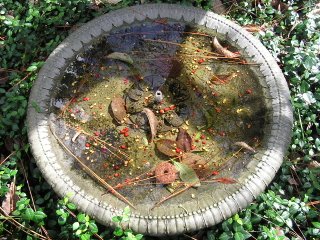
Although the flowers seem full of life still, the half-century fountain shows a different side of the season. Full of fallen pine needles, dead dogwood leaves and bright red dogwood berries, it is almost a quintessential picture of autumn's movement towards winter's quiet.

"Show Condition" and Showing Off

It's been over a month since I posted, but I have a reasonably good excuse: we've put the house on the market and I've been frantically trying to get it in "show" condition and maintain it that way.

Now, as those of you who know me are well aware, I'm not a "show condition" sort of person, so this has been rather stressful. But I'm surviving. More tellingly, so are Prairiewolf and all the animals.

I've finally decided that it's time to quit worrying quite so much and start enjoying my life and my garden again. With that in mind, I've started taking a few photos and thought I'd share ("show off") a few of them....


First, here is my wood nymph, contemplating life's bounties while surrounded by a bonanza of fall flowers.

Next, here is the "outback" seating area as seen from the deck, showing off the yard's new openness which is compliments of the post-Katrina beetle infestation. Luckily (and I'm knocking on wood as I say this), the beetle infestation seems to be over for now. The remaining pines look wonderfully healthy.


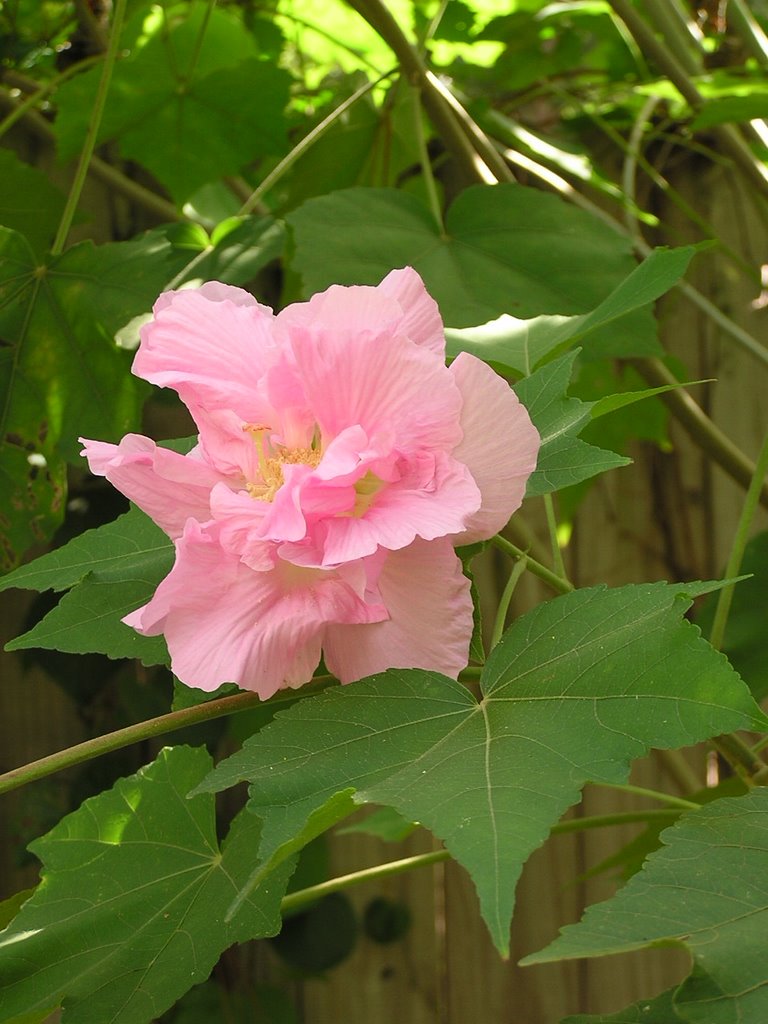
Last but not least for this post, the pink flower is a Confederate rose - actually sort of a cousin to the rose-of-sharon or althea. Its scientific name is Hibiscus mutabilis (althea's scientific name is Hibiscus syriacus), and the blooms are supposed to open white and then change color to pink and finally to red. Mine, however, opens this pretty pink and seems to enjoy the color enough to stay the exact same shade until the flower gets tired and falls off. Xanthy gave me the start to this beautiful plant a couple years ago, but this is the first year it's bloomed. Ivan toppled it in 2004 and Katrina stripped it bare in 2005. It's a survivor, though, and is now about 12-15' tall and covered with blooms.

It's hard to believe with all the blooms in the yard, but fall is fully here and winter is just around the corner. It will be interesting to see how much longer I continue as the custodian of this garden. It will be hard to leave and turn over guardianship to another, but that's been in the cards since the first day we moved in. Meanwhile, I have vowed to just enjoy the time I have left - and to see what lessons are still waiting for me to learn here before I go.

Saturday, September 23, 2006

Assorted "End of Summer" Photos

I've tried to go back and add these photos to my "End of Summer" post, but for some reason, it's not working. So I'll add them here.

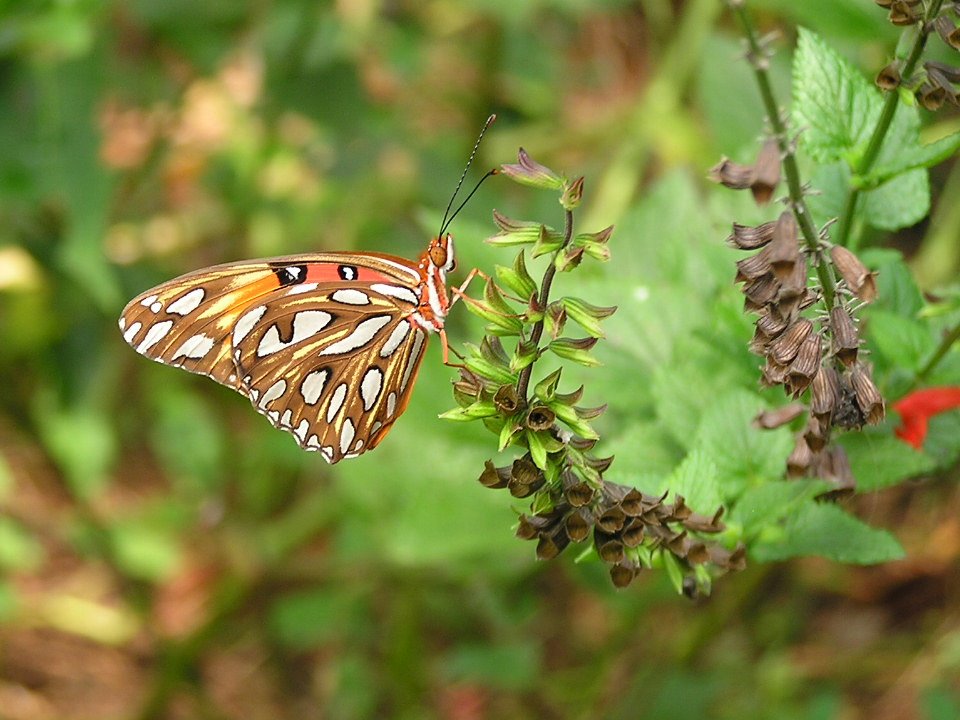
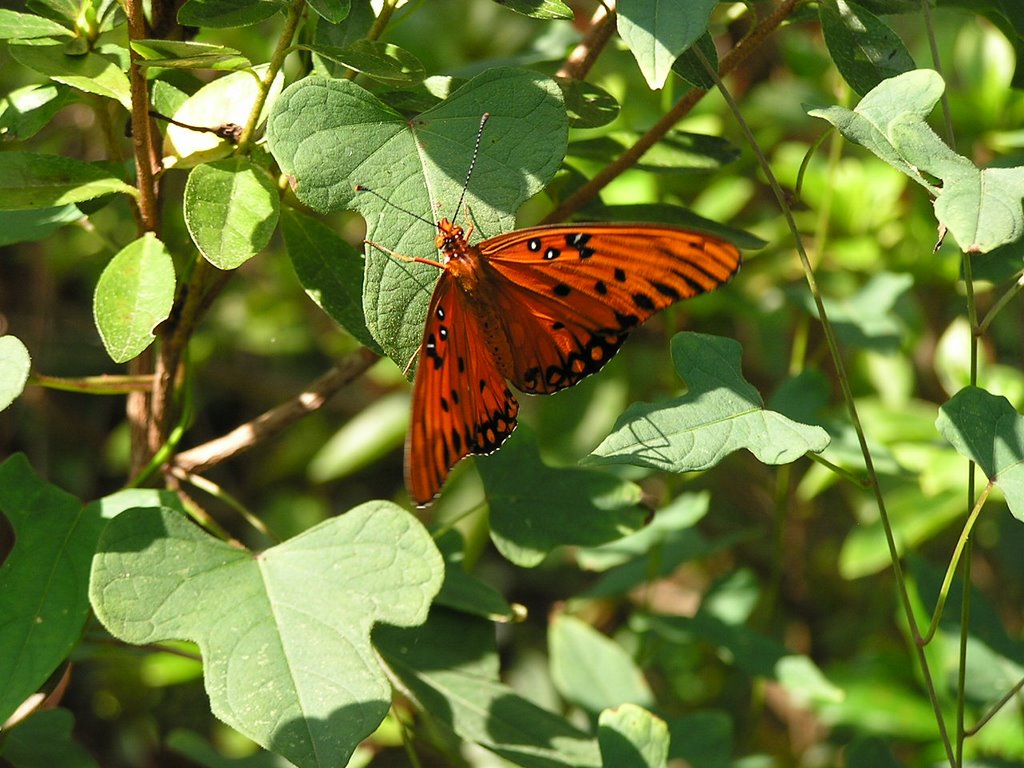
First, a couple shots of my "flying flowers". The butterflies are gulf fritillaries. The flying fritillary (blurred) had amorous intentions on his/her mind, but the one clinging to the spent flower stalk was interested only in resting. This was one of several "overtures" which the resting fritillary resisted while I watched, trying to get a decent photo.

The second photo is of two bees (carpenter? bumble?) nectaring on Rudbeckia blooms. The entire plant was covered with blooms, and the blooms were hosting dozens of wasps and bees of many different species. Interestingly, the butterflies didn't seem very interested in the Rudbeckia blossoms.

The last photo here is of pokeberry berries. I love the deep purple color of the berries against the bright red of the stems and the dark green of the leaves. The mockingbirds love the taste of the berries, so they disappear fairly rapidly. This is, unfortunately, one of the plants I'm feeling I ought to grub out of the yard to make it more "sellable." Pokeberries are poisonous for humans to eat, despite being such good wildlife food, so it's a plant I wouldn't recommend for a yard where small children play.

Gulf Fritillaries Galore


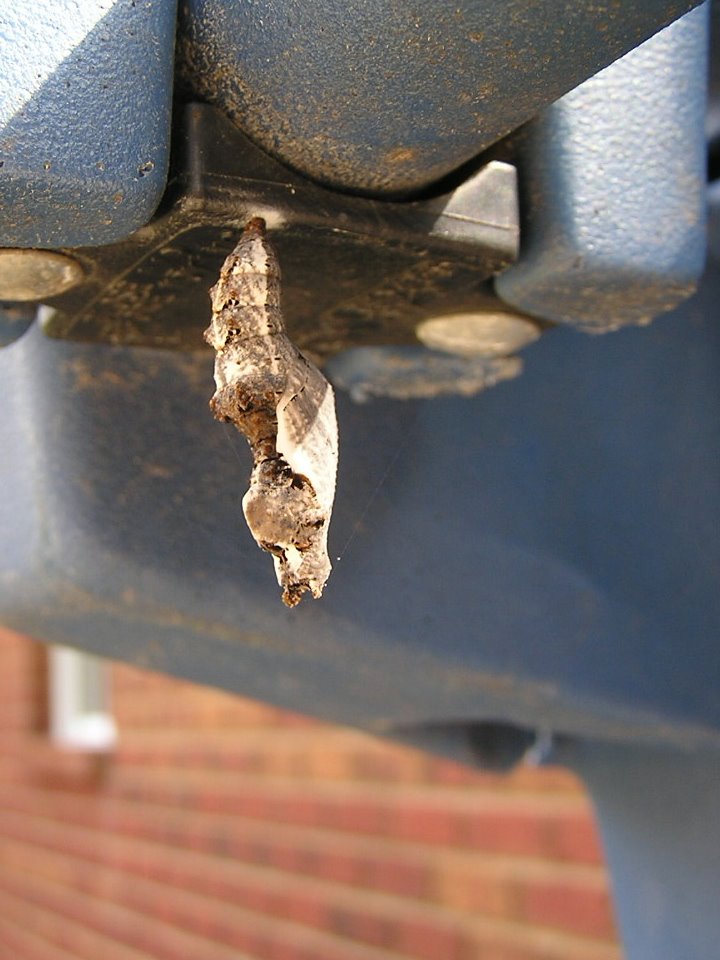
For the first time in several years, we have oodles of gulf fritillaries managing to live through their caterpillar stage and pupate successfully. The first year I planted their larval food, maypop (Passiflora incarnata), we had numbers like this. But then a pair of Carolina wrens moved in and gave us a firsthand demonstration of "natural control". It's the maypop that's been winning in recent years.


That natural control on the fritillary population doesn't seem to be "working" right now, though. Not that I mind in the least. I've seen a Carolina wren recently, and the pair successfully raised a brood earlier this summer, so I'm not too worried about their survival. Right now, despite the wrens' obvious reproductive success this year, we have ragged, defoliated maypop vines, multitudes of bright orange, "thorny" caterpillars happily munching away, and dozens of pupae hanging off eaves and in lots of other creative places. (In the photos, the caterpillar is next to its outgrown and discarded exoskeleton, and the chrysalis is hanging on the underside of our trashcan handle.)


Most stunning of all, at any one time I commonly see 10 or more velvety orange adults doing twining mating flights, resting in the sun, laying eggs or (occasionally) feeding.


The garden itself may be looking pretty ragged right now, but butterflies are in their glory!

Poetry That Sustains Me

I stumbled across this poem earlier this year, and it resonates within me on many different levels. It's by Stanley Kunitz, and it's called "The Layers". Although I've seen it in several compilations, in this case it's from his book, The Wild Braid, p. 82-83:

I have walked through many lives,
some of them my own,
and I am not who I was,
though some principle of being
abides, from which I struggle
not to stray.
When I look behind,
as I am compelled to look
before I can gather strength
to proceed on my journey,
I see the milestones dwindling
toward the horizon
and the slow fires trailing
from the the abandoned camp-sites,
over which scavenger angels
wheel on heavy wings.
Oh, I have made myself a tribe
out of my true affections,
and my tribe is scattered!
How shall the heart be reconciled
to its feast of losses?
In a rising wind
the manic dust of my friends,
those who fell along the way,
bitterly stings my face.
Yet I turn, I turn,
exulting somewhat,
with my will intact to go
wherever I need to go,
and every stone on the road
precious to me.
In my darkest night,
when the moon was covered
and I roamed through wreckage,
a nimbus-clouded voice
directed me:
"Live in the layers,
not on the litter."
Though I lack the art
to decipher it,
no doubt the next chapter
in my book of transformations
is already written.
I am not done with my changes.

Saturday, September 16, 2006

Summer's End

I've finally gotten back out into the garden again, spending several hours just restoring order in the back yard over the last two days. I still have serious work to do in the front yard, but I don't think that's too bad for a garden the size of mine, especially considering that I've hardly set foot outside for almost a month now.

Before I go any further, though, I HAVE to mention the activity in the butterfly garden - there are so many butterflies, moths, carpenter bees, wasps, and flying creatures of all sorts that it feels like the very flowers themselves are flying as I stand and watch.

On a more somber note, for the first time as I work, I really feel like I'm preparing the garden for someone else. I'm making the edges a little neater, being a little more rigorous in cutting back, being more careful to remove tiny weed seedlings, and generally being more "J" than I normally am as I garden.

I find myself trying to converse with the gardener who will (hopefully) come after me....

"Sorry about these variegated artemesia - they get out of hand so easily in this bed. Be sure to keep them pulled out."

"I'll always wonder about the gripeweed in the yard. I thought it was such a pretty plant when I first saw it (a mimosa seedling?!) that I left it to 'see what it would do'. Would it be as widespread if I'd been less tolerant and more vigorous in pulling it out right away?"

"What do you think about this variegated vinca major? I agree. I think I'll pull it out and save you the trouble. The bed will look much neater this way."

"Should I grub out all of the pokeberry? The mockingbirds go crazy over its berries and it is so pretty, but I understand why you might not want it around."

I sure hope the next owner likes to garden; despite losing so many pines this summer, the yard has really started to come together. The blue spiral ginger is blooming beautifully and putting up several strong new shoots. The arborvitae fern is starting to fill in, becoming a graceful mat against the deep mulch. The Florida anise is almost as tall as I am now, and looking lush and healthy after such a misshapen start to life. Speaking of misshapen, the oriental chain fern has finally put out a few fronds on the right side and is almost completely balanced now. Its large-scaled daintiness looks fantasic next to Miss Lily's sturdy peacock gingers. The Grape Sensation gaillardia is purplishly spectacular, and the Knockout roses are head-high and absolutely covered with burgundy new growth, fresh buds and fluorescent pink flowers.

I could go on and on, but I'd be belaboring the point.

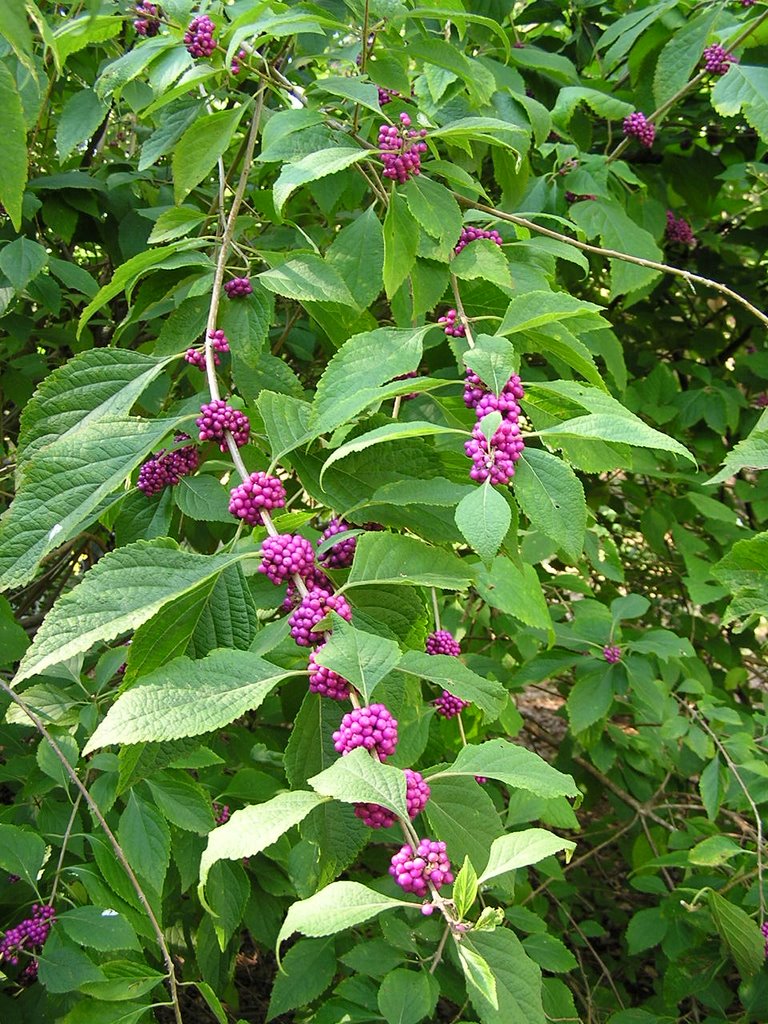
One last verbal picture, though: the wild beautyberry by the back shed is so loaded with brilliant magenta berries that it gleams richly in the dappled shade. I literally stopped in my tracks when I first saw it this week, its gracefully arching, heavily laden branches swaying drunkenly in the slightest breeze.

By the time we leave, those berries will have passed through the digestive system of a variety of birds and they will have been deposited, with a healthy dose of fertilizer, all over the local area. I have to believe that at least one or two will carry the genetic wealth of their parent and grow to create grace and beauty and bounty somewhere nearby, no matter what happens to their parent in this garden.

Monday, August 28, 2006

Changing Seasons

Although the temperatures are still in the 90's on most days, I am beginning to see signs that summer is waning and fall is coming.

Most notably, everyday now there are a few golden and brown leaves slowly sifting down out of the trees, letting go, weary from their nonstop duties of capturing sunlight and converting it to food. The Half Century Fountain seems to attract a fair number of these tired-out toilers, so each morning I find myself skimming out the prior day's leavings.

Having finished their primary job of creating food for their parent plant, now the leaves will slowly decompose. Ironically yet fittingly, they continue to feed their parent through their death and recycling.

An anonymous quote caught my attention last night: "Humans - despite their artistic pretensions, their sophistication, and their many accomplishments - owe their existence to a six-inch layer of topsoil and the fact that it rains." How much healthier our psyches and our world would be if we'd all realize and remember that fact.

Thursday, August 10, 2006

Flotsam and Jetsam

There have been many crosscurrents lately. The flow carrying Prairiewolf and me toward our move appears to be gaining strength and velocity. It begins to look like we'll have the house (and garden) on the market in October. Running almost directly counter to this steady movement is the current that contains my friends and botanical "family" here in Mobile, carrying me towards the shore of the Fall Plant Sale...also in October. And when I've occasionally had the chance to bob around in a few, gentle, backwater eddies, I've been reading a great book on permaculture in the home landscape, entitled (ironically enough) Gaia's Garden,
by Toby Hemenway.

With such conflicting currents constantly pulling at me, it's hard to focus on any one thought, botanical or philosophical, for very long. But a lot of interesting things are happening, and somehow it feels soothing to take note of them and share them.

Trees....

Two more pine trees became infested with pine beetles. I was lucky enough to find a tree service who could remove them relatively promptly; they came in less than a week and took them out today. Which, unfortunately, was necessary and therefore good. Hopefully we got them out before the "infection" had spread to any more healthy trees in the yard.

Countering the relief at getting that unhappy chore done, though, is the fact that both tree services I consulted recommended taking down a third pine tree that looked weak to them...and I decided to follow their advice and have it taken out. I won't bore you with the details, but suffice it to say that after the tree was cut down today, the stump rapidly covered with sap, bleeding over the fatal wound. The beetle infested trees were already dead and did not bleed at all. My heart aches at the unnecessary death that I caused today, however well-intentioned my decision was.

Tree facts from Gaia's Garden:

Planting a tender plant under the canopy edge of an evergreen tree can protect it enough during the winter to allow you to grow a plant that normally requires at least one higher hardiness zone. (p. 115)

A full-grown tree (presumably deciduous, although it's not specified) can transpire up to 2000 gallons of water on a hot, dry day, cooling the air around and beneath it. (p. 100)

The same full-grown tree can have between 10 and 30 ACRES of leaf surface, filtering dust and pollen and spores and pollutants and nutrients from the air. When rain comes, it coats the leaves first, making a "soup" with the ingredients captured on the leaf surfaces. When the rain does finally fall from the leaves, it is essentially carrying the tree's own fertilizer and innoculant with it. (p. 100-101)

Sightings around the garden:

There are butterflies galore right now. Yesterday morning, I saw 2 perfect giant swallowtails majestically feeding on Salvia, along with several pairs of gulf fritillaries flirtaciously chasing each other, a tattered and dull black swallowtail methodically nectaring, and several skippers flipping from bloom to bloom.

Hummingbirds are everywhere too. Just when you least expect it, one will buzz by and make you jump. Like the swallowtails, they are also enjoying the Salvia...although I saw a couple checking out the leaves of an oak tree this afternoon, for some strange reason.

I have recently learned that having your water moving during the day is not enough to deter mosquito larvae here...at least not if that water is still at night. Now my Half Century Fountain sports a debonair mosquito donut bobbing about, and I'm hoping to sport a few less mosquito bites on my ankles and arms.

After seeing quite a few small banana (golden silk) spiders in the garden a few weeks ago, I'm finding almost none now. Discussing with friends who had noticed the same phenomenon in their own gardens, we concluded that the birds have been reduced to eating the spiderlings because of decreased insects due to the drought.

Which leads me to comment that the drought appears to have broken at last. We've been getting our normal afternoon thunderstorms almost daily for the last 10 days or so. It seems odd to be celebrating extreme humidity and damp...but sometimes what you need isn't necessarily what you enjoy!

It's time to drift on to other activities. To mangle a truism, "A time for everything...and everything in its time."

Thursday, August 03, 2006

Free Cell vs. Life's Problems

I have been playing FreeCell a lot lately, subconsciously trying to bring order to my life. It's funny how I default to that game when I'm feeling out of control. Knowing that every hand is supposed to be solvable, I feel as if I'm somehow solving all of my life's problems by carefully ordering the cards in descending order, black on red on black on red....

Unfortunately, of course, what I'm actually doing is wasting time.

I've been feeling stressed lately. The formation of Tropical Storm Chris in the Caribbean is a good part of my dis-ease, but not all of it. Three more pine trees in the back yard have gotten beetles and have to be removed now - an expensive problem at any time but really problematic if a hurricane gets here before the tree service folks. Most of all, though, it's time to seriously finish putting the house in order and have it ready to show. Several people have expressed interest, and I'd like to be able to invite them in for a look around at a moment's notice.

Funny, it's not the move per se that has me uptight - it's selling the house. Somehow it feels like my life and my decorating ability (or lack thereof) and simply my general worthiness as a human being are all being judged by a bunch of strangers. If the house sells rapidly, I've done well and I am "worthy"; if the house languishes on the market, I'm being found wanting. (And given the fact that this house had languished on the market for months before we bought it, I feel like the deck is stacked against me to begin with.)

Logically I know that this is stupid and that I am not my house...but it's what I feel emotionally. And it adds a horrible degree of stress to what is already a somewhat stressful situation (i.e. moving).

I know that this too shall pass. We have successfully sold 4 other houses. We will eventually successfully sell this one. But, boy, I will be SOOOO glad when we have come through this gauntlet and have moved on to other challenges.

Friday, July 14, 2006

Goodbye to a pine tree

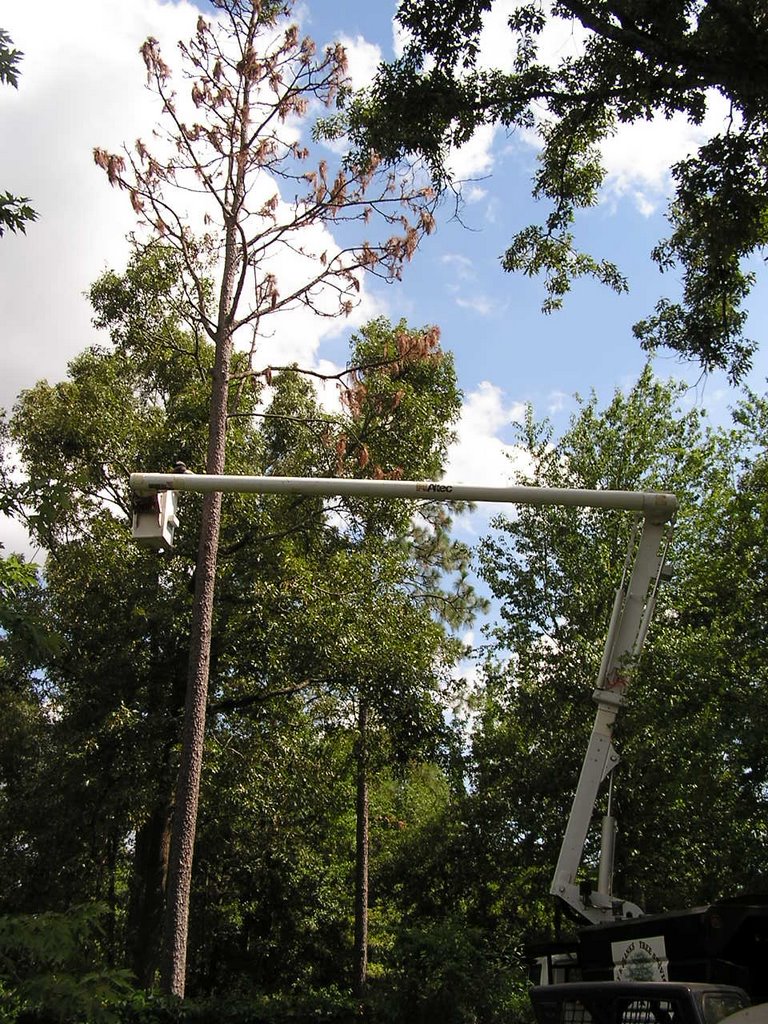
The tree guys finally got here yesterday and cut down the dead pine tree.

While I'm sad that it died and had to be cut down, I'm VERY glad that they got here and took it out before any tropical storms or hurricanes decided to take it out while rearranging our roofline.

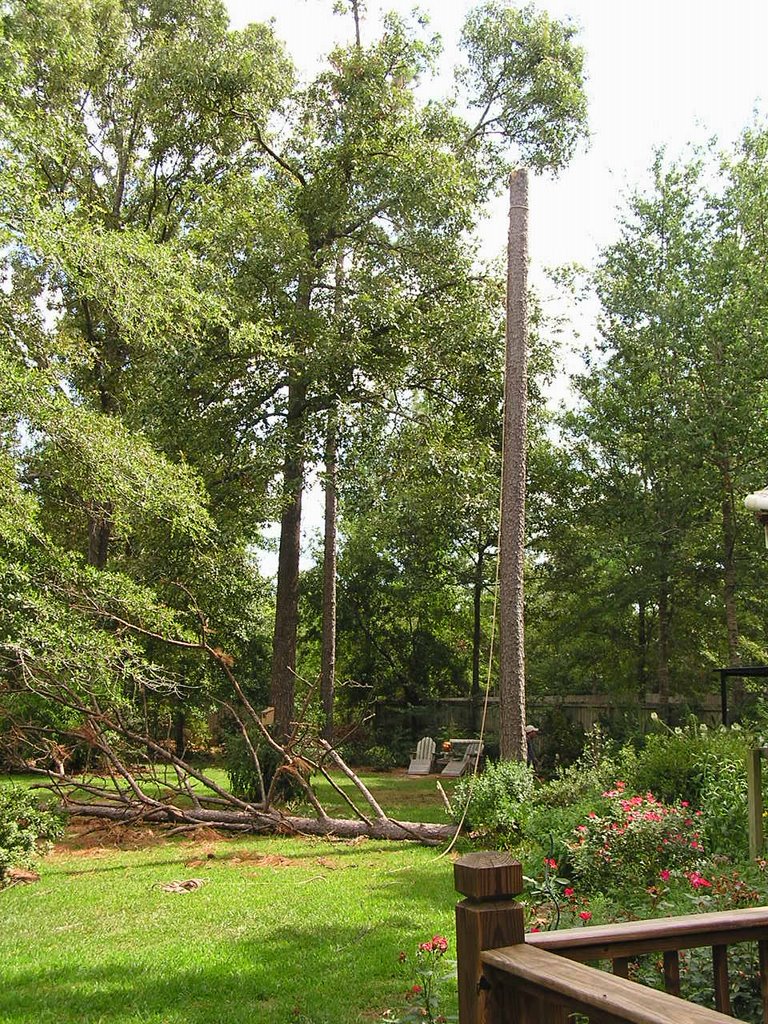
The picture to the right here shows the first major cut being made. They had a rope tied to the top section to make sure that it fell in the direction they intended.


The second picture, to the left, shows the top down and the leftover "stub", which they rapidly felled to lie right beside the top.

After cutting the trunk up into 8-10 foot sections, they systematically loaded everything up into the bucket of a Bobcat and carried it out of the yard to a waiting dumptruck. Even the pine straw was eventually scooped up into the bucket.

In less than 1 1/2 hours, they were done. The tree was gone, the stump was ground up, and a new normal was being established in the yard.

The thing that amazes me the most is how open and vulnerable that area seems now. Since the tree has been dead for almost 2 months, and since we saw nothing but the bare trunk at our eye level, I didn't expect to feel as much of an impact in the yard as I do. It will be good for the butterfly garden to get a little more sun, but we've lost any sense of destination and/or enclosure for the "Outback" seating area.

A little side note: the tree was younger than I expected. Counting the rings, I estimated that the tree was between 42 and 47 years old, depending on how long it had stayed in the "grass" stage. Overall, about my age or a little younger. Somehow that gives me pause.

Life goes on. Typical of any gardener, I suppose, I'm already planning what I'm going to put in the empty space. Suggestions anyone?

Tuesday, July 11, 2006

Meditating on Weeds...and IPM and Lawn Care

As I did my walkabout this afternoon, I kept thinking of the concept of weeds.

My favorite definition of a weed is "a plant out of place." Therefore, an oak seedling can be a weed in a lawn; grass is often weed in a garden bed. The plant species is not really the problem, it's the placement of the plant that is at issue.

A weed is just a plant out of place. That's all. A weed is not the precursor to the downfall of civilization as we know it. It is not Public Enemy #1. If weeds make you feel slightly (or very) panicky, you've been watching (and believing) too many herbicide commercials on TV. Remember (and repeat after me): "The goal of herbicide commercials is to sell herbicide...and fear is a good sales technique. Weeds are not evil creatures of the devil waiting to ruin my home and yard. Weeds are simply plants out of place."

That being said, weeds can take nutrients away from the plants we desire to grow. As such, we often want to remove them from our lawns and gardens. In a garden setting, weeding by hand, mulching the beds, and maintaining appropriate mowing/watering schedules for the lawn are usually all that is necessary for reasonable weed control. Generally "command and control" is a better weeding motto than "total eradication." You're not going to achieve the latter anyway, and you're going to waste a lot of money and poison a lot of earth trying to do so.

All this leads me to a difficult confession, though. Our yard can no longer really be considered organic. As we get ready to move, we are more truthfully operating under "Integrated Pest Management (IPM)" strategies. Specifically, Prairiewolf has been spot-spraying broadleaf weeds in the lawn with an herbicide as he mows.

I am not happy about this.

The lawn is looking the best it has ever looked. You could make the case that the herbicide weed control is the reason for the lawn's health, but I think it's more because of several other concurrent factors:
1) We finally realized the importance of regular watering to the health of the lawn grasses here in the Deep South, and therefore we have been watering religiously whenever the grass begins to get that gray-green color that denotes water stress. Centipede and St. Augustine, our two turf grasses here, don't really go healthily dormant when drought occurs like fescue and many other turfgrasses do.
2) Prairiewolf has been mowing extremely regularly. To my knowledge, he has only missed one weekend all summer. This is much better for the grass than skipping weekends and letting it get too tall. Keeping a consistent height encourages runner formation and keeps the grass from getting too stressed by having too much leaf surface cut off at once.
3) We have been gradually changing out the backyard grass from centipede, which can't handle shade, to St. Augustine, which can. The St. Augustine is doing much better under all our trees.
4) Whenever we get any brown spots or unhealthy looking areas in the grass, Prairiewolf brews up some compost tea and treats the area(s). This has proven to be a wonderful remedy, keeping the lawn much healthier overall.
5) Besides mowing the grass regularly, Prairiewolf has also been cutting the grass quite high. This keeps the soil cooler, prevents a lot of weed seed germination by keeping the soil surface shaded, decreases water evaporation from the soil, and generally reduces stress on the grass.
6) Last but not at all least, we haven't caused or been the victim of any real goofs lately - goofs like killing the "dormant" centipede by applying Round-up to the embedded winter weeds in January or having a contractor kill a large swath of lawn in the middle of the front yard by laying down clear plastic to "protect" the grass as he painted the front door. Come to think of it, it's been a couple years since those things happened. (Knock on wood!)

So there are a lot of reasons why the lawn is looking good this year. It's a lot more than just the broadleaf herbicide. In fact, I contend that it doesn't have anything to do with the herbicide...but I'm sure that Prairiewolf will contest that statement!

Any way you look at it, weeds are a powerful issue in gardening circles.

Can animals be "weeds"? Why not?

How about people? ...It's an interesting concept to meditate about during my next walkabout in the back yard.