Friday, February 23, 2007
Beaver Addendum

Signs of Spring
The birds have really started singing. It's the cardinals that I particularly notice when I go outside, but the white-crowned sparrows contribute their plaintive whistles and sometimes I'll catch the redwings or meadowlarks adding their melodies too. Even the woodpeckers have become extremely vocal back down in the draw.
The male red-winged blackbirds have started puffing out their epaulettes when another male flies near them at the feeders. My heart gives a little jump every time I see the soft, threatening puff of vivid red and yellow.
And I'm seeing males and females of all 3 of my main woodpecker species in at the feeders (downy woodpeckers, red-bellied woodpeckers, and flickers). I even saw a red-shafted flicker, female, in the draw earlier this week. That's a little unusual for Kansas, where yellow-shafted flickers tend to be the rule.
 Most excitedly, I looked out my kitchen window about 3 days ago and saw a splotch of yellow in the grass. Closer examination revealed a beautiful bunch of crocuses in full bloom. (Note: does anyone know why Blogger isn't allowing me to load photos in portrait format any more? Every time I try to upload one, it changes it back to landscape format.)
Finding the crocuses led to my first real gardening in our new home yesterday: I spent 45 minutes or so pulling out Bermuda grass from the remains of the old flowerbed where the crocuses were. In the process I discovered several other clumps of bulbs beginning to push their way up to the sunlight. It wasn't a big area at all, but my hands feel battered and bashed this morning - I'd forgotten how unforgiving Bermuda grass is to remove. I foresee long, painful hours ahead this spring.
 After carefully getting out all of the grass that I could, I bedded the plants back down with leaf mulch...wondering at the time if this was futile, but wanting to cover the bare soil at least a little. It was no surprise, though, when I got up this morning and discovered that the wind had thoroughly removed all of the mulch overnight. We ARE back in Kansas, after all. I guess Windswept Cottage is beginning to live up to its name. (Obviously this photo is from before the wind had its way with the mulch.)
I don't like bark mulch as well as leaf mulch, but I think I'm going to have to give it a try. Of course, there are no guarantees that even that will remain in place.
Speaking of which, I wonder if you can get a wind meter anywhere? I'm curious to know how fast the winds are blowing out here. It's always fun to have something to brag and/or complain about!
Tuesday, February 20, 2007
The Painted Drum
This book is rich. There are themes of connection between the living and the dead, between past and present, between seemingly unrelated people, and even between people and certain important objects. The impact of passion over generations is explored. Sacrifice and redemption become part of the storyline. The role of parents in shaping their children's lives is significant.
Obviously I saw myself in parts of it, but I also saw Prairiewolf in other parts, and life in general in still other places. Then, in reading the critics' summaries at the end of the book, I noticed that they each seemed to see something totally different than I had seen and than even each of the other critics had seen.
Most amazingly, despite all of the philosophical commentary, the story line seems to move forward naturally, without getting bogged down in needless wordiness.
I highly recommend this book as a satisfying read that leaves you feeling hopeful, yet more aware of life's complexities. And if you do read it, let me know what you think.
Rude Reminders
First, about 10:30 p.m. last night, as we were getting ready for bed, a coyote pack started to yodel and yip quite nearby, setting the neighborhood dogs into a frenzy. When Prairiewolf went down to check on Lefty, our old and very unhousebroken English setter, he was out in the yard with his hackles raised. (This, in and of itself, is amazing, since the only sensory organ that seems to work on Lefty anymore is his nose. He certainly cannot hear at all, and his eyesight is abysmal.) Prairiewolf brought Lefty inside, in his kennel, to keep him safe, but Lefty would have none of it. After several trips up and down the stairs to let him back out because he was complaining so vociferously, Prairiewolf finally just let Lefty stay outside after all. All of the activity, though, must have scared the coyotes off, because Lefty was fine this morning, thank goodness. However, it makes me a little nervous about regularly leaving him out as the weather warms up.
Second, this morning as I watched the sunrise from our closet window after Prairiewolf left, I noticed a black and white beast gallumphing across our driveway down near the road. It made an unwelcome turn into our yard and followed our driveway back in, before disappearing from my sight under the redcedar hedge to the south. This wasn't a cat. I went down to the kitchen to call Prairiewolf with the news that I'd seen a skunk in the yard, when I saw the beastie again, this time right outside the back door beside the deck, which it skirted before running across the yard and under the gate into the lagoon area. I lost sight of it again as it tried to get under the lagoon fence on the far side, next to the draw.
Now I'm wondering if the skunk comes through every morning and evening on its way to and from feeding in the barns next door and down the street. I've been trying to be careful not leave any dogfood out at night - now I need to be twice as vigilant.
Skunks and coyotes. Ah, the pleasures of country life. How long, now, before our young, gallant, naive German shepherd learns about skunk defenses the hard way? Not long, I'm guessing. (Is tomato juice actually the best remedy if he does have a mishap?)
Wednesday, February 14, 2007
History of Place
So yesterday I went in to the Clearwater Public Library and did a little research. Along the way, I met an extremely helpful woman, Jackie, who turned out to be the past director of the Clearwater Historical Museum. She was full of great information and wonderful stories.
Apparently this was Osage Indian territory before the European settlers came. The nearest river to us is called the Ninnescah River - "Ninnescah" meaning sweet water or clear water in Osage. "Ninnescah"...."Clear Water"...."Clearwater" - and the genesis of the town name is as simple as that.
In 1865, Jesse Chisholm, an Indian trader, laid out a new trail for trade between Wichita and Oklahoma City (and parts beyond?). The trail crossed the Ninnescah River at the best ford he could find, a spot just a little east of the current site of the town of Clearwater.
In 1867, the railroad finally reached Abilene, Kansas, and the first successful cattle drives from south of the Red River in Texas to Abilene occurred over the Chisholm Trail. Cattle drives on the Trail peaked in 1871, with over 600,000 head coming north.
(Did you know that the optimum size for a cattle herd on the Trail was 3000 head? It would often take cattle from several ranches to make the appropriately sized herd, so the cattle would be branded with a special drive brand, as well as with their original ranch/owner's brand. A herd of this size required the services of one trail boss, one chuckwagon, one horse wrangler, and about 8 drovers (cowboys). Each cowboy would have 3 horses: the regular one for daytime, a quiet nighttime horse, and one horse for backup. The cattle could only move about 10-12 miles/day and if they'd moved several days without a rest, they would need a couple days on pasture with water to recuperate. With herds of +/- 3000 head, the Chisholm Trail was actually as much as 1/2 mile wide, and when herds were resting, they might be pastured 3-5 miles away from the trail itself.)
The last large herd of bison were seen in the area during 1873. By 1874, farmers had started fencing land along the Chisholm Trail and the use of the Trail basically ended. So the Chisholm Trail, famous in legend and song, lasted less than 10 years. Amazing, isn't it?
Anyway, the original settlement of Clearwater grew up around the ford across the Ninnescah and the trading post on its north banks that soon developed. It was the only town to actually form because of the Chisholm Trail. After the trail declined, so did the town...at least until a new railroad line was brought in to connect Wichita to the town of Kiowa to the southwest. The railroad company built a depot about 1 1/2 miles to the northwest of the old Clearwater settlement.
Being resourceful people who disliked unnecessary work, the remaining settlers packed up and recreated their town by the new railroad depot. The first train came through on July 4, 1884. By April 1885, there were 700 people in town, and by September 1885 there were over 2000! The town incorporated on September 1, 1885. Over the next 5 years, a drought occurred (1887) and the Oklahoma territory opened up (1889). Many people packed up and left town for "greener pastures," abandoning their houses or literally picking them up and moving them elsewhere. By 1900, there were only 304 inhabitants left in Clearwater.
The town currently has 2000+ inhabitants again. It's a pleasant, friendly little town with miniature windmills for street signs. At first glance, it seems to be a combination of a farming community and a bedroom community for Wichita. I'm looking forward to getting to know it better.
Tuesday, February 13, 2007
Thoughts on Wind and Weather and Life Changes
On the other hand, the hawks are reveling in it. They head into the wind, bucking the gusts, drifting lower to look for calmer air. Suddenly they turn and soar, letting the wind carry them backwards and upwards, until they turn back and begin the game all over again. They could be waiting out the wind, securely clutching to a tree branch or fence post, but they choose to stay airborne, pitting their skills against the elements.
Despite the wind and the cold and the gray, it's a bracing day. Not like yesterday. Yesterday was a dreary, misty, rainy day. A Seattle day. A "cocoon inside" day. But (for those of you back in Mobile) despite rain all day yesterday, there was only 0.3" of rain in the gauge this morning...we're back in precarious water country again.
I am tempted to draw some inane (but culturally acceptable) analogy, saying that I want to be like the hawks, honing my skills and flying in the face of adversity...but let's get real! I'm much more like the trees, fighting the winds of change, rocking stubbornly and irritatedly in place while I try to reestablish my roots in this new soil.
Actually, that analogy works pretty well, now that I think about it. I've been transplanted. The process of settling in to a new home and a new community, like root growth, seems slow and is taking place pretty much out of sight. (In other words, not much visible progress appears to be occurring.) I'm trying to find new sources of nourishment of all kinds - from grocery stores for actual caloric nourishment to social activities for mental nourishment. And I'm trying to change my local environment (our home) to better support Prairiewolf and me and our needs. As I start putting out new growth, I'll need to find local pollinators - friends - to bring me fresh ideas and help connect me to my new community. And, in turn, hopefully I can "pollinate" them with new ideas and insights from my past experiences.
As an image, it's a little hokey - but it's fun too. And it makes me think it's time to get off my tail and go searching for some more of that local nourishment, specifically carpet samples today. It's time to extend my roots out a little further.
Monday, February 12, 2007
An Appropriate Coincidence
From Chapter 15 of the Tao Te Ching (Stephen Mitchell's renderings, New York: Harper & Row, 1988; quoted on page 209 of Smith's The World Religions):
Do you have the patience to wait
till your mud settles and the water is clear?
Can you remain unmoving
till the right action arises by itself?
And from Chapter 29 of Witter Bynner's The Way of Life According to Laotzu (New York: Putnam, 1986 reprint of 1944 edition; quoted on page 212 of Smith's The World Religions):
Those who would take over the earth
And shape it to their will
Never, I notice, succeed.
The earth is like a vessel so sacred
That at the mere approach of the profane
It is marred
And when they reach out their fingers it is gone.
Beaver Sign
So verbal descriptions will have to do for now. The first thing I noticed was raw wood exposed on the underneath side of a willow trunk hanging over the creek, about 15" above the ground/water. As I looked a little further, I noticed that several small saplings nearby (probably willow also) had been cut off about a foot above the ground, leaving the classic "pencil point" ending. There seems to be a small, not remotely effective, dam right by the big willow. And, as I've watched this week, I've seen a little gnawing being done on a few of the other, bigger willows upstream a bit.
I'm watching this with mixed emotions: my homeowner/gardener persona is in direct conflict with my ecological side on this one.
Beaver are a "keystone" species. That means that they change their environment in ways that create new habitat for many other species...and most of those other species are partly or wholly dependent on the beaver's manipulation of the habitat. In the Rocky Mountains, it was beaver that created the beautiful flat, lush valley meadows that so attracted early settlers. In Kansas, they are about the only way that ponds are created naturally.
In creating their ponds, beaver trap soil that would otherwise get washed out to the Gulf of Mexico (in the case of streams here). As the ponds fill in through soil settlement, they create wetlands that moderate floods, filter and purify the surface water, and recharge groundwater. The ponds and wetlands also increase the water/land boundary, increasing this productive habitat that is home to so many plants and animals. Last but not least, as the wetlands fill in, very productive woodlands and meadows are created on the rich soil left behind. So by their actions, the beaver store water in a dry environment, moderate floods, filter and purify surface waters, recharge groundwaters, increase habitat for a variety of plants and animals, and eventually capture/create exceptionally productive bottomland soil. Pretty impressive, really.
Twenty years ago, there were hardly any beaver left in Kansas. Now they are apparently inhabiting almost every drainage in the state. It's a true wildlife success story.
But, of course, as a landowner who lives only a little way away from the newly establishing beaver, all I can think of is whether or not they are going to gnaw down my precious trees. It's hard to look ahead to all the good they will do eventually, when it takes so blasted long for a tree to grow to a decent size in this prairie environment. If I lived upstream of the beaver, and if my house or outbuildings were a little too close to the water, I'd be worried about water backing up too.
So, as is unfortunately so often the case in human/animal encounters, I'm watching what happens with a leery eye. Will the beaver be allowed to remain? If they do remain, how will they impact the little area of creek that they are living on? Will they eventually venture on to my property and, if so, what will their impact be there?
Underneath I'm asking myself how I would be reacting if they were actually setting up shop, right now, in my draw. I can keep this as a philosophical question for now (and be glad that I don't have to make any actual decisions), because I don't think they'll move into a dry draw, but I may be surprised yet. And I'm disappointed in myself for not being absolutely certain that I'd let them "do their thing."
I'm feeling a little guilty, too, about not knocking on the doors of the nearest homes to tell them what I am seeing. I'm justifying that because, so far, I can see no signs that the beaver have impacted their planted landscapes and their homes are well out of the flood plain, as far as I can tell. The typical knee-jerk reaction would unfortunately be to shoot or trap the beaver to get rid of them. Heck, even I am feeling somewhat nervous and unsettled about having them so close. (And by that comment, I simply mean that I am willing to put up with much more "disruption" - which is usually temporary in my experience - from wildlife than many folks are.) So I'm erring on the side that will give the beaver a chance to do their thing.
Feeling distinctly hypocritical, I'll sign off for now and continue to keep an eye on their progress.
Saturday, February 10, 2007
Somewhat Mysterious Damage on Sapling Bur Oak Bark

Eastern Redcedars as Natural Villains?!!!

No mention is made in the article about the redcedar's importance to wildlife as the only evergreen native to the state.
No mention is made in the article about the declining prairie wildlife species actually losing numbers because of overgrazing, destruction of native grasslands, increased use of pesticides and the general overuse of the land by many of those same ranchers.
No mention is made in the article about the fact that Kansas' water supply is primarily jeopardized by overutilization to grow crops that were never meant to grow in dry climates, by wetland destruction, and by lousy farming and ranching practices that increase runoff and soil erosion and that decrease aquifer recharge.
No mention is made of the fact that farmers, ranchers and other landowners in the state have understood for decades (if not centuries) that grassland left unmanaged will revert to brushland. And that good grassland management consists, in part, of periodic burns (mechanical or real) to remove redcedar encroachment.
So ultimately no mention is made in the article that if there's increased redcedar encroachment, it means that landowners aren't doing their management chores like they should. The ranchers are losing "millions in lost grazing grass" because they are not doing their chores like they should. Not much different, really, than little kids not wanting to clean up their rooms and then trying to blame everyone around them for their laziness.
Sadly, the real difference, though, is that most people who read this article will take it at face value and start seeing this wonderful plant as evil. It is one more wedge between the average person and basic understanding of how the natural world works. And that saddens me beyond belief.
Thursday, February 01, 2007
Observations on a Winter Morning
The rosy glow shining luminously through the icy fog hugging the earth, as the sun rises in the sky....
Thousands of dainty little bird footprints marking the snow under the feeders....
Looking out an upstairs window to see Family Circus-like dog tracks through the fresh snow, meandering around the trees and shrubs in the front yard....
The different curves of the tire tracks from where Prairiewolf came home last night versus where he pulled out this morning....
Memory from 2 nights ago: ice crystals on the grass glinting and glittering in the light of a full moon....
Wednesday, January 31, 2007
Birds in Winter Wonderland

 After having the suet feeder totally ignored by all of the birds for almost 2 weeks, this flicker came in and found it. He immediatedly started vigorously defending it (and anything near it) from all comers. I actually had to move the suet feeder away from all the other feeders, to its own separate tree, to keep him from attacking the other birds.

Organic Lawn Care is Finally Going National!
These guys have been involved in organic gardening on both a personal and professional level for over 20 years, including one who has successfully run an organic lawncare service. It can be done. And it can be done throughout the country.
And I personally know it can be done, because we did it in Mobile, where everybody said it was impossible.. Our lawn may not have always been perfect, but it was just as nice or nicer than all those folks around me who drenched their yards in chemicals.
A couple tips that I picked up as I read the site:
1) To control crabgrass in a lawn, corn gluten should be applied as the forsythia begins to bloom. By the time the forsythia are done blooming, the crabgrass will have germinated and the corn gluten (which has a 9% nitrogen level, according to SafeLawns) will act as a fertilizer for the new young plants instead of killing them. The application rate is 20 lbs./1000 sq ft.
2) They've coined an acronym for weed control: RILE.
Relax.
Identify (the weed).
Listen (to what the weed species is telling you about your lawn conditions).
Eradicate (the problematic lawn conditions, as well as the weeds).
As with so many organic changeovers, the first several years may be more time and energy intensive, but within a couple years you will be spending much less in all categories, as well as watering less and having the satisfaction of knowing that you are not inadvertently poisoning your yard and everything living in it.
And your lawn will look great.
Monday, January 15, 2007
A New Chapter: Windswept Cottage
In the first week of January, a new home with its own unique yard and garden, in a entirely different ecosystem, entered into Prairiewolf's and my lives. We are now living southwest of Wichita, Kansas, near the little town of Clearwater, on 10 acres of land. Our land was presumably once mid-grass prairie, with a mix of tall and short grass species. There's a dry swale that drains most of the section west and south of us, bisecting our land about 1/3 of the way back. In its protected lowlands, there are black willows, a few large cottonwoods, and lots and lots of shrub-form poison ivy.

In front of the swale is the Yard Proper - about 3 acres of mowed grass with the house, workshop/auxiliary garage, and a wide variety of planted trees and shrubs.
Behind the swale is overgrown pasture, full of brome grass, young cedars, and a few clumps of Indian grass, big bluestem and other prairie species.
The sunsets, which we can enjoy from our kitchen table, are sublime. On dark nights, the stars are breathtaking. And the wind is unceasing. (No surprise there, though. This IS Kansas, after all!) I've tentatively named our new home "Windswept Cottage".

We've set up bird feeders just behind the deck, and the birds are rewarding us by literally flocking to them. We have dozens of juncos and Harris sparrows and white crowned sparrows; about 20 goldfinch; and cardinals, blue jays, red-winged blackbirds, brown headed cowbirds, rufous sided towhees, tree sparrows, black-capped chickadees, and house finch. We've even had a red-bellied woodpecker, a downy woodpecker, a Carolina wren, a song sparrow, a mourning dove, and a Carolina wren.
There have been a pair of red tail hawks visiting regularly (checking out the nesting potential, I hope?!), and a couple mockingbirds are helping me transition from south to "north".
One of the most interesting bird-events occurred on Friday when we put out a bird bath with heated water. We put it out about 1:30 p.m. and watched for a while, noticing that a couple starlings found it fairly rapidly. When we checked it out about 4, almost all the water was gone, which we thought was a little strange. So I refilled it with 2 gallons and watched amazed as about 100 starlings rapidly descended on it, bathing and drinking. Within about 10 minutes, almost all the water was gone...and the starlings drifted off. We repeated the process again, with the same results. By the next morning, we decided that heated water just wasn't going to be on the menu anymore.
The temperature when all this happened was about 17 degrees, and we were amazed at how delighted the starlings were to be bathing in those temperatures. A couple of them seemed to have big gray beards, which turned out to be made of ice when we looked at them through the binoculars. Not my idea of how to cope with subfreezing temperatures!
68 degrees one day and 22 the next. Bearded starlings. Neverending wind. Stunning sunsets. We're back in Kansas, and there are new adventures ahead.
Friday, December 01, 2006
Sharing a Few Last Favorite Fall Experiences
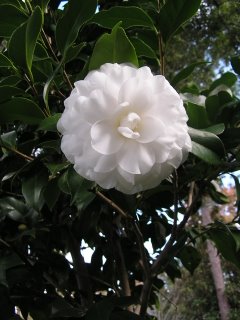 This is the bloom of an 'Alba Plena' camellia. It's one of the oldest of all the named camellia varieties, and I love its stately grace. (For a sense of scale, this blossom is about 4" in diameter.)
In fact, I've become rather a camellia fan after living here for 6 years. Their wildlife value is, of course, negligible, for which reason I doubt that I'll ever go completely nuts about them, but their beauty is undeniable. Their foliage is deep and lustrous, and their blooms are captivating.
One of the many assets of camellias is that they bloom in the late fall, winter and early spring. Alba Plena is one of the first camellias to bloom, so it's another sign that fall is winding down and winter is fast approaching.
 I love finding co-inhabitants of my garden...and it's even better when I can photograph them and share those photographs. This captivating guy was hiding out underneath an aster in the wood nymph garden at the beginning of November. I think he was hoping that I didn't see him, as he stayed perfectly still for a long time, inadvertently posing beautifully for me!
I'm assuming that he was there because the asters were absolutely shimmering with insect life, especially bumble bees and skippers, feeding on the nectar. It must have been like an all-you-can-eat buffet!

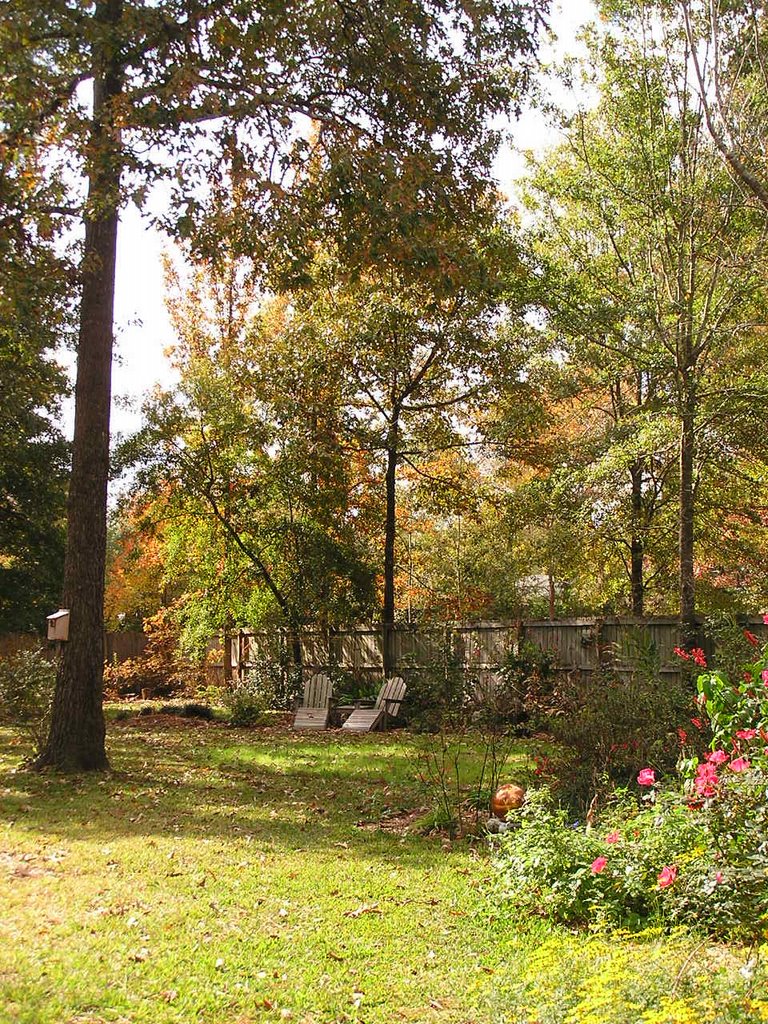
And, finally, here is our "Outback" seating area, surrounded by signs of fall. Maybe it's just that I've spent so many mornings and evenings sitting out there, sipping coffee or some other beverage of choice, journalling or just enjoying the life in the garden, but this vista makes me smile just looking at it.
A sanctuary. And how lucky we are to have it.
A Limestone 'Begging Bowl'

Now, however, the falling leaves have literally left their mark on it and it has morphed, almost overnight, from a blank spot to a daily changing canvas of impressions.

My biggest frustration at this point is how to capture it most effectively in a photograph. Lighting and shadows, changing displays of leaves coating its surface, and naturally evolving tannin prints all create its appeal to me. To a great extent, though, it's the fleeting nature of those patterns that fascinates me and, in trying to photograph them, I destroy that very nature that speaks to me.
Whether I ever get the photograph that I want, I now feel that having this blank canvas in the garden is a big plus. In its own way, it's the classic monk's begging bowl - highlighting the day's or the season's offerings.
Looking back a little....
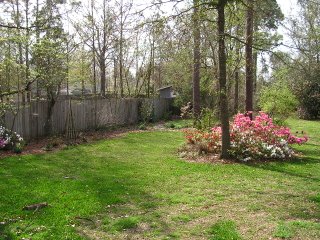
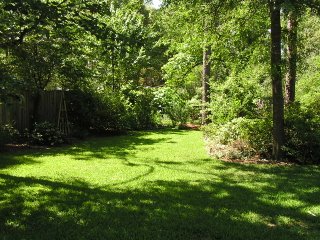
Just for kicks and grins, here are three vistas of the east side of our garden, over the course of the last year....
First we have spring - March 12, to be exact. Deciduous plants are just starting to leaf out. The azaleas have been blooming for a week or two and will be in full glory in another week or so. A week before this photo, the yard looked noticeably barer, but I wanted to show the azaleas really starting to ramp up.
Next is the start of full summer, June 6. The spring flowers are gone and the lushness of summer is setting in. Heat and humidity are almost radiating from this vista.
Last in my quick series is fall, November 28. The green is fading out, taken over by bright fall colors. Leaves are falling, and those that remain bear witness to a growing season's worth of life experience: spots from minor diseases, missing sections where insects dined, dessicated edges reminding of dry spells.
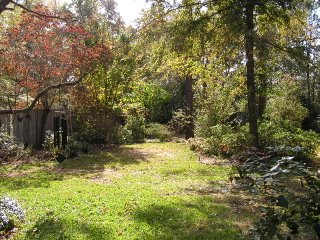
Each season has its beauty...and each season has its flaws. Life's rather funny that way, isn't it?
Monday, November 27, 2006
Going to the Source...So To Speak
In reading it, I realized that the story was misquoted somewhat in Utne. (I am disappointed in Utne. I thought they had better journalistic standards than that.) As summarized in Audubon, the original study was a four year study, not a five year study. And while the percentage increases were correctly reported in Utne for plant species and number of bats (105% and 75% respectively), the percentage increase for winter birds was 62%, and there was actually a 48% increase in spiders. Insect species and/or numbers were still not mentioned.
My junior English teacher in high school had us do a great exercise comparing the same story as reported by several different sources. I have never forgotten how different the story was depending on who reported it.
And it makes me wonder what changes have occurred in the translation between original study and the report in Audubon.
Anyway, despite the discrepancies, the message remains the same.
Now I'm on a quest to find the original study report.
It's Just Better When It's Organic....
Not having read the original article in Audubon (let alone the actual study!), I don't know if they tallied the increased number of insect species found, but I'd be willing to bet a fair amount that insects showed similar gains. More importantly, I'd be willing to bet that insect predator species rebounded significantly, working to control insect plant eaters and balance the farms' ecosystems naturally.
If farmers, who have to make their livelihood from their land, can increase habitat and species diversity like this, just think what us homeowners could do if we all decided to go organic!
I need to try to find the Audubon article. Better yet, I'd like to read the original study. But why wasn't this study widely reported in the national news? It seems to me that its conclusions are one more clue pointing us in the direction of a healthier and more balanced lifestyle.
Wednesday, November 01, 2006
Scarlet Bodied Wasp Moth
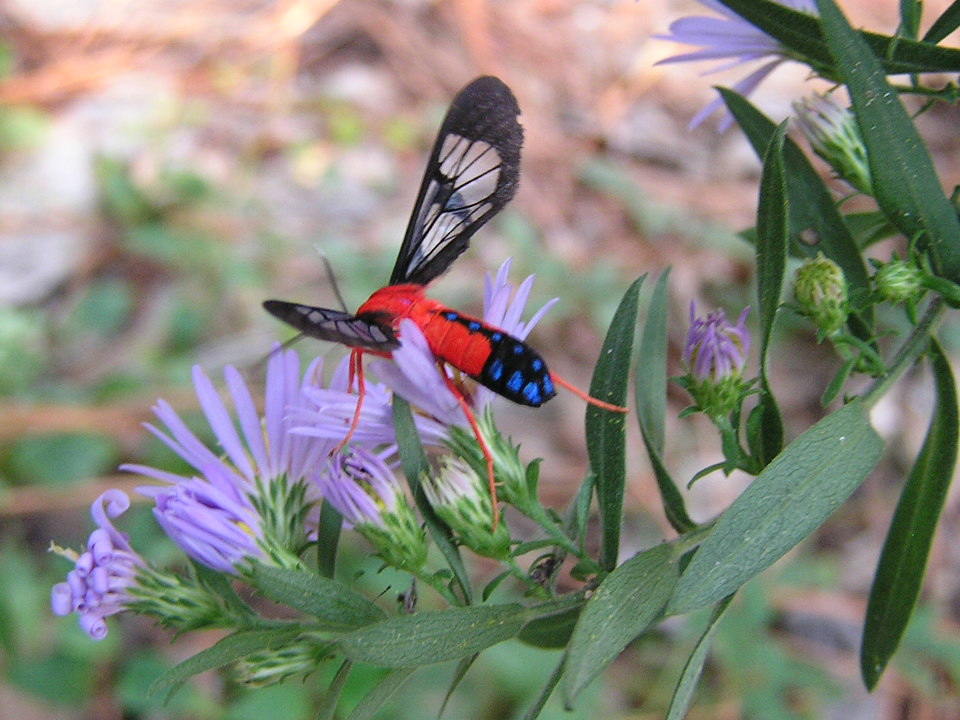
Isn't that a cool name? It's a pretty cool moth, too. Not easy to forget, once you've seen one.
I first found one dead on my doorstep, believe it or not, about a week ago. With my eyeglasses needing an update and my fantastic old loop magnifying glass playing a permanent game of hide-and-go-seek with me, I wasn't quite sure what type of insect it was. So I picked it up and saved it on a plate in the refrigerator, hoping to be able to identify it.
Two days ago in the late afternoon, I noticed several dozen of these unknown insects feeding on the asters in the back yard. I'd been enjoying all of the other "bugs" at the asters, but this was the first time I'd seen these creatures in the mix. They were even more dazzling alive than dead. (To give you an idea of scale, their bodies range from 1/2 - 3/4" in length.)
By watching closely, I was able to figure out that these guys were feeding with a proboscis, nailing their identity as a moth. I checked my guides, but the only information I could find out was that clearwing moths, as a family, are borers and can actually cause quite a bit of damage. Peach borers and dogwood borers, for example, are in this family. That caused my heart to sink, and I had visions of these beautiful insects creating untold havoc in their larval stage.
Luckily, a quick Google search set me straight. This is a scarlet bodied wasp moth, and it is indeed in the clearwing moth family. Its host plant, however, is the climbing hempvine - not what you would call an important commercial plant! This moth is considered to be a tropical species, which is why I wasn't able to find it in the guides that I had.
So I can enjoy these little beauties with a clear conscience. I've noticed that I primarily see them in the late afternoon, rather than throughout the day, despite the fact that they are supposed to be diurnal. Who knows what else I can discover about their habits as I watch them making themselves at home in my garden?