"The yard is alive, with the sound of music! With songs that've been sung for a million years...." (My deepest apologies to Rodgers & Hammerstein for that abysmal rewording of their song.)
The yard IS alive, now, but when we moved in, it was quiet and boring. Here's a summary of our journey so far....
THEN:
When we moved to southeast Virginia in fall 2019, our "new" yard challenged us.

The Prairie Boy was overwhelmed by the trees, 100+' giants that dwarfed the prairie trees he grew up with. He likes to see the horizon, and you basically can't do that when you are surrounded by giant trees. The yard was an enigma to him.
The Druid was excited about having real, live, BIG trees in her everyday life again, having a true forest garden. Her elementary school days had been spent in the eastern deciduous woodlands and she missed the ambiance and the ecosystem.
However, the yard has ended up stymying both the Druid and the Prairie Boy. These weren't just tall trees, these were TALL trees. The neighbors told many tales of trees falling unexpectedly and hitting houses, so every time the wind blew, a sense of uncertainty swept in as well.
There were remnants of prior landscaping in the yard, but they were truly remnants: solo large shrubs, deer pruned and lonely, unsupported by companions and some seemingly placed almost at random. In the spring, daffodils emerged and bloomed beautifully, but there were no flower beds, there was no lawn, and there was little discernible landscape design of any sort.
Making matters even less promising, the vast majority of the huge shrubs were non-natives: Chindo Viburnum, Camellias, Burford Hollies, Little Leaf Hollies, evergreen Azaleas, (small) Boxwoods, and a huge Rhododendron. For native shrubs, there were a couple large Yaupon Hollies, planted way too close to the old greenhouse wall, and 3 Yellow Anise Shrubs. Neither of these species are technically native to southeast Virginia, but at least they were "near natives". There were no true native shrubs.
As far as the "forest floor" was concerned, the yard had a lot of Japanese Stiltgrass and other non-native weeds, a few huge clumps of old fescue, a bit of Poison Ivy, and not much else besides the springtime daffodils and summer snowflakes.

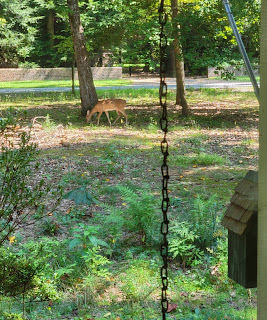
How in the world could we bring this space to life? How could we create cohesion, and even beauty, in this struggling and rather awkward space? In the spring of 2020, shown in the photo above, our newly acquired yard felt barren, despite the towering 100' tall trees that graced it. We'd been feeding birds all winter, but there was precious little other wildlife to be found: a skink or two, squirrels (of course), and honeybees from neighbors' hives, but almost no native insects. That summer we had an Eastern Ratsnake show up one day, only to be found dead in the neighbor's driveway not long after. A Leopard Frog made a brief appearance, as did a toad or two. That was about it.
I started pulling out the Japanese Stiltgrass the first summer, sitting directly on the ground, clearing out that invasive annual a few square feet at a time. I'd researched stiltgrass and I'd learned that it didn't bloom and set seed until late summer or fall, but at that point it seeded prolifically; I was determined to avoid new seed falling in as large an area as possible. As I sat on the ground working, I got to know our yard "up close and personal".

For example, in the photo above, you can see the bloom of a Naked-Flowered Tick-trefoil and a sedge, both of which are native, interspersed with the invasive non-native Japanese Stiltgrass, which has the broader leaves. These particular native plants aren't showy, but the native insects need and use them.

I found a few really nice surprises: several Striped Wintergreen plants (two are shown above), Southern Adder's Tongue, a few native tree and shrub seedlings, 2 stunted Mayapple leaves, 2 or 3 single Bloodroot leaves, and some nice Partridgeberry vines. Mostly, though, I found a lot of non-natives, some of which were problematic and a few of which were outright invasive.
Most disturbingly, I found almost no life in the leaf litter. We'd left the leaves on the ground in the fall, so we did have leaf litter itself, but despite hours of sitting on the ground, all I saw that summer were a few little black crickets.
NOW:

It's been 4 years since that first daunting summer. The Japanese stiltgrass still shows up a little, but it's easily pulled as I meander in the yard. I've moved on to actively extracting Asiatic Hawkweed, fescue clumps, and Ground Ivy. Ajuga is on my radar screen. We've left the leaves every year and a healthy leaf litter has started to develop, feeding and protecting the soil, as well as providing habitat for a myriad of little animals.

We've established a series of paths in the front yard, outlining them with branches from the tree trimming that has occurred. We've left a large log and several small sections of logs, forming an impromptu "jungle gym" for our grandsons in the front yard. These have become favorite seats for me, as well. In the back yard, we have a brush pile that the birds and the skinks find irresistible.
For the most part over these intervening growing seasons, I've welcomed whatever native plants wanted to show up in the yard, relocating a few of them, but generally just observing and enjoying. Because we have many seedlings sprouting, I can tell which plants are the birds' favorites, species like Spicebush, Wax Myrtle, and Black Cherry. We've also planted a lot of native plants: ferns, Columbine, Beautyberry, Viburnums, Goldenrod, Mayapples, and Bloodroot, just to name a few.

We fight the deer...and the voles...and even, for a brief time last spring, a groundhog. The deer have kept our newly planted plants undersized, but with judicious and regular use of deer repellants, we're finally seeing some growth. Last spring the voles set us back on our heels for a while, but they haven't been as bad this year.

Most excitingly, our yard has come alive with animal life. These days I hear bird song all day long from a variety of species, including Brown Thrashers like the one shown above. Fireflies twinkle at night.

Butterflies flit through the air. During the summer, I see Zebra Swallowtails and Eastern Tiger Swallowtails almost every day, but to get both in the same photo last summer felt like a real coup!

In the leaf litter, there are now millipedes (like the one in the photo above), as well as snails and centipedes and roly-polies and firefly larvae and a gazillion ants and ...and ....and crickets, too, of course. Moths have FINALLY appeared, especially the drab little leaf litter moths that are so incredibly important as food for many other animals.

Solitary native bees, like this Georgia Mason Bee (Osmia georgica), visit our flowers and nest in the yard, as do a variety of solitary wasps who feed their young with paralyzed spiders or crickets or caterpillars or beetle larvae, depending on the species, helping to keep those populations in balance.

So far this spring, we've had the parent birds of 10 different species bring their young to our feeders, including Carolina Wrens, Hairy Woodpeckers, and Brown Thrashers. The photo above is of a father Downy Woodpecker feeding his daughter last spring.

 ,
, 
Butterfly numbers and species have increased, including this Common Buckeye (Junonia coenia) from last August, but greedily I would love to see even more. I'm hoping that my increasing numbers of native flowers and host plants will bring them in - and help raise up new generations of lepidopterans.
Most excitingly, this spring we've now seen TWO Eastern Ratsnakes, a big one and a little one. Presumably they are why the voles are less of a problem this year!
I still feel like the yard's design is far from optimal, but I'm continuing to work on it, aiming for beauty and cohesion as well as for increasingly healthy native plant and animal populations.