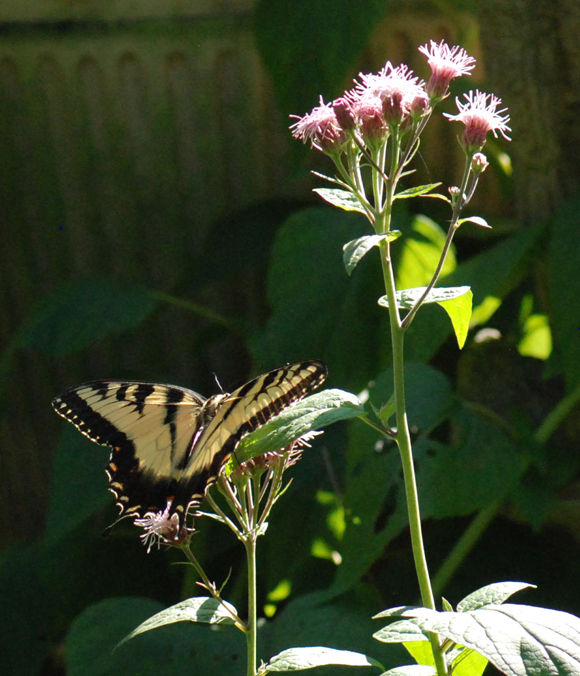
I love ferns. They delight me deeply. However, ferns and south central Kansas don't really go together, at least not without a major input of water and/or very, very special and protected conditions. I'm not willing to provide the first and I don't have the second, but I can still have some ferny components to my gardens by utilizing a few other plants that are hardy (and native) here.
Columbine:
One of my favorite ferny plants is red columbine (
Aquilegia canadensis). To tell the truth, I've never actually heard this species called red columbine, but that's what the USDA site says the official common name is. I just usually call it native columbine...which, of course, creates problems because there are many other native columbine species out there! So, I'll see if I can't start getting used to the official common name.
Red columbine is
native to the east half of the United States and Canada and it grows well in shade. It is a short lived perennial, but reseeds pleasantly, so there are usually young plants coming on as the older individuals fade away. Red columbine is a touch unusual in that it blooms a soft red with yellow highlights at a time of year when it seems like most other flowers are blooming blue and white and pink, but somehow red columbine just seems to work almost anywhere you plant it.

Some years the leaves of columbine sport even lacier patterns after the columbine leaf miners get to work. Leaf miners are larval insects that grow by eating out the plant cells living between the upper and lower surfaces of leaves. The leaf surfaces protect the growing larvae, but you can see the pattern of tunnels they form as they grow and eat. I've always actually rather liked the patterns leaf miners form, but some people get all upset and consider the leaves "disfigured." I've seen a few remnants of columbine leaf miners on a few leaves over the past 6 years, but there have never been enough for me to consider them a real problem.
I don't have any personal photos of leaf miners on columbine (did I mention that this hasn't really been a problem for me?), but here is a photo of leaf miners on an unknown plant in the draw, several years ago....
If you feel bound and determined to have perfect leaves - or if the population of leaf miners is just too overwhelming - you can always pick off the affected leaves and dispose of them in the trash or burn them. On the other hand, remember that predator species take some time to catch up with prey species. Enjoy the lacy patterns of the leaf miners' tunnels and trust that their numbers will come down in a year or two.
Oh, by the way,
leaf mining is a characteristic strategy of several different types of generally tiny insects, ranging from wasps to flies to beetles to moths to sawflies. Columbine leaf miners are tiny flies. I have no idea what insect was causing the leaf miner tunnels on the leaves in the photo above....
Spanish needles:
This is a recommendation that is not for the faint of heart...or the heat intolerant, probably. Spanish needles (
Bidens bipinnata) is usually considered a weed, and I totally understand why. It's an annual native plant with absolutely gorgeous young foliage. It is
native across much of the United States. The flowers are bright yellow, but insignificant, and they rapidly turn to seeds that are...vicious in their desire to hitch a ride to a new location.
This is one of those plants that turned up on its own in one of my flower beds. I noticed several small plants growing and let them be, so that I could see what they would turn into. I loved them! That is, I loved them until they got to the end of their life cycle and rapidly went from ferny and green and gorgeous...to dried out and airy porcupines that I could swear shoot their quills. Spanish needles has definitely mastered, "How do I conquer new worlds?" In fact, it gets an A+ on that test question.
So, why do I recommend Spanish needles? Because it's so pretty, of course. BUT, I highly recommend pulling almost all of the plants out the second you see the first little bright yellow flower. Yes, that little spot of yellow is the fully open, blooming flower. You'll actually have to keep a rather close eye on the plants to be sure you don't miss them.
The seeds won't be far behind the first flowers, and the ugly phase has absolutely no redeeming value. Based on my photographs, you will need to plan on pulling Spanish needles out around the end of July, when it is generally quite hot, so be prepared. On the plus side, they generally pull out quite easily, so it shouldn't take too long.
If you decide that you, too, enjoy these little guys, you'll want to leave a couple in unobtrusive places so they can go ahead and go to seed. Just don't leave them to go to seed anywhere that you or your dogs walk past, or you'll be picking the seeds out of fur and jeans and socks for several weeks.
Common Yarrow:
There is absolutely nothing common about common yarrow, in my opinion. The leaves of the basal rosette, which overwinters, are the closest thing to ferns that I have in my yard. In fact, they almost outfern real ferns. And they are tough as nails.
Common yarrow (
Achillea millefolium) is "...cosmopolitan throughout the Northern Hemisphere", according to the
Lady Bird Johnson Wildflower Center's Native Plant Database. They state that the
A. millefolium that is considered native in North America is actually "...a complex of both native and introduced plants and their hybrids."
There are cultivars of common yarrow, too. (In fact, you could consider the "native" species a cultivar, at this point in time.) Terracotta, to give an example of one of the commercially available cultivars, is extremely attractive, and there are many, many more cultivars in a wide range of colors. Even knowing about the colorful cultivars, though, I like the regular, common white, which grows wild all around our property. It combines beautifully with many other flowers in the spring, and its dried seed heads bring a pleasant texture all their own to the summer and winter grasslands. (The dried seedheads are popular in dried flower arrangements, as well.)
Here is common yarrow intermixed with spiderwort....
Catclaw Sensitive Briar:
As a child, do you remember touching mimosa leaves and watching in amazement as they folded close in response? I do. I thought that was just amazing. Well, we have a prairie mimosa that does the same thing and, to boot, it has the most gorgeous little miniature, bright pink pom-pom flowers that you could ever want. Catclaw sensitive briar (
Mimosa nuttallii, a.k.a.
Mimosa quadrivalvis var.
nuttallii) is
native to the central portion of our country. It's a vine with small prickles on its stems - hence the name "briar" in the name - that can trail 2-4', but the plants never gets more than about 12" high.
Despite the prickles on the stems, cattle love this plant for its high protein content and they preferentially graze it. Because of this preference, you are more likely to see catclaw sensitive briar along roadsides than in pastures.
I don't currently have catclaw sensitive briar in my gardens, but I do have a couple plants on the property. I think it would make an interesting addition to an informal bed as a "stitcher", winding throughout the other plants and providing some unity throughout the bed(s). If you have grandchildren, now or in your future, I think this is a plant that would really catch their attention, based on my childhood memories. Has anyone ever used catclaw sensitive briar in their garden? If so, I'd love to hear how it worked out for you.
For the moment, this wraps up my suggestions for bold, fine, and ferny textures in the prairie garden. I'm sure that I will find more species to share with you over the years. Gardening sure keeps us learning and changing, doesn't it?!