Greg and I spent the month of June in Ft. Walton Beach, Florida, on "Baby Watch." Connor finally decided to join us about 10 days ago, arriving safely but with a whole lot of uproar. Greg and I stuck around Florida for a week or so, getting him and his parents snuggled in a bit, then we hightailed it back here to Clearwater for a bittersweet fortnight to be spent doing a final cleanup and clearout here, culminating in a total packup and moveout.
Because of Baby Watch, we've literally been gone for over a month. We've had a great couple mowing our lawn for us, once a week, but otherwise the yard has been on its own during that time. No weeding (during all of April and May, too, to be honest), no watering, no transplanting, no nothing. So I had no idea what I was going to find when we got back, especially as wet as the weather was for much of May.
Doing a walkabout yesterday morning, I found some good things and some disappointing things, some expected changes and some unexpected changes. To get the disappointment out of the way without further ado, I was very unhappy to see how weedy the buffalo grass was. After 3 years of relatively careful weeding, I was hoping that there wouldn't be much crabgrass...but I was sadly mistaken. I'm hoping to find time to weed it out one last time before we leave...but I'm not counting on it. Weeding the lawn is a pretty low priority right now.
The front flower garden is full, but not very floriferous, a common problem for this bed at this time of year. The rain has made everything very tall this summer, which is a little overwhelming. The daylilies bloomed while we were gone, as did the butterfly milkweed. The lanceleaf coreopsis and the pink evening primrose were just beginning when we left; they are completely done now, but the Echinacea is still blooming nicely.
Looking down the front walk, there is a single tall wild lettuce dominating the center stage, but at least that will be quick and easy to pull out. The eastern gama grass (Tripsacum dactyloides) that didn't get relocated this spring is liking its spot next to the walk entirely TOO well. If no one wants it, it will get moved to the compost pile. Five or six foot tall grasses right next to a front walkway are just not welcome, even if they are native.
The wild bergamot (Monarda fistulosa) bloomed while we were gone and it is just about finished. I'm going to cut most of it way, way back and see what happens. Or, actually, I guess I won't see, but at least it won't be quite so front-and-center with its drying seed heads. If anyone wants some, I have several nice, healthy clumps that could use a new home.....
The back courtyard is rather wild & woolly and no flowers are currently blooming, but at least there is some open space left. Looking out my back kitchen door, I just saw some fireflies beginning their nightly display. Somebody's enjoying the beds in their rather overgrown condition!
The back courtyard was where I started a bit of work this morning, weeding away with a will until I accidentally backed into a healthy poison ivy plant I hadn't noticed. I tried to go on, but it was hard to concentrate while worrying about how much oil I had on my bare legs, so I gave up and went in to take a shower. Nine hours later, I can report that the shower, with large amounts of soap vigorously applied, did the trick - no itchy rashes anywhere, at least not yet.
The vegetable garden is the real problem child right now. We have done absolutely nothing in it all spring, and it is an overgrown disaster. Sigh. So much potential and it's just totally buried from sight right now.
So there's lots of work to do this week. On the plus side, the weather is supposed to be reasonable, with one or two days in the 70s. On the negative side, I managed to put out my back very thoroughly yesterday afternoon. On the plus side, as long as I sit in straight chairs or directly on the ground and move slowly and carefully, I can get some work done. On the negative side, our air conditioner wasn't working correctly when we got home. On the positive side, we broke down and called Bob Stith Heating and Plumbing and they came to fix it today, despite the holiday. Cool temperatures in the house is a BIG positive!
I'll leave you with several more positives from our walkabout yesterday....
First, a tiger swallowtail nectaring at the wavy-leaf thistle (Cirsium undulatum) in the lagoon. (Yes, the lagoon needs to be mowed, but we won't think about that right now.)
Second, our beautiful patch of smooth milkweed (Asclepias sullivantii) in the Cedar Grove beyond the Draw. (No, I did not see any monarch caterpillars, unfortunately.)
Third, my Pitcher's clematis (Clematis pitcheri) is looking better than I've seen it look in several years! Here are a couple of the blooms, on a stem weaving through one of the rose bushes. They're not colored as deeply blue-purple as usual, but they are still quite attractive in my opinion.
And, finally, a gorgeous patch of whorled milkweed (Asclepias verticillata) next to the path in the Front Tallgrass. The pollinators were literally dizzy with delight as they fed on the blooms!
Wish us luck! I'll try to share our progress over the upcoming several weeks.....
Showing posts with label Family. Show all posts
Sunday, July 05, 2015
Wednesday, June 24, 2015
A New Chapter Begins "Down South"...
I haven't been blogging lately because we're in the middle of a big transition - moving from the prairies of south central Kansas back to the Gulf Coast, this time to Ft. Walton Beach, Florida.
John Lennon once said, "Life is what happens while you're making other plans," and that sentiment fits this move to a T. Our first grandbaby is due any minute now (literally), and we are moving down here to help with childcare, since both of his parents are active duty in the Air Force.
It's very hard to leave our little bit of prairie...but it's also enjoyable to have a new challenge greeting me. I'll be bouncing back and forth between the two places for a while, but I'll try to be clear which one I'm talking about in my blog posts.
Having arrived in Ft. Walton Beach right as summer really took hold, I'm not doing much more than observing what is growing and living in our new digs. Our new yard is much smaller - a bit less than half an acre backing up to a small, but picturesque, manmade, freshwater lake. The soil in our yard is VERY sandy and there are good-sized trees, giving a rather savannah-like effect.
As far as plant material goes, for starters, we have 6 sand live oaks (Quercus geminata). This species is THE major tree in the local area. Visually, however, it is less important in our yard than in the general area simply because our individual sand live oak trees are rather plain. Here, in contrast, are a couple sand live oak trees in our daughter's yard, about a block away....
Back to our yard, there are also 3 reasonably large southern magnolias (Magnolia grandiflora), ....
...and 3 hickories that I'm pretty sure are bitternut hickory (Carya cordiformis).
The native plant material essentially comes to an end there. Obviously the previous owners were not native plant buffs. We have camellias and azaleas, all carefully hacked - oh, sorry, "pruned" - into "manageable" sizes and shapes; ...
...and multiple Loropetalums (a large shrub/small tree that likes to top out around 12' tall) carefully planted in front of windows that go almost to the ground.
Finalizing the majority of the plant palette, there are Indian hawthorns pruned into green meatball forms, variegated Pittosporum, a couple Sky Pencil hollies that don't look too healthy, African iris, and Lily-of-the-Nile.
For those of you in areas where these plants aren't common, this array of plants is basically an almost complete list of "non-native shrubs every homeowner finds at Lowe's or Home Depot and plants to make their yard look like everybody else's yard." The only plant missing is crepe myrtle.
Okay, I exaggerated. There ARE a couple native shrubs - 2 (remaining of 4) yellow anise trees - planted right below our picture window in the kitchen. Yellow anise trees naturally grow to about 20' tall and wide and these definitely like their spot, so they're doing well. Therefore, they've had to be squared off into a 4' tall hedge, neatly nestled right up against the house. A hedge that has, by the way, grown at least 6" just since the end of May, making sure we can't miss it as we look out the window.
All in all, this is a classic "challenges and opportunities" yard in which to make a garden. The view to the water is fantastically picturesque without us needing to do anything except (maybe) mow our lawn. There is a sprinkler system already installed (although it needs a lot of TLC). Drainage will absolutely not be an issue, between the lightly sloping land and the sandy soil.
On the challenge side of the site, did I mention that the soil is VERY sandy?
There is a flat, low area right beside the water, set off by "sea walls". The soil there is pure sand. The entire area is overgrown with brambles and weeds. Obviously some thoughtful landscaping is in order. However, we have to be careful about inadvertently creating "snake spots" while designing that landscaping. Cottonmouths ARE a real thing here and, much as I like snakes in general, I don't want sudden surprises with poisonous ones if I can help it.
The neighbor to the west of us has an OLD chainlink fence half hidden with vines and shrubs in a wild area formed from benign neglect. I don't mind wild areas, in general, but this one is full of popcorn trees and other weedy, woody, invasive plants that need to be judiciously removed. Then I'll be able to see more clearly what's worth saving in that region.
The neighbors to the east have a gorgeous BLUE hydrangea right on the property line. Friends in prairie places, eat your hearts out! I'm more than happy to "borrow" this part of their yard, even if it isn't native.
Dewberries, a very thorny type of bramble, are coming up all over the yard, in the lawn and garden beds alike, so one of my first tasks will be weeding those out...for the first of many, many times, I'm sure.
There are lots of seedling sand live oaks and hickories, too; I want to see if there are a couple seedlings I want to "save" to start regenerating the tree canopy, then weed out the rest.
And, of course, there are several species of greenbrier and lots and lots of gripeweed to go after. Some plants seem to spring eternal in the modern southern yard. In the photo above, taken under the magnolia in the front yard, is gripeweed lining the sidewalk, backed up by dewberry, and augmented with a small popcorn tree seedling. This is supposed to simply be mulched ground between the two Indian hawthorns, those green meatballs towards the top of the photo. Yes, I've got lots of work to do.
So wish us luck! (And, incidentally, I'd welcome any design ideas or plant suggestions.)
John Lennon once said, "Life is what happens while you're making other plans," and that sentiment fits this move to a T. Our first grandbaby is due any minute now (literally), and we are moving down here to help with childcare, since both of his parents are active duty in the Air Force.
It's very hard to leave our little bit of prairie...but it's also enjoyable to have a new challenge greeting me. I'll be bouncing back and forth between the two places for a while, but I'll try to be clear which one I'm talking about in my blog posts.
Having arrived in Ft. Walton Beach right as summer really took hold, I'm not doing much more than observing what is growing and living in our new digs. Our new yard is much smaller - a bit less than half an acre backing up to a small, but picturesque, manmade, freshwater lake. The soil in our yard is VERY sandy and there are good-sized trees, giving a rather savannah-like effect.
As far as plant material goes, for starters, we have 6 sand live oaks (Quercus geminata). This species is THE major tree in the local area. Visually, however, it is less important in our yard than in the general area simply because our individual sand live oak trees are rather plain. Here, in contrast, are a couple sand live oak trees in our daughter's yard, about a block away....
Back to our yard, there are also 3 reasonably large southern magnolias (Magnolia grandiflora), ....
...and 3 hickories that I'm pretty sure are bitternut hickory (Carya cordiformis).
The native plant material essentially comes to an end there. Obviously the previous owners were not native plant buffs. We have camellias and azaleas, all carefully hacked - oh, sorry, "pruned" - into "manageable" sizes and shapes; ...
...and multiple Loropetalums (a large shrub/small tree that likes to top out around 12' tall) carefully planted in front of windows that go almost to the ground.
Finalizing the majority of the plant palette, there are Indian hawthorns pruned into green meatball forms, variegated Pittosporum, a couple Sky Pencil hollies that don't look too healthy, African iris, and Lily-of-the-Nile.
For those of you in areas where these plants aren't common, this array of plants is basically an almost complete list of "non-native shrubs every homeowner finds at Lowe's or Home Depot and plants to make their yard look like everybody else's yard." The only plant missing is crepe myrtle.
Okay, I exaggerated. There ARE a couple native shrubs - 2 (remaining of 4) yellow anise trees - planted right below our picture window in the kitchen. Yellow anise trees naturally grow to about 20' tall and wide and these definitely like their spot, so they're doing well. Therefore, they've had to be squared off into a 4' tall hedge, neatly nestled right up against the house. A hedge that has, by the way, grown at least 6" just since the end of May, making sure we can't miss it as we look out the window.
All in all, this is a classic "challenges and opportunities" yard in which to make a garden. The view to the water is fantastically picturesque without us needing to do anything except (maybe) mow our lawn. There is a sprinkler system already installed (although it needs a lot of TLC). Drainage will absolutely not be an issue, between the lightly sloping land and the sandy soil.
On the challenge side of the site, did I mention that the soil is VERY sandy?
There is a flat, low area right beside the water, set off by "sea walls". The soil there is pure sand. The entire area is overgrown with brambles and weeds. Obviously some thoughtful landscaping is in order. However, we have to be careful about inadvertently creating "snake spots" while designing that landscaping. Cottonmouths ARE a real thing here and, much as I like snakes in general, I don't want sudden surprises with poisonous ones if I can help it.
The neighbor to the west of us has an OLD chainlink fence half hidden with vines and shrubs in a wild area formed from benign neglect. I don't mind wild areas, in general, but this one is full of popcorn trees and other weedy, woody, invasive plants that need to be judiciously removed. Then I'll be able to see more clearly what's worth saving in that region.
The neighbors to the east have a gorgeous BLUE hydrangea right on the property line. Friends in prairie places, eat your hearts out! I'm more than happy to "borrow" this part of their yard, even if it isn't native.
Dewberries, a very thorny type of bramble, are coming up all over the yard, in the lawn and garden beds alike, so one of my first tasks will be weeding those out...for the first of many, many times, I'm sure.
There are lots of seedling sand live oaks and hickories, too; I want to see if there are a couple seedlings I want to "save" to start regenerating the tree canopy, then weed out the rest.
And, of course, there are several species of greenbrier and lots and lots of gripeweed to go after. Some plants seem to spring eternal in the modern southern yard. In the photo above, taken under the magnolia in the front yard, is gripeweed lining the sidewalk, backed up by dewberry, and augmented with a small popcorn tree seedling. This is supposed to simply be mulched ground between the two Indian hawthorns, those green meatballs towards the top of the photo. Yes, I've got lots of work to do.
So wish us luck! (And, incidentally, I'd welcome any design ideas or plant suggestions.)
Labels:
Family,
Garden Design,
Gulf Coast flora,
native plants
Wednesday, December 31, 2014
2014: A Retrospective from the Wilds of South Central Kansas, Part 1
How should I sum up my last year in this blog? I've been obsessing about this for several days now. I want to share a couple exceptional books I read...but they aren't gardening books. I took the time to go through the myriad of photos that I took, looking for special shots that I hadn't shared or trends or a "one a month, best of" sort of theme, but nothing gelled appropriately. Most problematically, some months I literally had nothing and other months I had lots still to share.
Then, on Facebook this morning, I ran across NPR's best books of 2014. As I scrolled through the graphic, I quickly realized that I hadn't read a single book they were highlighting - and there were 250 books on the list. I don't think I even have a single book they highlighted, despite the fact that we have many, many piles of books sitting around the house, waiting to be read!
What could I do? What should I do...?
Oh, screw it! After all this angst and navel gazing, I'm just going to share a few things that seem like they were really good or interesting from my year, whether they have to do with gardening or not. Thanks for sharing these things with me!
Our Daughter's Wedding:
I've been very quiet about this - partly because it wasn't a "gardening" topic and partly because I abandoned my normal role as photographer and thus, for several months after the event, had no photos to share. There are many photos I could share now, but one will have to suffice.
Jessica and Kyle pledged themselves to each other at the end of May, in front of family and friends. They seem very, very good together and we are tremendously happy for them. We wish them many loving years together...and we will do our best to support them and the family they have decided they would like to have.
How to segue from that news?! I can't, so I'll just have to change the subject....
Interesting Birds in the Yard:
Of course, the subtext for this section is "...that I was able to catch on camera"!
At the end of January, I noticed this different-looking, sparrow-like bird joining in the flocks at the feeders: a female purple finch. She didn't stay around long, but it was fun to welcome her to the group for a brief visit. I hadn't heard of purple finches in the area and I actually saw fewer northern birds than usual last winter, so having her show up was particularly surprising.
Speaking of brief visits, this male lazuli bunting was a definite first for the yard! Coming through in May, he didn't stay around long, either, but he'd have been welcome to take up permanent residence. He's so skinny, though, that I have to wonder if he actually made it to the breeding grounds.
Just as we're saying goodbye to 2014, we've been visited by a deep cold spell, which has brought a couple birds to the yard I hadn't seen all year:
Since this is basically just a female cardinal, she obviously isn't an unusual species, but she is sporting an unusual color pattern known as (partial) leucism or as "piebald". I've been surprised by all of the oddballs, usually aka genetic abnormalities, that I've seen at my feeders over the last 8 years here.
Finally, the last "oddity" isn't really an unusual species either, it's just the first time I've seen one of these cute birds this year. Pine siskins are generally a northern bird, but they "irrupt" southwards during many winters. They weren't here in my yard last winter, but I'm seeing a fair number of them suddenly with this end-of-2014 cold spell. Sue, of the Facebook group, Gardening with Nature in Mind, asked me for a photo, so here it is!
Good Reads With Staying Power:
I wouldn't be me if I didn't share a couple of the excellent books that I've read this year. For the last 10 years or so, I've kept a list of all the books I've read "cover to cover" each year, no matter what genre they represent. If I hate a book, I don't finish reading it any more - there are too many books waiting to be explored for me to waste time on something that isn't intriguing me. Not all "good" books stay with me, though...and not all books that speak to me need to be shared. However, some DO need to be shared, and here are the ones that fit this category for me in 2014....
Still Alice, by Lisa Genova: With a plot line about a highly intellectual woman who develops early onset Alzheimer's, we read this book for our local book club. The story is told from Alice's perspective, so the reader experiences Alice's life along with her as the disease progresses and her mind changes. It is both terrifying and reassuring...and the book seems to be based on a very current understanding of the processes of Alzheimer's. Our book club discussion about this novel was one of the best discussions we've had yet - and that's saying quite a lot!
The other book that makes my cut this year is A Sting in the Tale, by Dave Goulson, which I reviewed recently. Definitely excellent, and it seems especially appropriate for anyone who reads my blog!
Sadly, since I've taken up Facebok, my reading seems to have declined. I used to regularly get through 50 books a year, plus or minus, based on my lists. This year it was just 31 books. I think I may need to make some adjustments.....
Well, I think I'll end Part 1 here and continue in another blog post. Individual posts shouldn't be books, in and of themselves! Have a great last day of 2014!
Then, on Facebook this morning, I ran across NPR's best books of 2014. As I scrolled through the graphic, I quickly realized that I hadn't read a single book they were highlighting - and there were 250 books on the list. I don't think I even have a single book they highlighted, despite the fact that we have many, many piles of books sitting around the house, waiting to be read!
What could I do? What should I do...?
Oh, screw it! After all this angst and navel gazing, I'm just going to share a few things that seem like they were really good or interesting from my year, whether they have to do with gardening or not. Thanks for sharing these things with me!
Our Daughter's Wedding:
I've been very quiet about this - partly because it wasn't a "gardening" topic and partly because I abandoned my normal role as photographer and thus, for several months after the event, had no photos to share. There are many photos I could share now, but one will have to suffice.
Jessica and Kyle pledged themselves to each other at the end of May, in front of family and friends. They seem very, very good together and we are tremendously happy for them. We wish them many loving years together...and we will do our best to support them and the family they have decided they would like to have.
How to segue from that news?! I can't, so I'll just have to change the subject....
Interesting Birds in the Yard:
Of course, the subtext for this section is "...that I was able to catch on camera"!
At the end of January, I noticed this different-looking, sparrow-like bird joining in the flocks at the feeders: a female purple finch. She didn't stay around long, but it was fun to welcome her to the group for a brief visit. I hadn't heard of purple finches in the area and I actually saw fewer northern birds than usual last winter, so having her show up was particularly surprising.
Speaking of brief visits, this male lazuli bunting was a definite first for the yard! Coming through in May, he didn't stay around long, either, but he'd have been welcome to take up permanent residence. He's so skinny, though, that I have to wonder if he actually made it to the breeding grounds.
Just as we're saying goodbye to 2014, we've been visited by a deep cold spell, which has brought a couple birds to the yard I hadn't seen all year:
Since this is basically just a female cardinal, she obviously isn't an unusual species, but she is sporting an unusual color pattern known as (partial) leucism or as "piebald". I've been surprised by all of the oddballs, usually aka genetic abnormalities, that I've seen at my feeders over the last 8 years here.
Finally, the last "oddity" isn't really an unusual species either, it's just the first time I've seen one of these cute birds this year. Pine siskins are generally a northern bird, but they "irrupt" southwards during many winters. They weren't here in my yard last winter, but I'm seeing a fair number of them suddenly with this end-of-2014 cold spell. Sue, of the Facebook group, Gardening with Nature in Mind, asked me for a photo, so here it is!
Good Reads With Staying Power:
I wouldn't be me if I didn't share a couple of the excellent books that I've read this year. For the last 10 years or so, I've kept a list of all the books I've read "cover to cover" each year, no matter what genre they represent. If I hate a book, I don't finish reading it any more - there are too many books waiting to be explored for me to waste time on something that isn't intriguing me. Not all "good" books stay with me, though...and not all books that speak to me need to be shared. However, some DO need to be shared, and here are the ones that fit this category for me in 2014....
Still Alice, by Lisa Genova: With a plot line about a highly intellectual woman who develops early onset Alzheimer's, we read this book for our local book club. The story is told from Alice's perspective, so the reader experiences Alice's life along with her as the disease progresses and her mind changes. It is both terrifying and reassuring...and the book seems to be based on a very current understanding of the processes of Alzheimer's. Our book club discussion about this novel was one of the best discussions we've had yet - and that's saying quite a lot!
The other book that makes my cut this year is A Sting in the Tale, by Dave Goulson, which I reviewed recently. Definitely excellent, and it seems especially appropriate for anyone who reads my blog!
Sadly, since I've taken up Facebok, my reading seems to have declined. I used to regularly get through 50 books a year, plus or minus, based on my lists. This year it was just 31 books. I think I may need to make some adjustments.....
Well, I think I'll end Part 1 here and continue in another blog post. Individual posts shouldn't be books, in and of themselves! Have a great last day of 2014!
Sunday, December 07, 2014
"We're Not in Kansas Any More!"
There's little like a vacation to stir up the blood and help you see new perspectives. We've just returned from a 10 day trip to the Florida panhandle, where we celebrated Thanksgiving with our kids and began to get a picture of what the coming years might hold for us. One of the many enjoyable activities while we were there was a relaxing walk through a recreational area on Eglin Air Force Base. As winter really starts to descend here in Kansas and throughout much of the country, I thought it might be fun to share some of the plants I saw just a week ago, in a warmer clime....
While Greg, Jess, Sean, and "the girls" walked on ahead, intent on true exercise, I lingered behind to take photos along the old roadway. Truthfully I was surprised by the variety of plants I saw. Even more truthfully, I was surprised by how many species I remembered from my gardening days in Mobile!
As I started off down the trail, my first impression was of food. Lots and lots of food...for birds and other animals. Food seemed to be available everywhere I looked.
There were vividly red yaupon holly (Ilex vomitoria) berries crowding each other in the sunlight.
Along with the crimson yaupon berries were other berries, such as these deep blue, greenbrier (Smilax sp.) berries, and lots and lots of seeds. Goldenrod (Solidago sp.) seedheads were particularly full of feathery goodness.
This feathery goldenrod plant joined with beautyberry (Callicarpa americana) berries to offer the local wildlife a feast.
As I walked and looked and took photos, the old phrase, "Toto, we're not in Kansas anymore!" kept echoing through my head. No, it for sure wasn't Kansas. Sometimes it amazes me how few plant species are found both along the Florida/Alabama coastline and up here in the prairie land. Certainly there are genuses that are in both areas, but the species are quite separate.
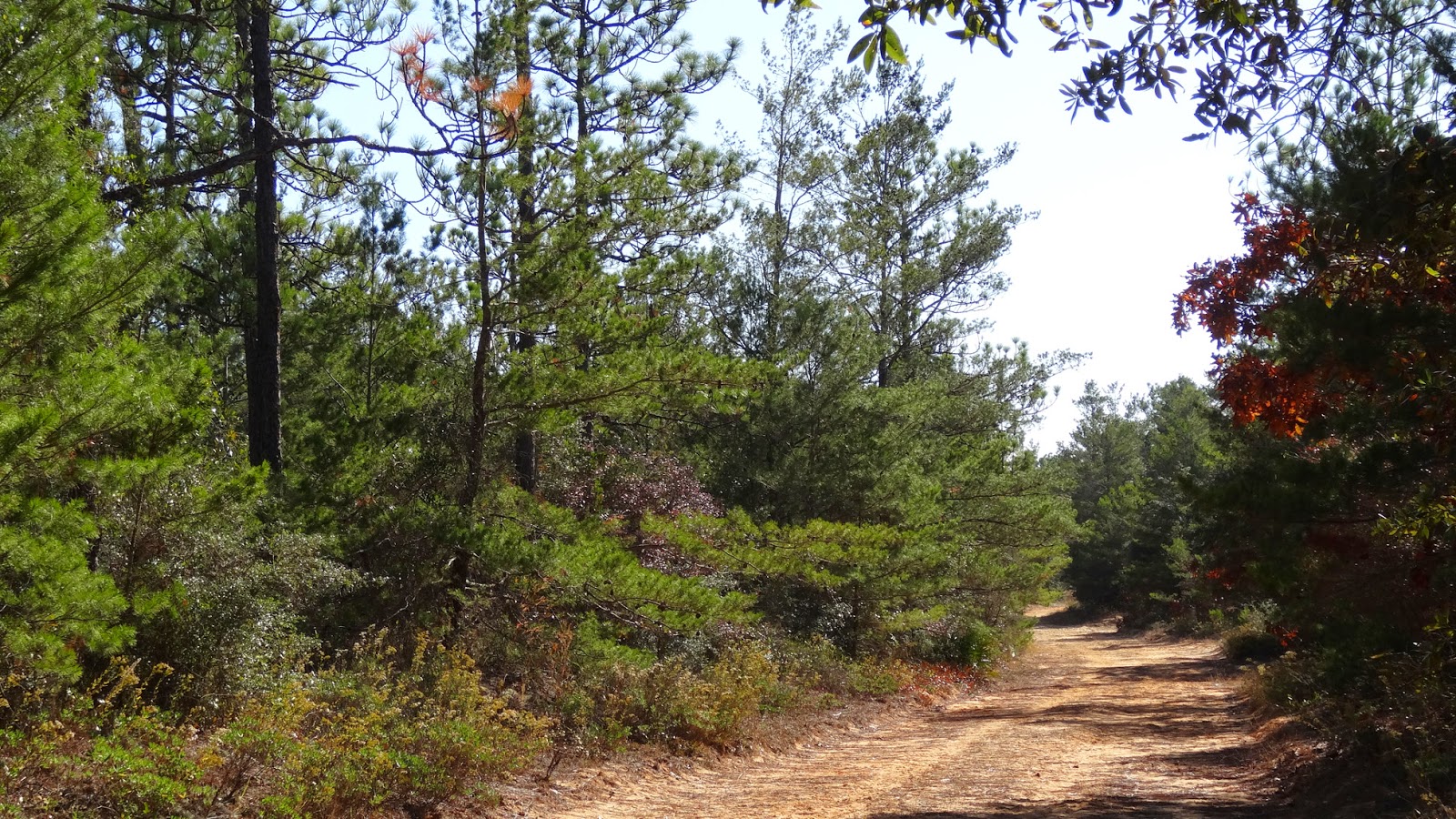
Between Kansas and the Gulf Coast, the feel of the plant communities is very different too - which is hardly surprising. Sporting a covering of pine needles and a diversity of moss and lichen on a heavily sandy soil, this view of the woodland floor is typical for the area we were visiting.
Towering over the rest of the vegetation were the longleaf pines (Pinus palustris). Historically, these keystone plants formed massive open forests which predominated all along the southern coastal plains, from Virginia around the corner to Texas, until about 100-150 years ago. First the majestic longleafs were tapped to make turpentine and cut to make ship masts, then later they were cut down to burn in steam engines as the country expanded. Of course, their wood was also used in building as well. The land that was cleared was either put into agriculture or replanted with faster growing slash or loblolly pines. Within just a few decades, almost all of the longleaf forests were gone. Nationwide, a University of Florida study done in 1997 found only 15 sites with virgin longleaf pine forest left, totalling about 1600 acres.
A typical understory plant throughout much of the area, saw palmetto (Serenoa repens), gives a vaguely tropical feel to the woodlands. It is a true native (unlike most of the others palms and palm-like plants you see along the Gulf Coast) and it is very valuable for wildlife.
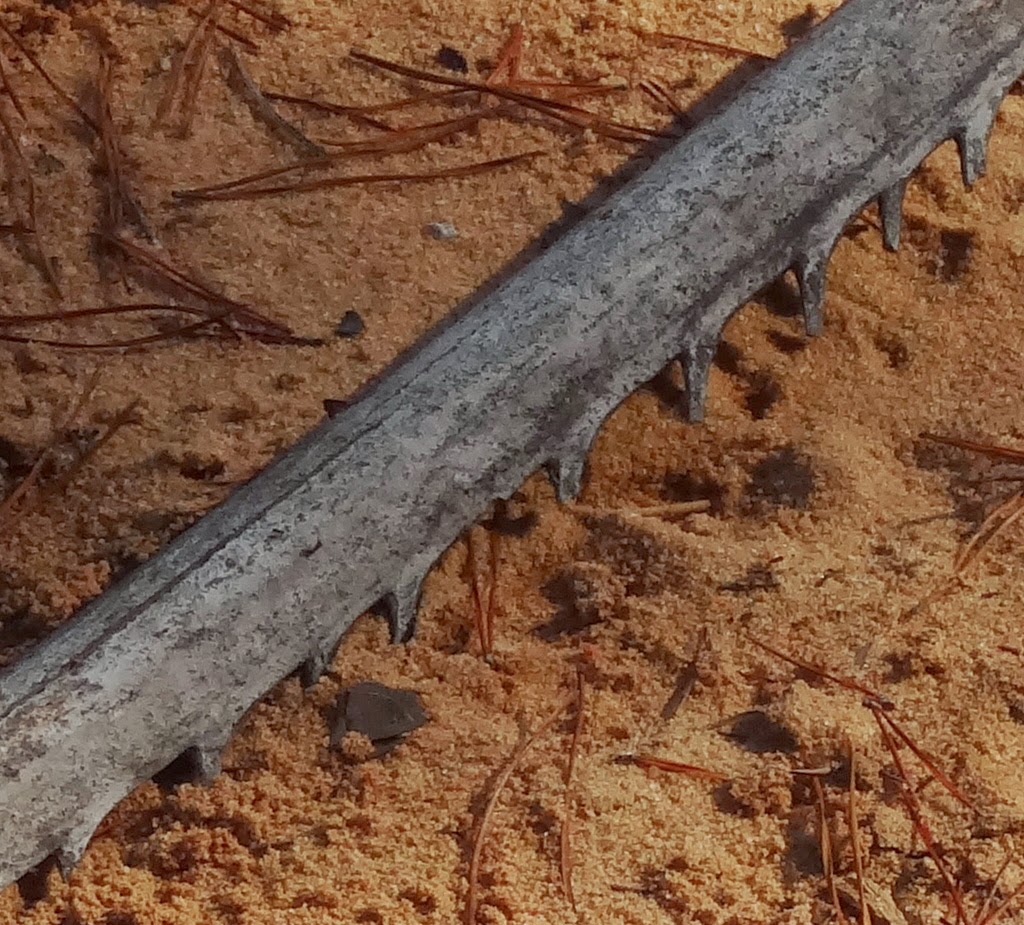
Here is a remnant of the "stem" of one of the big fan leaves found on saw palmetto. You can see where the name "saw" comes from! It makes me think of fossil dinosaur jaws whenever I see it.
Usually not considered a beneficial plant, there was a lot of greenbrier (Smilax sp.) in the understory along the path, too. I actually like greenbrier for its wildlife versatility - the berries are great food for birds and other animals, while (as is typical for native plants) the leaves are larval food for caterpillars of several different moth species such as the turbulent phosphila and the ruby quaker. Note: the names are cool, but the adult moths are pretty cryptic, a.k.a. drab. Still, they too are food for numerous other animals. Many greenbrier vines are bristling with thorns and can serve as excellent shelter and nest protection for birds and other small animals.
This essentially thornless greenbrier had a few healthy berries to share, and you can see the parallel leaf veins that help identify it as a Smilax.
One find that surprised me was what I think was a nicely sized American holly (Ilex opaca). While they are native to the area, I didn't see them very often when we lived in Mobile.
Scattered in small clusters amongst the broad leaves, the holly berries were bright red and looked great, but they didn't put on as much of a show for the camera as the yaupon berries did. With its yellowish green leaves, American holly is widely used in crosses with other species, but isn't commonly found as a straight species in the nursery trade.
Walking back along the trail, though, and thus seeing from a different direction with a different angle of light, the leaves of the holly do look much darker.
To eyes accustomed to fall further north, the woodlands still look very green, but signs of fall were everywhere. While I've talked about the colorful berries and fluffy seedheads, there was also some fall color. An excellent source of fall color in longleaf territory is sparkleberry, Vaccinium arboreum. In the blueberry genus, sparkleberry has tiny blue berries that are snatched up by birds as soon as they ripen, which is earlier in the year, but their shiny leaves color beautifully and remain on the plant for a long time. This individual was a beautiful maroon...
while across the path and down the way a bit, another sparkleberry went in for oranger and golder tones.
Speaking of orange and gold, there were a few yellow-gold blooms still gallantly blazing, although I don't know what they were, ...
and a male monarch was traveling the path with me, too. He rested on a yaupon long enough to give me a "photographic opportunity" before continuing on his journey. I wonder if he'll make it to Mexico or not?
There are 2 other plants that I want to highlight from this walk, but I think I'll separate them out into another post or two.
Meanwhile, Greg, Sean, Jess, Gabby and Dahlia got done walking and have come looking for me - so I'll end this ramble. Hope you enjoyed my glimpse of the south land in your chilly December!
While Greg, Jess, Sean, and "the girls" walked on ahead, intent on true exercise, I lingered behind to take photos along the old roadway. Truthfully I was surprised by the variety of plants I saw. Even more truthfully, I was surprised by how many species I remembered from my gardening days in Mobile!
As I started off down the trail, my first impression was of food. Lots and lots of food...for birds and other animals. Food seemed to be available everywhere I looked.
There were vividly red yaupon holly (Ilex vomitoria) berries crowding each other in the sunlight.
Along with the crimson yaupon berries were other berries, such as these deep blue, greenbrier (Smilax sp.) berries, and lots and lots of seeds. Goldenrod (Solidago sp.) seedheads were particularly full of feathery goodness.
This feathery goldenrod plant joined with beautyberry (Callicarpa americana) berries to offer the local wildlife a feast.
As I walked and looked and took photos, the old phrase, "Toto, we're not in Kansas anymore!" kept echoing through my head. No, it for sure wasn't Kansas. Sometimes it amazes me how few plant species are found both along the Florida/Alabama coastline and up here in the prairie land. Certainly there are genuses that are in both areas, but the species are quite separate.
Between Kansas and the Gulf Coast, the feel of the plant communities is very different too - which is hardly surprising. Sporting a covering of pine needles and a diversity of moss and lichen on a heavily sandy soil, this view of the woodland floor is typical for the area we were visiting.
Towering over the rest of the vegetation were the longleaf pines (Pinus palustris). Historically, these keystone plants formed massive open forests which predominated all along the southern coastal plains, from Virginia around the corner to Texas, until about 100-150 years ago. First the majestic longleafs were tapped to make turpentine and cut to make ship masts, then later they were cut down to burn in steam engines as the country expanded. Of course, their wood was also used in building as well. The land that was cleared was either put into agriculture or replanted with faster growing slash or loblolly pines. Within just a few decades, almost all of the longleaf forests were gone. Nationwide, a University of Florida study done in 1997 found only 15 sites with virgin longleaf pine forest left, totalling about 1600 acres.
A typical understory plant throughout much of the area, saw palmetto (Serenoa repens), gives a vaguely tropical feel to the woodlands. It is a true native (unlike most of the others palms and palm-like plants you see along the Gulf Coast) and it is very valuable for wildlife.
Here is a remnant of the "stem" of one of the big fan leaves found on saw palmetto. You can see where the name "saw" comes from! It makes me think of fossil dinosaur jaws whenever I see it.
Usually not considered a beneficial plant, there was a lot of greenbrier (Smilax sp.) in the understory along the path, too. I actually like greenbrier for its wildlife versatility - the berries are great food for birds and other animals, while (as is typical for native plants) the leaves are larval food for caterpillars of several different moth species such as the turbulent phosphila and the ruby quaker. Note: the names are cool, but the adult moths are pretty cryptic, a.k.a. drab. Still, they too are food for numerous other animals. Many greenbrier vines are bristling with thorns and can serve as excellent shelter and nest protection for birds and other small animals.
This essentially thornless greenbrier had a few healthy berries to share, and you can see the parallel leaf veins that help identify it as a Smilax.
One find that surprised me was what I think was a nicely sized American holly (Ilex opaca). While they are native to the area, I didn't see them very often when we lived in Mobile.
Scattered in small clusters amongst the broad leaves, the holly berries were bright red and looked great, but they didn't put on as much of a show for the camera as the yaupon berries did. With its yellowish green leaves, American holly is widely used in crosses with other species, but isn't commonly found as a straight species in the nursery trade.
Walking back along the trail, though, and thus seeing from a different direction with a different angle of light, the leaves of the holly do look much darker.
To eyes accustomed to fall further north, the woodlands still look very green, but signs of fall were everywhere. While I've talked about the colorful berries and fluffy seedheads, there was also some fall color. An excellent source of fall color in longleaf territory is sparkleberry, Vaccinium arboreum. In the blueberry genus, sparkleberry has tiny blue berries that are snatched up by birds as soon as they ripen, which is earlier in the year, but their shiny leaves color beautifully and remain on the plant for a long time. This individual was a beautiful maroon...
while across the path and down the way a bit, another sparkleberry went in for oranger and golder tones.
Speaking of orange and gold, there were a few yellow-gold blooms still gallantly blazing, although I don't know what they were, ...
and a male monarch was traveling the path with me, too. He rested on a yaupon long enough to give me a "photographic opportunity" before continuing on his journey. I wonder if he'll make it to Mexico or not?
There are 2 other plants that I want to highlight from this walk, but I think I'll separate them out into another post or two.
Meanwhile, Greg, Sean, Jess, Gabby and Dahlia got done walking and have come looking for me - so I'll end this ramble. Hope you enjoyed my glimpse of the south land in your chilly December!
Labels:
Beautyberry,
Family,
Goldenrod,
Holly,
Longleaf Pine,
Monarchs,
Saw Palmetto,
Seasons,
Smilax,
Sparkleberry,
Vacations,
Yaupon
Tuesday, December 24, 2013
The Different Faces of Christmas
We're having a quiet Christmas this year, even quieter than usual. For the first time since the birth of our elder child over 30 years ago, we won't be celebrating the season with either of our children. Our daughter is a physician in Florida, on call for the week of Christmas, then going with her boyfriend to his parents' home over New Year's. Our son has run out of vacation days and is unable to take time off until after the new year. We were all together over Thanksgiving and had a wonderful time enjoying each others' company, so it's not as much of a hole as it might have been. In fact, once I got the gifts bought, wrapped, and in the mail, having a quiet Christmas has allowed me to slow down a bit and philosophize. What in the world is going on with the Christmas holidays these days?
There's so much angst over Christmas right now. Expectations are sky high. Time is tight and precious; there never seems to be enough time to get everything done. Money seems to become scarcer every year. Commercialism is through the roof and starts before the leaves turn in the fall. Manipulative calls about a "War on Christmas" turn even a simple greeting of goodwill into a perceived assault against religion.
How can we get some sanity back into the season and into our celebrations of it? Or has the entire holiday just become an excuse for excess that needs to be excised?
I'm thinking that the answer to that pair of questions is different for different people, depending on their understanding of Christmas...and I've come to recognize that there are many different perceptions and expectations for this major holiday in western culture.
I'm going to ignore some basic (and pretty important) expectations for Christmas, like the perceived need by store owners to make a lot of money during this time of year. I want to think about and look at the understandings and expectations of the average person at this time of year...in as much as I consider myself to be an "average person," I guess, because mostly I've been thinking about MY personal understandings and expectations for Christmas.
Nowadays, I see 3 different faces of Christmas every year. The first "face" of Christmas is the religious event that is being marked in Christianity, the birth of Christ. Without looking it up, I'm assuming that the word, "Christmas", is a shortening of Christ Mass - a mass in celebration of Christ. "Christ is the reason for the season." "Let's put Christ back in Christmas." And so on and so forth. If a person is a Christian, then I'm all for them celebrating Christmas as a celebration of the birth of Christ. To me, personally, though, there are further depths and meaning to this holiday.
In thinking about my frustration with the rallying cries about the "War on Christmas", I've realized that I see an important second face to Christmas. To me, the Christmas holiday has meaning as a time to celebrate our love for our friends and family, to demonstrate to those who are important to us just how much we care about them, to spend our precious time with them. Valentine's Day is our day to celebrate our pair bond, if we're lucky enough to be part of a pair, but Christmas is broader - a way to celebrate, as families and friends, the important bonds between and among our family members and within our community-of-choice.
Gifts, then, become a physical manifestation of our bonds of affection - a message that we understand and care about what our loved ones need and want, that we want our loved ones to be happy. Unfortunately, as our time has become ever more taken up with working away from our homes, gifts have become charged with larger and heavier emotional burdens: "I'm unable to spend as much time with you as I'd like to, because I have to pay the bills, but this wonderful present will show you how well I know you and how much I love you." Of course, physical presents will never take the place of time spent together, no matter how much money we spend, but still we try.
One thing we don't have to try to do any more is petition the sun to start shining again. This is the third face of Christmas that I've become aware of, and it's the oldest face by far. Christmas comes shortly after the Winter Solstice, the shortest day of the year and the longest night. The ancients didn't know what caused the sun to start shining less and less each fall, so they were concerned that some day the sun might just disappear, leaving them in permanent darkness. Each year, as the days got shorter and darker, the ancients would pray to the sun and the earth spirits to bring back the light and the warmth. Of course, each year after Winter Solstice, the sun would start to shine a little bit more and, in a few months, the warmth would return as well, bringing the bounty of spring and summer with it. Each year, the petitions were successful!
These days, with our understanding of the tilt of the Earth's axis and its rotation around the sun, even the least scientific among us knows that the sun stays steadfast, that the Earth revolves around the sun. We know that the sun "will return to us" without fail, no matter what we do or don't do. We no longer need to petition for the return of the sun's light and the warmth that comes with it. I think, though, that there are echoes of the old fear of the winter darkness tiptoeing around inside our psyches, despite our modern understanding of how things really work.
So these are the three primary faces of the Christmas season that I see operating these days: the religious celebration of Christ's birth, the communal celebration of love between family and friends, and the ancient celebration of the return of sunlight. Celebrating the return of the light is a primal celebration, usually buried deep within us and mostly unconscious. Bright sparkling lights on our houses, evergreen trees with bright lights and ornaments decorating their boughs, and roaring fires are manifestations of this ancient winter celebration of "Christmas". The religious celebration of the birth of Jesus is of critical importance for Christians, and its rituals have become an important part of our winter celebrations as well: the creche, carols about angels, shepherds, wise men and a baby in a manger, services and masses celebrating the birth of the Christ child.
To me personally, though, the deepest and most important reason to celebrate Christmas is the chance to recognize and celebrate the loving bonds that bring and keep us all together. As winter's cold descends upon us and we find ourselves together in close proximity for days and weeks on end, isn't it the perfect time to let each other know how much we care? Isn't it the perfect time to say, "I'm choosing to spend my days with you, because you are important to me!"?
Just after Winter Solstice, it becomes obvious that the physical light of the sun is returning to the Northern Hemisphere, day by day. What a perfect time to celebrate the deep spiritual and social light of our love and caring for each other!
There's so much angst over Christmas right now. Expectations are sky high. Time is tight and precious; there never seems to be enough time to get everything done. Money seems to become scarcer every year. Commercialism is through the roof and starts before the leaves turn in the fall. Manipulative calls about a "War on Christmas" turn even a simple greeting of goodwill into a perceived assault against religion.
How can we get some sanity back into the season and into our celebrations of it? Or has the entire holiday just become an excuse for excess that needs to be excised?
I'm thinking that the answer to that pair of questions is different for different people, depending on their understanding of Christmas...and I've come to recognize that there are many different perceptions and expectations for this major holiday in western culture.
I'm going to ignore some basic (and pretty important) expectations for Christmas, like the perceived need by store owners to make a lot of money during this time of year. I want to think about and look at the understandings and expectations of the average person at this time of year...in as much as I consider myself to be an "average person," I guess, because mostly I've been thinking about MY personal understandings and expectations for Christmas.
Nowadays, I see 3 different faces of Christmas every year. The first "face" of Christmas is the religious event that is being marked in Christianity, the birth of Christ. Without looking it up, I'm assuming that the word, "Christmas", is a shortening of Christ Mass - a mass in celebration of Christ. "Christ is the reason for the season." "Let's put Christ back in Christmas." And so on and so forth. If a person is a Christian, then I'm all for them celebrating Christmas as a celebration of the birth of Christ. To me, personally, though, there are further depths and meaning to this holiday.
In thinking about my frustration with the rallying cries about the "War on Christmas", I've realized that I see an important second face to Christmas. To me, the Christmas holiday has meaning as a time to celebrate our love for our friends and family, to demonstrate to those who are important to us just how much we care about them, to spend our precious time with them. Valentine's Day is our day to celebrate our pair bond, if we're lucky enough to be part of a pair, but Christmas is broader - a way to celebrate, as families and friends, the important bonds between and among our family members and within our community-of-choice.
Gifts, then, become a physical manifestation of our bonds of affection - a message that we understand and care about what our loved ones need and want, that we want our loved ones to be happy. Unfortunately, as our time has become ever more taken up with working away from our homes, gifts have become charged with larger and heavier emotional burdens: "I'm unable to spend as much time with you as I'd like to, because I have to pay the bills, but this wonderful present will show you how well I know you and how much I love you." Of course, physical presents will never take the place of time spent together, no matter how much money we spend, but still we try.
One thing we don't have to try to do any more is petition the sun to start shining again. This is the third face of Christmas that I've become aware of, and it's the oldest face by far. Christmas comes shortly after the Winter Solstice, the shortest day of the year and the longest night. The ancients didn't know what caused the sun to start shining less and less each fall, so they were concerned that some day the sun might just disappear, leaving them in permanent darkness. Each year, as the days got shorter and darker, the ancients would pray to the sun and the earth spirits to bring back the light and the warmth. Of course, each year after Winter Solstice, the sun would start to shine a little bit more and, in a few months, the warmth would return as well, bringing the bounty of spring and summer with it. Each year, the petitions were successful!
These days, with our understanding of the tilt of the Earth's axis and its rotation around the sun, even the least scientific among us knows that the sun stays steadfast, that the Earth revolves around the sun. We know that the sun "will return to us" without fail, no matter what we do or don't do. We no longer need to petition for the return of the sun's light and the warmth that comes with it. I think, though, that there are echoes of the old fear of the winter darkness tiptoeing around inside our psyches, despite our modern understanding of how things really work.
So these are the three primary faces of the Christmas season that I see operating these days: the religious celebration of Christ's birth, the communal celebration of love between family and friends, and the ancient celebration of the return of sunlight. Celebrating the return of the light is a primal celebration, usually buried deep within us and mostly unconscious. Bright sparkling lights on our houses, evergreen trees with bright lights and ornaments decorating their boughs, and roaring fires are manifestations of this ancient winter celebration of "Christmas". The religious celebration of the birth of Jesus is of critical importance for Christians, and its rituals have become an important part of our winter celebrations as well: the creche, carols about angels, shepherds, wise men and a baby in a manger, services and masses celebrating the birth of the Christ child.
To me personally, though, the deepest and most important reason to celebrate Christmas is the chance to recognize and celebrate the loving bonds that bring and keep us all together. As winter's cold descends upon us and we find ourselves together in close proximity for days and weeks on end, isn't it the perfect time to let each other know how much we care? Isn't it the perfect time to say, "I'm choosing to spend my days with you, because you are important to me!"?
Just after Winter Solstice, it becomes obvious that the physical light of the sun is returning to the Northern Hemisphere, day by day. What a perfect time to celebrate the deep spiritual and social light of our love and caring for each other!
Friday, December 28, 2012
Tallgrass Prairie National Preserve
Years ago - sometimes it seems like it was in another life - I worked with and for the Kansas Audubon Council. One of our projects at the time was trying to get the Z-Bar Ranch, as it was known then, into federal protection as a national park. Through the work of many dedicated people and organizations, with the Kansas office of The Nature Conservancy serving as a key link, that dream came to life - and the American people now have under their protection the Tallgrass Prairie National Preserve.
The Tallgrass Prairie National Preserve has the Z-Bar Ranch, originally known as the Spring Hill Ranch, as its core. Located near Strong City, Kansas, the Spring Hill Ranch was settled by a wealthy cattleman and his family in the late 1870's and early 1880's. Stephen Jones built a literal mansion out of native Flint Hills limestone, situated on the side of a hill above the main road into Strong City.
To go along with his mansion, he built a huge limestone barn, a limestone outhouse (a 3 holer!), a limestone ice house, a limestone chicken coop, a limestone curing house and a limestone carriage house. And 30 miles of limestone "fence."
A little to the north of his ranch headquarters, he donated land for a school house...and a limestone school house was built.
All of these beautiful limestone buildings still stand today. For decades, they intrigued travelers along Highway 177, which runs directly in front of the ranch house, but very few were privileged to see the insides of any of the buildings, even though they were rarely owner occupied after about 1900.
Now travelers are privileged enough to be able to explore both the buildings AND the surrounding prairie through a collaboration between the National Park Service and The Nature Conservancy. There are self guided tours of the buildings, wonderful nature trails of various lengths, bus tours of the "back country" during the summer and fall, and events held throughout the year. There is a newly built interpretive center, too, which is due to get its permanent exhibits sometime this spring. For now, they show a 10 minute film about the preserve and the tallgrass prairie, have bathrooms, a gift shop, and a very helpful park ranger to answer questions or give you guidance.
While our son Sean was home from Boston for Christmas, we decided to go up and check it out. Neither Sean nor Greg had ever been there, although we'd all driven by it many times traveling between Wichita and points north and east. Plus, while December temperatures that are regularly in the 60's make me nervous about global warming, I have to admit that a bright blue day with a high of 64 degrees F. was extremely pleasant for exploring the prairie!
Here Sean and I are posing for the camera on the old road bed, with the mansion behind us on the hill.
The old road bed in front of Spring Hill Ranch is extremely obvious from some angles and almost invisible from others. Here you can see the path of the old road to Strong City, running next to the new highway, with an old American elm (Ulmus americana) arching over it.
That old elm just fascinated me! Such a huge, majestic tree! And out on the prairie - thriving!
The site selected by Stephen Jones for Spring Hill Ranch was rather unusual in that it had a good spring located on top of a hill - hence the name, Spring Hill Ranch. Rather oddly, then, the vegetable garden was located on top of the hill where it would be easy to water during dry times. With the suppression of fire around the ranch buildings, a cedar grove has established on top of Spring Hill also.
The Southwind Trail starts by this vegetable garden, goes through the cedar grove, and meanders the pasture to the north of the ranch buildings, with a spur going up to the limestone schoolhouse. This is a pleasant, relatively level trail that is just right for an easy stroll. As we left the cedar grove, this pair of cedars, with the small series of steps between them, felt like a gateway into the open prairie.
In the shrubs to the right of the "gateway", several bright orange clusters of berries caught my attention - American bittersweet (Celastrus scandens)! Although this attractive vine is native here in Kansas, I haven't seen it growing in the wild for a long time. I suspect that most of it, at least along the roadways, has been killed by overcollecting for Thanksgiving and Christmas decorations.
Just beyond the "gateway," if you look to the north, you can see the old limestone schoolhouse on the next hilltop....
Sean and Greg decided to go up to the schoolhouse, while I stayed on the main loop of the trail and photographed a few shrubs and wildflower seed heads.
I could ramble on for a long, long time about all the interesting and beautiful things we saw...but I won't. Instead I will recommend one last treat that we discovered in the downtown Strong City. Having not had any official lunch and having explored the buildings, the visitor's center, the Southwind Trail, the schoolhouse, and the Bottomland Nature Trail, we were rather dry and hungry when we left the Preserve. Sean had seen a restaurant in Strong City whose name appealed to him, so we pulled in to check it out....
Ad Astra was wonderful! We were expecting to just get a coke and a snack, then go home to eat, but an enjoyable atmosphere of brick and stone walls with a gorgeous tin ceiling, as well as a gourmet sandwich and entree menu, enticed us to have dinner here.
A delicious bison burger with a side of black bean chili called to Sean,...
while I fell for a Reuben sandwich with homemade potato chips and a homemade pickle, and Greg had a fantastic looking (and tasting) ham and cheese creation with a broccoli salad side. Boulevard and Ad Astra ales were on tap, so we were able to quench our thirst too! Last of all we decided to splurge on dessert: a decadent peanut butter and chocolate cheesecake slice for Greg, a rich peppermint and chocolate cheese cake slice for Sean, and a delicious creme brulee for me. All worth the stop, just on their own!
All in all, a most excellent adventure! If you've never checked out the Tallgrass Prairie Nature Preserve and you live somewhere within a couple hours, I'd say it would make both a nice trip for yourself and a great place to share with visitors. If you're driving through Kansas sometime, I'd highly recommend checking it out for a unique and memorable experience. It's one of the only places left where you can truly experience the American tallgrass prairie in its vastness and openness. Just don't forget to refresh yourself at Ad Astra (or in nearby downtown Cottonwood Falls) when you're done!
The Tallgrass Prairie National Preserve has the Z-Bar Ranch, originally known as the Spring Hill Ranch, as its core. Located near Strong City, Kansas, the Spring Hill Ranch was settled by a wealthy cattleman and his family in the late 1870's and early 1880's. Stephen Jones built a literal mansion out of native Flint Hills limestone, situated on the side of a hill above the main road into Strong City.
To go along with his mansion, he built a huge limestone barn, a limestone outhouse (a 3 holer!), a limestone ice house, a limestone chicken coop, a limestone curing house and a limestone carriage house. And 30 miles of limestone "fence."
A little to the north of his ranch headquarters, he donated land for a school house...and a limestone school house was built.
All of these beautiful limestone buildings still stand today. For decades, they intrigued travelers along Highway 177, which runs directly in front of the ranch house, but very few were privileged to see the insides of any of the buildings, even though they were rarely owner occupied after about 1900.
Now travelers are privileged enough to be able to explore both the buildings AND the surrounding prairie through a collaboration between the National Park Service and The Nature Conservancy. There are self guided tours of the buildings, wonderful nature trails of various lengths, bus tours of the "back country" during the summer and fall, and events held throughout the year. There is a newly built interpretive center, too, which is due to get its permanent exhibits sometime this spring. For now, they show a 10 minute film about the preserve and the tallgrass prairie, have bathrooms, a gift shop, and a very helpful park ranger to answer questions or give you guidance.
While our son Sean was home from Boston for Christmas, we decided to go up and check it out. Neither Sean nor Greg had ever been there, although we'd all driven by it many times traveling between Wichita and points north and east. Plus, while December temperatures that are regularly in the 60's make me nervous about global warming, I have to admit that a bright blue day with a high of 64 degrees F. was extremely pleasant for exploring the prairie!
Here Sean and I are posing for the camera on the old road bed, with the mansion behind us on the hill.
The old road bed in front of Spring Hill Ranch is extremely obvious from some angles and almost invisible from others. Here you can see the path of the old road to Strong City, running next to the new highway, with an old American elm (Ulmus americana) arching over it.
That old elm just fascinated me! Such a huge, majestic tree! And out on the prairie - thriving!
The site selected by Stephen Jones for Spring Hill Ranch was rather unusual in that it had a good spring located on top of a hill - hence the name, Spring Hill Ranch. Rather oddly, then, the vegetable garden was located on top of the hill where it would be easy to water during dry times. With the suppression of fire around the ranch buildings, a cedar grove has established on top of Spring Hill also.
The Southwind Trail starts by this vegetable garden, goes through the cedar grove, and meanders the pasture to the north of the ranch buildings, with a spur going up to the limestone schoolhouse. This is a pleasant, relatively level trail that is just right for an easy stroll. As we left the cedar grove, this pair of cedars, with the small series of steps between them, felt like a gateway into the open prairie.
In the shrubs to the right of the "gateway", several bright orange clusters of berries caught my attention - American bittersweet (Celastrus scandens)! Although this attractive vine is native here in Kansas, I haven't seen it growing in the wild for a long time. I suspect that most of it, at least along the roadways, has been killed by overcollecting for Thanksgiving and Christmas decorations.
Just beyond the "gateway," if you look to the north, you can see the old limestone schoolhouse on the next hilltop....
Sean and Greg decided to go up to the schoolhouse, while I stayed on the main loop of the trail and photographed a few shrubs and wildflower seed heads.
I could ramble on for a long, long time about all the interesting and beautiful things we saw...but I won't. Instead I will recommend one last treat that we discovered in the downtown Strong City. Having not had any official lunch and having explored the buildings, the visitor's center, the Southwind Trail, the schoolhouse, and the Bottomland Nature Trail, we were rather dry and hungry when we left the Preserve. Sean had seen a restaurant in Strong City whose name appealed to him, so we pulled in to check it out....
Ad Astra was wonderful! We were expecting to just get a coke and a snack, then go home to eat, but an enjoyable atmosphere of brick and stone walls with a gorgeous tin ceiling, as well as a gourmet sandwich and entree menu, enticed us to have dinner here.
A delicious bison burger with a side of black bean chili called to Sean,...
while I fell for a Reuben sandwich with homemade potato chips and a homemade pickle, and Greg had a fantastic looking (and tasting) ham and cheese creation with a broccoli salad side. Boulevard and Ad Astra ales were on tap, so we were able to quench our thirst too! Last of all we decided to splurge on dessert: a decadent peanut butter and chocolate cheesecake slice for Greg, a rich peppermint and chocolate cheese cake slice for Sean, and a delicious creme brulee for me. All worth the stop, just on their own!
All in all, a most excellent adventure! If you've never checked out the Tallgrass Prairie Nature Preserve and you live somewhere within a couple hours, I'd say it would make both a nice trip for yourself and a great place to share with visitors. If you're driving through Kansas sometime, I'd highly recommend checking it out for a unique and memorable experience. It's one of the only places left where you can truly experience the American tallgrass prairie in its vastness and openness. Just don't forget to refresh yourself at Ad Astra (or in nearby downtown Cottonwood Falls) when you're done!
Subscribe to:
Posts (Atom)