Showing posts with label Gulf Coast flora. Show all posts

Sunday, February 26, 2017

Winter Walkout 2017

Labeling my walk this morning as a "winter walkout" seems like lying, but the calendar rules, so that's what I'll call it.

Leaving my front door, the first thing I noticed was this American flag.  The flag is not, technically, in my yard, even though it's visible from my front door, so I don't think I'm breaking the winter walkout rules by including this vignette.

Since I see it every time I leave my house, this algae-stained and sadly weathered flag has become symbolic to me.  The folks who display it are staunch conservatives; I'm sure they consider themselves to be displaying their patriotism.  I, however, see many other layers of meaning in its treatment as well.

Passing by their garden this morning, along the sidewalk in front of their house, I noticed a red camellia bloom with multiple centers:  colorful, perfectly imperfect, brightly shining for a few days...and then gone forever.  How's that for reading meaning into the natural world?!

Looking up, Spanish moss draping from the trees silvered the sand live oak canopies, which were silhouetted against the crisp blue sky.  It was truly a gorgeous morning!

Across the street, a painted concrete ball added a touch of whimsy to an otherwise classic, if rather off-kilter, driveway pillar.

Why a soccer ball?  I have visions of sports-mad teenagers living in the house, but I have never actually seen any activity beyond a single parked pickup truck in the driveway.

As I passed under the sand live oaks whose finery of Spanish moss had caught my eye, I looked up into the interior of one of the trees, relishing the texture of the heavy, sinuous branches with their finely textured leaves against the sky.

Live oaks, sand live oaks, burr oaks, cottonwoods, prairie elms - I love statuesque, gnarly trees with character!

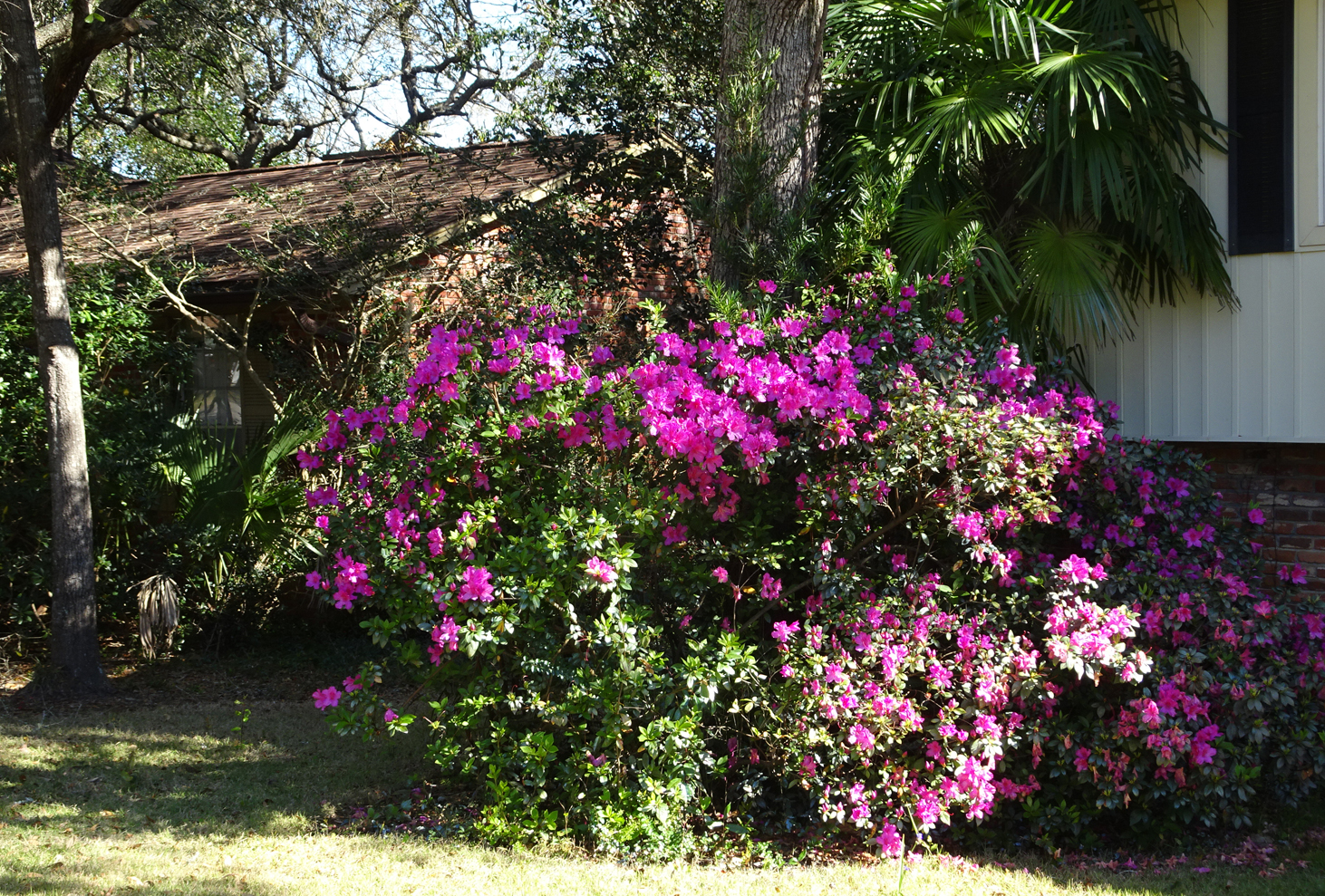
Despite the February date, azaleas are in full bloom around here - about 3 weeks earlier than normal.  It always amuses and entertains me to imagine how azaleas mirror the personalities of their owners.  This big, beautiful plant feels like a woman with her hair down, relaxing in the sunlight.

Across the street, however, an azalea hedge separating two houses has a much more "buttoned up" appearance, sacrificing blooms and density for formality and "neatness".

As I pondered the character-predicting capabilities of azalea shrubs, I heard a large bird calling loudly up above me in the tree canopy.  Frustrated by my rude intrusion as I stood stock still on the sidewalk just below her perch, a red-shouldered hawk squawked at me from a tall pine for several minutes before finally flying off, unwilling to tolerate my presence any longer.  As she flew, I mentally thanked her for allowing me to capture her picture, despite her irritation.
Continuing down the sidewalk, I couldn't pass up a picture of this evocative rope swing, taking advantage of a meandering sand live oak branch in someone's front yard.  I just wish there had been several small kids playing on it while I passed by!

Not too far away, another large oak was in obvious decline, being strangled by a rapacious English ivy vine scrambling up its trunk to compete for the light above, while its roots competed for water and nutrients below.

Even as I was aiming the camera, trying to get a good angle on the ivy vine and oak tree, I registered calls from the red-shouldered hawk again.  Looking up, over a house roof and into a back yard, I saw a huge nest with its raucous owner standing guard nearby.

I had known there was a pair of red-shouldered hawks nesting in the area, as I'd seen some of their mating displays from our backyard, but now I know where their nest is!  Even a short walk can uncover some pretty amazing discoveries.

"Hawk Street" ends in a cul-de-sac that borders the local golf course.  I couldn't resist a quick photo of these blooming azalea bushes along the golf course fence, framed by oak trunks and overhung with Spanish moss.

Continuing around the cul-de-sac had me heading back towards home.  As I walked past a quite neglected (but obviously once loved) front yard, I noticed this little concrete cherub.  Nestled down in a mix of variegated English ivy and fern fronds, he was a warm love note amidst the ragged remnants of the overgrown landscape.
As a contrast to the earlier "interior landscape" of the sand live oak tree, I snapped a quick picture looking up into a fairly young southern magnolia.  They are both native trees, but there is such a different quality of light, color and texture in their forms!

Hearing a variety of different bird calls, loudly rattled off in sequence, I wasn't too surprised when this mockingbird flew over to a hedge, then up onto the electric wires.  It was so nice of him to pose for me!

Across the street from the mockingbird, more "buttoned down" neighbors are obviously careful to keep their azaleas from looking too wild and crazy.  These shrubs are probably younger than the earlier hedge, in a sunnier location, and pruned more frequently, so there were more blooms and a thicker appearance overall.  Still, I prefer my azaleas to be free.

Rounding another corner, I was looking at a highly squared off azalea when I noticed the trunk of the southern magnolia shading it.  What causes this braided appearance?  Pruning up of the branches earlier in its life?

Speaking of pruning, why was it necessary to pollard this poor tree, looking like hell in the hell strip?  I didn't recognize the species from just the truncated remains of the branches and the bark alone, so I'll have to keep an eye on it and see what the leaves look like when the poor thing finally manages to push out a few.

As an aside, though, the bark on the trunk had obviously been a favorite place for yellow-bellied sapsuckers to feed over the years, bearing a textural pattern of holes that could almost be used to create a modern art piece.

Now I was completing my small neighborhood loop, looking at the streetscape, ornamented by sand live oak trees, with the light behind me.   Aren't these trees wonderful?  It was the presence of these trees that attracted our daughter to this neighborhood, 5 or 6 years ago.  (Then 2 years ago, she and her husband and our grandbabies attracted us to the same neighborhood!)

In the foreground of the photo above, you can see the soccer plinth and a stump in front of it.  That stump is the remnant of a large popcorn tree, an invasive species (in the Euphorbia family!) that was, thankfully, cut down a year ago.  The stump is beginning to sport an accent of frilly fungus as it starts to decompose, but it was the deep blue of the spiderwort blooms that caught my eye.  I'm a real sucker for blues of this hue.

As I approached the end of my walk, I couldn't resist capturing this quintessentially southern scene, again from the garden across the street from us.  Oak trees provide structure, high shade, and a catch-hold for graceful Spanish moss.  Underneath those picturesque giants, tall, dark green camellias and lower, rounded azaleas bloom brightly, skirted by fallen camellia petals and ferns.  Can't you just hear the whispered southern accents and the clinking of ice in tall drink glasses?

Thank you for coming on my winter walkout with me.  It's been fun to share my regular haunts with you - and I've loved seeing where everyone else is doing their winter walkouts, too.

As I finish, though, I have to wonder what it would be like for different people to walk the same route and share what caught their attention.  Wouldn't that be a fun way to compare and contrast how each of us sees the world differently?!  Another project for another time, I guess.  I hope you're enjoying the world around you, whatever season your weather is bringing these days, wherever you're planted.

Tuesday, September 20, 2016

A Trickle of Native Insects Begins to Appear....

FINALLY!  We've lived here for about 16 months now and at last I am beginning to see a greater variety of  insects attracted to and living in our yard.  It's so exciting to go outside and see native pollinators nectaring at the few little blooms we have scattered around, or predatory insects patrolling the foliage and flowers.  It sure goes to show that changes don't have to be big or dramatic to have an impact.  Every little bit counts.

So here are some of my recent finds....


Gulf fritillaries (Agraulis vanillae) are gorgeous butterflies, with silver patterns on the undersides of their wings and an almost fluorescent orange coloration on the top side.  The fresh individual in the top photo was nectaring at garden phlox (Phlox paniculata), while the tattered one in the lower photo is nectarying at Flyr's Nemesis (Brickellia cordifolia), a rare wildflower in Florida that has recently become available at some native plant nurseries, including 7 Pines Native Plant Nursery in DeFuniak Springs.


Out and about, I'm seeing more gulf fritillaries flying everywhere these days, presumably due to the time of year.  However, I'm starting to count on seeing them regularly in our yard since we finally have some caterpillars eating the maypop vines (Passiflora incarnata) that we planted on the lower terraces last spring.  Just as monarch caterpillars only eat milkweeds, plants in the genus Asclepias, so gulf fritillary caterpillars only eat maypops and passionflowers, plants in the genus Passiflora.

Predators are pretty rare in the yard still.  It took me around 5 years to start noticing them regularly in my Kansas gardens, so I'm trusting that they'll increase in number as I garden naturally here.

With a lake right out the back door, however, we do have several dragonfly and damselfly species.  One of the species I've just started to see is the eastern amberwing (Perithemis tenera).  A male and a female have staked out the small patch of powderpuff (Mimosa strigillosa) in the front yard and I can count on finding them there essentially every day.


Although this species is quite small for a dragonfly, the male eastern amberwing, shown above, is easy to spot since he's dramatically colored, with shining amber-colored wings and a darker amber body.  Up close, the camera captures yellow markings on the thorax and abdomen that the eye generally misses.  The female, however, is much different....

...and much drabber.  Her darkly blotched wings and more sober colors don't attract the eye as her mate's colors do, but that's probably the point.  She, too, has yellow markings on her thorax and abdomen. 

These small dragonflies are said to eat "tiny, flying insects", which I interpret to mean mosquitoes.  Hopefully my male and female eastern amberwings will produce lots and lots of baby eastern amberwings to patrol my yard even more thoroughly!

Another colorful species that I've observed, photographed, and been able to identify is the metallic green bee, Agapostemon splendens.  I've always loved the metallic green bees, especially the ones that are entirely green, because of their vibrant coloring.

Shown above, the females of Agapostemon splendens are especially beautiful to my eye and earn their "splendid" moniker based on the beautiful shadings of blue and green on their abdomen.  Note:  I have no real idea why this species was labeled the splendid green metallic bee, but I think the abdomenal color IS splendid.

Here's another, closer look at that gorgeous color.  Look, too, at the pollen load that this little bee is carrying - the pollen from this species of flower is white, not yellow, and that's a LOT of pollen clustered on her hind legs!  She still has to finish her load and, most importantly, fly back to her nest with her carefully gathered provisions.  Like many other native bees, the Agapostemon bees nest in the ground, usually in a tunnel dug by the female.  After digging the tunnel, the female gathers together a ball of pollen and nectar, lays an egg on it, seals off the cell, and repeats the process several times.

Interestingly, like the eastern amberwing dragonfly above, Agapostemon splendens is another dimorphic insect species, with the male looking significantly different from the female.  The photo above is a male of the same species.  While the thorax is similar to the female's, the abdomen is completely different - males sporting a natty black and yellow stripe pattern that is vibrant, but not as pleasing to my eye.  This little guy was fun to watch.  He seemed to perform head stands as he fed, diving deeply into the flower to get his prize.

Unlike the colorful green metallic bees, the next bees I want to share with you are somber black with a few white markings.

Another native bee, this is a carpenter-mimic cuckoo-leaf-cutter (Coelioxys dolichos) - a name that seems more interesting than the bee looks, at least on first appraisal.  That's the bloom of a wild lettuce (Lactuca sp.) that she's feeding on.

What drew my attention to this bee was the pointed abdomen, which is very distinctive.  Cuckoo bees are parasites on other bees.  The females of this genus of cuckoo bee, Coelioxys, use that sharp abdomen to break into the nests of their host species and lay eggs on the pollen and nectar stored there for the host's eggs.  Because female cuckoo bees don't have to provision their own nests, they don't have pollen baskets and they aren't seen carrying pollen;  they do, however, still have to feed themselves.

This particular species, the carpenter-mimic cuckoo-leaf-cutter, is a parasite on a single bee species called the carpenter-mimic leaf-cutter bee (Megachile xylocopoides). Ironically, when I went to look up M. xylocopoides, I recognized the pictures as showing the same species as another, unidentified bee species in my recent photos!  I even took the photos of the two different species within a few feet of each other, just 1 day apart!

Here is the male carpenter-mimic leaf-cutter bee (Megachile xylocopoides), also feeding on wild lettuce blooms.  Did the two bees, the predator and the prey, hatch out of the same nest?  There's probably a good chance of it.  At the very least, it would appear that the nests were nearby.

There are many more sightings I'd love to share, but this post is long enough for now.  Hope you're seeing lots of interesting insects in your gardens, too!

Wednesday, May 04, 2016

Continuing to Learn the Local Natives

When you watch a garden, day by day, it can seem like little changes in it, but if you go away for a week or two, when you come back, it's obvious how big the changes are.

The same phenomenon occurs when you walk a wild area regularly.  Greg and I went for a walk on Eglin AFB this morning, following the same trail that Anna and I took almost 2 weeks ago.  We had both dogs with us and only limited time available, so Greg and I didn't walk as far as Anna and I had, but we still got to see quite a few of the same plants, as well as a couple new bloomers.

Some plants are harder than others to identify, even when they are in full bloom. This little cutie caught my eye 2 weeks ago and it was even prettier today, but I still have no idea what it is.  It's about 6-8" tall, found in a sandhill/mixed pine and oak forest along a roughly maintained road.

The big, smooth stem in the foreground of this photo is probably a VERY healthy Smilax shoot;  it's about 1/2" in diameter, to give you a sense of scale.  Whatever it was, it hadn't leafed out yet. Here are some of the blooms from my mystery plant...

...and a closeup of one of the bloom spikes. 

If anyone can help me with the identification, I would be extremely grateful.  I doubt this plant is in the hort trade, as it is much too small to have any sort of visual impact in the landscape, but its daintiness and bright, cheery color appeal to me.

Not too far down the trail from my mysterious, little, pink charmer, we came across this healthy looking Gopherweed, Baptisia lanceolata.

Gopherweed is a horrible name for an attractive perennial, and I can find nothing about the genesis of or the rationale for the name to justify its use. Surely this pleasant plant, especially with its importance to native bees, deserves a pleasanter name!

Anyway, while the flowers aren't particularly showy, the foliage is pretty and the plant shape is nice. Like all Baptisias, Gopherweed is a nitrogen fixer for the soil, so it can be a good plant to have in the garden, especially here in sandy soil country.

Next on our wildflower discovery tour was a repeat specimen from my last visit, a pinewoods milkweed, Asclepias humistrata.  This individual was one of the only pinewoods milkweeds with fully open blooms 2 weeks ago - now it is developing a couple seed pods, but the blooms appear to be almost done.

It will be interesting to see if this plant reblooms, or if a single bloom is all that occurs, since seed will apparently develop.

Beyond the milkweed was a small, but extremely attractive, bloomer who was almost hidden behind a small, fallen branch and some other foliage.

I knew from the shape of the blooms and from the compound leaves that this plant was in the pea/bean family, but I had to come home and look it up to determine its identity.  Even after looking it up, I'm not sure what to call it.  The scientific name is Tephrosia virginica.  That's pretty straightforward.  However, there are multiple common names.  The USDA Plant Database calls it Virginia Tephrosia, so I assume that's its official common name.  It was, however, most commonly referred to as Goat's Rue.  Other common names are Devil's Shoestrings (apparently referring to its long, tough, stringy roots), Catgut, Rabbit Pea, Hoary Pea, Wild Sweetpea, and North American Turkey Pea.  That's EIGHT different common names.  Thank goodness for scientific nomenclature!

I found several other specimens of Goat's Rue further along the trail, including a couple that seemed to be small colonies, but this little individual, nestled by the reindeer moss, was my favorite.

Goat's Rue has a fairly wide range, including most of the eastern U.S., and it appears to have been a well known medicinal plant to Native Americans.  Multiple sources mentioned that its roots contain rotenone, a chemical that has been used as an organic insecticide and as a fish poison.  Probably not a plant to think about munching on.

Providing a sudden change from the spring-like colors of pink, white and yellow that I'd been seeing so far along the trail, the bright scarlet blooms of Red Basil (Calamintha coccinea) actually surprised me.

I thought this plant was primarily a fall bloomer...but apparently it will bloom at least sporadically throughout the growing season.  It's another plant I'm hoping to find a source for and then add to our yardscape - low-growing, gorgeous flowers, evergreen foliage.  The foliage is very fine textured and rather sparse, but I still think the plant is quite attractive, and in full bloom it is quite stunning.

With our truncated walk, we didn't see much wildlife:  tracks of deer, boar, and raccoon, a male towhee, and the lacy spider web....

...of a funnel spider.  The spider, as is normal for funnel spiders, kept herself hidden deep in her funnel, but the web was beautiful - a true, lacy, fairy's handkerchief. 


Wednesday, April 20, 2016

Learning the Local Native Plants

Ashamedly, I have to admit that it took me living here for over 10 months to get off my duff and go back out to the nearby wild area for a walk-about to look for native plants.  Even then, my friend Anna had to initiate the outing.  I can't believe I waited this long - and I'm kicking myself about all the interesting sights I have been missing.

On Monday morning, Anna and I sallied forth to the same road/trail that my family and I visited 18 months ago.  I blogged about our finds in "We're Not in Kansas Any More!" as well as two subsequent posts about specific plants.  Walking on Monday, I actually recognized the American holly tree that I talked about in that original post, but otherwise my attention was generally drawn to very different plants this time.

We were scouting for lupine, which Anna had seen along this sand road just a week or two earlier.  Unfortunately, in the intervening time, some "maintenance" had been done on the trail by a bulldozer, carelessly and messily widening it, and we found no trace of the lupine.  We did, however, discover some other treasures.

One of the first plants we noticed was Pinewoods Milkweed, Asclepias humistrata.

This plant is also known by the common names of sandhill milkweed, for its preferred habitat, and pink-veined milkweed or purple milkweed for rather obvious reasons.  This is a plant that I would love to grow in my yard, as I find the leaves gorgeous just by themselves. 

Add in the attractive pinkish flowers and its function as food for monarch caterpillars and this plant becomes almost irresistible.

Another attractive plant that we noticed was this little white-flowered beauty with its beautifully shaped, dark green leaves.

As I researched to figure out what we were seeing, I was very glad that we didn't try to pick any of the flowers we saw, just to save us from picking this one.  This plant is called Tread-Softly, Cnidoscolus stimulosus, and all of the green, above-ground parts of the plant are covered with stinging hairs.  While this isn't not a true nettle, it is sometimes called bull nettle or spurge nettle.  Another name for it is finger rot, which makes my imagination run wild in all sorts of nasty ways.  Needless to say, this is NOT a plant that I plan on trying to import into our yard!   Ironically, at least one source said that the tuberous roots are edible...but getting to those roots might take some serious caution.

Silphium is a genus that I became somewhat familiar with on the prairie, where one of its most famous members is Compass Plant, Silphium laciniatum.  As soon as I saw the leaves of this basal rosette, my mind yelled, "Silphium!", and I think that instinctive reaction is probably correct.

While I won't know for sure until later in the year when I see it bloom, I think this beautiful little clump of big, bright green leaves belongs to Kidneyleaf Rosinweed, Silphium compositum.   I'm not sure you could dream up a much uglier name for a plant.  Despite its ugly name, I hope to find a source for this species, since I think the leaves would look really nice in a native flower bed, adding some dramatic size and visual texture to the overall mix.

There were two flowers that we found that I haven't been able to identify yet.  First was this pinky-purple little beauty.

That's reindeer moss nestled beside it, to give you a sense of scale.  We saw several of these plants blooming and they were all less than 12" tall.

Second was this yellow-green, almost abstract bloomer that I suspect is in the Euphorbiaceae family. We saw several;  they seemed to run about 15-18" tall.

If anyone knows the identity of either of these plants, I would love to know what they are.

Another plant we noticed was this silvery, quiet-looking plant.

A little research gave me the identity, Healing Croton, Croton argyranthemus

What I haven't been able to determine is why it's been given the common name of Healing Croton.  It is the larval food for a pretty little butterfly known as a goatweed leafwing.   I haven't seen a goatweed leafwing since moving here to Florida, although they do occur here, but here are photos of one in Kansas, taken in September 2013.

Speaking of butterflies, at one point we found this large chrysalis hanging from a bare branch.  I don't know enough about such things to begin to guess what species made this chrysalis, but I think it's cool.

Another insect sighting was this black and white wasp, working busily to deal with a caterpillar, presumably extracted from this stitched together clump of leaves.

At the time, I was concerned that it might be a bald-faced hornet, so I didn't get too close. 

When I got home and downloaded the photos, I realized that this little beauty is actually a potter or mason wasp, a solitary wasp, presumably collecting caterpillars to paralyze and store for its young to eat as it grows.

Reindeer moss, sparkleberry, blooming yaupon, black cherry, beach rosemary.....  We saw a lot of other things that entranced us.  I'll leave you with a photo of the sky through the pine trees - a slice of heaven.