Showing posts with label Thoughts and Ideas. Show all posts

Sunday, October 28, 2018

Book Time: CLIMATE-WISE LANDSCAPING

After reading this review, you can heave a big sigh of relief -I will have caught up with all my gardening related book reviews!

Having just finished Climate-Wise Landscaping, I feel very au courant in writing this review!

I'm not sure what I was expecting, but somehow this book seemed different from what the title suggested it was going to be - different in a good way, more important, filling a gap that's been existing in gardening literature.

Climate-Wise Landscaping:  Practical Actions for a Sustainable Future, by Sue Reed and Ginny Stibolt, New Society Publishers, British Columbia, Canada, 2018, is a perfect guide for people who are worried about our planet's future and are looking for something that they, personally, can do to help lessen climate change and to make our ecosystems healthier.

Every single piece of land can help heal our planet.

There are ten sections in this book, each section dealing with an area of the landscape around a typical home, wherever it is located, starting with the lawn.  Why do Reed and Stibolt begin with the lawn?  As they put it, "...[C]hanging the way we think about and deal with our lawns might be the easiest and most significant step we can take to help the planet."  How much lawn do you think there is in the continental U.S.?  According to the International Society for Photogrammetry and Remote Sensing, as quoted in this book, there is about 63,000 square miles of lawn, an area approximately the size of the state of West Virginia.  That's a lot of lawn - and most of it gets mowed weekly, inundated with fertilizers and pesticides, and irrigated.  Despite all those inputs, lawn produces no food, for people or even for wildlife.  It's essentially a sterile wasteland.

Reed and Stibolt go on to cover many other ways we can help the climate by changing the way we use our landscape.  For example, planting trees sequesters a lot of carbon, as does, surprisingly to me, increasing the health of soils and decreasing the disturbance to them.  Did you know that soils sequester more than 4 times the amount of carbon as forests?  I didn't.  Apparently they are the second largest carbon dioxide absorbing system on our planet, after oceans.  I also didn't know that every time you disturb the soil - through digging, for example - you release carbon dioxide.  So switching from planting annuals, which have to be replanted regularly, to planting perennials actually helps the planet by sequestering carbon!

I'm all for minimizing digging, so that's what I call a win-win.

There's a section on how good planning and design of a landscape can help decrease energy use (and thus carbon dioxide emissions), as well as a section specifically devoted to urban issues.  Each section contains an introductory explanation, followed by a series of "Action Topics", specific ways you can make your landscape work to help stabilize Earth's climate and often to help yourself and other living things at the same time.

Last, but hardly least, the final section covers materials that are commonly used in landscaping and evaluates their carbon footprint, helping us choose rationally among such options as concrete, brick, stone, even asphalt.  This is the first time I've ever seen a carbon analysis of landscaping materials and I really appreciate finding it included in this book.

This is an excellent resource to start with if you're interested in personally doing something specific to help the future of our species and of our planet.  It's a broad overview of the topics covered;  for specific details, you will probably want to explore the areas that interest you further, with further reading or study.  Most of all, Climate-Wise Landscaping examines a broad array of possibilities - and possibilities are a great starting point for building a better future. 

Thursday, June 07, 2018

The Icon Tree

Have you ever read Stanley Kunitz's The Wild Braid?  If you haven't, you should.  It's a marvelous meditation on the intersection between gardening and poetry, one of those books I like to pull out and dip into every so often.  Each time I reread it, I find something new that stands out.

Several months ago, looking (I think) for references to winter solstice, I pulled The Wild Braid back off my shelf and revisited it.  While I didn't find anything that spoke to me about winter solstice, I did find a passage about an old tree in his Provincetown garden that resonated, so I marked the passage to blog about.  As I've thought back to that passage over the intervening time, I've remembered his old tree as an aging eyesore that became an "icon tree" in his garden.

Speaking of aging eyesores, smack dab in the center of our view of the lake, there's a dying laurel oak down by our dock. 

As I went about daily life this winter and spring, occasionally I'd think about the blog post waiting to be written.  Somehow our gaunt and decrepit laurel oak merged in my mind with that dying cherry, tended by Kunitz in his long ago Provincetown garden.  I came to think of this laurel oak as our garden's "icon tree".

Well, 6 months later I'm finally getting around to writing that blog post.  I pulled The Wild Braid out of the stack of books by the recliner to refresh my memory by rereading the passage before beginning.  Scanning the passages I'd marked, I could find no reference to an "icon tree".

Puzzled, I went back and looked harder.  I'd marked a section about a tree that Kunitz called the lamentation tree (p. 58-61).  Could that be the tree I was remembering as the "icon tree"?  As I reread the section closely, I decided that it was.  Funny how our minds play tricks on us!

"When we first moved in, there was a wild cherry tree, rather nondescript, growing there in a bed of ivy by the cellar door in front of the house.  It was the only tree in the garden areas, and, like most wild cherry trees, it was infested with gypsy moths and all sorts of destructive creatures.   ...[T]he tree showed no signs of recovering....  ...[T]he roots were being devoured by root borers...and meanwhile the wild ivy kept growing.  ...[S]oon the ivy covered the whole tree and began dangling from it.  In time the tree assumed the character of a woman locked in mourning."

Kunitz goes on to recall Martha Graham and a famous dance she performed called "Lamentation," where the postures of the body contracted and bent to visually personify grief.  "Gradually my ivy-burdened cherry tree seemed to take on the exact same posture.  It was so bent over with the weight of its grief that it no longer reached toward the sky but toward the earth, and so I named it "The Lamentation Tree."

After several years, the tree eventually succumbed to the weight of the ivy combined with the force of storm winds.  Kunitz wrote, "The lamentation tree was the most conspicuous eccentricity in the garden during those early years.  I've always regarded it as an allegory of the capacity for change in nature.  That tree changed its character and took on a life of its own, transforming from a wild diseased cherry tree into something else, no longer a tree really, but something emblematic, mythological.

"Part of the fascination of gardening is that it is, on the one hand, a practical exercise of the human body and, on the other, a direct participation in the ritual of birth and life and death."

The ritual of birth and life and death.....  Something emblematic, mythological....  An eccentricity.

While I'm not trying to be sacrilegious, there's something in the shape of my gaunt laurel oak that reminds me of a cross...or a scarecrow...or the burning man.

In April of 2015, before we even bought our house, this was the icon tree.

About a year later, the top 4-5' or so broke off.


I kept the broken wood and have it nestled in a bed just a few feet  away from the base of the tree.


There are holes in the remaining snag at the top, one of which I think woodpeckers used to nest in last summer.

There's no ivy climbing up my icon tree, only a little bit of Spanish moss draping from the few remaining branches.  The shape is not bent, but starkly upright, courageously tall despite the continual erosion of its body parts.
  
We moved here to celebrate new life - the birth of our first grandchild - and have since also welcomed his brother into our lives.  Birth and new life, while this stark tree reminds us of death.

While our icon tree can't actually talk, we've (coincidentally) mounted a sonorous wind chime on it which only sounds in relatively strong breezes, accompanied by clanks of its clapper chain that call to mind Ebenezer Scrooge's chains.  Describing it makes it sound lugubrious, but listening to it is peaceful and reassuring.

Obviously, I've never known this tree as anything but half dead.  Truthfully I find it amazing that the tree has survived at all:  about 10 years ago, when the seawall and deck were put in along the back of our property, almost half of this poor plant's root system was stripped away when the hill it grew on was sheared off.  Then, adding insult to injury, bringing the water line from the house to the deck required trenching through another quarter of its roots down to at least 2'.  So our icon tree has lost at least 60-75% of its root system.  Any wonder that it's not looking too healthy these days?

Recently I noticed that there seem to be streaks on the lower bark that look discolored.  A fungal disease attacking?  How much longer can this survivor hang on?

Tragically, no matter how much care it receives one way or another, this tree will never again be totally healthy...which makes me think about humans whose support systems are removed from them.  How can they be expected to fulfill their potential - ever - if they've been dealt devastating blows or been denied significant support, removing their very roots and the (human psychological) nutrients those roots provide in their lives?

However compromised this tree is, though, it still hangs tenaciously on to its spot on the side of our hill - and it still provides shelter for other forms of life, like the woodpeckers who have used its dead wood to bring new life of their own into the world.  I've known quite a few humans like that, too, and my hat is off to them as they take circumstances that would cripple others and continue to make the world a better place through their presence and their lives.  I hope I, too, can take heart and learn life lessons from this gaunt old individual, enduring through adversity. 


Thursday, July 24, 2014

What's the Point of Gardening? A Gardening Ethic for Our Times

Why do you garden?

If you're like me at all (and I suspect that many gardeners are), you probably have several reasons you garden - several passions that gardening feeds - several functions that gardening performs in your life....

I garden because it makes me feel good to see flowers blooming around my home.

I garden because it's a form of exercise that I enjoy and it gets me outside, in the fresh air.

I garden to increase our property value (I hope).

I garden to provide some good, chemical free food for us to enjoy.

I garden because plants and animals fascinate me in their infinite variety.

Most of all, though, I garden because it's my way of doing something very concrete, very local, and very specific to make the world healthier and more ALIVE.  I garden, and I garden the way I do, because it's my way of helping to heal the life force on our planet, which seems to be in serious danger from the increasing human assaults on it over the last 100 years or so.

"Okay, Cynth, " I can almost hear you sigh.  "What brought this up?  Can't we just look at pretty pictures and move on?"

Well, of course you can.  But I read something the other day that really got me thinking about my role as a gardener.  Ben Vogt of Nebraska, who blogs at The Deep Middle, posted a commentary that struck a deep chord with me:  "Is There Any Difference Between a Land Ethic and a Garden Ethic?"
Hmmm.  Is there?  Why DO I garden?  Why do most people garden?

Ben started his thought-provoking post by quoting bits and pieces from Aldo Leopold's wonderful statement about developing a land ethic, as written in A Sand County Almanac.  Leopold finished writing this small, but important, three part book in 1948, just before he died.  The book was published a year later.  I think the most concise statement of Leopold's land ethic is actually written in Leopold's own forward to this book, "We abuse land because we regard it as a commodity belonging to us.  When we see land as a community to which we belong, we may begin to use it with love and respect."  (My italics)

Filling the last 25 pages of A Sand County Almanac, the entirety of Leopold's "The Land Ethic" is certainly too long for me to quote here, but it's well worth reading...and rereading.  In it, he moves from showing how we humans have developed our ethical codes, first working on the relationships between individual humans and later developing codes such as the Golden Rule and democracy for how the individual relates to society as a whole and how society relates back to the individual.  Now, Leopold believed, it had become necessary to develop another layer to our ethical codes to govern how humans related to the land and to the plants and animals that shared it with them.  Otherwise, in Leopold's words, "There is no other way for land to survive the impact of mechanized man...."

Aldo Leopold wrote in 1948 and presumably developed his ideas even earlier.  What would he say about the way we treat the land, and the plants and animals on it, now?  I'm rather glad he's not around to see what we've done and, even worse, what we're in the process of doing.

Because I am around to see what we've done and what we're currently doing, I try to treat our little 10 acres according to Leopold's Land Ethic, adopting this ethical code, to the best of my ability, as my gardening ethic.  I try to treat our land, with its associated plants and animals, with love and respect, thinking of it as a community that I belong to rather than as a resource to maximize.  Realizing that communities - like most complex things - are healthier when they have all of the parts that they should have, I am trying to reintroduce plants that have disappeared over the last 150 years while this parcel of land was being extensively and intensively farmed.  I'm hoping that, as the plants reestablish, many of the smaller animals will find their way back too.

My goal is to have as stable, as healthily functioning, a prairie community on our 10 acres as I possibly can.  Someday, perhaps, the plants and animals that remain on this tiny piece of land will serve as a source to move back out into the wider landscape as a whole, helping to heal it as well.

Towards the end of "The Land Ethic," Leopold talked about a schism among folks who work with and on the land - he called it a cleavage - that divided people into 2 camps which deeply affected their relationship to the land they worked with:

In all of these cleavages, we see repeated the same basic paradoxes:  man the conqueror versus man the biotic citizen;  science the sharpener of his sword versus science the searchlight on his universe; land the slave and servant versus land the collective organism.  Robinson's injunction to Tristram may well be applied, at this juncture, to Homo sapiens as a species in gelogical time:
Whether you will or not
You are a King, Tristram, for you are one
Of the time-tested few that leave the world,
When they are gone, not the same place it was.
Mark what you leave.

As a gardener, which cleavage do you belong to:  the conqueror or the citizen?  Is your garden your slave and servant or a community that you belong to?  When you are gone from your garden, what will you leave for the future?  What mark will you have made?


Thursday, April 03, 2014

Thoughts Provoked By Trash

As I walked down the driveway last week, I saw some trash caught along the fenceline.  It irritated me a bit, but it's a part of modern life.  I picked it up, stuck it in my pocket, and headed back inside.

When I fished the trash out to throw it away, though, something made me look at it a little more closely - and for a brief moment I got really mad.  Seriously - have we become so crunched for time (or simply lazy) and so consumerized that it is necessary to buy peanut butter and jelly sandwiches premade and pre-packaged???  Peanut butter and jelly sandwiches?  Really?

This rates right up there with buying tap water by the (plastic) bottle, for over $1 each.  Come on, folks, just turn the tap on and fill a bottle up for free!  Save the plastic.  Save money.  Avoid some extra chemicals leaching into your water from the plastic.  Then slap some peanut butter and jelly on 2 slices of bread.  Cut the crust off if you've encouraged your kids to be picky about such things.  I haven't priced it all out, but I can almost guarantee making the sandwiches yourself will be cheaper than buying commercial, pre-made pb & j's.

When we've gotten to the point where we're too busy or stretched too thin to get ourselves a glass of water from the faucet or to make our children a peanut butter and jelly sandwich, we're too busy.  Something's got to give.

It takes 2 people to earn a living these days.  If even 2 people can.  Working 40 hours each, 50 hours each, 60 hours each.  Working hard, because we'd never want to be seen as slackers and because we have no choice.  Performing "internships" for free so that we can get experience, then not getting hired because the next unpaid intern is waiting, anxious to work for "experience."  Working 2 jobs at 35 hours each so that the companies don't have to pay benefits - we're "part-timers" working 70 hours each week but not "worth" health insurance or paid time off or sick leave.  When these horrible hours have their inevitable result and our bodies rebel, we become one of the "slackers", too sick to keep working.  If our health insurance comes from our employer, we're really screwed.  Too sick to work, but no health insurance if we're not working...and no work to get money to pay for health insurance.

We're not machines.  Any of us.  We're human beings, with good points and with faults, with weaknesses and with strengths.  Some of us are kind and some of us aren't.  Some of us naturally work harder than others.  Some of us are smarter than others.  Some of us are more social or less social than others.  Caring - or not.  Artistic - or not.  Creative - or not.  Neat - or not.  One way or another, there's much more to human life and human worth than paid labor.  And it's time for us - all of us - to remember that.  We need to be treated as living humans, to treat each other as worthwhile humans, and to treat ourselves with love and compassion.   We need to take our lives and our world back.  One way...or another.

Tuesday, December 24, 2013

The Different Faces of Christmas

We're having a quiet Christmas this year, even quieter than usual.  For the first time since the birth of our elder child over 30 years ago, we won't be celebrating the season with either of our children.  Our daughter is a physician in Florida, on call for the week of Christmas, then going with her boyfriend to his parents' home over New Year's.  Our son has run out of vacation days and is unable to take time off until after the new year.  We were all together over Thanksgiving and had a wonderful time enjoying each others' company, so it's not as much of a hole as it might have been.  In fact, once I got the gifts bought, wrapped, and in the mail, having a quiet Christmas has allowed me to slow down a bit and philosophize.  What in the world is going on with the Christmas holidays these days?

There's so much angst over Christmas right now.  Expectations are sky high.  Time is tight and precious; there never seems to be enough time to get everything done.  Money seems to become scarcer every year.  Commercialism is through the roof and starts before the leaves turn in the fall.  Manipulative calls about a "War on Christmas" turn even a simple greeting of goodwill into a perceived assault against religion.

How can we get some sanity back into the season and into our celebrations of it?  Or has the entire holiday just become an excuse for excess that needs to be excised?

I'm thinking that the answer to that pair of questions is different for different people, depending on their understanding of Christmas...and I've come to recognize that there are many different perceptions and expectations for this major holiday in western culture.

I'm going to ignore some basic (and pretty important) expectations for Christmas, like the perceived need by store owners to make a lot of money during this time of year.  I want to think about and look at the understandings and expectations of the average person at this time of year...in as much as I consider myself to be an "average person," I guess, because mostly I've been thinking about MY personal understandings and expectations for Christmas.

Nowadays, I see 3 different faces of Christmas every year.  The first "face" of Christmas is the religious event that is being marked in Christianity, the birth of Christ.  Without looking it up, I'm assuming that the word, "Christmas", is a shortening of Christ Mass - a mass in celebration of Christ.  "Christ is the reason for the season."  "Let's put Christ back in Christmas."  And so on and so forth.  If a person is a Christian, then I'm all for them celebrating Christmas as a celebration of the birth of Christ.  To me, personally, though, there are further depths and meaning to this holiday.

In thinking about my frustration with the rallying cries about the "War on Christmas", I've realized that I see an important second face to Christmas.  To me, the Christmas holiday has meaning as a time to celebrate our love for our friends and family, to demonstrate to those who are important to us just how much we care about them, to spend our precious time with them.  Valentine's Day is our day to celebrate our pair bond, if we're lucky enough to be part of a pair, but Christmas is broader - a way to celebrate, as families and friends, the important bonds between and among our family members and within our community-of-choice.

Gifts, then, become a physical manifestation of our bonds of affection - a message that we understand and care about what our loved ones need and want, that we want our loved ones to be happy.  Unfortunately, as our time has become ever more taken up with working away from our homes, gifts have become charged with larger and heavier emotional burdens:  "I'm unable to spend as much time with you as I'd like to, because I have to pay the bills, but this wonderful present will show you how well I know you and how much I love you."   Of course, physical presents will never take the place of time spent together, no matter how much money we spend, but still we try. 

One thing we don't have to try to do any more is petition the sun to start shining again.  This is the third face of Christmas that I've become aware of, and it's the oldest face by far.  Christmas comes shortly after the Winter Solstice, the shortest day of the year and the longest night.  The ancients didn't know what caused the sun to start shining less and less each fall, so they were concerned that some day the sun might just disappear, leaving them in permanent darkness.  Each year, as the days got shorter and darker, the ancients would pray to the sun and the earth spirits to bring back the light and the warmth.  Of course, each year after Winter Solstice, the sun would start to shine a little bit more and, in a few months, the warmth would return as well, bringing the bounty of spring and summer with it.  Each year, the petitions were successful!

These days, with our understanding of the tilt of the Earth's axis and its rotation around the sun, even the least scientific among us knows that the sun stays steadfast, that the Earth revolves around the sun.  We know that the sun "will return to us" without fail, no matter what we do or don't do.  We no longer need to petition for the return of the sun's light and the warmth that comes with it.  I think, though, that there are echoes of the old fear of the winter darkness tiptoeing around inside our psyches, despite our modern understanding of how things really work.

So these are the three primary faces of the Christmas season that I see operating these days:  the religious celebration of Christ's birth, the communal celebration of love between family and friends, and the ancient celebration of the return of sunlight.  Celebrating the return of the light is a primal celebration, usually buried deep within us and mostly unconscious.  Bright sparkling lights on our houses, evergreen trees with bright lights and ornaments decorating their boughs, and roaring fires are manifestations of this ancient winter celebration of "Christmas".  The religious celebration of the birth of Jesus is of critical importance for Christians, and its rituals have become an important part of our winter celebrations as well:  the creche, carols about angels, shepherds, wise men and a baby in a manger, services and masses celebrating the birth of the Christ child.

To me personally, though, the deepest and most important reason to celebrate Christmas is the chance to recognize and celebrate the loving bonds that bring and keep us all together.  As winter's cold descends upon us and we find ourselves together in close proximity for days and weeks on end, isn't it the perfect time to let each other know how much we care?  Isn't it the perfect time to say, "I'm choosing to spend my days with you, because you are important to me!"?

Just after Winter Solstice, it becomes obvious that the physical light of the sun is returning to the Northern Hemisphere, day by day.  What a perfect time to celebrate the deep spiritual and social light of our love and caring for each other!

Tuesday, September 03, 2013

(Warning!) Rant: Too Much is Too Much

(Note:  this isn't a gardening post!)

How much is too much?


My mother-in-law passed along several issues of Architectural Digest last week and, for kicks and giggles, I started thumbing through them over the weekend.  One article, in particular, has stuck with me, raising my blood pressure every time I think about it.

A husband owns a business, geological services, in New Orleans.  He wants to move his business (and family) to Houston.  His wife sees a home there, which hasn't been lived in for some time, and tells him that if he'll buy that home, she'll move.

He buys the home.  It's a large mansion on 4 acres, completed originally in the early 1930's.  Of course there are repairs and updates and remodeling to do:  plumbing, wiring, heating, cooling, a new roof, bigger closets, a bigger kitchen, a family room, a conservatory....

Among those more normal things, which any well-to-do family buying an older home would want and expect to do, here is a list of things they've done in the last 14 years that were touted in Architectural Digest:

1.  Reopened a closed quarry to mine limestone, so that they could exactly match the limestone on the outside of their home, during expansions, with the limestone used by the original architect/builder.

2.  Had their decorator go on buying trips to New York, Los Angeles, and Paris, often with them accompanying her.  They have found (and used in their home) a huge chandelier once owned by Napoleon III, 16th century Italian painted ceiling panels, a 17th century Brussels tapestry (in the wine cellar) and a "museum quality" 18th century Italian mirror - among many, many other beautiful pieces of antique and more modern furniture.

3.  Installed an antique chapel - imported from France - adding an 18th century chandelier and 19th century stained glass windows and pews to it.

4.  Imported (from France) the antique cobblestones with which they surfaced the driveway.

Am I jealous?  Believe it or not, no.  As I've gotten older, I've learned that the more I have, the more I have to take care of, in one way or another.  I'm finding that simpler is better, at least for me, personally.

What is infuriating to me is that this is a "relatively ordinary" rich couple who is doing this.  This isn't a mogul whose name is on all our lips.  These aren't the Rockefellers or Carnegies or Hearsts.  These folks aren't someone particularly special or unique right now.  And they can afford to do this (and ARE doing this) in a time when poverty is climbing, jobs are scarce, and the middle class - those poor blokes who just want to be able to own a 1200 square foot house on a 0.1 acre lot somewhere - are being squeezed out of existence.

Is the house gorgeous?  Oh, my, yes.  However, as beautiful as this house is and as special as the activities are that has brought it into this sort of condition - I have a real problem with having an entire class of people who are able to do this in our "egalitarian" country.  Should people be rewarded for hard work and initiative?  Definitely.  But there needs to be a limit to those rewards, a limit that is reached before the level of, literally, living like kings.  I don't think our Founding Fathers were trying to establish an economic aristocracy when they revolted from England.

Thursday, April 11, 2013

Facing Into the Sun

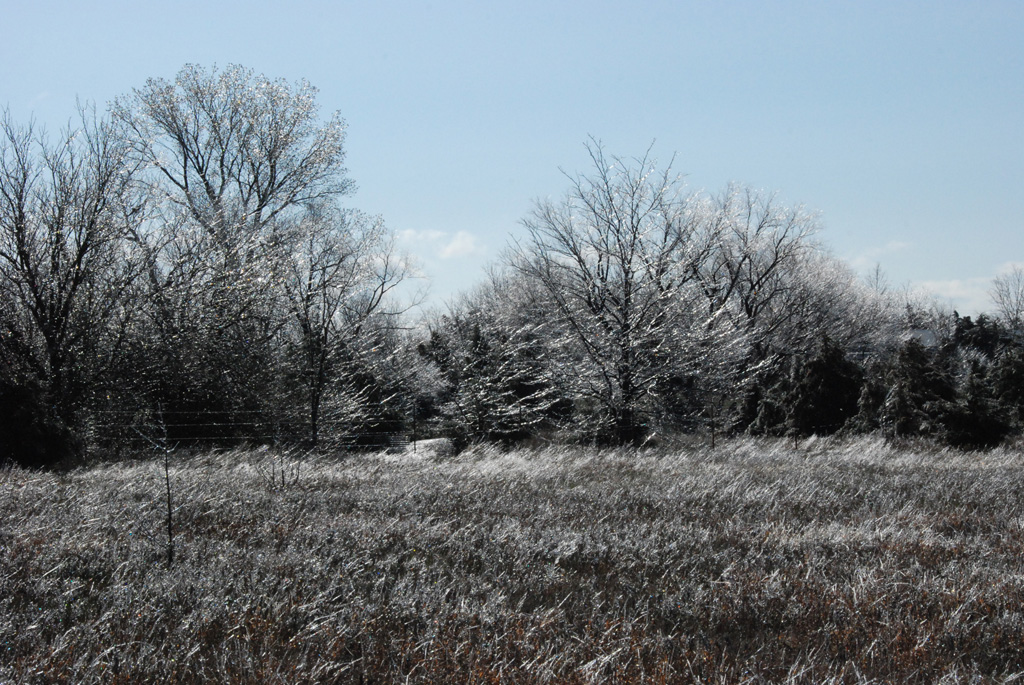
This morning's exercise in photography - trying to capture the beauty of a world encased in ice - provided a philosophical lesson as well as an artistic one:  sometimes the only way to see the real truth of a situation is to look directly into the light.

Looking directly at the light can be painful.  In fact, it can be blinding. Done correctly, though, it can show us exactly what's going on.

Looking away from the light can be misleading, making us miss the reality of a situation.  The above two photos were taken less than a minute apart, simply by changing the direction that I was aiming the camera.  The first picture shows the reality of the ice coating everything.  The second photo looks basically normal - you have to look hard to see any evidence that anything is different from a regular spring day.

Moving from ice storms to a broader view of life, this metaphor works well for a "controversial" issue facing our society today:  climate change.  Truly, there is no scientific controversy concerning this issue.  The scientific community is shining the light of their research and knowledge, showing us the reality of climate change.  However, too many people are turning away from the information the scientists are providing because it hurts - and, truthfully, it's pretty scary too.

Looking away from the sun this morning, I could hardly tell this wasn't a perfect spring morning but, looking towards the light of the day, I could see that there was a hard layer that was affecting everything.

The Union of Concerned Scientists has been addressing the issue of climate change for some time.  Here is an article they shared on Facebook this morning, giving a specific example of how the truth about climate change is being hidden for political reasons:  What South Carolinians Deserve to Know About Climate Change.

The National Center for Science Education is another group that has picked up the job of getting scientific information about climate change into the public arena.  They, too, had a good article that they shared this morning addressing the issue of climate change, A Denver TV Meteorologist...in His Own Words.  This article was actually originally posted by The Yale Forum on Climate Change & The Media.

There are many other groups and individuals trying to share scientific facts, as well as the predictions based upon those facts and upon the best scientific knowledge we currently have about how our Earth's atmosphere works. 

There are also those groups and individuals who are afraid they will lose a great deal of economic and political power if climate change is acknowledged and if, as a country, we start to work to keep the worst of those scientific predictions from occurring.  Because these latter folks currently DO have a great deal of economic and political power - and money - their views are getting much more attention than they should.

Too many people are looking away from the light of knowledge, into the "pretty picture" that distorts the reality of the situation.

On this issue, as on so many other issues, be very careful where you get your "knowledge".  All information is not created equal.  Even if it hurts and is frightening, we all need to look at the world through the best light we have available to us, instead of turning our backs to the truth.

Sunday, February 17, 2013

Water, Stitching the World Together

On one of my regular walkabouts recently, I noticed ice crystals that seemed rather picturesque....

After catching a couple different photos of the crystals, I found myself mulling over the importance of water, stitching our world together. 

Here in south central Kansas, we're well into what appears to be the third year of a serious drought, combined with much higher than "normal" temperature patterns.  Even for a prairie, we're dry.  I sure don't take water for granted like I used to.

Tuesday, November 20, 2012

Patchwork Prairie

Several years ago now, I asked for suggestions on what to name our little piece of property.  I got a few suggestions, but none of them seemed right.  The ideas I was coming up with didn't fit either.  So I let the concept brew for a while longer and eventually a name suggested itself.

Patchwork Prairie.

It's not a fancy name...but, then, this isn't a fancy piece of property.  The name fits on many levels and, most importantly, it comes naturally as I think about our land.  So Patchwork Prairie it is.

So what do I think about our property?  Why does the concept of "patchwork" seems to fit so perfectly?

First of all, prairies themselves are patchworks of many plants:  a clump of this, a spread of that, a few individuals stitching things together throughout, another large swath of something else over here.   Different patches appear during different seasons.  It's a crazy quilt design where some pieces intermingle with others and it all changes from year to year.  To give you examples, right now, on the back 5 acres (Back Five) that we are working to restore from highly overgrazed pasture to reasonable prairie, I have large swaths of tall dropseed (Sporobolus compositus) developing.  I didn't notice any tall dropseed at all in our Back Five until the second year we were here; now it's a major component of our grassland.  In the photo below, the tall dropseed is occurring in the two lighter gold sweeps that run from one side of this photo to the other.


There are almost a dozen patches, ranging from large to small, of dotted gayfeather (Liatris punctata).  The first summer, I noticed fewer than a dozen gayfeathers in one single, small area.  Presumably, all of the current patches have either spread from those original plants or the plants in each of them were simply too stunted to bloom for the first several years.


Heath aster (Symphyotrichum ericoides), the small, white flowers in the photo below, and silver bluestem (Bothriochloa laguroides subsp. torreyana), the grasses with the soft, fluffy seedheads in the same photo, are found throughout the Back Five, stitching all of the recovering prairie together.


An increasing number of compass plants (Silphium laciniatum) are beginning to appear scattered throughout the Back Five, acting as another "stitcher."  I found my first ones about 3 years ago, and have now counted over 2 dozen individuals.  The photo to the left shows one of only 3 compass plants that were mature enough to bloom this year.


Another stitcher, this time one that's declining as the grassland recovers, is the annual threeawn grass (Aristida sp.) that was so prevalent 6 years ago - I can walk the paths and not get a single awn in my socks these days, which is a major change from when we started.  The whitish grass, leaning over the mowed path, is a threeawn plant that I found this morning.


There are large, diffuse patches of white prairieclover (Dalea candida) in the spring


and I've even noticed a few small patches of whorled milkweed (Asclepias verticillata) developing.


On the other hand, another milkweed known as green antelopehorn (Aslcepias viridis) is dispersed everywhere during the spring, but is nowhere to be seen at this time of year.


It's not just the recovering prairie that's a patchwork on our 10 acres.  The entire property is, itself, a patchwork quilt:  the house and lawn (moving towards buffalo grass, Buchloe dactyloides) with flower beds form one major patch with smaller areas forming patterns within it.  Other patches include the courtyard; the vegetable garden; the lagoon area; the Draw; the Cedar Grove; the front tallgrass areas; and the Back Five, the recovering pasture/prairie. Within each of these patches are smaller patterns:  aromatic aster (Symphyotrichum oblongifolium) in the flower beds, rows of eastern redcedars (Juniperus virginiana) forming hedges at the edges, different vegetables in each of the raised vegetable garden beds, a large area of prairie wild rose (Rosa arkansana) in the Cedar Grove, panicled aster (Symphyotrichum lanceolatum) in the draw, pokeberry (Phytolacca americana) along the edges of the draw and up near the house.  Paths stitch the patchwork areas together.


Finally, patchwork is a perfect historical term for modern human life on the prairies too.  European and other settlers had a tradition of using even small scraps of cloth from wornout clothing or from other leftover material.  The women would gather these scraps and sew them together to make warm, artistically beautiful and intricate quilts:  patchwork quilts.  The settlements themselves formed a patchwork on the prairie of different cultures from around the world.  And, of course, the farms soon created patches in the landscape - eventually forming a quilt that almost completely replaced the original prairie with agricultural fields.

Patchwork Prairie.  It's the right name for now, and we'll be working to increase the richness of our crazy quilt of a property for as long as we are its stewards.  The pattern is set.  Our success will be measured in the future.

Like Leaves on The Grass....


One of the things I enjoy most about being outside, walking or gardening, is how my mind is free to spin and make connections.  This morning I had one of those "Aha!" moments.


What if human lives are like leaves on a tree?  Each leaf is born, new and fresh and perfect.


Over time, the leaves grow to maturity, making food for the tree as they convert sunlight to the sugars that the tree needs to grow.


Along the way, the leaves experience problems.  Drought shrivels them a bit around the edges.  Insects gnaw holes in their pristine surfaces.  Diseases may kill off part of a leaf - or may even kill off entire groups of leaves.  Stormy winds pull some leaves off before their time.  Hail shreds other leaves, especially those on the outer and upper levels of the tree's canopy.


Eventually most of the leaves are simply worn out.  It's the end of their life span.  The tree withdraws the life force from within them, they turn colors,...


...and they drop from where they've lived high up in the air, down onto the ground.


There they will join with a myriad of other dead leaves...


...and slowly decompose, turning into fertile soil that enriches the ground where the tree, of which they were once a living part, grows stronger each year.


No two leaves are ever exactly the same, yet all of them are more alike than different.  All the leaves on a single tree are part of the same living organism, even though they each seem separate from each other.  No leaf can - or should - live forever, yet the life of the tree goes on for a long time...and the life of the forest of trees goes on even longer.


This analogy soothes me.  It gives me a concrete understanding on which to pin philosophical concepts such as "we are all one" and "there is life after death," as well as biological concepts such as aging and the inevitability of death.  To every thing, there is a season....

Sunday, October 21, 2012

Samsara, A Visual Feast

Following the trail that serendipity was showing me, I convinced Greg to go with me to see the new movie, Samsara, on Friday night.  The day before, I'd come across an article about its making in a magazine.  Earlier that day, several friends had waxed enthusiastically about it on Facebook.  Realizing that Samsara was actually showing in Wichita seemed like a sign.  If nothing else, I wanted to support Warren Theaters for screening something beyond the latest low-level comedy or gore-filled thriller.

The movie fascinated me.  However, Greg fell asleep several times in the first 20 minutes and then, apparently, had to force himself to stay awake for the rest of it.  Perhaps not a movie to see after a long day at work....

Samsara took 5 years to film and was filmed in something like 25 countries.  There are no actors, per se, and there is no talking - just music and video sequences.  The trailer gives a good feel for how the movie feels overall.


There is no labeling, so you have no idea where each sequence is from, unless you happen to recognize it from your internal store of world knowledge.

I am aching to have someone to discuss some of the scenes from the movie with, as well as to help me analyze what the intent of the film-makers was in how they juxtaposed the sequences.  Why they chose to film what they filmed.  Sometimes the movie seemed celebratory, but at other times very disturbing.

It took me quite a while to come out of the spell that the film wove and, even now, I find myself slipping back into a mesmerized state thinking about it.  The scenes of the Great Mosque were mind-blowing.  A mechanized milking platform that still amazes me.  Shifting sands.  Martial arts practice by a crowd, a real CROWD.  Inside views of soaring modern hotels, ancient cathedrals, and homes being buried.  Red-robed monks creating a sand painting, watched by young initiates.  Beautiful women from different ancient cultures, some dancing in ways that seemed unreal.  Resolve.  Hopelessness.  The mechanics of daily life in places far removed from my daily here and now.

Hopefully I'll be able to see the movie again, preferably with someone who is stirred enough by it that they want to delve into what they've seen.  Meanwhile, I'm finding that I recognize certain images that wouldn't have meant much to me before.  (That's how I was able to pair up the movie sequences of the Great Mosque in Mecca with the name of the actual place I had seen - thank you, National Geographic!)  I may even go back and see Samsara alone, just to see what I notice on my second viewing that escaped my eyes the first time around.

If anyone who reads this has seen Samsara, I hope you leave a comment and let me know what you thought about it.  And if you haven't seen this movie, I must admit that I hope you get a chance to do so, at least once.

Monday, September 17, 2012

Rachel Carson Still Has Lessons to Teach

This month is the 50th anniversary of the publication of Silent Spring, Rachel Carson's seminal book about pesticides.  This single book is often credited with jump-starting the environmental movement during the 1960's.  Less than 2 years after Silent Spring was published, Carson herself was dead at the age of 56 from breast cancer.  I was 6 when the book was published, and not quite 8 when she died.  I'm 56 now....

Last week, I finished reading a lengthy biography about this important woman, Rachel Carson: Witness for Nature, written by Linda Lear and published in 1997.  I'd been gnawing away at this fairly hefty book for several weeks.  It wasn't a particularly easy read, and parts of it were downright dripping with details that I really didn't think needed to be included.  However, over and over again as I read it, I found myself riveted by the path of her life: by her frequent troubles, by her dogged determination, by certain "silver linings" that serendipitously encouraged her along her way.  By those who supported her...and by those whom she supported, literally and figuratively.  (Note:  All information discussed/mentioned below about Rachel Carson and her life was provided by this biography.)

A little personal back story:  my 9th grade physical science teacher, Mr. Jack Pylant, encouraged a small cadre of his students to form an Ecology Club during the 1970-1971 school year.  We had a blast, making a Super 8 movie about "Captain Ecology:  He's Everywhere!  He's Everywhere!" that showcased one of our classmates in tights and a cape jumping out of bathtubs and garbage cans, helping teach people how not to pollute in their every day life.  We made posters and picketed the local grocery store on the first anniversary of Earth Day.  And, during that year, Mr. Pylant had me read Silent Spring

I'd always been a kid who loved bugs and animals and plants, but this book opened up my eyes to the longterm damage that people were doing to those same bugs and animals and plants - and also to us humans.  I never again had a mentor who encouraged my interest in the environment in the way that Jack Pylant did, but I've never forgotten those early lessons in human short-sightedness either.

As I raised our children, I came across Carson's wonderful book, A Sense of Wonder, published (I learned when I read this biography) posthumously.  To me, this short book is almost a prayer, asking that all children have at least one adult in their life who has retained their sense of wonder in nature and who will take the time to share the child's delight in the natural world around them.  Unfortunately, I think fewer and fewer children have such an adult these days.

So why did I pick up this biography?  And what insights did I gain from the life story of a woman who died almost 50 years ago?

I'd bought Linda Lear's biography of Carson shortly after it came out, following my tendency to pick up books of interest when I see them.  The problem is that my interests are broader than my time to read about them is long - so, in this case, as in many other cases, I put the book on a bookshelf and left it there, intending to read it "some day."

"Some day" came about in August when I volunteered to give a program about "an influential woman in my life" for my small town sorority's monthly meeting.  For some reason, my mind grabbed onto the unread biography sitting on my bookshelf, I announced my intention, and I picked up the book and started to read.  Almost a month later, here are the insights (in italics) that are still rattling around in my head....

Rachel Carson didn't have a particularly easy or happy childhood.  Her mother Maria was intelligent and well educated for her time, from a family that valued both.  Maria was in danger of becoming "an old maid" when she married a man who turned out to be relatively sickly, unlucky, and a poor provider.  There is no evidence that Robert Carson valued Maria for her intelligence or her education.  Within a few years of marriage, they had two children, a girl and a boy.  Eventually moved to a pretty, but hilly, piece of property along the Allegheny River near the burgeoning town of Pittsburgh, Pennsylvania.  Soon after the move, and 7 years after the birth of their younger child, Maria had a 3rd child, a little girl they named Rachel.  With both of her older children in school, Maria devoted herself to her youngest, roaming the woods of their farm, exploring the natural world together.  Maria also shared her love of reading with her children, but it was her youngest, Rachel, who most shared their mother's interests. 

At the end of the 1800's and start of the 1900's, there was a large cadre of amateur naturalists, many of them educated, middle class women.  Keenly interested in natural history, Maria Carson was part of this cadre.  Many of these well educated women wrote books about nature, creating a nature study movement nationwide.  In 1911, the Handbook of Nature Study was published by Cornell University that provided methods and actual study guides and lesson plans for non-scientists to teach children about nature.  This was a perfect fit for Maria Carson and her young daughter Rachel.

So Rachel grew up loving and knowing nature.  She read a great deal and, by age 11, was writing pieces that were accepted by a children's magazine, St. Nicholas, for publication in their monthly children's writing contests.

Rachel had an adult close to her who shared her delight in nature and who encouraged her to read, instilling in Rachel twin passions that would enrich and shape her entire life.

The Carson family farm was rather removed from town and Rachel grew up playing by herself most of the time.  Her mother being the overprotective sort, Rachel was also frequently kept home from school if illnesses threatened in town.  With her frequent absences, strong love of reading and nature, poor economic situation, rather solitary nature and her close relationship with her mother, Rachel did not fit in very well at school;  she had few friends of her own age.

College only emphasized her singularity.  Her parents scraped and scraped to send her to college, so the need to do well academically was deeply impressed upon Rachel.  Her mother Maria, starved for intellectual stimulation, visited Rachel almost every weekend, staying with her and studying alongside her.  This could not have helped her social life in college.  Meanwhile, Rachel's 2 older siblings were enjoying a less academic entrance to adult life.  Both became rather wild and eventually married young; neither marriage working out well.  Rachel's older sister Marion was left with 2 young girls to raise on her own.  She moved back in with her parents and Rachel, adding 3 more mouths to an already economically stressed family.  Rachel's brother moved in and out of the family home for many years, but never seemed to contribute money or emotional support to the larger family unit.  With her parents and her siblings serving as her examples of married life, it is no great wonder that Rachel Carson did not aspire to marriage herself.

Rachel only dated one young man in college, and that was briefly.  While she was active socially in her all women's institution, her primary concern was learning.  She started in English, planning to be an author, but switched halfway through to science, especially biological sciences.  Luckily, Rachel had strong mentors, especially one of her biology professors, who guided her during college and helped her find appropriate work after college, their teacher-student relationship strengthening to a strong friendship that lasted their entire lives.

Although Carson tried hard to continue on with her education after college, enrolling in graduate work at Johns Hopkins, eventually national economic realities interfered.  It was the Depression.  Rachel's father was ill and couldn't support his wife, eldest daughter and 2 granddaughters adequately.  Rachel ended up moving her entire family to be near her in Maryland and took part time work to both help her family economically as well as pay for her graduate work.  There seems to have been no regret in leaving the family farm near Pittsburgh.  By this time, the pollution generated in that large industrial city had decimated the natural environment of the area.  For a lover of nature like Rachel, this rapid destruction of her home's surroundings would have been a tragedy of major proportions, a personal environmental tragedy that would thereafter color her awareness of natural process with an understanding of just how fragile the environment could be in relation to human interference.

Once again living with her family, sharing bills and housekeeping with them, maintaining stable finances continued to be difficult for Rachel, her parents and her sister.  However, one of Rachel's part time jobs turned out to be writing radio program scripts for the U.S. Bureau of Fisheries...which eventually morphed into a full time position writing, and eventually into editing.   Before she got the full time position with the Bureau, though, her father died, leaving Rachel as the primary economic support for the rest of the household.

Except for the brief 9 month period between college and bringing her family to Silver Springs, Rachel Carson lived with her mother for her entire life, until her mother's death 5 years before her own.  Until the last few years, Maria took care of running the household for Rachel, as well as occasionally helping her with her work.

While working part time, Rachel had started freelance writing articles about nature for newspapers and magazines, including the Baltimore Sun and, eventually, the Atlantic Monthly.  She was exposed to the most current fisheries research in her job and, loving the sea, would share the information she was learning with the non-scientific public.  Eventually she was encouraged to write a book, Under the Sea-Wind, which was released in November, 1941.  The critics raved about the book.  Carson had found the perfect union of her talents and passions, uniting her love of writing and biology in a career of nature writing.

Once again, however, national events strongly effected her life.  With the U.S. being drawn into World War II, there was little money to promote the book of a relatively unknown author.   Very few copies of the book sold, its time in bookstores overlapping so thoroughly with a war that completely sapped the time, energy and resources of our entire nation.

Carson, however, persevered.  Still working in her spare time, she started work on another book, which eventually became The Sea Around Us, published almost 10 years after Under the Sea-Wind was released.  In the intervening 10 years, Carson had widened her circle of friends and professional acquaintances.  She had also hired a literary agent.  Last, but far from least, Carson had also learned from her previous experience.  This book was promoted much more professionally - and it made quite a splash, making it onto the best-seller list and remaining there for 86 weeks.

The popularity of The Sea Around Us was partially due to Rachel Carson's poetic ability to interpret science for the non-scientific reader, but it was also because this was the right book for its time.  At a point in history when a great chasm was opening up between most people and the natural world, Carson helped to bridge that chasm in understandable, enjoyable prose.  She presented her information in a format that took a long view of time, helping ease people's fears about current events.

Interestingly to those of us used to current standards, Carson's success created a maelstrom of criticism based entirely on her gender.  A FEMALE writing a successful, scientific book?  Her looks and her persona were the subject of much speculation.  At least one high profile interview with Carson, after her book was a strong success, talked more about how she was dressed and what makeup she wore than it did about her academic background or her interest in the sea.  This was just 60 years ago.  Perhaps it's not surprising that there is still a strong element espousing this view of the world - and frantically trying to recreate their desired reality before it disappears completely into the past.

For the most part, all of this angst simply amused Carson.  This second book had allowed her to do something she'd been wanting to do more and more:  to quit her job with the U.S. Fish and Wildlife Service so that she could concentrate more completely on her writing and on caring for her mother, who still lived with her and was, at this point, over 80 years old.

The next project that Carson undertook was a guide to the sea shore, connecting the world of The Sea Around Us to the land that most people were more familiar with.  Once more Rachel started doing both scientific literature research in libraries and field work along the Atlantic shore to fully understand her topic and to be able to interpret it for her nonscientific audience.  Originally scheduled to be completed in two years, it was actually four years until The Edge of the Sea was published, in 1955.

During this time, Carson had many claims on her time.  Not only was she researching and writing, as well as caring for her mother, she received several major awards that required both travel and well thought out acceptance speeches.   Since she saw these speeches as important opportunities for her to share her love of nature and the environment with others, she always prepared for them carefully.  There were magazine articles to write and even the script to a television show.  Friends came to visit, often staying for a week or more at a time. 

Her family was also claiming more of her time and energy.   Rachel was assuming another family burden - her niece, Marjorie, a fragile diabetic, became pregnant unexpectedly and suffered a complicated and dangerous pregnancy.  The father of the child being unavailable, this family dilemma became, to a great extent, Rachel's responsibility.  Roger was born early in 1952, living with his mother (but both of them spending large amounts of time with Rachel and her mother) until Marjorie died early in 1957, at which time Rachel assumed primary care of the not-quite-5 year old boy.

One of the things Rachel most loved to do on visits with her great-nephew Roger was to explore outside with him, much as her mother had done with her.   In 1956 she wrote an article about their times together for the Woman's Home Companion, "Help Your Child to Wonder."  She always intended to lengthen this essay and publish it as a book, but that was never to be.  The article is the basis for The Sense of Wonder, published posthumously in 1965.

The years of 1956 to 1958 were difficult ones for Rachel Carson, as she tried to combine her writing with caring for her extremely ill niece, her elderly mother, and her young great-nephew.  As mentioned, Marjorie died early in 1957.  Maria, Rachel's mother, passed away at the end of 1958.  Now it was just Rachel and her young grand-nephew left in the household.

Life, of course, rarely gives anyone clear lines of demarcation...or time to grieve.  Shortly after Marjorie died, early in 1957, Rachel learned about a new USDA program, trying to eradicate fire ants in the south, that involved the aerial spraying of powerful pesticides over thousands of acres of land.  There was even some talk, on the part of government scientists, about such spraying being able to eradicate insects altogether.

Back in 1945, Rachel had learned about DDT through her work with the U.S. Fish and Wildlife Service.  The new chemical DDT was used in World War II against lice and insect-borne diseases; after the war, the government and the chemical companies that manufactured DDT were left with large stockpiles of it.  Wanting to use this material up, the government decided to release DDT for non-military use.  Testing of DDT's toxicity to humans was woefully incomplete;  testing of its toxicity in the general environment was even weaker.

The Fish & Wildlife folks decided to run some preliminary tests on DDT's broader effects at their Patuxtent Research facility in Laurel, Maryland.  Rachel learned the results of the early tests through her professional colleagues and by editing some of the reports.  At the time, she wanted to do an article on DDT for Readers' Digest, but the magazine wasn't interested.  Meanwhile, others who learned of the test results likened DDT to the atomic bomb in its ability to create whole scale destruction of "the enemy."

Now, in 1957, not only was this new program to eradicate fire ants being proposed, but DDT mixed with fuel oil was being aerially sprayed over wide areas of the east coast in an attempt to eradicate Dutch elm disease. This lethal mixture was also being widely used in fogging to try to control mosquitoes.  In fact, a group of Long Island residents (including Dr. Bejamin Spock's younger sister, Marjorie) had sued the government to discontinue this spraying of their land, in concern for their own personal health.   At one point, Spock's garden had been aerially sprayed with this mixture 14 times in a single day.  Folks in other areas of the country were watching the Long Island case closely, as their land was being sprayed with the same mixture in an attempt to control gypsy moth and tent caterpillars, as well as mosquitoes.

It wasn't too long before Rachel Carson realized that a book on the subject of these synthetic pesticides and their environmental effects was something tremendously important that she needed to write.  By 1958 she had begun work on this project, which essentially took up the remainder of her life.

Once she started this work, all was not smooth, however.  First of all were her mother's health issues, culminating in her mother's death at the end of 1958.  1959 was a little better, although research for her book had to compete with care of Roger and with other writing obligations.  1960, however, almost immediately brought with it major health problems.  In early January, Rachel was diagnosed with a serious ulcer.  By the end of January, she got hit with a serious viral pneumonia, followed by a sinus infection.  In March she found several "cysts" in her left breast, which turned out to be cancer.  Surgery, which ended up including a radical mastectomy and the removal of multiple lymph nodes, occurred in early April.  Under careful questioning, her surgeon assured her that she didn't need any followup treatment because the lumps and nodes he'd removed weren't actually malignant, but just bordered on malignancy.

Roger, now 8 years old, was starting to act up in school, adding another component of stress to Rachel's life.  Then, in November, her cancer reoccurred in the form of a hard lump on a rib, and she started radiation treatment.  Radiation treatments continued, off and on, for several years, making her feel extremely ill each time.  From here on out, Rachel Carson's life feels like a race between finishing her book and dying of cancer. 

Despite her seriously bad health (about which she swore those near her to secrecy), Rachel continued on with her research and writing.  The invading cancer weakened her body, never truly strong in the first place, bringing a serious Staph infection the following January.  Just as the infection seemed to be responding to antibiotics, one knee and the opposite ankle became extremely painful and swollen, keeping her confined for a long while to a bed or wheelchair and eventually requiring hospitalization.  Radiation treatments brought serious nausea.  The first 5 months of 1961 flew by with little work on the pesticide book getting done.  The summer and early fall were better;  most of the research and the writing were finally complete.  The title, Silent Spring, was finally decided upon.  It was time to revise...and ill health intervened again.  This time Rachel developed a severe inflammation of the iris in November, causing her great pain and making her essentially blind.   

Finally, in January 1962,  Rachel was able to work again for a few hours a day without too much pain.  Now she commenced fact checking, again and again.  Chapters were sent out to scientific experts for editing and to check for factual errors.  Every statement was carefully sourced.  Rachel and her agent discussed the possibility of libel suits, being particularly worried about this possibility because of Rachel's financial vulnerability.  This made Rachel doubly and triply cautious about making sure her statements were true and verifiable. 

The publisher and Rachel's agent began to talk about publicity for the book.  Two friends of Rachel's, who had each been professionally involved in fighting against pesticide use for some time, took the time to prepare her for the industry attacks that they were sure were going to come her way. 

In the midst of all the furor of the upcoming publication, Rachel discovered more lumps.  They were, indeed, further metastases of her cancer.  Radiation began again, with all its side effects, while work continued.  Rachel continued to work hard to hide her illness, buying wigs and getting friends to spread rumors about how wonderful she looked. 

Beginning in May, the public events to publicize Silent Spring began.  First was a luncheon in D.C. where particularly influential women who might be interested in the book were invited.  Next was the White House Conference on Conservation, convened by Stewart Udall at the request of John F. Kennedy, with Rachel as a distinguished guest.  By this time, many of the conference attendees had received advance copies of Silent Spring.  Rachel gave the commencement address at Scripps in California.  Book-of-the-Month Club chose Silent Spring as its October selection.  The New Yorker began its planned serial installments.

And the criticism started...  First out of the box was a letter suggesting that Rachel Carson was a Communist sympathizer and that "We can live without birds and animals, but...we cannot live without business.  As for insects, isn't it just like a woman to be scared to death of a few little bugs?  As long as we have the H-bomb everything will be O.K."

In August, the thalidomide scandal (with the disclosure that the U.S. drug companies had tried to market thalidomide in the U.S. but been blocked by a single - female - scientist at FDA).  Perhaps serendipitously, public interest was focused on the health consequences of using the wrong chemical.

The chemical companies and certain governmental agencies began their response to Carson's soon-to-be-released book.  They could find few errors of fact to attack, so they started by attacking her writing skill and her "one-sided approach."  The  U.S. Dept. of Agriculture, home of the DDT spraying campaigns, issued a bland statement in support of the concerns brought forward by "Miss Carson."  One chemical company threatened legal action against the publisher and suggested that Carson was part of  "a conspiracy" with "sinister influences" at work.  Houghton-Mifflin refused to capitulate to the threat, simply responding that the facts had been thoroughly checked.  When that threat didn't work, the chemical company lawyers talked with National Audubon Society leaders (Audubon having agreed to publish excerpts of Silent Spring in their magazine), suggesting that they had wives and family to care for that might be jeopardized by the publication of the Silent Spring excerpts.  Audubon didn't cave either and, in fact, published excerpts of the chemical company's original letter to Houghton-Mifflin.

Undeterred, publication of Silent Spring occurred on September 27, 1962. 

Letters poured in.  Many were from doctors.  Over half the letters were written by men, a fact that Carson felt was important to mention publicly, in that it showed that men, as well as women, were concerned about the effects of pesticides. 

Public interest and support was high.  So was criticism.  It rapidly became obvious to Carson that few of her critics had actually read her book.  So she pointed this out in her speeches.  She described the liaison that had developed between science and industry, asking, "When the scientific organization speaks, whose voice do we hear, that of science or of the sustaining industry?"

By Christmas, Carson was having to curtail speaking engagements and was back at the hospital daily, enduring more radiation treatments.  She started having severe chest pain.  Although she was trying to keep things normal for Roger's sake, it became increasingly difficult.

Criticism and attacks continued, none substantive against her facts, but all determined to undermine her credibility.  A former Secretary of Agriculture commented, "Why [is] a spinster with no children...so concerned about genetics?"  He postulated that she was "probably a Communist."  Once again, a great deal of focus was placed on Carson's gender and marital status.  Her book was dismissed as overly emotional and "inaccurate" (but no factual errors were actually pointed out).   Because she "only" had a master's degree, she was characterized as being an amateur, not a professional scientist, and therefore too unskilled to truly understand and critique the "scientific" synthetic pesticides.  Carson loved birds and had cats, therefore she was characterized as hysterical and overly sensitive. 

The trade associations for the chemical industry printed brochures and "fact sheets" denouncing Carson's work.  They parodied her opening chapter and sent it to newspapers across the country.  They characterized anyone who believed and/or supported her book as faddists and pseudo-scientists.   They publicly castigated her for "abandoning scientific proof and truth for exaggeration," but they provided no proof of their own.  One industry affiliate rewrote and publicized a nursery rhyme, "Rachel, Rachel, we've been hearing...,"  in which they mocked her and her conclusions.  She was accused of telling half truths, and the public was warned that listening to Carson (and using fewer pesticides) would cause widespread starvation and death.  At one point when she declined an invitation to be on a public panel because of health issues (and before she knew who the other panelists would be), the sponsoring group published a statement saying that she had declined to attend AFTER she found out who the other panelists would be.  (Furious, Carson was able to get the group to admit their fallacy and to retract their statement.)

(Note:  What really made an impact on me about all of this was that these same tactics are still being used on a widespread basis today, in many different public arenas, to protect monied interests and to discredit the work of those who threaten them.

Carson herself continued to speak, as much as her ongoing illness allowed her.  She urged people to pay careful attention to what they were hearing about pesticides, being sure to ask themselves who was speaking and what their motivation might be.   She testified to Congress.  She accepted several awards, making a final speech during her last trip to New York City in December, 1963.

On April 14, 1964, Rachel Carson passed away.   Her brother Robert, who had never been supportive, came rampaging through the house within hours of her death to collect things he felt were his (including the TV in Roger's bedroom) and to destroy letters and documents that he didn't like.  Roger, only 12 years old, went to live with Rachel's editor at Houghton-Mifflin. 

Robert also assumed control of her funeral arrangements.  Rachel had wanted a quiet memorial service at All Souls Unitarian Church.  She wished to be cremated and her ashes scattered in the Atlantic Ocean off her beloved Maine coast.  Instead, her brother Robert insisted on an elaborate funeral at the Washington National Cathedral.  On a positive note, her pallbearers were some of her best friends, including Edwin Way Teale, a U.S. senator, and Secretary of Interior Stewart Udall.  Brother Robert also insisted on Rachel's burial alongside her mother, Maria.  Enough friends knew of her desire to be cremated that Robert was forced to compromise, having Rachel's body cremated and half of her ashes interred at the cemetery, while half were given to her good friend in Maine to scatter in the ocean, as Rachel had wished.

Rachel's agent, Marie Rodell, arranged for the desired quiet memorial service at All Soul's Unitarian Church after Robert had left.  Later she spent 2 years sorting through Rachel's letters and papers, returning letters to their senders and requesting them to review them all and return only those they were willing to give permanently to Yale, where Rachel's papers were to find their final home.

Marie Rodell's final two projects for Rachel were to organize a committee of her friends to form The Rachel Carson Trust for the Living Environment, and to posthumously publish The Sense of Wonder.

So....  My final insights from Rachel Carson's life?

1.  Some people truly seem to be born to accomplish an important task.  In Carson's case, this was calling attention to the natural world and to the dangers being arrayed against it by human activity.

2.  As I have come to realize more and more, successful people do not necessarily have happy childhoods.  Often times, the very things that make a person successful later in life serve to isolate them during childhood.

3.   Carson would probably not have been able to accomplish her life's work if she had been married.  Her mother's lifelong support was also very instrumental in helping Rachel's interests and talents to develop and in allowing them to blossom and fruit.

4.  Adversity that forced changes in her early plans actually worked to create the opportunities that Carson needed to do her work.   Going to work for the Bureau of Fisheries, for example, showed her the way to combine her love of science with her writing talent, as well as giving her access to many scientists and their research. 

5.  Like Thoreau and the Concord, MA, transcendentalists, Carson was part of an important cadre of environmentalsts, including Teale, Eiseley, and Beston, who all knew each other and complemented each other's work and philosophy.  Friends, personal and professional, can form an incredible scaffold of aid and support to enrich one's life.

6.  Family can build a person up...or it can tear a person down.  Carson had some of both in her life.

7.  The powers-that-be (monied or influential, political or business) will be ruthless in attacking anything and anyone that threatens them.  Their methods of attack include innuendo, outright lies, ridicule, belittlement, threats, and many other difficult-to-withstand tactics.  They have no compunction about viciously tearing a person down to attain their own goals, and no ethical or moral code that involves telling the truth.

8.  National events can have strong effects on individual lives...whether a person pays attention to politics or current events or history, or not.

I asked my Facebook friends how many of them had read Silent Spring.  No one answered in the affirmative.  I haven't read it since 9th grade, but maybe it's time to revisit it.  I've read The Sense of Wonder many times now, and it never grows old. 

As global climate change seems to be taking strong hold, year by year, and as our use of toxic chemicals continues, seemingly with little thought to the future, I wonder if Rachel Carson's warning to us all has been heeded, or whether it has just been forgotten, buried under the cacophony of everyday life.  She closed Silent Spring with an epigraph, a quote from E. B. White.  It seems very appropriate to close this post with the same quote:
I am pessimistic about the human race because it is too ingenious for its own good.  Our approach to nature is to beat it into submission.  We would stand a better chance of survival if we accommodated ourselves to this planet and viewed it appreciatively instead of skeptically and dictatorially.