Showing posts with label People and Nature. Show all posts

Sunday, January 26, 2025

Books that Expanded My Outlook in 2023

So I shared brief summaries of the environmental books that I read in 2024 in my last post, but I kept thinking about some of the excellent books I read in 2023, too.  Adding them all to one post seemed too clunky, so I decided to wax enthusiastic over my 2023 reads in this separate post.

Looking over my 2023 list, I was struck by how much more "natural history" I read than in 2024.
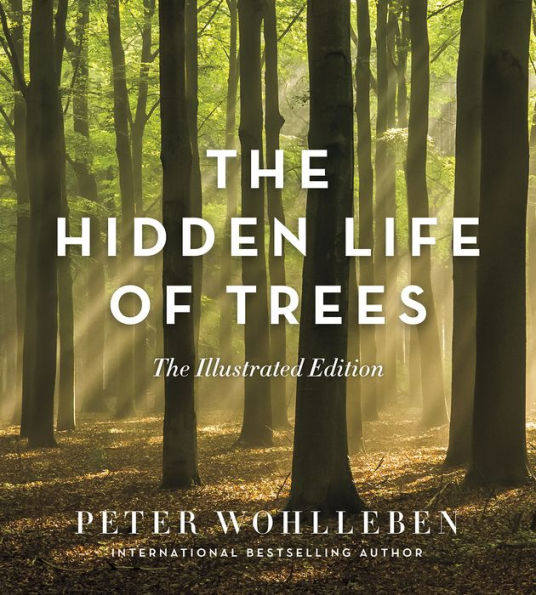

The Hidden Life of Trees: The Illustrated Edition

The Hidden Life of Trees:  The Illustrated Edition, by Peter Wohlleben, Greystone Books Ltd./David Suzuki Institute, 2015/2016/2018. 

   The text in this edition is abridged from the original (and I still need to find and read the original), but the photographs are sublime.  This book is an excellent and easily readable introduction to forest ecology, incorporating many of the recent breakthroughs in our knowledge. (Note:  Peter Wohlleben is an author and has worked for the forestry commission in Germany for over 20 years.  He now manages a forest academy and a natural woodland in Germany.)

What did I gain from reading this book?  Just opening this book and looking at the gorgeous photos relaxes me.  It is absolutely beautiful.  More than simply being a "pretty face", though, this book was a great summary of the workings of forests.
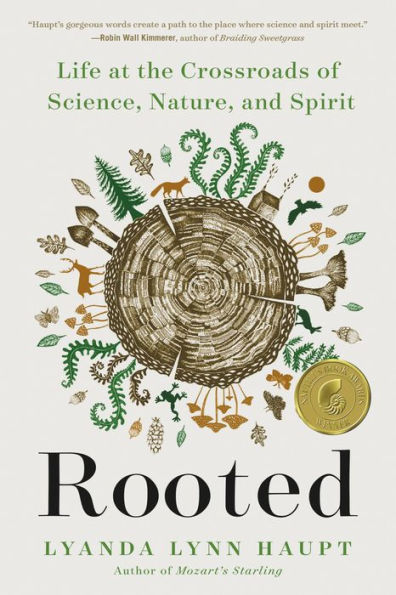

Rooted: Life at the Crossroads of Science, Nature, and Spirit

Rooted: Life at the Crossroads of Science, Nature, and Spirit, by Lyanda Lynn Haupt,  Little, Brown Spark/Hachette Book Group, 2021.

    Rooted is very different from the other books that I have talked about here.  It is based in science, but it is also part philosophy, part spiritual guidance, and part nature guide.  Weaving in quotes from a wide variety of people like Mary Oliver, John O'Donoghue,  Robert Macfarlane, Merlin Sheldrake, and Richard Louv, this book is a rich tapestry from which to draw inspiration and a deep sense of connection with the natural world.

What did I gain from reading this book?  As I read this book, I felt a variety of strands from my life and my reading come together in new ways, highlighting possibilities and encouraging changes in the way I relate to the natural world.  After I finish reading a book, assuming I decide to keep it, I store each one in a  different area, based on how I think I'll access or use it in the future:  plant or animal reference book, general ecological principles, environmental commentary, gardening, poetry, and so forth.  This book is one of the few I keep at my bedside so that I can dip into it for inspiration and rejuvenation when I'm feeling my well run dry.
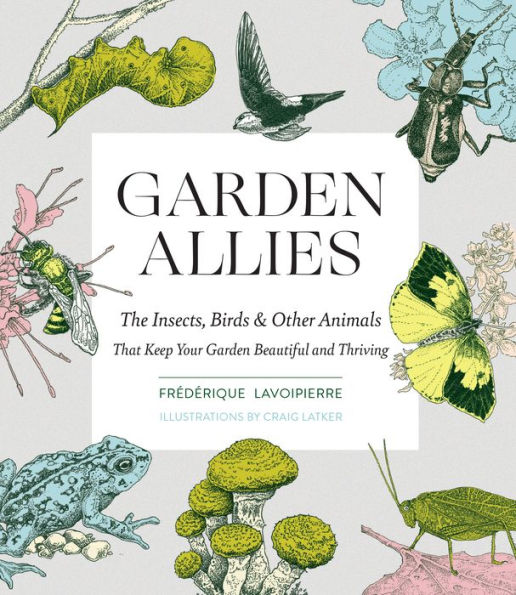
 

Garden Allies: The Insects, Birds, and Other Animals That Keep Your Garden Beautiful and Thriving

Garden Allies: The Insects, Birds & Other Animals That Keep Your Garden Beautiful and Thriving, by Frederique Lavoipierre, Timber Press, Portland, Oregon, 2021.

    A chapter subheading sums up this book well:  "Actors on Your Garden's Stage".  While other books I read in 2023 talked about all the insects and other animals that share life in and on trees, this book does the same for our gardens.  If you read this book, you'll recognize many, many more of the "little  guys" you see in your garden.  (Note:  Frrederique Lavoipierre has a Masters Degree in Biology with an emphasis on ecological principles of sustainable landscaping;  she was written and worked in this field in numerous capacities.)

What did I gain from reading this book?  Garden Allies was a wonderful introduction to a wide variety of the beings that we see in our yards and gardens.  It would be especially useful for someone wanting to learn more about the variety of "bugs" they encounter in their garden.

Silent Earth: Averting the Insect Apocalypse

Silent Earth: Averting the Insect Apocalypse, by Dave Goulson, Harper (HarperCollins), 2021.

    For me, this is simply the best book on what's going on with insect declines.  Not only is there good information on insects themselves, there is excellent background on pesticides and changing farming practices, how artificial fertilizers affect insects, the effects of climate change, and the surprising problem of light pollution.  One of the most memorable sections of this book was Goulson's imaginative trip 50-60 years into the future, pondering what life might be like then if we didn't manage to protect insects now.  The last section of this book is titled "What Can We Do?" and, in it, Goulson outlines specific tasks that we can each do to help protect insect populations.  (Note:  Dave Goulson is Professor of Biology at the University of Sussex in Great Britain.)

What did I gain from reading this book?  Simply put, while Milman's book, The Insect Crisis, was good, this book was excellent at defining the problem of insect decline and also, critically, on giving us concrete suggestions that we each can do to avert the "insect apocalypse".

The New Climate War: The Fight to Take Back Our Planet

The New Climate War: The Fight to Take Back Our Planet, by Michael E. Mann, PublicAffairs (Hachette Book Group), 2021.

    Michael Mann is a climate scientist who has, for decades, been at the forefront of trying to awaken our country to the looming reality of the climate crisis.   This book is about the history of our understanding about global warming and the history of the fight against action to solve this extreme threat to our world.   This is a call to action, and Mann emphasizes that it is NOT too late to act; he helps us see the way forward.  He is adamant that solving the climate crisis will take more than individual action, and he points us in the direction we need to work. (Note:  Michael E. Mann is a Professor of Atmospheric Science at Penn State.)

What did I gain from reading this book?  Having read about Mann's climate work for decades, I found it fascinating to read his story of how climate policies have been submarined by the fossil fuel industry over the years.  The tactics the industry has used have been impressively effective.  Mann himself has been personally vilified in the industry's quest to "Damn the torpedoes and full speed ahead!"  We don't think of scientists as warrior heroes, but Mann has been at the forefront of this battle, fighting for the future for all of us.   
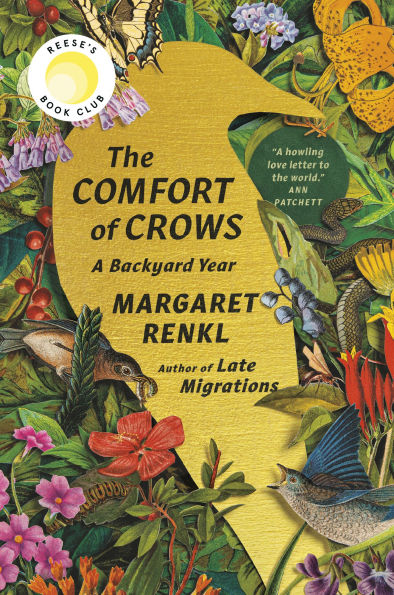

The Comfort of Crows (Reese's Book Club Pick): A Backyard Year

The Comfort of Crows: A Backyard Year, by Margaret Renkl, Spiegel & Grau, New York, 2023.

    Accompanied by a series of delightful artworks depicting nature, this book is a collection of thoughtful and poignant essays on the wildlife all around us in our home landscapes.  Tales of ecstasy and tragedy, musings filled with love and concern, every time I think of reading this book, I reflexively smile.  (Note:  Margaret Renkl is the author of several books and a contributing writer for the New York Times.)

What did I gain from reading this book?  This book gave me beauty and richness and a sense of camaraderie with the author.
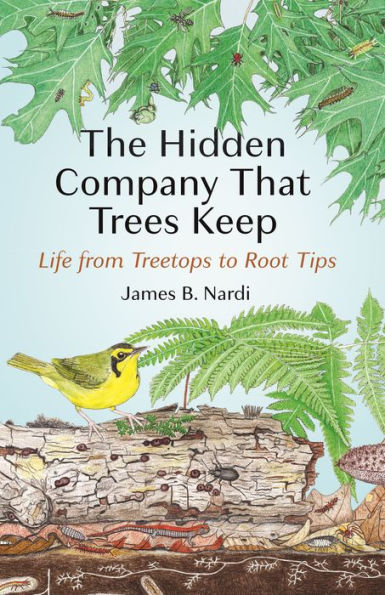
   

The Hidden Company That Trees Keep: Life from Treetops to Root Tips

The Hidden Company That Trees Keep: Life from Treetops to Root Tips, by James B. Nardi, Princeton University Press, 2023.

    When I look at a tree, I look for the animals in and around it, too.  Until I read this book, I usually saw just birds, squirrels, and maybe a few caterpillars.  In this book, Nardi goes much deeper, showing the interconnected webs of hundreds of organisms that are supported by each tree and that support the tree, as well.  He takes each part of the tree and describes the other organisms interacting with that part specifically:  leaves, twigs & buds, the circulatory system, the trunk, the roots, the flowers & fruits.  Who makes galls?  How do trees respond to insect or disease attacks?  What animals help the trees protect themselves?  The richness and diversity Nardi describes are breathtaking. (Note:  James Nardi is a research scientist in biology at the University of Illinois, Urbana-Champaign.)

What did I gain from reading this book?  I love taking walks around our yard and photographing every animal I can find, big or small.  Many of the animals I find are small...and odd looking to my eyes.  This book helped me understand the complex interactions between the animals I observe and the trees in our yard.  I underlined so much as "important - I want to remember this" that there's hardly a page I haven't marked in some way!
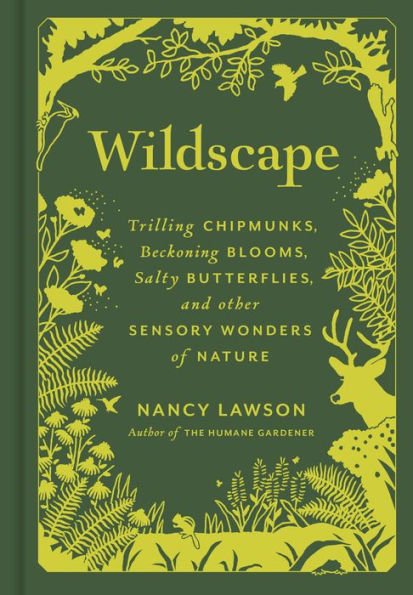
 

Wildscape: Trilling Chipmunks, Beckoning Blooms, Salty Butterflies, and other Sensory Wonders of Nature

Wildscape: Trilling Chipmunds, Beckoning Blooms, Salty Butterflies, and Other Sensory Wonders of Nature, by Nancy Lawson, Princeton Architectural Press, 2023.

    Evocative is the best word I can come up with to describe Nancy Lawson's latest book.  In the grand scheme of things, her Maryland garden doesn't lie all that far from our southeast Virginia one, so she almost feels like a next door neighbor as she talks about the plants and animals in her yard.  And the stories she tells!  Flea beetles helping monarchs in their quest for protective chemicals from milkweeds.  Chipmunks and mice spreading mycorrhizal fungi that connect and nurture plants.  The difference between the songs of "city birds" and "country birds" in the white-throated sparrow population.  The rich discoveries in this book give an increased depth to my experiences in the landscape. (Note: Nancy Lawson is an author, conservationist, and lecturer.)

What did I gain from reading this book?  Nancy Lawson has the gift of loving the unloved - and helping me to love them too.  I see certain plants and animals with new eyes after reading her books or listening to her lectures.  In this book, she took me on a fascinating nature walk, helping me decode some of the behavior or animal traces that I see...or hear...or smell...or touch in the landscape, while helping me appreciate the complexity of plant-animal relationships even more deeply. 


So many books, so little time.....

I hope you're able to find the time to pick up one or more of these books so you can enjoy them too.


Sunday, October 28, 2018

Book Time: CLIMATE-WISE LANDSCAPING

After reading this review, you can heave a big sigh of relief -I will have caught up with all my gardening related book reviews!

Having just finished Climate-Wise Landscaping, I feel very au courant in writing this review!

I'm not sure what I was expecting, but somehow this book seemed different from what the title suggested it was going to be - different in a good way, more important, filling a gap that's been existing in gardening literature.

Climate-Wise Landscaping:  Practical Actions for a Sustainable Future, by Sue Reed and Ginny Stibolt, New Society Publishers, British Columbia, Canada, 2018, is a perfect guide for people who are worried about our planet's future and are looking for something that they, personally, can do to help lessen climate change and to make our ecosystems healthier.

Every single piece of land can help heal our planet.

There are ten sections in this book, each section dealing with an area of the landscape around a typical home, wherever it is located, starting with the lawn.  Why do Reed and Stibolt begin with the lawn?  As they put it, "...[C]hanging the way we think about and deal with our lawns might be the easiest and most significant step we can take to help the planet."  How much lawn do you think there is in the continental U.S.?  According to the International Society for Photogrammetry and Remote Sensing, as quoted in this book, there is about 63,000 square miles of lawn, an area approximately the size of the state of West Virginia.  That's a lot of lawn - and most of it gets mowed weekly, inundated with fertilizers and pesticides, and irrigated.  Despite all those inputs, lawn produces no food, for people or even for wildlife.  It's essentially a sterile wasteland.

Reed and Stibolt go on to cover many other ways we can help the climate by changing the way we use our landscape.  For example, planting trees sequesters a lot of carbon, as does, surprisingly to me, increasing the health of soils and decreasing the disturbance to them.  Did you know that soils sequester more than 4 times the amount of carbon as forests?  I didn't.  Apparently they are the second largest carbon dioxide absorbing system on our planet, after oceans.  I also didn't know that every time you disturb the soil - through digging, for example - you release carbon dioxide.  So switching from planting annuals, which have to be replanted regularly, to planting perennials actually helps the planet by sequestering carbon!

I'm all for minimizing digging, so that's what I call a win-win.

There's a section on how good planning and design of a landscape can help decrease energy use (and thus carbon dioxide emissions), as well as a section specifically devoted to urban issues.  Each section contains an introductory explanation, followed by a series of "Action Topics", specific ways you can make your landscape work to help stabilize Earth's climate and often to help yourself and other living things at the same time.

Last, but hardly least, the final section covers materials that are commonly used in landscaping and evaluates their carbon footprint, helping us choose rationally among such options as concrete, brick, stone, even asphalt.  This is the first time I've ever seen a carbon analysis of landscaping materials and I really appreciate finding it included in this book.

This is an excellent resource to start with if you're interested in personally doing something specific to help the future of our species and of our planet.  It's a broad overview of the topics covered;  for specific details, you will probably want to explore the areas that interest you further, with further reading or study.  Most of all, Climate-Wise Landscaping examines a broad array of possibilities - and possibilities are a great starting point for building a better future. 

Friday, October 26, 2018

Book Time: THE INWARD GARDEN

I don't know about you, but I have a perplexing habit of buying books and then getting distracted before I actually read them.  Thus my shelves are full of books that look awesome, but that I haven't read yet.

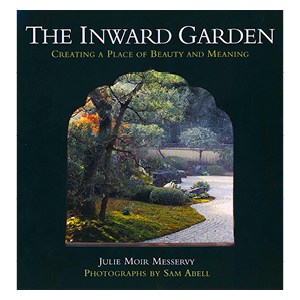
The Inward Garden:Creating a Place of Beauty and Meaning, by Julie Moir Messervy, Little, Brown and Company, 1995, is a book that has been a victim of my book hoarding habit, but this spring I finally read it - cover to cover - and  I fell in love.  I truly don't remember when I found and bought this book.  I'm hoping it wasn't shortly after it was published, in 1995, because that would mean that I've been unnecessarily missing the wisdom found within its pages for over 20 years.

Unlike the last 3 books I've reviewed, which have focused on native plants and gardening for wildlife, this book is more of a classic garden design book.  And yet it's so much more than just that.....

The Inward Garden encourages us to make gardens more than just pretty places.  In the beginning of this book, Moir Messervy describes a garden in this way, "...[A] garden means far more than just a planted place.  It is a touchstone;  a repository of memories that forms a place of joy in your life.  A garden exists not only as part of your backyard landscape, but as a site that resides in your imagination, a collection of personally satisfying images that can be expressed upon your land."

Do you remember your favorite outdoor places to be as a child?   Are you drawn to enclosures or promontories?  What's your personal image of paradise?  Moir Messervy guides us through these sorts of questions, showing us how our gardens can reflect our own personal histories and memories, our own personal inspirations.  First, though, we have to THINK about these sorts of questions - and then we have to take the answers we've come up with and help them take shape within the parameters of our actual physical space.

There are so many components we can draw upon to create our own touchstone gardens:  color, form, sound, light, plants, geometric vs. natural order, uniformity vs. variety.  It's hard to keep track of all of the different possibilities, but Moir Messervy helps us think about each one in turn without dictating what is "right" or "better".

To a great extent, this book is a combination of psychological concepts and gardening, examining such classic themes as the sacred forest, a classic hut, the need for enclosure, thresholds, bridges, and gateways.   Moir Messervy talks about journeys through our gardens, both mental and physical, with starting points, pathways, and destinations.  

 "...[P]eople garden in order to make something grow; to interact with nature; to share, to find sanctuary, to heal, to honor the earth, to leave a mark.  Through gardening, we feel whole as we make our personal work of art upon our land."

The Inward Garden is a book to aid us in making our gardens into true personal works of art upon our own land.  With ideas and passions to inspire us, this is a book that gives us a serious look at the kinds of gardens we can to aspire to create.  The richness in this book is many layered and it invites us to return for refreshment and new inspiration again and again and again.  I highly recommend finding a copy of this classic work and immersing yourself within it.  You'll be so glad that you did.

Tuesday, October 23, 2018

Book Time: A NEW GARDEN ETHIC

Quite a few years ago now, I started "talking" with my books by underlining passages that spoke to me and by writing comments in the margins.  It was hard to do at first, but once I got over my good-girl habits of keeping my books pristine, I found that it really helps when I go back to a book to review and refresh myself about what it said.  Most importantly, doing this provides a conversation to join when I reread the book.  I can see what captured my attention originally and compare those ideas to what strikes me now, making my understanding of the book deeper with each reading.  Occasionally I've even shared a book with a friend and invited her to comment (in a different color ink), which adds yet another level of interaction with the written words.

Because of this habit I have of physically talking with my books in written form, one of my easiest "sorts" for which books I want to keep and which ones just need to be passed along is a simple look to see whether or not I've underlined and commented in the book in question.  If it wasn't interesting enough to mark up, it's not interesting enough to keep.  Maybe someone else needs that book more than I do.

A New Garden Ethic, by Benjamin Vogt, New Society Publishers, BC Canada, 2017, passed my "Do I keep this?" sorting question with flying colors.  It's marked up all over the place.  It's marked up so much that my big question for this post is, "How can I possibly do this book justice in a simple, short review of it?"

As I sat down this afternoon to start thinking about writing this review, I began to thumb through the pages.  An entire paragraph highlighted here.  Exclamation point there.  "Great series of questions...." on one page.  Lots of "Wow!" and "Yes!" comments in the margin.  Ideas for blog posts.  Books to read.  More underlining.  Asterisks.  Occasional notes asking about sources for certain claims.  There is so much to digest here that I've become convinced A New Garden Ethic would make a wonderful book for a gardening book club to read and discuss - probably over a long weekend, as a single hour or two wouldn't be nearly long enough.

One interesting twist to this ecological gardening book is its author, Benjamin Vogt.  Dr. Vogt has a PhD, but it's in creative writing, not in biology or ecology or horticulture or landscape architecture or any of the myriad fields that one would normally associate with a book of this nature.  That said, prairie and ecological garden design are obviously deep passions for Vogt and he's educated himself accordingly.  Coming from a creative background, his writing has a vibrancy that can sometimes be lacking in more scientific tomes.

I'll be up front, though:  to me, Vogt's lack of scientific training shows up rather glaringly here as a lack of citations for some of his specific facts.  It is not enough to say Scientist Y did a study in which she found xyz.  I want to know where to find that study - what journal was it published in?  when and where was the study performed?  what were the parameters?  I want to be able to delve into some of those studies more closely to see if the findings are being accurately reported in what was written.  I may want to use those statistics in something I write, too, but I'm not going to quote statistics without knowing where they come from, even in a simple blog post.  A revised edition with this major flaw remedied would strengthen this book significantly, in my opinion.

Beyond that flaw, though, there's an incredible amount of substance in this book that captures my spirit and that doesn't rely on specific studies or individual facts.  Take this wonderful passage that I've seen others pull from the book as a quote, "We live in a world of perfectly spaced plants that mimic headstones aligned in exact intervals.  Wood mulch is more important to us than flowers.  We clean up our gardens like they are living rooms after the children have gone to bed."  With 3 lines, Vogt has given us several iconic images that capture the lack of real life in so many modern gardens.

In the first chapter of this book, Vogt gives us a basic framework about what he sees as being right and wrong about most gardens, yards, and natural areas in our current day and age.  This framework leads him to a statement of a new garden ethic that he believes we need to live by if we want to have our gardens function as more than just a pretty fashion accessory...and Vogt is compelling as he shows us why we want our gardens to function so richly.

With native plants being integral to ecological function in any landscape, Chapter 2 is generally a discussion of native plants, their importance, and the pushback against their use in many circles.  There's a small, fascinating section on the politics and culture of using native plants:  is it "fair" or "democratic" to say that gardeners should only use native plants?  "When we step in and impose our ideals of democracy on a landscape, we disrupt and destroy the landscape, altering life processes that have worked long before we created human democracy...."  Vogt notes that plant culture should not be mistaken for human culture, that nature and ecosystem function have little to do with patriotism or freedom or other political concepts.

In the remaining 3 chapters of the book, Vogt discusses a wide variety of topics ranging from cognitive dissonance and the value of anger and hopelessness to the impact of the Enlightenment on where we are today, all with the object of moving us towards developing and being willing to utilize the defiant compassion that he believes we need to bring to our relationship with our landscapes and gardens.

A New Garden Ethic is a call to action, a call to enrich our own lives and the world immediately around us by connecting deeply to our specific physical environs.  By answering this call, Vogt believes we can each help to save the planet's living fabric, one garden at a time.

Monday, October 22, 2018

Book Time: THE HUMANE GARDENER

After running across and deeply enjoying Nancy Lawson's blog, Humane Gardener, I was excited when I realized she was writing a book by the same name.  The subtitle of her blog is perfect, "Cultivating Compassion for All Creatures Great and Small".  Lawson worked for many years as an editor for the Humane Society of the United States - and I think that caring and compassion for ALL animals has seeped into her psyche, based on the writing she shares both on her blog and in her book.

The Humane Gardener:  Nurturing a Backyard Habitat for Wildlife, by Nancy Lawson, Princeton Architectural Press, New York, New York, 2017 is a relatively small book, almost a series of 6 essays rather than a scientific tome or an intense guide of gardening methodologies.  Each essay, or chapter, is accompanied by a "portrait" of a real garden and its real gardener, exemplifying the characteristics talked about in the companion chapter.  The gardens range from California to Florida, from Ontario to Oregon, with Colorado and the Chicago area filling in the area in the middle.

More than most gardening books, The Humane Gardener focuses on the animals that are so often collateral damage in modern gardening methods:  from the wide variety of small animals that get chopped up, along with the grass, by lawnmowers to the tiny denizens of leaf litter when it's allowed to lie undisturbed under shrubs and perennials.  There are a few statistics ("The nestlings of 96 percent of North American terrestrial bird species survive on spiders and insects, mostly caterpillars, who are themselves babies with specialized habitat needs....") but most of the information and advice is given in anecdotal form, which makes it easy to digest.

In the book's introduction, Lawson remarks that the gardeners she chose to highlight "embody the ethic of compassionate landscaping, challenging long-held assumptions about animals, plants, and themselves."   Compassionate landscaping.  Compassionate landscaping.  I love that term and the ethic it defines.  The Humane Gardener is a great introduction to this ethical concept.

This ethical concept does not, however, meld well with the perfection-driven standards promoted in most regular garden literature, and Lawson talks about her journey from a mainstream gardener to a compassionate gardener, from being willingly sucked into the "marketing ploys of the Landscaping Industrial Complex" to learning from the plants and animals sharing her yard with her.  In her garden portraits, she often talks about the journeys these other gardeners have made, too. 

As a map of a changing journey in gardening, this book is written as a general guide of concepts which can be used across the entire country.  Thus there is little talk of specifics:  don't look to this book for which particular species to use where or what the best method of performing a particular task is.  The overarching ideas Lawson shares are widely adaptable and easily understandable, though.

The last section of The Humane Gardener is a series of resources you can turn to if you want to get started practicing compassionate landscaping yourself:  among them are a couple addresses for excellent blogs, a short list of regional references for wildlife habitat gardening, notes on the individual chapters, and a selected bibliography.

I greatly enjoyed The Humane Gardener and I would highly recommend it to anyone intrigued by the idea of using compassionate landscaping in their own home environs.

Book Time: GARDEN REVOLUTION

As I started thinking about getting ready for holiday guests and Thanksgiving feasts, I realized that I had a pile of books on our dining room table that were there to remind me to write about them.  It's a pile that's been slowly but steadily growing for quite some time now - and I was somewhere between shocked and dismayed to realize that, in that pile, I had amassed 6 books with gardening as their theme.

So I've pulled them out and arranged them in the order that I read them, in the process realizing that one book had been added to the pile without my actually having read it.  Oops.  Wrong pile.  (Yes, sadly, I have many piles of books around the house.)  So let me get busy with the first of the remaining 5 books in my dining room table pile.

Without further ado, here are my thoughts on Garden Revolution, by Larry Weaner and Thomas Christopher, Timber Press, 2016, which I read about a year ago, in November 2017.....

Subtitled "How our landscapes can be a source of environmental change",  Garden Revolution truly amazed me.  I've been interested in gardening for and with wildlife for decades now and I have read a lot on the subject.  I am deeply interested in the environment and in ecology.  Not surprisingly, I've done a lot of hands-on gardening and landscaping for wildlife over the years.  Native plants are my "go to" species in planting my yard and its individual gardens.  Truthfully, it's rare for me to find a book with a really new spin or a new series of concepts on any of these subjects - but that's exactly the sort of book I found as I delved into Garden Revolution.

Larry Weaner is a landscape designer who specializes in ecological restoration AND fine garden design.  One of his early insights as he worked in garden design was "...a traditional garden is like a beautiful car with no engine.  The body is sleek, the interior is plush, and the stereo sounds great, but the owner will always need to push it up the hills with bags of fertilizer, weeding forks, and watering wands."  Weaner works WITH nature, in truly amazing ways, to develop beautiful, continually changing, living landscapes.

Working with nature....  What, exactly, do I mean by that?  Before, I've always just meant avoiding pesticides and using native plants, while trying to match the plant species to its preferred growing conditions and hopefully creating habitat for wildlife.  Weaner takes it so much further.  He pays attention to the seeds found in the "seed bank" that is present in every soil, adds in seeds for species that will help succession move in preferred directions, plants small clumps of wildflowers as seed sources to allow for natural spread, and has many other techniques to nudge natural processes in ways helpful to gardeners and landscapers.

Presented in large format with lots of photos, Garden Revolution at first gives off a vibe almost like a "coffeetable book", but it's much more than that.  There is background information, both historical and biological, presented conversationally so that it doesn't overwhelm.  From Weaner's decades of work, there are examples of gardens from large estates to small suburban gardens, discussed in the text as well as illustrated by gorgeous photography.

Using aggressive native species to outcompete problematic invasive species.  Planning and planting for seasonal and successional niches instead of just planting a "once in time" landscape plan.  Cutting weeds off just below the surface instead of pulling them out by the roots and disturbing the soil.  The new ways of thinking about garden design, preparation, planting, and maintenance just keep coming in this book.

Want to help nature and our planet's ecosystems in a very basic, personal, and satisfying way?  Want to help yourself have a thriving landscape with less work?   Want to attract wildlife to your surroundings?  Read this book.  You'll be glad you did.

Monday, April 02, 2018

Spreading the Wild(life) News

About a week ago I took a deep breath and plunged into a new "platform" for me:  a Nextdoor neighborhood group I've belonged to for a couple years now.  I've posted briefly on it once or twice before, with little response, but this time I decided to be a bit more blunt and opinionated.  The results have been interesting.

Here along the Gulf Coast, early spring is the biggest season for leaf fall as the evergreen oaks push off last year's leaves before they put out a new flush of leaves for this growing season.  First the laurel oaks drop their leaves, then the sand live oaks drop their leaves, and finally the live oaks drop their leaves.  It's about 6 weeks of constantly falling, relatively small, brown leaves.  In our neighborhood, these oaks are almost all BIG trees and the leaves that get dropped in this relatively short period of time rival the leaf drop of autumn in essentially any other forested area of the country.  Except there's no pretty color, I have to note.

So the leaf blowers have been working overtime for the month around here and there have literally been mountains of leaves pushed to the curb for the city to come by and pick up.  It saddens me to see all this beautiful mulch getting thrown away, so I posted:

"As I watch oak leaves being raked and put out by the curb for the city to pick up, I'd like to suggest that everyone consider blowing them into shrub and flower beds instead. They make great mulch and look as nice or nicer than anything you can buy. The birds love to rustle through them looking for food, and the leaves decompose easily to make your soil much richer and healthier."

Within a day, 8 different people had responded to my post.  After 10 days, 14 different people had responded in total.  A total of 14 people had thanked me.

Six of the comments were negative, with most people concerned about all the animals that would live and breed in the mulch.  Mentioned by name were roaches, fleas, termites, and mosquitoes.  I assured everyone that the roaches in leaves were not the same roaches that get into kitchens, that termites need wood rather than leaves (although I didn't recommend deep piles of leaves directly against the side of a house either), and that fleas were more likely in a lawn than in a mulched bed.  Another person got on to say that mosquitoes needed standing water to breed, although they might hang out in leaf mulch, and that they were unlikely to have enough water to breed in oak leaves, as compared to magnolia leaves.

Other concerns mentioned by negative commenters were the "lack of nutrition in oak leaves" (which I responded to by noting the importance of organic matter in our sandy soil), the tannins that would leach and kill plants (which I said weren't a problem according to experts who'd studied the issue), and the leaves blowing out of the flower/shrub beds (at which point I suggested that any leaves that blew out of the beds could be mulched mowed into the grass to provide organic matter there).

A couple comments were neutral.  One person said she thought using leaves as mulch was a great idea, but she was terrified of birds, so she wouldn't be doing it at her house.  I wasn't quite sure HOW to respond to her.  Yet another individual was thankful people don't burn leaves any more because now she could breath.  One woman tried to send me a link to an article which she said proved that mulching leaves into lawns was harmful, but the link to which she sent me said that it was beneficial.

Another man said I seemed knowledgeable about plants and asked me if I designed landscapes.  Laughing to myself, I thanked him for the compliment and said, no, I definitely did not.  After another person recommended her husband's lawn care and landscape service to him, the gentleman said he wanted an area around his pool landscaped with a "nice tropical design".  So much for someone interested in wildlife!

Not surprisingly, my favorite 3 comments were the ones which said they already used their leaves as mulch or they composted them.  Those 3 commenters and the gal who said mosquitoes needed standing water to breed restored my faith in other local gardeners, at least a little!

Which is, perhaps, a bit of a harsh judgement on my part, since a further 11 people thanked me for my original post, but did not comment.

So 25 people responded altogether: 6 actively negative, 4 actively neutral, 4 actively positive, and 11 passively positive.

I've gone on to make three further posts on this neighborhood site in the last 2 weeks:  one post warning people about buying plants that have been treated with neonics for butterfly and pollinator gardens;  another post offering wild strawberry plants if anyone wanted to come by and pick them up; and a third post simply talking about the birds I was seeing in my yard and how they preferred foraging in the wilder, less manicured areas of the landscape.  All 3 posts elicited at least a dozen comments and the same number or more "thanks".

I've been trying to keep Mother Teresa's comment in mind lately, "I alone cannot change the world, but I can cast a stone across the waters to create many ripples."  I feel like these neighborhood posts are creating a few quiet ripples in our local waters, and that makes me happy.


Sunday, February 04, 2018

Blueberry Blooms...But No Bees

My blueberry bushes have started to bloom and I am anxiously watching to see if any southeastern blueberry bees show up to pollinate them.

I literally sat about 10 feet away from the bushes yesterday, from 11:40 a.m. to noon and watched.  It was 55 degrees F. outside and sunny.  There were no bees visiting the flowers.

Today I went out at about 3:25 p.m. and watched again for 10 minutes.  Again, it was sunny.  The temperature was 72 degrees F.  Again, I saw no bees.

Why am I so concerned?  I had bees (and blueberries) last year.

Well, last spring I shared with you my excitement over finding a small cluster of southeastern blueberry bee nests in what I thought was a public area down the street from us.  Across the road from this little cluster of nests was a 15 year old hedge of blueberry bushes in the backyard of another neighbor.  Such unassuming little creatures, such delicious fruits, and it was so much fun to connect the two.

Several months after my enthusiastic post, though, the neighbor whose yard abutted that "small public area" where I found those blueberry bee nests chose to rototill up this small triangular area and cover it with sod, effectively annexing it to his yard.  It all looks very "upscale" now, so nobody else seems to be upset, but I doubt any of the bees were able to survive the dual assault - and, like most solitary bees, southeastern blueberry bees only have one generation per year.  Effectively that little population of southeastern blueberry bees has been destroyed.

Even if a few of the bees managed to survive the rototilling and heavy sod overlayment, the sod carpet was almost assuredly grown with neonicotinoid insecticides.  Given the immaculate and well groomed appearance of the property overall, I'm guessing that neonics have been and will continue to be used to maintain the lawn's manicured appearance.

Neonicotinoids affect bees.  They are insect-icides, and very potent ones at that, even at small concentrations.

Sadly, the destruction wasn't done yet.  The house across the street, the one with the blueberry hedge, had sold the previous fall.  Last summer, the new owners yanked out all the blueberry bushes, presumably because they interfered with their unobstructed view of our little lake.

I'm trusting that there are other southeastern blueberry bee nests around that haven't been destroyed and that the little bees will find my blooms before too long.  It IS early in the season, after all.  Meanwhile, when I can, I'm going to keep going out and keeping watch over my blossoms, hoping to see the little "mini-bumble bees" busily poking their way up into the blooms.

There has been a lot of habitat destruction around our neighborhood in the last 12 months or so, all in the name of "sprucing up".  It's been disheartening to watch, since one of the big factors that attracted us to this area was the mature landscaping.  In fact, I'm planning to do an entire post on the topic, so for now I'll stop here.

Please join me in hoping that there are other pockets of southeastern blueberry bees around, ready to find our blooms, producing delicious berries and food for next year's bees in the process.


Slut Shamed, Homeowner Style

Pardon my French, but "slut shamed" rather perfectly describes what I feel like about this....

I came home last Wednesday night to this unsolicited message, gathered up with the mail and lying on our dining room table:

Presumably Greg found this tag, a "lawn report card", if you will, hanging on the handle of our front door.

Apparently, a total stranger happened to come by our house and felt compelled to stop and leave a written note for us, telling us that our lawn needs weed control, fertilization, pre-emergent treatment and pest control.  Our lawn is also apparently suffering from freeze burn.  This stranger repeated that our lawn needed pre-emergent and weed control.  Evidently the situation is dire because he exclaimed about how badly it needed these things.  He also told us that grass plugs would be available soon.

Call, he said.  It was underlined to underscore the urgency.

I am rather amused by the depth of my angst about this.  Of course I understand that this is purely a marketing ploy, done to drum up business, but it still really bothered me when I read it.

Because I consciously and conscientiously garden to provide habitat for pollinators, birds, and other wild creatures, I don't use commercial pest control or pre-emergents or weed control.  Insecticides, herbicides, and even standard fertilizers work against my goal.  After all, "-cide" means "-killer" and there is no pesticide, herbicide or insecticide that can differentiate between "good" and "bad".  They just kill what they are designed to kill:  "pests", broad-leaved plants, grasses, insects, etc., depending on the chemical formulation of the -cide being used.


Taken yesterday, this is a photo of our front lawn, 4 days after our failing report card was hand delivered to us.  We have done nothing to the lawn or to the gardens in those intervening days.  To be honest, we really haven't done anything in our yard or gardens in several months now, and there IS obviously work that needs to be done as spring begins to sneak up on us.  There is also lots more gardening, planting, and growing that I want to accomplish.  However, given all that, I am comfortable with the general appearance of our lawn.  It seems to balance reasonably well between looking rationally maintained and providing healthy habitat.

Here is our front lawn in early October, while it is still green.  Far from perfect, but it still seems acceptable to me.

Truthfully, I am rather astounded by how unsettled having this "report card" left on my door actually made me feel.   If receiving this little "reminder" upset ME this much, when I am knowingly making the choices I am making for reasons that are very important to me, what does an unsolicited report like this do to the average homeowner, who is just worried about property values and neighbors' approval? 

I KNOW our lawn is full of non-grass plants, also known as weeds.  Some of these plants are native, most are not.  I remove the really problematic ones by hand, but if the non-grass plants will handle being mowed, I generally don't worry too much about their inclusion in our lawn.

What I DO manage for - and worry about providing - is a healthy mix of plants and animals in our yard overall, a mix that includes pollinators, predators, and a good selection of native plants to feed leaf and seed eaters, as well as pollinators, birds, toads, anoles, and all the other wonderful life forms that I've observed just in our little 0.4 acre lot over the last 2 2/3 years.

Is our yard "pristine"?  No.  I don't want our yard pristine, I want it ALIVE. 

Is our yard alive?  Yes, it is.  Our yard is alive with chattering chickadees and flitting yellow-rumped warblers, with brilliant gulf fritillary butterflies and little solitary bees, with stalking preying mantids and shimmering long-tailed skippers, with watchful green anoles and fat saucy toads. 

That's worth a bit of lawn shaming any day.

Wednesday, September 27, 2017

Turtle Rescue

Sometimes you just get lucky.

I don't go out by the compost piles very often during the course of any average week, but I needed to take something out there yesterday morning.  I had started to walk away when something caught my eye - a bit of movement.

There was this poor female box turtle, firmly caught in the open hole of a cinder block.  Her shell was pretty scuffed, so it looked like she'd been there for a fairly long period of time, scrabbling uselessly, trying to get out.

How unfair that she could not make a noise to attract my attention!  (I've never consciously thought about turtles' silence before, but somehow it seems tragic in this situation.)

The poor thing was stressed enough that she didn't withdraw into her shell when I picked her up.   In fact, she didn't withdraw into her shell until I picked her back up, after I'd put her down, to take a photo of her underside.

She's a big box turtle - and I honestly wonder how in the world she got herself in that predicament.  I think she was lucky to be tail down, not head down, in the hole.

I hope she's none the worse for her adventure and that she was able to get food and water without issue.

Now I've got to fill in those holes so this doesn't happen again.  I checked the area today and will continue to do so every day until we get the holes filled.  The compost piles, rimmed by these cinder blocks, have been in place since shortly after we moved here over 2 years ago, with no prior problems.  Funny - I never would have thought of them as being dangerous to much of anybody or anything....

Thursday, September 21, 2017

Am I Still On Track?

Reading a magazine about blogging earlier this week, I tried to remember exactly why I began Gaia Garden.  Was it simply to share the photos I was taking as I gardened?  To share the plants and animals I found as my hands dug in the soil surrounding our home?  Amazingly, I realized that I started writing this blog over 11 1/2 years  - and 2 gardens - ago, in March 2006, while we lived in Mobile, Alabama.   I must say that my memory is fuzzy on many of the details.  I do remember clearly, though, that our son Sean had a LOT to do with my starting this blog.  He basically bullied me into picking a name ("It doesn't have to be perfect, Mom!"), picked a platform he felt would work well for me, and in those lovingly irritating ways, actually got me online with my first posts.

To refresh my mind about my deeper motivations, however, I decided to go back to the earliest posts and see what I had to say for myself....

In my very first post, "New Beginnings", I wrote that "...it's not just gardening that interests me.  It's gardening within the genius of the place, gardening that celebrates the local flora and fauna."  That certainly still rings true.  If anything, I think I've become even more fascinated by what is now known as "gardening with native plants".  I like the way I phrased it back then, though.  "The genius of the place..."  It sounds much softer, even somewhat romantic.  That is a concept that I haven't thought about for a long time.

So different from the prairies of southcentral Kansas and our last garden, the "genius of the place" here in our Florida panhandle neighborhood is reflected in Spanish moss literally dripping from evergreen oak trees.

A little further along in that same post, I mentioned hoping to gently encourage a sense of cooperation between gardeners and the natural elements in their gardens, as opposed to the more common combative feel of gardeners battling nature's tendencies.  At least in my own mind, this concept is central to most of my posts to this day.

Towards the end of that original post, I started to wrap up by expressing a broadening mission for my new blog: "Since gardening works so well as a metaphor for living, along the way I expect to be looking for ties to philosophy, politics, literature, and any other subject that "crops up."  I hope to hear from others who are similarly involved...or even just interested in the process."

It's in that final, broader hope for where my blog might lead me that I feel I've perhaps lost my way.  In recent years I have found it quicker and easier to share photos and explore what I'm actually seeing as I garden than it has been for me to delve into other facets of life that I think about or learn while I'm  getting my hands dirty.

So my blog has become more photo driven.  Is that a good thing...or not?  We all seem to respond instinctively to photos, so in that regard it's helpful, but it can also be limiting to rely too heavily on them.  For example, so far in 2017, the only "philosophical" post that I have written was to think a bit about what I think about as I garden.  Hardly deep stuff, but I was able to find photos to illustrate my thoughts!

It's also not deep (literary) stuff, but if a book seems relevant to science or gardening or the environment, I still do book reviews, as in this 2014 post about "A Sting in the Tale" by Dave Goulson.  In the last several years, though, this is about as close to "...ties to philosophy, politics, literature..." beyond gardening as I get.  Sigh.

Another big change I see in my post topics, compared to 2006, is that I am a lot more involved these days in identifying insects and figuring out what they are doing in the garden.  For example, note this little halictid bee, feeding on the nectar and pollen of the Gaillardia bloom - and pollinating the plant in the process. Sometimes I actually feel as if growing plants has now become secondary, for me, to learning about and nurturing bees, butterflies, spiders, and other wildlife in my gardens!  Ironically, photos are a big part of WHY this change has occurred, as I got a DSLR camera several years ago and am now able to take pictures of a small insect, enlarge them, and identify the species.  Knowing the actual identity of the insect I'm seeing allows me to research its biology.  In fact, I'm becoming quite the bug nerd, at least in my own mind.

Well, it's time to wrap this up.  Enough navel gazing.

Upshot?  In general, I think I'm still on track.  I'd like to work in some more "tangential" subjects as blog post topics, if only because I'm finding it fun to go back and read those posts, years later. 

For my own sanity, I'd like to get back into regular posting - blogging feels creative in a way that Facebook posts don't.  I think more carefully about what I'm saying when I write a full blog post, and I rework the wording to get as precise as possible about what I mean.  I can more easily choose my topics, too, which in this current political clime is not all bad.

So, onward into the next 11 1/2 years!  I wonder how many gardens I'll have made in that next interval of time - and where we'll be putting our literal and figurative roots down by then?

Sunday, February 26, 2017

Winter Walkout 2017

Labeling my walk this morning as a "winter walkout" seems like lying, but the calendar rules, so that's what I'll call it.

Leaving my front door, the first thing I noticed was this American flag.  The flag is not, technically, in my yard, even though it's visible from my front door, so I don't think I'm breaking the winter walkout rules by including this vignette.

Since I see it every time I leave my house, this algae-stained and sadly weathered flag has become symbolic to me.  The folks who display it are staunch conservatives; I'm sure they consider themselves to be displaying their patriotism.  I, however, see many other layers of meaning in its treatment as well.

Passing by their garden this morning, along the sidewalk in front of their house, I noticed a red camellia bloom with multiple centers:  colorful, perfectly imperfect, brightly shining for a few days...and then gone forever.  How's that for reading meaning into the natural world?!

Looking up, Spanish moss draping from the trees silvered the sand live oak canopies, which were silhouetted against the crisp blue sky.  It was truly a gorgeous morning!

Across the street, a painted concrete ball added a touch of whimsy to an otherwise classic, if rather off-kilter, driveway pillar.

Why a soccer ball?  I have visions of sports-mad teenagers living in the house, but I have never actually seen any activity beyond a single parked pickup truck in the driveway.

As I passed under the sand live oaks whose finery of Spanish moss had caught my eye, I looked up into the interior of one of the trees, relishing the texture of the heavy, sinuous branches with their finely textured leaves against the sky.

Live oaks, sand live oaks, burr oaks, cottonwoods, prairie elms - I love statuesque, gnarly trees with character!

Despite the February date, azaleas are in full bloom around here - about 3 weeks earlier than normal.  It always amuses and entertains me to imagine how azaleas mirror the personalities of their owners.  This big, beautiful plant feels like a woman with her hair down, relaxing in the sunlight.

Across the street, however, an azalea hedge separating two houses has a much more "buttoned up" appearance, sacrificing blooms and density for formality and "neatness".

As I pondered the character-predicting capabilities of azalea shrubs, I heard a large bird calling loudly up above me in the tree canopy.  Frustrated by my rude intrusion as I stood stock still on the sidewalk just below her perch, a red-shouldered hawk squawked at me from a tall pine for several minutes before finally flying off, unwilling to tolerate my presence any longer.  As she flew, I mentally thanked her for allowing me to capture her picture, despite her irritation.
Continuing down the sidewalk, I couldn't pass up a picture of this evocative rope swing, taking advantage of a meandering sand live oak branch in someone's front yard.  I just wish there had been several small kids playing on it while I passed by!

Not too far away, another large oak was in obvious decline, being strangled by a rapacious English ivy vine scrambling up its trunk to compete for the light above, while its roots competed for water and nutrients below.

Even as I was aiming the camera, trying to get a good angle on the ivy vine and oak tree, I registered calls from the red-shouldered hawk again.  Looking up, over a house roof and into a back yard, I saw a huge nest with its raucous owner standing guard nearby.

I had known there was a pair of red-shouldered hawks nesting in the area, as I'd seen some of their mating displays from our backyard, but now I know where their nest is!  Even a short walk can uncover some pretty amazing discoveries.

"Hawk Street" ends in a cul-de-sac that borders the local golf course.  I couldn't resist a quick photo of these blooming azalea bushes along the golf course fence, framed by oak trunks and overhung with Spanish moss.

Continuing around the cul-de-sac had me heading back towards home.  As I walked past a quite neglected (but obviously once loved) front yard, I noticed this little concrete cherub.  Nestled down in a mix of variegated English ivy and fern fronds, he was a warm love note amidst the ragged remnants of the overgrown landscape.
As a contrast to the earlier "interior landscape" of the sand live oak tree, I snapped a quick picture looking up into a fairly young southern magnolia.  They are both native trees, but there is such a different quality of light, color and texture in their forms!

Hearing a variety of different bird calls, loudly rattled off in sequence, I wasn't too surprised when this mockingbird flew over to a hedge, then up onto the electric wires.  It was so nice of him to pose for me!

Across the street from the mockingbird, more "buttoned down" neighbors are obviously careful to keep their azaleas from looking too wild and crazy.  These shrubs are probably younger than the earlier hedge, in a sunnier location, and pruned more frequently, so there were more blooms and a thicker appearance overall.  Still, I prefer my azaleas to be free.

Rounding another corner, I was looking at a highly squared off azalea when I noticed the trunk of the southern magnolia shading it.  What causes this braided appearance?  Pruning up of the branches earlier in its life?

Speaking of pruning, why was it necessary to pollard this poor tree, looking like hell in the hell strip?  I didn't recognize the species from just the truncated remains of the branches and the bark alone, so I'll have to keep an eye on it and see what the leaves look like when the poor thing finally manages to push out a few.

As an aside, though, the bark on the trunk had obviously been a favorite place for yellow-bellied sapsuckers to feed over the years, bearing a textural pattern of holes that could almost be used to create a modern art piece.

Now I was completing my small neighborhood loop, looking at the streetscape, ornamented by sand live oak trees, with the light behind me.   Aren't these trees wonderful?  It was the presence of these trees that attracted our daughter to this neighborhood, 5 or 6 years ago.  (Then 2 years ago, she and her husband and our grandbabies attracted us to the same neighborhood!)

In the foreground of the photo above, you can see the soccer plinth and a stump in front of it.  That stump is the remnant of a large popcorn tree, an invasive species (in the Euphorbia family!) that was, thankfully, cut down a year ago.  The stump is beginning to sport an accent of frilly fungus as it starts to decompose, but it was the deep blue of the spiderwort blooms that caught my eye.  I'm a real sucker for blues of this hue.

As I approached the end of my walk, I couldn't resist capturing this quintessentially southern scene, again from the garden across the street from us.  Oak trees provide structure, high shade, and a catch-hold for graceful Spanish moss.  Underneath those picturesque giants, tall, dark green camellias and lower, rounded azaleas bloom brightly, skirted by fallen camellia petals and ferns.  Can't you just hear the whispered southern accents and the clinking of ice in tall drink glasses?

Thank you for coming on my winter walkout with me.  It's been fun to share my regular haunts with you - and I've loved seeing where everyone else is doing their winter walkouts, too.

As I finish, though, I have to wonder what it would be like for different people to walk the same route and share what caught their attention.  Wouldn't that be a fun way to compare and contrast how each of us sees the world differently?!  Another project for another time, I guess.  I hope you're enjoying the world around you, whatever season your weather is bringing these days, wherever you're planted.