As I look around my garden these days, there are definitely places where it's starting to look worn out and ratty.
For example, what's the end result of this sight, on August 25th?
This
sight on September 9th! And LOTS of gulf fritillary butterflies
gracing our yard, too. Just recently a seemingly unpenetrable wall of
green, the passion vine (Passiflora incarnata) is literally skeletal now. All of its leaves - literally ALL of them - have been eaten by gulf fritillary caterpillars (Agraulis vanillae),
leaving nothing but awkward stems with the remnants of a few fruits
hanging on. I'm not worried, though. The passion vine will be back
next spring, as full and pretty as ever.
Also, did you
notice? The leaves of the vines were beginning to turn yellow by the
end of August anyway. They weren't going to last much longer even if
the caterpillars hadn't been eating them.
The victim of twin onslaughts - monarch caterpillars and advancing age, the swamp milkweed (Asclepias incarnata)
is looking rather pathetic too. It's a battle to see whether the
caterpillars will eat the leaves first or whether they'll turn yellow
and fall off from the bottom up. (The tall, leggy plants in the photo
above are the swamp milkweed, planted just behind the birdbath basin on
the ground.) It's the legginess and ugliness of this stage of their
life cycle that encourages me to generally plant swamp milkweed in the
back of the border, hopefully behind some "fluffy" lower plants like red
sage (Salvia coccinea) or short species of asters. If you look
closely at the left side of the photo, however, you can see that the
monarchs aren't upset by the state of the milkweed at all.
There are still many flying in the yard, with females frequently seen laying eggs here and there - even on "ugly" plants.
Flyr's nemesis (Brickellia cordifolia)
is just about done blooming, so its small, cotton candy pink pom-poms
of flowers are fading into grayish lavender mush. The leaves still look
good, but the stalks have sprawled everywhere, thanks to the weight of
all those beautiful blossoms over the last couple weeks.
I've
got these few stalks held up with stakes because they were lying flat
on the lawn. Our 3 year old grandson gives a good sense of scale
against these shortest of the Flyr's nemesis stalks. Despite the waning
number of blooms, the monarchs, gulf fritillaries, and little bees are
all still enjoying the Flyr's nemesis immensely.
Declining in the same way they grew, from the bottom up, the Dr. Seuss flowers of spotted horsemint (Monarda punctata)
are past their prime as well. There are still individual flowers in
the upper bloom clusters, but the bottom clusters are turning brown and
drying out. Like the Flyr's nemesis, the stems have sprawled from the
weight of bountiful blossoms.
Looking up into the trees, numerous nests of fall webworms (Hyphantria cunea) pockmark the ends of the branches of the pignut hickories (Carya glabra).
I've noticed an increased number of birds like bluejays up in the
canopy since the webworm nests appeared, so I'm guessing that the birds
are having quite a nice, seasonal, tree top feast up there.
In the front gardens, even the tidy green mounds of the trailing pineland lantana (Lantana depressa) are showing signs of decline, although thankfully you have to look fairly closely to see them.
Many
leaves have been used as caterpillar food by some sort of leaf rollers
this summer and they have become gray ghosts of themselves. Empty
flower stalks are numerous now, too, although the blossoms still attract
most of the attention, especially from a distance. Luckily, again, the
butterflies, skippers, and other creatures don't seem to mind at all.
When
I worked the phone line for the Master Gardener office, we'd always get
concerned calls at this time of year, "My plant leaves are looking so
sick. What should I spray on them?"
My response then was
the same as it is internally to myself now, "It's the end of summer.
The leaves have been working hard all summer and they are tired and worn
out. It's almost time for them to fall, where they will continue
working to make the garden healthier as they decompose into rich
topsoil. Don't spray anything. This is all just part of the natural
cycle of life. Nothing is wrong at all."
Or, in other
words, it's the time of year to remind ourselves to "tolerate the
uglies" as the seasons begin to change yet again, moving us into the
release of fall and the quiet peace of winter. This, too, shall pass.
Showing posts with label Monarchs. Show all posts
Tuesday, September 11, 2018
Friday, August 17, 2018
Monarch Caterpillars, Chrysallises, and Wasps: Sometimes Things Go Wrong
Two days ago, as I came back into the house after dumping my coffee grounds in the garden, I noticed a small black and white wasp sitting on top of something on the swamp milkweed. Looking closer, I saw what I thought was a discolored monarch caterpillar, about the size of a 2nd or 3rd instar. "Damn. Oh, well, her babies have to eat, too," I thought to myself.
Of course I grabbed my camera to capture some photos, but it was early morning and the humidity was high, so I was only able to take a couple frames before the lens fogged up and became too opaque for me to continue. By the time the lens cleared, the wasp with her payload had disappeared.
Well, my garden is definitely a place for nature to "do its thing", so I made no attempt to intervene. In the late afternoon, I noticed what looked like the same female wasp working at the entrance to a hollow tube in my bee house which is above and behind the swamp milkweed. Obviously that was where her nest was.
When I downloaded my photos, I was relieved to see that the caterpillar the little wasp had was NOT a monarch caterpillar. If I had to guess, I'd say it was a cutworm of some sort, actually. Much as I love insects, that's not a caterpillar I'm sorry to see feed some baby wasps.
Yesterday, when I went back out to take photos, the nest tube this little wasp was working on had been completely closed off. It's the right hand tube near the center of this photo. Inside it, I am sure that a wasp egg is developing into a larva that will use this hapless caterpillar to create the next generation of mason wasps. As horrific as that seems in one sense, at the same time it seems pretty amazing.
I see these little wasps hunting in my gardens frequently. It would be fascinating to know how many caterpillars they remove over the course of each growing season - and what species get "harvested".
In other caterpillar news, I was thrilled a few days ago to notice a monarch cat hanging upside down in the classic "J" position as it started the transition from caterpillar to pupa/chrysalis. Because we've been watching Youtube videos about metamorphosis, I carefully pointed it out to our oldest grandson, Connor, who is 3.
We were both ecstatic to see that the caterpillar had completed its change the next morning...
...but by the following day, I began to suspect that something was seriously wrong.
Two days after it had formed, I removed the remnants of the chrysalis, as well as the leaf it was attached to, fearing for bacterial contamination. It was probably too little, too late, but I figured it was worth a try to keep further contamination from spreading to other monarch caterpillars in the area.
Does anyone with more specialized knowledge of monarch/butterfly metamorphosis know more precisely what caused the demise of this pupating monarch?
Once again, as with bird nests, if I find it, I'm beginning to assume that the chrysalis/pupa is not likely to have a positive outcome. Sometimes I have to be content with letting exciting events happen "off stage" in the garden. If the result is more baby birds and more adult butterflies, then it's all good and my curiosity will just have to go unsatisfied. Thank goodness for Youtube videos!
Of course I grabbed my camera to capture some photos, but it was early morning and the humidity was high, so I was only able to take a couple frames before the lens fogged up and became too opaque for me to continue. By the time the lens cleared, the wasp with her payload had disappeared.
Well, my garden is definitely a place for nature to "do its thing", so I made no attempt to intervene. In the late afternoon, I noticed what looked like the same female wasp working at the entrance to a hollow tube in my bee house which is above and behind the swamp milkweed. Obviously that was where her nest was.
When I downloaded my photos, I was relieved to see that the caterpillar the little wasp had was NOT a monarch caterpillar. If I had to guess, I'd say it was a cutworm of some sort, actually. Much as I love insects, that's not a caterpillar I'm sorry to see feed some baby wasps.
Yesterday, when I went back out to take photos, the nest tube this little wasp was working on had been completely closed off. It's the right hand tube near the center of this photo. Inside it, I am sure that a wasp egg is developing into a larva that will use this hapless caterpillar to create the next generation of mason wasps. As horrific as that seems in one sense, at the same time it seems pretty amazing.
I see these little wasps hunting in my gardens frequently. It would be fascinating to know how many caterpillars they remove over the course of each growing season - and what species get "harvested".
In other caterpillar news, I was thrilled a few days ago to notice a monarch cat hanging upside down in the classic "J" position as it started the transition from caterpillar to pupa/chrysalis. Because we've been watching Youtube videos about metamorphosis, I carefully pointed it out to our oldest grandson, Connor, who is 3.
We were both ecstatic to see that the caterpillar had completed its change the next morning...
...but by the following day, I began to suspect that something was seriously wrong.
Two days after it had formed, I removed the remnants of the chrysalis, as well as the leaf it was attached to, fearing for bacterial contamination. It was probably too little, too late, but I figured it was worth a try to keep further contamination from spreading to other monarch caterpillars in the area.
Does anyone with more specialized knowledge of monarch/butterfly metamorphosis know more precisely what caused the demise of this pupating monarch?
Once again, as with bird nests, if I find it, I'm beginning to assume that the chrysalis/pupa is not likely to have a positive outcome. Sometimes I have to be content with letting exciting events happen "off stage" in the garden. If the result is more baby birds and more adult butterflies, then it's all good and my curiosity will just have to go unsatisfied. Thank goodness for Youtube videos!
Saturday, August 11, 2018
Tolerate the Uglies!!!
After carefully watching my larval plants for several months (which felt like years!), I'm finally seeing caterpillars on them.
There are monarch caterpillars on the milkweed,
black swallowtail caterpillars on the parsley,
gulf fritillary caterpillars on the maypop vines,
and - based on the foliage - probably phaon crescent caterpillars on the fogfruit.
YEAH!!! My plants are starting to get ugly! They are making butterflies!!!
As much as I love seeing the caterpillars, though, I find that I do cringe at how ragged my plants start to look at this point of the summer. Not only is the heat taking a toll, the plants are so large that any dry spells can cause wilting and brown edges, even partial leaf drop. By the time the caterpillars show up and start eating the leaves, the plants can start looking like I should yank them out of the garden at the first possible moment.
Of course I don't pull them out. I chose and planted these plants especially as butterfly food. Why would I pull them out just as they are starting to actually produce butterflies? Even if I do "mentally hear" my neighbors gossiping about how ragged my garden is looking these days.
Honestly, couldn't these plants be a little NEATER and PRETTIER while they go through this stage of their life cycle?!
My own phrase for this is "Tolerate the uglies!" Benjamin Vogt of Monarch Gardens shares the same concept with his phrase of "Redefine pretty." In a world saturated with television ads showing happy, beautiful people in manicured yards that don't have a single tattered leaf or brown spot in the lawn, it feels subversive to allow caterpillars to actually eat the leaves on your plants. Seriously, shouldn't this be done behind closed doors, people?!
To be even more subversive, this summer I've noticed that my monarch caterpillars seemed to purposefully deflower the milkweed they are feeding upon.
First, mama monarch laid quite a few eggs underneath flower bud clusters, so the caterpillars have been eating the flowers and buds from the moment they hatched.
Secondly, as the caterpillars reached one of their later, larger instars, I noticed that 3 of them had cut the stem of the entire flower cluster partway through, resulting in the entire bloom head hanging upside down and dying. Seriously, what's up with that?! The only thing I can figure out is that, evolutionarily, this decreases the chances of parasites being attracted to the plant for nectar and thereby finding the caterpillar(s) nearby to host their offspring on. I've never heard of this as a "thing" before, though, so I don't know if my imagination is just running away with me - or if, maybe, I'm on to something. Any monarch researchers out there that might want to look into this idea?
Along the same lines, is it coincidence that the eggs were laid shortly after the buds started opening and the plants started blooming? Evolutionarily, could it be that so many eggs were laid on these newly opening flower buds to decrease the overall numbers of blooms, decreasing the seed production, and thus moving the plant energies into leaf production, thereby providing more food for more baby monarchs?
Or is this egg placement just a way to hide the caterpillars until they get a little bigger and less attractive to wasps and other caterpillar parasites who might not care that they don't taste good? See how well that monarch caterpillar is hidden?
Can you see it now???
How about now? Pretty safe hiding place, isn't it?
WHY the timing and placement for egg laying? Coincidence or evolutionary plan? Inquiring minds want to know.
While I contemplate these possibilities, I meander my garden enjoying the new life chomping hungrily on my plants and try not to cringe at the blooms being cut short and the leaves disappearing in the process. Life is a balance - and never more so than in a garden.
There are monarch caterpillars on the milkweed,
black swallowtail caterpillars on the parsley,
gulf fritillary caterpillars on the maypop vines,
and - based on the foliage - probably phaon crescent caterpillars on the fogfruit.
YEAH!!! My plants are starting to get ugly! They are making butterflies!!!
As much as I love seeing the caterpillars, though, I find that I do cringe at how ragged my plants start to look at this point of the summer. Not only is the heat taking a toll, the plants are so large that any dry spells can cause wilting and brown edges, even partial leaf drop. By the time the caterpillars show up and start eating the leaves, the plants can start looking like I should yank them out of the garden at the first possible moment.
Of course I don't pull them out. I chose and planted these plants especially as butterfly food. Why would I pull them out just as they are starting to actually produce butterflies? Even if I do "mentally hear" my neighbors gossiping about how ragged my garden is looking these days.
Honestly, couldn't these plants be a little NEATER and PRETTIER while they go through this stage of their life cycle?!
My own phrase for this is "Tolerate the uglies!" Benjamin Vogt of Monarch Gardens shares the same concept with his phrase of "Redefine pretty." In a world saturated with television ads showing happy, beautiful people in manicured yards that don't have a single tattered leaf or brown spot in the lawn, it feels subversive to allow caterpillars to actually eat the leaves on your plants. Seriously, shouldn't this be done behind closed doors, people?!
To be even more subversive, this summer I've noticed that my monarch caterpillars seemed to purposefully deflower the milkweed they are feeding upon.
First, mama monarch laid quite a few eggs underneath flower bud clusters, so the caterpillars have been eating the flowers and buds from the moment they hatched.
Secondly, as the caterpillars reached one of their later, larger instars, I noticed that 3 of them had cut the stem of the entire flower cluster partway through, resulting in the entire bloom head hanging upside down and dying. Seriously, what's up with that?! The only thing I can figure out is that, evolutionarily, this decreases the chances of parasites being attracted to the plant for nectar and thereby finding the caterpillar(s) nearby to host their offspring on. I've never heard of this as a "thing" before, though, so I don't know if my imagination is just running away with me - or if, maybe, I'm on to something. Any monarch researchers out there that might want to look into this idea?
Along the same lines, is it coincidence that the eggs were laid shortly after the buds started opening and the plants started blooming? Evolutionarily, could it be that so many eggs were laid on these newly opening flower buds to decrease the overall numbers of blooms, decreasing the seed production, and thus moving the plant energies into leaf production, thereby providing more food for more baby monarchs?
Or is this egg placement just a way to hide the caterpillars until they get a little bigger and less attractive to wasps and other caterpillar parasites who might not care that they don't taste good? See how well that monarch caterpillar is hidden?
Can you see it now???
How about now? Pretty safe hiding place, isn't it?
WHY the timing and placement for egg laying? Coincidence or evolutionary plan? Inquiring minds want to know.
While I contemplate these possibilities, I meander my garden enjoying the new life chomping hungrily on my plants and try not to cringe at the blooms being cut short and the leaves disappearing in the process. Life is a balance - and never more so than in a garden.
Labels:
Butterflies,
Caterpillars,
Fogfruit,
Gardening for Wildlife,
Milkweed,
Monarchs,
Questions
Wednesday, August 01, 2018
A Recent Cast of Characters in My Gardens: Pollinators and Predators
With the initiation of several days of rain, it seems like a good time to share a few garden photos from the plethora I've taken over the last few weeks. Since I'm obsessed with pollinators and other wildlife, that's what I'll generally be showing you!
Gaillardia (Gaillardia pulchella) brings in a lot of insect activity. I have several pots of gaillardia on our back patio, as well as a few plants along the street by our mailbox. Not surprisingly, most of my photos are from the plants I see most often - the ones near my back door.
This is a lousy photo, but I wanted to share the single bumble bee (Bombus sp.) I've seen in my gardens so far this summer. Gaillardia is the ONLY flower I've seen her on so far.
A female monarch (Danaus plexippus) finally visited the yard for several days last week and she left several eggs behind. Here's she's ovipositing on a swamp milkweed (Asclepias incarnata) I planted a couple months ago. I'm a "survival of the fittest" biologist, so I don't collect the eggs and raise the caterpillars inside; I'm waiting to see if I see any caterpillars - this photo was taken on the 28th, so there should be a couple tiny babies out there munching away, but I haven't gone looking yet. (Update: my grandson and I went out in the rain this afternoon and found at least 3 tiny new monarch caterpillars! Yeah!)
Ms. Blue Dasher (Pachydiplax longipennis) here isn't a pollinator, but I love welcoming her and her relatives into the yard. Every mosquito this mosquito hawk eats is a mosquito that doesn't bite me! Aren't her eyes particularly gorgeous? The body of the male blue dasher is a beautiful powdery blue, but I've been seeing almost exclusively females lately.
This green treefrog (Hyla cinerea) seems to have decided that the outside corner of our gutter near the bright lights of the kitchen window makes a perfect home. Over the past week, I've been seeing her (him?) frequently within just a few inches of this location. Note: nothing like a closeup photo to let you know the house badly needs a power washing!
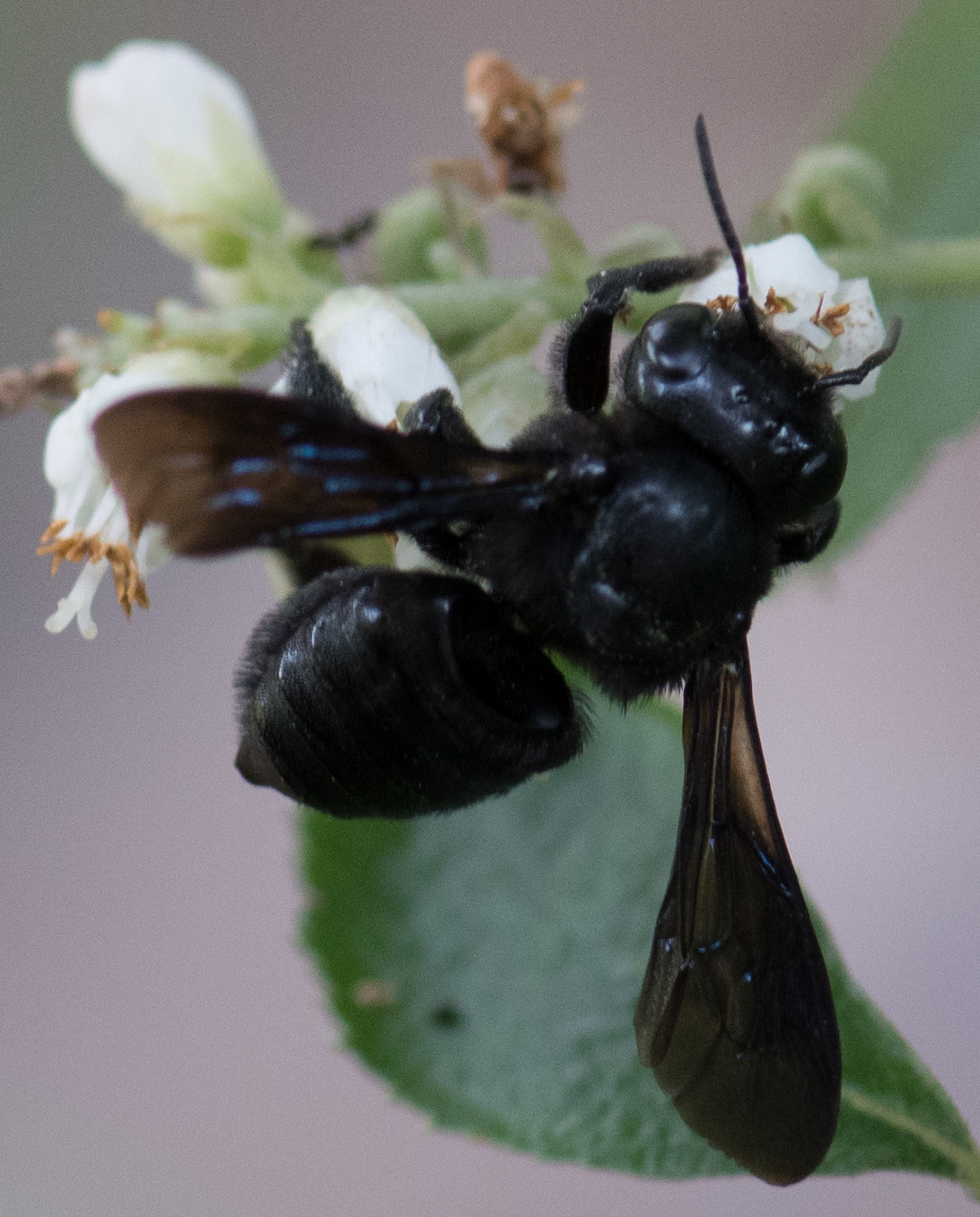
Out front, the newly planted sweet pepperbush (Clethra alnifolia) has excited a lot of pollinator interest. I shared the potter wasp and the 4 spotted scarab hunter wasp I've seen nectaring here in my recent post; this is a carpenter-mimic leaf-cutter bee (Megachile xylocopoides) who also has seemed to enjoy the blooms.
The deep velvet black of this bee's body and the iridescent blue-black of its wings are just stunning. I wonder if this is the species that has been harvesting circles of dogwood leaves to make their nest cells waterproof?
Another little green treefrog was tucked away inside a Flyr's nemesis (Brickellia cordifolia), hoping against hope that I didn't actually see him as I looked around. I let him pretend that I hadn't noticed him.....
With the spotted beebalm (Monarda punctata) beginning to bloom, I'm starting to see a little more activity in that section of the garden, including this small green anole (Anolis carolinensis). I'm still not seeing many insects attracted to the spotted beebalm blossoms, but I did see a hummingbird feeding - even though I didn't have my camera with me so I could visually share with you.
Back to the anole for a moment, I've been seeing many tiny little green anoles for the last several weeks, which just makes me smile. Obviously it's been a good year for anole love!
Another recent dragonfly visitor was the great blue skimmer (Libellula vibrans), who perched on top of the poles in our tomato pots for a while - and was lucky enough (and good enough) to capture a passing moth shortly after I took the top photo. Those big, black-spotted blue eyes aren't just for show!
Out front, enjoying the turkey tangle fogfruit (Phyla nodiflora), there's been the phaon crescent (Phyciodes phaon), nectaring - and possibly laying eggs, since fogfruit is their larval plant. Note: I don't know if this individual is a male or female.
The fogfruit has also attracted many other insects, including a female blue dasher dragonfly, a carpenter-mimic leaf-cutter bee, several different species of wasps, bees, and flies. In fact, the fogfruit is active enough that it's probably worth a post just by itself. I just wish it looked a little more "gardeny"....
Anoles have been out in the front gardens as well as in the back. Here was one haunting a summer phlox (Phlox paniculata) blossom. Sometimes I wonder if I don't see huge numbers of pollinators because I DO see lots and lots of predators around the blooms - and I'm sure it's not a coincidence that they are hanging out there!
Speaking of predators, whether nymphs (like this one) or adults, I'm seeing quite a few milkweed assassin bugs (Zelus longipes) this summer. I thought they were so-named because they were part of the milkweed community, but recent reading suggests their name comes from their coloration. I've certainly seen them on many, many plants, not just on milkweed.
The clustered mountain mint (Pycnanthemum muticum) in the back yard has brought in quite a few unusual (for my garden) pollinators. Besides several wasp species, there is this grapeleaf skeletonizer moth (Harrisina americana) which has both a common name and a color pattern that make it a perfect Halloween animal.
Believe it or not, this small, colorful, Halloween themed moth, also nectaring on the mountain mint, is from the a group of moths known as bird dropping moths. Yes, that's an actual common name for moths in the subfamily Acontiinae . This moth goes by the hard-to-remember name of black-dotted spragueia moth (Spragueia onagrus) and is an animal I've never seen before in my life. Kudos to the helpful folks at BugGuide.net for helping me identify this one!
Lacewing larvae, looking for all the world like prehistoric monsters or like some less glittery version of Tamatoa, the Crab, on Moana, are hard to see unless you look closely, but they are great allies in garden pest control. This photo is blurry (the entire "mound" is barely 1/4" across and I wasn't using a tripod) but, if you look carefully, you can see the huge jaws under the front edge as well as a wing from one of its dinners right above the jaws.
In all, this lineup of characters from my garden highlights 6 garden predators (green anole, green treefrog, milkweed assassin bug, lacewing larva, blue dasher dragonfly, great blue skimmer dragonfly) and 6 pollinators (monarch, bumblebee, carpenter-mimic leaf-cutter bee, phaon crescent butterfly, grapevine skeletonizer moth, and black-spotted spragueia moth). During the 10 days that I photographed these animals, I saw many other animals, too. Some, like the 5 species of wasps that I talked about in my last post, I've shared with you. Others, like bluebirds, cardinals, bluejays, gray squirrels, chickadees, tufted titmice, house finch, mockingbirds, red-shouldered hawk, brown skinks, southern toads, and Eastern box turtle, I haven't shared.
How can anyone be happy with a statically "pretty" landscape, when a garden filled with wildlife changes minute by minute?! I love the surprise of going out into my yard and meeting a new insect neighbor. I love the pleasure of looking at a flower cluster and realizing that I'm looking into the eyes of a little lizard or camouflaged frog. Each new animal I see adds a layer of richness to the world around me that delights and soothes me. What an honor to be sharing my yard and gardens with all these other forms of life here on Earth.
Gaillardia (Gaillardia pulchella) brings in a lot of insect activity. I have several pots of gaillardia on our back patio, as well as a few plants along the street by our mailbox. Not surprisingly, most of my photos are from the plants I see most often - the ones near my back door.
This is a lousy photo, but I wanted to share the single bumble bee (Bombus sp.) I've seen in my gardens so far this summer. Gaillardia is the ONLY flower I've seen her on so far.
A female monarch (Danaus plexippus) finally visited the yard for several days last week and she left several eggs behind. Here's she's ovipositing on a swamp milkweed (Asclepias incarnata) I planted a couple months ago. I'm a "survival of the fittest" biologist, so I don't collect the eggs and raise the caterpillars inside; I'm waiting to see if I see any caterpillars - this photo was taken on the 28th, so there should be a couple tiny babies out there munching away, but I haven't gone looking yet. (Update: my grandson and I went out in the rain this afternoon and found at least 3 tiny new monarch caterpillars! Yeah!)
Ms. Blue Dasher (Pachydiplax longipennis) here isn't a pollinator, but I love welcoming her and her relatives into the yard. Every mosquito this mosquito hawk eats is a mosquito that doesn't bite me! Aren't her eyes particularly gorgeous? The body of the male blue dasher is a beautiful powdery blue, but I've been seeing almost exclusively females lately.
This green treefrog (Hyla cinerea) seems to have decided that the outside corner of our gutter near the bright lights of the kitchen window makes a perfect home. Over the past week, I've been seeing her (him?) frequently within just a few inches of this location. Note: nothing like a closeup photo to let you know the house badly needs a power washing!
Out front, the newly planted sweet pepperbush (Clethra alnifolia) has excited a lot of pollinator interest. I shared the potter wasp and the 4 spotted scarab hunter wasp I've seen nectaring here in my recent post; this is a carpenter-mimic leaf-cutter bee (Megachile xylocopoides) who also has seemed to enjoy the blooms.
The deep velvet black of this bee's body and the iridescent blue-black of its wings are just stunning. I wonder if this is the species that has been harvesting circles of dogwood leaves to make their nest cells waterproof?
Another little green treefrog was tucked away inside a Flyr's nemesis (Brickellia cordifolia), hoping against hope that I didn't actually see him as I looked around. I let him pretend that I hadn't noticed him.....
With the spotted beebalm (Monarda punctata) beginning to bloom, I'm starting to see a little more activity in that section of the garden, including this small green anole (Anolis carolinensis). I'm still not seeing many insects attracted to the spotted beebalm blossoms, but I did see a hummingbird feeding - even though I didn't have my camera with me so I could visually share with you.
Back to the anole for a moment, I've been seeing many tiny little green anoles for the last several weeks, which just makes me smile. Obviously it's been a good year for anole love!
Another recent dragonfly visitor was the great blue skimmer (Libellula vibrans), who perched on top of the poles in our tomato pots for a while - and was lucky enough (and good enough) to capture a passing moth shortly after I took the top photo. Those big, black-spotted blue eyes aren't just for show!
Out front, enjoying the turkey tangle fogfruit (Phyla nodiflora), there's been the phaon crescent (Phyciodes phaon), nectaring - and possibly laying eggs, since fogfruit is their larval plant. Note: I don't know if this individual is a male or female.
The fogfruit has also attracted many other insects, including a female blue dasher dragonfly, a carpenter-mimic leaf-cutter bee, several different species of wasps, bees, and flies. In fact, the fogfruit is active enough that it's probably worth a post just by itself. I just wish it looked a little more "gardeny"....
Anoles have been out in the front gardens as well as in the back. Here was one haunting a summer phlox (Phlox paniculata) blossom. Sometimes I wonder if I don't see huge numbers of pollinators because I DO see lots and lots of predators around the blooms - and I'm sure it's not a coincidence that they are hanging out there!
Speaking of predators, whether nymphs (like this one) or adults, I'm seeing quite a few milkweed assassin bugs (Zelus longipes) this summer. I thought they were so-named because they were part of the milkweed community, but recent reading suggests their name comes from their coloration. I've certainly seen them on many, many plants, not just on milkweed.
The clustered mountain mint (Pycnanthemum muticum) in the back yard has brought in quite a few unusual (for my garden) pollinators. Besides several wasp species, there is this grapeleaf skeletonizer moth (Harrisina americana) which has both a common name and a color pattern that make it a perfect Halloween animal.
Believe it or not, this small, colorful, Halloween themed moth, also nectaring on the mountain mint, is from the a group of moths known as bird dropping moths. Yes, that's an actual common name for moths in the subfamily Acontiinae . This moth goes by the hard-to-remember name of black-dotted spragueia moth (Spragueia onagrus) and is an animal I've never seen before in my life. Kudos to the helpful folks at BugGuide.net for helping me identify this one!
Lacewing larvae, looking for all the world like prehistoric monsters or like some less glittery version of Tamatoa, the Crab, on Moana, are hard to see unless you look closely, but they are great allies in garden pest control. This photo is blurry (the entire "mound" is barely 1/4" across and I wasn't using a tripod) but, if you look carefully, you can see the huge jaws under the front edge as well as a wing from one of its dinners right above the jaws.
In all, this lineup of characters from my garden highlights 6 garden predators (green anole, green treefrog, milkweed assassin bug, lacewing larva, blue dasher dragonfly, great blue skimmer dragonfly) and 6 pollinators (monarch, bumblebee, carpenter-mimic leaf-cutter bee, phaon crescent butterfly, grapevine skeletonizer moth, and black-spotted spragueia moth). During the 10 days that I photographed these animals, I saw many other animals, too. Some, like the 5 species of wasps that I talked about in my last post, I've shared with you. Others, like bluebirds, cardinals, bluejays, gray squirrels, chickadees, tufted titmice, house finch, mockingbirds, red-shouldered hawk, brown skinks, southern toads, and Eastern box turtle, I haven't shared.
How can anyone be happy with a statically "pretty" landscape, when a garden filled with wildlife changes minute by minute?! I love the surprise of going out into my yard and meeting a new insect neighbor. I love the pleasure of looking at a flower cluster and realizing that I'm looking into the eyes of a little lizard or camouflaged frog. Each new animal I see adds a layer of richness to the world around me that delights and soothes me. What an honor to be sharing my yard and gardens with all these other forms of life here on Earth.
Sunday, September 17, 2017
Fall? Well, maybe.....
While all my friends in more northern climes are talking about goldenrod blooming, ducks and geese flying south, and the massive Painted Lady butterfly migration, I am left looking around for signs of the seasons changing in my Florida panhandle garden. What do I notice here?
First and foremost, I realize that I am finally back outside! During the peak heat of the summer, it's hard to motivate to do more than look out through the windows at the flowers blooming. Now, though, I'm back out in the garden, pulling the summer weeds that have grown up, working to lessen the seed load for next year and to give my perennials a bit of breathing room. It's still hot. After a couple hours, I still come in dripping sweat and craving water. Somehow, though, the worst of the sauna is gone and I leave the garden looking forward to my next time out in it.
With the autumnal equinox approaching rapidly, the days are definitely shorter now and, while I want to work outside more, I have fewer daylight hours to do so. I awake to dim, early sunlight and find myself with extra evening time on my hands after darkness falls.
Along with shortening days, another fall change is that hummingbird migration is in full swing. Walking out of the back porch, I can count on being buzzed by at least one hummer, zooming past as close as an inch or two from my face or shoulders: "This is OUR territory, lady!" They never seem to take into account that I am their FRIEND, the one who fills the feeders they so dearly love.
Looking up, there are Fall Webworm webs in our Pignut Hickory trees (Carya glabra)...
and. looking down, the Fall Webworms (Hyphantria cunea) are starting to leave their nests and look for a place to pupate. Eventually they'll become white moths with black spots.
The hickory nuts are beginning to drop, resounding sharply off the metal roof of the playhouse like a sudden shot or thudding loudly on the resonant boards of the deck.
The squirrels are busily gnawing away at the fresh largesse, leaving tiny sculptures scattered around the yard in quiet testimony to their appetites.
Butterflies and moths, while sadly still not common this year, are seen more frequently now.
There are the Gulf Fritillaries (Agraulis vanillae), busily nectaring at Beggarticks (Bidens alba) and laying eggs on the Passionvine (Passiflora incarnata), ...
Long-tailed Skippers (Urbanus proteus) nectaring at the Flyr's Nemesis (Brickellia cordifolia) and Agastache, ....
Monarchs (Danaus plexippus) dropping eggs on the milkweed (Asclepias sp.), ....
Cloudless Sulfurs (Phoebis sennae) stopping to snack at Scarlet Sage (Salvia coccinea) on their way to points south, ...
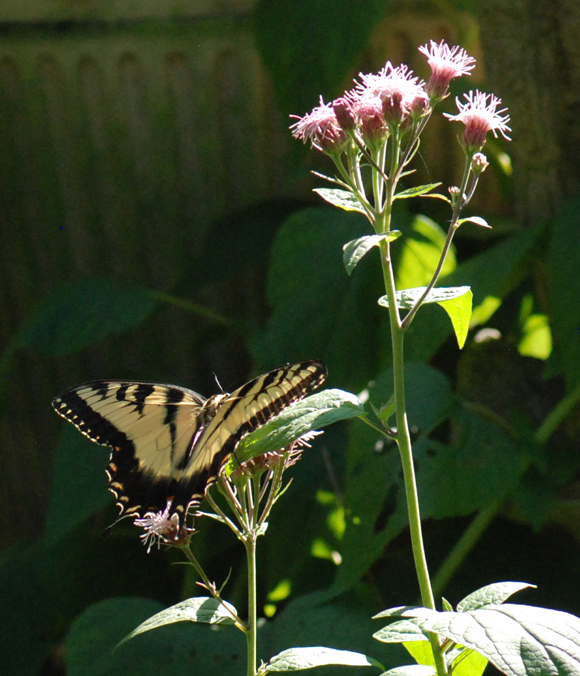
Swallowtails majestically visiting, but generally camera shy, like this Eastern Tiger Swallowtail (Papilio glaucus) nectaring at Flyr's Nemesis, ....
and even the occasional "rarity", like this Hummingbird Clearwing moth (Hemaris thysbe) that dropped in to feed at the Flyr's Nemesis while I was sitting quietly nearby, weeding.
With summer basically done, many plants are starting to look ragged, and that's okay.
There are the annuals and short-lived perennials, like this Indian Blanket (Gaillardia pulchella), that have bloomed valiantly all summer long and are suddenly just tired out, ready to call it quits.
There are the milkweeds, whose lower leaves dropped months ago and whose upper leaves are now caterpillar food, busily making new Monarchs. (Look how tiny this little Monarch caterpillar is! See how thick the leaf he's eating is in comparison to his size?!)
There are passionvines (Passiflora incarnata), whose holey-ness (or is it holiness?) speaks of many more Gulf Fritillaries to come.
The signs of fall may be more subtle here in the southland...but they are here all around me, nonetheless.
First and foremost, I realize that I am finally back outside! During the peak heat of the summer, it's hard to motivate to do more than look out through the windows at the flowers blooming. Now, though, I'm back out in the garden, pulling the summer weeds that have grown up, working to lessen the seed load for next year and to give my perennials a bit of breathing room. It's still hot. After a couple hours, I still come in dripping sweat and craving water. Somehow, though, the worst of the sauna is gone and I leave the garden looking forward to my next time out in it.
With the autumnal equinox approaching rapidly, the days are definitely shorter now and, while I want to work outside more, I have fewer daylight hours to do so. I awake to dim, early sunlight and find myself with extra evening time on my hands after darkness falls.
Along with shortening days, another fall change is that hummingbird migration is in full swing. Walking out of the back porch, I can count on being buzzed by at least one hummer, zooming past as close as an inch or two from my face or shoulders: "This is OUR territory, lady!" They never seem to take into account that I am their FRIEND, the one who fills the feeders they so dearly love.
Looking up, there are Fall Webworm webs in our Pignut Hickory trees (Carya glabra)...
and. looking down, the Fall Webworms (Hyphantria cunea) are starting to leave their nests and look for a place to pupate. Eventually they'll become white moths with black spots.
The hickory nuts are beginning to drop, resounding sharply off the metal roof of the playhouse like a sudden shot or thudding loudly on the resonant boards of the deck.
The squirrels are busily gnawing away at the fresh largesse, leaving tiny sculptures scattered around the yard in quiet testimony to their appetites.
Butterflies and moths, while sadly still not common this year, are seen more frequently now.
There are the Gulf Fritillaries (Agraulis vanillae), busily nectaring at Beggarticks (Bidens alba) and laying eggs on the Passionvine (Passiflora incarnata), ...
Long-tailed Skippers (Urbanus proteus) nectaring at the Flyr's Nemesis (Brickellia cordifolia) and Agastache, ....
Monarchs (Danaus plexippus) dropping eggs on the milkweed (Asclepias sp.), ....
Cloudless Sulfurs (Phoebis sennae) stopping to snack at Scarlet Sage (Salvia coccinea) on their way to points south, ...
Swallowtails majestically visiting, but generally camera shy, like this Eastern Tiger Swallowtail (Papilio glaucus) nectaring at Flyr's Nemesis, ....
and even the occasional "rarity", like this Hummingbird Clearwing moth (Hemaris thysbe) that dropped in to feed at the Flyr's Nemesis while I was sitting quietly nearby, weeding.
With summer basically done, many plants are starting to look ragged, and that's okay.
There are the annuals and short-lived perennials, like this Indian Blanket (Gaillardia pulchella), that have bloomed valiantly all summer long and are suddenly just tired out, ready to call it quits.
There are the milkweeds, whose lower leaves dropped months ago and whose upper leaves are now caterpillar food, busily making new Monarchs. (Look how tiny this little Monarch caterpillar is! See how thick the leaf he's eating is in comparison to his size?!)
There are passionvines (Passiflora incarnata), whose holey-ness (or is it holiness?) speaks of many more Gulf Fritillaries to come.
The signs of fall may be more subtle here in the southland...but they are here all around me, nonetheless.
Subscribe to:
Posts (Atom)