Showing posts with label Birdfeeding. Show all posts

Wednesday, January 26, 2022

Kids in Nature


Richard Louv's important book, Last Child in the Woods, was written in 2008 and brought attention to the reality that few children actually get to spend much time playing freely outdoors.   It sparked a subset of parents and other adults who have been trying to encourage families to get their kids outdoors in nature.  Unfortunately, it's seemed (from the outside, at least) like a bit of a slog, fighting through the mud that is the way our society is currently set up - barren yards full of chemicalized lawn and non-native plants, schedules jammed with activities that require all of our highly scheduled time and attention, parks given over to sports' fields rather than natural areas, and a general distrust of free time as "unproductive", the ultimate sin in the U.S.

When I was in elementary school, I spent days...weeks... months exploring the woods and creek near our home in College Park, Maryland.  There were tadpoles and crayfish to try to catch, minnows and frogs to watch, and many, many special places where my imagination could run wild.  The holly glade magically hid me, the tiny islands became my kingdoms, the paths (deer?) became trails leading me to new lands.....  When we moved to Massachusetts, I continued playing in the woods but I was getting a bit older.  Now I had a favorite log on a hillside overlooking a pond where my best friend and I would go after school to talk and just generally try to figure out life.  I led a band of neighborhood kids in catching toads and keeping them, naming them and "training" them to race in sandbox toad races such as high jump, long jump, and speed or distance trials.  (What can I say?  I knew I'd never have a horse;  maybe this was scratching that itch!)

In junior high, in the Panama Canal Zone, I tried my hand at gardening (I was awful at it) and explored the sea shore as much as I could, bringing home hermit crabs and other sea creatures to form my own attempt at a personal zoo.  Sadly, coming home with me was generally a death sentence for the poor animals, but I tried my best to provide good habitat and food for them.  Gerald Durrell's My Family and Other Animals, which my maternal uncle had introduced to me, was one of my favorite books - and a real inspiration.  More mundanely, I collected shells, too.  A lot of shells, which I carefully worked to identify and which I housed in cigar boxes, grouped by "type": moon shells, pen shells, scallops, whelks, cowries, etc.  I wanted so badly to be a marine biologist...but our next move was to Kansas and I didn't know any marine biologists.  How did you actually make a living as a marine biologist?  My courage and my imagination failed me in figuring out how to step in that direction, and life soon led me in other directions.

All of this is to say that playing outside, freely and with little oversight, was incredibly important to me and was influential in forming the person I became.  Greg and I were able to give our kids a taste of that freedom in the natural world, too, when they were in late elementary and middle school.

And now we're trying to give the gift of free play in nature to our grandsons as well.

It's a goal that seems to get harder with each generation.  If my parents worried about where I was while I was gone for most of each day, playing in the woods, I was unaware of it, and the wild area was right down the street from where we lived.  I walked there.  When our kids were playing outdoors, we lived in farm country and they were able to ramble through a wooded draw behind our house and through a neighbor's cow pasture.

Where do kids play now?  There are few natural areas left where they can roam and wander at will.  There's so much fear about "danger" that parents actually get prosecuted for letting their children roam freely.  (Or, at least, that's the story we're told.)


So I'm working to make our personal landscape an interesting natural area for our grandsons to explore and play in.  I've come across a wonderful book by Nancy Striniste, Nature Play at Home, which has a plethora of great ideas for changing your yard from bland to fascinating.   I highly recommend it if the topic interests you at all.


When dead wood was trimmed out of our trees last month, I had the tree service leave the major branches and trunks.  One of the things I've done with that dead wood is create play areas for the boys in our yard.
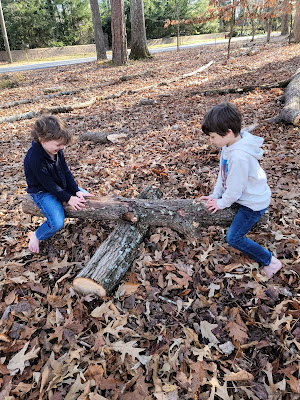

Good habitat for people AND animals.


Even their dad has gotten in on the action!
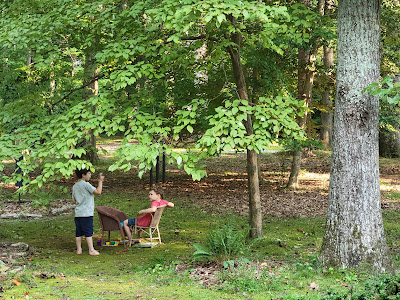

Bare feet are the norm for the boys, not the exception.  In fact, it's hard now to get them to wear shoes, even in cold weather.  Talk about "grounding"!


And imaginations run wild.


My heart truly swelled with happiness and pride the day that the boys came outside, on their own, with notebooks, guidebooks, binoculars, and pencils to "study nature".


They are not always successful in their endeavors - patience was not their strong suit as Connor tried to entice birds to eat out of his hand.  But that's part of the learning.


Even meal times have an element of outside nature for all of us, as we watch our bird feeders from the table on the back porch.  The boys have become excellent birders.  For example, it was our older grandson who first noticed the immature male Baltimore oriole feeding on the bark butter feeder a few weeks ago.  I'm not sure I wouldn't have quickly glanced at the bird and dismissed it as the pine warbler that had been frequently visiting.  I never expected a Baltimore oriole in January!

In other interactions with animals, we and the boys watch fireflies at night in the summer - last summer we noticed 3 different waves of them: one in April, one in mid summer, and one in early fall.  The April fireflies seem to stay 30' or more above the ground.  I've even found the firefly larvae occasionally as I weed.  

We planted around 30 swamp milkweed last spring and we watched for monarch caterpillars all summer long;  we did find a few and we're hoping for more next summer.  Our plants are still young.  We've found large numbers of black swallowtail caterpillars on parsley, enough that we've had to hit the grocery store for organic parsley when the hungry hordes decimated the plants they were on.

Late this summer, a box turtle wandered through the front yard - the first one I've seen in our yard in 2 years.  We see skinks and a few baby toads.  The boys haven't shown any interest in toad races yet, though! 

I hope we're building happy memories for them, strongly grounded in the natural world, that will last the boys for a lifetime.  Most importantly, I hope we're helping to create a new generation that cares enough about the Earth to help care for it in the future.

Tuesday, March 17, 2015

Another Bird Deformity

It has amazed me how many bird deformities I've seen in our yard over the last 8 years.  Some I've shared on this blog.  Mainly beak deformities, but also color changes like the piebald cardinal I've seen this winter and the "yellow breasted" red-winged blackbird I saw several years ago.

At the end of February, another beak deformity showed up.  This time it was a starling that I noticed drinking during a snowstorm.

I am presuming that this is a case of a beak malocclusion - which results in the upper mandible (in this case) not being automatically trimmed as it closes against the lower mandible.

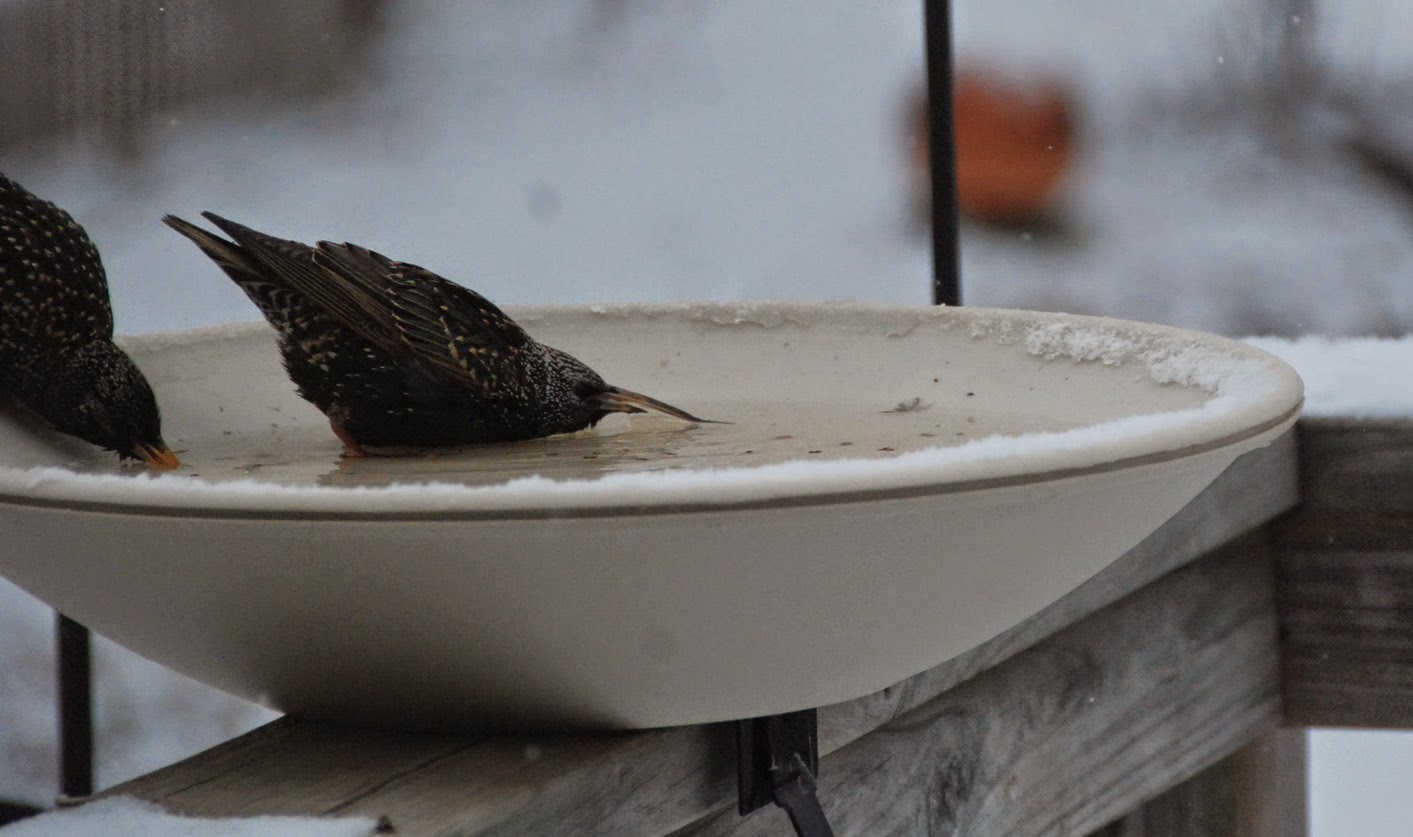
As with so many genetic abnormalities, this one is not a good change from normal.  Note how wet the feathers down the front of this individual are?

That's because it has to drink by almost immersing itself in water and skewing its body sideways, as in this picture.  I presume it has to eat this way, too.

Compared to the "normal way" a starling would eat and drink, shown by the bird on the left, this deformed starling has to work much harder for both calories and water.  As the top mandible grows longer, it will get harder and harder for this individual to get what it needs.  It also can't be good for this bird to get this wet during cold weather.  Presumably, eventually, it will weaken and die, perhaps becoming food for a predator of some sort.

Seeing individuals like this always makes me sad...but, at the same time, I have to admire them for their bravery and persistence in the face of difficulty.  As beautiful as life is overall, sometimes it seems starkly hard and cruel.  I just try to remember how often things go right, rather than how awful it is when they go wrong....


Thursday, January 01, 2015

Beginning the 2015 Yard List

Do you keep a yard list of the birds you see each year?

We do.  We've found it's a fun way to keep our eyes peeled for the unusual visitor, and it's also good for remembering the cool stuff we've seen in prior years.  Sadly, it's all too easy to forget the occasional visitors, but they can provide a real spark, both when you first observe them and, later, when you remember seeing them.

We didn't do a very good job of observing birds in 2014 - but, then, we were much more focused on Florida than usual!  As of right now, I only have a tally of 53 species for last year, which is the lowest number of species I've recorded since we moved in. As I go through my photos, though, I suspect I may be able to identify one or two more species to add to the list.  For now, in 2014, we saw 53 species.

That said, the lazuli bunting last May was a yard record.  Truthfully, though, I'd forgotten I'd seen it until I saw the photos again....

Compiled over the 8 years we've lived here, our overall yard list is now up to 121 species.  I don't think that's half bad for 10 acres in the middle of the country!

Of course, part of the fun of keeping an annual yard list is the chance to start fresh each January 1.  It's 2:13 p.m. as I write this.  Today, so far, I've tallied 20 species for our 2015 list - all of them observed from inside the house, since I'm feeling cocoonish.

So far, we have many of the normal feeder birds:  cardinals, blue jays, house sparrows, house finch, goldfinch, downy woodpeckers, red-bellied woodpeckers, starlings, chickadees, tufted titmice, slate colored juncos....

Then we have the birds that are normal to us, but may be less familiar in other areas of the country.

Harris sparrows lead the list here.  Apparently they are quite rare in many areas of the country, but here they are a common, winter feeder bird.  All 3 birds in the photo above are Harris sparrows.  We generally have 30 or 40 coming in every day.

White-crowned sparrows (adult, on the left) are also very common for us, both mature and immature individuals.  As with the Harris sparrows (on right), we generally have 30 or so feeding in the backyard each day.

Some years we have pine siskins with us during the winter, and this year appears to be one of those years.  Pine siskins are a northern bird; they only move south when they need better food supplies.  They are rather like goldfinch cousins, eating much the same menu and being about the same size.

Another winter bird that I don't see all that regularly is the spotted towhee, shown here on the left.  By the way, the "old" name was rufous-sided towhee, which was quite descriptive and somehow more appropriate.  Towhees are a bird I tend to see because I notice that something is throwing up leaf debris everywhere - they are vigorous foragers in the leaf litter and really get their heart and soul into the search!

Not all birds come in for seed or suet.  This mockingbird visits several times a day, simply to take a drink of water from one of our heated birdbaths.

Then there are the cute, rusty Carolina wrens.  I love Carolina wrens, with their jaunty tails and their quick, restless motions.  They have a HUGE voice, which is thankfully quite musical, and a similarly sized persona.  We have a pair that seems to stick around all year, although I don't always see them consistently during the winter.  They will take suet and seed, and they also frequently take a quick sip of water or two.  The picture above is from this morning.

Rather surprisingly for the beginning of January, I have a male and a female brown-headed cowbird hanging around, and half a dozen red-winged blackbirds, too.  Most of the redwings I'm seeing are male, but there is a female or two coming in as well.  The first several years we were here, I don't remember having either of these species hanging on through the winter.  Neither is here now in large numbers, but it still surprises me to have any cowbirds or red-winged blackbirds hanging around, rather than having them headed south with their flockmates.

This morning Greg noticed that one of the male redwings has a maloccluded beak, leaving the mandibles to grow way too long.  I've seen worse and this individual appears to be coping just fine, but I have to wonder if a bird like this ever finds a mate and reproduces.

My final bird of the morning, species #20, was a majestic, red-tailed hawk that sailed over the yard and landed in one of the big trees in the draw.  No photo of this one, I'm afraid - I didn't think fast enough.   Each winter we have a pair of redtails in the area, and each year I hope that they'll nest in our yard, but so far they haven't.  Hope springs eternal...I'm keeping my fingers crossed.

So that's the start of my 2015 yard bird list!  Do you put out feeders?  What birds do you notice foraging in and around your gardens?  Just think of all the dormant insects they are eating - and all the fertilizer they are depositing!  What are you waiting for?!


Wednesday, December 31, 2014

2014: A Retrospective from the Wilds of South Central Kansas, Part 1

How should I sum up my last year in this blog?  I've been obsessing about this for several days now.  I want to share a couple exceptional books I read...but they aren't gardening books.  I took the time to go through the myriad of photos that I took, looking for special shots that I hadn't shared or trends or a "one a month, best of" sort of theme, but nothing gelled appropriately.  Most problematically, some months I literally had nothing and other months I had lots still to share.

Then, on Facebook this morning, I ran across NPR's best books of 2014.  As I scrolled through the graphic, I quickly realized that I hadn't read a single book they were highlighting - and there were 250 books on the list.  I don't think I even have a single book they highlighted, despite the fact that we have many, many piles of books sitting around the house, waiting to be read!

What could I do?  What should I do...?

Oh, screw it!  After all this angst and navel gazing, I'm just going to share a few things that seem like they were really good or interesting from my year, whether they have to do with gardening or not.  Thanks for sharing these things with me!

Our Daughter's Wedding:

I've been very quiet about this - partly because it wasn't a "gardening" topic and partly because I abandoned my normal role as photographer and thus, for several months after the event, had no photos to share.  There are many photos I could share now, but one will have to suffice.

Jessica and Kyle pledged themselves to each other at the end of May, in front of family and friends.  They seem very, very good together and we are tremendously happy for them.  We wish them many loving years together...and we will do our best to support them and the family they have decided they would like to have.

How to segue from that news?!  I can't, so I'll just have to change the subject....

Interesting Birds in the Yard:

Of course, the subtext for this section is "...that I was able to catch on camera"!

At the end of January, I noticed this different-looking, sparrow-like bird joining in the flocks at the feeders:  a female purple finch.  She didn't stay around long, but it was fun to welcome her to the group for a brief visit.  I hadn't heard of purple finches in the area and I actually saw fewer northern birds than usual last winter, so having her show up was particularly surprising.

Speaking of brief visits, this male lazuli bunting was a definite first for the yard!  Coming through in May, he didn't stay around long, either, but he'd have been welcome to take up permanent residence.  He's so skinny, though, that I have to wonder if he actually made it to the breeding grounds.

Just as we're saying goodbye to 2014, we've been visited by a deep cold spell, which has brought a couple birds to the yard I hadn't seen all year:

Since this is basically just a female cardinal, she obviously isn't an unusual species, but she is sporting an unusual color pattern known as (partial) leucism or as "piebald".  I've been surprised by all of the oddballs, usually aka genetic abnormalities, that I've seen at my feeders over the last 8 years here.

Finally, the last "oddity" isn't really an unusual species either, it's just the first time I've seen one of these cute birds this year.  Pine siskins are generally a northern bird, but they "irrupt" southwards during many winters.  They weren't here in my yard last winter, but I'm seeing a fair number of them suddenly with this end-of-2014 cold spell.  Sue, of the Facebook group, Gardening with Nature in Mind, asked me for a photo, so here it is!

Good Reads With Staying Power:

I wouldn't be me if I didn't share a couple of the excellent books that I've read this year.  For the last 10 years or so, I've kept a list of all the books I've read "cover to cover" each year, no matter what genre they represent.  If I hate a book, I don't finish reading it any more - there are too many books waiting to be explored for me to waste time on something that isn't intriguing me.  Not all "good" books stay with me, though...and not all books that speak to me need to be shared.   However, some DO need to be shared, and here are the ones that fit this category for me in 2014....

Still Alice, by Lisa Genova:  With a plot line about a highly intellectual woman who develops early onset Alzheimer's,  we read this book for our local book club.  The story is told from Alice's perspective, so the reader experiences Alice's life along with her as the disease progresses and her mind changes.  It is both terrifying and reassuring...and the book seems to be based on a very current understanding of the processes of Alzheimer's.  Our book club discussion about this novel was one of the best discussions we've had yet - and that's saying quite a lot!

The other book that makes my cut this year is A Sting in the Tale, by Dave Goulson, which I reviewed recently.  Definitely excellent, and it seems especially appropriate for anyone who reads my blog!

Sadly, since I've taken up Facebok, my reading seems to have declined.  I used to regularly get through 50 books a year, plus or minus, based on my lists.  This year it was just 31 books.  I think I may need to make some adjustments.....

Well, I think I'll end Part 1 here and continue in another blog post.  Individual posts shouldn't be books, in and of themselves!  Have a great last day of 2014!

Thursday, November 21, 2013

Reconstructing the Biodiversity Records

What do these photos have in common?

The yellow-headed blackbirds that came through for a couple hours in April, 2009.....


The black and yellow garden spider that built a web across our patio door - and let me watch her eat her old web and spin a new web, early one morning....

A cowkiller velvet ant (a type of female wasp) discovering a ground nest, in September 2008, that she checked out for its suitability to lay an egg in....

An unusually colored cicada.....

Keeled treehoppers, being tended by ants, on giant ragweed....

Stilt bugs on a velvety gaura bloom at the end of June, 2008....

An adult spotted-winged antlion, resting on the side of the house in June, 2008....

Hatching wheelbugs in early May, 2008....

A goatweed leafwing (butterfly) sheltering deep in the grass in mid-March, 2008....

What do all of these have in common?  I'd forgotten about many of these discoveries, or forgotten that I got good photos of them, but now I've rediscovered them as I sort through my old files and work to compile biodiversity lists for our 10 acres.

I've been missing in action for the last month or so.  While it's a busy time of year, the main reason is that I've been immersed in a new garden-related project, my personal biodiversity project:  The Plants and Animals of Patchwork Prairie.

I'm a collector at heart, so listing all of the species that I've noticed on our property resonates deeply for me.  These aren't "my" species, but it fascinates me to learn how many different plants and animals share this simple 10 acres with us.  My goal, of course, is to increase the numbers of species that call this spot home, particularly those species who belong here but might not have homes on the surrounding land anymore.

So how am I filling in these records?  I've started by going through all of my old photos and labeling them, adding new species to the lists as I find and identify them.  This won't be totally inclusive, but I figure I need to do it anyway, and it gives me a good starting point.  Since I currently have over 26,000 photos, it's taking me a while just to tackle this introductory step.  And, as you can see from above, I'm rediscovering an interesting variety of plants and animals that I'd frankly forgotten about.

Not surprisingly, I have lots and lots of photos that I've never really edited, sorted and identified.  After all, especially during the middle and end of the summer, it's not uncommon for me to take 50 or 100 photos a day;  editing all of those photos and identifying the species in them is very time consuming.  Most of these mid- and late-summer photos have never been examined closely.  My tendency is to look through the photos when I upload them, identify the really exciting ones and edit/identify/label those, then tell myself that I'll get back to the rest "later".  Well, "later" is finally here....

Bugguide.net has been a wonderful help with the insect identifications.  My photos aren't great, especially compared with the professional entomologists' photos, but where they can identify species, the folks who volunteer on that site have very kindly done so.  I try hard to identify those that I can, before I submit a photo for identification, but it's VERY time consuming.  I can almost always get down to order and sometimes to family, but getting down to genus, let alone species, requires clicking through thousands of photos.  I am learning a lot, though!

Right now I'm about 2 1/2 years into our sojourn here, photographically speaking.  In the database, I'm up to a little over 150 plant species, 70 insect species, and 30 vertebrate species.  The vertebrate species list is particularly low, since I have a yard list of over 100 bird species alone.  I also haven't started lists for spider species or arthropods other than insects, since I have no general knowledge in those areas...yet.  However, I intend to remedy those holes as soon as I possibly can.  Generally speaking, "I've only just begun...."  I'm looking forward to my next (re)discoveries!

Thursday, August 29, 2013

An Unexpected Visitor: Rufous Hummingbird

Well, I think my computer is back up and running....  Three weeks after getting a new computer, the hard drive crashed.  While it was under warranty, that still necessitated sending it back to the Toshiba factory, which kept it for three interminable weeks.  Once we got it back, it's taken almost a week to restore the programs and files, then get my photos back up.  There's been so much going on in the yard that it's been tough to be without my technical sidekick.  Sharing these happenings just isn't the same without photos to illustrate what I'm seeing.

However, as if to celebrate the return of my computer to reasonable use again, I've had an unexpected visitor in my back yard for about 48 hours now:  a very territorial, very brightly colored, adult, male rufous hummingbird!

This is NOT a usual visitor in this area, to my knowledge, so I wasn't sure I was believing my eyes at first.  But adult male rufous hummingbirds are nothing if not distinctive, so I was soon quite sure of my identification.  As you can see, I've even been able to catch a couple photos of my wanderer - albeit fuzzy photos because I took them from inside the kitchen.

We are well out of the normal range for a rufous, but they are known to be explorers and are probably the most common out-of-range hummingbirds sighted across the United States.  Generally, they breed in western Canada and the Pacific Northwest of the U.S, then winter down in Mexico, along the west coast.

However, it's believed that rufous hummingbirds are starting to develop a secondary wintering site in southern Florida and along the Gulf Coast...so perhaps this guy is on his way to the "new wintering hotspot"!

Whatever his final destination is going to be, I'm glad that he chose to stop at our animal "bed & breakfast" for a while.  It's been a lot of fun to watch him and steal a few photos now and then.

Saturday, February 23, 2013

Sad, but Tough, "Old" Bird

It's amazing how many mutations I've noticed over the last couple years.  I found the latest one this morning, in a small flock of red-winged blackbirds that was feeding out in the back yard.  I noticed a male that seemed to be carrying a long straw or something, so I got my binoculars out to take a closer look....

It wasn't a straw, it was the poor guy's beak.

To eat, he turns his head sideways and picks up the seeds with the side of his beak/mouth, since otherwise his beak gets in the way.

He was strong enough to get in brief flurries with another bird or two, but I have to wonder how long he'll survive.  I'm amazed he's made it this long...and this far!

Thursday, February 21, 2013

Let It Snow! Let It Snow! Let It Snow!


After months of bemoaning the lack of precipitation we've been experiencing, I can finally write with excitement that we've got snow!!!  Lots and lots of snow!!!  About 12" of snow, actually, which is amazing for the Wichita, Kansas, area.  In fact, according to the Wichita Eagle, the last time this area saw a foot of snow was in 1971 - 42 years ago!


Precipitation of any sort tends to pull in more birds to my feeders than usual.  The cardinals are the most vivid, with their red feathers providing such a bright, warm contrast to the black and white winter world.  This big snow event, though, has my bird feeders being overrun by large flocks of red-winged blackbirds and cowbirds.  The former are welcome.  The latter are not, but I have not figured out a way to welcome the blackbirds while keeping out the cowbirds.   Somewhat surprisingly, the red-winged flocks are a mix of males and females;  I would have expected primarily males this early in the year.  All of these birds must have been wintering just south of here, since I rarely see more than 6-10 red-wings at a time on a "normal" day, and I hadn't seen any cowbirds yet this year.


Not surprisingly, my feeder regulars are being overwhelmed by all the short-timers.  Occasionally, though, an unusual "regular" shows up.  This pied cardinal came fairly often last year, but this is only the second time I've seen her this winter.  I'm glad to know she made it through the summer;  I wonder if she ever found a mate and produced any young?


Gardeners tend to be optimistic every spring;  I find this snow is finally refilling my springs of optimism - and just in time for the spring planting season to begin!  It's hard to imagine a more welcome winter weather event.


Thursday, February 02, 2012

Possum Pellets

In the comment section of an earlier post, I mentioned the "possum pellets" that I frequently find in the birdfeeders, letting me know that an opossum has been enjoying the largesse I put out for the birds.  I finally remembered to get a photo....


The main photo is really too busy to be able to see the pellets clearly (they seem much less "camouflaged" in real life), so I zoomed in to let you see the pellets up close.  The closeup is a little fuzzy, but gives a better feel of what you'll see in the feeder.