Showing posts with label Vacations. Show all posts

Sunday, December 07, 2014

"We're Not in Kansas Any More!"

There's little like a vacation to stir up the blood and help you see new perspectives.  We've just returned from a 10 day trip to the Florida panhandle, where we celebrated Thanksgiving with our kids and began to get a picture of what the coming years might hold for us.  One of the many enjoyable activities while we were there was a relaxing walk through a recreational area on Eglin Air Force Base.  As winter really starts to descend here in Kansas and throughout much of the country, I thought it might be fun to share some of the plants I saw just a week ago, in a warmer clime....

While Greg, Jess, Sean, and "the girls" walked on ahead, intent on true exercise, I lingered behind to take photos along the old roadway.  Truthfully I was surprised by the variety of plants I saw.  Even more truthfully, I was surprised by how many species I remembered from my gardening days in Mobile!

As I started off down the trail, my first impression was of food.  Lots and lots of food...for birds and other animals.  Food seemed to be available everywhere I looked.

There were vividly red yaupon holly (Ilex vomitoria) berries crowding each other in the sunlight.

Along with the crimson yaupon berries were other berries, such as these deep blue, greenbrier (Smilax sp.) berries, and lots and lots of seeds.  Goldenrod (Solidago sp.) seedheads were particularly full of feathery goodness.

This feathery goldenrod plant joined with beautyberry (Callicarpa americana) berries to offer the local wildlife a feast.

As I walked and looked and took photos, the old phrase, "Toto, we're not in Kansas anymore!" kept echoing through my head.  No, it for sure wasn't Kansas.  Sometimes it amazes me how few plant species are found both along the Florida/Alabama coastline and up here in the prairie land.  Certainly there are genuses that are in both areas, but the species are quite separate.

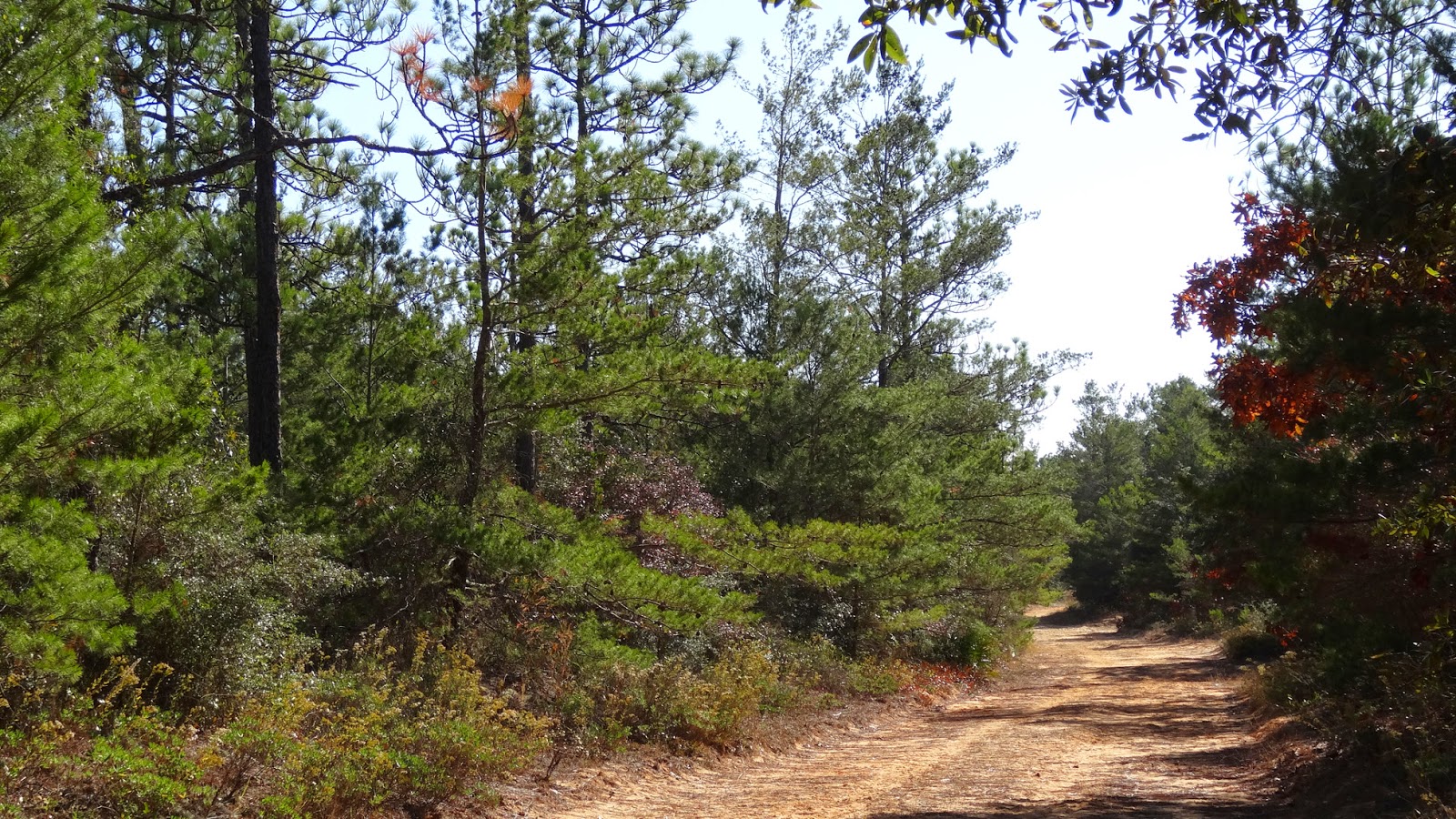
Between Kansas and the Gulf Coast, the feel of the plant communities is very different too - which is hardly surprising.  Sporting a covering of pine needles and a diversity of moss and lichen on a heavily sandy soil, this view of the woodland floor is typical for the area we were visiting.

Towering over the rest of the vegetation were the longleaf pines (Pinus palustris).  Historically, these keystone plants formed massive open forests which predominated all along the southern coastal plains, from Virginia around the corner to Texas, until about 100-150 years ago.  First the majestic longleafs were tapped to make turpentine and cut to make ship masts, then later they were cut down to burn in steam engines as the country expanded.  Of course, their wood was also used in building as well.  The land that was cleared was either put into agriculture or replanted with faster growing slash or loblolly pines.  Within just a few decades, almost all of the longleaf forests were gone.  Nationwide, a University of Florida study done in 1997 found only 15 sites with virgin longleaf pine forest left, totalling about 1600 acres.

A typical understory plant throughout much of the area, saw palmetto (Serenoa repens), gives a vaguely tropical feel to the woodlands.  It is a true native (unlike most of the others palms and palm-like plants you see along the Gulf Coast) and it is very valuable for wildlife.

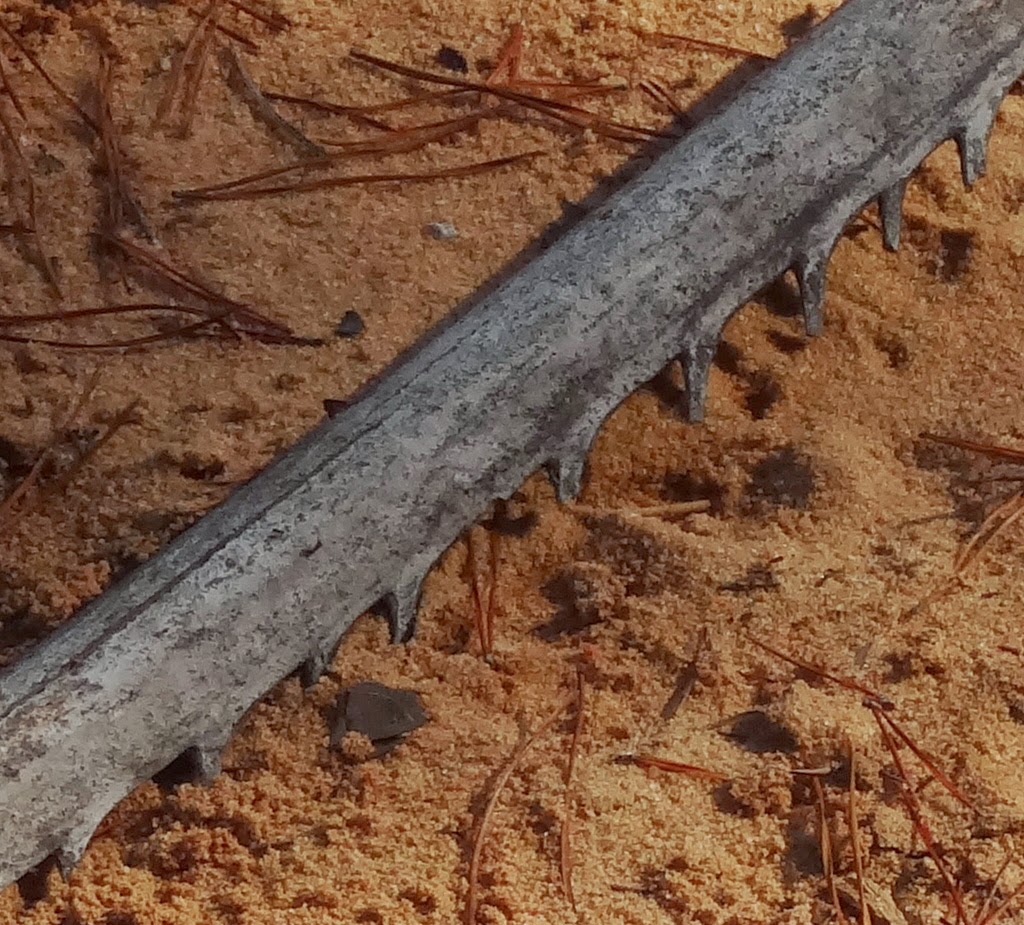
Here is a remnant of the "stem" of one of the big fan leaves found on saw palmetto.  You can see where the name "saw" comes from!   It makes me think of fossil dinosaur jaws whenever I see it.

Usually not considered a beneficial plant, there was a lot of greenbrier (Smilax sp.) in the understory along the path, too.  I actually like greenbrier for its wildlife versatility - the berries are great food for birds and other animals, while (as is typical for native plants) the leaves are larval food for caterpillars of several different moth species such as the turbulent phosphila and the ruby quaker.  Note:  the names are cool, but the adult moths are pretty cryptic, a.k.a. drab.   Still, they too are food for numerous other animals.  Many greenbrier vines are bristling with thorns and can serve as excellent shelter and nest protection for birds and other small animals.

This essentially thornless greenbrier had a few healthy berries to share, and you can see the parallel leaf veins that help identify it as a Smilax.

One find that surprised me was what I think was a nicely sized American holly (Ilex opaca).  While they are native to the area, I didn't see them very often when we lived in Mobile.

Scattered in small clusters amongst the broad leaves, the holly berries were bright red and looked great, but they didn't put on as much of a show for the camera as the yaupon berries did.  With its yellowish green leaves, American holly is widely used in crosses with other species, but isn't commonly found as a straight species in the nursery trade. 

Walking back along the trail, though, and thus seeing from a different direction with a different angle of light, the leaves of the holly do look much darker.

To eyes accustomed to fall further north, the woodlands still look very green, but signs of fall were everywhere.  While I've talked about the colorful berries and fluffy seedheads, there was also some fall color.  An excellent source of fall color in longleaf territory is sparkleberry, Vaccinium arboreum.  In the blueberry genus, sparkleberry has tiny blue berries that are snatched up by birds as soon as they ripen, which is earlier in the year, but their shiny leaves color beautifully and remain on the plant for a long time.  This individual was a beautiful maroon...

while across the path and down the way a bit, another sparkleberry went in for oranger and golder tones.

Speaking of orange and gold, there were a few yellow-gold blooms still gallantly blazing, although I don't know what they were, ...

and a male monarch was traveling the path with me, too.  He rested on a yaupon long enough to give me a "photographic opportunity" before continuing on his journey.  I wonder if he'll make it to Mexico or not?

There are 2 other plants that I want to highlight from this walk, but I think I'll separate them out into another post or two. 

Meanwhile, Greg, Sean, Jess, Gabby and Dahlia got done walking and have come looking for me - so I'll end this ramble.  Hope you enjoyed my glimpse of the south land in your chilly December!


Friday, December 28, 2012

Tallgrass Prairie National Preserve

Years ago - sometimes it seems like it was in another life - I worked with and for the Kansas Audubon Council.  One of our projects at the time was trying to get the Z-Bar Ranch, as it was known then, into federal protection as a national park.  Through the work of many dedicated people and organizations, with the Kansas office of The Nature Conservancy serving as a key link, that dream came to life - and the American people now have under their protection the Tallgrass Prairie National Preserve.


The Tallgrass Prairie National Preserve has the Z-Bar Ranch, originally known as the Spring Hill Ranch, as its core.  Located near Strong City, Kansas, the Spring Hill Ranch was settled by a wealthy cattleman and his family in the late 1870's and early 1880's.  Stephen Jones built a literal mansion out of native Flint Hills limestone, situated on the side of a hill above the main road into Strong City.


To go along with his mansion, he built a huge limestone barn, a limestone outhouse (a 3 holer!), a limestone ice house, a limestone chicken coop, a limestone curing house and a limestone carriage house.  And 30 miles of limestone "fence."


A little to the north of his ranch headquarters, he donated land for a school house...and a limestone school house was built.


All of these beautiful limestone buildings still stand today.  For decades, they intrigued travelers along Highway 177, which runs directly in front of the ranch house, but very few were privileged to see the insides of any of the buildings, even though they were rarely owner occupied after about 1900.

Now travelers are privileged enough to be able to explore both the buildings AND the surrounding prairie through a collaboration between  the National Park Service and The Nature Conservancy.  There are self guided tours of the buildings, wonderful nature trails of various lengths, bus tours of the "back country" during the summer and fall, and events held throughout the year.  There is a newly built interpretive center, too, which is due to get its permanent exhibits sometime this spring.  For now, they show a 10 minute film about the preserve and the tallgrass prairie, have bathrooms, a gift shop, and a very helpful park ranger to answer questions or give you guidance.

While our son Sean was home from Boston for Christmas, we decided to go up and check it out.  Neither Sean nor Greg had ever been there, although we'd all driven by it many times traveling between Wichita and points north and east. Plus, while December temperatures that are regularly in the 60's make me nervous about global warming, I have to admit that a bright blue day with a high of 64 degrees F. was extremely pleasant for exploring the prairie!

Here Sean and I are posing for the camera on the old road bed, with the mansion behind us on the hill.


The old road bed in front of Spring Hill Ranch is extremely obvious from some angles and almost invisible from others.  Here you can see the path of the old road to Strong City, running next to the new highway, with an old American elm (Ulmus americana) arching over it.


That old elm just fascinated me!  Such a huge, majestic tree!  And out on the prairie - thriving!


The site selected by Stephen Jones for Spring Hill Ranch was rather unusual in that it had a good spring located on top of a hill - hence the name, Spring Hill Ranch.  Rather oddly, then, the vegetable garden was located on top of the hill where it would be easy to water during dry times.  With the suppression of fire around the ranch buildings, a cedar grove has established on top of Spring Hill also.


The Southwind Trail starts by this vegetable garden, goes through the cedar grove, and meanders the pasture to the north of the ranch buildings, with a spur going up to the limestone schoolhouse.  This is a pleasant, relatively level trail that is just right for an easy stroll.  As we left the cedar grove, this pair of cedars, with the small series of steps between them, felt like a gateway into the open prairie.


In the shrubs to the right of the "gateway", several bright orange clusters of berries caught my attention - American bittersweet (Celastrus scandens)!  Although this attractive vine is native here in Kansas, I haven't seen it growing in the wild for a long time.  I suspect that most of it, at least along the roadways, has been killed by overcollecting for Thanksgiving and Christmas decorations.


Just beyond the "gateway," if you look to the north, you can see the old limestone schoolhouse on the next hilltop....


Sean and Greg decided to go up to the schoolhouse, while I stayed on the main loop of the trail and photographed a few shrubs and wildflower seed heads.


I could ramble on for a long, long time about all the interesting and beautiful things we saw...but I won't.  Instead I will recommend one last treat that we discovered in the downtown Strong City.  Having not had any official lunch and having explored the buildings, the visitor's center, the Southwind Trail, the schoolhouse, and the Bottomland Nature Trail, we were rather dry and hungry when we left the Preserve.  Sean had seen a restaurant in Strong City whose name appealed to him, so we pulled in to check it out....


Ad Astra was wonderful!  We were expecting to just get a coke and a snack, then go home to eat, but an enjoyable atmosphere of brick and stone walls with a gorgeous tin ceiling, as well as a gourmet sandwich and entree menu, enticed us to have dinner here.


A delicious bison burger with a side of black bean chili called to Sean,...


while I fell for a Reuben sandwich with homemade potato chips and a homemade pickle, and Greg had a fantastic looking (and tasting) ham and cheese creation with a broccoli salad side.  Boulevard and Ad Astra ales were on tap, so we were able to quench our thirst too!  Last of all we decided to splurge on dessert:  a decadent peanut butter and chocolate cheesecake slice for Greg, a rich peppermint and chocolate cheese cake slice for Sean, and a delicious creme brulee for me.  All worth the stop, just on their own!

All in all, a most excellent adventure!  If you've never checked out the Tallgrass Prairie Nature Preserve and you live somewhere within a couple hours, I'd say it would make both a nice trip for yourself and a great place to share with visitors.  If you're driving through Kansas sometime, I'd highly recommend checking it out for a unique and memorable experience.  It's one of the only places left where you can truly experience the American tallgrass prairie in its vastness and openness.  Just don't forget to refresh yourself at Ad Astra (or in nearby downtown Cottonwood Falls) when you're done!


Thursday, May 17, 2012

A Wildflower Treat in Texas

I remember Lady Bird Johnson primarily for initiating the "Keep America Beautiful" campaign.  Why this sticks in my mind is rather a mystery to me, since the only parts of that campaign that I remember were the anti-litter and anti-billboard pushes that went along with it.  In November, 1963, when Lady Bird became First Lady, I was 7 1/2 years old and in 2nd grade.  While to this day I get disgusted and angry when I see someone throw trash out a car window, I don't remember knowing anything about her interest in wildflowers, along the roadside or within the landscape proper.

Of course, in more recent years, you can't be interested in native wildflowers without being aware of the Lady Bird Johnson Wildflower Center in Austin, Texas.  I've been on the website many times, but I had never visited the center itself...until last Sunday.

And what a treat that was!  Truthfully I was actually surprised at how beautiful, practical and educational the Wildflower Center is.  I'd imagined the Wildflower Center as primarily interested in beautification of the roadways, acting in conjunction with the bluebonnets and Indian paint blooms along the Texas highways, but I was not giving Lady Bird Johnson and her Wildflower Center anywhere near the credit that she and it are due.

Walking into the Center, there was a fantastic quote by Lady Bird Johnson...which I stupidly did not photograph or write down.  My memory is that it was the quote from which others have extracted this phrasing, "Native plants give us a sense of where we are in this great land of ours. I want Texas to look like Texas and Vermont to look like Vermont."  The entire quote set the perfect tone for the rest of the visit: while the educational emphasis was on the importance of native plants in general, the gardens and natural areas were specifically exhibiting native plants of the hill country of Texas. 

That combination of general theory (the importance of native plants) and site specific examples in the Wildflower Center was brilliant.  My only dismay is that there isn't a series of Lady Bird Johnson Wildflower Centers around the entire country, each emphasizing the same general theory, but showcasing that theory with each region's own, site specific examples of wildflowers and cultural use of the vegetation.

For starters, the Exhibit Gallery had a very simple but also very effective stand displaying individual cut blooms of the wildflowers currently blossoming on the property.  (As a side note, I could just imagine being the staff person responsible for keeping that particular display current and looking good!)


There is a big aqueduct that collects rainwater from all of the roof surfaces and stores it for use during dryer seasons.  In the courtyard, the plantings are all native but the ambiance is restrained and sedate.  One planting that caught my eye (and it's native here in Kansas, so I can copy it if I want to!) was coralberry or buckbrush, Symphoricarpos orbiculatus, used as a groundcover under one of the trees.


Nature trails went through the region's primary habitat types:  open meadow and woodland.  I was stunned at the carpet effect of many of the wildflowers, especially in the open meadows.  Near the buildings there were smaller areas devoted to dry creekbeds, moist wetlands, etc.   In these photos, Greg is standing beside the relatively small entrance to a cave, hidden in this clump of brush, below, along the open meadow trail.  The brush looked totally unremarkable - only a sign talking about a cave encouraged us to take a closer look.


Probably the most useful exhibits of all were the examples of how the native plants, especially wildflowers, could be used in more "typical" human landscapes, with several different demonstration home landscapes, a big butterfly garden area, and individual beds highlighting a cutting garden, edible native plants, medicinal plants, dye plants, water gardens, groundcovers, a white garden, a succulent garden and so forth.

We toured the Center at mid-day, so I didn't take many photos.  Most would have been pretty badly washed out.  I'm rather regretting that decision, though, as I try to share what we saw in this blog post; hindsight is always 20/20.

At one point as we walked on the trails, Greg overheard a man comment that it was obvious the entire area had been heavily overseeded.  We doubted that...and our suspicions were justified when we drove north out of Fredericksburg the following day:  there were many areas literally and liberally carpeted with wildflowers, especially with golden plains coreopsis (Coreopsis tinctoria).  From the large areas of recently bloomed out gaillardia, it was obvious they'd been just as spectacular a week or two earlier. 

It seems appropriate to end this post with another quote from Lady Bird Johnson, this time captured from one of the display boards in the Exhibit Gallery....


Thursday, December 08, 2011

Trees - The Natural Playground

I've been an absent blogger...and I apologize. Not surprisingly, I've got many, many photos to share...because I've been busy...and I haven't had time to blog. Funny how that works!

We got back a few days ago from a wonderful 10 day trip to the wilds of Florida's panhandle. While we were there, we stayed with Jess, our daughter, in her new house in Ft. Walton Beach, and also spent time in Pensacola visiting with my side of the family who were all gathered there for Thanksgiving and in Mobile with some of my good, good friends there.


Jess's new home was actually built several decades ago and the yard boasts quite a few large, picturesquely beautiful, sand live oak trees that corkscrew towards the sun in unusual and interesting patterns.

When the extended family came for a visit one day, it was truly amazing to see how quickly those trees attracted everyone - especially the children and the young at heart! I don't think the most expensive play equipment in the world would have attracted everyone as quickly and surely as these sand live oaks did!

From 7 to 17....


...from 5 to 47....


...from 30 to 57 - all the kids had to play!!!

Tuesday, October 18, 2011

"What We Did On Our [October] Vacation"

We toddled off to Boston about 2 weeks ago for a long overdue visit with our son, Sean. I was finishing David Abram's interesting book, Becoming Animal, at the time and I fully expected to feel a little "out of place" when we first landed...but, truthfully, I didn't.

After we'd been there for a few days, I started noticing things that surprised me. We walked a lot and used public transportation almost exclusively while we were in Boston itself. I loved it (despite my bad knees). In fact, by the 4th or 5th day, my knees were doing somewhat better, which seemed counter-intuitive since the pain is caused, at least in part, from disappearing cartilage. I noticed, too, that the people who walked and used public transportation seemed to have a much lower incidence of obesity than is standard for our country. (It was actually a rather glaring difference.)

Locally sourced foods were rather easy to find in the restaurants - many restaurants even listed "their" local farms by name. The selections in these restaurants were always fresh and delicious and often served in unusual ways.

Sunday brunch at Henrietta's Table in Harvard Square, a gustatory extravaganza that Sean was eager for us to experience, was particularly spectacular. I have to say that getting the chance to sample all of the local foods was really exciting and enjoyable, as I only know one restaurant here in the Wichita area that works with local foods (Lotus Leaf in Delano - which is excellent, by the way).

On the natural front, though, things were a little less rosy. I didn't hear the wind rustling the leaves in the trees there, and it's a constant accompaniment to life here. I missed it. There were few birds around and even fewer bird songs...and I didn't see any bird feeders set up at all. At one point near the Boston Museum of Science, we heard a mockingbird in a small group of Bradford pears and stopped to try to see it, but it had hidden itself craftily out of sight. Yes, Boston is a city, but it still seemed light on bird life in comparison to other cities I've visited. Maybe it was just the season.

There were more honeylocusts being used as street trees than I expected. Somehow I think of this species as a plains tree rather than as an eastern deciduous woodland tree. Occasionally the honeylocusts were used particular effectively. This photo is of an allee of honeylocusts leading from Harvard Square down to the riverside park. I'd never thought of using them in this manner, but it created a distinct sense-of-place with a pleasant, lacy effect...if not the gravitas that I might have expected for a path coming off of Harvard Square!


We were able to make it a little ways up the coast of Maine during the middle of the week while Sean was working. The Rachel Carson National Wildlife Refuge called to us and we enjoyed the opportunity to learn a bit about how the salt marshes along the coast work, as well as enjoying some very pretty fall foliage (photo above). The office had binoculars and a bird guide available to borrow, so I was even able to do a little birding. It was early afternoon, which is hardly a grandly productive time to bird, but I managed to see several fun species: a male black-throated blue warbler (the first I've seen in a long time!), a small flotilla of green-winged teal, and several white-throated sparrows.

Although this last has little to do with nature, we stopped for the night in Camden, Maine, and went down to the harbor to look around. Both of us were rather amazed and amused at the way they now winterize some of the boats, including fairly large sailing vessels - they shrinkwrap them! One had been completed and 2 more were in the process of being "put to bed" in this way. I can only imagine the comments that the ghosts of sailors past are making!


Although I'll spare you further descriptions, we had many other interesting and enjoyable experiences while we were there - a great tour guide on the Freedom Trail, lunch at the Green Dragon pub where the Sons of Liberty often met, the chance to see an excellent exhibit on Pompeii at the Science Museum, and, of course (and foremost!), the chance to enjoy a wonderful visit with Sean and Tina. All in all, a great getaway.