Behold the great herbivore of the prairie!
No, not the bison. Not any more. We killed most of those off. Remember?
No, this guy. The lowly grasshopper. Grasshoppers, as a group, are now considered to be the primary herbivore on the prairie. What each individual lacks in terms of gravitas and majesty is more than compensated for by the sheer number of individuals and their collective appetite.
In our yard this summer, the grasshoppers have been flexing their herbivorous muscles. They started with the potato plants. Seemingly overnight these went from healthy and green to decimated central veins on a stem. Nothing else in the garden appeared to be touched.
It only took the grasshoppers a day or two, though, to eat those potato vines. Their appetite was whetted. Surprisingly, the onion and garlic plants were next. Down to nubs the onions went. The bunching onions were hammered. The garlic plants became 6" brown stubs sticking out of the soil.
Soon I noticed grasshoppers on the asparagus plants. The iris leaves around the yard were getting shortened daily, too, and every time I walked across the remaining fescue, clouds of little nymphs erupted. Before long, the fescue looked like it had been mowed short, the asparagus was abandoned after being nibbled down to brown, drying stems, and the iris leaves that had ranged from 12" to 24" tall just a week before were now topping out between 2" and 8".
The strawberries were next. They'd given us a wonderful crop just a few weeks before and we were discussing cutting them back, but I was afraid that the grasshoppers would love fresh, new leaves. Not to worry. The grasshoppers decided that the old leaves were just fine... though the new leaves were even better.
Somewhere along in this process, the grasshoppers also ate almost every leaf on my newly planted Agastache. Drought tolerant? Perhaps. I didn't really get a chance to check that out, because Agastache certainly isn't grasshopper tolerant!
The six-legged varmints have also stripped the old cole and kale plants to "sticks". I pulled most of them out and fed their poor, remaining carcasses to the compost pile, but I left these 6 kale plants in the ground, just to see what would happen. There was, after all, just a tiny bit of green in their "hearts".
Even the bullet-proof Jerusalem artichoke is not immune to grasshopper depredations this summer, although this hungry, leaf-eating beauty had better beware of the wheelbug lurking behind the next leaf.
Now the grasshoppers have descended on to my Rose-of-Sharon shrubs along the driveway. (I showed you what was left of them 2 summers ago, after the grasshoppers got done.) Any bets on how long it will be until these, too, are again down to woody twigs?
My biggest question is, "Why aren't the grasshoppers interested in my crabgrass?" It's green, it's healthy-looking, and, well, it's growing like a weed! I'd gladly donate it to the grasshopper cause. But the jawed marauders don't seem interested.
It's 102 today. Last week it got to 107. I'm starting to dream of a killing frost. If one doesn't come soon, I may not have any plants left BUT crabgrass around here!
Friday, July 12, 2013
Thursday, July 04, 2013
Wavy Leaf Thistle - A Welcome Prairie Native
Say "thistle" and the automatic response is to think "aggressive, obnoxious weed" and "How fast can I get rid of it?" Wavy leaf thistle (Cirsium undulatum), though, is the reasonable cousin in a family of assertive rapscallions. With its gray-green foliage, short height, and less heavily armed leaves and stems, it's definitely a kinder, gentler thistle. It's also not as likely to take over the landscape as many of its relatives are, a distinct advantage when thinking about including it in a garden or in a restoring prairie.
Luckily, the basal rosettes of wavy leaf thistle are not easy to confuse with other thistles. The gray green color and wavy leaf edges are a straightforward "tell", so the plant is easy to identify, even in very early spring.
I like the color and texture of the leaves of wavy leaf thistle, but my favorite part of the plant is the bloom.
Not only is it a beautiful, clear, light purple that looks for all the world like a purple powder puff in a rough, green handle, but these flowers are like magnets to insects. Even as I was focusing in on this blossom for a second shot, I noticed a hint of orange - a sulfur butterfly had landed on the backside, not more than a couple feet away from me, while I was taking the first photograph.
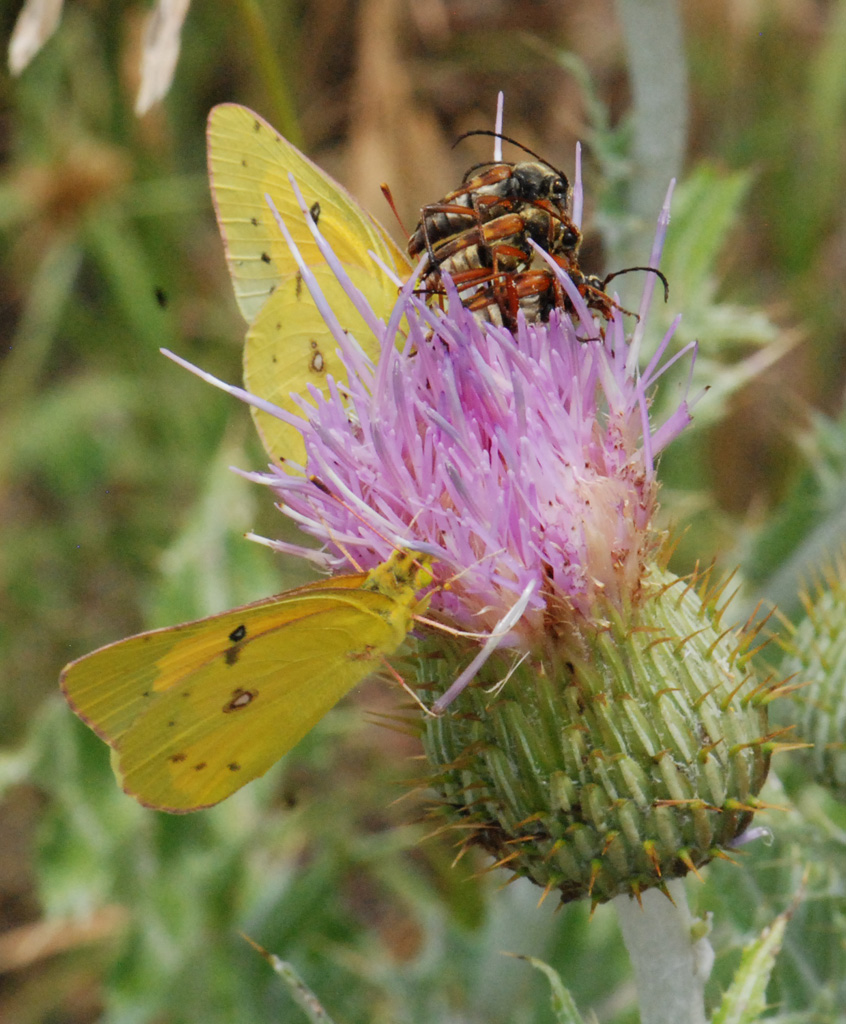
I managed to miss the early blooms of the thistles this summer, but obviously there were still a few around when I went tromping through the Back Five yesterday afternoon. The most popular single bloom was this one which, for some reason, had attracted 2 sulfur butterflies and a triple-decker array of flowerloving longhorn beetles. Its nectar must have been particularly sweet!
Sometimes it didn't seem to be the nectar that attracted insects to the blossoms. On this blossom, a bumblebee and two beetles almost seemed to be resting in the shade of the purple pom-pom.
Even when definitely past their prime, the fading wavy leaf thistle blooms seem to attract more than the normal number of insects. The sulfur butterflies still found them attractive, as did a moth on this bloom.
Here a bumblebee seemed to be nectaring, while a grasshopper nymph watched.
And a flowerloving longhorn beetle still thought this over-the-hill bloom was worth feeding on, as well.
I'm sure that, if I had looked a little longer or a little harder, I could have found many more insects enjoying these showy flowers.
So have I put any wavy leaf thistles into my flower beds? No, actually I haven't. In fact, I didn't even think of doing it until I started writing this paragraph! But now I'm thinking that I ought to give them a try. The bloom color would echo the lavender of wild bergamot (Monarda fistulosa) nicely, while the leaves would both give a different form in the garden mix and, at the same time, echo the color of the large, gray-green leaves of the giant coneflower (Rudbeckia maxima). When I do try them, I'll let you know how it works out. After all, I wouldn't try this with just any old thistle!
Luckily, the basal rosettes of wavy leaf thistle are not easy to confuse with other thistles. The gray green color and wavy leaf edges are a straightforward "tell", so the plant is easy to identify, even in very early spring.
I like the color and texture of the leaves of wavy leaf thistle, but my favorite part of the plant is the bloom.
Not only is it a beautiful, clear, light purple that looks for all the world like a purple powder puff in a rough, green handle, but these flowers are like magnets to insects. Even as I was focusing in on this blossom for a second shot, I noticed a hint of orange - a sulfur butterfly had landed on the backside, not more than a couple feet away from me, while I was taking the first photograph.
I managed to miss the early blooms of the thistles this summer, but obviously there were still a few around when I went tromping through the Back Five yesterday afternoon. The most popular single bloom was this one which, for some reason, had attracted 2 sulfur butterflies and a triple-decker array of flowerloving longhorn beetles. Its nectar must have been particularly sweet!
Sometimes it didn't seem to be the nectar that attracted insects to the blossoms. On this blossom, a bumblebee and two beetles almost seemed to be resting in the shade of the purple pom-pom.
Even when definitely past their prime, the fading wavy leaf thistle blooms seem to attract more than the normal number of insects. The sulfur butterflies still found them attractive, as did a moth on this bloom.
Here a bumblebee seemed to be nectaring, while a grasshopper nymph watched.
And a flowerloving longhorn beetle still thought this over-the-hill bloom was worth feeding on, as well.
I'm sure that, if I had looked a little longer or a little harder, I could have found many more insects enjoying these showy flowers.
So have I put any wavy leaf thistles into my flower beds? No, actually I haven't. In fact, I didn't even think of doing it until I started writing this paragraph! But now I'm thinking that I ought to give them a try. The bloom color would echo the lavender of wild bergamot (Monarda fistulosa) nicely, while the leaves would both give a different form in the garden mix and, at the same time, echo the color of the large, gray-green leaves of the giant coneflower (Rudbeckia maxima). When I do try them, I'll let you know how it works out. After all, I wouldn't try this with just any old thistle!
Bird ID - Can You Help?
For all of you birders out there, I have a question: can you identify this bird? From its behavior, I think it was quite young - there were two that flushed up from the grass quite close to me, then flew onto the barbed wire fence nearby. By the time I had gotten over my surprise and thought to take a photo, one of the two had flown off, but this one remained and let me take two photos before flying off to join its companion.
The fence is at the back of our property, with our 5 acre (restoring) prairie on one side and a wheat field, newly harvested, on the other side. Both birds flushed from our side of the fence.
With the large eye in proportion to the head, the relatively flat head, the white eye ring, the white stripe through the center of the crown (which you can't see in my 2 photos), the pink legs and the mainly pink beak, and the relatively unmarked face, I'm wondering about a young grasshopper sparrow. Thoughts, anyone?
The fence is at the back of our property, with our 5 acre (restoring) prairie on one side and a wheat field, newly harvested, on the other side. Both birds flushed from our side of the fence.
With the large eye in proportion to the head, the relatively flat head, the white eye ring, the white stripe through the center of the crown (which you can't see in my 2 photos), the pink legs and the mainly pink beak, and the relatively unmarked face, I'm wondering about a young grasshopper sparrow. Thoughts, anyone?
Woohoo! The Big Weed Is Done!
I've traded the last week of my gardening life (and probably the last cooler temperatures we'll see until September or October) for a weed-free front lawn. As I sat on my hiney for 30 hours, more or less, carefully pulling out the crabgrass and other invaders, I had plenty of time to wonder if I'm truly just a crazy Luddite - or if I'm doing the environment (and us) a huge favor by handling a perceived problem the low-tech, non-chemical way.
Scene: The front lawn, where the goal is a carpet of buffalograss.
The center of the lawn was plugged 2 summers ago during late July and early August, with half dead plugs of buffalo grass. It has filled in nicely, but it still had some crabgrass and prostrate spurge that managed to come through this summer, probably at least in part because Greg had mowed it very low this spring to help it green up more rapidly.
Along the edges and between the lower flower bed and the main body of the lawn, where there had been remnants of the old mix of fescue, Bermuda grass, and weeds, Greg added more buffalo grass plugs this spring, so those areas had lots of open soil this spring that had filled in thickly with weeds since then.
(Important note: The back lawn, which was the first area we plugged two summers ago, is looking great and needs almost no weeding at all this summer.)
Conundrum the First:
The standard way to manage a buffalo grass lawn after plugging is simply to mow it regularly at about 2" height. Slowly, as the buffalo grass fills in, fewer and fewer weeds will germinate; those that do germinate will be chopped off and stressed, allowing the buffalo grass to continue getting thicker each year. We could certainly do that, but I wanted a weed free lawn faster than that. Greg really wanted a weed free lawn too.
Conundrum the Second:
Why, in heaven's name, do I care about having a weed free lawn? I've never worried about it before. Mulling over this question, I realized I want to be able to choose not to mow the lawn at all, during the summer, because I love the soft, fluffy look that a buffalo grass lawn gets without mowing. However, ANY weed shows up starkly in that situation, because the weed is almost invariably taller, stiffer, and/or a wildly different color of green than the softly undulating, gray green of the buffalo grass..
Also of significance regarding this question of weeding, my weeding mantra ("One year of seed, 7 years of weed") kept running through my brain. Any crabgrass or other weed that I allowed to seed into the lawn this summer would simply mean more weeds germinating in future years.
Conundrum the Third:
Why not judiciously use an herbicide? Although buffalo grass is notoriously sensitive to herbicides, there are a few that are labeled for it, and Greg keeps reminding me that "antibiotics" are occasionally necessary and useful. But I just can't bring myself to use the darn things except against plants such as poison ivy - it would be too easy for me to keep justifying the tradeoff as far as time goes, probably leading me to a quick and rapid slide down a very slippery slope. I also knew, though, that Greg would have no such qualms - and therefore I also wanted to give him his weed free lawn before he took matters into his own hands!
So, despite my periodic plunges into feelings of total ridiculousness over spending so much time WEEDING GRASS, for Pete's sake, I kept at it - and I am happy to report that the front lawn is now weed free (or, at least, as weed free as it's going to get this summer) and gracefully descending into dormancy as the heat and drought of another prairie summer take hold.
Ironically, I have no pretty pictures to share with you of my newly pristine lawn. Did you catch the part about the lawn descending into dormancy? That means that the photos I took this morning make the look dead - not the sort of image that inspires. In person, the health and vibrancy of the lawn is obvious. In a photo (at least, in MY photos), not so much. So I'll share pictures after the next good rain, when the returns to its soft, gray-green beauty.
A final thought: I'm not sure that buffalo grass is a good option for most American yards these days. The cultural fixation on vivid green, crew cut carpets in front of each home - weed free and, often, actually maintained by a mow, blow & go crew - is simply not in sync with a buffalo grass lawn. I can't imagine anyone else in this country being as...stupid?...stubborn?...dogmatic? as I've been to hand weed even a tiny area of lawn, and I can't imagine anyone in this country willingly and knowingly accepting a lawn that isn't weed-free from the get-go. So, while I love our soft carpet of buffalo grass lawn, I can't really recommend it for others without pointing out its serious (to the typical American gardener/homeowner) limitations.
That said, I'm going to be thoroughly enjoying our soft, gray-green carpet of grass for the rest of the summer without feeling the need to mow or fertilize it and rarely feeling the need to water it. I'm really glad that we made the switch to buffalo grass. It was definitely the right decision for us.
Scene: The front lawn, where the goal is a carpet of buffalograss.
The center of the lawn was plugged 2 summers ago during late July and early August, with half dead plugs of buffalo grass. It has filled in nicely, but it still had some crabgrass and prostrate spurge that managed to come through this summer, probably at least in part because Greg had mowed it very low this spring to help it green up more rapidly.
Along the edges and between the lower flower bed and the main body of the lawn, where there had been remnants of the old mix of fescue, Bermuda grass, and weeds, Greg added more buffalo grass plugs this spring, so those areas had lots of open soil this spring that had filled in thickly with weeds since then.
(Important note: The back lawn, which was the first area we plugged two summers ago, is looking great and needs almost no weeding at all this summer.)
Conundrum the First:
The standard way to manage a buffalo grass lawn after plugging is simply to mow it regularly at about 2" height. Slowly, as the buffalo grass fills in, fewer and fewer weeds will germinate; those that do germinate will be chopped off and stressed, allowing the buffalo grass to continue getting thicker each year. We could certainly do that, but I wanted a weed free lawn faster than that. Greg really wanted a weed free lawn too.
Conundrum the Second:
Why, in heaven's name, do I care about having a weed free lawn? I've never worried about it before. Mulling over this question, I realized I want to be able to choose not to mow the lawn at all, during the summer, because I love the soft, fluffy look that a buffalo grass lawn gets without mowing. However, ANY weed shows up starkly in that situation, because the weed is almost invariably taller, stiffer, and/or a wildly different color of green than the softly undulating, gray green of the buffalo grass..
Also of significance regarding this question of weeding, my weeding mantra ("One year of seed, 7 years of weed") kept running through my brain. Any crabgrass or other weed that I allowed to seed into the lawn this summer would simply mean more weeds germinating in future years.
Conundrum the Third:
Why not judiciously use an herbicide? Although buffalo grass is notoriously sensitive to herbicides, there are a few that are labeled for it, and Greg keeps reminding me that "antibiotics" are occasionally necessary and useful. But I just can't bring myself to use the darn things except against plants such as poison ivy - it would be too easy for me to keep justifying the tradeoff as far as time goes, probably leading me to a quick and rapid slide down a very slippery slope. I also knew, though, that Greg would have no such qualms - and therefore I also wanted to give him his weed free lawn before he took matters into his own hands!
So, despite my periodic plunges into feelings of total ridiculousness over spending so much time WEEDING GRASS, for Pete's sake, I kept at it - and I am happy to report that the front lawn is now weed free (or, at least, as weed free as it's going to get this summer) and gracefully descending into dormancy as the heat and drought of another prairie summer take hold.
Ironically, I have no pretty pictures to share with you of my newly pristine lawn. Did you catch the part about the lawn descending into dormancy? That means that the photos I took this morning make the look dead - not the sort of image that inspires. In person, the health and vibrancy of the lawn is obvious. In a photo (at least, in MY photos), not so much. So I'll share pictures after the next good rain, when the returns to its soft, gray-green beauty.
A final thought: I'm not sure that buffalo grass is a good option for most American yards these days. The cultural fixation on vivid green, crew cut carpets in front of each home - weed free and, often, actually maintained by a mow, blow & go crew - is simply not in sync with a buffalo grass lawn. I can't imagine anyone else in this country being as...stupid?...stubborn?...dogmatic? as I've been to hand weed even a tiny area of lawn, and I can't imagine anyone in this country willingly and knowingly accepting a lawn that isn't weed-free from the get-go. So, while I love our soft carpet of buffalo grass lawn, I can't really recommend it for others without pointing out its serious (to the typical American gardener/homeowner) limitations.
That said, I'm going to be thoroughly enjoying our soft, gray-green carpet of grass for the rest of the summer without feeling the need to mow or fertilize it and rarely feeling the need to water it. I'm really glad that we made the switch to buffalo grass. It was definitely the right decision for us.
Monday, June 24, 2013
An Exciting Variation on a Theme?
Last week I was up in Iowa, getting together with family to celebrate the life (and mourn the passing) of an uncle of mine - a musician and teacher of music who shared his gift widely and passed along his knowledge to many. He was one of those individuals who truly brought more beauty into this world through his living.
But on to the reason for my post. While there, we visited the home of a relative renowned for her gardens, her cooking, and her hospitality...who just happened to have a rather unusual tree in her yard. Looking around, we noticed a similar tree in a neighbor's yard as well.
These two maples had sections of leaves that were beautifully variegated. Apparently Henrietta's tree, at least, had not been purchased as a variegated specimen. In fact, according to her, it did not have any variegation in its foliage until she and her husband decided to move it from the front yard to the back, disappointed that it hadn't grown very well in the front yard. After they moved it, the variegation appeared.
Apparently, this is how the leaves emerge. As the summer goes on, the variegation disappears and the leaves turn to full green. They color normally in the fall. And repeat each year.
Is this a response to something in the soil? A virus? A genetic mutation? I have no idea and would welcome any thoughts. Meanwhile, I thought it was cool enough - and pretty enough - to share it.
I must admit to wondering if it could be propagated.....
But on to the reason for my post. While there, we visited the home of a relative renowned for her gardens, her cooking, and her hospitality...who just happened to have a rather unusual tree in her yard. Looking around, we noticed a similar tree in a neighbor's yard as well.
These two maples had sections of leaves that were beautifully variegated. Apparently Henrietta's tree, at least, had not been purchased as a variegated specimen. In fact, according to her, it did not have any variegation in its foliage until she and her husband decided to move it from the front yard to the back, disappointed that it hadn't grown very well in the front yard. After they moved it, the variegation appeared.
Apparently, this is how the leaves emerge. As the summer goes on, the variegation disappears and the leaves turn to full green. They color normally in the fall. And repeat each year.
Is this a response to something in the soil? A virus? A genetic mutation? I have no idea and would welcome any thoughts. Meanwhile, I thought it was cool enough - and pretty enough - to share it.
I must admit to wondering if it could be propagated.....
Wednesday, June 19, 2013
Robber Fly Chowing Down
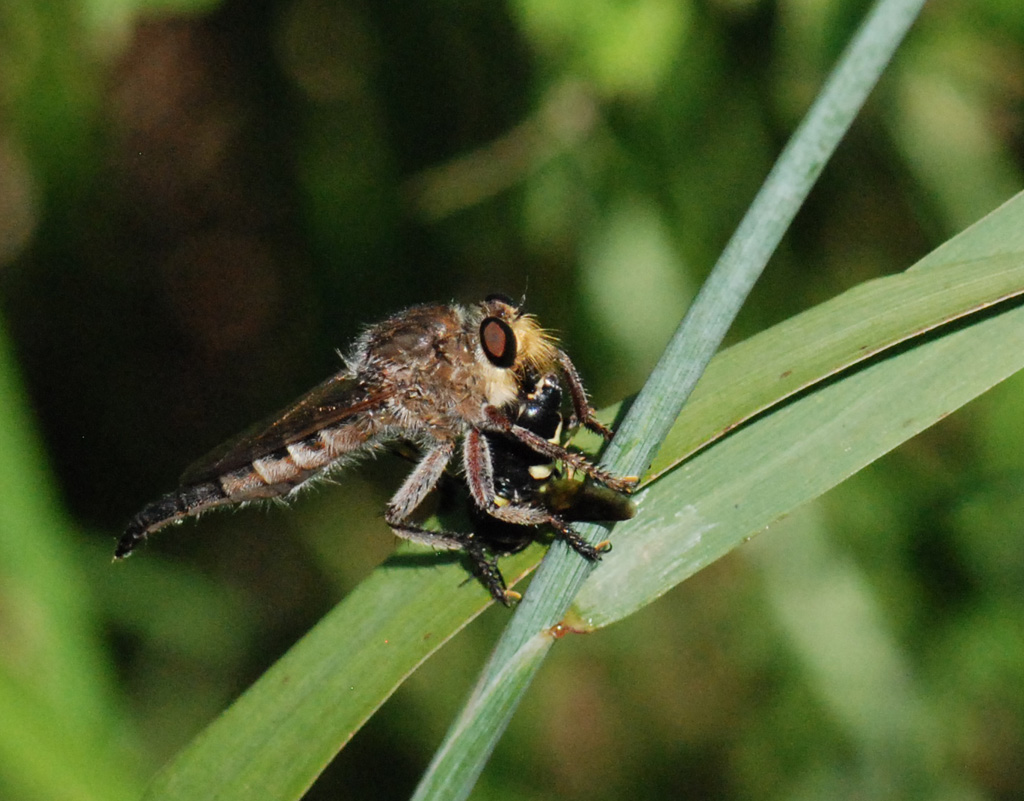
I just wanted to share this photo I caught of a robber fly chowing down on another insect. (Perhaps a syrphid fly?) When I first saw the robber fly and started taking its picture, I didn't realize it had prey in its grasp, but by the time I got close enough for this last shot, I knew it had something.
Robber flies are great predators! Another insect to welcome into your garden.
Labels:
Organic Gardening,
Predator-Prey,
Robber flies
Saturday, June 15, 2013
Bloom Day June 2013
Here in south central Kansas, it's not been the best of days to get good bloom photos: windy and mostly overcast. However, I did what I could...and I am cheating just a bit by adding in a few photos from yesterday. I figure that the flowers are still in bloom today, so it's not too out of line!
I'm new to this meme, so perhaps a quick introduction is in order. On the prairie, where we live, conditions can get tough and stressful for plants. While around here we all yearn to be able to grow ferns and woodland plants, blue hydrangeas and a wide variety of evergreens, the truth is that only the sturdiest of plants will survive our climate. Since I'm out in the country, that is especially true in my gardens. If it needs to be pampered, it doesn't make it here!
Both because of the difficult prairie growing conditions and because I'm naturally interested in the animals around me, as well as the plants, I focus primarily on native plants. We are lucky enough to have 10 acres, which we moved onto about 6 years ago, and we are working to restore tall grass prairie on about 7 of those acres. Up near the house, though, I just garden for fun and beauty.
Weatherwise, we've just recently gone from a pleasantly cool spring to full summer conditions. Out here, that means that the pastel flowers are finishing up and the bright hues of summertime are taking over. In my front flower bed, those bright hues are coming from the butterfly milkweed, gaillardia and yellow coneflower, all in full bloom.
Here's another view of the same area, taken yesterday. There's a little bit of lanceleaf coreopsis and some pink evening primrose hanging around, but they are both winding up for the year and turning the palette over to the next crew.
Not all my flowers are rooted. Here is a native bee trying to chase off a painted lady butterfly. All she's trying to do is get a quiet meal. For some reason, the bee seemed much more upset by the painted lady than by the pearl crescent nearby. The yellow coneflowers have been hopping with insect activity every time I go outside.
I noticed today that this particular butterfly milkweed variety has a deep red streak down the center of each petal. I think that makes an already attractive flower even more interesting!
Just around the corner from all this orange and red and yellow is a spot of cool - an oakleaf hydrangea in full bloom.
What I've particularly enjoyed seeing in the last few days are perfectly round circles cut out of a few of the petals. These are the work of leafcutter bees, one of our little native pollinators. They line their nest cells with these bits of petal and leaf to help protect their developing larvae.
Narrowleaf coneflower is our main native Echinacea around here. It's not readily available in "the trade" as its roots are too deep and it doesn't, apparently, germinate easily. I was able to get hold of a few small plants last year, however. This one is blooming particularly nicely for me. It's not the showiest of Echinaceas, but it's ours.
The checkered skipper seems to be enjoying it, too.
Another new plant that shot out a bloom for me is this Penstemon. I don't remember what kind it is, and I couldn't get the bloom and the base of the plant in the same photo without getting WAAAAY back, but I think the flower spike is quite attractive. Hopefully next year it will get a little fuller and not quite so tall!
Two summers ago, at the start of what turned out to be 53 days over 100 degrees with no rain, my husband and I started plugging in a buffalo grass lawn. It's done amazingly well. In the middle of the front yard, though, a purple poppy mallow came up. Well, I just haven't been able to bring myself to pull it out - and we are in the country, after all, so Greg mows around it and we enjoy its magenta blooms and interesting foliage.
Up close, as the blooms open, they form an interesting spiral pattern...
...and as they close, they seem to make a purple star, with a clear white echo in the center.
In the back yard, I have masses of larkspur blooming. I love the deep purplish blue of the larkspur blooms...
and the occasional pink accent that shows up, too. The foliage is about as close as we get to ferns around here.
Well, that's it for now. It's fun to see what's blooming in everyone's garden - some so much ahead of us, into full summer, and some still enjoying the pastel, cool beauty of spring. Thanks for stopping by!
I'm new to this meme, so perhaps a quick introduction is in order. On the prairie, where we live, conditions can get tough and stressful for plants. While around here we all yearn to be able to grow ferns and woodland plants, blue hydrangeas and a wide variety of evergreens, the truth is that only the sturdiest of plants will survive our climate. Since I'm out in the country, that is especially true in my gardens. If it needs to be pampered, it doesn't make it here!
Both because of the difficult prairie growing conditions and because I'm naturally interested in the animals around me, as well as the plants, I focus primarily on native plants. We are lucky enough to have 10 acres, which we moved onto about 6 years ago, and we are working to restore tall grass prairie on about 7 of those acres. Up near the house, though, I just garden for fun and beauty.
Weatherwise, we've just recently gone from a pleasantly cool spring to full summer conditions. Out here, that means that the pastel flowers are finishing up and the bright hues of summertime are taking over. In my front flower bed, those bright hues are coming from the butterfly milkweed, gaillardia and yellow coneflower, all in full bloom.
Here's another view of the same area, taken yesterday. There's a little bit of lanceleaf coreopsis and some pink evening primrose hanging around, but they are both winding up for the year and turning the palette over to the next crew.
Not all my flowers are rooted. Here is a native bee trying to chase off a painted lady butterfly. All she's trying to do is get a quiet meal. For some reason, the bee seemed much more upset by the painted lady than by the pearl crescent nearby. The yellow coneflowers have been hopping with insect activity every time I go outside.
I noticed today that this particular butterfly milkweed variety has a deep red streak down the center of each petal. I think that makes an already attractive flower even more interesting!
Just around the corner from all this orange and red and yellow is a spot of cool - an oakleaf hydrangea in full bloom.
What I've particularly enjoyed seeing in the last few days are perfectly round circles cut out of a few of the petals. These are the work of leafcutter bees, one of our little native pollinators. They line their nest cells with these bits of petal and leaf to help protect their developing larvae.
Narrowleaf coneflower is our main native Echinacea around here. It's not readily available in "the trade" as its roots are too deep and it doesn't, apparently, germinate easily. I was able to get hold of a few small plants last year, however. This one is blooming particularly nicely for me. It's not the showiest of Echinaceas, but it's ours.
The checkered skipper seems to be enjoying it, too.
Another new plant that shot out a bloom for me is this Penstemon. I don't remember what kind it is, and I couldn't get the bloom and the base of the plant in the same photo without getting WAAAAY back, but I think the flower spike is quite attractive. Hopefully next year it will get a little fuller and not quite so tall!
Two summers ago, at the start of what turned out to be 53 days over 100 degrees with no rain, my husband and I started plugging in a buffalo grass lawn. It's done amazingly well. In the middle of the front yard, though, a purple poppy mallow came up. Well, I just haven't been able to bring myself to pull it out - and we are in the country, after all, so Greg mows around it and we enjoy its magenta blooms and interesting foliage.
Up close, as the blooms open, they form an interesting spiral pattern...
...and as they close, they seem to make a purple star, with a clear white echo in the center.
In the back yard, I have masses of larkspur blooming. I love the deep purplish blue of the larkspur blooms...
and the occasional pink accent that shows up, too. The foliage is about as close as we get to ferns around here.
Well, that's it for now. It's fun to see what's blooming in everyone's garden - some so much ahead of us, into full summer, and some still enjoying the pastel, cool beauty of spring. Thanks for stopping by!
Labels:
Butterflies,
Echinacea,
Forbs,
General Gardening,
Milkweed,
Native Pollinators,
Prairie
Friday, June 14, 2013
Bits and Pieces from Around the Garden
I went out this morning to take a single photo - and ended up taking about 150! Good lighting, some interesting bees, and nice blooms. Here is just a smattering of the photos I garnered....
I've been thinking that I want to try to gussy up my photographic technique a bit - maybe try some different angles, "tell a story" about the garden, capture in pictures how I feel as I work around the yard. I was quite pleased with how this shot of my front garden came out, which I took from a different vantage point than usual....
The bright orange butterfly milkweed (Asclepias tuberosa) in the foreground has come into full and glorious bloom, there are a few, sunny yellow, lanceleaf coreopsis blossoms (Coreopsis lanceolata) hanging on, the deep reddish-orange blanket flower is putting on a spectacular show (Gaillardia sp.) and the tall, yellow coneflower (Echinacea paradoxa) is in great beauty this year.
Speaking of the yellow coneflower, its blooms were obviously chock full of pollen and nectar, judging from the number of little native bees that were busily packing their pollen baskets.
Leaving the Echinacea after a plethora of native bee photos, I glanced at this clump of coreopsis and noticed a small white insect of some sort. I couldn't really tell what it was, but I took its photo and figured that I'd be able to tell a little better when I enlarged it on the computer screen.
Sure enough, once I magnified the white bug it turned out to be a small white moth being eaten by a spider. There were also native bees, beetles, and even a caterpillar feeding at (and on) the coreopsis blooms.
Out in the middle of the front yard's buffalo grass lawn, I've left a purple poppy mallow (Callirhoe involucrata). It's just too darn pretty to pull out! A couple of the spent blooms from yesterday were forming this attractive star pattern...
...while a newly opening bloom was coyly getting ready to share its largesse.
I've noticed recently that the insects seem to prefer pushing their way into newly opening blossoms, rather than working the fully open blooms. Looking at the fresh pollen anthers awaiting their arrival, I can see why!
Butterflies weren't abundant on anything, but the butterfly milkweed did attract this thread-waisted wasp (Ammophila sp.), whose abdominal stripe seems to be designed to match the color of the blossoms.
Thread-waisted wasps feed on nectar as adults, as this individual was doing. However, the female digs a tunnel in sandy soil, as a nest, which she stocks with paralyzed caterpillars, upon which she lays an egg. So thread-waisted wasps are great predators to have in your garden!
I'll leave you with a photo of the larkspur in the back courtyard. I'm always a sucker for blue and bluish purple flowers!
I've been thinking that I want to try to gussy up my photographic technique a bit - maybe try some different angles, "tell a story" about the garden, capture in pictures how I feel as I work around the yard. I was quite pleased with how this shot of my front garden came out, which I took from a different vantage point than usual....
The bright orange butterfly milkweed (Asclepias tuberosa) in the foreground has come into full and glorious bloom, there are a few, sunny yellow, lanceleaf coreopsis blossoms (Coreopsis lanceolata) hanging on, the deep reddish-orange blanket flower is putting on a spectacular show (Gaillardia sp.) and the tall, yellow coneflower (Echinacea paradoxa) is in great beauty this year.
Speaking of the yellow coneflower, its blooms were obviously chock full of pollen and nectar, judging from the number of little native bees that were busily packing their pollen baskets.
Leaving the Echinacea after a plethora of native bee photos, I glanced at this clump of coreopsis and noticed a small white insect of some sort. I couldn't really tell what it was, but I took its photo and figured that I'd be able to tell a little better when I enlarged it on the computer screen.
Sure enough, once I magnified the white bug it turned out to be a small white moth being eaten by a spider. There were also native bees, beetles, and even a caterpillar feeding at (and on) the coreopsis blooms.
Out in the middle of the front yard's buffalo grass lawn, I've left a purple poppy mallow (Callirhoe involucrata). It's just too darn pretty to pull out! A couple of the spent blooms from yesterday were forming this attractive star pattern...
...while a newly opening bloom was coyly getting ready to share its largesse.
I've noticed recently that the insects seem to prefer pushing their way into newly opening blossoms, rather than working the fully open blooms. Looking at the fresh pollen anthers awaiting their arrival, I can see why!
Butterflies weren't abundant on anything, but the butterfly milkweed did attract this thread-waisted wasp (Ammophila sp.), whose abdominal stripe seems to be designed to match the color of the blossoms.
Thread-waisted wasps feed on nectar as adults, as this individual was doing. However, the female digs a tunnel in sandy soil, as a nest, which she stocks with paralyzed caterpillars, upon which she lays an egg. So thread-waisted wasps are great predators to have in your garden!
I'll leave you with a photo of the larkspur in the back courtyard. I'm always a sucker for blue and bluish purple flowers!
Labels:
Echinacea,
Milkweed,
Moths,
native plants,
Native Pollinators,
Organic Gardening,
Spiders,
Wasps
Life in the Soil
I've been nibbling away at Life in the Soil: A Guide for Naturalists and Gardeners, by James B. Nardi, for about 2 months now. It was easy to read, but a lot to digest, I guess. Much of it was essentially a list of the types of organisms that live in the soil, discussing each group's place in the life cycle/food web of the community there. I've underlined copiously, so that I can flip through for quick tidbits when I return for information or for refreshment.
Probably the overarching lesson that I took away from this book is how alive the soil really is. The complexity and diversity of life there is phenomenal, although we (as humans) see and understand relatively little of it.
If we can't see it, it isn't important, right? Wrong. In fact, that's the kind of thinking that leads to dead soil and, ultimately, desertification and a dying world. Many of the discussions on soil organisms had a summary list for each group, with a category labeled, "Impact on Garden". The options for that category appeared to be "allies", "absent", or "adversaries", or a combination of those responses. Allies vastly outweighed either the organisms with no impact or the ones considered adversaries. Occasionally a group (e.g. nematodes) would earn the title, "allies/adversaries" when their impact could swing different directions, or when the different members of the group had very different places in the soil community. Nematodes, for example again, consist of approximately 15,000 species. It's amazingly simplistic to think that "nematodes", as a group, would ONLY function as allies or adversaries in the garden.
(An aside: why do we always classify everything as "good" or "bad" based on how it relates, specifically, to us? Maybe we ought to grow up a little and start realizing that we aren't, actually, the center of the universe.)
I learned a myriad of things from this book. For starters, fungi and roots literally are intertwined, each feeding the other, each in the other's space, but both "...always respecting each other's integrity." (p. 15) Fungi finds and transports minerals and water into the roots, roots feed the fungi with sugars from photosynthesis. It's been shown that pine seedlings with mycorrhizae absorb more than twice as much phosphorus (as well as more nitrogen and potassium) than pine seedlings without mycorhhizea.
On a prairie, typically more than 3 times as many roots are produced as shoots. There is literally more than 3 times as much life BELOW the soil surface as above it.
"Roots mine the mineral resources of the soil, and roots make these 18 essential nutrients available to animals of the land. In going from soil to plant, calcium, for example, is first concentrated eightfold; and in going from plant to animal, this elements is then concentrated five-fold more, for a total of 40 times the concentration found in soil Animals are not only entirely dependent on energy that is ultimately derived from sugars produced by plants during photosynthesis, but also almost entirely dependent on plant roots for concentrating from the soil the many mineral nutrients that sustain their lives." p.20.
I'll leave you with one other interesting interaction of soil animals....
Dung beetles recycle animal droppings, especially droppings from herbivores like elephants or bison or cattle. Both the adult and larval stages of dung beetles rely on dung for food: the adults eat the dung juices and then move dung underground where they lay their eggs upon it. The dung beetle larvae then utilize it as their food source while growing. Fly maggots also like animal droppings as both adult and larval food, and there is a frequent tussle going on over which type of insect will get most of the energy from this important food source. Dung beetles (and rove beetles and hister beetles, two other types of beetles that commonly feed on animal dung and its inhabitants) carry tiny mites on them - up to 30 mites/beetle. When the beetle alights on a dung pile, the mites jump off and eat fly eggs and newly hatched fly maggots, then jump back onto the beetle(s) to move on to the next food source. Without the hitchhiking mites eating the fly eggs and small maggots, the beetles can't effectively compete with the flies to get the amount of dung that they need to survive and reproduce.
Gross? Yes, to us. But fascinating, too. And a perfect example of nothing going to waste.
I would highly recommend reading this book to anyone who is interested in what's going on around them, especially gardeners. It'll help you understand the importance and complexity of a garden's soil in ways you never even thought about before! What connections will it make for you?
Probably the overarching lesson that I took away from this book is how alive the soil really is. The complexity and diversity of life there is phenomenal, although we (as humans) see and understand relatively little of it.
If we can't see it, it isn't important, right? Wrong. In fact, that's the kind of thinking that leads to dead soil and, ultimately, desertification and a dying world. Many of the discussions on soil organisms had a summary list for each group, with a category labeled, "Impact on Garden". The options for that category appeared to be "allies", "absent", or "adversaries", or a combination of those responses. Allies vastly outweighed either the organisms with no impact or the ones considered adversaries. Occasionally a group (e.g. nematodes) would earn the title, "allies/adversaries" when their impact could swing different directions, or when the different members of the group had very different places in the soil community. Nematodes, for example again, consist of approximately 15,000 species. It's amazingly simplistic to think that "nematodes", as a group, would ONLY function as allies or adversaries in the garden.
(An aside: why do we always classify everything as "good" or "bad" based on how it relates, specifically, to us? Maybe we ought to grow up a little and start realizing that we aren't, actually, the center of the universe.)
I learned a myriad of things from this book. For starters, fungi and roots literally are intertwined, each feeding the other, each in the other's space, but both "...always respecting each other's integrity." (p. 15) Fungi finds and transports minerals and water into the roots, roots feed the fungi with sugars from photosynthesis. It's been shown that pine seedlings with mycorrhizae absorb more than twice as much phosphorus (as well as more nitrogen and potassium) than pine seedlings without mycorhhizea.
On a prairie, typically more than 3 times as many roots are produced as shoots. There is literally more than 3 times as much life BELOW the soil surface as above it.
"Roots mine the mineral resources of the soil, and roots make these 18 essential nutrients available to animals of the land. In going from soil to plant, calcium, for example, is first concentrated eightfold; and in going from plant to animal, this elements is then concentrated five-fold more, for a total of 40 times the concentration found in soil Animals are not only entirely dependent on energy that is ultimately derived from sugars produced by plants during photosynthesis, but also almost entirely dependent on plant roots for concentrating from the soil the many mineral nutrients that sustain their lives." p.20.
I'll leave you with one other interesting interaction of soil animals....
Dung beetles recycle animal droppings, especially droppings from herbivores like elephants or bison or cattle. Both the adult and larval stages of dung beetles rely on dung for food: the adults eat the dung juices and then move dung underground where they lay their eggs upon it. The dung beetle larvae then utilize it as their food source while growing. Fly maggots also like animal droppings as both adult and larval food, and there is a frequent tussle going on over which type of insect will get most of the energy from this important food source. Dung beetles (and rove beetles and hister beetles, two other types of beetles that commonly feed on animal dung and its inhabitants) carry tiny mites on them - up to 30 mites/beetle. When the beetle alights on a dung pile, the mites jump off and eat fly eggs and newly hatched fly maggots, then jump back onto the beetle(s) to move on to the next food source. Without the hitchhiking mites eating the fly eggs and small maggots, the beetles can't effectively compete with the flies to get the amount of dung that they need to survive and reproduce.
Gross? Yes, to us. But fascinating, too. And a perfect example of nothing going to waste.
I would highly recommend reading this book to anyone who is interested in what's going on around them, especially gardeners. It'll help you understand the importance and complexity of a garden's soil in ways you never even thought about before! What connections will it make for you?
Labels:
beetles,
Biodiversity,
Books,
Fungi,
Organic Gardening,
Soil
Monday, June 10, 2013
Hungry Hordes
Summer has finally arrived, seemingly for good. It's 94 degrees outside, the sun is shining brightly, the wind is up and there is no rain in the forecast. It's hard to say goodbye to the pleasant, protracted spring that we've had, but at least the real heat didn't show up until mid June.
I was able to get out and get a good solid 2 hours of work done in the gardens before the heat and biting flies drove me in this morning. For the most part all was good: I saw my first monarch of the year, I got one bed weeded, finished mulching another bed, and started weeding a third bed.
But in weeding that third bed, I noticed something that sent shivers up and down my spine....
See this western ragweed (Ambrosia psilostachya)?
I had left it in the newly made bed last summer, figuring that at least it provided some green during a summer where it seemed that brown was the predominant color. It's also good wildlife food. This spring I am in the process of weeding it and its progeny out of the (now) precious bed space.
You can't really see them from even this close. You have to get a little closer....
There! Grasshopper nymphs. Hundreds and hundreds of grasshopper nymphs.
I've seen them jumping up as I walk through the wild areas, but I hadn't seen many in the more domestic part of the yard...until this morning.
I need chickens and guineas and any other kind of bird I can think of to come hang out and eat their fill. I dread to think how many adults there are going to be later this summer. We were hoping that the long, cool spring had decreased their numbers, but this morning's horde squashed that dream.
Chocolate covered grasshoppers, anyone?
I was able to get out and get a good solid 2 hours of work done in the gardens before the heat and biting flies drove me in this morning. For the most part all was good: I saw my first monarch of the year, I got one bed weeded, finished mulching another bed, and started weeding a third bed.
But in weeding that third bed, I noticed something that sent shivers up and down my spine....
See this western ragweed (Ambrosia psilostachya)?
I had left it in the newly made bed last summer, figuring that at least it provided some green during a summer where it seemed that brown was the predominant color. It's also good wildlife food. This spring I am in the process of weeding it and its progeny out of the (now) precious bed space.
You can't really see them from even this close. You have to get a little closer....
There! Grasshopper nymphs. Hundreds and hundreds of grasshopper nymphs.
I've seen them jumping up as I walk through the wild areas, but I hadn't seen many in the more domestic part of the yard...until this morning.
I need chickens and guineas and any other kind of bird I can think of to come hang out and eat their fill. I dread to think how many adults there are going to be later this summer. We were hoping that the long, cool spring had decreased their numbers, but this morning's horde squashed that dream.
Chocolate covered grasshoppers, anyone?
Sunday, June 09, 2013
Community Rules: Prairie Larkspur and Friends
Neighborly generosity ruled on Friday evening - Sid, one of my fellow Master Gardeners and also a fellow Clearwater-ian (?!), had called that morning to tell me he had prairie larkspur (Delphinium carolinianum) blooming in his pasture. Did I want to take a look?
Did I want to take a look? Heck, yes, I wanted to take a look! I wanted to take a couple pictures, too, if he didn't mind. He didn't, so we set a time in the evening, when the light would be good, for me to drop by. At the appointed time, my camera and I made the journey over to Sid's house and off we went on a tour of exploration.
Sid is a descendant of one of the original homesteaders in the area. Even more amazing to me is that he and his wife live on land that was actually claimed and homesteaded by his pioneer ancestors. In a culture often characterized by rootlessness, Sid's roots run deep, right where he, himself, is planted.
The first thing Sid pointed out to me were three trees, 2 of which he planted as seedlings about 25 years ago.
On the left is a bur oak (Quercus macrocarpa), in the center is a catalpa (Catalpa speciosa), and on the right is an osage orange (Maclura pomifera). The differing growth patterns of these tree species are so beautifully highlighted here: the lighter green, large-leaved, upright catalpa in the middle; the young, but soon to be rugged, dark green presence of the bur oak; the gently arching, bright green dignity of the old osage orange, allowed to grow into its natural form, rather than having been hacked back into tortured crippledness. I'm hoping to get invited back in the winter to take a photo comparing their bare branch structures.
Sid led me up to the catalpa so that I could take a couple photos of its flowers. They were high enough up in the tree that I couldn't get too close, but Sid snagged a couple individual blooms to let me take in their sweet, rich fragrance.
As we walked on, I saw purple poppymallow, yarrow, spiderwort (with its flowers done for the day), cats claw sensitive brier, and many other prairie natives. There were several blue Baptisia plants and one large cream Baptisia whose blooms were done for the year.
Then we came upon the prairie larkspur...
and I realized that I had seen it before, from a car window whizzing by as we traveled 60 mph down the road. However, I'd mistaken the dainty, white spires for a small species of Penstemon.
Up close, the spurs of "larkspur" were obvious in the blossoms
and the dainty, fern-like leaves also reminded me of my domestic larkspur.
How in the world do those fragile leaves collect enough energy to send up such a large and glorious bloom spike?
In the same general area as the larkspur were many seed heads of another prairie plant it had taken me a long time to find and recognize: Junegrass (Koeleria macrantha).
To be sure that I was identifying this grass properly, several years ago I'd finally purchased a couple plants at the Dyck Arboretum plant sale and placed them in my flower beds. They've done well there and it's become one of my favorite native grasses to garden with - not too tall, nicely clumping, with attractive seedheads that hang on throughout the year. It's one of the few cool season grasses in the prairie, too, so it greens up, flowers and seeds earlier than most other grasses here.
There were many other interesting plants in the prairie, but the last one I'll share with you was a glorious blue wild indigo (Baptisia australis).
Walking back up to the house, I happened to see an older blue baptisia bloom spike that was developing seed pods, highlighted against the sun. In the larger pods were what looked like drops of water - seeds just beginning to develop? I don't know, but the richness of the colors and the image made me happy, so I'm sharing it here with you.
There is so much beauty around us: in nature, in friends, and in communities. Here's a mental toast to that beauty in all its many forms!
Did I want to take a look? Heck, yes, I wanted to take a look! I wanted to take a couple pictures, too, if he didn't mind. He didn't, so we set a time in the evening, when the light would be good, for me to drop by. At the appointed time, my camera and I made the journey over to Sid's house and off we went on a tour of exploration.
Sid is a descendant of one of the original homesteaders in the area. Even more amazing to me is that he and his wife live on land that was actually claimed and homesteaded by his pioneer ancestors. In a culture often characterized by rootlessness, Sid's roots run deep, right where he, himself, is planted.
The first thing Sid pointed out to me were three trees, 2 of which he planted as seedlings about 25 years ago.
On the left is a bur oak (Quercus macrocarpa), in the center is a catalpa (Catalpa speciosa), and on the right is an osage orange (Maclura pomifera). The differing growth patterns of these tree species are so beautifully highlighted here: the lighter green, large-leaved, upright catalpa in the middle; the young, but soon to be rugged, dark green presence of the bur oak; the gently arching, bright green dignity of the old osage orange, allowed to grow into its natural form, rather than having been hacked back into tortured crippledness. I'm hoping to get invited back in the winter to take a photo comparing their bare branch structures.
Sid led me up to the catalpa so that I could take a couple photos of its flowers. They were high enough up in the tree that I couldn't get too close, but Sid snagged a couple individual blooms to let me take in their sweet, rich fragrance.
As we walked on, I saw purple poppymallow, yarrow, spiderwort (with its flowers done for the day), cats claw sensitive brier, and many other prairie natives. There were several blue Baptisia plants and one large cream Baptisia whose blooms were done for the year.
Then we came upon the prairie larkspur...
and I realized that I had seen it before, from a car window whizzing by as we traveled 60 mph down the road. However, I'd mistaken the dainty, white spires for a small species of Penstemon.
Up close, the spurs of "larkspur" were obvious in the blossoms
and the dainty, fern-like leaves also reminded me of my domestic larkspur.
How in the world do those fragile leaves collect enough energy to send up such a large and glorious bloom spike?
In the same general area as the larkspur were many seed heads of another prairie plant it had taken me a long time to find and recognize: Junegrass (Koeleria macrantha).
To be sure that I was identifying this grass properly, several years ago I'd finally purchased a couple plants at the Dyck Arboretum plant sale and placed them in my flower beds. They've done well there and it's become one of my favorite native grasses to garden with - not too tall, nicely clumping, with attractive seedheads that hang on throughout the year. It's one of the few cool season grasses in the prairie, too, so it greens up, flowers and seeds earlier than most other grasses here.
There were many other interesting plants in the prairie, but the last one I'll share with you was a glorious blue wild indigo (Baptisia australis).
Walking back up to the house, I happened to see an older blue baptisia bloom spike that was developing seed pods, highlighted against the sun. In the larger pods were what looked like drops of water - seeds just beginning to develop? I don't know, but the richness of the colors and the image made me happy, so I'm sharing it here with you.
There is so much beauty around us: in nature, in friends, and in communities. Here's a mental toast to that beauty in all its many forms!
Labels:
Baptisia,
Community,
Junegrass,
native plants,
Prairie,
Prairie Larkspur,
Trees
Subscribe to:
Posts (Atom)