Showing posts with label grasshoppers. Show all posts

Friday, July 27, 2018

This Week in Pest-Controlling and Pollinating Wasps

While I'd love to be seeing more insect life in our yard, I have to admit that I AM seeing some interesting insects - including a few that are totally new to me.  So I thought it would be fun to share what I'm seeing as well as the blooms that are bringing them in.

How to organize this????  By day?  By bloom?  By type of insect?  I'll just have to see what flows best.....

I started out to make this post an overview of all the pollinators I've seen over the week, but it quickly became apparent that would be overwhelming, so I decided to focus this post just on wasps.

Wasps have been quite prominent recently, especially solitary wasps.  Last Friday, July 20th, was when I first noticed some unusual ones -3 in a row, in fact, over the course of about 10 minutes, on the clustered mountain mint (Pycnanthemum muticum).

The first was a large scarab hunter wasp that has no common name so I've nicknamed it the fuzzy scarab hunter wasp (Campsomeris plumipes).  Like other scarab hunters, this wasp flies low above the ground, searching for (buried) scarab beetle larvae, a.k.a. beetle grubs.  When she finds one, she digs down to it, paralyzes it, lays an egg on it, and flies away.  The egg hatches out and the wasp larva consumes the beetle grub.  One wasp egg on one beetle grub, so every one of these you see means that a scarab beetle of some sort - say a June bug or green June beetle - didn't make it to adulthood.

As you can see, the adult wasp actually eats nectar to sustain itself, as is true for most of these solitary wasps.  Also as solitary wasps, they are not aggressive and they will not sting unless you actively try to handle them or they get caught in your clothing, stepped on in bare feet, etc.  You can assume this is true for all solitary wasps unless someone mentions otherwise.  It's a nice change from the more problematic social wasps.

As an aside, all the solitary wasps I'm familiar with have only one generation each year, so if you take them out (for example, by spraying insecticides), it may be several years before their population numbers can rebuild by migrating in from surrounding areas.  Given how well they function as both pollinators and, probably more importantly, as pest control, that would seem to be extremely short sighted to me.

Back to my magic 10 minutes by the mountain mint, the next insect to fly in, while I was photographing the fuzzy scarab hunter wasp, was the great golden digger wasp (Sphex ichneumoneus).  This is a species I've seen before, both here and in Kansas, and I love its fiery color and large size.  You just can't mistake this distinctive wasp with its red legs and black-tipped red abdomen for any other species.  Look, too, at the golden glow created by the gold hair on its head and thorax.  That's something you almost have to take a picture of to appreciate, although I've seen it highlighted occasionally as one of these beauties nectars. 

Another solitary wasp, great golden digger wasps hunt for and paralyze grasshoppers and crickets as food for their larvae.  The female digs a burrow in sandy soil, with a central, almost vertical, main burrow and individual cells radiating out from this primary burrow.  She places one paralyzed grasshopper or cricket in each cell, lays an egg on it, then seals up the cell.

As I was finishing up my "photo session" with the great golden digger wasp and taking a few last photos of the fuzzy scarab hunter wasp, I noticed more movement in the air space around the mountain mint - a thread waisted wasp had come in to feed, too. 

This rather bizarre looking wasp not only held its abdomen up at a strange angle as it flew, but the sun caught metallic glimmers of color on its otherwise black body and wings.  Researching on BugGuide.net, I identified this species as Eremnophila aureonotata.  Again there is no common name, so I've nicknamed it the gold-marked thread-waisted wasp, "aureonotata" meaning "gold-marked" in Latin.  This solitary wasp species feeds its larvae on a wide variety of (paralyzed) moth caterpillars, utilizing a burrow in the ground, as far as I can tell.

So, according to the time stamps on my photos, in just over 10 minutes my mountain mint had nurtured predators working to control beetle grubs, grasshoppers and mole crickets, and moth caterpillars in my gardens.  Not too shabby!!!  And it didn't cost me a dime beyond the initial cost of a very pretty perennial plant.

I've seen a couple other wasps this week, too.  One I've been seeing frequently for several weeks now is less than half the size of the big guys above.  It's a cute little black mason wasp with 2 white stripes on its abdomen (Euodynerus sp.).  When I grabbed its picture above, I think it was hunting for caterpillars among the ferns.  Again, there is no common name for this wasp, so my description above ("cute little black mason wasp") will have to suffice.  Mason and potter wasps feed their larvae primarily on moth caterpillars, although some species also use the larvae of leaf-eating beetles.  If you see smallish wasps using mud to fill up small holes (for example in brick, where your hurricane shutters have gone up in the past), it may well be one of these mason wasps.  They build cells out of mud in hollow tubes, provisioning each cell with a paralyzed caterpillar or beetle larvae on which they lay an egg before closing up the cell and moving on. 

Do you sense a pattern among the solitary wasps here?! They've found a good gig in paralyzing prey to keep it fresh for their young to eat after hatching, then tweaked the process in a myriad of different ways so that each species has its own spin...and ecological niche.

I've seen these little black and white mason wasps nectaring on blossoms as well as hunting in my gardens.  I've found small holes filled with dried mud, which I presume are their nest cells.  These are enjoyable little creatures for me to notice as I go out and about weeding, planting, transplanting, watering, and photographing.  Just in the last week I have photographs of this species hunting in these ferns, shown above, as well as in camphorweed and in and out of leaves and mulch at the base of phlox and lyreleaf sage.  Front yard, back yard.  Sun, shade.  This little wasp is a "busy bee" in its work habits.

At the other end of the size spectrum from the cute little mason wasp is the gigantic 4-spotted scarab hunter wasp (Campsomeris quadrimaculata) that I've seen a couple times now.  Boy, am I ever glad that these guys aren't at all aggressive, because they are HUGE and they give me pause even though I know they won't bother me.  The photo above shows this big black beauty all coated with pollen from nectaring at maypop flowers (Passiflora incarnata).

Here is a photo I took about 2 weeks ago of a "clean" 4 spotted scarab hunter wasp, nectaring on sweet pepperbush blooms (Clethra alnifolia).   See how much pollen the individual nectaring at the passion vine is wearing in comparison?!  That's what I call a pollinator!

For the sake of clarity, again I've made up a nickname for this wasp as, again, it has not been given an official common name.  Its specific Latin name, "quadrimaculata", means "4-spotted", while the entire genus is known as scarab hunter wasps, hence the "4-spotted scarab hunter wasp".   This is another great predator in the garden, paralyzing and laying eggs in scarab beetle grubs.

Big and little, I've got wasps sharing my gardens that are making life easier - and much more interesting - for me.  I used to hate wasps, but now I smile whenever I see one.  I hope you're seeing some great solitary wasps in your gardens, too.


Thursday, March 12, 2015

Tolerating the Uglies, Take 2

Probably the hardest lesson I've learned in gardening here is to tolerate the uglies caused by blister beetles.

Our vegetable garden was one of the first gardens we began after moving in during the spring of 2007.  Having just spent 6 years in southern Alabama, where tomatoes didn't grow very well, we were aching for some sweet-tart, juicy, home-grown tomatoes - and therefore tomato seedlings were some of the first plants that went in.

The tomatoes did beautifully...except that they got pretty ragged looking in late summer, in large part because of all the blister beetles - both black and gray - that were munching on their leaves.  Mind you, the plants were still producing huge numbers of tomatoes.  There were more tomatoes than we could possibly eat or even give away.  But, doggone it, the plants looked positively decrepit, with ratty leaves, covered in blister beetle poop...er, frass.  How could I call myself a gardener with my tomato plants looking this bad?

So in I rushed, intrepid organic gardener to the rescue!  Every morning I would fill an old peanut butter jar half full of water with dish soap in it and sally forth to fight the blister beetles.  Carefully I inspected the leaves of the tomato plants and gently picked off the blister beetles, dropping them to their soapy deaths in my peanut butter jar.  At first I wore gloves, worried about the defensive chemical, cantharidin, that blister beetles are known to secrete.  It's cantharidin which will cause the blisters that earn this group of beetles their family name.  Eventually, though, I shed the gloves and still had no problems.  It wasn't uncommon for me to pick 50 or 100 blister beetles off my tomatoes each day.   Best of all, I could simply flush the dead beetles down the toilet or even put them in the compost when I was done, since my "killing agent" was simply dish soap and water.

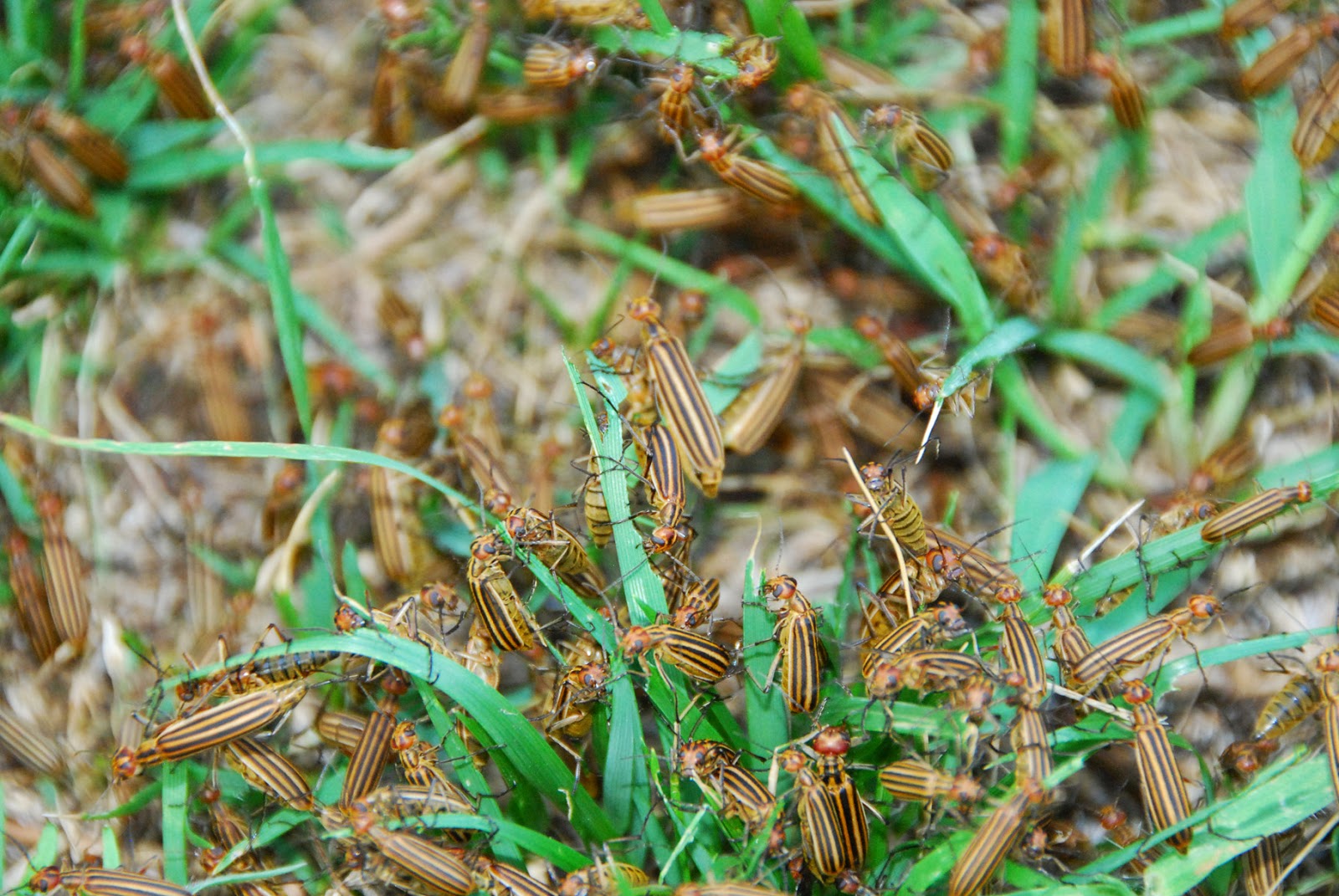
Faithfully I protected my tomato plants for several summers this way, culminating in 2011, when we came home from a trip in early June to find several huge masses of Three-Striped Blister Beetles engaged in orgies on our front lawn. 

I'd not seen ONE of this blister beetle species in our yard before, let alone thousands of them.  What should we do?!  What if ALL of these guys started eating the plants around the yard?

Getting creative, I put my soapy water solution in a small shop vac and we vacuumed most of the striped blister beetles up.  Whew.  Disaster averted.

But, wait.  No.  Disaster NOT averted.  It just wasn't the disaster I thought I was getting.  Up until this point, we hadn't had any real issue with grasshopper populations, despite living in the country and being surrounded by tall grass and crop fields.  Beginning in 2011 and continuing into the present, we've learned the benefit of blister beetles.

You see, blister beetle young (larvae) burrow through the soil and eat grasshopper eggs.  For every adult blister beetle you see, 21-27 grasshopper eggs have NOT grown up into grasshoppers.  And those 21-27 grasshoppers that haven't grown up also haven't produced any eggs or young of their own.  While blister beetles eat leaves for a few weeks and make them look pretty ugly while they are munching, they don't generally eat a wide variety of plants and they don't even defoliate the ones they do lunch on.  Grasshoppers, on the other hand, will eat almost anything, including bark, and they will eat it all down to nubs.  The photo below shows what they did to our (shrub) althea one summer.....

Weather certainly played a role in our grasshopper outbreak, but I'm quite certain that our grasshoppers wouldn't have been as numerous if I hadn't been so zealous about controlling the blister beetle populations in our yard.

Blister beetles have now become almost a sacred animal around here.  I welcome them to the yard when I see them, and I mentally encourage them to munch for a while.  Happily, I've been seeing a few more blister beetles each year.  I still don't see three-striped ones, though.

Meanwhile, last summer had wet spells.  It turns out that, during rainy spells, grasshoppers get a fungus which causes them to climb to the top of plants, grasp the stem firmly,... and die.  Our yard was full of these weird grasshopper mummies gruesomely hanging on to the tips of plants. 

Between healthier blister beetle populations and grasshopper reproduction being down due to the zombie fungus last year, I'm hoping there will be fewer grasshoppers overall this summer than there have been in recent years.

I'm hoping, too, that the blister beetle populations will once again be healthy and that our tomato plants will look quite ragged by summer's end.  From now on, the blister beetle "uglies"  will be welcomed with open arms in our landscape!

Sunday, September 28, 2014

Fabulous Blooms and Friendly Brains: Kansas Native Plant Society Wildflower Weekend

Last weekend at this time (2 p.m., Sunday afternoon), I was just arriving home after a great weekend getaway.

For seven years I've been thinking about going to this annual event, but something always got in the way.  One year we were heading over to Winfield to go to the Walnut River Valley Music Festival.  Another year we were on a trip to England and Norway.  Yet another year we were getting ready to leave for a trip to Germany.  The year before last, I was getting ready to take an adopted dog down to our daughter in Florida. 

"Where did you go last weekend?  Why did it take you so long to make it?" you ask.  "It sounds like you were doing LOTS of traveling already, so that can't have been the problem."

"To the Annual Wildflower Weekend of the Kansas Native Plant Society," I answer.  The AWW, as many people seem to call it.  As to why it took me so long to make it a priority to attend, I can't give you a rational answer.  All I can say is that I'm glad I went this year.

Each year KNPS's Annual Wildflower Weekend is held in a different location within Kansas, but it's always on the same weekend, the 3rd weekend in September.  No matter where the AWW is held, the weekend seems to hold lots of tromping around through impressive prairie sites full of not-so-common native wildflowers and grasses, as well as a lot of camaraderie with other souls who value the chance to spend time out tromping around and looking at plants too.

This year Greg told me to go.  I politely scuffled my feet a little, feeling quite guilty at leaving him home alone to take care of the homestead for 2 days while I went out to "play"...then I shoved the guilt down, made my reservations, and skedaddled.

I'm so glad I did.  I had a great time and I had a chance to see some beautiful sights and sites.  Most exciting of all, I reconnected with a couple friends from many years ago, had a chance to meet two friends I've previously known only through blogging, and became acquainted with several other folks who are new friends in the making.  The most hopeful part is that all of us share a passion for plants and animals and wild spaces...and learning about the web of which they are all a part.


In the photo above, Theresa and Melanie (with Melanie's daughter Cami) are two friends I've met entirely through garden blogging.  It was so much fun to share time with them in person while poking around and looking at plants.  Cami seemed to have a great time exploring, too, and she and I explored our common interests in taking photos and looking at insects and rocks.

This year's AWW was based in Pratt, Kansas, home of the Kansas Department of Wildlife and Parks.  Not surprisingly, our first field trip was to the KDWP museum and to the pollinator garden right beside it, in the southeast corner of town.  The Pratt Master Gardeners have done a superb job of putting together a beautiful and interesting pollinator and native wildflower display garden, complete with a gorgeous pool, for which they received a well deserved award from KNPS.

Whispered on the wind were comments about possible expansions of the native plant display gardens, as well. Wouldn't that be awesome?!

During the course of the weekend, we got to explore 5 different prairie sites - 3 in the Red Hills south of Pratt and 2 sand prairies east of Pratt.  The last site also included a section of the Ninnescah River, so we were able to do a little riparian scouting as well.  Almost all of the sites were on privates land that had been graciously opened up to us to explore, so I don't want to be too specific about the locations.  The photo above show the group moving away from our cars, beginning to explore a site in the rugged landscape near Sun City.

I have no idea what the official plant list (i.e. total species count) for the weekend was because I was doing some landscape gazing, some insect hunting, some photography teaching, and a lot of chatting...besides looking for flowers and grasses, of course.


This delicate white beauty is the flower of the Sand Lily (Mentzelia nuda) in the Red Hills of Kansas.  Such a beautiful, soft looking flower on such a thorny, spiky plant!

Broad-leaf milkweed (Asclepias latifolia) doesn't look all that interesting in this photo, but it really captured my attention in the field...maybe because it was SO green and lush looking in an otherwise scorched looking landscape.  The leaves almost looked like cabbage!  The remnants of the pods were actually rather small and cute;  they were found under and between the leaves, rather than at the top of the plant.  This is one that I want to try to find for our garden.  USDA Plant Profiles does show Sedgwick County as part of this plant's range.

Isn't this guy gorgeous?  This is the rainbow grasshopper (Dactylotum bicolor), also commonly called the pictured grasshopper.  It's posing on dotted gayfeather (Liatris punctata), which was in bloom in all of the prairies we visited.


I was lucky enough to get a glimpse of this insect accidentally.  Do you see it?  It's a walking stick, colored perfectly to blend in with the grass.  The only reason I saw it was that it moved as I knelt down to look at a nearby flower.  Sad to say, I don't have a good enough photo of it to risk trying to get it down to the genus level, let alone the species level.  (I would welcome anyone's help on this matter, though.)

A last extra punch for the weekend was getting to hear Iralee Barnard speak about grass identification (an area in which I am sadly lacking) and then being able to purchase her new book, Field Guide to the Common Grasses of Oklahoma, Kansas, and Nebraska.  It's a great help and, after reading it, I already feel more confident in my ability to tackle a few of the more obscure grasslike plants that I'm seeing around our prairie at home, Patchwork Prairie.

Will I return for another AWW?  Absolutely!  It was an AWWsome chance to become active in a human community of interesting and fun plant nerds!  It was also an AWWsome chance to roam around and learn about plants in natural areas that are normally unavailable for "regular folks" to explore.  What wasn't to like?!

Monday, July 28, 2014

Death Comes For the Grasshopper(s)

Not surprisingly after 3 hot, dry years, there have been a lot of grasshoppers around this summer.  Grasshoppers and hot, dry weather go together like bread goes with peanut butter and jelly.  I've been noticing a few things that bode a little better for next year, though, and I'd like to share them with you.

The beginning of the summer started with literal hordes of grasshoppers, especially newly hatched nymphs.  The photo above shows a phalanx of said nymphs on a soon-devoured broccoli leaf.  It wasn't uncommon to have hundreds of tiny grasshoppers flying up with every step through grassy areas. 

Now, towards the end of July, there are still a lot of grasshoppers, but the numbers seem to have declined a bit - dozens fly up at every step instead of hundreds.  Sometimes only a few fly up.  I haven't sprayed or made any effort to curb their numbers, so what has happened?

First of all, the weather has been cooler and wetter than during the last 3 or 4 summers.  Cooler, wetter weather is good for plants, but bad for grasshoppers.  Newly hatched grasshoppers can be killed by cool, wet weather.  Truthfully, I'm not sure we were cool enough or wet enough for this to happen this year, but I'm mentioning it anyway.  However, warm, wet weather can also have a negative effect on grasshopper populations....

During warm, wet weather, there is a naturally occurring fungus, Entomophthora grylli, which infects grasshoppers and causes them to climb to the top of vegetation and grasp the stem with their legs, then die.  I've been seeing quite a few grasshoppers seemingly mummified like this.  The best news is that, as these grasshoppers dry out, the fungal spores spread on the wind to other grasshoppers, infecting them as well.

So not only is there one less grasshopper reproducing for next year, but each one that dies like this has also potentially caused other grasshoppers in the area to die as well!  Rather nightmarish...but effective.

Predators have been playing a role in decreasing grasshopper numbers, too.  Just in my ramblings with camera in hand, I've caught shots of several wheel bugs eating grasshoppers. 

I've got a large population of wheel bugs this year;  after such an abundance of prey, I suspect I'll have an even larger population next year!

Spiders, too, eat grasshoppers.  This photo of a black and yellow garden spider eating a grasshopper was actually taken last October, but I'm sure that the spiders I'm seeing this summer are taking out quite a few grasshoppers as well.  (My garden spiders aren't this big yet, but they will be!)

Birds, not surprisingly, eat grasshoppers as well, although I haven't been lucky enough to get any photos of that happening.  Bluebirds, quail, pheasant, meadowlarks, lark sparrows, and lots of other birds are known to eat grasshoppers.

I occasionally see great golden digger wasps around the yard, as in this rather out-of-focus photo from about a week ago, hunting (in this case) on Bradbury beebalm.  If these beautiful, big wasps aren't feeding themselves with nectar and pollen on flowers, they are actively prowling for grasshoppers to sting and paralyze.  Once the grasshopper is paralyzed, the female wasp takes it back to her nests as baby food to lay her eggs on.

The long and the short of it is that grasshoppers are grazers on plants, and a lot of animals eat them.  With bison no longer freely roaming the prairie, I understand that grasshoppers are actually the primary herbivore for this important ecosystem!  Because grasshoppers are so mobile, it's hard to kill them with insecticides.  Ironically, it's much easier to kill the insects that prey on grasshoppers - so any time you spray an insecticide, even an organic one, you are probably helping to increase grasshopper populations, in the long run, by decreasing their predators.

Speaking of spraying insecticides and accidentally killing off insect predators, the last grasshopper predator I'm going to show you today fell victim to some actions Greg and I took several years ago before we knew any better.  While we didn't actually spray, we did kill enough of these predators that their population declined around our yard and gardens for a few years, so we've actually had more grasshoppers than we would have had if we hadn't tried to solve a "problem" we were sure we had.

The first summer or two that we lived and gardened here, we started our vegetable garden.  Despite the tall grass that we encouraged to grow on much of the property, we didn't see a large number of grasshoppers.  Some, yes, but not enough to cause noticeable damage.  Generally, our garden plants did superbly, although the tomatoes, in particular, attracted large numbers of black blister beetles.  A few grey blister beetles came too.  Not only were these insects a little creepy looking, but they ate the tomato leaves and made the tomato plants look really ugly.  I still harvested more tomatoes than I could possibly use and there weren't enough blister beetles to defoliate the plants, but definitely there were enough to make the plants look ratty. So I started to handpick the blister beetles, dropping them in soapy water to kill them.  Each morning I would do this, and it wasn't unusual for me to dispatch 50 or 100 each day.  It definitely lessened their populations over the course of the summer.

Even after I learned that blister beetle larvae ate grasshopper eggs, I continued to handpick the blister beetles, reasoning that I was seeing plenty of blister beetles, so it shouldn't be a problem.

In June, 2011, we came back from a trip to San Antonio to find several masses of hundreds of striped blister beetles writhing on our front lawn, presumably in an ecstasy of mating.  Our only thought was how to dispatch them as quickly as possible before they, too, started to eat the leaves of our tomatoes and other plants!  So we put soapy water in our shop vac and vacuumed most of them up.  Problem solved.

By later that same summer, I was seeing very few blister beetles...but hordes of grasshoppers.  As you may remember, the summer of 2011 was horribly hot and dry.  We had 53 days over 100 degrees F. and almost no rain.  By late July of that year, our althea had been defoliated by the grasshopper hordes.

For every adult blister beetle you see, an average of 27 grasshoppers don't get born.  What had we done?

For several years now, we've had so many grasshoppers that by early summer most of our vegetable garden is gone.  Once the grasshoppers hatch out, they devour the spinach, kale, broccoli and cauliflower within days.  Then the onion and garlic go.  The asparagus stalks become dried brown sticks with all the green gnawed off.  Over the course of the summer, all the iris leaves get whittled down to nubs.  Thankfully, 2011 was the only year our althea were entirely defoliated, but their leaves have been severely chewed each summer since then.
 
This year I'm finally seeing black blister beetles on the tomatoes and a few other plants again.  Mind you, I'm not seeing them in huge numbers, but they are there and they are reasonably common.  This year I'm NOT picking them off and killing them.   I'll share my tomato leaves so that, hopefully, the black blister beetle larvae will be feasting on grasshopper eggs over the winter!

The more I learn, the more I realize that I don't know very much.  A blog post I read over the weekend was talking about tangleveined flies as a grasshopper predator.  That's a new species I don't recognize, so now I want to learn more about them and see if I have any of those grasshopper predators in the yard.

There is an incredibly complex web of plants and animals that will generally keep each other in balance and keep the Earth healthy, if we leave enough of them alone to "do their thing."  We humans, though, get pretty cocksure of ourselves and start killing plants and animals off, thinking we know a lot and can surely manage better than Mother Nature does. 

We're not as smart as we think we are.

Hopefully my yard is getting back into balance a bit better again.  Ah, the gardening spirit never fails, does it?  Next year will be better.....

Sunday, June 08, 2014

Jungle on the Prairie

A week ago yesterday, our daughter was married.  In Florida.  Needless to say, we traveled down there, both to help out ahead of time and to attend the wedding.  Rather than hurry back, we decided to stay a few extra days and relax, which was...relaxing.

There was one big problem with this agenda.  After months of almost no rain, it rained here the day after we left and then again several more times while we were gone.  In fact, we received more rain in the 2 weeks we were gone than we'd received since the start of the new year until the day we left.

Not too surprisingly, then, we came home to a jungle - or as close to a jungle as it gets on the Kansas prairie.

Including the driveway, the only area that didn't look overgrown was the buffalo grass!  (Have I told you recently how much I'm coming to enjoy buffalo grass?!)

The vegetable garden looked particularly disastrous - the spinach, lettuce and many of the broccoli and cauliflower plants had bolted and the weeds had literally appeared as if by magic.  Pigweed - which I hadn't even noticed germinating before we left - was over a foot tall.  Crabgrass - which had barely started to germinate - was a 4" tall carpet of green in areas.

So we started working yesterday morning.  Greg put in about 8 hours of weeding and mulching (for the second time this spring) in the vegetable garden.  I put in about 3 hours of vegetable garden weeding, then a couple more hours, off and on, weeding in the flower gardens and lawn.  After he got too tired to weed any more, Greg mowed.

Things are looking a little better, but far from where we want them yet.

Meanwhile, we discovered that we'd had a MAJOR hatch of grasshoppers while we were gone.  There are grasshopper nymphs everywhere.


This little merry band was on one of the older cauliflower leaves....

...while this more mixed assortment was brazenly staking out one of the broccoli plants.

But wait!  One of those isn't a grasshopper!

Good eyes.  It's not a grasshopper, it's a wheel bug nymph.  With a grasshopper meal on its mind!

The wheel bug nymphs are everywhere and, much to my delight, I found a couple of them snacking on baby grasshoppers.

This one was on lamb's quarters in the vegetable garden,...

...while this one was hiding under a Jerusalem artichoke leaf.

Obviously even an army of wheel bugs won't be able to handle the hordes of grasshopper nymphs that we are currently hosting.  I'm keeping my fingers crossed that continued wet and cool will help with that problem, but meanwhile the wheel bugs are giving me great pleasure as I notice them skulking throughout the yard.   Terminators, baby!

Wednesday, September 11, 2013

Jerusalem Artichokes: Spider Heaven?

Although I've tried to establish them at other times and in other places, I decided to try Jerusalem artichokes (Helianthus tuberosus), a member of the showy sunflower tribe, again this spring.  I planted several groups around the yard, including this particular clump, which is located just a few feet from our compost pile.

I've noticed quite a few insects on these Jerusalem artichoke plants over the course of the summer. The leaves are pretty tattered, but the plants still grow stoutly on.  Presumably they'll be blooming soon, but they don't seem to need to bloom to attract insects.

Over the course of the summer, on this one little clump, I've seen crescent butterfly caterpillars, cicadas, grasshoppers galore, preying mantises, and wheel bugs, just to name the insects that come to mind most easily.  This would be a good plant to pick for a species diversity highlight, come to think of it!

I've seen some spiders here and there, as well.

When I went outside yesterday morning, though, I noticed something I don't think I've ever seen before:  within 2' of this unprepossessing clump of greenery, there were FOUR large female garden spiders in their webs, with a 5th less than 10 feel away above the compost pile.

Here is Spider #1, on the south side of the Jerusalem artichoke clump.  Yesterday she had both a grasshopper AND a cicada in her web.  When I took her photo this morning, she had finished with both of those and was waiting for another meal.

Less than 2' away to the west, but on the other side of the chainlink fence is Spider #2.

Spider #3 is on the north side of the clump, between the clump and the compost pile.  As you can see, this morning she has caught a cicada in her web.  She was busily repairing the damage the cicada had done and she paid absolutely no attention to me as I took photos.

Less than 2' away to the west, but again on the other side of the chainlink fence is Spider #4.

Last of all is Spider #5.  She's in the empty compost bin to the north of our regular bin.  She had the remains of a meal in her web yesterday;  this morning she hadn't repaired her web and was on the wood pallet surrounding the pile.  She is distinctly skinnier than the other 4 females.  Has she laid her eggs already?  Is there something wrong with her?  I have no idea, but I'll watch and see what happens to her.

Here is a photo of Spiders #3 and #4 to show you how close these webs are to each other:  Spider #3 is in the bottom left of the picture, while Spider 4 is in the top right corner.  The greenery on the left side of the photo is the north side of the Jerusalem artichoke clump.

Addendum, 2 hours later:  I decided to pop back outside and see how my gaggle of spiders was doing before I posted this.  Spider #5 has, indeed, produced a huge egg sac, hanging in the shelter of the pallet she was resting on.

She still hasn't tried to make another web.  She looks tired;  I suspect she won't last much longer.

Spider #4 seemed to have disappeared at first, but then I noticed her on the fence, near the top.  Is she starting the process of making her egg sac?  She appears to be spinning silk....

Spider #3 had cut loose the cicada hanging from her web and she appeared to just be resting.

Spider #2 was busily consuming something - perhaps a moth?

And Spider #1 was just waiting for another meal to show up.  The greenery in the background is, again, the clump of Jerusalem artichoke.

Last but not least, looking around a bit more closely, I noticed another fresh egg sac only a couple feet away from both Spiders #1 and #2.  Neither looks like they've produced an egg sac yet.  Could there have been a 6th garden spider in this gaggle?

The last little bit of information I found interesting:  While I was out doing my second check on these gals, I saw almost a dozen grasshoppers in and around this little area, as well as seeing a cicada hiding under a leaf, and a wasp flying by.  There may be a bunch of spiders hanging around this spot - but it appears they all chose their location well!