Showing posts with label Moths. Show all posts

Sunday, February 10, 2019

Insects Using Gaillardia in My Gardens

Another staple of my (native) pollinator plants is Indian blanket or Gaillardia, Gaillardia pulchella to be precise.   This widespread, short-lived perennial blooms for months and months;  the colorful blossoms almost always seem to have some sort of insect on them. 

Interestingly, though, as I went through my photos, the variety of insects utilizing Gaillardia was not as great as it was for fogfruit.  For 2018, I have photos of only 6 different species using Gaillardia in my gardens. 

By far the most frequent visitor to my Indian blanket flowers was Poey's Furrow Bee (Halictus poeyi), one of the small, somewhat nondescript, native bees. 

I saw this little bee a lot, from early June through the end of October, and it could well have been present before or after I have it documented photographically.  As I understand it, the hook on the back, lower corner of the head, which you can see in this photo, is "diagnostic" of this species.  Even in photographs, though, it can be hard to see this feature due to the diminutive size of this bee and the fact that it tends to round its back and tuck its head a bit as it feeds.

This is typical of what I usually see, even through the camera lens, when looking at Poey's Furrow Bee.

Throughout the summer months, the Brown-winged Striped Sweat Bees (Agapostemon splendens) visited regularly.  I love these vivid little green jewels.  The females are solid green, while the males have black and yellow striped abdomens and a green "jacket" on the thorax. 

In the photo above, the male is probably more interested in the female than in the flower.

Here is a closer view of a different female, giving you a bit more of a feel for the vivid coloration of these little sweethearts.  What a disappointment the common name of this bee is - "Brown-Winged Striped Sweat Bee".  The "A. splendens" of the Latin name much more closely describes how I feel about them!

An insect that I've seen on several different plants around the yard, this Camouflaged Looper, a.k.a. the caterpillar of the Wavy Emerald Moth (Synchlora aerata), looks a bit different depending on which bloom it's raiding for its wardrobe.

What looks like a large, brightly colored piece of debris hanging from the underside of the flower is, in fact, the caterpillar with bits of petal attached.   

Yes, the bloom this little guy raided looks rather tattered, but I personally think it's well worth the less than perfect blossom to see how the flower finery has been used!  In 2018, I photographed camouflaged loopers on Gaillardia blooms on June 23 and again on August 5.

Getting back to native bees, one of my favorite groups is the leafcutter bees.   Females in this group are easy to recognize because they carry pollen in hairs on the underside of their abdomen, giving them a potbellied appearance.
This cute little female (Megachile sp.) demonstrates that trait perfectly.

The only insect I photographed utilizing something besides the bloom of Gaillardia was this paper wasp, which I saw on July 18th.

Truthfully, I don't know if I just didn't notice other insects on the stems and leaves, or if few insects actually utilize the foliage of this plant.

The final insect in my Gaillardia roundup is this flower beetle, the Pygmy Chafer (Strigoderma pygmaea).


In conclusion, I enjoy having Gaillardia in my gardens a lot, finding that it brings in a reasonable number of insects and provides a nice pop of color throughout most of the growing season.  Loving full sun and tolerating pretty dry conditions, it's usually very easy to grow.  The only downside I've found to Gaillardia pulchella is that each individual plant lasts for 2-3 years at most.  It will reseed a bit and, if I watch for seedlings, I can usually keep it as a garden presence without having to buy it again each year.  If you live within its (wide) native range, I'd definitely recommend it for your pollinator garden.

Wednesday, August 01, 2018

A Recent Cast of Characters in My Gardens: Pollinators and Predators

With the initiation of several days of rain, it seems like a good time to share a few garden photos from the plethora I've taken over the last few weeks.  Since I'm obsessed with pollinators and other wildlife, that's what I'll generally be showing you!

Gaillardia (Gaillardia pulchella) brings in a lot of insect activity.  I have several pots of gaillardia on our back patio, as well as a few plants along the street by our mailbox.  Not surprisingly, most of my photos are from the plants I see most often - the ones near my back door.

This is a lousy photo, but I wanted to share the single bumble bee (Bombus sp.) I've seen in my gardens so far this summer.  Gaillardia is the ONLY flower I've seen her on so far.

A female monarch (Danaus plexippus) finally visited the yard for several days last week and she left several eggs behind.  Here's she's ovipositing on a swamp milkweed (Asclepias incarnata) I planted a couple months ago.  I'm a "survival of the fittest" biologist, so I don't collect the eggs and raise the caterpillars inside;  I'm waiting to see if I see any caterpillars - this photo was taken on the 28th, so there should be a couple tiny babies out there munching away, but I haven't gone looking yet.  (Update:  my grandson and I went out in the rain this afternoon and found at least 3 tiny new monarch caterpillars!  Yeah!)

Ms. Blue Dasher (Pachydiplax longipennis) here isn't a pollinator, but I love welcoming her and her relatives into the yard.  Every mosquito this mosquito hawk eats is a mosquito that doesn't bite me! Aren't her eyes particularly gorgeous?  The body of the male blue dasher is a beautiful powdery blue, but I've been seeing almost exclusively females lately.

This green treefrog (Hyla cinerea) seems to have decided that the outside corner of our gutter near the bright lights of the kitchen window makes a perfect home.  Over the past week, I've been seeing her (him?) frequently within just a few inches of this location.   Note:  nothing like a closeup photo to let you know the house badly needs a power washing!

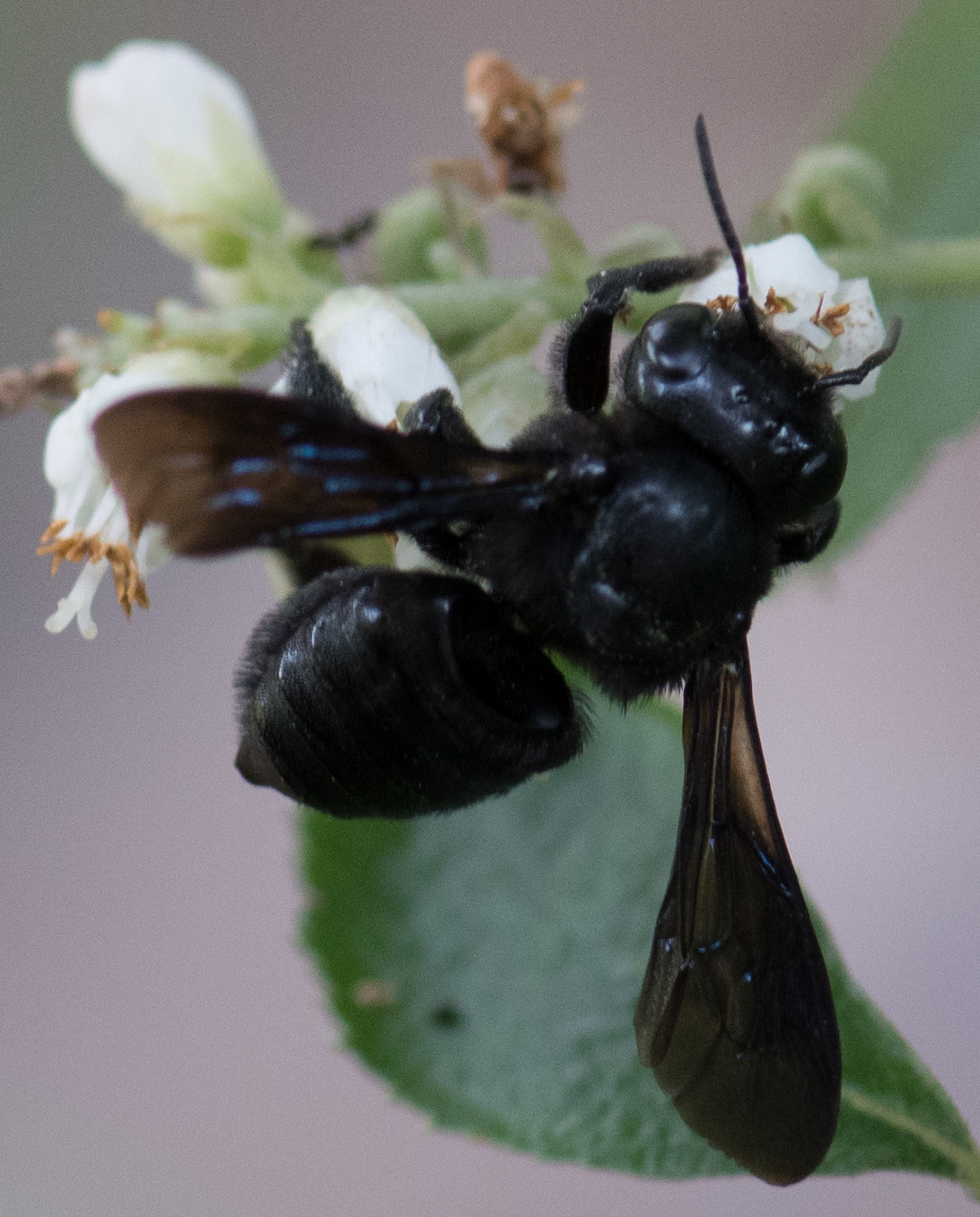
Out front, the newly planted sweet pepperbush (Clethra alnifolia) has excited a lot of pollinator interest.  I shared the potter wasp and the 4 spotted scarab hunter wasp I've seen nectaring here in my recent post;  this is a carpenter-mimic leaf-cutter bee (Megachile xylocopoides) who also has seemed to enjoy the blooms. 

The deep velvet black of this bee's body and the iridescent blue-black of its wings are just stunning.  I wonder if this is the species that has been harvesting circles of dogwood leaves to make their nest cells waterproof?

Another little green treefrog was tucked away inside a Flyr's nemesis (Brickellia cordifolia), hoping against hope that I didn't actually see him as I looked around.  I let him pretend that I hadn't noticed him.....

With the spotted beebalm (Monarda punctata) beginning to bloom, I'm starting to see a little more activity in that section of the garden, including this small green anole (Anolis carolinensis).  I'm still not seeing many insects attracted to the spotted beebalm blossoms, but I did see a hummingbird feeding - even though I didn't have my camera with me so I could visually share with you.

Back to the anole for a moment, I've been seeing many tiny little green anoles for the last several weeks, which just makes me smile.  Obviously it's been a good year for anole love!

Another recent dragonfly visitor was the great blue skimmer (Libellula vibrans), who perched on top of the poles in our tomato pots for a while - and was lucky enough (and good enough) to capture a passing moth shortly after I took the top photo.  Those big, black-spotted blue eyes aren't just for show!

Out front, enjoying the turkey tangle fogfruit (Phyla nodiflora), there's been the phaon crescent (Phyciodes phaon), nectaring - and possibly laying eggs, since fogfruit is their larval plant.  Note:  I don't know if this individual is a male or female.

The fogfruit has also attracted many other insects, including a female blue dasher dragonfly, a carpenter-mimic leaf-cutter bee, several  different species of wasps, bees, and flies.  In fact, the fogfruit is active enough that it's probably worth a post just by itself.  I just wish it looked a little more "gardeny"....

Anoles have been out in the front gardens as well as in the back.  Here was one haunting a summer phlox (Phlox paniculata) blossom.  Sometimes I wonder if I don't see huge numbers of pollinators because I DO see lots and lots of predators around the blooms - and I'm sure it's not a coincidence that they are hanging out there!

Speaking of predators, whether nymphs (like this one) or adults, I'm seeing quite a few milkweed assassin bugs (Zelus longipes) this summer.  I thought they were so-named because they were part of the milkweed community, but recent reading suggests their name comes from their coloration.  I've certainly seen them on many, many plants, not just on milkweed.

The clustered mountain mint (Pycnanthemum muticum) in the back yard has brought in quite a few unusual (for my garden) pollinators.  Besides several wasp species, there is this grapeleaf skeletonizer moth (Harrisina americana) which has both a common name and a color pattern that make it a perfect Halloween animal.

Believe it or not, this small, colorful, Halloween themed moth, also nectaring on the mountain mint, is from the a group of moths known as bird dropping moths.  Yes, that's an actual common name for moths in the subfamily Acontiinae .  This moth goes by the hard-to-remember name of black-dotted spragueia moth (Spragueia onagrus)  and is an animal I've never seen before in my life.  Kudos to the helpful folks at BugGuide.net for helping me identify this one!

Lacewing larvae, looking for all the world like prehistoric monsters or like some less glittery version of Tamatoa, the Crab, on Moana, are hard to see unless you look closely, but they are great allies in garden pest control.  This photo is blurry (the entire "mound" is barely 1/4" across and I wasn't using a tripod) but, if you look carefully, you can see the huge jaws under the front edge as well as a wing from one of its dinners right above the jaws.

In all, this lineup of characters from my garden highlights 6 garden predators (green anole, green treefrog, milkweed assassin bug, lacewing larva, blue dasher dragonfly, great blue skimmer dragonfly) and 6 pollinators (monarch, bumblebee, carpenter-mimic  leaf-cutter bee, phaon crescent butterfly, grapevine skeletonizer moth, and black-spotted spragueia moth).  During the 10 days that I photographed these animals, I saw many other animals, too.  Some, like the 5 species of wasps that I talked about in my last post, I've shared with you.  Others, like bluebirds, cardinals, bluejays, gray squirrels, chickadees, tufted titmice, house finch, mockingbirds, red-shouldered hawk, brown skinks, southern toads, and Eastern box turtle, I haven't shared.

How can anyone be happy with a statically "pretty" landscape, when a garden filled with wildlife changes minute by minute?!  I love the surprise of going out into my yard and meeting a new insect neighbor.  I love the pleasure of looking at a flower cluster and realizing that I'm looking into the eyes of a little lizard or camouflaged frog.  Each new animal I see adds a layer of richness to the world around me that delights and soothes me.  What an honor to be sharing my yard and gardens with all these other forms of life here on Earth.


Thursday, August 28, 2014

The Fly and the Caterpillar: Not a Love Story

As I was doing a quick look-see in the vegetable garden yesterday, I heard a fly buzzing.  Why a buzzing fly caught my attention, I really can't tell you, but it did.  Perhaps it was because the noise was coming from the top of a tomato plant, which isn't normally fly country.  Anyway, I stopped to see what was going on.

At first I didn't see anything, then a movement attracted my attention.  Was that a smallish horn worm? 

I kept looking, finally able to see the outline of the caterpillar against the underside of one of the tomato leaves tucked in a ways.  Suddenly I saw a quick, dark movement and the caterpillar thrashed wildly.  What was going on???

As I watched, it became obvious that a fly was attacking the hornworm.  Every time the fly circled around and came near, the hornworm would move.... Trying to defend itself?  Trying to attack the fly?  Trying to keep the fly from landing?  I couldn't really see what was going on, but I took a series of photos, hoping to capture something with my lens that my eyes couldn't see.

Here are the best shots from the encounter...

The hornworm when I first saw it.

The first view of the fly.

Another "fly by" by the fly.  (Look carefully - you can see the fly's legs above the caterpillar;  the body of the fly is mostly hidden by the tomato stem.)

The fly comes back for another go-around.

And another attack - Fly attack #4...

This one lasted a little longer and the fly seemed to land on the caterpillar's body, despite the hornworm's thrashing and attempts to defend itself.

Fly attack #5.....  (You can just see the eyes of the fly coming into focus to the left of and slightly below the caterpillar.)

Fly attack #6...

Now there's fluid on the back of the caterpillar;  the fly has definitely made contact.

Still the fly comes back again....

But this seems to be the end of the attack.  A drop of "blood" on the back of the caterpillar remains, but the buzzing fly is gone.

According to my camera's time stamp, all of these photos were taken within a 2 minute window.  I don't know how long the attack had been going on when I chanced upon it.  Still, overall, the action didn't last that long.

I am assuming that the fly was a female and that she laid at least one egg in the caterpillar.  Judging from the fly's hairy abdomen that I could see in the photos, this was probably a tachinid fly.  If that's the case, the hornworm will go back to eating as if nothing has happened, but when it goes to pupate, the fly larva that has grown inside it will take over and kill the developing moth.  The hornworm pupa will actually only produce one or more fly pupae, which will, in their turn, produce more tachinid flies to carry on the cycle.

I knew that tachinid flies were parasitoids of caterpillars, but this is the first time I've actually witnessed the interaction between the caterpillar and the fly.  I see many, many tachinid flies in the garden, especially in the fall when they are feeding at my asters, so I knew this sort of event had to be occurring.  Adult tachinid flies are pollen and nectar feeders...and good pollinators.  Hornworms, while I think they are cool and interesting, are pests on tomato plants.  This is natural predator control at its most basic.

Life is not particularly gentle, but it tends to balance itself when allowed to do so.  Sometimes the variety of feeding strategies truly boggles my mind.   What predatory insects have you seen in YOUR garden lately?

Monday, April 21, 2014

Lousy Photos Still Have Their Value

Having set myself the task, last year, of documenting all of the plants and animals that I can identify on our 10 acres, I have found myself overwhelmed with photos in short order now that spring has arrived. 

It's MUCH easier to take photos of insects than it is to identify them.  Just in case you wondered.

It's also much easier to take photos of insects than it is to take GOOD photos of insects - good photos being defined as photos where you have a snowball's chance of actually identifying the insect in question based on what you are seeing on the screen in front of you.  I learned my basic insect identification skills the "good" old fashioned way, a.k.a. by capturing the insects and killing them, then identifying them at my leisure through the use of various magnifying devices and dichotomous keys.

I prefer trying to identify living insects in blurry photos, even if it means I won't get many of them actually identified.  I'm just not into killing living beings of any sort, if I can avoid it.  So here are a few of my so-so photos, some of which I've managed to identify and some of which are still mysteries to me....

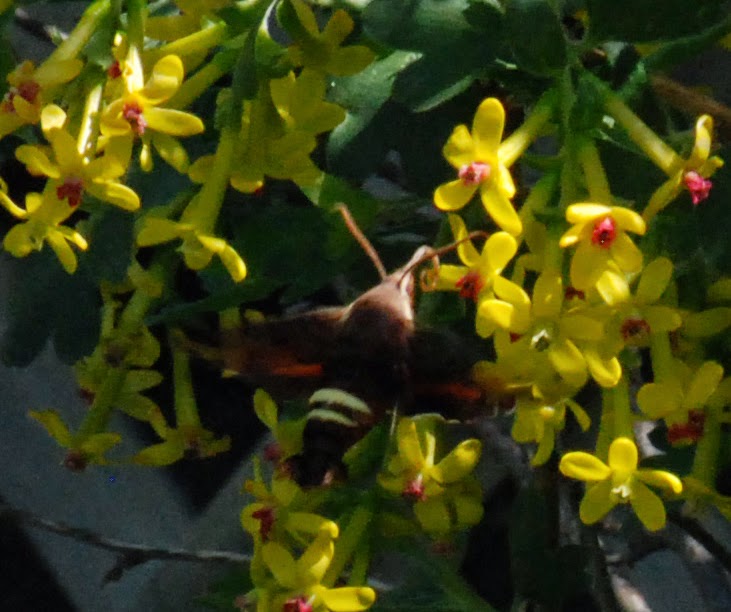
The clove currant (Ribes odoratum) is in sweet, full and glorious bloom right now.  On Saturday, when I stopped by it, I noticed a dark hawk moth feeding.   The wings blurred rusty brown as the moth moved from bloom to bloom, while the heavy abdomen had a tuft at its end and was encircled by 2 bright yellow bands. I'd never seen this particular hawk moth before, so I tried to take its picture, thinking I could identify it more accurately if I had a good photo.  The blasted little beast was definitely camera shy and not very trusting of giant beings standing nearby with big black boxes stuck up near their face.  It tended to keep to the far side of the plants, rather than venturing out into the open near to me.

Thank heavens for digital.  Fifteen photos later, the moth flew away and I've not seen it since.  When I checked out those 15 shots to see what I'd managed to capture, sadly this was the BEST image of the lot.

As lousy as this photo is, I was still able to use it to identify my "dark" hawk moth as a Nessus Sphinx Moth (Amphion floridensis).  This species is supposedly one of the more commonly encountered day-flying moths, but I've never seen one before.  The larvae/ caterpillars, which are a type of hornworm, feed on grape, Ampelopsis, and Capsicum (bell and hot pepper) plants, all of which are frequent in our yard.

Looking around under one of our green ash trees (Fraxinus pennsylvanica), I noticed some small, gnat-like creatures flying.  When one came to rest within my sightline, I decided to snap its picture.  Then I noticed a second one nearby.  Snap.  Snap.  Snap.  These little creatures were about 1/4" or 3/8" long, colored gray and sitting on gray bark.  I have no idea why I thought I could get a good photo.  Here's what I managed to capture, 26 photos later, ....

I didn't think this silhouette would show me much at first, but when I zoomed in, I noticed that the "big" fly had a small fly caught underneath it, held in a classic "I'm eating you" sort of position.  When I showed it to Greg, he immediately thought the "big fly" was a robber fly of some sort.  I can go with that.

Another shot of the same individual accidentally captured a second "big fly" just above it on the bark. 

Do you see the 2 of them?  The one in the bottom right of the photo is the one shown in silhouette above; the second one is in the top left of the photo.  When I zoomed in on the second individual, it also seemed to have some sort of fly prey - with a yellow tipped abdomen - caught.
From the top, there's little evidence of "big fly #1" having prey captured beneath it, but the silhouette shot accidentally revealed the secret.

I haven't decided yet whether I'm going to try to submit these photos to Bug Guide or not - my feel is that they are not good enough for any sort of identification, but maybe I'll chance it anyway.  I do think these are tiny robber flies and I'd love to see if anyone can tell me any more about them.

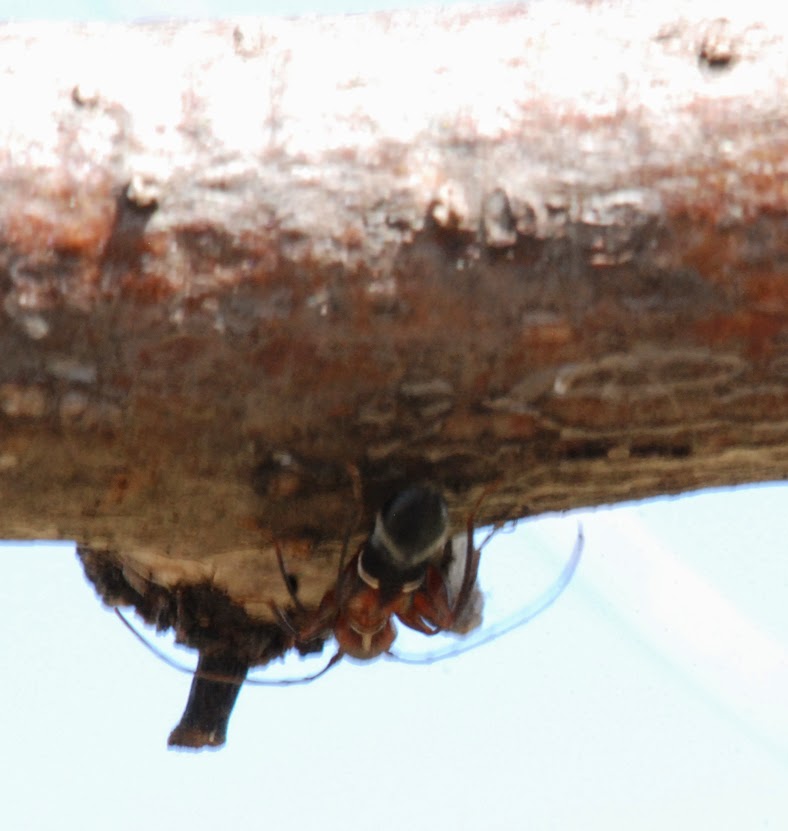
Another lousy picture that nonetheless taught me something new about the creatures in our yard was this one, taken Saturday of some sort of critter on the underside of a small honeylocust branch....

When I took the photo, I thought the mess of moving legs was perhaps an emerging wheel bug.  As I took several more shots, I changed my mind to thinking I was looking at a brightly colored ant.  As I took the very last picture, something clicked and made me think, "Beetle?"  When I looked it up, sure enough, beetle was correct!  This is an Antlike Longhorned Beetle (Euderces pini).  The larvae of this beetle feed on dead wood in a variety of types of trees; the adults are typically seen nectaring at flowers.  The adults mimic ants and are notoriously hard to photograph because they never quit moving.  This is another insect that tops out around 3/8" long.  As lousy as my photos of this creature are (and this is the best of the lot), I feel lucky that I got a couple shots that allowed me to identify it at all.

As you can tell, I've got a LO-O-O-ONG way to go before I get very decent at taking good insect photos, but I do have fun and I learn a lot, even at the level of (in)competence that I have attained.  The natural world seems more wondrous every day.

Saturday, January 11, 2014

Learning Another (Fly) Stitch in the Tapestry of Patchwork Prairie

After all the hoopla of the holidays, I'm finally getting back to my projects, particularly the one where I'm learning to identify the different insects that I've photographed in the yard over the last 7 years.

With that goal in mind, I've started posting some of the insects that I can't identify on bugguide.net.  This wonderful site has generous volunteers that identify the insects they can in photos shared by people from all around the country.

The last time I posted any photos on bugguide.net was almost 2 months ago, so I was rather surprised recently to get a message in my e-mail box saying that someone had added comments to one of my submissions.  Checking it out, I learned that one of the flies I had posted from early November had been identified as a particular species of tachinid fly, Archyatus marmoratus.  Which meant exactly what?

I had been pretty sure that the fly, which I observed feeding on aromatic aster blooms, was a tachinid.  And it was.  Tachinids are rather large flies that look like very hairy, even bristly, house flies.  Despite their homely appearance, they are considered a beneficial insect.  In their larval stage, they are parasitoids, because their larvae grow inside a variety of other insects and kill those insects as they grow.  Often the species parasitized is specific to the species of tachinid fly, so finding out the species of tachinid fly gave me a good chance of learning how this particular insect fit within the community of plants and animals in our yard.

Googling was in order...and rapidly accomplished.

I didn't find a lot on Archyatus marmoratus during my quick Google search, but what I did find was reassuring, even exciting.  This tachinid species is not completely host specific, but it does parasitize caterpillars in a specific group of moths, Noctuids, particularly within a group of caterpillars that includes armyworms, budworms and other pest species.  The female fly lays her eggs in the area where host caterpillars are likely to occur and, after the eggs hatch, the young fly larvae hitch onto appropriate host caterpillars when they come by.  Each caterpillar that picks up a tiny fly larva eventually gives up its life, producing one adult tachinid fly in the process.

So, for every adult fly I see, an armyworm or budworm gave its life.  For every adult A. marmoratus fly I see, an armyworm or budworm didn't make it to adulthood to reproduce.  For every adult A. marmoratus I see, a new generation of tachinid flies has a good chance of appearing to help keep next year's armyworm and budworm populations under control.  And along the way, my asters get some extra help in pollination.

All in all, it's a mighty sweet deal, despite being all wrapped up in a pretty homely package.

Friday, June 14, 2013

Bits and Pieces from Around the Garden

I went out this morning to take a single photo - and ended up taking about 150!  Good lighting, some interesting bees, and nice blooms.  Here is just a smattering of the photos I garnered....

I've been thinking that I want to try to gussy up my photographic technique a bit - maybe try some different angles, "tell a story" about the garden, capture in pictures how I feel as I work around the yard.  I was quite pleased with how this shot of my front garden came out, which I took from a different vantage point than usual....

The bright orange butterfly milkweed (Asclepias tuberosa) in the foreground has come into full and glorious bloom, there are a few, sunny yellow, lanceleaf coreopsis blossoms (Coreopsis lanceolata) hanging on, the deep reddish-orange blanket flower is putting on a spectacular show (Gaillardia sp.) and the tall, yellow coneflower (Echinacea paradoxa) is in great beauty this year.

Speaking of the yellow coneflower, its blooms were obviously chock full of pollen and nectar, judging from the number of little native bees that were busily packing their pollen baskets.

Leaving the Echinacea after a plethora of native bee photos, I glanced at this clump of coreopsis and noticed a small white insect of some sort.  I couldn't really tell what it was, but I took its photo and figured that I'd be able to tell a little better when I enlarged it on the computer screen.

Sure enough, once I magnified the white bug it turned out to be a small white moth being eaten by a spider.  There were also native bees, beetles, and even a caterpillar feeding at (and on) the coreopsis blooms.

Out in the middle of the front yard's buffalo grass lawn, I've left a purple poppy mallow (Callirhoe involucrata).  It's just too darn pretty to pull out!  A couple of the spent blooms from yesterday were forming this attractive star pattern...

...while a newly opening bloom was coyly getting ready to share its largesse.

I've noticed recently that the insects seem to prefer pushing their way into newly opening blossoms, rather than working the fully open blooms.  Looking at the fresh pollen anthers awaiting their arrival, I can see why!

Butterflies weren't abundant on anything, but the butterfly milkweed did attract this thread-waisted wasp (Ammophila sp.), whose abdominal stripe seems to be designed to match the color of the blossoms.

Thread-waisted wasps feed on nectar as adults, as this individual was doing.  However, the female digs a tunnel in sandy soil, as a nest, which she stocks with paralyzed caterpillars, upon which she lays an egg.  So thread-waisted wasps are great predators to have in your garden!

I'll leave you with a photo of the larkspur in the back courtyard.  I'm always a sucker for blue and bluish purple flowers!