Showing posts with label Native Pollinators. Show all posts

Sunday, July 28, 2024

Hairy Elephant's Foot, A Surprising Pollinator Magnet

At least until you get to know them well, there are some plants that are hard to get excited about.  Often that's because they don't have fascinating foliage or stunning flowers.  Just because a plant isn't classically beautiful, though, that doesn't mean it isn't greatly loved by pollinators and other insects.


Frankly, Hairy Elephant's Foot (Elephantopus tomentosus) is just such a plant.  It is a hard plant to photograph well.  For the first few months of spring and summer, it consists of a few large, hairy leaves lying flat on the ground, all coming from a central point.  Not glamorous, but definitely easy to photograph.

It's in July that the trouble begins.  The plants start to put up their flowering stalks, which rise for 12-15" above the basal leaves.  There is hardly any foliage on these stems at all.  At the top of each stalk, sudden branches stick out awkwardly, each crowned with a trio of small, bright green, hairy, pointy "leaves".  Nestled within those bracts, the small, lavender flowers open, dainty and subtle.  They open in the morning and close in mid afternoon.


These delicate little blooms wash out readily in a photo, especially in any bright light.   Their dainty airiness just looks sparse on "film", even though it looks charming en masse in real life.

A great plant for shade, Hairy Elephant's Foot grows well there, although it tends to be rather widely scattered.  Unexpectedly last year, I had an experiment in our yard when a neighbor cut down several large trees right near our joint property line and turned what had been almost complete shade into full sun, for 5-6 hours each day.

I expected the shade-loving understory plants that grew in that area to frazzle and die, which many of them did.  The Hairy Elephant's Foot, however, had a banner year, blooming prolifically and attracting an amazing number of pollinators and other insects - 21 different species that I was able to photograph!

So how do I best share the amazing number and diversity of insects that I observed?  A simple list, even illustrated with photos and spiced with bits of (hopefully) interesting information, seems overwhelming and ultimately boring.  So I thought I would talk about a few of the "categories" of insects that I observed:  1) Butterflies and Skippers, 2) Pest Control Squad - Solitary Wasps and Syrphid Flies, 3) A Predator and Prey Duo, 4) Native Bees - Pollinators Extraordinaire, 5) Flies, and 6) Passersby.

Two of the species I photographed using Hairy Elephant's Foot last summer are considered somewhat rare or threatened:  the American Bumble Bee and the Yellow-thighed Thick-leg Fly, a form of syrphid fly.  Both are shown below in their appropriate categories.


BUTTERFLIES AND SKIPPERS:

It's always fun to start with "the pretties" - and I've come to think of butterflies and skippers as "flying flowers", the prettiest group of insects overall.

Butterflies and skippers (and moths) are more than just pretty, though.  Their caterpillars are, according to Dr. Doug Tallamy, one of the primary ways that energy, captured by plants from the sun, moves up the food chain.  EVERYTHING seems to eat caterpillars.  For those of us who are birders, that's especially true of most of the songbirds, 95% of whom raise their young on insects, especially caterpillars.  

So in feeding adult butterflies and skippers, Hairy Elephant's Foot is also helping to keep those adults in our yard, thus supporting the production of caterpillars to feed the upcoming generation of birds and other animals here.
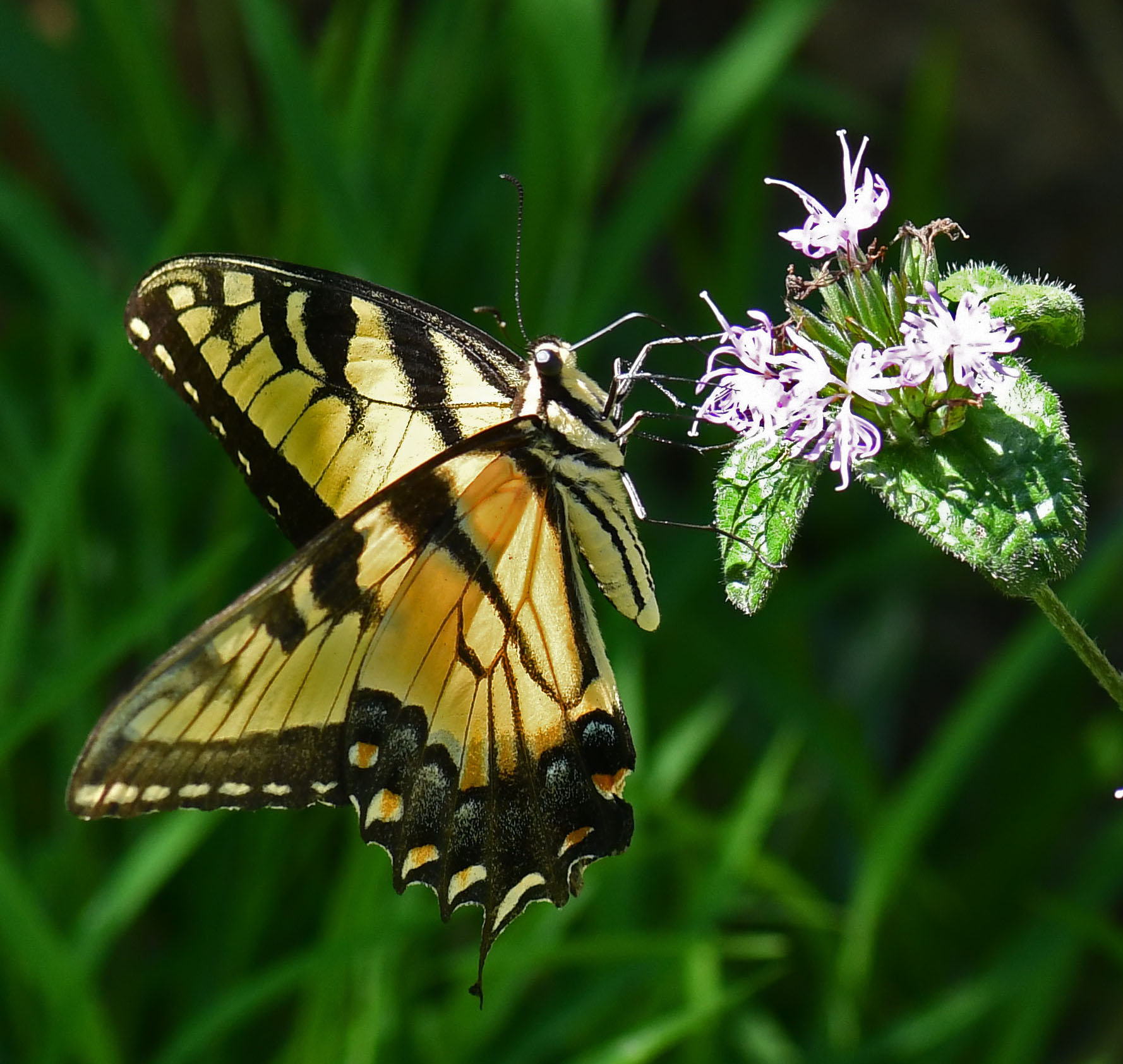


Eastern Tiger Swallowtail (Papilio glaucus), 8/19/23.   With a variety of host plants in the Magnolia and the Rose families, Eastern Tiger Swallowtails are fairly common across a wide range in North America.  In our yard, I'm guessing that they usually spend their larval time on Tulip Poplars, since we have several extremely large specimens of that majestic tree.  It's often easy to overlook the fact that trees can serve as important host and pollinator plants.


Zebra Swallowtail (Eurytides marcellus), 8/19/23).  If you don't have pawpaws, you won't have Zebra Swallowtails.  Our neighborhood has a plethora of pawpaws, in great part because deer don't like it and so it spreads with little competition in our deer-challenged yards.  Consequently, we have a plethora of zebra swallowtails.  Most of the time, these ethereal beauties are just floating through, but Hairy Elephant's Foot got them to stick around for a bit.


Common Buckeye (Junonia coenia), 8/20/23.  This was the first time I had seen a Common Buckeye in our yard.  I've started planting Carolina Petunias (Ruellia caroliniensis) as a "matrix plant" and it turns out that they, along with plantains, are host plants for Common Buckeye caterpillars, along with several other species.  So, was it a coincidence to see this one last summer, a year or two after I started adding Carolina Petunias to the yard?  Or the result of adding yet another native plant species to the local plantscape?


Silver-spotted Skipper (Epargyreus clarus), 8/23/23.  If you look very closely, you can also see a little crab spider under the flowers to the right of the skipper.  The caterpillars of Silver-spotted Skippers feed on many plants in the pea family, from Wisteria to Tick-trefoils, where they build a shelter with silk.  According to iNaturalist, it's unusual to see this species visiting yellow flowers;  they prefer blue, pink, red, purple and even white blooms.


Wavy-lined Emerald Moth caterpillar (Synchlora aerata), 8/23/23.  This is the only species of butterfly or skipper (or moth) that I have seen using Hairy Elephant's Foot as a host plant.  These little guys camouflage themselves by sticking pieces of the flower they are eating to their bodies, so this one has purple bits pasted to it, but the same species will have bright yellow bits on one of the Rudbeckias, white bits on Mountain Mint, etc.  Many times, it's hard to see the caterpillar body at all!  The adult moth is a very pretty light emerald green with wavy lines, as suggested by its name.

Other butterflies that I've observed nectarting on Hairy Elephant's Foot include the Sleepy Orange (Abaeis nicippe) and the Cabbage White (Pieris rapae).  Other skippers that I've observed include Horace's Duskywing (Erynnis horatius), Common Checkered Skipper (Burnsius communis), and Zabulon Skipper (Lon zabulon).


PEST CONTROL SQUAD - SOLITARY WASPS:

Wasps seem scary to many of us, but it's literally a few "bad apples" that have spoiled the barrel of public opinion.  Social wasps (paper wasps and yellowjackets) live in colonies, which they defend vigorously.  Solitary wasps, on the other hand, build nests by themselves and are not at all aggressive.  They will only sting if you attempt to catch them in your bare hands.  I have not observed any social wasps using Hairy Elephant's Foot, but I've observed several solitary wasp species doing so.

All wasps raise their larvae (their "babies") on meat, usually on paralyzed insects, sometimes on paralyzed spiders, and (for social wasps) on chewed up insects.  Because they raise their young on other insects and on spiders, wasps are important predators in our yards and gardens, helping to keep the populations of other species in balance and under control.

Solitary wasps paralyze various species of insect or spider and then lay an egg on the paralyzed prey.   Each different species of wasp preys on a different species of insect or spider.  After being paralyzed, the prey animal lives and provides fresh food for the larva when the wasp egg hatches.  Gruesome, to my mind, but very effective.


Double-banded Scoliid Wasp (Scolia bicincta), 8/20/23.  Scoliid wasps are scarab beetle predators, digging for beetle larvae (a.k.a. grubs) in the soil, paralyzing them, and laying an egg on each.  When the egg hatches, the wasp larva eats the beetle larva, then pupates in the host body.   These wasps are excellent grub control!  About 10 years ago, when we lived in south-central Kansas, I did an entire blog post on this species:  http://gaiagarden.blogspot.com/2014/08/double-banded-scoliid-wasp.html


Blue-winged Scoliid Wasp (Scolia dubia), 8/20/23.  Isn't this a cool looking wasp?!  I had never seen this interesting looking species before last summer.  As a scoliid wasp, it is another species that preys on scarab beetle larvae (white grubs), like the Double-banded Scoliid Wasp above.  It is thought that these species may also parasitize Japanese beetle larvae!  


Gold-marked Thread-waisted Wasp (Eremnophila aureonotata), 8/21-3/23.  I've always wondered how anything - food, blood, etc. - gets through that narrow waist!  Anyway, this interesting looking solitary wasp preys on larger moth larvae, like those of the sphinx moths and owlet & cutworm moths, for food for its larvae.


Fraternal Potter Wasp (Eumenes fraternus), 8/20/23.  There's a reason this little wasp is called a "potter wasp" - the female builds a gorgeous little mud pot in which she stashes the caterpillars that she paralyzes for her young to eat.  She then lays an egg and closes the pot, also with mud, making a perfect little nursery.


Weevil Wasp (Cerceris halone), 8/23/23.  Another solitary wasp, this wasp provisions the cells in her nursery burrows with paralyzed weevils from the genus Curculio.


A PREDATOR AND PREY DUO:

There are bees known as "cuckoo bees" that parasitize the nests of other bees.  Often this happens by the cuckoo bee following the female of its host species back to her nest.  When the host female departs for another load of pollen and nectar to provision her latest brood cell, the female cuckoo bee quickly ducks in and lays an egg.  Generally, when the egg of the cuckoo bee hatches, it either attacks and kills the larva of the host bee, or it hatches first and eats the egg of the host bee before it hatches.  Either way, the cuckoo bee larva then eats the provisions that the mother host bee stored for her own offspring, pupates, and emerges the following year in place of the young of the host bee.

The relationship between the host bee and the cuckoo bee is often very specific, with each cuckoo bee parasitizing only a single species.

How does the cuckoo bee find the host bee?  Well, she hangs out at the same "bar", so to speak.  The life cycles of the host bee and the cuckoo bee are perfectly timed to overlap, and both will be found nectaring at the same flowers.  I found such a pair using the blooms of Hairy Elephant's Foot in our yard:  the Two-spotted Longhorn Bee (host) and the Lunate Longhorn-cuckoo Bee (parasite).


Two-spotted Longhorn Bee (Melissodes bimaculatus), 8/20/23 - host bee.  This almost pure black bee gets its name from the two squarish white spots on either side of its abdomen.  Unfortunately, you can't see those field marks in this photo.


Lunate Longhorn-cuckoo Bee (Triepeolus lunatus), 8/20/23 - cuckoo bee (parasite).


NATIVE BEES - POLLINATORS EXTRAORDINAIRE:

More people are understanding the importance of our native bees for pollination.  The beloved Honey Bee is actually a European import, brought here by colonists who unsurprisingly wanted the honey it produced, as well as its pollination services.  But, for all we hear about honey bees pollinating plants, they are not as efficient at the job as many of our native bees are.

Before the European colonists arrived, there was no problem with pollination in North America.  This continent has almost 4000 species of native bees, often with life cycles exquisitely timed to coincide with those of the plant they evolved to partner with.  Some of these native bees are generalist pollinators, others are specialists who only pollinate one single species, still others pollinate the flowers of just a few plants.

I have not seen honey bees use Hairy Elephant's Foot, although that certainly doesn't mean they don't.  The bees I've seen pollinating this plant all fall under the heading of generalist native bees.  I'll start with two different bumble bee species.....


American Bumble Bee (Bombus pensylvanicus), 8/23/23.  According to iNaturalist, this species used to be one of the most common types of bumble bee, especially in the south, but 90% of its population has been lost in the last 20 years.  It is now considered threatened throughout much of its range.


Common Eastern Bumble Bee (Bombus impatiens), 8/20/23.  As its name implies, this is the bumble bee that I see most commonly in our yard.


Eastern Carpenter Bee (Xylocopa virginica), 8/20/23.  What looks like a bumble bee but has a smooth abdomen?  A carpenter bee.  Great pollinators, they do NOT eat wood...although they do tunnel into it to make their solitary nests.  The females will reuse existing nest tunnels, only taking the time and energy to excavate new tunnels when absolutely necessary.


Pure Green Sweat Bee (Augochlora pura), 8/20/23.  This beautiful little bee nests in rotting logs, a habitat that we have been restoring on our property.  The fertilized females also overwinter underneath rotting logs, waiting until it's time for them to emerge in the spring.


FLIES:

Many flies act as pollinators, although they are not as well known in that role as bees are.  The first species I share here is one of the relatively rare species I've seen on Hairy Elephant's Foot.


Yellow-thighed Thick-leg Fly (Tropidia albistylum), 8/23/23.  This is a relatively rare species of syrphid fly with a very unattractive common name.  As of this writing, there are only 212 observations of this species in iNaturalist, as opposed to 25,000-50,000 observations of two more common syrphid fly species that I've seen in our yard.


Greenbottle Fly (Lucilia sp.), 8/20/23.  This genus of flies (I can't identify this photo below that level) are scavengers, generally speaking.

There were at least 2 other species of flies that I photographed on Hairy Elephant's Foot, but I was unable to identify either of them further.


PASSERSBY:

Of course, in watching any plant or area, there will be some insects that just happen to perch for a while.  Rounding out this line-up of Hairy Elephant's Foot insect fans are a couple of those more incidental visitors....


Blue Dasher (Pachydiplax longipennis), 8/22/23.  This is a dimorphic species, meaning that the male and female look dissimilar.  This individual is a female;  it is the male that has the blue coloration for which the species is named.  Dragonflies are fierce predators of smaller insects.  I'm always hoping the ones I see are living up to their colloquial name of "mosquito hawks".


Eastern Tailed Blue butterflies (Cupido comyntas)  - and a Midge (7/30/23).   Hairy Elephant's Foot can even be used for a bit of canoodling, with or without a voyeuristic midge looking on.

In conclusion, Hairy Elephant's Foot is not a classically "beautiful" plant, but it sure packs a powerful punch for wildlife.  Including insects I've seen but not photographed, I've noticed over 30 different species using this plant - and the deer don't bother it at all.  If you can find a corner somewhere, I highly recommend it.  I've never seen Hairy Elephant's Foot "in the trade", but personal experience tells me that it transplants well.  Mine just showed up on their own.  Keep your eyes peeled or ask if anyone you know has some they'd be willing to share.  You'll be glad you did.  

Wednesday, June 19, 2024

Tiny, But Mighty, Pollinators

It's Pollinator Week, so it seems like a perfect time to write about pollinators.  Little pollinators, to be more specific.

The first spring after we moved into The Land of the Giant Trees, small white flowers with yellow centers appeared in relative abundance around the yard.  Although I was pretty sure these were some sort of fleabane (Erigeron sp.), I wasn't sure which one.


"Are they useful for pollinators?" Prairie Boy kept asking, "Because they look rather weedy."  The question amused and irritated me.  We have all been brainwashed to think that almost any plant that grows without being purchased from somewhere is a "weed".  I'm trying hard to uproot this attitude from my own psyche, but it's well established and deeply rooted, even for me.  

Despite my amusement about Prairie Boy's question, I had trouble answering it.  My instinct was to say yes, the fleabane was useful for pollinators since these plants were native, but I honestly wasn't seeing much action on the flowers.  No honey bees.  No bumble bees.  No butterflies.  (Although that last observation wasn't really fair, since we weren't seeing any butterflies anywhere.)

Surely SOMETHING was using the fleabane!

It seemed like a good idea to identify which fleabane we had.  It turned out to be Philadelphia Fleabane (Erigeron philadelphicus), a biennual. Now I could learn more about the plant and know what to expect from it in future years.

I started watching the blooms more closely...and I started noticing quite a bit of activity on the them.  However, almost all the visitors were tiny little insects that I literally couldn't see from very far away.  No wonder it didn't look like there was much activity on the fleabane until I started looking closely!  

The aster-like flowers of Philadelphia Fleabane are relatively small, about 3/4-1" in diameter, and most of the insects were MUCH smaller than the flowers.  In fact, many were so small that I had trouble identifying them much beyond "flying insect" with just my eyes.  As the days and weeks went by, though, it was obvious these tiny animals were, in fact, pollinators - and they were excellent pollinators at that.  The flowers developed into healthy seed heads in short order.

Eventually I started using my camera to focus on the tiny pollinators of Philadelphia Fleabane and other small flowers, trying to learn the identify of these minuscule creatures.  It's an amazing world that exists literally right alongside us - and yet most of us are completely unaware of these important little creatures who live inches from us.


As I explored this minute world further, I found a varied cast of characters.  Not only were there pollinators, but there were predators and parasitoids and even passers-by, who just seemed to be stopping in the neighborhood for a rest and a quiet "think".

For example, in the photo above, there is a Georgia Mason Bee (Osmia georgica) in the middle of the photo.  There is also a Club-horned Wasp (Sapyga centrata) in the upper left, a Harvestman (a.k.a. Daddy Longlegs) below that, a Crab Spider on the bloom just below and to the right of the mason bee, a tiny wasp about to land on that same bloom, and some other insect hiding on the other side of that blossom that I can't quite make out.  Any of these insects can be acting as pollinators as they move across the flowers, although the mason bee and the wasp are the ones we would traditionally categorize that way.  

Blue-eyed Grass (Sisyrinchium angustifolium) is another native plant that I didn't see pollinators using until I started looking more closely - and with a camera.  This member of the iris family has beautiful blue, but tiny, flowers.  They average about 1/2" in diameter.


In the photo above, a small Blue-eyed Grass flower is being pollinated by a tiny sweat bee (Lasioglossum sp.).....


and, in this second photo, another small Blue-eyed Grass flower is being pollinated by a tiny Thin-lined Calligrapher (Toxomerus boscii), a syrphid fly which is not only a pollinator as an adult, but a fierce aphid predator in its larval stage.

One of our native spireas, Meadowsweet (Spiraea alba), is another plant whose small flowers often attract small pollinators to them.  Each individual Meadowsweet flower is less than 1/4" across, although these small flowers are clustered in much larger, showy panicles.


It's easy for us to see the Emerald Flower Scarab (Trichiotinus lunulatus) pollinating the Meadowsweet flowers above, but the tiny, black Tumbling Flower Beetle (Mordella sp.) just beside it is also a potent pollinator, despite the fact that this little creature measures only about 1/4", just like each individual Meadowsweet flower it visits.

Goldenrods are yet another example of plants with showy, gorgeous blooms...that actually consist of tiny individual flowers.  They often attract tiny pollinators, too.


Here is a cloud of tiny sweat bees (Lasioglossum sp.) pollinating the flowers on Wreath Goldenrod (Solidago caesia) last October. Lasioglossum bees are fairly common tiny, but mighty, pollinators.

I was taught about the role of insects in pollination by learning about the Western Honey Bee, (Apis mellifera) which is actually a fairly large bee.  I'm not a gambler, but I'd be willing to place a good-sized bet that you learned about pollination as a function of the European honey bee, too.  Did you realize that honey bees are not native in North America, and that many folks consider them an invasive species?!  

So how did the plants on this continent get pollinated before Europeans brought honey bees over with them?  Our native pollinators, that's how, and many of these native pollinators are TINY.  Our native pollinators evolved with our native plants to do the job that needed to be done, and they are exceptionally good at doing their job. 

Check your flowers this summer.  Look past the "giant" bumble bees and the "large" honey bees for the smaller pollinators.   Then take a moment to let yourself get lost in wonder at the Lilliputian worlds all around us. It's pretty close to magic for me. 


Sunday, February 10, 2019

Insects Using Gaillardia in My Gardens

Another staple of my (native) pollinator plants is Indian blanket or Gaillardia, Gaillardia pulchella to be precise.   This widespread, short-lived perennial blooms for months and months;  the colorful blossoms almost always seem to have some sort of insect on them. 

Interestingly, though, as I went through my photos, the variety of insects utilizing Gaillardia was not as great as it was for fogfruit.  For 2018, I have photos of only 6 different species using Gaillardia in my gardens. 

By far the most frequent visitor to my Indian blanket flowers was Poey's Furrow Bee (Halictus poeyi), one of the small, somewhat nondescript, native bees. 

I saw this little bee a lot, from early June through the end of October, and it could well have been present before or after I have it documented photographically.  As I understand it, the hook on the back, lower corner of the head, which you can see in this photo, is "diagnostic" of this species.  Even in photographs, though, it can be hard to see this feature due to the diminutive size of this bee and the fact that it tends to round its back and tuck its head a bit as it feeds.

This is typical of what I usually see, even through the camera lens, when looking at Poey's Furrow Bee.

Throughout the summer months, the Brown-winged Striped Sweat Bees (Agapostemon splendens) visited regularly.  I love these vivid little green jewels.  The females are solid green, while the males have black and yellow striped abdomens and a green "jacket" on the thorax. 

In the photo above, the male is probably more interested in the female than in the flower.

Here is a closer view of a different female, giving you a bit more of a feel for the vivid coloration of these little sweethearts.  What a disappointment the common name of this bee is - "Brown-Winged Striped Sweat Bee".  The "A. splendens" of the Latin name much more closely describes how I feel about them!

An insect that I've seen on several different plants around the yard, this Camouflaged Looper, a.k.a. the caterpillar of the Wavy Emerald Moth (Synchlora aerata), looks a bit different depending on which bloom it's raiding for its wardrobe.

What looks like a large, brightly colored piece of debris hanging from the underside of the flower is, in fact, the caterpillar with bits of petal attached.   

Yes, the bloom this little guy raided looks rather tattered, but I personally think it's well worth the less than perfect blossom to see how the flower finery has been used!  In 2018, I photographed camouflaged loopers on Gaillardia blooms on June 23 and again on August 5.

Getting back to native bees, one of my favorite groups is the leafcutter bees.   Females in this group are easy to recognize because they carry pollen in hairs on the underside of their abdomen, giving them a potbellied appearance.
This cute little female (Megachile sp.) demonstrates that trait perfectly.

The only insect I photographed utilizing something besides the bloom of Gaillardia was this paper wasp, which I saw on July 18th.

Truthfully, I don't know if I just didn't notice other insects on the stems and leaves, or if few insects actually utilize the foliage of this plant.

The final insect in my Gaillardia roundup is this flower beetle, the Pygmy Chafer (Strigoderma pygmaea).


In conclusion, I enjoy having Gaillardia in my gardens a lot, finding that it brings in a reasonable number of insects and provides a nice pop of color throughout most of the growing season.  Loving full sun and tolerating pretty dry conditions, it's usually very easy to grow.  The only downside I've found to Gaillardia pulchella is that each individual plant lasts for 2-3 years at most.  It will reseed a bit and, if I watch for seedlings, I can usually keep it as a garden presence without having to buy it again each year.  If you live within its (wide) native range, I'd definitely recommend it for your pollinator garden.

Wednesday, August 01, 2018

A Recent Cast of Characters in My Gardens: Pollinators and Predators

With the initiation of several days of rain, it seems like a good time to share a few garden photos from the plethora I've taken over the last few weeks.  Since I'm obsessed with pollinators and other wildlife, that's what I'll generally be showing you!

Gaillardia (Gaillardia pulchella) brings in a lot of insect activity.  I have several pots of gaillardia on our back patio, as well as a few plants along the street by our mailbox.  Not surprisingly, most of my photos are from the plants I see most often - the ones near my back door.

This is a lousy photo, but I wanted to share the single bumble bee (Bombus sp.) I've seen in my gardens so far this summer.  Gaillardia is the ONLY flower I've seen her on so far.

A female monarch (Danaus plexippus) finally visited the yard for several days last week and she left several eggs behind.  Here's she's ovipositing on a swamp milkweed (Asclepias incarnata) I planted a couple months ago.  I'm a "survival of the fittest" biologist, so I don't collect the eggs and raise the caterpillars inside;  I'm waiting to see if I see any caterpillars - this photo was taken on the 28th, so there should be a couple tiny babies out there munching away, but I haven't gone looking yet.  (Update:  my grandson and I went out in the rain this afternoon and found at least 3 tiny new monarch caterpillars!  Yeah!)

Ms. Blue Dasher (Pachydiplax longipennis) here isn't a pollinator, but I love welcoming her and her relatives into the yard.  Every mosquito this mosquito hawk eats is a mosquito that doesn't bite me! Aren't her eyes particularly gorgeous?  The body of the male blue dasher is a beautiful powdery blue, but I've been seeing almost exclusively females lately.

This green treefrog (Hyla cinerea) seems to have decided that the outside corner of our gutter near the bright lights of the kitchen window makes a perfect home.  Over the past week, I've been seeing her (him?) frequently within just a few inches of this location.   Note:  nothing like a closeup photo to let you know the house badly needs a power washing!

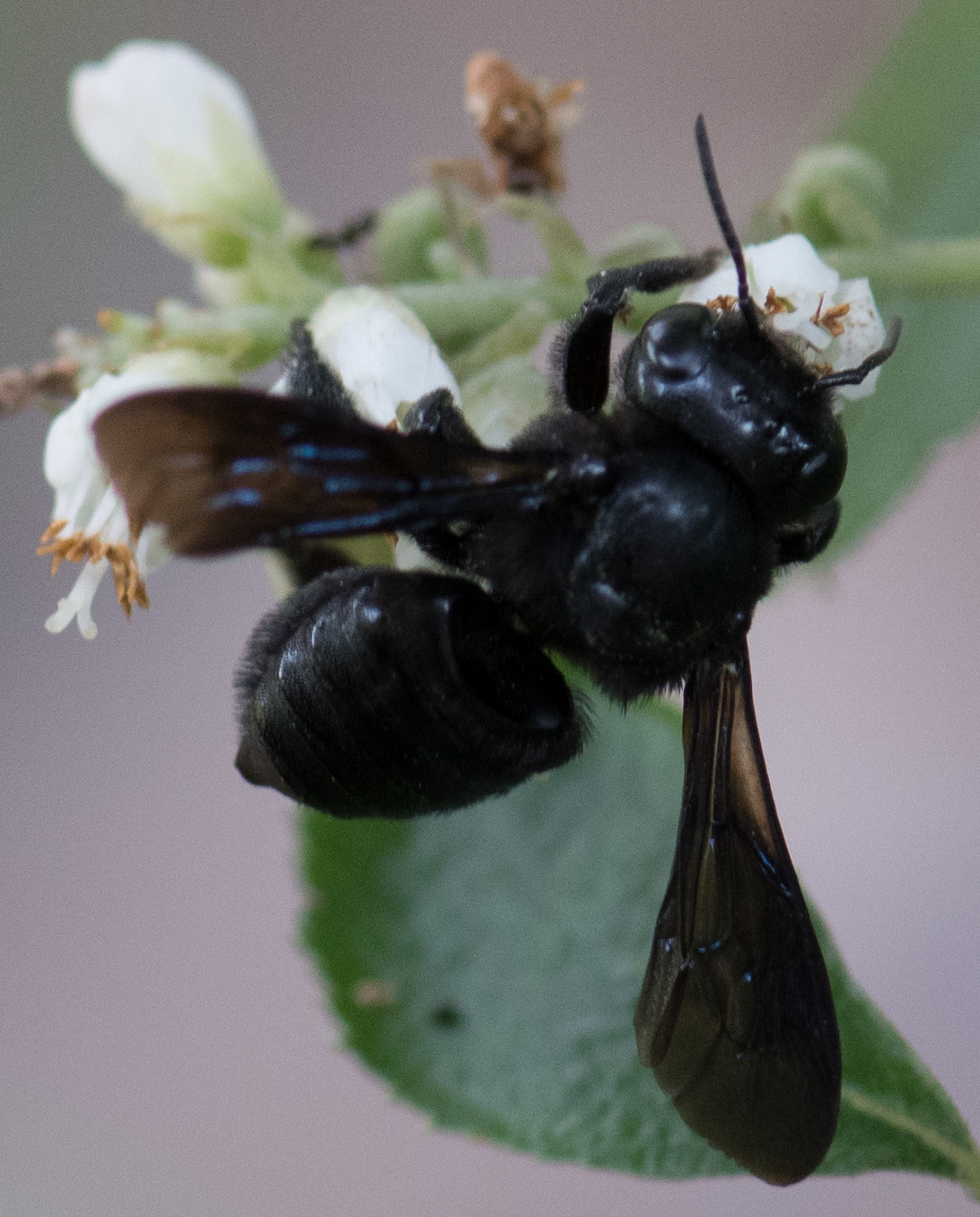
Out front, the newly planted sweet pepperbush (Clethra alnifolia) has excited a lot of pollinator interest.  I shared the potter wasp and the 4 spotted scarab hunter wasp I've seen nectaring here in my recent post;  this is a carpenter-mimic leaf-cutter bee (Megachile xylocopoides) who also has seemed to enjoy the blooms. 

The deep velvet black of this bee's body and the iridescent blue-black of its wings are just stunning.  I wonder if this is the species that has been harvesting circles of dogwood leaves to make their nest cells waterproof?

Another little green treefrog was tucked away inside a Flyr's nemesis (Brickellia cordifolia), hoping against hope that I didn't actually see him as I looked around.  I let him pretend that I hadn't noticed him.....

With the spotted beebalm (Monarda punctata) beginning to bloom, I'm starting to see a little more activity in that section of the garden, including this small green anole (Anolis carolinensis).  I'm still not seeing many insects attracted to the spotted beebalm blossoms, but I did see a hummingbird feeding - even though I didn't have my camera with me so I could visually share with you.

Back to the anole for a moment, I've been seeing many tiny little green anoles for the last several weeks, which just makes me smile.  Obviously it's been a good year for anole love!

Another recent dragonfly visitor was the great blue skimmer (Libellula vibrans), who perched on top of the poles in our tomato pots for a while - and was lucky enough (and good enough) to capture a passing moth shortly after I took the top photo.  Those big, black-spotted blue eyes aren't just for show!

Out front, enjoying the turkey tangle fogfruit (Phyla nodiflora), there's been the phaon crescent (Phyciodes phaon), nectaring - and possibly laying eggs, since fogfruit is their larval plant.  Note:  I don't know if this individual is a male or female.

The fogfruit has also attracted many other insects, including a female blue dasher dragonfly, a carpenter-mimic leaf-cutter bee, several  different species of wasps, bees, and flies.  In fact, the fogfruit is active enough that it's probably worth a post just by itself.  I just wish it looked a little more "gardeny"....

Anoles have been out in the front gardens as well as in the back.  Here was one haunting a summer phlox (Phlox paniculata) blossom.  Sometimes I wonder if I don't see huge numbers of pollinators because I DO see lots and lots of predators around the blooms - and I'm sure it's not a coincidence that they are hanging out there!

Speaking of predators, whether nymphs (like this one) or adults, I'm seeing quite a few milkweed assassin bugs (Zelus longipes) this summer.  I thought they were so-named because they were part of the milkweed community, but recent reading suggests their name comes from their coloration.  I've certainly seen them on many, many plants, not just on milkweed.

The clustered mountain mint (Pycnanthemum muticum) in the back yard has brought in quite a few unusual (for my garden) pollinators.  Besides several wasp species, there is this grapeleaf skeletonizer moth (Harrisina americana) which has both a common name and a color pattern that make it a perfect Halloween animal.

Believe it or not, this small, colorful, Halloween themed moth, also nectaring on the mountain mint, is from the a group of moths known as bird dropping moths.  Yes, that's an actual common name for moths in the subfamily Acontiinae .  This moth goes by the hard-to-remember name of black-dotted spragueia moth (Spragueia onagrus)  and is an animal I've never seen before in my life.  Kudos to the helpful folks at BugGuide.net for helping me identify this one!

Lacewing larvae, looking for all the world like prehistoric monsters or like some less glittery version of Tamatoa, the Crab, on Moana, are hard to see unless you look closely, but they are great allies in garden pest control.  This photo is blurry (the entire "mound" is barely 1/4" across and I wasn't using a tripod) but, if you look carefully, you can see the huge jaws under the front edge as well as a wing from one of its dinners right above the jaws.

In all, this lineup of characters from my garden highlights 6 garden predators (green anole, green treefrog, milkweed assassin bug, lacewing larva, blue dasher dragonfly, great blue skimmer dragonfly) and 6 pollinators (monarch, bumblebee, carpenter-mimic  leaf-cutter bee, phaon crescent butterfly, grapevine skeletonizer moth, and black-spotted spragueia moth).  During the 10 days that I photographed these animals, I saw many other animals, too.  Some, like the 5 species of wasps that I talked about in my last post, I've shared with you.  Others, like bluebirds, cardinals, bluejays, gray squirrels, chickadees, tufted titmice, house finch, mockingbirds, red-shouldered hawk, brown skinks, southern toads, and Eastern box turtle, I haven't shared.

How can anyone be happy with a statically "pretty" landscape, when a garden filled with wildlife changes minute by minute?!  I love the surprise of going out into my yard and meeting a new insect neighbor.  I love the pleasure of looking at a flower cluster and realizing that I'm looking into the eyes of a little lizard or camouflaged frog.  Each new animal I see adds a layer of richness to the world around me that delights and soothes me.  What an honor to be sharing my yard and gardens with all these other forms of life here on Earth.