Showing posts with label Mutations. Show all posts

Tuesday, March 17, 2015

Another Bird Deformity

It has amazed me how many bird deformities I've seen in our yard over the last 8 years.  Some I've shared on this blog.  Mainly beak deformities, but also color changes like the piebald cardinal I've seen this winter and the "yellow breasted" red-winged blackbird I saw several years ago.

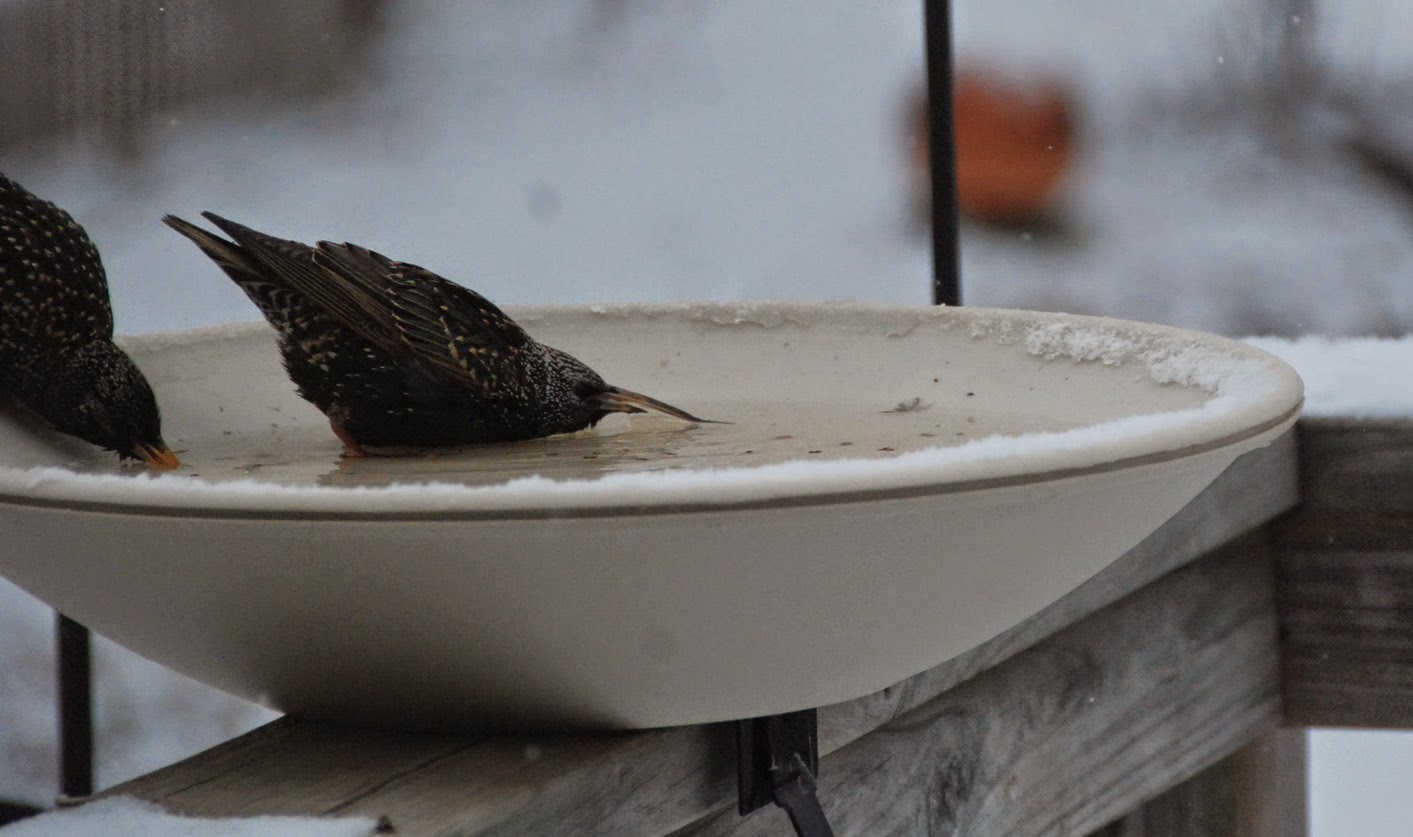
At the end of February, another beak deformity showed up.  This time it was a starling that I noticed drinking during a snowstorm.

I am presuming that this is a case of a beak malocclusion - which results in the upper mandible (in this case) not being automatically trimmed as it closes against the lower mandible.

As with so many genetic abnormalities, this one is not a good change from normal.  Note how wet the feathers down the front of this individual are?

That's because it has to drink by almost immersing itself in water and skewing its body sideways, as in this picture.  I presume it has to eat this way, too.

Compared to the "normal way" a starling would eat and drink, shown by the bird on the left, this deformed starling has to work much harder for both calories and water.  As the top mandible grows longer, it will get harder and harder for this individual to get what it needs.  It also can't be good for this bird to get this wet during cold weather.  Presumably, eventually, it will weaken and die, perhaps becoming food for a predator of some sort.

Seeing individuals like this always makes me sad...but, at the same time, I have to admire them for their bravery and persistence in the face of difficulty.  As beautiful as life is overall, sometimes it seems starkly hard and cruel.  I just try to remember how often things go right, rather than how awful it is when they go wrong....


Monday, June 24, 2013

An Exciting Variation on a Theme?

Last week I was up in Iowa, getting together with family to celebrate the life (and mourn the passing) of an uncle of mine - a musician and teacher of music who shared his gift widely and passed along his knowledge to many.  He was one of those individuals who truly brought more beauty into this world through his living.

But on to the reason for my post.  While there, we visited the home of a relative renowned for her gardens, her cooking, and her hospitality...who just happened to have a rather unusual tree in her yard.  Looking around, we noticed a similar tree in a neighbor's yard as well.

These two maples had sections of leaves that were beautifully variegated.  Apparently Henrietta's tree, at least, had not been purchased as a variegated specimen.  In fact, according to her, it did not have any variegation in its foliage until she and her husband decided to move it from the front yard to the back, disappointed that it hadn't grown very well in the front yard.  After they moved it, the variegation appeared.

Apparently, this is how the leaves emerge.  As the summer goes on, the variegation disappears and the leaves turn to full green.  They color normally in the fall.  And repeat each year.

Is this a response to something in the soil?  A virus?  A genetic mutation?  I have no idea and would welcome any thoughts.  Meanwhile, I thought it was cool enough - and pretty enough - to share it.

I must admit to wondering if it could be propagated.....


Saturday, February 23, 2013

Sad, but Tough, "Old" Bird

It's amazing how many mutations I've noticed over the last couple years.  I found the latest one this morning, in a small flock of red-winged blackbirds that was feeding out in the back yard.  I noticed a male that seemed to be carrying a long straw or something, so I got my binoculars out to take a closer look....

It wasn't a straw, it was the poor guy's beak.

To eat, he turns his head sideways and picks up the seeds with the side of his beak/mouth, since otherwise his beak gets in the way.

He was strong enough to get in brief flurries with another bird or two, but I have to wonder how long he'll survive.  I'm amazed he's made it this long...and this far!

Thursday, September 06, 2012

Stating the obvious, I haven't posted for a while.  We've had a little rain, but not enough to truly refresh the plants.  We've had some relief from the hellish temperatures, but not a steady relief yet.  Both rain and some temperature relief are looking likely by this weekend, but I'm not making any serious bets on either, based on the last 2 years' experience.

So, since being outside hasn't been very enjoyable, I've been concentrating on getting a few projects done in the house, none of which have included gardening or blogging.  The dogs, though, have been adamant in their desire for daily walks, so I've managed to photograph a few things that I thought I might share with other gardeners and nature lovers....

The dotted gayfeathers (Liatris punctata) have started blooming in the back prairie....


This year they seem to be spacing out their bloom times more than usual.  I noticed the first blooms on August 25, almost 2 weeks ago, and I would still say that the stands aren't in full bloom yet.  The first spikes, though, are almost done blooming already.

Anyway, because I was looking closely at the gayfeather blooms and trying to decide how best to photograph them, I happened to notice this garden spider in her web.  (If you don't see her,  the Liatris spike is to the left, the spider and web are in the bottom right corner.) I seriously doubt I would have noticed her, if not for the nearby blooms.


As I moved around to try to get the best photo of her, without getting too near (and without my canine destructo team ripping through), I noticed that she seemed to be pointing her abdomen straight at me - minimizing her profile, I would guess.  I'd never noticed the behavior before, but will watch for it now.


Another plant that's blooming prolifically, despite the heat and drought of the summer, is the annual, snow-on-the-mountain (Euphorbia marginata).  Solitary wasps, especially, seem to love feeding at these blooms...and I was surprised, when I got in close-up, at how pretty the flowers actually are.  I think this might make an interesting garden plant, if horticulturists would select for low-growing cultivars.


I was reminded that birth defects occur in all species when I saw this dragonfly perched out back on a metal post.  Was his malformed abdomen caused by a problem molting?  ...a genetic problem?  Was he malformed as a nymph?  How long did he survive after I took this photo?  Could he, possibly, have mated?  I've not seen him again, so I can't answer any of these questions.


This is the second time that the dogs and I have come across a box turtle chowing down on a dead cicada.  The dogs think that all cicadas were designed as crunchy, noisy dog treats, so the first time we came upon one, they stole it from the turtle before I realized what they were doing.  This time I was able to anticipate their greediness and, after disturbing the turtle long enough to get a photo or two, pull the dogs away and let the turtle finish her meal in peace.


Earlier this summer I was struck by how the abundant honeylocust (Gleditsia triacanthos) pods looked rather like party decorations, hanging off the trees.  They're still looking like that, although now they're brown spotted green streamers!


And I'll leave you, for now, with this photo of a grasshopper playing peek-a-boo with me.  When I moved, he moved.  The ensuing game reminded me of a small child hiding behind a little tree.  I guess when it's dry out and there aren't many pretty flowers, you have to find something to amuse yourself with!  (I'm speaking of me, here, not the grasshopper!  I'm sure he was trying, desperately, not to become people food.)


Monday, January 09, 2012

Another Cardinal Abnormality

It's odd.  Today I saw my second abnormally plumaged female cardinal at my feeders.  This one is a partial albino.  I've never seen this particular individual before.

I did my best to get mug shots.  Here she is from the side....


And from the front....


And here, just for comparison, is the other abnormally plumaged female that I've seen this year at my feeders.  Unlike the partial albino I saw this morning, this brighter-than-normal female is a regular at my feeders.


I'm curious to see if either attracts a mate this spring.