Showing posts with label Gaillardia. Show all posts

Sunday, February 10, 2019

Insects Using Gaillardia in My Gardens

Another staple of my (native) pollinator plants is Indian blanket or Gaillardia, Gaillardia pulchella to be precise.   This widespread, short-lived perennial blooms for months and months;  the colorful blossoms almost always seem to have some sort of insect on them. 

Interestingly, though, as I went through my photos, the variety of insects utilizing Gaillardia was not as great as it was for fogfruit.  For 2018, I have photos of only 6 different species using Gaillardia in my gardens. 

By far the most frequent visitor to my Indian blanket flowers was Poey's Furrow Bee (Halictus poeyi), one of the small, somewhat nondescript, native bees. 

I saw this little bee a lot, from early June through the end of October, and it could well have been present before or after I have it documented photographically.  As I understand it, the hook on the back, lower corner of the head, which you can see in this photo, is "diagnostic" of this species.  Even in photographs, though, it can be hard to see this feature due to the diminutive size of this bee and the fact that it tends to round its back and tuck its head a bit as it feeds.

This is typical of what I usually see, even through the camera lens, when looking at Poey's Furrow Bee.

Throughout the summer months, the Brown-winged Striped Sweat Bees (Agapostemon splendens) visited regularly.  I love these vivid little green jewels.  The females are solid green, while the males have black and yellow striped abdomens and a green "jacket" on the thorax. 

In the photo above, the male is probably more interested in the female than in the flower.

Here is a closer view of a different female, giving you a bit more of a feel for the vivid coloration of these little sweethearts.  What a disappointment the common name of this bee is - "Brown-Winged Striped Sweat Bee".  The "A. splendens" of the Latin name much more closely describes how I feel about them!

An insect that I've seen on several different plants around the yard, this Camouflaged Looper, a.k.a. the caterpillar of the Wavy Emerald Moth (Synchlora aerata), looks a bit different depending on which bloom it's raiding for its wardrobe.

What looks like a large, brightly colored piece of debris hanging from the underside of the flower is, in fact, the caterpillar with bits of petal attached.   

Yes, the bloom this little guy raided looks rather tattered, but I personally think it's well worth the less than perfect blossom to see how the flower finery has been used!  In 2018, I photographed camouflaged loopers on Gaillardia blooms on June 23 and again on August 5.

Getting back to native bees, one of my favorite groups is the leafcutter bees.   Females in this group are easy to recognize because they carry pollen in hairs on the underside of their abdomen, giving them a potbellied appearance.
This cute little female (Megachile sp.) demonstrates that trait perfectly.

The only insect I photographed utilizing something besides the bloom of Gaillardia was this paper wasp, which I saw on July 18th.

Truthfully, I don't know if I just didn't notice other insects on the stems and leaves, or if few insects actually utilize the foliage of this plant.

The final insect in my Gaillardia roundup is this flower beetle, the Pygmy Chafer (Strigoderma pygmaea).


In conclusion, I enjoy having Gaillardia in my gardens a lot, finding that it brings in a reasonable number of insects and provides a nice pop of color throughout most of the growing season.  Loving full sun and tolerating pretty dry conditions, it's usually very easy to grow.  The only downside I've found to Gaillardia pulchella is that each individual plant lasts for 2-3 years at most.  It will reseed a bit and, if I watch for seedlings, I can usually keep it as a garden presence without having to buy it again each year.  If you live within its (wide) native range, I'd definitely recommend it for your pollinator garden.

Wednesday, August 01, 2018

A Recent Cast of Characters in My Gardens: Pollinators and Predators

With the initiation of several days of rain, it seems like a good time to share a few garden photos from the plethora I've taken over the last few weeks.  Since I'm obsessed with pollinators and other wildlife, that's what I'll generally be showing you!

Gaillardia (Gaillardia pulchella) brings in a lot of insect activity.  I have several pots of gaillardia on our back patio, as well as a few plants along the street by our mailbox.  Not surprisingly, most of my photos are from the plants I see most often - the ones near my back door.

This is a lousy photo, but I wanted to share the single bumble bee (Bombus sp.) I've seen in my gardens so far this summer.  Gaillardia is the ONLY flower I've seen her on so far.

A female monarch (Danaus plexippus) finally visited the yard for several days last week and she left several eggs behind.  Here's she's ovipositing on a swamp milkweed (Asclepias incarnata) I planted a couple months ago.  I'm a "survival of the fittest" biologist, so I don't collect the eggs and raise the caterpillars inside;  I'm waiting to see if I see any caterpillars - this photo was taken on the 28th, so there should be a couple tiny babies out there munching away, but I haven't gone looking yet.  (Update:  my grandson and I went out in the rain this afternoon and found at least 3 tiny new monarch caterpillars!  Yeah!)

Ms. Blue Dasher (Pachydiplax longipennis) here isn't a pollinator, but I love welcoming her and her relatives into the yard.  Every mosquito this mosquito hawk eats is a mosquito that doesn't bite me! Aren't her eyes particularly gorgeous?  The body of the male blue dasher is a beautiful powdery blue, but I've been seeing almost exclusively females lately.

This green treefrog (Hyla cinerea) seems to have decided that the outside corner of our gutter near the bright lights of the kitchen window makes a perfect home.  Over the past week, I've been seeing her (him?) frequently within just a few inches of this location.   Note:  nothing like a closeup photo to let you know the house badly needs a power washing!

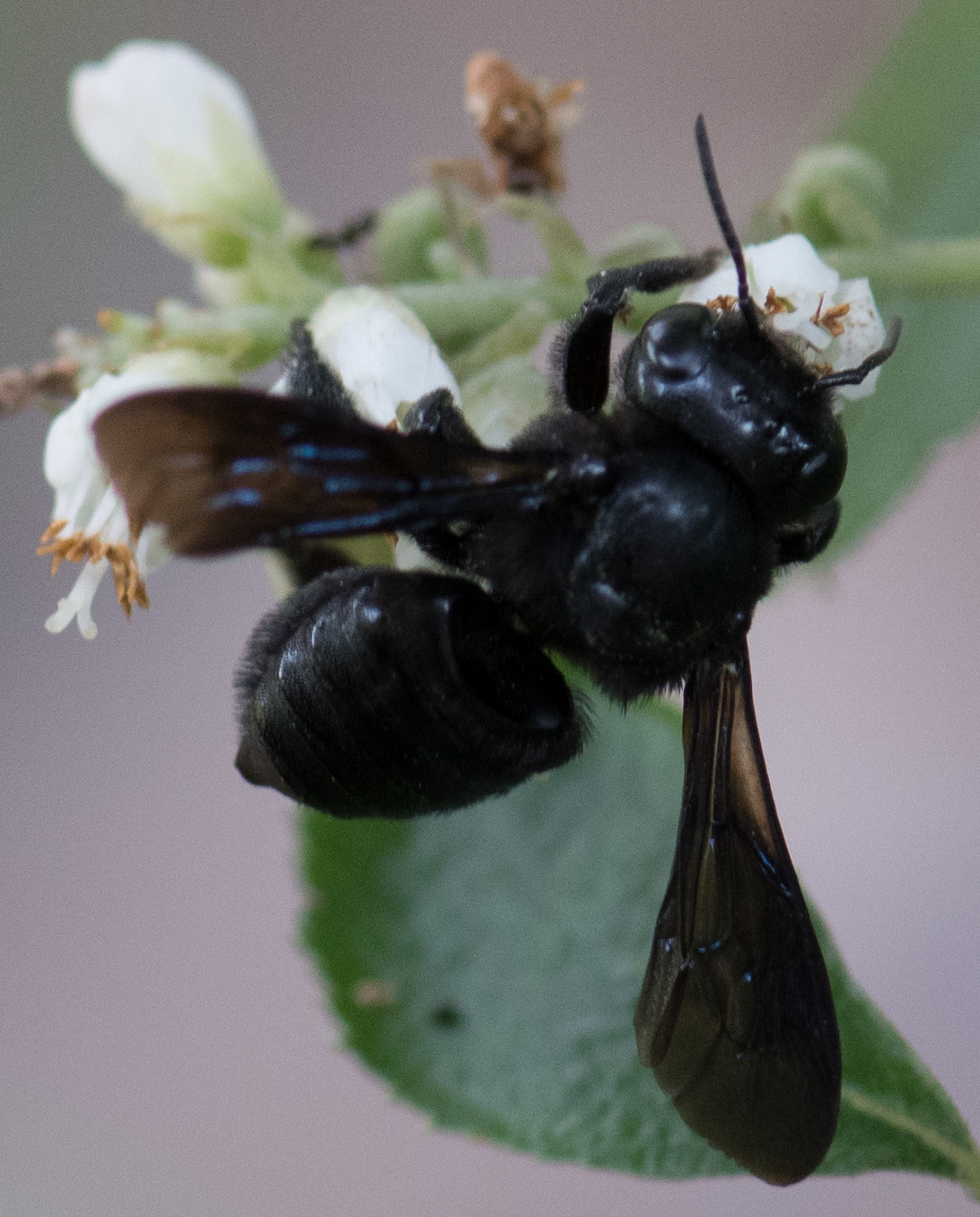
Out front, the newly planted sweet pepperbush (Clethra alnifolia) has excited a lot of pollinator interest.  I shared the potter wasp and the 4 spotted scarab hunter wasp I've seen nectaring here in my recent post;  this is a carpenter-mimic leaf-cutter bee (Megachile xylocopoides) who also has seemed to enjoy the blooms. 

The deep velvet black of this bee's body and the iridescent blue-black of its wings are just stunning.  I wonder if this is the species that has been harvesting circles of dogwood leaves to make their nest cells waterproof?

Another little green treefrog was tucked away inside a Flyr's nemesis (Brickellia cordifolia), hoping against hope that I didn't actually see him as I looked around.  I let him pretend that I hadn't noticed him.....

With the spotted beebalm (Monarda punctata) beginning to bloom, I'm starting to see a little more activity in that section of the garden, including this small green anole (Anolis carolinensis).  I'm still not seeing many insects attracted to the spotted beebalm blossoms, but I did see a hummingbird feeding - even though I didn't have my camera with me so I could visually share with you.

Back to the anole for a moment, I've been seeing many tiny little green anoles for the last several weeks, which just makes me smile.  Obviously it's been a good year for anole love!

Another recent dragonfly visitor was the great blue skimmer (Libellula vibrans), who perched on top of the poles in our tomato pots for a while - and was lucky enough (and good enough) to capture a passing moth shortly after I took the top photo.  Those big, black-spotted blue eyes aren't just for show!

Out front, enjoying the turkey tangle fogfruit (Phyla nodiflora), there's been the phaon crescent (Phyciodes phaon), nectaring - and possibly laying eggs, since fogfruit is their larval plant.  Note:  I don't know if this individual is a male or female.

The fogfruit has also attracted many other insects, including a female blue dasher dragonfly, a carpenter-mimic leaf-cutter bee, several  different species of wasps, bees, and flies.  In fact, the fogfruit is active enough that it's probably worth a post just by itself.  I just wish it looked a little more "gardeny"....

Anoles have been out in the front gardens as well as in the back.  Here was one haunting a summer phlox (Phlox paniculata) blossom.  Sometimes I wonder if I don't see huge numbers of pollinators because I DO see lots and lots of predators around the blooms - and I'm sure it's not a coincidence that they are hanging out there!

Speaking of predators, whether nymphs (like this one) or adults, I'm seeing quite a few milkweed assassin bugs (Zelus longipes) this summer.  I thought they were so-named because they were part of the milkweed community, but recent reading suggests their name comes from their coloration.  I've certainly seen them on many, many plants, not just on milkweed.

The clustered mountain mint (Pycnanthemum muticum) in the back yard has brought in quite a few unusual (for my garden) pollinators.  Besides several wasp species, there is this grapeleaf skeletonizer moth (Harrisina americana) which has both a common name and a color pattern that make it a perfect Halloween animal.

Believe it or not, this small, colorful, Halloween themed moth, also nectaring on the mountain mint, is from the a group of moths known as bird dropping moths.  Yes, that's an actual common name for moths in the subfamily Acontiinae .  This moth goes by the hard-to-remember name of black-dotted spragueia moth (Spragueia onagrus)  and is an animal I've never seen before in my life.  Kudos to the helpful folks at BugGuide.net for helping me identify this one!

Lacewing larvae, looking for all the world like prehistoric monsters or like some less glittery version of Tamatoa, the Crab, on Moana, are hard to see unless you look closely, but they are great allies in garden pest control.  This photo is blurry (the entire "mound" is barely 1/4" across and I wasn't using a tripod) but, if you look carefully, you can see the huge jaws under the front edge as well as a wing from one of its dinners right above the jaws.

In all, this lineup of characters from my garden highlights 6 garden predators (green anole, green treefrog, milkweed assassin bug, lacewing larva, blue dasher dragonfly, great blue skimmer dragonfly) and 6 pollinators (monarch, bumblebee, carpenter-mimic  leaf-cutter bee, phaon crescent butterfly, grapevine skeletonizer moth, and black-spotted spragueia moth).  During the 10 days that I photographed these animals, I saw many other animals, too.  Some, like the 5 species of wasps that I talked about in my last post, I've shared with you.  Others, like bluebirds, cardinals, bluejays, gray squirrels, chickadees, tufted titmice, house finch, mockingbirds, red-shouldered hawk, brown skinks, southern toads, and Eastern box turtle, I haven't shared.

How can anyone be happy with a statically "pretty" landscape, when a garden filled with wildlife changes minute by minute?!  I love the surprise of going out into my yard and meeting a new insect neighbor.  I love the pleasure of looking at a flower cluster and realizing that I'm looking into the eyes of a little lizard or camouflaged frog.  Each new animal I see adds a layer of richness to the world around me that delights and soothes me.  What an honor to be sharing my yard and gardens with all these other forms of life here on Earth.


Tuesday, January 09, 2018

Native Container Plants

Last spring, for the first time ever, I intentionally tried to find native plants that would work well in containers to sit on our back patio.  While I found a few, I would love to have a wider variety in my "stable".  I thought I'd share what worked and what didn't work for me - and I hope you'll share your favorites in the comment section to guide me this spring.

First of all, a disclaimer:  All of the photos in this post were taken on October 3rd, when I actually decided to post about this topic.  Most of the plants were well past their prime at that point, for which I apologize.  I find that I didn't take pictures of the full plants earlier in the summer;  I just took photos of the bees and butterflies and assorted other insects that were using them, especially their blossoms, for food and shelter!

Since we have no plant nurseries closer than about 45 minutes away, in trying to develop a native plant container garden, I started out at our local Home Depot.  There, I looked for plants that weren't labeled with the "sweet" little tags that essentially say, "I've been treated with death-causing chemicals so that you can have pretty flowers."  As I looked, I found that I had to be very careful:  some plants that were obviously from the same grower and batch weren't labeled, while others were.  Most disturbing were the numerous "butterfly" plants that I saw touted...while they bore that telltale, nasty little tag.

At Home Depot, then, I bought 3 "butterfly milkweeds" and a Coreopsis?/Rudbeckia?  As they grew, the butterfly milkweeds turned out to be Tropical Milkweeds (Asclepias curassavica) rather than Butterfly Milkweed (Asclepias tuberosa), but at least they weren't treated with neonic pesticides. 

Know how I knew for sure the milkweeds hadn't been treated with neonics?  They had aphids on them, including one individual with a pretty bad case of them.   Yes, I intentionally bought a plant that was seriously infested with aphids - and I was glad to get it.  Once I got them home, I didn't do anything but pot the milkweeds up.  As I've discussed before, the aphid populations cycle up and down, based on natural predators, so I wasn't too worried about them.  The 3 milkweeds are doing fine, even if they aren't actually native here.  In fact, these three tropical milkweeds from Home Depot are the plants on which I've observed (and photographed) most of the aphid/predator cycles that I've shared with you on this blog.

Note:  The tropical milkweeds are the leggy background plants in the photo above.

The Coreopsis/Rudbeckia (I can't remember which it was) was the only other "near native" I could find at our local Home Depot that hadn't been treated with neonics, so I bought it to show that some of us would rather have butterflies than poison-filled plants.  Sadly, the plant hasn't done well for me and essentially never bloomed again.  Half of it died;  the other half looks healthy, but remains bloom-less - and insect-less.

I've got a couple pots with Violets (Viola sp.) and Scarlet Sage (Salvia coccinea) that have seeded in naturally, taking over other plants like lettuce that had finished their life cycle.  Both of these naturally occurring container plants are doing well and seem worth keeping as containers, due to their attractive foliage and/or attractiveness to pollinators.

Here is the scarlet sage, which seeded itself into a container where Greg had been growing kale.  It's not gorgeous, but the butterflies visit frequently.  Next summer I'll fertilize it a bit and give it some attention;  hopefully it will be fuller and fluffier.

I've also got some natives that I picked up from native plant nurseries especially to put into containers this summer:  Blue Curls (Trichostema dichotomum), Indian Blanket (Gaillardia pulchella), Blue Hyssop (Agastache foeniculum), Mountain Mint (Pycnanthemum sp.) and Gaura (Gaura lindheimeri 'Siskiyou Pink').

While the Gaillardia hasn't been the "neatest" looking container, it has bloomed prolifically all summer long and has attracted many pollinators; I will continue to include it in future native plant container gardens.  By October 3rd, most of it had started to die back, so I didn't photograph it individually.  It's the pot at the far right of the photo at the beginning of this post.

The Blue Hyssop, above, which is not actually native to the southeast, was overgrown and floppy when I got it.  I did repot it, but I didn't cut it back like I should have.  It has done well, although it has looked a bit ragged because of my hesitancy with the pruning clippers.  I will continue to include it in future native container gardens, as it has been a reliable bee attractant.  I do not know if it will overwinter, or if I will have to treat it like an annual.

I bought and planted 2 different species of Mountain Mint this spring, but I don't remember which ones they are, let alone which is in the pot and which is in the ground.  I have the plant tags buried some where in the garage, but I am too lazy to look for them right now.  Anyway, both mountain mints are doing very well - and I love the fluffy white fullness of both of them.  Both have been good pollinator attractants;  I'll use Mountain Mint in containers again.  Hopefully the one in the pot behind my little girl, above, will be back next summer.

So far I've talked about the "good guys";  now let's discuss the more problematic patio occupants.

I'm iffy about using Blue Curls as container plants.  They bloomed well but, in the pots, the plants look quite leggy and scraggly while the flowers aren't large enough to overcome that deficit.  I think that part of this has been my fault:  I am not the most consistent waterer, and these were in smaller pots that tended to dry out fairly quickly.  In fact, I used the Blue Curls as my "indicator plants" to tell me when my containers needed watering.

This is, in fact, the first year I've grown Blue Curls at all.  Besides the 2 in containers on the patio, I also had 2 plants in the ground, and they looked much healthier and happier than the potted ones.  I may try Blue Curls in larger containers next year, but probably only if I can't find enough other natives to experiment with.  So far, none of the Blue Curls really seem all that attractive to pollinators, despite their reputation.

Frankly, the Gaura has been disappointing.  I think I either need to find a different variety - or just not try it again.  I don't know if it's a watering issue or if it was in too much shade, but it just wimped out.

Although I didn't think to buy any to put in containers, looking at all the wonderful photos of asters, covered in pollinators, this spring I'm wondering about trying pots with a couple different species of those in them.  I'm not sure which species would be best, though, both for good bloom and for nice looking foliage earlier in the summer.

So that's my "Native or Near Native Container Plant" roundup.  Are there any species that you would recommend?

Sunday, September 17, 2017

Fall? Well, maybe.....

While all my friends in more northern climes are talking about goldenrod blooming, ducks and geese flying south, and the massive Painted Lady butterfly migration, I am left looking around for signs of the seasons changing in my Florida panhandle garden.  What do I notice here?

First and foremost, I realize that I am finally back outside!  During the peak heat of the summer, it's hard to motivate to do more than look out through the windows at the flowers blooming.  Now, though, I'm back out in the garden, pulling the summer weeds that have grown up, working to lessen the seed load for next year and to give my perennials a bit of breathing room.  It's still hot.  After a couple hours, I still come in dripping sweat and craving water.  Somehow, though, the worst of the sauna is gone and I leave the garden looking forward to my next time out in it.

With the autumnal equinox approaching rapidly, the days are definitely shorter now and, while I want to work outside more, I have fewer daylight hours to do so.  I awake to dim, early sunlight and find myself with extra evening time on my hands after darkness falls.

Along with shortening days, another fall change is that hummingbird migration is in full swing.  Walking out of the back porch, I can count on being buzzed by at least one hummer, zooming past as close as an inch or two from my face or shoulders: "This is OUR territory, lady!" They never seem to take into account that I am their FRIEND, the one who fills the feeders they so dearly love.

Looking up, there are Fall Webworm webs in our Pignut Hickory trees (Carya glabra)...

and. looking down, the Fall Webworms (Hyphantria cunea) are starting to leave their nests and look for a place to pupate.  Eventually they'll become white moths with black spots.

The hickory nuts are beginning to drop, resounding sharply off the metal roof of the playhouse like a sudden shot or thudding loudly on the resonant boards of the deck. 

The squirrels are busily gnawing away at the fresh largesse, leaving tiny sculptures scattered around the yard in quiet testimony to their appetites.

Butterflies and moths, while sadly still not common this year, are seen more frequently now.

There are the Gulf Fritillaries (Agraulis vanillae), busily nectaring at Beggarticks (Bidens alba) and laying eggs on the Passionvine (Passiflora incarnata), ...

Long-tailed Skippers (Urbanus proteus) nectaring at the Flyr's Nemesis (Brickellia cordifolia) and Agastache, ....

Monarchs (Danaus plexippus) dropping eggs on the milkweed (Asclepias sp.), ....

Cloudless Sulfurs (Phoebis sennae) stopping to snack at Scarlet Sage (Salvia coccinea) on their way to points south, ...

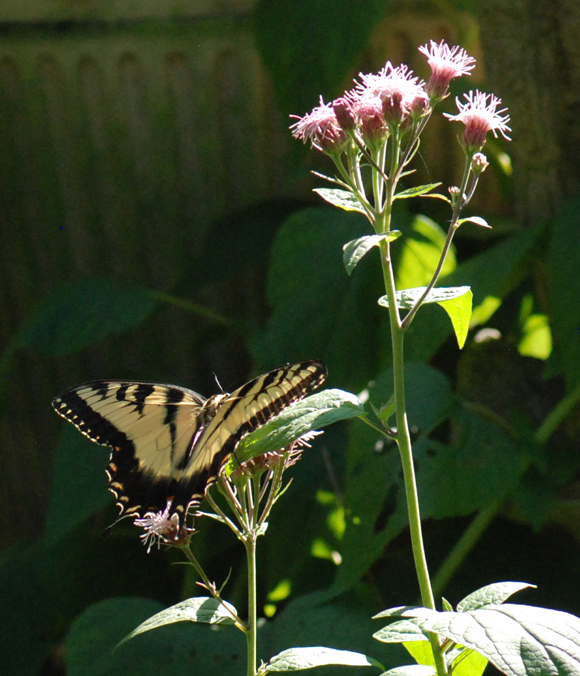
Swallowtails majestically visiting, but generally camera shy, like this Eastern Tiger Swallowtail (Papilio glaucus) nectaring at Flyr's Nemesis, ....

and even the occasional "rarity", like this Hummingbird Clearwing moth (Hemaris thysbe) that dropped in to feed at the Flyr's Nemesis while I was sitting quietly nearby, weeding.

With summer basically done, many plants are starting to look ragged, and that's okay.

There are the annuals and short-lived perennials, like this Indian Blanket (Gaillardia pulchella), that have bloomed valiantly all summer long and are suddenly just tired out, ready to call it quits.

There are the milkweeds, whose lower leaves dropped months ago and whose upper leaves are now caterpillar food, busily making new Monarchs.  (Look how tiny this little Monarch caterpillar is!  See how thick the leaf he's eating is in comparison to his size?!)

There are passionvines (Passiflora incarnata), whose holey-ness (or is it holiness?) speaks of many more Gulf Fritillaries to come.

The signs of fall may be more subtle here in the southland...but they are here all around me, nonetheless.

Tuesday, July 12, 2016

Pollinators and Other Creatures in the Garden

For the first time in quite a while, I was able to slip outside and take a few photos in the yard and gardens yesterday.  I didn't get great shots and I haven't had time to identify the animals, mainly insects, that I found, but I thought you might enjoy seeing them anyway.

I thought I was off to a great start when I found this black-winged damselfly as soon as I stepped off the back patio.  He was resting on a leaf of blue-eyed grass.

While I was taking the damselfly's photo, I noticed movement on the ground, in the verbena, about 2' away.  Doing some minor poking around, I was able to get a quick shot of this good-sized wolf spider lurking in the vegetation.

Next I walked around to the mailbox area, with its gay skirt of blooming gaillardia and butterfly milkweed.  Over the last month, I've seen more pollinators in this little 6 square foot area than in the rest of the yard combined, I think.  This little bee was busily gathering pollen from the gaillardia.

After the bee flew off, at first I didn't see any other action, then I noticed a colorful wasp hanging around.  This photo is rather blurry, but I wanted to show the overall markings of this gal...

...before I shared my favorite shot, which shows how her big, compound eye curves around the base of the antenna on her face.


Isn't that an amazing detail?!


Last of all, I found several insects on the aquatic milkweed (Asclepias perennis), despite its diminutive size and somewhat anemic appearance so far in my garden.  Truthfully, I only really noticed ONE insect at first - this small, dark bee....


...but note the ants that were also on the flowers.  I didn't see them until I downloaded the photo and magnified it. There was also a tiny fly hanging around, but I didn't get a clear enough photo of that one to share.

So that, fellow gardeners, completes the portfolio of "Pollinators & Others" that I found during my 25 minute walkabout yesterday afternoon.  I was a little disappointed not to find more insect life, but it's early days/months/years in my gardens here, so I guess it's not too surprising that the diversity is minimal.  I'm hearing, too, that insect life is on a major decline throughout the country, so maybe my quiet yard is just indicative of a larger problem.

Time will tell.  Meanwhile, I'm doing what I can, where I can - and enjoying the rewards that I am given.  I'll just hope to see more on another day.