Showing posts with label Gulf Fritillary. Show all posts

Tuesday, September 11, 2018

A Tired Time of Year in the Garden: Time to "Tolerate the Uglies"

As I look around my garden these days, there are definitely places where it's starting to look worn out and ratty.

For example, what's the end result of this sight, on August 25th?

This sight on September 9th!  And LOTS of gulf fritillary butterflies gracing our yard, too.  Just recently a seemingly unpenetrable wall of green, the passion vine (Passiflora incarnata) is literally skeletal now.  All of its leaves - literally ALL of them - have been eaten by gulf fritillary caterpillars (Agraulis vanillae), leaving nothing but awkward stems with the remnants of a few fruits hanging on.  I'm not worried, though.  The passion vine will be back next spring, as full and pretty as ever.

Also, did you notice?  The leaves of the vines were beginning to turn yellow by the end of August anyway.  They weren't going to last much longer even if the caterpillars hadn't been eating them.

The victim of twin onslaughts - monarch caterpillars and advancing age, the swamp milkweed (Asclepias incarnata) is looking rather pathetic too.  It's a battle to see whether the caterpillars will eat the leaves first or whether they'll turn yellow and fall off from the bottom up.  (The tall, leggy plants in the photo above are the swamp milkweed, planted just behind the birdbath basin on the ground.)  It's the legginess and ugliness of this stage of their life cycle that encourages me to generally plant swamp milkweed in the back of the border, hopefully behind some "fluffy" lower plants like red sage (Salvia coccinea) or short species of asters.  If you look closely at the left side of the photo, however, you can see that the monarchs aren't upset by the state of the milkweed at all. 

There are still many flying in the yard, with females frequently seen laying eggs here and there - even on "ugly" plants.  

Flyr's nemesis (Brickellia cordifolia) is just about done blooming, so its small, cotton candy pink pom-poms of flowers are fading into grayish lavender mush.  The leaves still look good, but the stalks have sprawled everywhere, thanks to the weight of all those beautiful blossoms over the last couple weeks.

I've got these few stalks held up with stakes because they were lying flat on the lawn.  Our 3 year old grandson gives a good sense of scale against these shortest of the Flyr's nemesis stalks.  Despite the waning number of blooms, the monarchs, gulf fritillaries, and little bees are all still enjoying the Flyr's nemesis immensely.

Declining in the same way they grew, from the bottom up, the Dr. Seuss flowers of spotted horsemint (Monarda punctata) are past their prime as well.  There are still individual flowers in the upper bloom clusters, but the bottom clusters are turning brown and drying out.  Like the Flyr's nemesis, the stems have sprawled from the weight of bountiful blossoms.

Looking up into the trees, numerous nests of fall webworms (Hyphantria cunea) pockmark the ends of the branches of the pignut hickories (Carya glabra).  I've noticed an increased number of birds like bluejays up in the canopy since the webworm nests appeared, so I'm guessing that the birds are having quite a nice, seasonal, tree top feast up there.

In the front gardens, even the tidy green mounds of the trailing pineland lantana (Lantana depressa) are showing signs of decline, although thankfully you have to look fairly closely to see them. 

Many leaves have been used as caterpillar food by some sort of leaf rollers this summer and they have become gray ghosts of themselves.  Empty flower stalks are numerous now, too, although the blossoms still attract most of the attention, especially from a distance.  Luckily, again, the butterflies, skippers, and other creatures don't seem to mind at all.

When I worked the phone line for the Master Gardener office, we'd always get concerned calls at this time of year, "My plant leaves are looking so sick.  What should I spray on them?"

My response then was the same as it is internally to myself now, "It's the end of summer.  The leaves have been working hard all summer and they are tired and worn out.  It's almost time for them to fall, where they will continue working to make the garden healthier as they decompose into rich topsoil.  Don't spray anything.  This is all just part of the natural cycle of life.  Nothing is wrong at all."

Or, in other words, it's the time of year to remind ourselves to "tolerate the uglies" as the seasons begin to change yet again, moving us into the release of fall and the quiet peace of winter.  This, too, shall pass.

Wednesday, July 25, 2018

A Passion for Life

The fragrances of the earth enjoin and
blossom in my nostrils and
sinus -
breath is what we
share with the world.
                    - Gavin Geoffrey Dillard, Graybeard Abbey

Hmmmm.  Seems like a good month to participate in Wildflower Wednesday, but what flower should I pick? 

The spotted beebalm (Monarda punctata) that just started blooming? 

The clustered mountain mint (Pycnanthemum muticum) that has become a new favorite of mine, with its frosty cool garden presence and its outstanding ability to pull in the pollinators - and their predators? 

The turkey tangle fogfruit (Phyla nodiflora) that I concurrently both love and simply dislike?

The Devil's grandmother (Elephantopus tomentosus) that also just started to bloom and which is actually looking like a garden plant this summer since I finally got around to transplanting some into a bed this spring?

The "Eveready bunny" of my garden, the old sturdy standby Indian blanket (Gaillardia pulchella) that just keeps going and going and going and going?

The swamp milkweed (Asclepias incarnata) that I'm relying on to attract some monarchs to my gardens one of these days?

The trailing pineland lantana (Lantana depressa) out by the front sidewalk, with its lemonade colored blossoms covering tidy mounds of vibrantly bright green leaves?

Nope.  Those are all cool and wonderful plants in my gardens, ...

...but I think I'm going for the maypop this time, a.k.a. passion vine (Passiflora incarnata).  Every time I walk down on the deck or dock this summer, the rich fragrance of these impossibly glamorous blossoms startles my senses with its complex allure.  Is it possible that the aroma of these blooms has given rise to the name "passion vine"?  I know that's not the commonly told history, which involves some rather convoluted symbolism about the "passion of Christ", but passion vine fragrance is every bit as romantic as gardenia to me.  This has been the first year that I've really processed how deeply fragrant these flowers are.  To my nose, I think the smell of maypop flowers is richer even than that of roses - and I love the fragrance of roses.

I wish there was a way to put a scratch & sniff app into this blog post.....

I'm obviously not the only living creature that thinks maypop flowers smell appealing, as I frequently see pollinators on them.  These big blooms seem built for BIG pollinators.  Recently, for example, I've seen both...

carpenter bees (Xylocopa virginica)...

and this huge scarab hunter wasp (Campsomeris quadrimaculata) acting almost drunk with the richness of the nectar they are drinking.  Note that the back and head of this wasp are actually coal black without pollen on them.  Yes, this wasp has accidentally gathered THAT MUCH pollen!

As this photo with the blurry carpenter bee shows, there is a horizontal space between the stigmas (curved, long and white with greenish tips) and anthers (yellowish rectangles) and the nectary (reddish purple fuzzy area at the base of the central stalk) that seems expressly designed for such big floral visitors.  If you look back at the photos above, you can see how absolutely covered with pollen the backs of these large insects are!  A smaller bee or wasp wouldn't be anywhere close to as efficient in transferring pollen as these big guys are.

A consequence of such efficient pollination is, of course, the production of seeds.  In the case of passion vine, the seeds are housed in the passion fruit.  For years I've heard that these tennis ball sized fruits are edible, but I've never tried one before because, quite frankly, they just didn't look that appealing to me.  I've decided that this year I'm going to be a bit more adventurous.  According to the web, the fruits are ripe when they start to turn yellow, get wrinkled, and fall off the vine, so I'm keeping my eyes open.  If these fruits taste at all like their fans online say, the taste may rival the fragrance of the flowers.

Humans, bees, and wasps aren't the only animals that love passion vines.  As almost anyone who has planted one knows, gulf fritillaries (Agraulis vanillae) use them as their larval plants and the fritillary caterpillars can quickly reduce a vine to tatters.  In fact, during most growing seasons I have to remind myself to "tolerate the uglies" so that my vine(s) can send many more gorgeously glowing, orange, floating "flowers" off into the breezes.  Luckily, no matter how thoroughly the passion vines are eaten, they always seem to survive and thrive the following year.

This year, however, has been different.  I saw 4 gulf fritillary caterpillars about 2 months ago, but I haven't seen another one since then...until yesterday.  Meanwhile my vines have grown huge, luxurious, almost rampant.  As passionvines do, new vines are sprouting up a dozen feet or more from the parent plant in every direction and they are now even starting to impinge on the deck stairs.  There are plenty of blossoms and a burgeoning crop of that intriguing fruit is developing.  A myriad of flower buds promise ever increasing numbers of blooms still to come.  Truth to tell, it's all beginning to get a little over-the-top, but I don't want to cut it back.  I'm waiting for the caterpillars to come and do that for me.

Finally, yesterday, I found 2 little gulf fritillary cats determinedly munching away.  Then, this afternoon, another 3 more.  Hopefully at least a couple of these tiny orange babies will make it to adulthood, providing some much needed pruning along the way.  Meanwhile, I'm joyously sharing the breath of the world with every deep inhalation of that glorious passion vine fragrance.

Friday, September 29, 2017

One Thing Leads to Another.....

(This post is an expansion on a Facebook post I made yesterday morning.  I wanted to share the photos I took - and add a few more comments.)

I love how one thing leads to another.....

I saw an Eastern Giant Swallowtail (Papilio cresphontes) out back nectaring on the Scarlet Sage (Salvia coccinea), so I got my camera and ran outside.

It flew over to a camellia where it sat for a while to bask, allowing me to get fairly close and to take multiple photos.

Then it flew back to the sage and continued nectaring, allowing me to take more photos.

After the swallowtail flew off, I noticed a battered Gulf Fritillary (Agraulis vanillae) basking, so I took photos of it, following as it, ...er, 

SHE lifted off and laid an egg or two on the Corky-Stemmed Passionvine (Passiflora suberosa) nearby.  It amazes me that this ragged female could still fly - and that she still had the energy to locate passionvine and lay eggs!  It makes me think that, perhaps, occasionally handling butterflies won't overly handicap their success after all.

Movement by the milkweed caught my eye and I was able to get a few shots (although I don't know if they turned out) of a syrphid fly laying eggs near aphids on the milkweed.  Note:  This was the best of the shots I took. It isn't great, but I thought you might enjoy it anyway, and it does serve to keep the narrative going!

More movement made me notice a little tufted titmouse hunting about 20 feet away, so I snagged a couple photos, one of which wasn't too bad....


Still more movement, this time nearby, helped me notice some sort of odd little wasp hunting on the swamp milkweed...  When I downloaded the photos, I realized that this isn't a wasp at all, but rather some sort of fly.  BugGuide has helped me determine that this is a female syrphid fly in the genus Xylota.  These syrphid flies eat pollen from the surface of leaves as adults, which I think you can actually see her doing in the above photo!  The larvae feed on sap runs.  So, my bare eyes said a small wasp, hunting, but increased magnification and more research revealed a fly, eating pollen!

Close to this unusual little syrphid fly was a Milkweed Assassin Bug nymph (Zelus longipes) that may have actually been hunting - attempting to catch the little syrphid fly unawares.

As an added pleasure, I found all of this activity while I was enjoying the sweet fragrance of the blue curls (Trichostema dichotomum) that are scraggly but blooming, in pots on the back patio!

A fun few minutes. Fifteen minutes, to be exact.  And all from the relative privacy of my back patio, while in bare feet and still in pajamas!

As I wrote the original post when I got back inside, I  looked out back onto the patio again and saw a male towhee perched proudly on the top of the statue there! Sadly, I  wasn't able to get a picture of him, but I did get to enjoy watching him from my spot in the recliner!

Gardening for wildlife is like having a nature preserve right outside my back door!

Sunday, September 17, 2017

Fall? Well, maybe.....

While all my friends in more northern climes are talking about goldenrod blooming, ducks and geese flying south, and the massive Painted Lady butterfly migration, I am left looking around for signs of the seasons changing in my Florida panhandle garden.  What do I notice here?

First and foremost, I realize that I am finally back outside!  During the peak heat of the summer, it's hard to motivate to do more than look out through the windows at the flowers blooming.  Now, though, I'm back out in the garden, pulling the summer weeds that have grown up, working to lessen the seed load for next year and to give my perennials a bit of breathing room.  It's still hot.  After a couple hours, I still come in dripping sweat and craving water.  Somehow, though, the worst of the sauna is gone and I leave the garden looking forward to my next time out in it.

With the autumnal equinox approaching rapidly, the days are definitely shorter now and, while I want to work outside more, I have fewer daylight hours to do so.  I awake to dim, early sunlight and find myself with extra evening time on my hands after darkness falls.

Along with shortening days, another fall change is that hummingbird migration is in full swing.  Walking out of the back porch, I can count on being buzzed by at least one hummer, zooming past as close as an inch or two from my face or shoulders: "This is OUR territory, lady!" They never seem to take into account that I am their FRIEND, the one who fills the feeders they so dearly love.

Looking up, there are Fall Webworm webs in our Pignut Hickory trees (Carya glabra)...

and. looking down, the Fall Webworms (Hyphantria cunea) are starting to leave their nests and look for a place to pupate.  Eventually they'll become white moths with black spots.

The hickory nuts are beginning to drop, resounding sharply off the metal roof of the playhouse like a sudden shot or thudding loudly on the resonant boards of the deck. 

The squirrels are busily gnawing away at the fresh largesse, leaving tiny sculptures scattered around the yard in quiet testimony to their appetites.

Butterflies and moths, while sadly still not common this year, are seen more frequently now.

There are the Gulf Fritillaries (Agraulis vanillae), busily nectaring at Beggarticks (Bidens alba) and laying eggs on the Passionvine (Passiflora incarnata), ...

Long-tailed Skippers (Urbanus proteus) nectaring at the Flyr's Nemesis (Brickellia cordifolia) and Agastache, ....

Monarchs (Danaus plexippus) dropping eggs on the milkweed (Asclepias sp.), ....

Cloudless Sulfurs (Phoebis sennae) stopping to snack at Scarlet Sage (Salvia coccinea) on their way to points south, ...

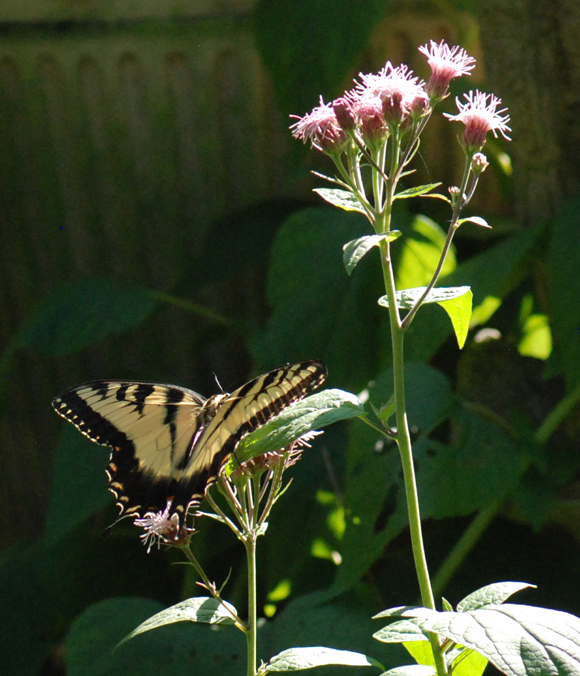
Swallowtails majestically visiting, but generally camera shy, like this Eastern Tiger Swallowtail (Papilio glaucus) nectaring at Flyr's Nemesis, ....

and even the occasional "rarity", like this Hummingbird Clearwing moth (Hemaris thysbe) that dropped in to feed at the Flyr's Nemesis while I was sitting quietly nearby, weeding.

With summer basically done, many plants are starting to look ragged, and that's okay.

There are the annuals and short-lived perennials, like this Indian Blanket (Gaillardia pulchella), that have bloomed valiantly all summer long and are suddenly just tired out, ready to call it quits.

There are the milkweeds, whose lower leaves dropped months ago and whose upper leaves are now caterpillar food, busily making new Monarchs.  (Look how tiny this little Monarch caterpillar is!  See how thick the leaf he's eating is in comparison to his size?!)

There are passionvines (Passiflora incarnata), whose holey-ness (or is it holiness?) speaks of many more Gulf Fritillaries to come.

The signs of fall may be more subtle here in the southland...but they are here all around me, nonetheless.