Last spring, for the first time ever, I intentionally tried to find native plants that would work well in containers to sit on our back patio. While I found a few, I would love to have a wider variety in my "stable". I thought I'd share what worked and what didn't work for me - and I hope you'll share your favorites in the comment section to guide me this spring.
First of all, a disclaimer: All of the photos in this post were taken on October 3rd, when I actually decided to post about this topic. Most of the plants were well past their prime at that point, for which I apologize. I find that I didn't take pictures of the full plants earlier in the summer; I just took photos of the bees and butterflies and assorted other insects that were using them, especially their blossoms, for food and shelter!
Since we have no plant nurseries closer than about 45 minutes away, in trying to develop a native plant container garden, I started out at our local Home Depot. There, I looked for plants that weren't labeled with the "sweet" little tags that essentially say, "I've been treated with death-causing chemicals so that you can have pretty flowers." As I looked, I found that I had to be very careful: some plants that were obviously from the same grower and batch weren't labeled, while others were. Most disturbing were the numerous "butterfly" plants that I saw touted...while they bore that telltale, nasty little tag.
At Home Depot, then, I bought 3 "butterfly milkweeds" and a Coreopsis?/Rudbeckia? As they grew, the butterfly milkweeds turned out to be Tropical Milkweeds (Asclepias curassavica) rather than Butterfly Milkweed (Asclepias tuberosa), but at least they weren't treated with neonic pesticides.
Know how I knew for sure the milkweeds hadn't been treated with neonics? They had aphids on them, including one individual with a pretty bad case of them. Yes, I intentionally bought a plant that was seriously infested with aphids - and I was glad to get it. Once I got them home, I didn't do anything but pot the milkweeds up. As I've discussed before, the aphid populations cycle up and down, based on natural predators, so I wasn't too worried about them. The 3 milkweeds are doing fine, even if they aren't actually native here. In fact, these three tropical milkweeds from Home Depot are the plants on which I've observed (and photographed) most of the aphid/predator cycles that I've shared with you on this blog.
Note: The tropical milkweeds are the leggy background plants in the photo above.
The Coreopsis/Rudbeckia (I can't remember which it was) was the only other "near native" I could find at our local Home Depot that hadn't been treated with neonics, so I bought it to show that some of us would rather have butterflies than poison-filled plants. Sadly, the plant hasn't done well for me and essentially never bloomed again. Half of it died; the other half looks healthy, but remains bloom-less - and insect-less.
I've got a couple pots with Violets (Viola sp.) and Scarlet Sage (Salvia coccinea) that have seeded in naturally, taking over other plants like lettuce that had finished their life cycle. Both of these naturally occurring container plants are doing well and seem worth keeping as containers, due to their attractive foliage and/or attractiveness to pollinators.
Here is the scarlet sage, which seeded itself into a container where Greg had been growing kale. It's not gorgeous, but the butterflies visit frequently. Next summer I'll fertilize it a bit and give it some attention; hopefully it will be fuller and fluffier.
I've also got some natives that I picked up from native plant nurseries especially to put into containers this summer: Blue Curls (Trichostema dichotomum), Indian Blanket (Gaillardia pulchella), Blue Hyssop (Agastache foeniculum), Mountain Mint (Pycnanthemum sp.) and Gaura (Gaura lindheimeri 'Siskiyou Pink').
While the Gaillardia hasn't been the "neatest" looking container, it has bloomed prolifically all summer long and has attracted many pollinators; I will continue to include it in future native plant container gardens. By October 3rd, most of it had started to die back, so I didn't photograph it individually. It's the pot at the far right of the photo at the beginning of this post.
The Blue Hyssop, above, which is not actually native to the southeast, was overgrown and floppy when I got it. I did repot it, but I didn't cut it back like I should have. It has done well, although it has looked a bit ragged because of my hesitancy with the pruning clippers. I will continue to include it in future native container gardens, as it has been a reliable bee attractant. I do not know if it will overwinter, or if I will have to treat it like an annual.
I bought and planted 2 different species of Mountain Mint this spring, but I don't remember which ones they are, let alone which is in the pot and which is in the ground. I have the plant tags buried some where in the garage, but I am too lazy to look for them right now. Anyway, both mountain mints are doing very well - and I love the fluffy white fullness of both of them. Both have been good pollinator attractants; I'll use Mountain Mint in containers again. Hopefully the one in the pot behind my little girl, above, will be back next summer.
So far I've talked about the "good guys"; now let's discuss the more problematic patio occupants.
I'm iffy about using Blue Curls as container plants. They bloomed well but, in the pots, the plants look quite leggy and scraggly while the flowers aren't large enough to overcome that deficit. I think that part of this has been my fault: I am not the most consistent waterer, and these were in smaller pots that tended to dry out fairly quickly. In fact, I used the Blue Curls as my "indicator plants" to tell me when my containers needed watering.
This is, in fact, the first year I've grown Blue Curls at all. Besides the 2 in containers on the patio, I also had 2 plants in the ground, and they looked much healthier and happier than the potted ones. I may try Blue Curls in larger containers next year, but probably only if I can't find enough other natives to experiment with. So far, none of the Blue Curls really seem all that attractive to pollinators, despite their reputation.
Frankly, the Gaura has been disappointing. I think I either need to find a different variety - or just not try it again. I don't know if it's a watering issue or if it was in too much shade, but it just wimped out.
Although I didn't think to buy any to put in containers, looking at all the wonderful photos of asters, covered in pollinators, this spring I'm wondering about trying pots with a couple different species of those in them. I'm not sure which species would be best, though, both for good bloom and for nice looking foliage earlier in the summer.
So that's my "Native or Near Native Container Plant" roundup. Are there any species that you would recommend?
Showing posts with label Scarlet Sage. Show all posts
Tuesday, January 09, 2018
Friday, September 29, 2017
One Thing Leads to Another.....
(This post is an expansion on a Facebook post I made yesterday morning. I wanted to share the photos I took - and add a few more comments.)
I love how one thing leads to another.....
I saw an Eastern Giant Swallowtail (Papilio cresphontes) out back nectaring on the Scarlet Sage (Salvia coccinea), so I got my camera and ran outside.
It flew over to a camellia where it sat for a while to bask, allowing me to get fairly close and to take multiple photos.
Then it flew back to the sage and continued nectaring, allowing me to take more photos.
After the swallowtail flew off, I noticed a battered Gulf Fritillary (Agraulis vanillae) basking, so I took photos of it, following as it, ...er,
SHE lifted off and laid an egg or two on the Corky-Stemmed Passionvine (Passiflora suberosa) nearby. It amazes me that this ragged female could still fly - and that she still had the energy to locate passionvine and lay eggs! It makes me think that, perhaps, occasionally handling butterflies won't overly handicap their success after all.
Movement by the milkweed caught my eye and I was able to get a few shots (although I don't know if they turned out) of a syrphid fly laying eggs near aphids on the milkweed. Note: This was the best of the shots I took. It isn't great, but I thought you might enjoy it anyway, and it does serve to keep the narrative going!
More movement made me notice a little tufted titmouse hunting about 20 feet away, so I snagged a couple photos, one of which wasn't too bad....
Still more movement, this time nearby, helped me notice some sort of odd little wasp hunting on the swamp milkweed... When I downloaded the photos, I realized that this isn't a wasp at all, but rather some sort of fly. BugGuide has helped me determine that this is a female syrphid fly in the genus Xylota. These syrphid flies eat pollen from the surface of leaves as adults, which I think you can actually see her doing in the above photo! The larvae feed on sap runs. So, my bare eyes said a small wasp, hunting, but increased magnification and more research revealed a fly, eating pollen!
Close to this unusual little syrphid fly was a Milkweed Assassin Bug nymph (Zelus longipes) that may have actually been hunting - attempting to catch the little syrphid fly unawares.
As an added pleasure, I found all of this activity while I was enjoying the sweet fragrance of the blue curls (Trichostema dichotomum) that are scraggly but blooming, in pots on the back patio!
A fun few minutes. Fifteen minutes, to be exact. And all from the relative privacy of my back patio, while in bare feet and still in pajamas!
As I wrote the original post when I got back inside, I looked out back onto the patio again and saw a male towhee perched proudly on the top of the statue there! Sadly, I wasn't able to get a picture of him, but I did get to enjoy watching him from my spot in the recliner!
Gardening for wildlife is like having a nature preserve right outside my back door!
I love how one thing leads to another.....
I saw an Eastern Giant Swallowtail (Papilio cresphontes) out back nectaring on the Scarlet Sage (Salvia coccinea), so I got my camera and ran outside.
It flew over to a camellia where it sat for a while to bask, allowing me to get fairly close and to take multiple photos.
Then it flew back to the sage and continued nectaring, allowing me to take more photos.
After the swallowtail flew off, I noticed a battered Gulf Fritillary (Agraulis vanillae) basking, so I took photos of it, following as it, ...er,
SHE lifted off and laid an egg or two on the Corky-Stemmed Passionvine (Passiflora suberosa) nearby. It amazes me that this ragged female could still fly - and that she still had the energy to locate passionvine and lay eggs! It makes me think that, perhaps, occasionally handling butterflies won't overly handicap their success after all.
Movement by the milkweed caught my eye and I was able to get a few shots (although I don't know if they turned out) of a syrphid fly laying eggs near aphids on the milkweed. Note: This was the best of the shots I took. It isn't great, but I thought you might enjoy it anyway, and it does serve to keep the narrative going!
More movement made me notice a little tufted titmouse hunting about 20 feet away, so I snagged a couple photos, one of which wasn't too bad....
Still more movement, this time nearby, helped me notice some sort of odd little wasp hunting on the swamp milkweed... When I downloaded the photos, I realized that this isn't a wasp at all, but rather some sort of fly. BugGuide has helped me determine that this is a female syrphid fly in the genus Xylota. These syrphid flies eat pollen from the surface of leaves as adults, which I think you can actually see her doing in the above photo! The larvae feed on sap runs. So, my bare eyes said a small wasp, hunting, but increased magnification and more research revealed a fly, eating pollen!
Close to this unusual little syrphid fly was a Milkweed Assassin Bug nymph (Zelus longipes) that may have actually been hunting - attempting to catch the little syrphid fly unawares.
As an added pleasure, I found all of this activity while I was enjoying the sweet fragrance of the blue curls (Trichostema dichotomum) that are scraggly but blooming, in pots on the back patio!
A fun few minutes. Fifteen minutes, to be exact. And all from the relative privacy of my back patio, while in bare feet and still in pajamas!
As I wrote the original post when I got back inside, I looked out back onto the patio again and saw a male towhee perched proudly on the top of the statue there! Sadly, I wasn't able to get a picture of him, but I did get to enjoy watching him from my spot in the recliner!
Gardening for wildlife is like having a nature preserve right outside my back door!
Sunday, September 17, 2017
Fall? Well, maybe.....
While all my friends in more northern climes are talking about goldenrod blooming, ducks and geese flying south, and the massive Painted Lady butterfly migration, I am left looking around for signs of the seasons changing in my Florida panhandle garden. What do I notice here?
First and foremost, I realize that I am finally back outside! During the peak heat of the summer, it's hard to motivate to do more than look out through the windows at the flowers blooming. Now, though, I'm back out in the garden, pulling the summer weeds that have grown up, working to lessen the seed load for next year and to give my perennials a bit of breathing room. It's still hot. After a couple hours, I still come in dripping sweat and craving water. Somehow, though, the worst of the sauna is gone and I leave the garden looking forward to my next time out in it.
With the autumnal equinox approaching rapidly, the days are definitely shorter now and, while I want to work outside more, I have fewer daylight hours to do so. I awake to dim, early sunlight and find myself with extra evening time on my hands after darkness falls.
Along with shortening days, another fall change is that hummingbird migration is in full swing. Walking out of the back porch, I can count on being buzzed by at least one hummer, zooming past as close as an inch or two from my face or shoulders: "This is OUR territory, lady!" They never seem to take into account that I am their FRIEND, the one who fills the feeders they so dearly love.
Looking up, there are Fall Webworm webs in our Pignut Hickory trees (Carya glabra)...
and. looking down, the Fall Webworms (Hyphantria cunea) are starting to leave their nests and look for a place to pupate. Eventually they'll become white moths with black spots.
The hickory nuts are beginning to drop, resounding sharply off the metal roof of the playhouse like a sudden shot or thudding loudly on the resonant boards of the deck.
The squirrels are busily gnawing away at the fresh largesse, leaving tiny sculptures scattered around the yard in quiet testimony to their appetites.
Butterflies and moths, while sadly still not common this year, are seen more frequently now.
There are the Gulf Fritillaries (Agraulis vanillae), busily nectaring at Beggarticks (Bidens alba) and laying eggs on the Passionvine (Passiflora incarnata), ...
Long-tailed Skippers (Urbanus proteus) nectaring at the Flyr's Nemesis (Brickellia cordifolia) and Agastache, ....
Monarchs (Danaus plexippus) dropping eggs on the milkweed (Asclepias sp.), ....
Cloudless Sulfurs (Phoebis sennae) stopping to snack at Scarlet Sage (Salvia coccinea) on their way to points south, ...
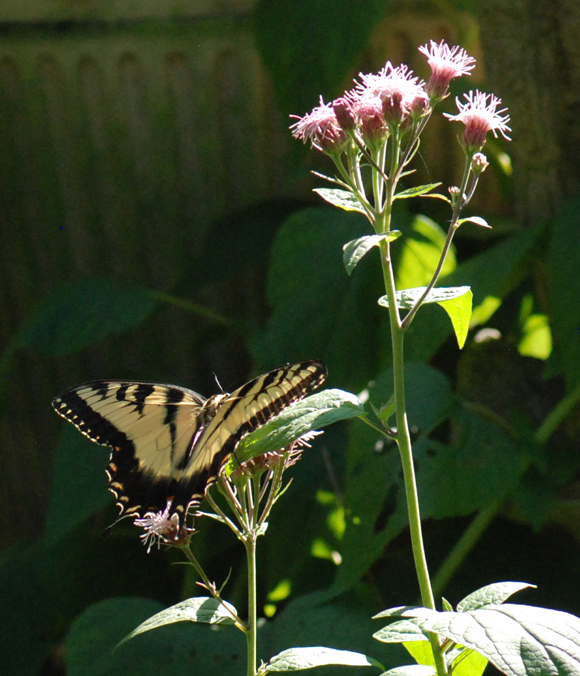
Swallowtails majestically visiting, but generally camera shy, like this Eastern Tiger Swallowtail (Papilio glaucus) nectaring at Flyr's Nemesis, ....
and even the occasional "rarity", like this Hummingbird Clearwing moth (Hemaris thysbe) that dropped in to feed at the Flyr's Nemesis while I was sitting quietly nearby, weeding.
With summer basically done, many plants are starting to look ragged, and that's okay.
There are the annuals and short-lived perennials, like this Indian Blanket (Gaillardia pulchella), that have bloomed valiantly all summer long and are suddenly just tired out, ready to call it quits.
There are the milkweeds, whose lower leaves dropped months ago and whose upper leaves are now caterpillar food, busily making new Monarchs. (Look how tiny this little Monarch caterpillar is! See how thick the leaf he's eating is in comparison to his size?!)
There are passionvines (Passiflora incarnata), whose holey-ness (or is it holiness?) speaks of many more Gulf Fritillaries to come.
The signs of fall may be more subtle here in the southland...but they are here all around me, nonetheless.
First and foremost, I realize that I am finally back outside! During the peak heat of the summer, it's hard to motivate to do more than look out through the windows at the flowers blooming. Now, though, I'm back out in the garden, pulling the summer weeds that have grown up, working to lessen the seed load for next year and to give my perennials a bit of breathing room. It's still hot. After a couple hours, I still come in dripping sweat and craving water. Somehow, though, the worst of the sauna is gone and I leave the garden looking forward to my next time out in it.
With the autumnal equinox approaching rapidly, the days are definitely shorter now and, while I want to work outside more, I have fewer daylight hours to do so. I awake to dim, early sunlight and find myself with extra evening time on my hands after darkness falls.
Along with shortening days, another fall change is that hummingbird migration is in full swing. Walking out of the back porch, I can count on being buzzed by at least one hummer, zooming past as close as an inch or two from my face or shoulders: "This is OUR territory, lady!" They never seem to take into account that I am their FRIEND, the one who fills the feeders they so dearly love.
Looking up, there are Fall Webworm webs in our Pignut Hickory trees (Carya glabra)...
and. looking down, the Fall Webworms (Hyphantria cunea) are starting to leave their nests and look for a place to pupate. Eventually they'll become white moths with black spots.
The hickory nuts are beginning to drop, resounding sharply off the metal roof of the playhouse like a sudden shot or thudding loudly on the resonant boards of the deck.
The squirrels are busily gnawing away at the fresh largesse, leaving tiny sculptures scattered around the yard in quiet testimony to their appetites.
Butterflies and moths, while sadly still not common this year, are seen more frequently now.
There are the Gulf Fritillaries (Agraulis vanillae), busily nectaring at Beggarticks (Bidens alba) and laying eggs on the Passionvine (Passiflora incarnata), ...
Long-tailed Skippers (Urbanus proteus) nectaring at the Flyr's Nemesis (Brickellia cordifolia) and Agastache, ....
Monarchs (Danaus plexippus) dropping eggs on the milkweed (Asclepias sp.), ....
Cloudless Sulfurs (Phoebis sennae) stopping to snack at Scarlet Sage (Salvia coccinea) on their way to points south, ...
Swallowtails majestically visiting, but generally camera shy, like this Eastern Tiger Swallowtail (Papilio glaucus) nectaring at Flyr's Nemesis, ....
and even the occasional "rarity", like this Hummingbird Clearwing moth (Hemaris thysbe) that dropped in to feed at the Flyr's Nemesis while I was sitting quietly nearby, weeding.
With summer basically done, many plants are starting to look ragged, and that's okay.
There are the annuals and short-lived perennials, like this Indian Blanket (Gaillardia pulchella), that have bloomed valiantly all summer long and are suddenly just tired out, ready to call it quits.
There are the milkweeds, whose lower leaves dropped months ago and whose upper leaves are now caterpillar food, busily making new Monarchs. (Look how tiny this little Monarch caterpillar is! See how thick the leaf he's eating is in comparison to his size?!)
There are passionvines (Passiflora incarnata), whose holey-ness (or is it holiness?) speaks of many more Gulf Fritillaries to come.
The signs of fall may be more subtle here in the southland...but they are here all around me, nonetheless.
Subscribe to:
Posts (Atom)