A dead tree is just dead, right? It must be time to get rid of it so that the woodland can stay healthy, right?
WRONG! Dead trees, whether standing (called snags) or fallen (called downed wood or logs), are vitally important to woodland health and to biodiversity. In fact, scientists believe that dead wood harbors more life than living wood does. Dead wood is critical to the health of a forest, feeding the soil and a myriad of plants and animals.
How can that be true? It's DEAD! It seems counterintuitive, doesn't it? Well, stop and think about it for a moment.....
As we all know, trees capture energy from the sun to make sugar, but they also pull up nutrients from deep within the soil, with the important help of extensive mycorrhizal networks. All of these nutrients and energy are stored within the leaves and wood of the tree. When the tree dies, that nutrition doesn't just disappear, it becomes a vital resource for other plants and for animals within the forest.
 |
| A slug inside a shelf fungus on a dead log. The green areas are lichen and, if you look closely, you can see tiny holes where some animal has bored into the dead wood. May 6, 2024 |
In fact, many, many species utilize dead wood for some or all of their life cycle. Dead wood is full of organisms decomposing it and, in the process, working to extract the nutrition stored in it. Fungi, lichens, mosses, microbes, beetle larvae, ants, termites, and more - all feeding on the nutrients in the dead wood and breaking it down in the process.
All of the decomposers then become food for other animals. These animals, like woodpeckers and other birds, beetle larvae, centipedes, and parasitic wasps, find a cornucopia of food as they feed on the organisms that are feeding on the dead wood.
 |
| This Pileated Woodpecker spent over an hour foraging on logs around our yard. April 26, 2023 |
 |
| A pair of Broad-headed Skinks took up housekeeping in the decaying roots of the dead black gum tree. May 16, 2023 |
Dead wood also forms important structural habitat for animals: woodpeckers make their nest holes, then other animals utilize the nest holes when the woodpeckers move out. Flying squirrels, screech owls, and raccoons all utilize cavities in trees as their home. Little solitary bees utilize the old tunnels of wood-boring larvae and carpenter bees excavate their own new tunnels in the dead wood. In these tunnels, the bees lay their eggs, provisioned with nectar and pollen for the growth of their developing larvae. Hollow trees are biodiversity central, harboring massive numbers of species. Dead branches serve as perches from which flycatchers and bluebirds and hawks hunt.
 |
| A squirrel sat on this stump, eating hickory nuts, as evidenced by the debris left behind. September 15, 2023 |
Even logs are often used as displaying and basking sites, as well as for protection during cold weather or drought.
As the dead wood decomposes, it forms humus in the soil which both feeds the soil and helps the soil to absorb and retain water, providing protection from drought conditions.
 |
| From the bottom left to the top right, there WAS a log, about 6" in diameter. Within 3 years, it had decomposed to this soft woody "dust". August 29, 2024 |
Downed wood will slow the flow of water off a landscape, helping rain be absorbed into the soil, decreasing floods and increasing groundwater storage, helping to keep the soil moist for the plants and animals living in it.
Last, but hardly least, one of the most undervalued benefits that trees provide is that they are important "carbon sinks", utilizing carbon dioxide during photosynthesis and storing the carbon in their wood and leaves as they grow. That carbon stays in the wood after the tree dies and, as the wood decomposes slowly, much of it will become held as organic material in the soil for even longer. Soil can hold a tremendous amount of carbon and I've seen estimates that a full third of the carbon that we need to remove from the atmosphere to solve the climate crisis could be stored in soils in the form of humus or organic material.
How much carbon does a tree store? Dry wood is about 45-50% carbon, depending on the species of tree. One unit of carbon (a pound, for example), if completely converted to carbon dioxide, will produce 3.67 units (pounds, in our example) of carbon dioxide. So, to estimate, one pound of dry wood is storing 1.8 pounds of carbon dioxide in its tissues.
So, do we have dead wood in our yard? Absolutely.
 |
| This is the remnant trunk of the dead black gum tree, cut off about 20' above the ground. Note the living Pileated Woodpecker below the iron silhouette of a pileated above. April 26, 2023 |
About a year after we moved in, I had our trees trimmed for safety purposes. I asked the arborist's crew to leave larger branches for me, which they very kindly did. Our yard also contained a dead black gum tree. It was tall enough that it could do some damage if it fell in the wrong direction, so I had the crew cut it off about 20' above the ground, leaving the lower part of the trunk standing for woodpeckers and other animals to use.
 |
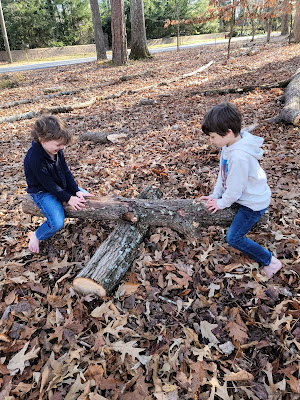
| With the truncated, dead black gum trunk rising behind one grandson, both play on the newly cut trunk sections we left. January 26, 2022 |
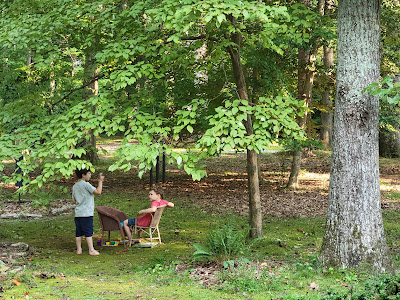
Then, instead of having the arborist's crew haul off all the rest of the wood, I had them cut the trunk into logs and used as many of those logs around the yard as I could: as an end table between 2 Adirondack chairs, as an obstacle course for the grandsons to play on, as occasional places for me to sit during a walkabout, as a decorative element in a flower bed. I also had them leave a 20' section of the upper trunk as a landscape feature just to let it rot in place.
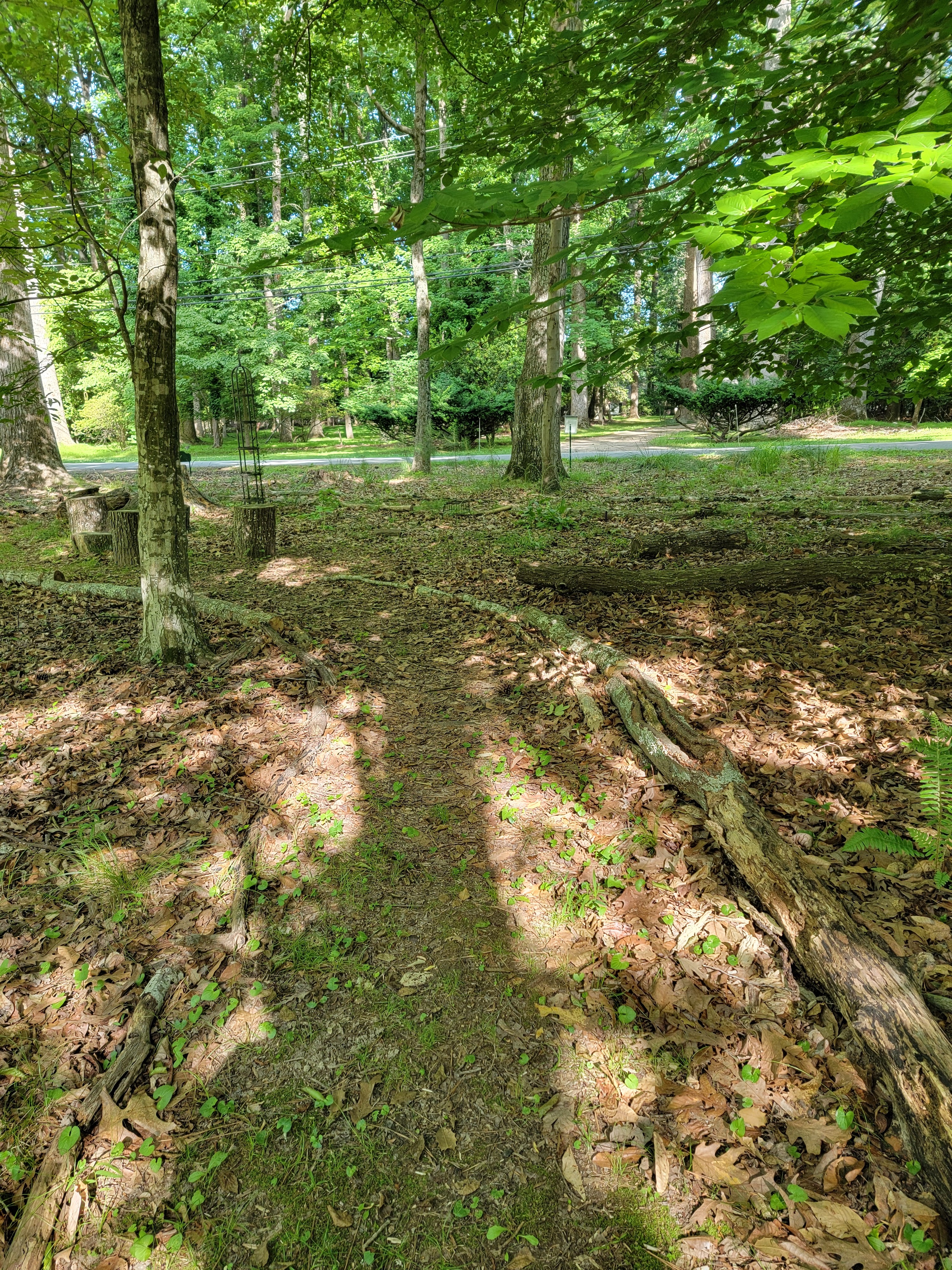 |
| A trail, lined with downed branches, that leads out into the wild area of the front yard. June 1, 2024 |
 |
| Another section of trail lined with downed branches. In this photo, you can see the remaining stump from the dead black gum tree that I talk about below. June 1, 2024 |
The larger branches that the arborist's crew trimmed off were cut into sections that I used to start outlining garden beds and paths.
Two years after the dead black gum trunk was cut back and left standing, it did fall, due to rot in its roots and in the base of the tree. Because I'd had the trunk cut back to 20' tall, it did no damage...although it was a little inconvenient since it landed in our driveway. We pushed it out of the way so that we could use the driveway, then got a crew to take much of it away. On 2/3 acre, there's unfortunately only so much dead wood that I can comfortably keep.
 |
| "After the fall". We were able to roll the log section off the driveway until we could hire someone to cut and remove the wood. August 11, 2023 |
 |
| A closer look at the remaining stump and hollowed out lower trunk of the dead black gum tree. August 11, 2023 |
I did keep the stump and a broken 3' section that was partially rotted away.
Not long after the truncated and dead black gum tree fell, we decided that we had to take down a large, beautiful southern red oak tree that was leaning too strongly towards the neighbor's house. It was right beside the driveway and there was/is rot in it from where the driveway has impinged upon it. I really hated having to make that decision, but I couldn't have lived with myself if the tree had fallen on my neighbor's home, so it had to come down. Before the tree crew came, I measured how far it was to the nearby electric pole and, instead of cutting the tree down completely, I had it topped at 20' as we'd done with the dead black gum.
I have no photo of that tree because it's still too painful that we felt we had to cut it down.
If I were an artist, I'd try to carve a face into the remaining trunk of the red oak. Since I'm not, I simply mounted 2 iron silhouettes on it: an owl and a pileated woodpecker. I suspect that the trunk will be there for a long time, slowly decomposing and feeding untold animals as it does.
In How to Love a Forest, forester Ethan Tapper wrote, "In a world in which a dead tree may contain four times the biomass that it held in life, I will watch the aspen's humming cavities, wondering what it means for a tree to be alive." (p. 89)
I am continually amazed at how much life is harbored in dead wood. Since this post is lengthy enough already, I'll stop here, but in my next post I'm going to share some of the species that we're seeing in our yard BECAUSE we have left the dead wood whenever we can. I hope you'll consider leaving some of the dead wood in your yard or garden, too.