Showing posts with label Dead Trees. Show all posts

Monday, March 17, 2025

The Life in Dead Wood

In my last post, Dead Wood in the Landscape, I shared the biological benefits of leaving dead wood in our gardens and landscapes.  In this post, I want to get more specific, describiing a sampling of the species that we see in our yard BECAUSE we have left dead wood where we can.

Before I start, I want to share a quote with you from Peter Wohlleben.   In The Hidden Life of Trees, The Illustrated Edition, he writes of a tree that suddenly dies, "For centuries, the tree sucked nutrients from the ground and stored them in its wood and bark.  And now it is a precious resource for its children.  But they don't have direct access to the delicacies contained in their dead parents. To access them, the youngsters need the help of other organisms.  As soon as the snapped trunk hits the ground, the tree and its root system become the site of a culinary relay race for thousands of species of fungi and insects.  Each is specialized for a particular stage of the decomposition process and for a particular part of the tree.  And this is why these species can never pose a danger to a living tree--it would be much too fresh for them.  Soft, woody fibers and moist, moldy cells--these are the things they find delicious. ... In total, a fifth of the animal and plant species in Central European forests--that's about six thousand of the species we know about--depend on dead wood." (p. 78-81)

That same general richness of species depends on dead wood all over the world.  Let's look at some of the ones I see in our yard, here in the eastern deciduous forest of North America.....

Pileated Woodpeckers could serve as the charismatic poster child for an animal that needs dead wood to have a healthy habitat.  These big, beautiful woodpeckers not only nest in dead trees, but they obtain a large portion of their food in dead wood.  Their diet is primarily made up of carpenter ants, along with wood-boring beetle larvae, termites, assorted other insects, and sometimes fruits and nuts.

Pileated Woodpecker foraging on downed wood along the paths
April 26, 2023

Although Pileated Woodpeckers are fairly wary, it is not unusual for us to see them foraging on the dead wood in our yard.  Getting decent photos can be a lot trickier, though, than simply seeing them!

Other woodpeckers use dead wood, too.  Downy Woodpeckers, Red-bellied Woodpeckers, Hairy Woodpeckers, and Northern Flickers all nest in dead wood, sometimes in dead branches in living trees.  Several of these species will also nest in living trees that are infected with heart rot fungus.

Every summer we see juvenile Red-bellied Woodpeckers, 
which means that their parents were able to build a successful nest
in dead wood somewhere nearby.
June 5, 2022

Mom is feeding her daughter (on the left).
We see juvenile Downy Woodpeckers every year 
because they've been able to successfully build their nest
in a large dead branch nearby.
May 22, 2022

One year we even had this beautiful adult Red-headed Woodpecker stop by,
another species that nests in dead wood.
June 20, 2022

Woodpecker nest holes are frequently reused as nest sites by other cavity nesting birds such as Bluebirds, Great-crested flycatchers, Chickadees, Tufted Titmice, Screech Owls, White-breasted Nuthatches, Wrens, Swallows, and even Wood Ducks.  During cold weather, woodpecker nests are often used as roosting sites for protection from the temperatures.

Birds aren't the only animals that reuse woodpecker nest holes. Squirrels, Flying Squirrels, even some species of bats will use these valuable spaces for nesting or winter shelter.

Skinks love to use the logs in our yard as basking sites and as pathways. As I shared in my last post, one pair nested in the rotting roots of the dead black gum tree.

An immature and a mature male Broad-headed Skink
using logs as a basking site and pathway.
May 18, 2023

I haven't found any in our yard yet, but many salamander species are found under or in rotting wood, too.

Many, many insect species spend at least part of their life cycle in dead wood.  (Note:  these insects use dead wood, not living wood, as the fibers are softer and decomposition is already occurring in the dead wood.)

Many beetle species lay their eggs in snags, logs, or dead branches and their larvae eat the decaying wood, then pupate there, all safely protected from prying eyes.  Protected from prying eyes...but not from woodpecker bills and tongues!  Beetle larvae are prime woodpecker food, and the woodpeckers help keep the beetle populations balanced and under control.

Last year I noticed a big jump in beetles feeding at and pollinating flowers in our yard.  It turns out that most of the new species I saw have larval stages that develop in dead wood.  One of my favorites is the uniquely marked Delta Flower Scarab (Trigonopeltastes delta).  I also saw Tumbling Flower Beetles (Mordella sp.) and Emerald Flower Scarabs (Trichiotinus lunulatus).

A Delta Flower Scarab on Meadowsweet (Spiraea alba)
June 11, 2024

An Emerald Flower Scarab and a Tumbling Flower Beetle
on Meadowsweet (Spiraea alba)
June 8, 2024

There are several species of flower longhorn beetles that showed up last year, too, all of whom spend their larval stage in dead wood:  Slender Flower Longhorns ((Strangalia famelica), Red-winged Longhorn Beetles (Brachyleptura rubrica), and Red-shouldered Flower Longhorns (Brachyleptura vagans).

Slender Flower Longhorn on Meadowsweet (Spiraea alba)
June 5, 2024

Red-winged Longhorn Beetle on Meadowsweet (Spiraea alba)
June 5, 2024

Red-shouldered Flower Longhorn on Meadowsweet (Spiraea alba)
June 11, 2024

The larvae of these species are some of insects that woodpeckers and other animals are eating when they feed on snags or logs.

It's not just woodpeckers that prey on beetle grubs, though.  There are other beetle species whose larvae are predators on the wood-boring beetle larvae.  An example of a beetle species with predatory larvae is the Eyed Click Beetle (Alaus oculatus).   

Eyed Click Beetle, whose larvae are predators on the larvae of wood-boring beetles
July 14, 2020

There are also parasitoid wasps that specialize in using the wood-boring beetle larvae as hosts for their developing larvae, including the species pictured below which specializes in laying its eggs in longhorn beetle larvae.  That long ovipositor is designed to pierce decaying wood to reach the beetle larva and lay an egg on it.

An Ichneumon Wasp (Spilopteron occiputale) that lays its eggs
in the larvae of longhorn beetle larvae.
July 2, 2024

Then there are yet other beetles whose larvae develop in dead wood, beetles like False Mealworm Beetles (Alobates pensylvanicus) who are predatory on other insects, or like Horned Passalus Beetles (Odontotaenius disjunctus), who live in small colonies in dead wood and whose adults feed their larvae pre-chewed rotting wood.

False Mealworm Beetle that was living under the bark
in the dead black gum trunk.
August 11, 2023

Horned Passalus Beetle, a species that lives in colonies in dead wood.
June 30, 2022

About 30% of the solitary native bees nest in places like stems or in beetle larvae tunnels in dead wood.  Pure Green Sweat Bees (Augochlora pura) are one of the species that I see in the yard that use beetle galleries in dead wood for their nests and whose fertilized females overwinter under logs.  Seeing these jewel-like pollinators gives me a real lift. 

Pure Green Sweat Bee on Wrinkle-leaf Goldenrod (Solidago rugosa)
October 13, 2023

Eastern Carpenter Bees (Xylocopa virginica), who are fabulous pollinators, excavate their own tunnels in dead wood to use as nest sites.  It's disconcerting to have Eastern Carpenter Bees use a railing or the eave of a house, but they naturally use dead wood in the landscape for their tunnels.  Keeping your wood surfaces well painted can encourage these guys to nest elsewhere.

Eastern Carpenter Bee on
Hairy Elephant's Foot (Elephantopus tomentosus)
August 20, 2023

I really dislike disturbing animals, so I haven't actually broken into or looked under the dead wood, standing or downed, to see what animals I can find by direct observation.  Someday I may.  Meanwhile, throughout the year, I'm enjoying the various species that I see specifically because we have logs and snags in our yard.

I've talked about some of the animals we see in our yard because of dead wood, but there are many fungi, mosses, and lichens we see for the same reason and it's been fascinating to see how many there actually are.  I know little about fungi, so I can't identify most of these, but I still enjoy looking at them.  Learning more about them is definitely on my "to do" list.

The first photo is of a slime mold rather than a fungus.  Slime molds are unique, with some characteristics of fungi and some characteristics, believe it or not, of animals.  I've only seen these "chocolate pom-poms" once, on a decaying stump, but when I looked them up, they are a well known species called Chocolate Tube Slime Mold (Stemonitis splendens).  Although some slime molds can look gross, they are decomposers and are not dangerous.  They disappear when environmental conditions change.

These "chocolate pom-poms" are actually Chocolate Tube Slime Mold
June 19, 2023

On that same stump, about 10 months before the Chocolate Tube Slime Mold appeared, I found a fungus known as Black-staining Polypore (Meripilus sumstinei).  This cluster was young, and I find it very elegant looking, especially from the side.  This species is considered edible, but I'm not good enough at identification to take a chance on eating it.

Black-staining Polypore
August 21, 2022

The same clump of mushrooms, Black-staining Polypore,
photographed from the top.
August 21, 2022

I have no idea what species this fungus is, but I love the lacy texture. Note the bit of lichen at its base.

Unknown lacy fungus with lichen at its base,
found on a dead hardwood branch.
August 8, 2024

To myself, I call the round clusters of fungal structures that are found in the next photo, "fungal roses".  That is, you understand, a totally unscientific name but they remind me of the paper flowers that I used to make when I wanted a pop of color on a table or bookcase. As with the fungus above, I do not know the name of this species.

"Fungal rose" on log
May 29, 2023

I'm including this last photo as much for the moss as for the fungus.  This is another fungus for which I do not know the name, nor do I know the name of the moss, but they both were growing on the same stump where I found the Chocolate Tube Slime Mold and the Black-staining Polypore cluster.  Moss and lichen are both frequently found on dead wood.

"Prickly fungus" in a bed of moss
on a stump by our driveway.
October 25, 2023

When we remove dead wood from the landscape, we are effectively starving the ecosystem.

Why do we instinctively feel that dead wood needs to be removed? Well, probably at least in part because it's "dead" and we generally don't like to be reminded of death as a part of life.  In our phobia about death, we've trained ourselves to think that any dead plant material is "ugly" - and ugly things need to be removed from our surroundings. 

However, dead wood isn't ugly, and it's chock full of nutrients that will feed a broad range of other life forms, including other trees.  Scientists have learned that even dead limbs shed by trees actually decompose into extra food that ends up feeding the tree from which they fell.  If the tree is stressed, shedding limbs can reduce the amount of living tissue it has to support during the stressful time as well as give it that boost of energy and nutrition as the dead wood decomposes.

In Victorian times, "stumperies" became popular in gardens - think of a rock garden, but using stumps and dead wood instead of rocks. Stumperies are making a comeback in some gardens and can be very attractively planted, benefitting both human aesthetic sensibilities and ecological needs.

In whatever way works for your garden aesthetic, I hope that you'll seriously consider adding a snag or some logs to your garden.  In doing so, you'll be adding important habitat for a wide variety of species.


Thursday, March 13, 2025

Dead Wood in the Landscape

A dead tree is just dead, right?  It must be time to get rid of it so that the woodland can stay healthy, right?

WRONG!  Dead trees, whether standing (called snags) or fallen (called downed wood or logs), are vitally important to woodland health and to biodiversity.  In fact, scientists believe that dead wood harbors more life than living wood does.  Dead wood is critical to the health of a forest, feeding the soil and a myriad of plants and animals.

How can that be true?  It's DEAD!  It seems counterintuitive, doesn't it?  Well, stop and think about it for a moment.....

As we all know, trees capture energy from the sun to make sugar, but they also pull up nutrients from deep within the soil, with the important help of extensive mycorrhizal networks.  All of these nutrients and energy are stored within the leaves and wood of the tree.  When the tree dies, that nutrition doesn't just disappear, it becomes a vital resource for other plants and for animals within the forest.

A slug inside a shelf fungus on a dead log.  The green
areas are lichen and, if you look closely, you can see
tiny holes where some animal has bored into the dead wood.
May 6, 2024

In fact, many, many species utilize dead wood for some or all of their life cycle.  Dead wood is full of organisms decomposing it and, in the process, working to extract the nutrition stored in it.  Fungi, lichens, mosses, microbes, beetle larvae, ants, termites, and more - all feeding on the nutrients in the dead wood and breaking it down in the process.

All of the decomposers then become food for other animals.  These animals, like woodpeckers and other birds, beetle larvae, centipedes, and parasitic wasps, find a cornucopia of food as they feed on the organisms that are feeding on the dead wood.

This Pileated Woodpecker spent over an hour foraging
on logs around our yard.  
April 26, 2023

A pair of Broad-headed Skinks took up housekeeping
in the decaying roots of the dead black gum tree.
May 16, 2023

Dead wood also forms important structural habitat for animals:  woodpeckers make their nest holes, then other animals utilize the nest holes when the woodpeckers move out.  Flying squirrels, screech owls, and raccoons all utilize cavities in trees as their home.  Little solitary bees utilize the old tunnels of wood-boring larvae and carpenter bees excavate  their own new tunnels in the dead wood.  In these tunnels, the bees lay their eggs, provisioned with nectar and pollen for the growth of their developing larvae.  Hollow trees are biodiversity central, harboring massive numbers of species.  Dead branches serve as perches from which flycatchers and bluebirds and hawks hunt.  

A squirrel sat on this stump, eating hickory nuts,
as evidenced by the debris left behind.
September 15, 2023

Even logs are often used as displaying and basking sites, as well as for protection during cold weather or drought.

As the dead wood decomposes, it forms humus in the soil which both feeds the soil and helps the soil to absorb and retain water, providing protection from drought conditions.

From the bottom left to the top right, there WAS a log, about 6" in diameter.
Within 3 years, it had decomposed to this soft woody "dust".
August 29, 2024

Downed wood will slow the flow of water off a landscape, helping rain be absorbed into the soil, decreasing floods and increasing groundwater storage, helping to keep the soil moist for the plants and animals living in it.

Last, but hardly least, one of the most undervalued benefits that trees provide is that they are important "carbon sinks", utilizing carbon dioxide during photosynthesis and storing the carbon in their wood and leaves as they grow.  That carbon stays in the wood after the tree dies and, as the wood decomposes slowly, much of it will become held as organic material in the soil for even longer.  Soil can hold a tremendous amount of carbon and I've seen estimates that a full third of the carbon that we need to remove from the atmosphere to solve the climate crisis could be stored in soils in the form of humus or organic material.

How much carbon does a tree store?  Dry wood is about 45-50% carbon, depending on the species of tree.  One unit of carbon (a pound, for example), if completely converted to carbon dioxide, will produce 3.67 units (pounds, in our example) of carbon dioxide.  So, to estimate, one pound of dry wood is storing 1.8 pounds of carbon dioxide in its tissues.

So, do we have dead wood in our yard?  Absolutely.

This is the remnant trunk of the dead black gum tree,
cut off about 20' above the ground.
Note the living Pileated Woodpecker below
the iron silhouette of a pileated above.
April 26, 2023

About a year after we moved in, I had our trees trimmed for safety purposes.   I asked the arborist's crew to leave larger branches for me, which they very kindly did.  Our yard also contained a dead black gum tree.  It was tall enough that it could do some damage if it fell in the wrong direction, so I had the crew cut it off about 20' above the ground, leaving the lower part of the trunk standing for woodpeckers and other animals to use.  

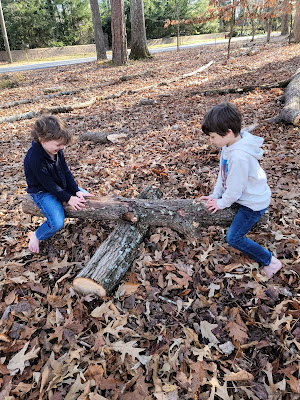
With the truncated, dead black gum trunk rising behind one grandson,
both play on the newly cut trunk sections we left.
January 26, 2022

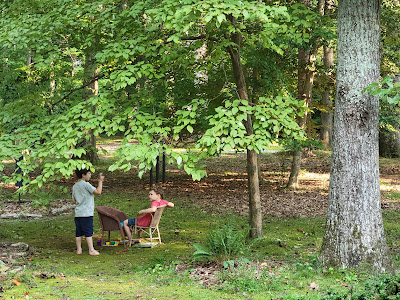
Then, instead of having the arborist's crew haul off all the rest of the wood, I had them cut the trunk into logs and used as many of those logs around the yard as I could:  as an end table between 2 Adirondack chairs, as an obstacle course for the grandsons to play on, as occasional places for me to sit during a walkabout, as a decorative element in a flower bed.  I also had them leave a 20' section of the upper trunk as a landscape feature just to let it rot in place.

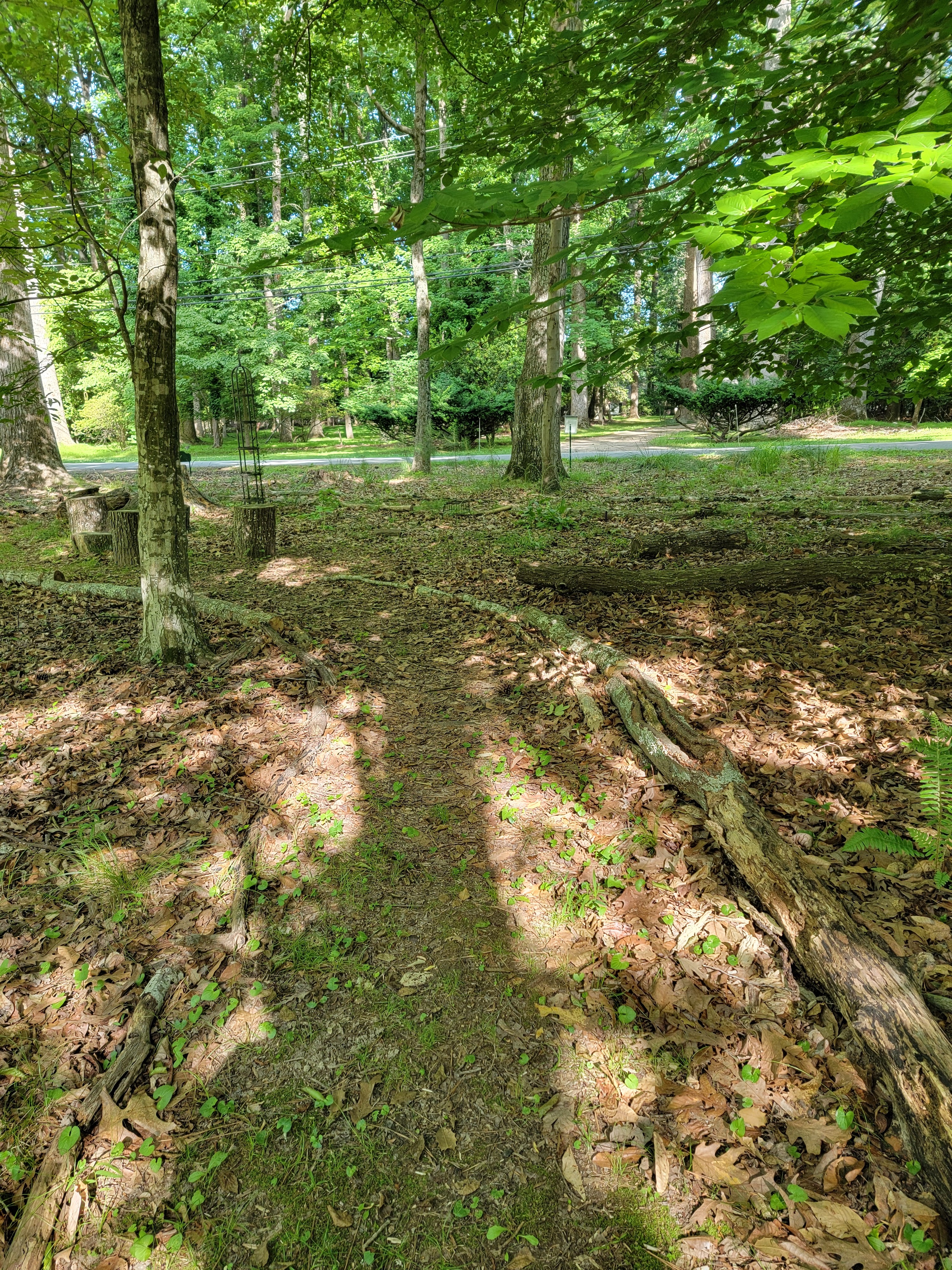
A trail, lined with downed branches, 
that leads out into the wild area of the front yard.
June 1, 2024

Another section of trail lined with downed branches.
In this photo, you can see the remaining stump
from the dead black gum tree that I talk about below.
June 1, 2024

The larger branches that the arborist's crew trimmed off were cut into sections that I used to start outlining garden beds and paths.

Two years after the dead black gum trunk was cut back and left standing, it did fall, due to rot in its roots and in the base of the tree.  Because I'd had the trunk cut back to 20' tall, it did no damage...although it was a little inconvenient since it landed in our driveway.  We pushed it out of the way so that we could use the driveway, then got a crew to take much of it away.  On 2/3 acre, there's unfortunately only so much dead wood that I can comfortably keep.  

"After the fall". We were able to roll the log section off the driveway
until we could hire someone to cut and remove the wood.
August 11, 2023

A closer look at the remaining stump and hollowed out lower trunk
of the dead black gum tree.
August 11, 2023

I did keep the stump and a broken 3' section that was partially rotted away.

Not long after the truncated and dead black gum tree fell, we decided that we had to take down a large, beautiful southern red oak tree that was leaning too strongly towards the neighbor's house.  It was right beside the driveway and there was/is rot in it from where the driveway has impinged upon it.  I really hated having to make that decision, but I couldn't have lived with myself if the tree had fallen on my neighbor's home, so it had to come down.  Before the tree crew came, I measured how far it was to the nearby electric pole and, instead of cutting the tree down completely, I had it topped at 20' as we'd done with the dead black gum.

I have no photo of that tree because it's still too painful that we felt we had to cut it down.

If I were an artist, I'd try to carve a face into the remaining trunk of the red oak.   Since I'm not, I simply mounted 2 iron silhouettes on it:  an owl and a pileated woodpecker.  I suspect that the trunk will be there for a long time, slowly decomposing and feeding untold animals as it does.

In How to Love a Forest, forester Ethan Tapper wrote, "In a world in which a dead tree may contain four times the biomass that it held in life, I will watch the aspen's humming cavities, wondering what it means for a tree to be alive." (p. 89)

I am continually amazed at how much life is harbored in dead wood.  Since this post is lengthy enough already, I'll stop here, but in my next post I'm going to share some of the species that we're seeing in our yard BECAUSE we have left the dead wood whenever we can.  I hope you'll consider leaving some of the dead wood in your yard or garden, too. 


Wednesday, January 26, 2022

Kids in Nature


Richard Louv's important book, Last Child in the Woods, was written in 2008 and brought attention to the reality that few children actually get to spend much time playing freely outdoors.   It sparked a subset of parents and other adults who have been trying to encourage families to get their kids outdoors in nature.  Unfortunately, it's seemed (from the outside, at least) like a bit of a slog, fighting through the mud that is the way our society is currently set up - barren yards full of chemicalized lawn and non-native plants, schedules jammed with activities that require all of our highly scheduled time and attention, parks given over to sports' fields rather than natural areas, and a general distrust of free time as "unproductive", the ultimate sin in the U.S.

When I was in elementary school, I spent days...weeks... months exploring the woods and creek near our home in College Park, Maryland.  There were tadpoles and crayfish to try to catch, minnows and frogs to watch, and many, many special places where my imagination could run wild.  The holly glade magically hid me, the tiny islands became my kingdoms, the paths (deer?) became trails leading me to new lands.....  When we moved to Massachusetts, I continued playing in the woods but I was getting a bit older.  Now I had a favorite log on a hillside overlooking a pond where my best friend and I would go after school to talk and just generally try to figure out life.  I led a band of neighborhood kids in catching toads and keeping them, naming them and "training" them to race in sandbox toad races such as high jump, long jump, and speed or distance trials.  (What can I say?  I knew I'd never have a horse;  maybe this was scratching that itch!)

In junior high, in the Panama Canal Zone, I tried my hand at gardening (I was awful at it) and explored the sea shore as much as I could, bringing home hermit crabs and other sea creatures to form my own attempt at a personal zoo.  Sadly, coming home with me was generally a death sentence for the poor animals, but I tried my best to provide good habitat and food for them.  Gerald Durrell's My Family and Other Animals, which my maternal uncle had introduced to me, was one of my favorite books - and a real inspiration.  More mundanely, I collected shells, too.  A lot of shells, which I carefully worked to identify and which I housed in cigar boxes, grouped by "type": moon shells, pen shells, scallops, whelks, cowries, etc.  I wanted so badly to be a marine biologist...but our next move was to Kansas and I didn't know any marine biologists.  How did you actually make a living as a marine biologist?  My courage and my imagination failed me in figuring out how to step in that direction, and life soon led me in other directions.

All of this is to say that playing outside, freely and with little oversight, was incredibly important to me and was influential in forming the person I became.  Greg and I were able to give our kids a taste of that freedom in the natural world, too, when they were in late elementary and middle school.

And now we're trying to give the gift of free play in nature to our grandsons as well.

It's a goal that seems to get harder with each generation.  If my parents worried about where I was while I was gone for most of each day, playing in the woods, I was unaware of it, and the wild area was right down the street from where we lived.  I walked there.  When our kids were playing outdoors, we lived in farm country and they were able to ramble through a wooded draw behind our house and through a neighbor's cow pasture.

Where do kids play now?  There are few natural areas left where they can roam and wander at will.  There's so much fear about "danger" that parents actually get prosecuted for letting their children roam freely.  (Or, at least, that's the story we're told.)


So I'm working to make our personal landscape an interesting natural area for our grandsons to explore and play in.  I've come across a wonderful book by Nancy Striniste, Nature Play at Home, which has a plethora of great ideas for changing your yard from bland to fascinating.   I highly recommend it if the topic interests you at all.


When dead wood was trimmed out of our trees last month, I had the tree service leave the major branches and trunks.  One of the things I've done with that dead wood is create play areas for the boys in our yard.


Good habitat for people AND animals.


Even their dad has gotten in on the action!


Bare feet are the norm for the boys, not the exception.  In fact, it's hard now to get them to wear shoes, even in cold weather.  Talk about "grounding"!


And imaginations run wild.


My heart truly swelled with happiness and pride the day that the boys came outside, on their own, with notebooks, guidebooks, binoculars, and pencils to "study nature".


They are not always successful in their endeavors - patience was not their strong suit as Connor tried to entice birds to eat out of his hand.  But that's part of the learning.


Even meal times have an element of outside nature for all of us, as we watch our bird feeders from the table on the back porch.  The boys have become excellent birders.  For example, it was our older grandson who first noticed the immature male Baltimore oriole feeding on the bark butter feeder a few weeks ago.  I'm not sure I wouldn't have quickly glanced at the bird and dismissed it as the pine warbler that had been frequently visiting.  I never expected a Baltimore oriole in January!

In other interactions with animals, we and the boys watch fireflies at night in the summer - last summer we noticed 3 different waves of them: one in April, one in mid summer, and one in early fall.  The April fireflies seem to stay 30' or more above the ground.  I've even found the firefly larvae occasionally as I weed.  

We planted around 30 swamp milkweed last spring and we watched for monarch caterpillars all summer long;  we did find a few and we're hoping for more next summer.  Our plants are still young.  We've found large numbers of black swallowtail caterpillars on parsley, enough that we've had to hit the grocery store for organic parsley when the hungry hordes decimated the plants they were on.

Late this summer, a box turtle wandered through the front yard - the first one I've seen in our yard in 2 years.  We see skinks and a few baby toads.  The boys haven't shown any interest in toad races yet, though! 

I hope we're building happy memories for them, strongly grounded in the natural world, that will last the boys for a lifetime.  Most importantly, I hope we're helping to create a new generation that cares enough about the Earth to help care for it in the future.

Saturday, January 23, 2016

A Different Kind of Yard Art

This made my day last week, when I happened to notice it during an afternoon walk!  I have heard of leaving standing dead trees for their wildlife value, and I personally have left standing dead trees well away from our house when we had large yards or acreage and I could safely do so, but I have never before seen the remains of a dead tree left standing in a suburban yard, to decompose gracefully in place.  I truly love it and find it mesmerizing.

I have no idea what species this tree was, whether it was cut down or came down in a storm, or how long it's been quietly decomposing in place.  However, I think it's perfect...and perfectly beautiful, too. Now I know what I want to do with the 3 live oaks in our yard that will probably fade away over the next few years!

Thursday, May 02, 2013

Rock-A-Bye...Raccoon?

One advantage to owning two large German shepherds when you live out in the country is that they HAVE to have their morning walkabout.  In the last several weeks, we've had several "cold" snaps, accompanied by snow or freezing rain or ice pellets.  These are definitely NOT considered sufficient reason to stay inside by The Boys.  It doesn't matter how ugly the weather is, they need a bit of romp time...and so I "suit up" to suit the weather and out we go.

Although it's hard to convince myself of the positive side of these walks when I'm donning waterproof shoes and wind-and-rain-resistant coat, facing cold winds that will cut through everything I have on, I do get to see some things that I'd probably miss otherwise. 

Sometimes I even have my camera along to capture the experience.  Here, for example, is one such time....

Look closely at this photo.  See anything much besides a bunch of snags and last year's dead plant stems, waiting to decompose?  I took this photo a week ago, on the day we woke up to snow.  This was taken about mid morning, after most of the snow had melted but while the temperatures were still quite chilly.

Look more closely at the center of the photo, right at the top of the broken black willow, where the top part of the trunk heads downwards at 90%.  (Yes, it's ugly.  No, I shouldn't have had someone out to "take care of it."  And this is why!)

See that bundle of gray fur?  I think it's a raccoon, perhaps the one that I photographed a couple weeks ago, climbing up a nearby black willow that was similarly "past its prime."  It could, however, be an opossum.  Anyone who is better than I at identifying fur is welcome to chime in with a positive identification!

Whichever it is, this is evidently a favorite hangout, especially (weirdly) in cold, wet, spring weather.  I saw it again this morning, similarly curled up, with enough rain falling that I'd taken neither my camera nor my binoculars along on our walkabout.  There it lay, seemingly snug as a bug in a rug.

Raccoons denning in hollow trees.  Raccoons napping in snags.  Woodpeckers nesting in holes, drilled into standing dead trees.  Insects overwintering in standing dead plant stems or snuggled deep in leaf litter.  We humans may see dead plants as ugly trash, messing up our landscape, but wild amimals view dead plants as shelter - safe, comfortable places to weather storms and cold and rain.  Secure places to raise the next generation. 

So, before you automatically cut down that dead tree at the back of your property, stop a minute and really analyze the situation.  Is it likely to fall on a building or a person passing by?  By all means, cut it down, and the sooner, the better!  But if that dead tree is not likely to cause any harm, then consider leaving it as a sort of wildlife hotel.  You never know what may decide to take up residence there!