Recently, a blog from a fellow Kansan had a piece on Gore's An Inconvenient Truth (http://musementparking.blogspot.com/2007/04/inconvenienttruth.html).
I wrote a comment, remarking that he had dissed folks who seemed to believe what Gore said without actually offering any useful critique of the movie itself or the content therein. Then I asked for his thoughts on global warming - if he had any serious faults with the information provided.
He wrote back, directing me to a site, http://www.junkscience.com/Greenhouse/.
My response is below. I think it's important to start challenging the junk science being passed out by corporate interests in the name of "safe science".
"To quote your post, "...when money's involved, sniff for sincerity."
The site that you sent me to is not a credible source of information.
When I did a Google search for Steven Milloy, who runs junkscience.com, I found several interesting links, including the following two:
http://en.wikipedia.org/wiki/Steven_Milloy
http://www.sourcewatch.org/index.php?title=Steven_J._Milloy
The concensus seems to be that he's a paid advocate (to quote SourceWatch) for Phillip Morris, ExxonMobil and other similar corporations. He's also been closely affiliated with the Cato Institute.
These affiliations hardly make him an unbiased source of information on global warming or much of any other topic that might endanger corporate profits.
I would suggest that you check out a couple actual scientific sources. For example, the American Association for the Advancement of Science (AAAS), the parent organization for Science magazine. Its Board of Directors issued this statement regarding global warming/climate change in February 2007:
"The scientific evidence is clear: global climate change caused by human activities is occurring now, and it is a growing threat to society...."
http://www.aaas.org/news/press_room/climate_change/mtg_200702/aaas_climate_statement.pdf
Their general information on global warming is at http://www.aaas.org/climate.
Another good site is the Union of Concerned Scientists. They have a section about global warming at http://www.ucsusa.org/global_warming/.
The Union of Concerned Scientists has also released a very interesting report entitled "Smoke, Mirrors and Hot Air: How ExxonMobil Uses Big Tobacco's Tactics to Manufacture Uncertainty on Climate Science." This is posted at www.ucsusa.org/assets/documents/global_warming/exxon_report.pdf.
One other site you might be interested in visiting is Woods Hole Research Center. They have an online guide to global warming at http://whrc.org/resources/online_publications/warming_earth/index.htm.
Last, but certainly not least, it's instructive to look at the segments of society that are beginning to act on global warming. The insurance industry was one of the first. Now a group of retired admirals and generals has come out with a report that states that global warming is a serious threat to our national security. The CNN article is here...
http://www.cnn.com/2007/US/04/15/warming.military.ap/index.html?eref=rss_topstories.
Hope these help."
Wednesday, April 18, 2007

Tuesday, April 17, 2007
Notes Gleaned from The American Gardener, the Am. Horticultural Society's Magazine
From pages 46-48 of the March/April 2007 issue of The American Gardener, the official magazine for the American Horticultural Society....
The Arbor Day Foundation has taken climate data for the U.S. from 1990 to 2004 and reworked the Plant Hardiness Zone Map. Go to their site, http://www.arborday.org/media/mapchanges.cfm, to view the newly released map and to check out what your current zone is. Note that this page starts with the 1990 map, based on 1974 to 1986 data. If you hit the "Play" button, it will morph into their new 2006 map. Then, if you hit "Differences", you can see the areas that have changed designations. Here in Clearwater, our zone has gone from 6 to 7, based on this data. (Can you say "global warming"?)
Along these same lines, research reports some of the changes in plant life that we can expect with increased CO2 levels:
1) Plants with short life cycles will adapt more readily than plants with long life cycles. Thus, annual weeds are actually expected to benefit from climate change.
2) Poison ivy grows 3 times larger and more vigorously when exposed to the expected 2050 levels of CO2 than it does at current levels. The oil, urushiol, that produces the allergic reaction and rash in humans is also much more potent at these CO2 levels.
3) Higher levels of CO2 may have already doubled the amount of ragweed pollen produced within the last 50 years or so. At the expected rate of CO2 increase, it is expected to double again by 2100. (Ragweed pollen is, of course, highly allergenic, affecting some 85% of the U.S.'s allergy sufferers.)
Last, but certainly not least, apparently research from several universities is linking Parkinson's Disease to pesticide exposure. The Harvard School of Public Health reported that chronic, low level exposure to pesticides increased the incidence of Parkinson's by 70%. Another study (from Mayo Clinic) reports that estrogen seems to provide some protection from this process, so pesticide exposure is more likely to produce Parkinson's in men than in women. Several other studies cited link Parkinson's to dieldrin, maneb, and organochlorine pesticides in general.
Gaia's comment: Just because we hide our head in the sand and yell, "More research!" doesn't mean that environmental changes detrimental to human life are not occurring. It's long past time that we take responsibility for our actions and start proactively addressing the situation.
The Arbor Day Foundation has taken climate data for the U.S. from 1990 to 2004 and reworked the Plant Hardiness Zone Map. Go to their site, http://www.arborday.org/media/mapchanges.cfm, to view the newly released map and to check out what your current zone is. Note that this page starts with the 1990 map, based on 1974 to 1986 data. If you hit the "Play" button, it will morph into their new 2006 map. Then, if you hit "Differences", you can see the areas that have changed designations. Here in Clearwater, our zone has gone from 6 to 7, based on this data. (Can you say "global warming"?)
Along these same lines, research reports some of the changes in plant life that we can expect with increased CO2 levels:
1) Plants with short life cycles will adapt more readily than plants with long life cycles. Thus, annual weeds are actually expected to benefit from climate change.
2) Poison ivy grows 3 times larger and more vigorously when exposed to the expected 2050 levels of CO2 than it does at current levels. The oil, urushiol, that produces the allergic reaction and rash in humans is also much more potent at these CO2 levels.
3) Higher levels of CO2 may have already doubled the amount of ragweed pollen produced within the last 50 years or so. At the expected rate of CO2 increase, it is expected to double again by 2100. (Ragweed pollen is, of course, highly allergenic, affecting some 85% of the U.S.'s allergy sufferers.)
Last, but certainly not least, apparently research from several universities is linking Parkinson's Disease to pesticide exposure. The Harvard School of Public Health reported that chronic, low level exposure to pesticides increased the incidence of Parkinson's by 70%. Another study (from Mayo Clinic) reports that estrogen seems to provide some protection from this process, so pesticide exposure is more likely to produce Parkinson's in men than in women. Several other studies cited link Parkinson's to dieldrin, maneb, and organochlorine pesticides in general.
Gaia's comment: Just because we hide our head in the sand and yell, "More research!" doesn't mean that environmental changes detrimental to human life are not occurring. It's long past time that we take responsibility for our actions and start proactively addressing the situation.
What Do We Really Value?
Sunday's Parade magazine had their annual report on what people earn. While this is far from a definitive, scientific study (to the best of my knowledge), I always find it fascinating to look through.
Making the basic assumption that we pay more for what we value more, I actually took pencil to paper and listed out the occupations that our society finds most and least valuable....
Most valuable by far were TV and screen celebrities, well known sports figures, even a NASCAR driver. Also up there were CEOs, including those of Halliburton, Hewlett-Packard, and Sara Lee. Only one real innovator, so to speak, jumped out at me, the co-founder of YouTube, who was listed at being worth $341,000,000. (Is YouTube really worth $341 million x however many co-founders there are?)
Interestingly, we value Katie Couric and a Nascar driver, Jimmie Johnson, almost equally. Both are worth in the vicinity of $15 million.
Then I looked at jobs that I felt were actually the backbone of keeping our society running efficiently: teachers, nurses, Air Force personnel, ministers, letter carriers, engineers, child care workers, police officers, architects, judges, school lunchroom workers, computer techs, etc. etc. etc. As reported in Parade this year, these folks averaged $56,019 in annual compensation.
So, looking at what we feel it's worth to pay them, a big-time NASCAR driver is worth 300 times more than the average U.S. worker who keeps our country functioning. (For driving really, really fast going around a track many, many times? Oh, yeah, THAT's real important.)
Last of all, I looked at the workers that we pay the least. The ones that we feel aren't very important. Some of these I had no trouble with (bartender at $25,000, for example), but some really bothered me. As usual, child care workers are low: only one was listed this time, at $24,000. A taxidermist earned $40,000; a paralegal earned $42,000; an accordionist earned $45,000; and an adult who drives around a track going really, really fast earned $15.8 million. I don't want to hear how much we value our children in this country.
And, of course, a person (male or female) who opts to take care of his/her own family full-time gets paid nothing. Zip. Zilch. No social security benefits. No nothing. You can take care of somebody else's family and get paid, but not your own. You can receive economic security playing the accordion, stuffing dead animals, or going around a track really, really fast, but you don't deserve it if you take care of your own family.
So we value taking care of our own families as worthless.
And we wonder why there are school shootings, an epidemic of depression, as many marriages ending in divorce as staying together, and the host of other fantastic perks that accompanies our magnificent society.
Maybe it's time we took our heads out of the sports pages and turned off the TV and really started looking at what makes our lives worthwhile and happy. I wonder what we'd discover then.
Making the basic assumption that we pay more for what we value more, I actually took pencil to paper and listed out the occupations that our society finds most and least valuable....
Most valuable by far were TV and screen celebrities, well known sports figures, even a NASCAR driver. Also up there were CEOs, including those of Halliburton, Hewlett-Packard, and Sara Lee. Only one real innovator, so to speak, jumped out at me, the co-founder of YouTube, who was listed at being worth $341,000,000. (Is YouTube really worth $341 million x however many co-founders there are?)
Interestingly, we value Katie Couric and a Nascar driver, Jimmie Johnson, almost equally. Both are worth in the vicinity of $15 million.
Then I looked at jobs that I felt were actually the backbone of keeping our society running efficiently: teachers, nurses, Air Force personnel, ministers, letter carriers, engineers, child care workers, police officers, architects, judges, school lunchroom workers, computer techs, etc. etc. etc. As reported in Parade this year, these folks averaged $56,019 in annual compensation.
So, looking at what we feel it's worth to pay them, a big-time NASCAR driver is worth 300 times more than the average U.S. worker who keeps our country functioning. (For driving really, really fast going around a track many, many times? Oh, yeah, THAT's real important.)
Last of all, I looked at the workers that we pay the least. The ones that we feel aren't very important. Some of these I had no trouble with (bartender at $25,000, for example), but some really bothered me. As usual, child care workers are low: only one was listed this time, at $24,000. A taxidermist earned $40,000; a paralegal earned $42,000; an accordionist earned $45,000; and an adult who drives around a track going really, really fast earned $15.8 million. I don't want to hear how much we value our children in this country.
And, of course, a person (male or female) who opts to take care of his/her own family full-time gets paid nothing. Zip. Zilch. No social security benefits. No nothing. You can take care of somebody else's family and get paid, but not your own. You can receive economic security playing the accordion, stuffing dead animals, or going around a track really, really fast, but you don't deserve it if you take care of your own family.
So we value taking care of our own families as worthless.
And we wonder why there are school shootings, an epidemic of depression, as many marriages ending in divorce as staying together, and the host of other fantastic perks that accompanies our magnificent society.
Maybe it's time we took our heads out of the sports pages and turned off the TV and really started looking at what makes our lives worthwhile and happy. I wonder what we'd discover then.
Slightly Odd Weather Trivia
Every night I record the daily high and low temperature wherever I've been. I don't know why, except that my journal has a spot to do it, so I do. I also record the basic weather info (sunny, cloudy, rainy, snowy). Nothing fancy. Truthfully, nothing too terribly accurate. My "stats" are a guess, as often as not.
Last night I decided to check out the wireless weather station gizmo that we bought when we first moved in. Both Prairiewolf and I seemed to recall that it recorded high and low temperatures, and I was hoping to increase my daily weather reporting accuracy, at least here at home.
I found out that our weather station does indeed record minimum and maximum temperatures. Unfortunately for the accuracy of my journal entries, it doesn't reset automatically every 24 hours, but has to be manually reset. Be that as it may, I learned some rather fun weather data by checking out this feature....
We bought the weather station on January 10th, not too long after we moved in here. It has been continuously operating since then. (It's battery operated, so power outages have not affected it.) The minimum temperature it recorded was 7.1 degrees Fahrenheit on February 16 at 3 a.m. That's not terribly surprising. The maximum temperature it has recorded, through this morning, was 81.1 degrees Fahrenheit on February 4th at 5:19 p.m. That one surprised me. Despite all the warm weather we had during March, February 4th actually recorded the highest temperature so far.
Ain't the prairie great? From 81 degrees to 7 degrees in 12 days. One of many reasons this is a challenging place for people AND plants to survive....
Last night I decided to check out the wireless weather station gizmo that we bought when we first moved in. Both Prairiewolf and I seemed to recall that it recorded high and low temperatures, and I was hoping to increase my daily weather reporting accuracy, at least here at home.
I found out that our weather station does indeed record minimum and maximum temperatures. Unfortunately for the accuracy of my journal entries, it doesn't reset automatically every 24 hours, but has to be manually reset. Be that as it may, I learned some rather fun weather data by checking out this feature....
We bought the weather station on January 10th, not too long after we moved in here. It has been continuously operating since then. (It's battery operated, so power outages have not affected it.) The minimum temperature it recorded was 7.1 degrees Fahrenheit on February 16 at 3 a.m. That's not terribly surprising. The maximum temperature it has recorded, through this morning, was 81.1 degrees Fahrenheit on February 4th at 5:19 p.m. That one surprised me. Despite all the warm weather we had during March, February 4th actually recorded the highest temperature so far.
Ain't the prairie great? From 81 degrees to 7 degrees in 12 days. One of many reasons this is a challenging place for people AND plants to survive....
Monday, April 16, 2007
Update on the Bur Oak Bark Incident
A couple months ago I blogged about an unusual phenomenon occuring in the backyard: a pair of downy woodpeckers were systematically pecking away the bark on a young bur oak tree in the yard. I've been watching the tree this spring to see if it will leaf out like usual.
As I was walking about with the puppy this evening, I noticed a large number of small (approx. 1/8"), black flies or wasps on the still unopened leaf buds of the bur oak. I couldn't tell if they were laying eggs, eating sap, or doing something else entirely. It makes me wonder if I was witnessing the reason for the downy woodpeckers pecking so diligently at the bark of this tree over the winter. If so, they didn't begin to get the population under control.
I'm curious now to see if there are signs of problems when the tree finally does leaf out. Bur oaks are late "bloomers", so to speak, so I'm not surprised that the tree still looks dormant. (And I've been checking the bark; it still shows green underneath on the twigs.) I ought to collect a few of the insects and look them over under a loop to see if I can key them out to learn a little more (at least whether they are flies or wasps!). However, with all our furniture, miscellaneous bits and books still in storage, I have no supplies to follow through with this plan in the near future. So I guess I'll just let nature take its course, literally, and see what happens.
If anyone recognizes what I'm seeing, I would still welcome the knowledge.
As I was walking about with the puppy this evening, I noticed a large number of small (approx. 1/8"), black flies or wasps on the still unopened leaf buds of the bur oak. I couldn't tell if they were laying eggs, eating sap, or doing something else entirely. It makes me wonder if I was witnessing the reason for the downy woodpeckers pecking so diligently at the bark of this tree over the winter. If so, they didn't begin to get the population under control.
I'm curious now to see if there are signs of problems when the tree finally does leaf out. Bur oaks are late "bloomers", so to speak, so I'm not surprised that the tree still looks dormant. (And I've been checking the bark; it still shows green underneath on the twigs.) I ought to collect a few of the insects and look them over under a loop to see if I can key them out to learn a little more (at least whether they are flies or wasps!). However, with all our furniture, miscellaneous bits and books still in storage, I have no supplies to follow through with this plan in the near future. So I guess I'll just let nature take its course, literally, and see what happens.
If anyone recognizes what I'm seeing, I would still welcome the knowledge.
Saturday, March 24, 2007
I Go to Nature....
My mother and I visited the Great Plains Nature Center today for a quick look-see. She'd never been there and I was happy to introduce her. It's a great place to be introduced to Kansas wildlife and plants, especially for children. (Of course, don't we all still have a big kid inside? I still get a kick out of seeing the actual depth of big bluestem roots, "petting" skunk fur, hearing a white-tail buck snort, and seeing a visual representation of the roots literally under our feet.)
Anyway, that's not really my point.
My point is that a quote they have painted on the wall really spoke to me today. It encapsulates why Prairiewolf and I moved back to Kansas and, specifically, to acreage in the country.
"I go to nature to be soothed and healed, and to have my senses put in tune once more."
- John Burroughs
Everytime I walk out the door into the yard, I feel myself returning to true pitch. We are so incredibly lucky.
Anyway, that's not really my point.
My point is that a quote they have painted on the wall really spoke to me today. It encapsulates why Prairiewolf and I moved back to Kansas and, specifically, to acreage in the country.
"I go to nature to be soothed and healed, and to have my senses put in tune once more."
- John Burroughs
Everytime I walk out the door into the yard, I feel myself returning to true pitch. We are so incredibly lucky.
I Think They Were All Waiting for the Official Okay....
Spring officially arrived sometime Tuesday night/Wednesday morning. I'd intended to post a blog for the occasion, but flu and life intervened. I'm happy to report that I'm much better...although life (and a "used" house) are throwing some curve balls our way.
Seemingly knowing that it's now officially spring, the rains have come and the leaves are simply bursting out of their buds. Tuesday was our big rain (2.8"); by Thursday the Bradford pears had gone from bud to full bloom.
...Okay, I know that I officially don't like Bradford pairs, but... their blooms sidelighted by the porch light and shining against the black night sky are truly breathtaking. For a week or so, at least, I'm almost happy to share my yard with them.
By the way, sniff those lovely blooms sometime. They smell like rotting meat. A real olfactory treat for the flies that they rely on for pollination! (Actually I've seen quite a few honey bees buzzing around them during the day too, so I guess the bees aren't always attracted just to sweet scents. At night it seems to be primarily flies coming around.)
In the past 5 days, our view out the kitchen door has transformed from a far-sighted westerly view through open screens of bare branches to the enclosed feel of a green-walled courtyard. I've been dreading this a little bit, not sure how I'd like feeling closed in, but it's rather fun to get enticing glimpses of the treetops in the swale and the prairie through the hedge-opening. Classic "enclosure and mystery beyond" gardening stuff. I'm going to have fun playing with this.
Seemingly knowing that it's now officially spring, the rains have come and the leaves are simply bursting out of their buds. Tuesday was our big rain (2.8"); by Thursday the Bradford pears had gone from bud to full bloom.
...Okay, I know that I officially don't like Bradford pairs, but... their blooms sidelighted by the porch light and shining against the black night sky are truly breathtaking. For a week or so, at least, I'm almost happy to share my yard with them.
By the way, sniff those lovely blooms sometime. They smell like rotting meat. A real olfactory treat for the flies that they rely on for pollination! (Actually I've seen quite a few honey bees buzzing around them during the day too, so I guess the bees aren't always attracted just to sweet scents. At night it seems to be primarily flies coming around.)
In the past 5 days, our view out the kitchen door has transformed from a far-sighted westerly view through open screens of bare branches to the enclosed feel of a green-walled courtyard. I've been dreading this a little bit, not sure how I'd like feeling closed in, but it's rather fun to get enticing glimpses of the treetops in the swale and the prairie through the hedge-opening. Classic "enclosure and mystery beyond" gardening stuff. I'm going to have fun playing with this.
Friday, March 16, 2007
Psycho Woodpeckers
Several weeks ago I posted a picture of our poor little bur oak tree, with the bark sadly thinned by a pair of downy woodpeckers who've been systematically working on it. I'm still not sure how that tree is going to fare as spring progresses, but I'm keeping a close eye on it.
Recently I noticed a couple of fairly large holes drilled in a cottonwood out front. The picture here is of the largest of these. The hole is about 1 1/2" deep and located about 5' above the ground.

Recently I noticed a couple of fairly large holes drilled in a cottonwood out front. The picture here is of the largest of these. The hole is about 1 1/2" deep and located about 5' above the ground.
Obviously this is a very different kind of hole than the all-over bark thinning that the downies are doing on the bur oak.
The only woodpecker I've seen in this tree is a hairy woodpecker, so presumably he did the work. I can only hypothesize that he was after cottonwood borer larvae, or some other insect, as the limb is way too small to support any kind of nesting hole. I'm open for suggestions, though.
What Went Before
It turns out that our home is aptly named Windswept Cottage.
 Maybe it's my imagination, but to the northeast of our yard, the trees seem to be smaller and younger in a pathway that spans several hundred feet and continues for a quarter mile or more.
Before 1991, a horse barn and corral stood on this piece of land. They belonged to the house just south of us.
According to the neighbors, the infamous 1991 Andover tornado, an F5 killer that stayed on the ground for 46 miles and about 50 minutes, started near here and took out the horse barn, the corral, and the house to the south before heading on to the northeast. Afterwards, the owners simply sold off this 10 acres, rather than rebuilding the barn.
I did a little internet research yesterday and found out that, if it was the Andover tornado, this occurred on April 26, 1991. At this point in its lifecycle, the tornado would actually only have been an F2 or F3; it strengthened as it moved northeast. However, there was another "Clearwater tornado" that occurred that year, on May 16, 1991. This second tornado also took out several farms and homes. I think the only way I'll be able to find out which tornado actually took out the barn here will be to research in the archives of the Clearwater and/or Wichita papers.
The history of place. In knowing this, I can't decide if I feel more secure, assuming that "lightning doesn't strike twice in the same place," or if this makes me want to build a saferoom in the basement for sure!
 Maybe it's my imagination, but to the northeast of our yard, the trees seem to be smaller and younger in a pathway that spans several hundred feet and continues for a quarter mile or more.
 And there's the impression of a perfect circle in the grass of the front yard. It's large and hard to see from ground level, but it's very obvious from our closet window. The ghost, in land form, of the horse corral.
Remnants of what happened here and what went before? I think so...and it adds a textural layer to our new home. The hurricanes of the Gulf coast; now the tornadoes of Kansas. The weather shapes us and shapes our homescapes, whether we want to admit it or not.
Thursday, March 15, 2007
New Eyes for Spring Changes
It's funny, but many times when I sit down to blog, I don't really know exactly what I want to say, but I know that something is percolating that wants to break forth.
Today is a day like that.
I'm seeing the Kansas spring with new eyes this year, having been away for 6 years. Somehow even normal changes seem fresh, different, and rather miraculous for me right now.
We're into that part of spring where you can see daily changes whenever you go outside. The forsythia is beginning to bloom. (Remember to put that corn gluten down to keep summer weed seeds from becoming viable plants in the lawn!) The lilac leaves are visibly larger each day and the buds for the blossoms are easily visible, although they seem ridiculously small. My unknown maple trees are leafing out too, as is a mystery shrub by the forsythia. (Weigela?) Some of the willows around town are leafing out, but my black willows aren't showing green yet. Of course, the buds on my Bradford pears are swelling visibly each day.
Side note: Yes, we are the "proud" owners of 3 Bradford pears. Ironic, isn't it, for those of you who know my longstanding opinion of that particular variety/species? Why couldn't the prior owners have picked redbuds? They bloom at the same time of year, they have a beautiful branching structure, they do well here, and they're actually native. But there's evidently something about green lollipops on sticks....
We're noticing spring's arrival within the animal populations too. Prairiewolf called me outside early yesterday morning to listen to turkeys gobbling in the riparian area across the road. (That's got him all stirred up - the hunting gear is being gathered and the turkey calls are out for some serious practicing. He's assured me that he wouldn't hunt that close to home, though.) From the draw, spring peepers are serenading throughout the day and night, whenever the temperature is high enough. In fact, the entire early morning symphony yesterday was superb: the turkeys, the spring peepers, a couple cardinals singing lustily nearby, flocks of redwings in the slight distance, and a multitude of other birds greeting the day whose calls I couldn't tease out from the chorus.
The killdeer have come back, and there is a small flock of cedar waxwings grazing on something in my trees. (Cedar "berries", perhaps? I have no crabapples in this yard.) Grackles, red-winged blackbirds, and cowbirds are mobbing the feeders throughout the day lately. A small flock of gulls went overhead yesterday, but I couldn't make out enough fieldmarks to identify them and they flew silently. (Not that I'm good enough to I.D. gulls by their vocalizations anyway!)
On a smaller scale, the boxelder bugs have been congregating for weeks in the warm, southwest-facing nook of the foundation. A few moths are being drawn in to the lights at night, and I thought I saw a couple small ichneumon wasps clinging to the back screen the other evening. Of course, the real sign of spring is that we've started to bring home ticks from our walks through the "back 5". THAT's a portion of Kansas life that I certainly didn't miss down in Mobile.
Bear with me, please, as I document all of these normal spring changes. I'm really enjoying the experience of full seasons again.
Today is a day like that.
I'm seeing the Kansas spring with new eyes this year, having been away for 6 years. Somehow even normal changes seem fresh, different, and rather miraculous for me right now.
We're into that part of spring where you can see daily changes whenever you go outside. The forsythia is beginning to bloom. (Remember to put that corn gluten down to keep summer weed seeds from becoming viable plants in the lawn!) The lilac leaves are visibly larger each day and the buds for the blossoms are easily visible, although they seem ridiculously small. My unknown maple trees are leafing out too, as is a mystery shrub by the forsythia. (Weigela?) Some of the willows around town are leafing out, but my black willows aren't showing green yet. Of course, the buds on my Bradford pears are swelling visibly each day.
Side note: Yes, we are the "proud" owners of 3 Bradford pears. Ironic, isn't it, for those of you who know my longstanding opinion of that particular variety/species? Why couldn't the prior owners have picked redbuds? They bloom at the same time of year, they have a beautiful branching structure, they do well here, and they're actually native. But there's evidently something about green lollipops on sticks....
We're noticing spring's arrival within the animal populations too. Prairiewolf called me outside early yesterday morning to listen to turkeys gobbling in the riparian area across the road. (That's got him all stirred up - the hunting gear is being gathered and the turkey calls are out for some serious practicing. He's assured me that he wouldn't hunt that close to home, though.) From the draw, spring peepers are serenading throughout the day and night, whenever the temperature is high enough. In fact, the entire early morning symphony yesterday was superb: the turkeys, the spring peepers, a couple cardinals singing lustily nearby, flocks of redwings in the slight distance, and a multitude of other birds greeting the day whose calls I couldn't tease out from the chorus.
The killdeer have come back, and there is a small flock of cedar waxwings grazing on something in my trees. (Cedar "berries", perhaps? I have no crabapples in this yard.) Grackles, red-winged blackbirds, and cowbirds are mobbing the feeders throughout the day lately. A small flock of gulls went overhead yesterday, but I couldn't make out enough fieldmarks to identify them and they flew silently. (Not that I'm good enough to I.D. gulls by their vocalizations anyway!)
On a smaller scale, the boxelder bugs have been congregating for weeks in the warm, southwest-facing nook of the foundation. A few moths are being drawn in to the lights at night, and I thought I saw a couple small ichneumon wasps clinging to the back screen the other evening. Of course, the real sign of spring is that we've started to bring home ticks from our walks through the "back 5". THAT's a portion of Kansas life that I certainly didn't miss down in Mobile.
Bear with me, please, as I document all of these normal spring changes. I'm really enjoying the experience of full seasons again.
Wednesday, March 07, 2007
A Remnant of the Old Among the New
With winter fading and spring beginning to arrive, it feels especially poignant when I stumble across a remnant of last year's summer fecundity. At least, that's the way I felt when I stumbled across this cicada shell clinging to the side of a honeylocust tree. It almost had the feel of a fossil, or a ruin from another age. 
Little Bit

It feels like a "little bit" time right now.
We've got a new "little bit" in the family: say howdy to Strider, our new English setter. He's 7 weeks old and doing amazingly well with such difficult issues as being away from his litter and learning about collars and leashes and kennels. With his dark, soulful eyes, I suggested that we name him Rudolph Valentino, but Prairiewolf didn't feel that the name sent the right image. I don't know - it seems to me like Valentino was quite the hunter...at least of women!
It's also "little bit" gardening time. That's what I've decided to name the style of gardening (especially weeding) I've developed where I'm not really in the mood, but I go outside and say, "Oh, I'll just do a little bit. Then I can quit." Two hours later I look up and my "little bit" has morphed into an area many times what my original goal was. Last night's "little bit" was under a lilac bush by our deck. By the time I was done, I'd weeded all of the grass out of the entire corner, which was much more than the 1' x 2' area that I'd set myself to accomplish originally.
I can carry the "little bit" philosophy into the house remodeling too. We're moving forward a little bit at a time: yesterday the furnace was finally repaired. The day before most of our new carpet was installed. Today we hope to get the purple martin house up. And this weekend we hope to have the wall between the kitchen and the den reconfigured. Then we can have the rest of the carpet installed. And then, finally, we'll be able to have the household goods delivered. A little bit at a time....
Spring's continuing to come a "little bit" at a time too. We saw bluebirds in the front yard last week, so we put up a bluebird house last weekend, started playing a bluebird song tape, and I'm seeing a pair of bluebirds almost daily now.
This morning I saw a killdeer flying over the yard. And the lilac buds are swelling and showing green.
A little bit at a time. All things will come, a little bit at a time.
We've got a new "little bit" in the family: say howdy to Strider, our new English setter. He's 7 weeks old and doing amazingly well with such difficult issues as being away from his litter and learning about collars and leashes and kennels. With his dark, soulful eyes, I suggested that we name him Rudolph Valentino, but Prairiewolf didn't feel that the name sent the right image. I don't know - it seems to me like Valentino was quite the hunter...at least of women!
It's also "little bit" gardening time. That's what I've decided to name the style of gardening (especially weeding) I've developed where I'm not really in the mood, but I go outside and say, "Oh, I'll just do a little bit. Then I can quit." Two hours later I look up and my "little bit" has morphed into an area many times what my original goal was. Last night's "little bit" was under a lilac bush by our deck. By the time I was done, I'd weeded all of the grass out of the entire corner, which was much more than the 1' x 2' area that I'd set myself to accomplish originally.
I can carry the "little bit" philosophy into the house remodeling too. We're moving forward a little bit at a time: yesterday the furnace was finally repaired. The day before most of our new carpet was installed. Today we hope to get the purple martin house up. And this weekend we hope to have the wall between the kitchen and the den reconfigured. Then we can have the rest of the carpet installed. And then, finally, we'll be able to have the household goods delivered. A little bit at a time....
Spring's continuing to come a "little bit" at a time too. We saw bluebirds in the front yard last week, so we put up a bluebird house last weekend, started playing a bluebird song tape, and I'm seeing a pair of bluebirds almost daily now.
This morning I saw a killdeer flying over the yard. And the lilac buds are swelling and showing green.
A little bit at a time. All things will come, a little bit at a time.
Friday, February 23, 2007
Beaver Addendum
Yahoo's news service had an article this morning mentioning the fact that a beaver has been sighted in New York City for the first time in about 200 years! Apparently, the lodge has been visible in the Bronx River for a little while now, but they were actually able to get a video of the beaver itself, a young male, swimming in the river. I think it's wonderful news...and it seems like a sign that maybe we actually are able, as a species, to learn to get along with others.
Signs of Spring
The weather has warmed up this week, and there are early signs of spring everywhere. For starters, the southern winds are here in all their persistent glory.
The birds have really started singing. It's the cardinals that I particularly notice when I go outside, but the white-crowned sparrows contribute their plaintive whistles and sometimes I'll catch the redwings or meadowlarks adding their melodies too. Even the woodpeckers have become extremely vocal back down in the draw.
The male red-winged blackbirds have started puffing out their epaulettes when another male flies near them at the feeders. My heart gives a little jump every time I see the soft, threatening puff of vivid red and yellow.
And I'm seeing males and females of all 3 of my main woodpecker species in at the feeders (downy woodpeckers, red-bellied woodpeckers, and flickers). I even saw a red-shafted flicker, female, in the draw earlier this week. That's a little unusual for Kansas, where yellow-shafted flickers tend to be the rule.
 Most excitedly, I looked out my kitchen window about 3 days ago and saw a splotch of yellow in the grass. Closer examination revealed a beautiful bunch of crocuses in full bloom. (Note: does anyone know why Blogger isn't allowing me to load photos in portrait format any more? Every time I try to upload one, it changes it back to landscape format.)
Finding the crocuses led to my first real gardening in our new home yesterday: I spent 45 minutes or so pulling out Bermuda grass from the remains of the old flowerbed where the crocuses were. In the process I discovered several other clumps of bulbs beginning to push their way up to the sunlight. It wasn't a big area at all, but my hands feel battered and bashed this morning - I'd forgotten how unforgiving Bermuda grass is to remove. I foresee long, painful hours ahead this spring.
 After carefully getting out all of the grass that I could, I bedded the plants back down with leaf mulch...wondering at the time if this was futile, but wanting to cover the bare soil at least a little. It was no surprise, though, when I got up this morning and discovered that the wind had thoroughly removed all of the mulch overnight. We ARE back in Kansas, after all. I guess Windswept Cottage is beginning to live up to its name. (Obviously this photo is from before the wind had its way with the mulch.)
I don't like bark mulch as well as leaf mulch, but I think I'm going to have to give it a try. Of course, there are no guarantees that even that will remain in place.
Speaking of which, I wonder if you can get a wind meter anywhere? I'm curious to know how fast the winds are blowing out here. It's always fun to have something to brag and/or complain about!
The birds have really started singing. It's the cardinals that I particularly notice when I go outside, but the white-crowned sparrows contribute their plaintive whistles and sometimes I'll catch the redwings or meadowlarks adding their melodies too. Even the woodpeckers have become extremely vocal back down in the draw.
The male red-winged blackbirds have started puffing out their epaulettes when another male flies near them at the feeders. My heart gives a little jump every time I see the soft, threatening puff of vivid red and yellow.
And I'm seeing males and females of all 3 of my main woodpecker species in at the feeders (downy woodpeckers, red-bellied woodpeckers, and flickers). I even saw a red-shafted flicker, female, in the draw earlier this week. That's a little unusual for Kansas, where yellow-shafted flickers tend to be the rule.
 Most excitedly, I looked out my kitchen window about 3 days ago and saw a splotch of yellow in the grass. Closer examination revealed a beautiful bunch of crocuses in full bloom. (Note: does anyone know why Blogger isn't allowing me to load photos in portrait format any more? Every time I try to upload one, it changes it back to landscape format.)
Finding the crocuses led to my first real gardening in our new home yesterday: I spent 45 minutes or so pulling out Bermuda grass from the remains of the old flowerbed where the crocuses were. In the process I discovered several other clumps of bulbs beginning to push their way up to the sunlight. It wasn't a big area at all, but my hands feel battered and bashed this morning - I'd forgotten how unforgiving Bermuda grass is to remove. I foresee long, painful hours ahead this spring.
 After carefully getting out all of the grass that I could, I bedded the plants back down with leaf mulch...wondering at the time if this was futile, but wanting to cover the bare soil at least a little. It was no surprise, though, when I got up this morning and discovered that the wind had thoroughly removed all of the mulch overnight. We ARE back in Kansas, after all. I guess Windswept Cottage is beginning to live up to its name. (Obviously this photo is from before the wind had its way with the mulch.)
I don't like bark mulch as well as leaf mulch, but I think I'm going to have to give it a try. Of course, there are no guarantees that even that will remain in place.
Speaking of which, I wonder if you can get a wind meter anywhere? I'm curious to know how fast the winds are blowing out here. It's always fun to have something to brag and/or complain about!
Tuesday, February 20, 2007
The Painted Drum
I don't read much fiction these days, but every once in a while I pick up a book that speaks to me. The Painted Drum, by Louise Erdrich, caught me on the third sentence. "These days I consider and reconsider the slightest of choices, as if one might bring me happiness and the other despair." That rings so true for me - and the older I get, the more I seem to fall into what seems like a trap of indecision. A topic for an entire essay of self analysis, but that's not the point of this post!
This book is rich. There are themes of connection between the living and the dead, between past and present, between seemingly unrelated people, and even between people and certain important objects. The impact of passion over generations is explored. Sacrifice and redemption become part of the storyline. The role of parents in shaping their children's lives is significant.
Obviously I saw myself in parts of it, but I also saw Prairiewolf in other parts, and life in general in still other places. Then, in reading the critics' summaries at the end of the book, I noticed that they each seemed to see something totally different than I had seen and than even each of the other critics had seen.
Most amazingly, despite all of the philosophical commentary, the story line seems to move forward naturally, without getting bogged down in needless wordiness.
I highly recommend this book as a satisfying read that leaves you feeling hopeful, yet more aware of life's complexities. And if you do read it, let me know what you think.
This book is rich. There are themes of connection between the living and the dead, between past and present, between seemingly unrelated people, and even between people and certain important objects. The impact of passion over generations is explored. Sacrifice and redemption become part of the storyline. The role of parents in shaping their children's lives is significant.
Obviously I saw myself in parts of it, but I also saw Prairiewolf in other parts, and life in general in still other places. Then, in reading the critics' summaries at the end of the book, I noticed that they each seemed to see something totally different than I had seen and than even each of the other critics had seen.
Most amazingly, despite all of the philosophical commentary, the story line seems to move forward naturally, without getting bogged down in needless wordiness.
I highly recommend this book as a satisfying read that leaves you feeling hopeful, yet more aware of life's complexities. And if you do read it, let me know what you think.
Rude Reminders
Over the last 12 hours, I got a double dose of "rude reminder" that we're living in the country again.
First, about 10:30 p.m. last night, as we were getting ready for bed, a coyote pack started to yodel and yip quite nearby, setting the neighborhood dogs into a frenzy. When Prairiewolf went down to check on Lefty, our old and very unhousebroken English setter, he was out in the yard with his hackles raised. (This, in and of itself, is amazing, since the only sensory organ that seems to work on Lefty anymore is his nose. He certainly cannot hear at all, and his eyesight is abysmal.) Prairiewolf brought Lefty inside, in his kennel, to keep him safe, but Lefty would have none of it. After several trips up and down the stairs to let him back out because he was complaining so vociferously, Prairiewolf finally just let Lefty stay outside after all. All of the activity, though, must have scared the coyotes off, because Lefty was fine this morning, thank goodness. However, it makes me a little nervous about regularly leaving him out as the weather warms up.
Second, this morning as I watched the sunrise from our closet window after Prairiewolf left, I noticed a black and white beast gallumphing across our driveway down near the road. It made an unwelcome turn into our yard and followed our driveway back in, before disappearing from my sight under the redcedar hedge to the south. This wasn't a cat. I went down to the kitchen to call Prairiewolf with the news that I'd seen a skunk in the yard, when I saw the beastie again, this time right outside the back door beside the deck, which it skirted before running across the yard and under the gate into the lagoon area. I lost sight of it again as it tried to get under the lagoon fence on the far side, next to the draw.
Now I'm wondering if the skunk comes through every morning and evening on its way to and from feeding in the barns next door and down the street. I've been trying to be careful not leave any dogfood out at night - now I need to be twice as vigilant.
Skunks and coyotes. Ah, the pleasures of country life. How long, now, before our young, gallant, naive German shepherd learns about skunk defenses the hard way? Not long, I'm guessing. (Is tomato juice actually the best remedy if he does have a mishap?)
First, about 10:30 p.m. last night, as we were getting ready for bed, a coyote pack started to yodel and yip quite nearby, setting the neighborhood dogs into a frenzy. When Prairiewolf went down to check on Lefty, our old and very unhousebroken English setter, he was out in the yard with his hackles raised. (This, in and of itself, is amazing, since the only sensory organ that seems to work on Lefty anymore is his nose. He certainly cannot hear at all, and his eyesight is abysmal.) Prairiewolf brought Lefty inside, in his kennel, to keep him safe, but Lefty would have none of it. After several trips up and down the stairs to let him back out because he was complaining so vociferously, Prairiewolf finally just let Lefty stay outside after all. All of the activity, though, must have scared the coyotes off, because Lefty was fine this morning, thank goodness. However, it makes me a little nervous about regularly leaving him out as the weather warms up.
Second, this morning as I watched the sunrise from our closet window after Prairiewolf left, I noticed a black and white beast gallumphing across our driveway down near the road. It made an unwelcome turn into our yard and followed our driveway back in, before disappearing from my sight under the redcedar hedge to the south. This wasn't a cat. I went down to the kitchen to call Prairiewolf with the news that I'd seen a skunk in the yard, when I saw the beastie again, this time right outside the back door beside the deck, which it skirted before running across the yard and under the gate into the lagoon area. I lost sight of it again as it tried to get under the lagoon fence on the far side, next to the draw.
Now I'm wondering if the skunk comes through every morning and evening on its way to and from feeding in the barns next door and down the street. I've been trying to be careful not leave any dogfood out at night - now I need to be twice as vigilant.
Skunks and coyotes. Ah, the pleasures of country life. How long, now, before our young, gallant, naive German shepherd learns about skunk defenses the hard way? Not long, I'm guessing. (Is tomato juice actually the best remedy if he does have a mishap?)
Wednesday, February 14, 2007
History of Place
I've been feeling quite unconnected here in our new community...and at least part of the feeling is because I knew so little about the history of the land and the town. For example, one question that has been haunting me is where the name "Clearwater" originated.
So yesterday I went in to the Clearwater Public Library and did a little research. Along the way, I met an extremely helpful woman, Jackie, who turned out to be the past director of the Clearwater Historical Museum. She was full of great information and wonderful stories.
Apparently this was Osage Indian territory before the European settlers came. The nearest river to us is called the Ninnescah River - "Ninnescah" meaning sweet water or clear water in Osage. "Ninnescah"...."Clear Water"...."Clearwater" - and the genesis of the town name is as simple as that.
In 1865, Jesse Chisholm, an Indian trader, laid out a new trail for trade between Wichita and Oklahoma City (and parts beyond?). The trail crossed the Ninnescah River at the best ford he could find, a spot just a little east of the current site of the town of Clearwater.
In 1867, the railroad finally reached Abilene, Kansas, and the first successful cattle drives from south of the Red River in Texas to Abilene occurred over the Chisholm Trail. Cattle drives on the Trail peaked in 1871, with over 600,000 head coming north.
(Did you know that the optimum size for a cattle herd on the Trail was 3000 head? It would often take cattle from several ranches to make the appropriately sized herd, so the cattle would be branded with a special drive brand, as well as with their original ranch/owner's brand. A herd of this size required the services of one trail boss, one chuckwagon, one horse wrangler, and about 8 drovers (cowboys). Each cowboy would have 3 horses: the regular one for daytime, a quiet nighttime horse, and one horse for backup. The cattle could only move about 10-12 miles/day and if they'd moved several days without a rest, they would need a couple days on pasture with water to recuperate. With herds of +/- 3000 head, the Chisholm Trail was actually as much as 1/2 mile wide, and when herds were resting, they might be pastured 3-5 miles away from the trail itself.)
The last large herd of bison were seen in the area during 1873. By 1874, farmers had started fencing land along the Chisholm Trail and the use of the Trail basically ended. So the Chisholm Trail, famous in legend and song, lasted less than 10 years. Amazing, isn't it?
Anyway, the original settlement of Clearwater grew up around the ford across the Ninnescah and the trading post on its north banks that soon developed. It was the only town to actually form because of the Chisholm Trail. After the trail declined, so did the town...at least until a new railroad line was brought in to connect Wichita to the town of Kiowa to the southwest. The railroad company built a depot about 1 1/2 miles to the northwest of the old Clearwater settlement.
Being resourceful people who disliked unnecessary work, the remaining settlers packed up and recreated their town by the new railroad depot. The first train came through on July 4, 1884. By April 1885, there were 700 people in town, and by September 1885 there were over 2000! The town incorporated on September 1, 1885. Over the next 5 years, a drought occurred (1887) and the Oklahoma territory opened up (1889). Many people packed up and left town for "greener pastures," abandoning their houses or literally picking them up and moving them elsewhere. By 1900, there were only 304 inhabitants left in Clearwater.
The town currently has 2000+ inhabitants again. It's a pleasant, friendly little town with miniature windmills for street signs. At first glance, it seems to be a combination of a farming community and a bedroom community for Wichita. I'm looking forward to getting to know it better.
So yesterday I went in to the Clearwater Public Library and did a little research. Along the way, I met an extremely helpful woman, Jackie, who turned out to be the past director of the Clearwater Historical Museum. She was full of great information and wonderful stories.
Apparently this was Osage Indian territory before the European settlers came. The nearest river to us is called the Ninnescah River - "Ninnescah" meaning sweet water or clear water in Osage. "Ninnescah"...."Clear Water"...."Clearwater" - and the genesis of the town name is as simple as that.
In 1865, Jesse Chisholm, an Indian trader, laid out a new trail for trade between Wichita and Oklahoma City (and parts beyond?). The trail crossed the Ninnescah River at the best ford he could find, a spot just a little east of the current site of the town of Clearwater.
In 1867, the railroad finally reached Abilene, Kansas, and the first successful cattle drives from south of the Red River in Texas to Abilene occurred over the Chisholm Trail. Cattle drives on the Trail peaked in 1871, with over 600,000 head coming north.
(Did you know that the optimum size for a cattle herd on the Trail was 3000 head? It would often take cattle from several ranches to make the appropriately sized herd, so the cattle would be branded with a special drive brand, as well as with their original ranch/owner's brand. A herd of this size required the services of one trail boss, one chuckwagon, one horse wrangler, and about 8 drovers (cowboys). Each cowboy would have 3 horses: the regular one for daytime, a quiet nighttime horse, and one horse for backup. The cattle could only move about 10-12 miles/day and if they'd moved several days without a rest, they would need a couple days on pasture with water to recuperate. With herds of +/- 3000 head, the Chisholm Trail was actually as much as 1/2 mile wide, and when herds were resting, they might be pastured 3-5 miles away from the trail itself.)
The last large herd of bison were seen in the area during 1873. By 1874, farmers had started fencing land along the Chisholm Trail and the use of the Trail basically ended. So the Chisholm Trail, famous in legend and song, lasted less than 10 years. Amazing, isn't it?
Anyway, the original settlement of Clearwater grew up around the ford across the Ninnescah and the trading post on its north banks that soon developed. It was the only town to actually form because of the Chisholm Trail. After the trail declined, so did the town...at least until a new railroad line was brought in to connect Wichita to the town of Kiowa to the southwest. The railroad company built a depot about 1 1/2 miles to the northwest of the old Clearwater settlement.
Being resourceful people who disliked unnecessary work, the remaining settlers packed up and recreated their town by the new railroad depot. The first train came through on July 4, 1884. By April 1885, there were 700 people in town, and by September 1885 there were over 2000! The town incorporated on September 1, 1885. Over the next 5 years, a drought occurred (1887) and the Oklahoma territory opened up (1889). Many people packed up and left town for "greener pastures," abandoning their houses or literally picking them up and moving them elsewhere. By 1900, there were only 304 inhabitants left in Clearwater.
The town currently has 2000+ inhabitants again. It's a pleasant, friendly little town with miniature windmills for street signs. At first glance, it seems to be a combination of a farming community and a bedroom community for Wichita. I'm looking forward to getting to know it better.
Tuesday, February 13, 2007
Thoughts on Wind and Weather and Life Changes
The wind is really whipping this morning. The trees are trying to resist it, rocking stiffly and stubbornly from root to twig.
On the other hand, the hawks are reveling in it. They head into the wind, bucking the gusts, drifting lower to look for calmer air. Suddenly they turn and soar, letting the wind carry them backwards and upwards, until they turn back and begin the game all over again. They could be waiting out the wind, securely clutching to a tree branch or fence post, but they choose to stay airborne, pitting their skills against the elements.
Despite the wind and the cold and the gray, it's a bracing day. Not like yesterday. Yesterday was a dreary, misty, rainy day. A Seattle day. A "cocoon inside" day. But (for those of you back in Mobile) despite rain all day yesterday, there was only 0.3" of rain in the gauge this morning...we're back in precarious water country again.
I am tempted to draw some inane (but culturally acceptable) analogy, saying that I want to be like the hawks, honing my skills and flying in the face of adversity...but let's get real! I'm much more like the trees, fighting the winds of change, rocking stubbornly and irritatedly in place while I try to reestablish my roots in this new soil.
Actually, that analogy works pretty well, now that I think about it. I've been transplanted. The process of settling in to a new home and a new community, like root growth, seems slow and is taking place pretty much out of sight. (In other words, not much visible progress appears to be occurring.) I'm trying to find new sources of nourishment of all kinds - from grocery stores for actual caloric nourishment to social activities for mental nourishment. And I'm trying to change my local environment (our home) to better support Prairiewolf and me and our needs. As I start putting out new growth, I'll need to find local pollinators - friends - to bring me fresh ideas and help connect me to my new community. And, in turn, hopefully I can "pollinate" them with new ideas and insights from my past experiences.
As an image, it's a little hokey - but it's fun too. And it makes me think it's time to get off my tail and go searching for some more of that local nourishment, specifically carpet samples today. It's time to extend my roots out a little further.
On the other hand, the hawks are reveling in it. They head into the wind, bucking the gusts, drifting lower to look for calmer air. Suddenly they turn and soar, letting the wind carry them backwards and upwards, until they turn back and begin the game all over again. They could be waiting out the wind, securely clutching to a tree branch or fence post, but they choose to stay airborne, pitting their skills against the elements.
Despite the wind and the cold and the gray, it's a bracing day. Not like yesterday. Yesterday was a dreary, misty, rainy day. A Seattle day. A "cocoon inside" day. But (for those of you back in Mobile) despite rain all day yesterday, there was only 0.3" of rain in the gauge this morning...we're back in precarious water country again.
I am tempted to draw some inane (but culturally acceptable) analogy, saying that I want to be like the hawks, honing my skills and flying in the face of adversity...but let's get real! I'm much more like the trees, fighting the winds of change, rocking stubbornly and irritatedly in place while I try to reestablish my roots in this new soil.
Actually, that analogy works pretty well, now that I think about it. I've been transplanted. The process of settling in to a new home and a new community, like root growth, seems slow and is taking place pretty much out of sight. (In other words, not much visible progress appears to be occurring.) I'm trying to find new sources of nourishment of all kinds - from grocery stores for actual caloric nourishment to social activities for mental nourishment. And I'm trying to change my local environment (our home) to better support Prairiewolf and me and our needs. As I start putting out new growth, I'll need to find local pollinators - friends - to bring me fresh ideas and help connect me to my new community. And, in turn, hopefully I can "pollinate" them with new ideas and insights from my past experiences.
As an image, it's a little hokey - but it's fun too. And it makes me think it's time to get off my tail and go searching for some more of that local nourishment, specifically carpet samples today. It's time to extend my roots out a little further.
Monday, February 12, 2007
An Appropriate Coincidence
I've been slowly reading Huston Smith's The World Religions (Harper San Francisco, 1991) for several weeks now and I just finished the section on Taoism last night, which resonated rather strongly with me. After writing the beaver post, I sheepishly remembered several quotes from the Tao Te Ching that Smith had included in the section. They seemed appropriate, so I am including them here.
From Chapter 15 of the Tao Te Ching (Stephen Mitchell's renderings, New York: Harper & Row, 1988; quoted on page 209 of Smith's The World Religions):
Do you have the patience to wait
till your mud settles and the water is clear?
Can you remain unmoving
till the right action arises by itself?
And from Chapter 29 of Witter Bynner's The Way of Life According to Laotzu (New York: Putnam, 1986 reprint of 1944 edition; quoted on page 212 of Smith's The World Religions):
Those who would take over the earth
And shape it to their will
Never, I notice, succeed.
The earth is like a vessel so sacred
That at the mere approach of the profane
It is marred
And when they reach out their fingers it is gone.
From Chapter 15 of the Tao Te Ching (Stephen Mitchell's renderings, New York: Harper & Row, 1988; quoted on page 209 of Smith's The World Religions):
Do you have the patience to wait
till your mud settles and the water is clear?
Can you remain unmoving
till the right action arises by itself?
And from Chapter 29 of Witter Bynner's The Way of Life According to Laotzu (New York: Putnam, 1986 reprint of 1944 edition; quoted on page 212 of Smith's The World Religions):
Those who would take over the earth
And shape it to their will
Never, I notice, succeed.
The earth is like a vessel so sacred
That at the mere approach of the profane
It is marred
And when they reach out their fingers it is gone.
Beaver Sign
Last week Prairiewolf and I noticed signs of beaver in the creek into which our little draw drains. I've been tempted to take pictures, but I don't want to draw attention to it, for fear of what the surrounding landowners will do.
So verbal descriptions will have to do for now. The first thing I noticed was raw wood exposed on the underneath side of a willow trunk hanging over the creek, about 15" above the ground/water. As I looked a little further, I noticed that several small saplings nearby (probably willow also) had been cut off about a foot above the ground, leaving the classic "pencil point" ending. There seems to be a small, not remotely effective, dam right by the big willow. And, as I've watched this week, I've seen a little gnawing being done on a few of the other, bigger willows upstream a bit.
I'm watching this with mixed emotions: my homeowner/gardener persona is in direct conflict with my ecological side on this one.
Beaver are a "keystone" species. That means that they change their environment in ways that create new habitat for many other species...and most of those other species are partly or wholly dependent on the beaver's manipulation of the habitat. In the Rocky Mountains, it was beaver that created the beautiful flat, lush valley meadows that so attracted early settlers. In Kansas, they are about the only way that ponds are created naturally.
In creating their ponds, beaver trap soil that would otherwise get washed out to the Gulf of Mexico (in the case of streams here). As the ponds fill in through soil settlement, they create wetlands that moderate floods, filter and purify the surface water, and recharge groundwater. The ponds and wetlands also increase the water/land boundary, increasing this productive habitat that is home to so many plants and animals. Last but not least, as the wetlands fill in, very productive woodlands and meadows are created on the rich soil left behind. So by their actions, the beaver store water in a dry environment, moderate floods, filter and purify surface waters, recharge groundwaters, increase habitat for a variety of plants and animals, and eventually capture/create exceptionally productive bottomland soil. Pretty impressive, really.
Twenty years ago, there were hardly any beaver left in Kansas. Now they are apparently inhabiting almost every drainage in the state. It's a true wildlife success story.
But, of course, as a landowner who lives only a little way away from the newly establishing beaver, all I can think of is whether or not they are going to gnaw down my precious trees. It's hard to look ahead to all the good they will do eventually, when it takes so blasted long for a tree to grow to a decent size in this prairie environment. If I lived upstream of the beaver, and if my house or outbuildings were a little too close to the water, I'd be worried about water backing up too.
So, as is unfortunately so often the case in human/animal encounters, I'm watching what happens with a leery eye. Will the beaver be allowed to remain? If they do remain, how will they impact the little area of creek that they are living on? Will they eventually venture on to my property and, if so, what will their impact be there?
Underneath I'm asking myself how I would be reacting if they were actually setting up shop, right now, in my draw. I can keep this as a philosophical question for now (and be glad that I don't have to make any actual decisions), because I don't think they'll move into a dry draw, but I may be surprised yet. And I'm disappointed in myself for not being absolutely certain that I'd let them "do their thing."
I'm feeling a little guilty, too, about not knocking on the doors of the nearest homes to tell them what I am seeing. I'm justifying that because, so far, I can see no signs that the beaver have impacted their planted landscapes and their homes are well out of the flood plain, as far as I can tell. The typical knee-jerk reaction would unfortunately be to shoot or trap the beaver to get rid of them. Heck, even I am feeling somewhat nervous and unsettled about having them so close. (And by that comment, I simply mean that I am willing to put up with much more "disruption" - which is usually temporary in my experience - from wildlife than many folks are.) So I'm erring on the side that will give the beaver a chance to do their thing.
Feeling distinctly hypocritical, I'll sign off for now and continue to keep an eye on their progress.
So verbal descriptions will have to do for now. The first thing I noticed was raw wood exposed on the underneath side of a willow trunk hanging over the creek, about 15" above the ground/water. As I looked a little further, I noticed that several small saplings nearby (probably willow also) had been cut off about a foot above the ground, leaving the classic "pencil point" ending. There seems to be a small, not remotely effective, dam right by the big willow. And, as I've watched this week, I've seen a little gnawing being done on a few of the other, bigger willows upstream a bit.
I'm watching this with mixed emotions: my homeowner/gardener persona is in direct conflict with my ecological side on this one.
Beaver are a "keystone" species. That means that they change their environment in ways that create new habitat for many other species...and most of those other species are partly or wholly dependent on the beaver's manipulation of the habitat. In the Rocky Mountains, it was beaver that created the beautiful flat, lush valley meadows that so attracted early settlers. In Kansas, they are about the only way that ponds are created naturally.
In creating their ponds, beaver trap soil that would otherwise get washed out to the Gulf of Mexico (in the case of streams here). As the ponds fill in through soil settlement, they create wetlands that moderate floods, filter and purify the surface water, and recharge groundwater. The ponds and wetlands also increase the water/land boundary, increasing this productive habitat that is home to so many plants and animals. Last but not least, as the wetlands fill in, very productive woodlands and meadows are created on the rich soil left behind. So by their actions, the beaver store water in a dry environment, moderate floods, filter and purify surface waters, recharge groundwaters, increase habitat for a variety of plants and animals, and eventually capture/create exceptionally productive bottomland soil. Pretty impressive, really.
Twenty years ago, there were hardly any beaver left in Kansas. Now they are apparently inhabiting almost every drainage in the state. It's a true wildlife success story.
But, of course, as a landowner who lives only a little way away from the newly establishing beaver, all I can think of is whether or not they are going to gnaw down my precious trees. It's hard to look ahead to all the good they will do eventually, when it takes so blasted long for a tree to grow to a decent size in this prairie environment. If I lived upstream of the beaver, and if my house or outbuildings were a little too close to the water, I'd be worried about water backing up too.
So, as is unfortunately so often the case in human/animal encounters, I'm watching what happens with a leery eye. Will the beaver be allowed to remain? If they do remain, how will they impact the little area of creek that they are living on? Will they eventually venture on to my property and, if so, what will their impact be there?
Underneath I'm asking myself how I would be reacting if they were actually setting up shop, right now, in my draw. I can keep this as a philosophical question for now (and be glad that I don't have to make any actual decisions), because I don't think they'll move into a dry draw, but I may be surprised yet. And I'm disappointed in myself for not being absolutely certain that I'd let them "do their thing."
I'm feeling a little guilty, too, about not knocking on the doors of the nearest homes to tell them what I am seeing. I'm justifying that because, so far, I can see no signs that the beaver have impacted their planted landscapes and their homes are well out of the flood plain, as far as I can tell. The typical knee-jerk reaction would unfortunately be to shoot or trap the beaver to get rid of them. Heck, even I am feeling somewhat nervous and unsettled about having them so close. (And by that comment, I simply mean that I am willing to put up with much more "disruption" - which is usually temporary in my experience - from wildlife than many folks are.) So I'm erring on the side that will give the beaver a chance to do their thing.
Feeling distinctly hypocritical, I'll sign off for now and continue to keep an eye on their progress.
Saturday, February 10, 2007
Somewhat Mysterious Damage on Sapling Bur Oak Bark
We have one - and only one - bur oak on our 10 acres, and I've been really glad that we have at least that one. It's a fairly young, but seemingly well established, sapling planted near the draw.

Earlier this week as I was wandering the yard, I noticed that the bark looked strange. When I looked more closely, it appeared to have been eaten off in places. There was no damage near the ground, nor were there obvious toothmarks, so a bird seemed the likeliest cause, although I also wondered about a mouse-like critter.
When I took Prariewolf out to look at it today, he noticed a woodpecker flying off. (He thought it was either a hairy or a downy.) That would be consistent with the texture on the "eaten" areas of the bark.
The questions now are "Why is this bark being eaten?" and "Is it really a woodpecker doing this damage?" and "Will this kill or set back the tree this year?"
I checked - it's the only tree in the yard getting munched on in this manner.
Could be bark beetles. Could be a weird food fetish on the part of the woodpecker.
Has anyone else ever seen damage like this before? Any ideas?
Otherwise, I'll post more about it when I know more about it!
Last note: I've got better photos, but for some reason I couldn't get a portrait format photo to load without switching to landscape format tonight. Me or the new blogger? Ah, the big questions in life!
Eastern Redcedars as Natural Villains?!!!

I am just stewing tonight about a front page article in today's Wichita Eagle, "Cedar Trees Gone Bad: Native Evergreen Threatens Ecosystem". According to this biased piece of pseudo-journalism, eastern redcedars are becoming more of a problem to "generations of Kansans" than "...blizzards and searing droughts...grasshopper swarms and hailstorms." They "threaten Kansas' water supply, cost ranchers millions in lost grazing grass and displace many kinds of wildlife."
No mention is made in the article about the redcedar's importance to wildlife as the only evergreen native to the state.
No mention is made in the article about the declining prairie wildlife species actually losing numbers because of overgrazing, destruction of native grasslands, increased use of pesticides and the general overuse of the land by many of those same ranchers.
No mention is made in the article about the fact that Kansas' water supply is primarily jeopardized by overutilization to grow crops that were never meant to grow in dry climates, by wetland destruction, and by lousy farming and ranching practices that increase runoff and soil erosion and that decrease aquifer recharge.
No mention is made of the fact that farmers, ranchers and other landowners in the state have understood for decades (if not centuries) that grassland left unmanaged will revert to brushland. And that good grassland management consists, in part, of periodic burns (mechanical or real) to remove redcedar encroachment.
So ultimately no mention is made in the article that if there's increased redcedar encroachment, it means that landowners aren't doing their management chores like they should. The ranchers are losing "millions in lost grazing grass" because they are not doing their chores like they should. Not much different, really, than little kids not wanting to clean up their rooms and then trying to blame everyone around them for their laziness.
Sadly, the real difference, though, is that most people who read this article will take it at face value and start seeing this wonderful plant as evil. It is one more wedge between the average person and basic understanding of how the natural world works. And that saddens me beyond belief.
No mention is made in the article about the redcedar's importance to wildlife as the only evergreen native to the state.
No mention is made in the article about the declining prairie wildlife species actually losing numbers because of overgrazing, destruction of native grasslands, increased use of pesticides and the general overuse of the land by many of those same ranchers.
No mention is made in the article about the fact that Kansas' water supply is primarily jeopardized by overutilization to grow crops that were never meant to grow in dry climates, by wetland destruction, and by lousy farming and ranching practices that increase runoff and soil erosion and that decrease aquifer recharge.
No mention is made of the fact that farmers, ranchers and other landowners in the state have understood for decades (if not centuries) that grassland left unmanaged will revert to brushland. And that good grassland management consists, in part, of periodic burns (mechanical or real) to remove redcedar encroachment.
So ultimately no mention is made in the article that if there's increased redcedar encroachment, it means that landowners aren't doing their management chores like they should. The ranchers are losing "millions in lost grazing grass" because they are not doing their chores like they should. Not much different, really, than little kids not wanting to clean up their rooms and then trying to blame everyone around them for their laziness.
Sadly, the real difference, though, is that most people who read this article will take it at face value and start seeing this wonderful plant as evil. It is one more wedge between the average person and basic understanding of how the natural world works. And that saddens me beyond belief.
Thursday, February 01, 2007
Observations on a Winter Morning
The crunching sound of dry snow under my feet as I walk down the driveway, trying to stay in the car tracks, to get the paper....
The rosy glow shining luminously through the icy fog hugging the earth, as the sun rises in the sky....
Thousands of dainty little bird footprints marking the snow under the feeders....
Looking out an upstairs window to see Family Circus-like dog tracks through the fresh snow, meandering around the trees and shrubs in the front yard....
The different curves of the tire tracks from where Prairiewolf came home last night versus where he pulled out this morning....
Memory from 2 nights ago: ice crystals on the grass glinting and glittering in the light of a full moon....
The rosy glow shining luminously through the icy fog hugging the earth, as the sun rises in the sky....
Thousands of dainty little bird footprints marking the snow under the feeders....
Looking out an upstairs window to see Family Circus-like dog tracks through the fresh snow, meandering around the trees and shrubs in the front yard....
The different curves of the tire tracks from where Prairiewolf came home last night versus where he pulled out this morning....
Memory from 2 nights ago: ice crystals on the grass glinting and glittering in the light of a full moon....
Wednesday, January 31, 2007
Birds in Winter Wonderland
Kansas has been out to reacquaint us with winter this year. In the last 2 1/2 weeks, we've had an ice storm with temperatures in the single digits, a 6" snow, and now a 4" snow...which is supposed to be followed by more frigid temperatures. It's been pretty, but I'm ready for warmer temperatures now. It's unusual for Kansas, but the ice from the first storm hasn't even had a chance to melt completely off yet, and much of the snow from the second storm has changed to ice too. Luckily most of the main roads are (or were, before today) in good shape.

 After having the suet feeder totally ignored by all of the birds for almost 2 weeks, this flicker came in and found it. He immediatedly started vigorously defending it (and anything near it) from all comers. I actually had to move the suet feeder away from all the other feeders, to its own separate tree, to keep him from attacking the other birds.
I managed to get photos of a few birds, mainly during the 6" snowstorm, which I thought might be fun to post.
Franksparrow, this is especially for you!
During the storm, birds were literally flocking to the feeders. I think that the cardinals look particularly gorgeous against snow-covered trees.
 After having the suet feeder totally ignored by all of the birds for almost 2 weeks, this flicker came in and found it. He immediatedly started vigorously defending it (and anything near it) from all comers. I actually had to move the suet feeder away from all the other feeders, to its own separate tree, to keep him from attacking the other birds.
During the first few days following the big (6") 

snowstorm, it remained below freezing. With solar heating, the snow on the deck slowly melted anyway, and I noticed quite a few of the birds coming in to drink water. While I noticed a robin, Harris sparrows, white-crowned sparrows, and a house finch, I only managed to get good photos of this mockingbird and junco.


Organic Lawn Care is Finally Going National!
Finally! According to a blurb in The American Gardener, there is a new non-profit organization being launched in March known as SafeLawns. They've got a website up already (www.safelawns.org) with some great information and videoclips on how to care for lawns without all of the insecticides and herbicides and chemical fertilizers normally considered mandatory for a nice-looking lawn.
These guys have been involved in organic gardening on both a personal and professional level for over 20 years, including one who has successfully run an organic lawncare service. It can be done. And it can be done throughout the country.
And I personally know it can be done, because we did it in Mobile, where everybody said it was impossible.. Our lawn may not have always been perfect, but it was just as nice or nicer than all those folks around me who drenched their yards in chemicals.
A couple tips that I picked up as I read the site:
1) To control crabgrass in a lawn, corn gluten should be applied as the forsythia begins to bloom. By the time the forsythia are done blooming, the crabgrass will have germinated and the corn gluten (which has a 9% nitrogen level, according to SafeLawns) will act as a fertilizer for the new young plants instead of killing them. The application rate is 20 lbs./1000 sq ft.
2) They've coined an acronym for weed control: RILE.
Relax.
Identify (the weed).
Listen (to what the weed species is telling you about your lawn conditions).
Eradicate (the problematic lawn conditions, as well as the weeds).
As with so many organic changeovers, the first several years may be more time and energy intensive, but within a couple years you will be spending much less in all categories, as well as watering less and having the satisfaction of knowing that you are not inadvertently poisoning your yard and everything living in it.
And your lawn will look great.
These guys have been involved in organic gardening on both a personal and professional level for over 20 years, including one who has successfully run an organic lawncare service. It can be done. And it can be done throughout the country.
And I personally know it can be done, because we did it in Mobile, where everybody said it was impossible.. Our lawn may not have always been perfect, but it was just as nice or nicer than all those folks around me who drenched their yards in chemicals.
A couple tips that I picked up as I read the site:
1) To control crabgrass in a lawn, corn gluten should be applied as the forsythia begins to bloom. By the time the forsythia are done blooming, the crabgrass will have germinated and the corn gluten (which has a 9% nitrogen level, according to SafeLawns) will act as a fertilizer for the new young plants instead of killing them. The application rate is 20 lbs./1000 sq ft.
2) They've coined an acronym for weed control: RILE.
Relax.
Identify (the weed).
Listen (to what the weed species is telling you about your lawn conditions).
Eradicate (the problematic lawn conditions, as well as the weeds).
As with so many organic changeovers, the first several years may be more time and energy intensive, but within a couple years you will be spending much less in all categories, as well as watering less and having the satisfaction of knowing that you are not inadvertently poisoning your yard and everything living in it.
And your lawn will look great.
Monday, January 15, 2007
A New Chapter: Windswept Cottage
At the end of December, Prairiewolf and I said a sad good-bye to Mobile, Alabama, and to our beautiful house and garden there. A new gardener has taken over that home, which pleases me intensely. She will, I'm sure, make the garden her own. I hope that she has as much pleasure and as many pleasant surprises there as I had.
In the first week of January, a new home with its own unique yard and garden, in a entirely different ecosystem, entered into Prairiewolf's and my lives. We are now living southwest of Wichita, Kansas, near the little town of Clearwater, on 10 acres of land. Our land was presumably once mid-grass prairie, with a mix of tall and short grass species. There's a dry swale that drains most of the section west and south of us, bisecting our land about 1/3 of the way back. In its protected lowlands, there are black willows, a few large cottonwoods, and lots and lots of shrub-form poison ivy.

In front of the swale is the Yard Proper - about 3 acres of mowed grass with the house, workshop/auxiliary garage, and a wide variety of planted trees and shrubs.
Behind the swale is overgrown pasture, full of brome grass, young cedars, and a few clumps of Indian grass, big bluestem and other prairie species.
The sunsets, which we can enjoy from our kitchen table, are sublime. On dark nights, the stars are breathtaking. And the wind is unceasing. (No surprise there, though. This IS Kansas, after all!) I've tentatively named our new home "Windswept Cottage".

We've set up bird feeders just behind the deck, and the birds are rewarding us by literally flocking to them. We have dozens of juncos and Harris sparrows and white crowned sparrows; about 20 goldfinch; and cardinals, blue jays, red-winged blackbirds, brown headed cowbirds, rufous sided towhees, tree sparrows, black-capped chickadees, and house finch. We've even had a red-bellied woodpecker, a downy woodpecker, a Carolina wren, a song sparrow, a mourning dove, and a Carolina wren.
There have been a pair of red tail hawks visiting regularly (checking out the nesting potential, I hope?!), and a couple mockingbirds are helping me transition from south to "north".
One of the most interesting bird-events occurred on Friday when we put out a bird bath with heated water. We put it out about 1:30 p.m. and watched for a while, noticing that a couple starlings found it fairly rapidly. When we checked it out about 4, almost all the water was gone, which we thought was a little strange. So I refilled it with 2 gallons and watched amazed as about 100 starlings rapidly descended on it, bathing and drinking. Within about 10 minutes, almost all the water was gone...and the starlings drifted off. We repeated the process again, with the same results. By the next morning, we decided that heated water just wasn't going to be on the menu anymore.
The temperature when all this happened was about 17 degrees, and we were amazed at how delighted the starlings were to be bathing in those temperatures. A couple of them seemed to have big gray beards, which turned out to be made of ice when we looked at them through the binoculars. Not my idea of how to cope with subfreezing temperatures!
68 degrees one day and 22 the next. Bearded starlings. Neverending wind. Stunning sunsets. We're back in Kansas, and there are new adventures ahead.
In the first week of January, a new home with its own unique yard and garden, in a entirely different ecosystem, entered into Prairiewolf's and my lives. We are now living southwest of Wichita, Kansas, near the little town of Clearwater, on 10 acres of land. Our land was presumably once mid-grass prairie, with a mix of tall and short grass species. There's a dry swale that drains most of the section west and south of us, bisecting our land about 1/3 of the way back. In its protected lowlands, there are black willows, a few large cottonwoods, and lots and lots of shrub-form poison ivy.
In front of the swale is the Yard Proper - about 3 acres of mowed grass with the house, workshop/auxiliary garage, and a wide variety of planted trees and shrubs.
Behind the swale is overgrown pasture, full of brome grass, young cedars, and a few clumps of Indian grass, big bluestem and other prairie species.
The sunsets, which we can enjoy from our kitchen table, are sublime. On dark nights, the stars are breathtaking. And the wind is unceasing. (No surprise there, though. This IS Kansas, after all!) I've tentatively named our new home "Windswept Cottage".
We've set up bird feeders just behind the deck, and the birds are rewarding us by literally flocking to them. We have dozens of juncos and Harris sparrows and white crowned sparrows; about 20 goldfinch; and cardinals, blue jays, red-winged blackbirds, brown headed cowbirds, rufous sided towhees, tree sparrows, black-capped chickadees, and house finch. We've even had a red-bellied woodpecker, a downy woodpecker, a Carolina wren, a song sparrow, a mourning dove, and a Carolina wren.
There have been a pair of red tail hawks visiting regularly (checking out the nesting potential, I hope?!), and a couple mockingbirds are helping me transition from south to "north".
One of the most interesting bird-events occurred on Friday when we put out a bird bath with heated water. We put it out about 1:30 p.m. and watched for a while, noticing that a couple starlings found it fairly rapidly. When we checked it out about 4, almost all the water was gone, which we thought was a little strange. So I refilled it with 2 gallons and watched amazed as about 100 starlings rapidly descended on it, bathing and drinking. Within about 10 minutes, almost all the water was gone...and the starlings drifted off. We repeated the process again, with the same results. By the next morning, we decided that heated water just wasn't going to be on the menu anymore.
The temperature when all this happened was about 17 degrees, and we were amazed at how delighted the starlings were to be bathing in those temperatures. A couple of them seemed to have big gray beards, which turned out to be made of ice when we looked at them through the binoculars. Not my idea of how to cope with subfreezing temperatures!
68 degrees one day and 22 the next. Bearded starlings. Neverending wind. Stunning sunsets. We're back in Kansas, and there are new adventures ahead.
Friday, December 01, 2006
Sharing a Few Last Favorite Fall Experiences
A few last fall impressions:
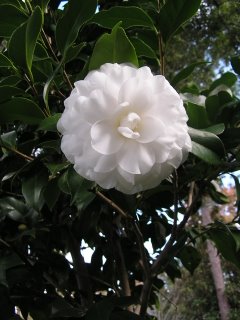 This is the bloom of an 'Alba Plena' camellia. It's one of the oldest of all the named camellia varieties, and I love its stately grace. (For a sense of scale, this blossom is about 4" in diameter.)
In fact, I've become rather a camellia fan after living here for 6 years. Their wildlife value is, of course, negligible, for which reason I doubt that I'll ever go completely nuts about them, but their beauty is undeniable. Their foliage is deep and lustrous, and their blooms are captivating.
One of the many assets of camellias is that they bloom in the late fall, winter and early spring. Alba Plena is one of the first camellias to bloom, so it's another sign that fall is winding down and winter is fast approaching.
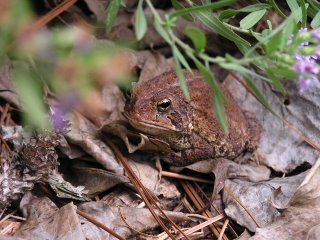 I love finding co-inhabitants of my garden...and it's even better when I can photograph them and share those photographs. This captivating guy was hiding out underneath an aster in the wood nymph garden at the beginning of November. I think he was hoping that I didn't see him, as he stayed perfectly still for a long time, inadvertently posing beautifully for me!
I'm assuming that he was there because the asters were absolutely shimmering with insect life, especially bumble bees and skippers, feeding on the nectar. It must have been like an all-you-can-eat buffet!
And, finally, here is our "Outback" seating area, surrounded by signs of fall. Maybe it's just that I've spent so many mornings and evenings sitting out there, sipping coffee or some other beverage of choice, journalling or just enjoying the life in the garden, but this vista makes me smile just looking at it.
A sanctuary. And how lucky we are to have it.
This is the bloom of an 'Alba Plena' camellia. It's one of the oldest of all the named camellia varieties, and I love its stately grace. (For a sense of scale, this blossom is about 4" in diameter.)In fact, I've become rather a camellia fan after living here for 6 years. Their wildlife value is, of course, negligible, for which reason I doubt that I'll ever go completely nuts about them, but their beauty is undeniable. Their foliage is deep and lustrous, and their blooms are captivating.
One of the many assets of camellias is that they bloom in the late fall, winter and early spring. Alba Plena is one of the first camellias to bloom, so it's another sign that fall is winding down and winter is fast approaching.
 I love finding co-inhabitants of my garden...and it's even better when I can photograph them and share those photographs. This captivating guy was hiding out underneath an aster in the wood nymph garden at the beginning of November. I think he was hoping that I didn't see him, as he stayed perfectly still for a long time, inadvertently posing beautifully for me!
I'm assuming that he was there because the asters were absolutely shimmering with insect life, especially bumble bees and skippers, feeding on the nectar. It must have been like an all-you-can-eat buffet!

And, finally, here is our "Outback" seating area, surrounded by signs of fall. Maybe it's just that I've spent so many mornings and evenings sitting out there, sipping coffee or some other beverage of choice, journalling or just enjoying the life in the garden, but this vista makes me smile just looking at it.
A sanctuary. And how lucky we are to have it.
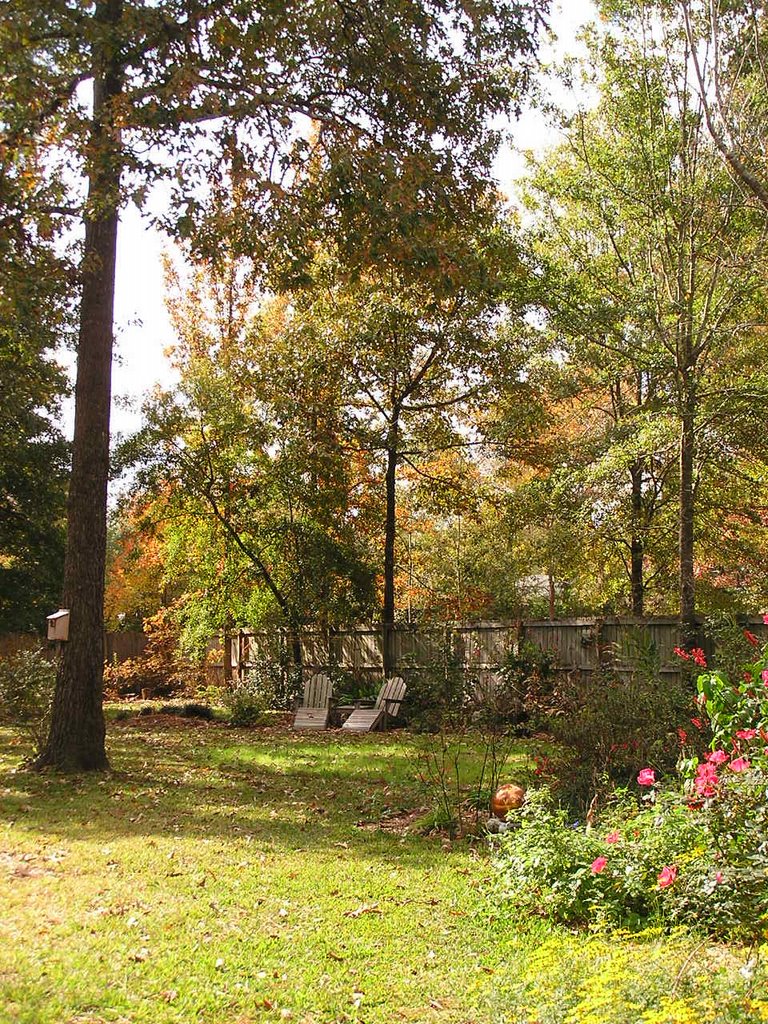
A Limestone 'Begging Bowl'
This limestone slab has been fascinating me for the last month or so. We've had it for over a year now, but it had such a blandly smooth surface that I've had a hard time figuring out what to do with it in the garden. It seemed so characterless and unnatural.

Now, however, the falling leaves have literally left their mark on it and it has morphed, almost overnight, from a blank spot to a daily changing canvas of impressions.

My biggest frustration at this point is how to capture it most effectively in a photograph. Lighting and shadows, changing displays of leaves coating its surface, and naturally evolving tannin prints all create its appeal to me. To a great extent, though, it's the fleeting nature of those patterns that fascinates me and, in trying to photograph them, I destroy that very nature that speaks to me.
Whether I ever get the photograph that I want, I now feel that having this blank canvas in the garden is a big plus. In its own way, it's the classic monk's begging bowl - highlighting the day's or the season's offerings.
Looking back a little....
I've been sorting through photos from the garden, putting together an album of how the yard has looked throughout the year. Seeing the months condensed like that, it is amazing how much the garden changes annually...even though it is purely normal and therefore technically not amazing at all.
Just for kicks and grins, here are three vistas of the east side of our garden, over the course of the last year....
First we have spring - March 12, to be exact. Deciduous plants are just starting to leaf out. The azaleas have been blooming for a week or two and will be in full glory in another week or so. A week before this photo, the yard looked noticeably barer, but I wanted to show the azaleas really starting to ramp up.
Just for kicks and grins, here are three vistas of the east side of our garden, over the course of the last year....
First we have spring - March 12, to be exact. Deciduous plants are just starting to leaf out. The azaleas have been blooming for a week or two and will be in full glory in another week or so. A week before this photo, the yard looked noticeably barer, but I wanted to show the azaleas really starting to ramp up.
Next is the start of full summer, June 6. The spring flowers are gone and the lushness of summer is setting in. Heat and humidity are almost radiating from this vista.
Last in my quick series is fall, November 28. The green is fading out, taken over by bright fall colors. Leaves are falling, and those that remain bear witness to a growing season's worth of life experience: spots from minor diseases, missing sections where insects dined, dessicated edges reminding of dry spells.
Each season has its beauty...and each season has its flaws. Life's rather funny that way, isn't it?
Monday, November 27, 2006
Going to the Source...So To Speak
I just got reminded about why it's better to go directly to the source than to rely on secondhand information. I was able to find the original blurb about the organic farm study in the July/Aug 2006 Audubon magazine online.
In reading it, I realized that the story was misquoted somewhat in Utne. (I am disappointed in Utne. I thought they had better journalistic standards than that.) As summarized in Audubon, the original study was a four year study, not a five year study. And while the percentage increases were correctly reported in Utne for plant species and number of bats (105% and 75% respectively), the percentage increase for winter birds was 62%, and there was actually a 48% increase in spiders. Insect species and/or numbers were still not mentioned.
My junior English teacher in high school had us do a great exercise comparing the same story as reported by several different sources. I have never forgotten how different the story was depending on who reported it.
And it makes me wonder what changes have occurred in the translation between original study and the report in Audubon.
Anyway, despite the discrepancies, the message remains the same.
Now I'm on a quest to find the original study report.
In reading it, I realized that the story was misquoted somewhat in Utne. (I am disappointed in Utne. I thought they had better journalistic standards than that.) As summarized in Audubon, the original study was a four year study, not a five year study. And while the percentage increases were correctly reported in Utne for plant species and number of bats (105% and 75% respectively), the percentage increase for winter birds was 62%, and there was actually a 48% increase in spiders. Insect species and/or numbers were still not mentioned.
My junior English teacher in high school had us do a great exercise comparing the same story as reported by several different sources. I have never forgotten how different the story was depending on who reported it.
And it makes me wonder what changes have occurred in the translation between original study and the report in Audubon.
Anyway, despite the discrepancies, the message remains the same.
Now I'm on a quest to find the original study report.
It's Just Better When It's Organic....
According to a 5-year study discussed in Audubon's August 2006 issue (and excerpted in Utne's Nov-Dec 2006 issue, which is where I read about it), organic farms in England have 105% more plant species than their non-organic counterparts. This provides more habitat, leading to 48% more winter birds and 75% more bats.
Not having read the original article in Audubon (let alone the actual study!), I don't know if they tallied the increased number of insect species found, but I'd be willing to bet a fair amount that insects showed similar gains. More importantly, I'd be willing to bet that insect predator species rebounded significantly, working to control insect plant eaters and balance the farms' ecosystems naturally.
If farmers, who have to make their livelihood from their land, can increase habitat and species diversity like this, just think what us homeowners could do if we all decided to go organic!
I need to try to find the Audubon article. Better yet, I'd like to read the original study. But why wasn't this study widely reported in the national news? It seems to me that its conclusions are one more clue pointing us in the direction of a healthier and more balanced lifestyle.
Not having read the original article in Audubon (let alone the actual study!), I don't know if they tallied the increased number of insect species found, but I'd be willing to bet a fair amount that insects showed similar gains. More importantly, I'd be willing to bet that insect predator species rebounded significantly, working to control insect plant eaters and balance the farms' ecosystems naturally.
If farmers, who have to make their livelihood from their land, can increase habitat and species diversity like this, just think what us homeowners could do if we all decided to go organic!
I need to try to find the Audubon article. Better yet, I'd like to read the original study. But why wasn't this study widely reported in the national news? It seems to me that its conclusions are one more clue pointing us in the direction of a healthier and more balanced lifestyle.
Wednesday, November 01, 2006
Scarlet Bodied Wasp Moth
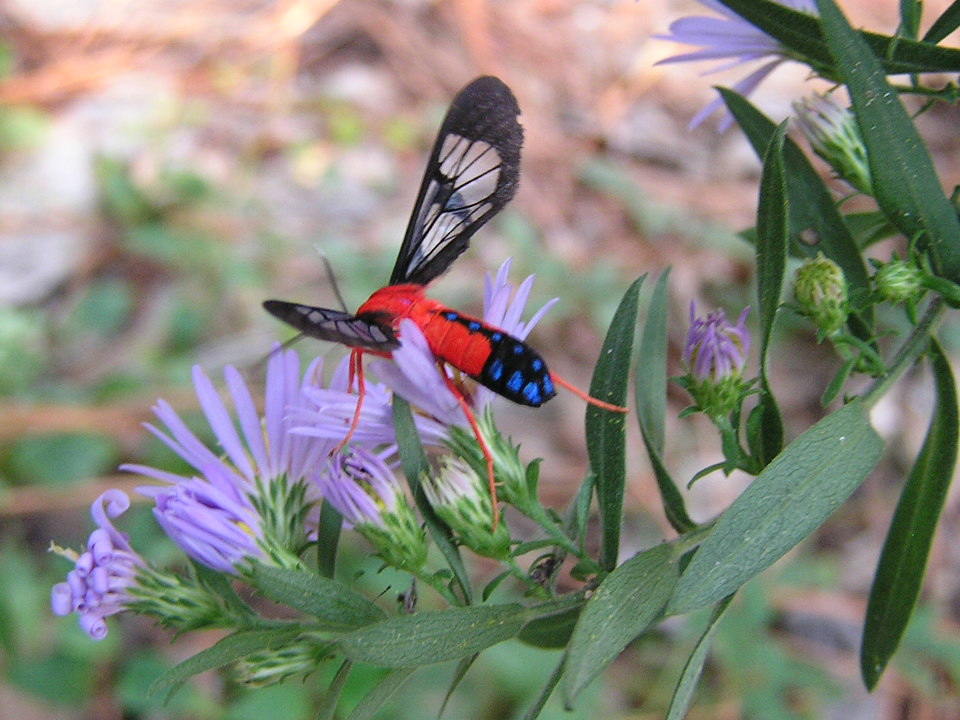
Isn't that a cool name? It's a pretty cool moth, too. Not easy to forget, once you've seen one.
I first found one dead on my doorstep, believe it or not, about a week ago. With my eyeglasses needing an update and my fantastic old loop magnifying glass playing a permanent game of hide-and-go-seek with me, I wasn't quite sure what type of insect it was. So I picked it up and saved it on a plate in the refrigerator, hoping to be able to identify it.
Two days ago in the late afternoon, I noticed several dozen of these unknown insects feeding on the asters in the back yard. I'd been enjoying all of the other "bugs" at the asters, but this was the first time I'd seen these creatures in the mix. They were even more dazzling alive than dead. (To give you an idea of scale, their bodies range from 1/2 - 3/4" in length.)
By watching closely, I was able to figure out that these guys were feeding with a proboscis, nailing their identity as a moth. I checked my guides, but the only information I could find out was that clearwing moths, as a family, are borers and can actually cause quite a bit of damage. Peach borers and dogwood borers, for example, are in this family. That caused my heart to sink, and I had visions of these beautiful insects creating untold havoc in their larval stage.
Luckily, a quick Google search set me straight. This is a scarlet bodied wasp moth, and it is indeed in the clearwing moth family. Its host plant, however, is the climbing hempvine - not what you would call an important commercial plant! This moth is considered to be a tropical species, which is why I wasn't able to find it in the guides that I had.
So I can enjoy these little beauties with a clear conscience. I've noticed that I primarily see them in the late afternoon, rather than throughout the day, despite the fact that they are supposed to be diurnal. Who knows what else I can discover about their habits as I watch them making themselves at home in my garden?
Saturday, October 28, 2006
More Signs of Fall
Here are a few more photos celebrating the season.
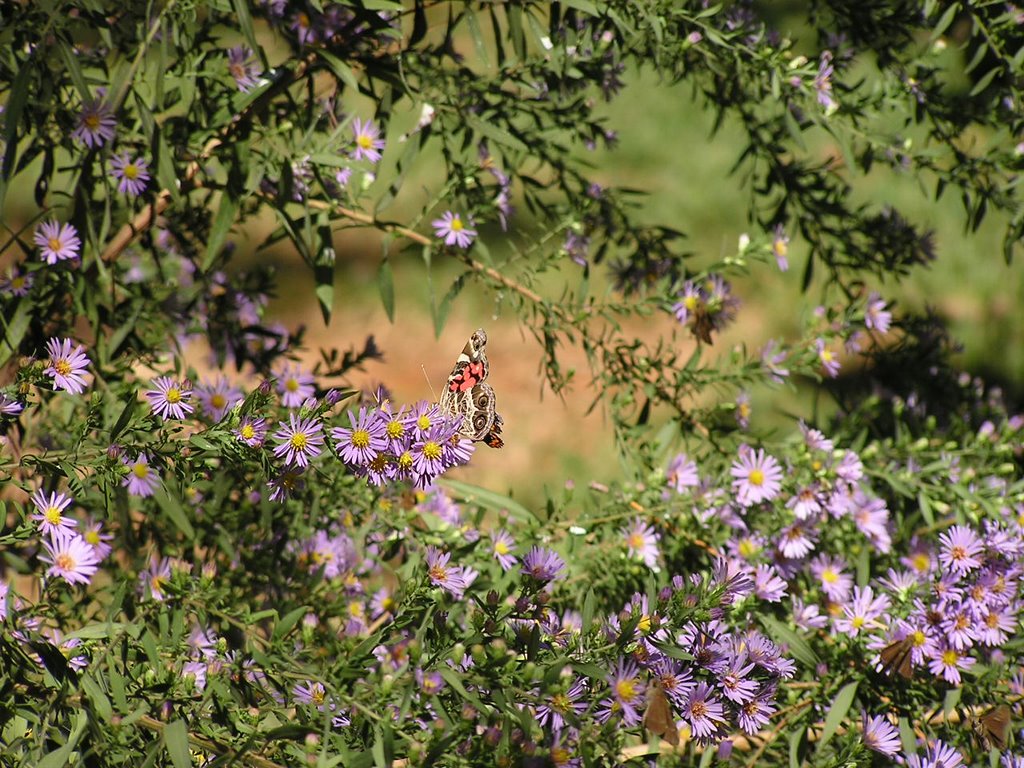 First is this photo of a painted lady feeding on the asters in the wood nymph garden. (It's hard to see because I was fairly far away, but the butterfly is almost exactly in the middle of the frame.) While this isn't the best picture of a painted lady, it commemorates two other neat phenomena. First, this is the first painted lady that I remember seeing in my garden this year, despite all of the other butterflies that have made this yard their home. Second, although I haven't been able to capture it in a photograph, these asters are positively bouncing and humming with insect life right now. There are literally hundreds of bumble bees and skippers moving constantly from flower to flower, with occasional other butterflies and insects joining in the feeding frenzy. It's stunning to watch.
Next is this photo of a native, fall-blooming tickseed, Coreopsis integrifolia 'Chipola River', blooming beside one of the paths in the yard. These coreopsis have proven to be extremely happy in their bed, and I have debated all year long as to whether I should thin them out and rein them in. Now that they are blooming so cheerfully, I'm glad that I resisted the impulse. There's time enough to redefine their limits when cold weather comes.
Although the flowers seem full of life still, the half-century fountain shows a different side of the season. Full of fallen pine needles, dead dogwood leaves and bright red dogwood berries, it is almost a quintessential picture of autumn's movement towards winter's quiet.
"Show Condition" and Showing Off
It's been over a month since I posted, but I have a reasonably good excuse: we've put the house on the market and I've been frantically trying to get it in "show" condition and maintain it that way.
Now, as those of you who know me are well aware, I'm not a "show condition" sort of person, so this has been rather stressful. But I'm surviving. More tellingly, so are Prairiewolf and all the animals.
I've finally decided that it's time to quit worrying quite so much and start enjoying my life and my garden again. With that in mind, I've started taking a few photos and thought I'd share ("show off") a few of them....
Now, as those of you who know me are well aware, I'm not a "show condition" sort of person, so this has been rather stressful. But I'm surviving. More tellingly, so are Prairiewolf and all the animals.
I've finally decided that it's time to quit worrying quite so much and start enjoying my life and my garden again. With that in mind, I've started taking a few photos and thought I'd share ("show off") a
 few of them....
First, here is my wood nymph, contemplating life's bounties while surrounded by a bonanza of fall flowers.
Next, here is the "outback" seating area as seen from the deck, showing off the yard's new openness which is compliments of the post-Katrina beetle infestation. Luckily (and I'm knocking on wood as I say this), the beetle infestation seems to be over for now. The remaining pines look wonderfully healthy.

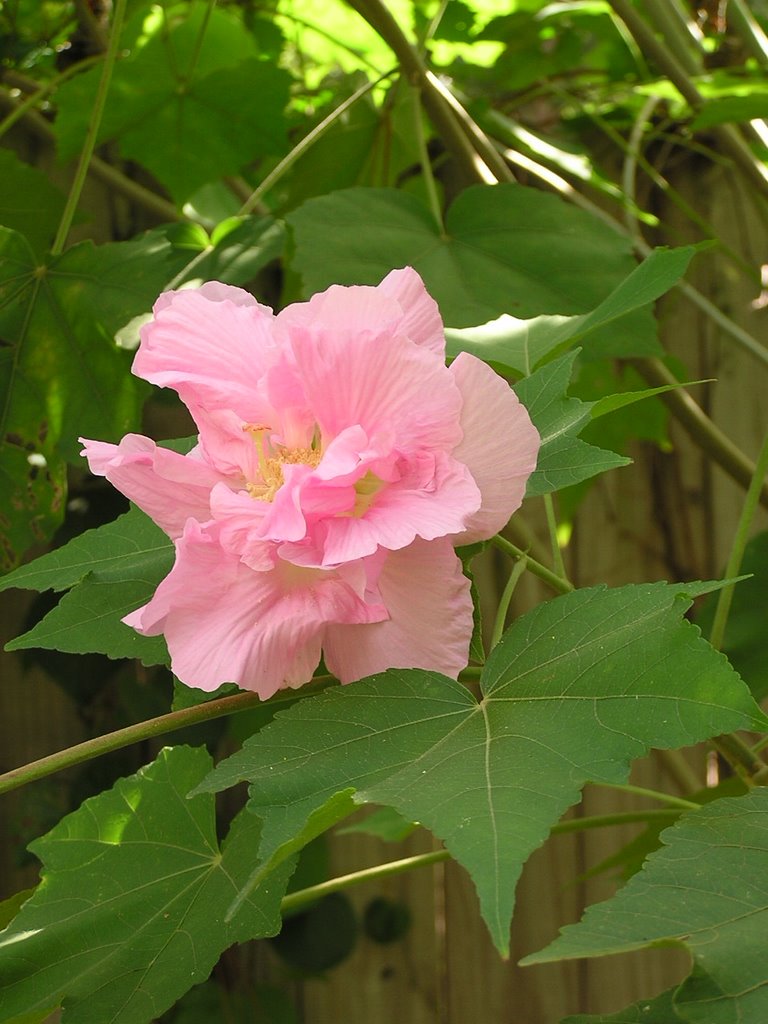
Last but not least for this post, the pink flower is a Confederate rose - actually sort of a cousin to the rose-of-sharon or althea. Its scientific name is Hibiscus mutabilis (althea's scientific name is Hibiscus syriacus), and the blooms are supposed to open white and then change color to pink and finally to red. Mine, however, opens this pretty pink and seems to enjoy the color enough to stay the exact same shade until the flower gets tired and falls off. Xanthy gave me the start to this beautiful plant a couple years ago, but this is the first year it's bloomed. Ivan toppled it in 2004 and Katrina stripped it bare in 2005. It's a survivor, though, and is now about 12-15' tall and covered with blooms.
It's hard to believe with all the blooms in the yard, but fall is fully here and winter is just around the corner. It will be interesting to see how much longer I continue as the custodian of this garden. It will be hard to leave and turn over guardianship to another, but that's been in the cards since the first day we moved in. Meanwhile, I have vowed to just enjoy the time I have left - and to see what lessons are still waiting for me to learn here before I go.
Saturday, September 23, 2006
Assorted "End of Summer" Photos
I've tried to go back and add these photos to my "End of Summer" post, but for some reason, it's not working. So I'll add them here.
First, a couple shots of my "flying flowers". The butterflies are gulf fritillaries. The flying fritillary (blurred) had amorous intentions on his/her mind, but the one clinging to the spent flower stalk was interested only in resting. This was one of several "overtures" which the resting fritillary resisted while I watched, trying to get a decent photo.
The second photo is of two bees (carpenter? bumble?) nectaring on Rudbeckia blooms. The entire plant was covered with blooms, and the blooms were hosting dozens of wasps and bees of many different species. Interestingly, the butterflies didn't seem very interested in the Rudbeckia blossoms.
The last photo here is of pokeberry berries. I love the deep purple color of the berries against the bright red of the stems and the dark green of the leaves. The mockingbirds love the taste of the berries, so they disappear fairly rapidly. This is, unfortunately, one of the plants I'm feeling I ought to grub out of the yard to make it more "sellable." Pokeberries are poisonous for humans to eat, despite being such good wildlife food, so it's a plant I wouldn't recommend for a yard where small children play.
First, a couple shots of my "flying flowers". The butterflies are gulf fritillaries. The flying fritillary (blurred) had amorous intentions on his/her mind, but the one clinging to the spent flower stalk was interested only in resting. This was one of several "overtures" which the resting fritillary resisted while I watched, trying to get a decent photo.
The second photo is of two bees (carpenter? bumble?) nectaring on Rudbeckia blooms. The entire plant was covered with blooms, and the blooms were hosting dozens of wasps and bees of many different species. Interestingly, the butterflies didn't seem very interested in the Rudbeckia blossoms.
The last photo here is of pokeberry berries. I love the deep purple color of the berries against the bright red of the stems and the dark green of the leaves. The mockingbirds love the taste of the berries, so they disappear fairly rapidly. This is, unfortunately, one of the plants I'm feeling I ought to grub out of the yard to make it more "sellable." Pokeberries are poisonous for humans to eat, despite being such good wildlife food, so it's a plant I wouldn't recommend for a yard where small children play.
Gulf Fritillaries Galore
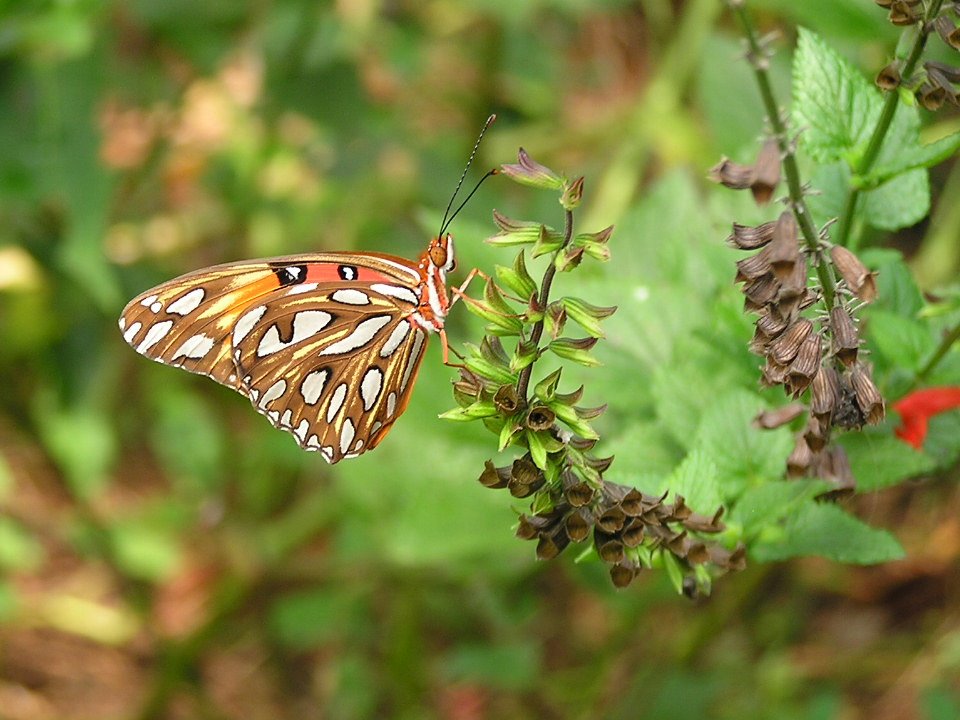
For the first time in several years, we have oodles of gulf fritillaries managing to live through their caterpillar stage and pupate successfully. The first year I planted their larval food, maypop (Passiflora incarnata), we had numbers like this. But then a pair of Carolina wrens moved in and gave us a firsthand demonstration of "natural control". It's the maypop that's been winning in recent years.

That natural control on the fritillary population doesn't seem to be "working" right now, though. Not that I mind in the least. I've seen a Carolina wren recently, and the pair successfully raised a brood earlier this summer, so I'm not too worried about their survival. Right now, despite the wrens' obvious reproductive success this year, we have ragged, defoliated maypop vines, multitudes of bright orange, "thorny" caterpillars happily munching away, and dozens of pupae hanging off eaves and in lots of other creative places. (In the photos, the caterpillar is next to its outgrown and discarded exoskeleton, and the chrysalis is hanging on the underside of our trashcan handle.)
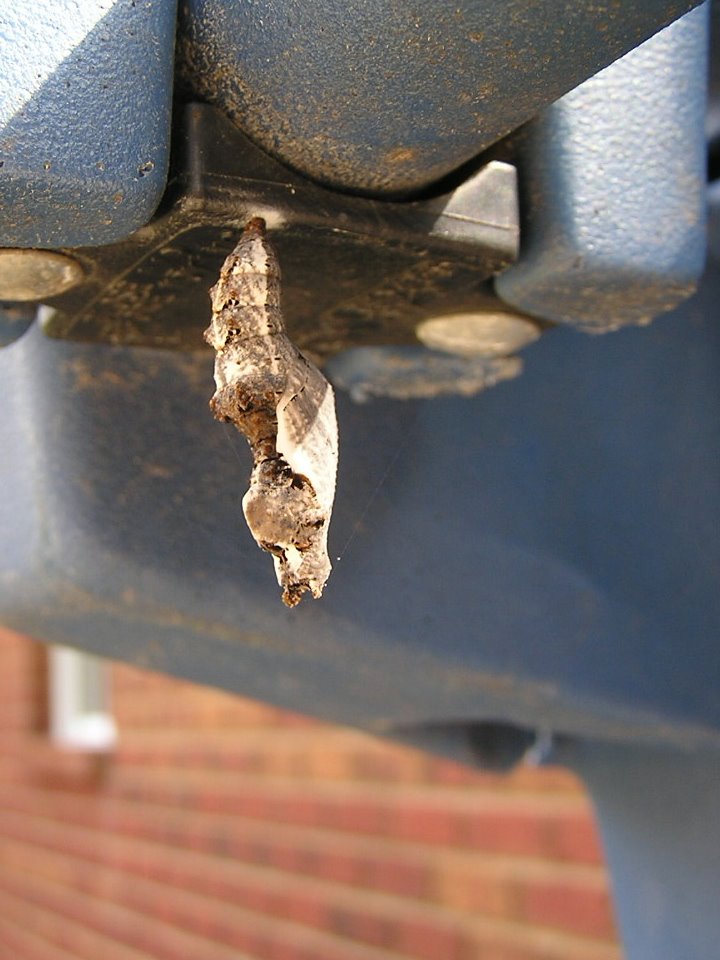
Most stunning of all, at any one time I commonly see 10 or more velvety orange adults doing twining mating flights, resting in the sun, laying eggs or (occasionally) feeding.
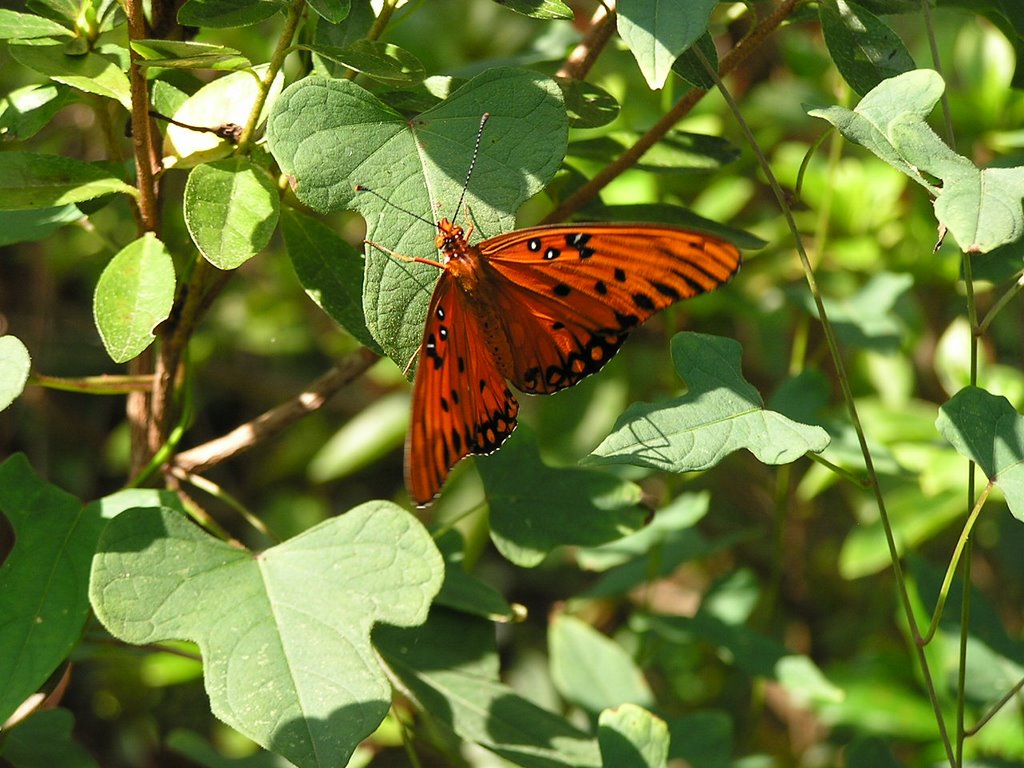
The garden itself may be looking pretty ragged right now, but butterflies are in their glory!
Poetry That Sustains Me
I stumbled across this poem earlier this year, and it resonates within me on many different levels. It's by Stanley Kunitz, and it's called "The Layers". Although I've seen it in several compilations, in this case it's from his book, The Wild Braid, p. 82-83:
I have walked through many lives,
some of them my own,
and I am not who I was,
though some principle of being
abides, from which I struggle
not to stray.
When I look behind,
as I am compelled to look
before I can gather strength
to proceed on my journey,
I see the milestones dwindling
toward the horizon
and the slow fires trailing
from the the abandoned camp-sites,
over which scavenger angels
wheel on heavy wings.
Oh, I have made myself a tribe
out of my true affections,
and my tribe is scattered!
How shall the heart be reconciled
to its feast of losses?
In a rising wind
the manic dust of my friends,
those who fell along the way,
bitterly stings my face.
Yet I turn, I turn,
exulting somewhat,
with my will intact to go
wherever I need to go,
and every stone on the road
precious to me.
In my darkest night,
when the moon was covered
and I roamed through wreckage,
a nimbus-clouded voice
directed me:
"Live in the layers,
not on the litter."
Though I lack the art
to decipher it,
no doubt the next chapter
in my book of transformations
is already written.
I am not done with my changes.
I have walked through many lives,
some of them my own,
and I am not who I was,
though some principle of being
abides, from which I struggle
not to stray.
When I look behind,
as I am compelled to look
before I can gather strength
to proceed on my journey,
I see the milestones dwindling
toward the horizon
and the slow fires trailing
from the the abandoned camp-sites,
over which scavenger angels
wheel on heavy wings.
Oh, I have made myself a tribe
out of my true affections,
and my tribe is scattered!
How shall the heart be reconciled
to its feast of losses?
In a rising wind
the manic dust of my friends,
those who fell along the way,
bitterly stings my face.
Yet I turn, I turn,
exulting somewhat,
with my will intact to go
wherever I need to go,
and every stone on the road
precious to me.
In my darkest night,
when the moon was covered
and I roamed through wreckage,
a nimbus-clouded voice
directed me:
"Live in the layers,
not on the litter."
Though I lack the art
to decipher it,
no doubt the next chapter
in my book of transformations
is already written.
I am not done with my changes.
Saturday, September 16, 2006
Summer's End
I've finally gotten back out into the garden again, spending several hours just restoring order in the back yard over the last two days. I still have serious work to do in the front yard, but I don't think that's too bad for a garden the size of mine, especially considering that I've hardly set foot outside for almost a month now.
Before I go any further, though, I HAVE to mention the activity in the butterfly garden - there are so many butterflies, moths, carpenter bees, wasps, and flying creatures of all sorts that it feels like the very flowers themselves are flying as I stand and watch.
On a more somber note, for the first time as I work, I really feel like I'm preparing the garden for someone else. I'm making the edges a little neater, being a little more rigorous in cutting back, being more careful to remove tiny weed seedlings, and generally being more "J" than I normally am as I garden.
I find myself trying to converse with the gardener who will (hopefully) come after me....
"Sorry about these variegated artemesia - they get out of hand so easily in this bed. Be sure to keep them pulled out."
"I'll always wonder about the gripeweed in the yard. I thought it was such a pretty plant when I first saw it (a mimosa seedling?!) that I left it to 'see what it would do'. Would it be as widespread if I'd been less tolerant and more vigorous in pulling it out right away?"
"What do you think about this variegated vinca major? I agree. I think I'll pull it out and save you the trouble. The bed will look much neater this way."
"Should I grub out all of the pokeberry? The mockingbirds go crazy over its berries and it is so pretty, but I understand why you might not want it around."
I sure hope the next owner likes to garden; despite losing so many pines this summer, the yard has really started to come together. The blue spiral ginger is blooming beautifully and putting up several strong new shoots. The arborvitae fern is starting to fill in, becoming a graceful mat against the deep mulch. The Florida anise is almost as tall as I am now, and looking lush and healthy after such a misshapen start to life. Speaking of misshapen, the oriental chain fern has finally put out a few fronds on the right side and is almost completely balanced now. Its large-scaled daintiness looks fantasic next to Miss Lily's sturdy peacock gingers. The Grape Sensation gaillardia is purplishly spectacular, and the Knockout roses are head-high and absolutely covered with burgundy new growth, fresh buds and fluorescent pink flowers.
I could go on and on, but I'd be belaboring the point.
One last verbal picture, though: the wild beautyberry by the back shed is so loaded with brilliant magenta berries that it gleams richly in the dappled shade. I literally stopped in my tracks when I first saw it this week, its gracefully arching, heavily laden branches swaying drunkenly in the slightest breeze.
By the time we leave, those berries will have passed through the digestive system of a variety of birds and they will have been deposited, with a healthy dose of fertilizer, all over the local area. I have to believe that at least one or two will carry the genetic wealth of their parent and grow to create grace and beauty and bounty somewhere nearby, no matter what happens to their parent in this garden.
Before I go any further, though, I HAVE to mention the activity in the butterfly garden - there are so many butterflies, moths, carpenter bees, wasps, and flying creatures of all sorts that it feels like the very flowers themselves are flying as I stand and watch.
On a more somber note, for the first time as I work, I really feel like I'm preparing the garden for someone else. I'm making the edges a little neater, being a little more rigorous in cutting back, being more careful to remove tiny weed seedlings, and generally being more "J" than I normally am as I garden.
I find myself trying to converse with the gardener who will (hopefully) come after me....
"Sorry about these variegated artemesia - they get out of hand so easily in this bed. Be sure to keep them pulled out."
"I'll always wonder about the gripeweed in the yard. I thought it was such a pretty plant when I first saw it (a mimosa seedling?!) that I left it to 'see what it would do'. Would it be as widespread if I'd been less tolerant and more vigorous in pulling it out right away?"
"What do you think about this variegated vinca major? I agree. I think I'll pull it out and save you the trouble. The bed will look much neater this way."
"Should I grub out all of the pokeberry? The mockingbirds go crazy over its berries and it is so pretty, but I understand why you might not want it around."
I sure hope the next owner likes to garden; despite losing so many pines this summer, the yard has really started to come together. The blue spiral ginger is blooming beautifully and putting up several strong new shoots. The arborvitae fern is starting to fill in, becoming a graceful mat against the deep mulch. The Florida anise is almost as tall as I am now, and looking lush and healthy after such a misshapen start to life. Speaking of misshapen, the oriental chain fern has finally put out a few fronds on the right side and is almost completely balanced now. Its large-scaled daintiness looks fantasic next to Miss Lily's sturdy peacock gingers. The Grape Sensation gaillardia is purplishly spectacular, and the Knockout roses are head-high and absolutely covered with burgundy new growth, fresh buds and fluorescent pink flowers.
I could go on and on, but I'd be belaboring the point.
One last verbal picture, though: the wild beautyberry by the back shed is so loaded with brilliant magenta berries that it gleams richly in the dappled shade. I literally stopped in my tracks when I first saw it this week, its gracefully arching, heavily laden branches swaying drunkenly in the slightest breeze.
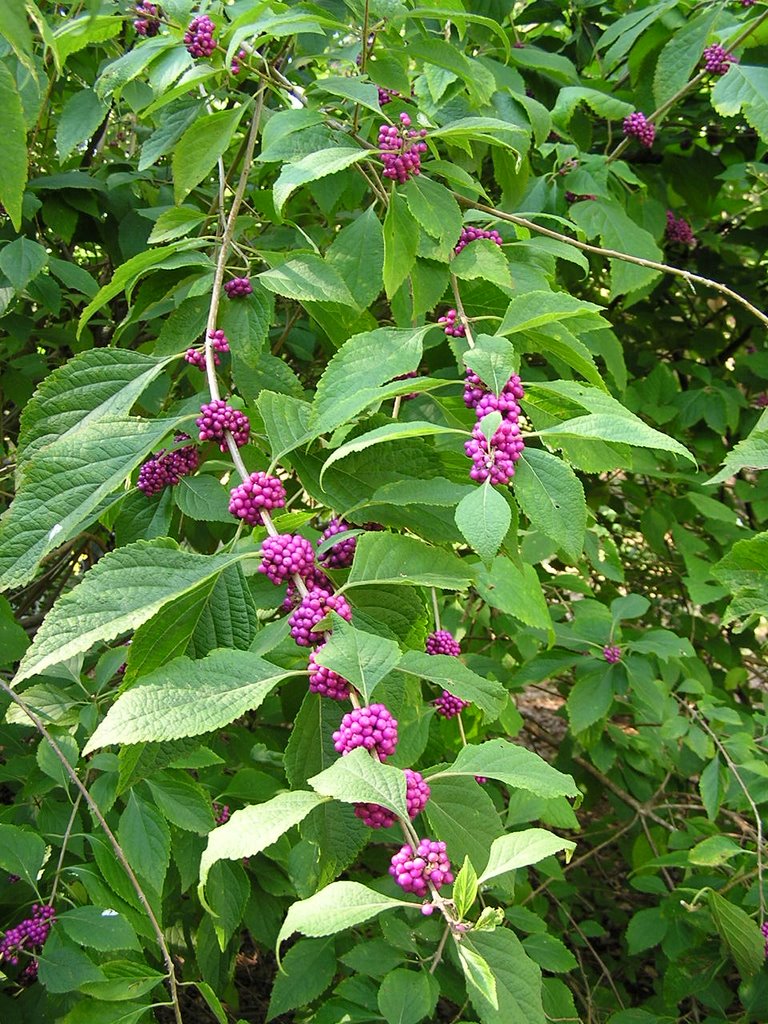
By the time we leave, those berries will have passed through the digestive system of a variety of birds and they will have been deposited, with a healthy dose of fertilizer, all over the local area. I have to believe that at least one or two will carry the genetic wealth of their parent and grow to create grace and beauty and bounty somewhere nearby, no matter what happens to their parent in this garden.
Monday, August 28, 2006
Changing Seasons
Although the temperatures are still in the 90's on most days, I am beginning to see signs that summer is waning and fall is coming.
Most notably, everyday now there are a few golden and brown leaves slowly sifting down out of the trees, letting go, weary from their nonstop duties of capturing sunlight and converting it to food. The Half Century Fountain seems to attract a fair number of these tired-out toilers, so each morning I find myself skimming out the prior day's leavings.
Having finished their primary job of creating food for their parent plant, now the leaves will slowly decompose. Ironically yet fittingly, they continue to feed their parent through their death and recycling.
An anonymous quote caught my attention last night: "Humans - despite their artistic pretensions, their sophistication, and their many accomplishments - owe their existence to a six-inch layer of topsoil and the fact that it rains." How much healthier our psyches and our world would be if we'd all realize and remember that fact.
Most notably, everyday now there are a few golden and brown leaves slowly sifting down out of the trees, letting go, weary from their nonstop duties of capturing sunlight and converting it to food. The Half Century Fountain seems to attract a fair number of these tired-out toilers, so each morning I find myself skimming out the prior day's leavings.
Having finished their primary job of creating food for their parent plant, now the leaves will slowly decompose. Ironically yet fittingly, they continue to feed their parent through their death and recycling.
An anonymous quote caught my attention last night: "Humans - despite their artistic pretensions, their sophistication, and their many accomplishments - owe their existence to a six-inch layer of topsoil and the fact that it rains." How much healthier our psyches and our world would be if we'd all realize and remember that fact.
Thursday, August 10, 2006
Flotsam and Jetsam
There have been many crosscurrents lately. The flow carrying Prairiewolf and me toward our move appears to be gaining strength and velocity. It begins to look like we'll have the house (and garden) on the market in October. Running almost directly counter to this steady movement is the current that contains my friends and botanical "family" here in Mobile, carrying me towards the shore of the Fall Plant Sale...also in October. And when I've occasionally had the chance to bob around in a few, gentle, backwater eddies, I've been reading a great book on permaculture in the home landscape, entitled (ironically enough) Gaia's Garden,
by Toby Hemenway.
With such conflicting currents constantly pulling at me, it's hard to focus on any one thought, botanical or philosophical, for very long. But a lot of interesting things are happening, and somehow it feels soothing to take note of them and share them.
Trees....
Two more pine trees became infested with pine beetles. I was lucky enough to find a tree service who could remove them relatively promptly; they came in less than a week and took them out today. Which, unfortunately, was necessary and therefore good. Hopefully we got them out before the "infection" had spread to any more healthy trees in the yard.
Countering the relief at getting that unhappy chore done, though, is the fact that both tree services I consulted recommended taking down a third pine tree that looked weak to them...and I decided to follow their advice and have it taken out. I won't bore you with the details, but suffice it to say that after the tree was cut down today, the stump rapidly covered with sap, bleeding over the fatal wound. The beetle infested trees were already dead and did not bleed at all. My heart aches at the unnecessary death that I caused today, however well-intentioned my decision was.
Tree facts from Gaia's Garden:
Planting a tender plant under the canopy edge of an evergreen tree can protect it enough during the winter to allow you to grow a plant that normally requires at least one higher hardiness zone. (p. 115)
A full-grown tree (presumably deciduous, although it's not specified) can transpire up to 2000 gallons of water on a hot, dry day, cooling the air around and beneath it. (p. 100)
The same full-grown tree can have between 10 and 30 ACRES of leaf surface, filtering dust and pollen and spores and pollutants and nutrients from the air. When rain comes, it coats the leaves first, making a "soup" with the ingredients captured on the leaf surfaces. When the rain does finally fall from the leaves, it is essentially carrying the tree's own fertilizer and innoculant with it. (p. 100-101)
Sightings around the garden:
There are butterflies galore right now. Yesterday morning, I saw 2 perfect giant swallowtails majestically feeding on Salvia, along with several pairs of gulf fritillaries flirtaciously chasing each other, a tattered and dull black swallowtail methodically nectaring, and several skippers flipping from bloom to bloom.
Hummingbirds are everywhere too. Just when you least expect it, one will buzz by and make you jump. Like the swallowtails, they are also enjoying the Salvia...although I saw a couple checking out the leaves of an oak tree this afternoon, for some strange reason.
I have recently learned that having your water moving during the day is not enough to deter mosquito larvae here...at least not if that water is still at night. Now my Half Century Fountain sports a debonair mosquito donut bobbing about, and I'm hoping to sport a few less mosquito bites on my ankles and arms.
After seeing quite a few small banana (golden silk) spiders in the garden a few weeks ago, I'm finding almost none now. Discussing with friends who had noticed the same phenomenon in their own gardens, we concluded that the birds have been reduced to eating the spiderlings because of decreased insects due to the drought.
Which leads me to comment that the drought appears to have broken at last. We've been getting our normal afternoon thunderstorms almost daily for the last 10 days or so. It seems odd to be celebrating extreme humidity and damp...but sometimes what you need isn't necessarily what you enjoy!
It's time to drift on to other activities. To mangle a truism, "A time for everything...and everything in its time."
by Toby Hemenway.
With such conflicting currents constantly pulling at me, it's hard to focus on any one thought, botanical or philosophical, for very long. But a lot of interesting things are happening, and somehow it feels soothing to take note of them and share them.
Trees....
Two more pine trees became infested with pine beetles. I was lucky enough to find a tree service who could remove them relatively promptly; they came in less than a week and took them out today. Which, unfortunately, was necessary and therefore good. Hopefully we got them out before the "infection" had spread to any more healthy trees in the yard.
Countering the relief at getting that unhappy chore done, though, is the fact that both tree services I consulted recommended taking down a third pine tree that looked weak to them...and I decided to follow their advice and have it taken out. I won't bore you with the details, but suffice it to say that after the tree was cut down today, the stump rapidly covered with sap, bleeding over the fatal wound. The beetle infested trees were already dead and did not bleed at all. My heart aches at the unnecessary death that I caused today, however well-intentioned my decision was.
Tree facts from Gaia's Garden:
Planting a tender plant under the canopy edge of an evergreen tree can protect it enough during the winter to allow you to grow a plant that normally requires at least one higher hardiness zone. (p. 115)
A full-grown tree (presumably deciduous, although it's not specified) can transpire up to 2000 gallons of water on a hot, dry day, cooling the air around and beneath it. (p. 100)
The same full-grown tree can have between 10 and 30 ACRES of leaf surface, filtering dust and pollen and spores and pollutants and nutrients from the air. When rain comes, it coats the leaves first, making a "soup" with the ingredients captured on the leaf surfaces. When the rain does finally fall from the leaves, it is essentially carrying the tree's own fertilizer and innoculant with it. (p. 100-101)
Sightings around the garden:
There are butterflies galore right now. Yesterday morning, I saw 2 perfect giant swallowtails majestically feeding on Salvia, along with several pairs of gulf fritillaries flirtaciously chasing each other, a tattered and dull black swallowtail methodically nectaring, and several skippers flipping from bloom to bloom.
Hummingbirds are everywhere too. Just when you least expect it, one will buzz by and make you jump. Like the swallowtails, they are also enjoying the Salvia...although I saw a couple checking out the leaves of an oak tree this afternoon, for some strange reason.
I have recently learned that having your water moving during the day is not enough to deter mosquito larvae here...at least not if that water is still at night. Now my Half Century Fountain sports a debonair mosquito donut bobbing about, and I'm hoping to sport a few less mosquito bites on my ankles and arms.
After seeing quite a few small banana (golden silk) spiders in the garden a few weeks ago, I'm finding almost none now. Discussing with friends who had noticed the same phenomenon in their own gardens, we concluded that the birds have been reduced to eating the spiderlings because of decreased insects due to the drought.
Which leads me to comment that the drought appears to have broken at last. We've been getting our normal afternoon thunderstorms almost daily for the last 10 days or so. It seems odd to be celebrating extreme humidity and damp...but sometimes what you need isn't necessarily what you enjoy!
It's time to drift on to other activities. To mangle a truism, "A time for everything...and everything in its time."
Thursday, August 03, 2006
Free Cell vs. Life's Problems
I have been playing FreeCell a lot lately, subconsciously trying to bring order to my life. It's funny how I default to that game when I'm feeling out of control. Knowing that every hand is supposed to be solvable, I feel as if I'm somehow solving all of my life's problems by carefully ordering the cards in descending order, black on red on black on red....
Unfortunately, of course, what I'm actually doing is wasting time.
I've been feeling stressed lately. The formation of Tropical Storm Chris in the Caribbean is a good part of my dis-ease, but not all of it. Three more pine trees in the back yard have gotten beetles and have to be removed now - an expensive problem at any time but really problematic if a hurricane gets here before the tree service folks. Most of all, though, it's time to seriously finish putting the house in order and have it ready to show. Several people have expressed interest, and I'd like to be able to invite them in for a look around at a moment's notice.
Funny, it's not the move per se that has me uptight - it's selling the house. Somehow it feels like my life and my decorating ability (or lack thereof) and simply my general worthiness as a human being are all being judged by a bunch of strangers. If the house sells rapidly, I've done well and I am "worthy"; if the house languishes on the market, I'm being found wanting. (And given the fact that this house had languished on the market for months before we bought it, I feel like the deck is stacked against me to begin with.)
Logically I know that this is stupid and that I am not my house...but it's what I feel emotionally. And it adds a horrible degree of stress to what is already a somewhat stressful situation (i.e. moving).
I know that this too shall pass. We have successfully sold 4 other houses. We will eventually successfully sell this one. But, boy, I will be SOOOO glad when we have come through this gauntlet and have moved on to other challenges.
Unfortunately, of course, what I'm actually doing is wasting time.
I've been feeling stressed lately. The formation of Tropical Storm Chris in the Caribbean is a good part of my dis-ease, but not all of it. Three more pine trees in the back yard have gotten beetles and have to be removed now - an expensive problem at any time but really problematic if a hurricane gets here before the tree service folks. Most of all, though, it's time to seriously finish putting the house in order and have it ready to show. Several people have expressed interest, and I'd like to be able to invite them in for a look around at a moment's notice.
Funny, it's not the move per se that has me uptight - it's selling the house. Somehow it feels like my life and my decorating ability (or lack thereof) and simply my general worthiness as a human being are all being judged by a bunch of strangers. If the house sells rapidly, I've done well and I am "worthy"; if the house languishes on the market, I'm being found wanting. (And given the fact that this house had languished on the market for months before we bought it, I feel like the deck is stacked against me to begin with.)
Logically I know that this is stupid and that I am not my house...but it's what I feel emotionally. And it adds a horrible degree of stress to what is already a somewhat stressful situation (i.e. moving).
I know that this too shall pass. We have successfully sold 4 other houses. We will eventually successfully sell this one. But, boy, I will be SOOOO glad when we have come through this gauntlet and have moved on to other challenges.
Subscribe to:
Posts (Atom)