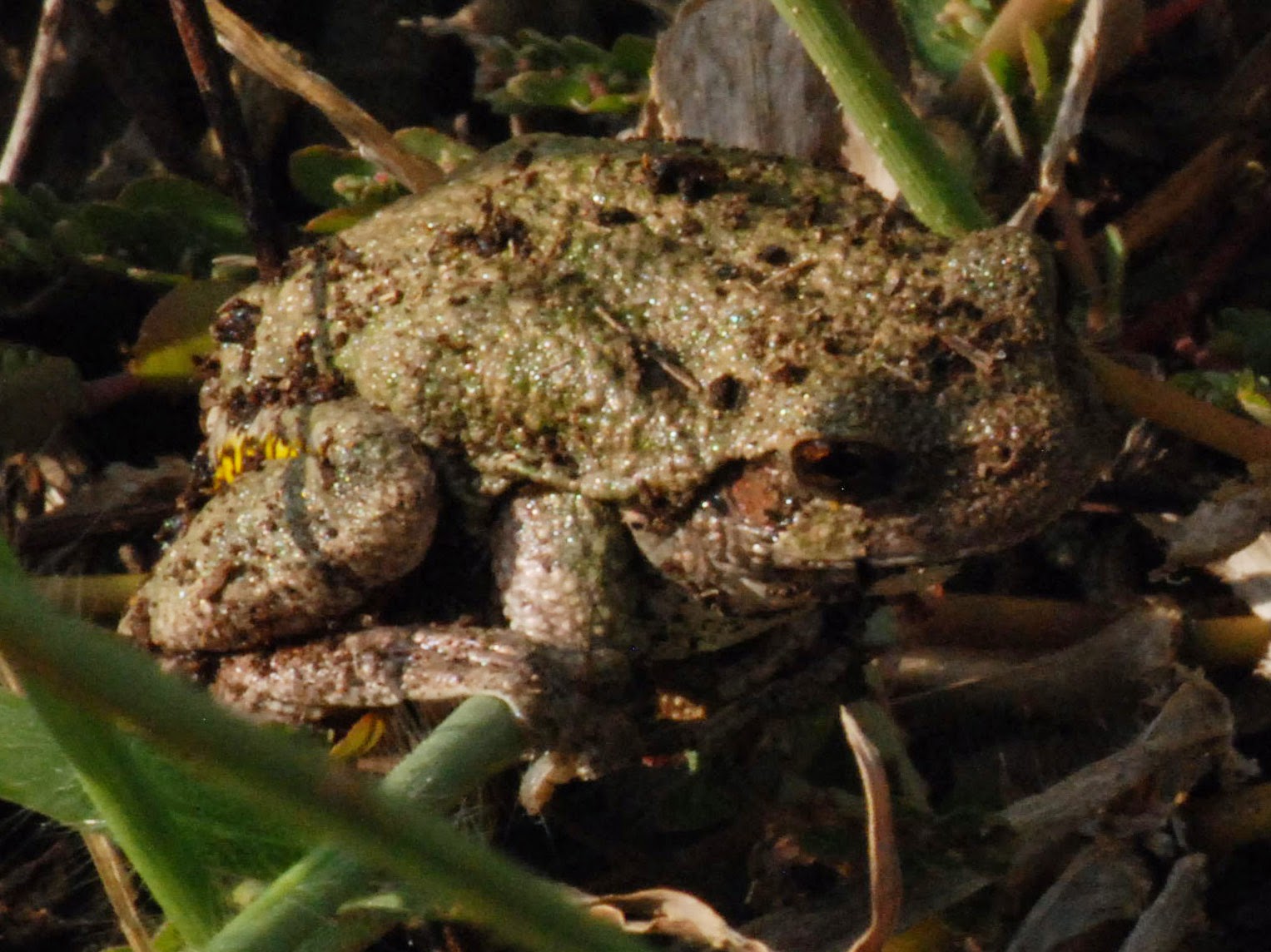
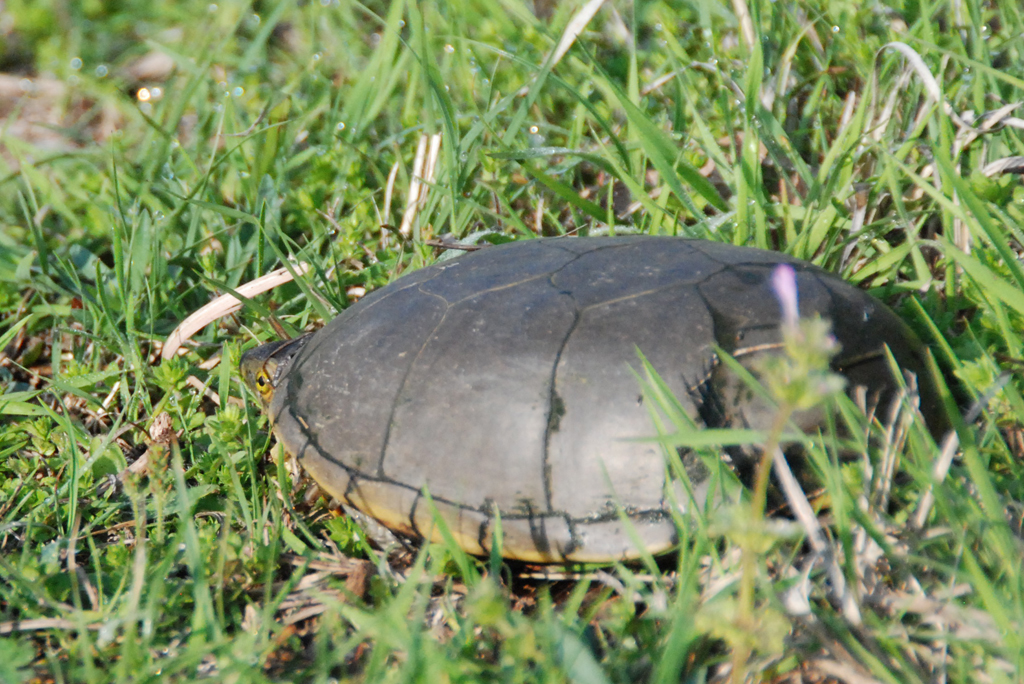
Sometimes you just get lucky.
I don't go out by the compost piles very often during the course of any average week, but I needed to take something out there yesterday morning. I had started to walk away when something caught my eye - a bit of movement.
There was this poor female box turtle, firmly caught in the open hole of a cinder block. Her shell was pretty scuffed, so it looked like she'd been there for a fairly long period of time, scrabbling uselessly, trying to get out.
How unfair that she could not make a noise to attract my attention! (I've never consciously thought about turtles' silence before, but somehow it seems tragic in this situation.)
The poor thing was stressed enough that she didn't withdraw into her shell when I picked her up. In fact, she didn't withdraw into her shell until I picked her back up, after I'd put her down, to take a photo of her underside.
She's a big box turtle - and I honestly wonder how in the world she got herself in that predicament. I think she was lucky to be tail down, not head down, in the hole.
I hope she's none the worse for her adventure and that she was able to get food and water without issue.
Now I've got to fill in those holes so this doesn't happen again. I checked the area today and will continue to do so every day until we get the holes filled. The compost piles, rimmed by these cinder blocks, have been in place since shortly after we moved here over 2 years ago, with no prior problems. Funny - I never would have thought of them as being dangerous to much of anybody or anything....
Showing posts with label Turtles. Show all posts
Wednesday, September 27, 2017
Wednesday, December 31, 2014
2014: A Retrospective from the Wilds of South Central Kansas, Part 2
From grasshopper-eating turtles to omnipresent praying mantises, there were so many interesting sightings in the yard and gardens this year that I hardly know where to begin. I've shared some of those sightings through posts throughout the year, but tonight it feels like those posts just skimmed the surface of what I observed. I've got a ve-e-e-ery long post drafted that is relatively complete...but it's way too long already and I'm just now looking at September's photos.
So I'm rebooting and sharing just a select few highlights.
We'll start our trip through 2014 in the yard/garden with a photo of the possum that showed up, snuffling through the birdseed leftovers, one day in early March. Its tail was stubby and bloody, so something had been after it fairly recently; I doubt it was feeling too good, which probably explains why it was willing to come in to birdfeeders in the middle of the day.
Incidentally, I have come to really appreciate possums. First, they rarely carry rabies. I believe it has to do with their low normal body temperature. Secondly, they act as supreme "tick sweepers" - they keep their fur almost entirely free of parasites such as ticks, presumably by eating any they find when they groom themselves. Thus possums will help reduce the population of ticks in an area, rather than increase it.
Amphibians were relatively common this year, which was so good to see. In the gardens around the house, I observed at least 5 or 6 different Woodhouse Toads (Anaxyrus woodhousii) over the course of the summer, ranging in size from a little over an inch to several inches long.
I also noted at least 3 Great Plains Toads (Anaxyrus cognatus) throughout the summer. On June 15th, I saw 3 different toads in one day: 2 Great Plains (one big and one little) and 1 Woodhouse!
On April 2nd, I went out one night to find this Plains Leopard Frog (Lithobates blairi) on the front porch, evidently enjoying an early feast on the insects that were being drawn to the porch light. I've seen toads and tree frogs do that, but I've never seen a leopard frog come to lights before.
The gardening year wrapped up with a new-to-the-yard amphibian species, a gray treefrog (Hyla sp.), who showed up in the vegetable garden on October 19th. It amazes me how animals that need water as much as amphibians do can survive the droughts we've had over the last several years.
My next highlight wasn't technically in our yard, although we do hear barred owls calling frequently in the evenings and at night. Coming home from the grocery store on April 17th, we noted this individual on a fence post by the road, about a mile south of our house. I have no idea what the size of a pair of barred owls' home range is, but perhaps it's possible that this is one of the birds we hear calling? Or maybe this bird is one of "our" owls' offspring? At any rate, it's a cool photo to have captured and I wanted to share it with you. (Actually, I think Greg took this photo, since the bird was on his side of the car. I want to give credit where credit is due.)
Compared to amphibians, reptiles weren't seen much during 2014. I was able to get photos of a couple different garter snakes and 3 ornate box turtles.
The best turtle photo of 2014, I guess, is this one of the turtle munching down on a grasshopper. She was quite nervous about the boys and me being so close, but she sure wasn't going to give up her tasty meal! Good protein!
Of course, many, many of my photos are of insects, but I'm going to save those for some other time.
Have a wonderful 2015, both in the garden and out of it!
So I'm rebooting and sharing just a select few highlights.
We'll start our trip through 2014 in the yard/garden with a photo of the possum that showed up, snuffling through the birdseed leftovers, one day in early March. Its tail was stubby and bloody, so something had been after it fairly recently; I doubt it was feeling too good, which probably explains why it was willing to come in to birdfeeders in the middle of the day.
Incidentally, I have come to really appreciate possums. First, they rarely carry rabies. I believe it has to do with their low normal body temperature. Secondly, they act as supreme "tick sweepers" - they keep their fur almost entirely free of parasites such as ticks, presumably by eating any they find when they groom themselves. Thus possums will help reduce the population of ticks in an area, rather than increase it.
Amphibians were relatively common this year, which was so good to see. In the gardens around the house, I observed at least 5 or 6 different Woodhouse Toads (Anaxyrus woodhousii) over the course of the summer, ranging in size from a little over an inch to several inches long.
I also noted at least 3 Great Plains Toads (Anaxyrus cognatus) throughout the summer. On June 15th, I saw 3 different toads in one day: 2 Great Plains (one big and one little) and 1 Woodhouse!
On April 2nd, I went out one night to find this Plains Leopard Frog (Lithobates blairi) on the front porch, evidently enjoying an early feast on the insects that were being drawn to the porch light. I've seen toads and tree frogs do that, but I've never seen a leopard frog come to lights before.
The gardening year wrapped up with a new-to-the-yard amphibian species, a gray treefrog (Hyla sp.), who showed up in the vegetable garden on October 19th. It amazes me how animals that need water as much as amphibians do can survive the droughts we've had over the last several years.
My next highlight wasn't technically in our yard, although we do hear barred owls calling frequently in the evenings and at night. Coming home from the grocery store on April 17th, we noted this individual on a fence post by the road, about a mile south of our house. I have no idea what the size of a pair of barred owls' home range is, but perhaps it's possible that this is one of the birds we hear calling? Or maybe this bird is one of "our" owls' offspring? At any rate, it's a cool photo to have captured and I wanted to share it with you. (Actually, I think Greg took this photo, since the bird was on his side of the car. I want to give credit where credit is due.)
Compared to amphibians, reptiles weren't seen much during 2014. I was able to get photos of a couple different garter snakes and 3 ornate box turtles.
The best turtle photo of 2014, I guess, is this one of the turtle munching down on a grasshopper. She was quite nervous about the boys and me being so close, but she sure wasn't going to give up her tasty meal! Good protein!
Of course, many, many of my photos are of insects, but I'm going to save those for some other time.
Have a wonderful 2015, both in the garden and out of it!
Labels:
Barred Owl,
Birds,
Ornate Box Turtle,
Possum,
Toads,
Treefrogs,
Turtles
Sunday, September 14, 2014
Diversity!
Greg gave me a gift for Christmas last year - Access (the software program, which unfortunately doesn't automatically come with the home version of Office) so that I could begin to keep a coherent database of all the plants and animals that I've found on our 10 acres.
I have been slowly working on this project in the intervening months, and I'm far from done. For the most part, I've been utilizing the photos I've taken over the years to remind me of what I've found and where I've found it.
For example, I saw this flower beetle (Batyle suturalis) on Black-Eyed Susan (Rudbeckia hirta) in the Back Five early in July this year; both species are now in my database.
The wonderful folks at BugGuide.net are probably quite sick of me, as I've been submitting quite a few photos for their help with identification - which has been wonderful and greatly appreciated. I can usually get an unknown insect down to order and often to family, using my experience and (if necessary) Borror and DeLong's Introduction to the Study of Insects for its excellent keys . Then I try, utilizing BugGuide's online guides, to get the insect down to genus and species, but without actual keys specifying what I'm looking for, it can be hard. It's at this point that I will submit an image for help.
Other species are often easier. For example, I've been birding for years, so I have a reasonable familiarity with bird species and I can trust my identifications and the species lists I've been keeping since we moved in. (Besides, it is much easier to figure out which of 450+ possible species a bird is compared to figuring out which of thousands of possible species an insect is.) Below, for example, is a red-winged blackbird watching a little blue heron, who hung out in our lagoon for several days in 2009.
There are a variety of books and online resources I go to for plant identifications: Michael Haddock's book and website on Wildflowers and Grassses of Kansas. Janet Bare's book, Wildflowers and Weeds of Kansas. Stephen's book, Trees, Shrubs and Woody Vines in Kansas. And many, many more.
I've recently purchased Bradley's book, Common Spiders of North America, to improve my ability to identify the spiders that I'm seeing. BugGuide is also useful with spiders, and I have a few other guidebooks (although most are much less comprehensive than Bradley's). Below is a male jumping spider (Phidippus clarus) which I photographed last summer hanging out on giant ragweed (Ambrosia trifida).
There are, obviously, many more references that I use to compile my species lists, but that isn't the point of this post. Right now, according to my Access database, I have 201 plant species that I've found (or planted) on our 10 acres, 157 species of insects, 3 species of amphibians, 8 species of mammals, 1 species of snake, and 5 species of turtles. (I have found quite a few more species of amphibians, mammals, snakes and turtles than that, but I haven't put them into my Access database yet.) My yard list has 121 bird species so far. That includes birds seen ON our property, as well as FROM our property (i.e. flying overhead during migration or seen from our property but physically on our neighbors' land). I haven't started a list of spider species yet, but in looking in my photo organizer, I easily have at least a dozen different species. Then there are the assorted invertebrates not covered by "insect" and "spider" catergories, species like prairie crayfish, roly-polies, and daddy longlegs.
Here is a boreal chorus frog (Pseudacris maculata) in the buffalo grass (Bouteloua dactyloides) of our front lawn last August.
So, in the 7 1/2 years we've lived here, I have documented (so far) 310 animal species and 201 plant species sharing our 10 acres with us.
Why am I posting about this right now? Because in yesterday's Wichita Eagle, there was an article about Chisholm Creek Park in northeast Wichita. The article was actually about algae in the lake there, but there was a brief aside saying that "[t]he park is home to 163 species of plants and 214 species of animals...." Chisholm Creek Park is large - 282 acres, according to the website of the Great Plains Nature Center, which is located there.
I have documented about 25% more species of plant species and almost 50% more species of animals on our 10 acres than have been documented in the 282 acres of Chisholm Creek Park in the same county.
Does this mean that there really ARE that many more species on our little 10 acres than in Chisholm Creek Park? No. Absolutely not. The species summary list on the Great Plains Nature Center site above does not give any number of species at all for invertebrates or grasses, for example, and their numbers for birds, mammals, reptiles and amphibians are all greater than the number I've observed on our property. Chisholm Creek Park also has fish species, while we have no year-round water habitat except our lagoon.
I've just been more meticulous about recording (and identifying) the variety of species I've found here, particularly the species of insects and other invertebrates, than the folks in charge of that park have had the time or the inclination to do. Still, it was definitely a psychological boost to realize just how diverse a piece of property we actually have!
Do you keep any sort of species list of what you've identified on your property? If so, what sorts of insights or discoveries has that process given you?
Read more here: http://www.kansas.com/news/local/article2095022.html#storylink=cpy
I have been slowly working on this project in the intervening months, and I'm far from done. For the most part, I've been utilizing the photos I've taken over the years to remind me of what I've found and where I've found it.
For example, I saw this flower beetle (Batyle suturalis) on Black-Eyed Susan (Rudbeckia hirta) in the Back Five early in July this year; both species are now in my database.
The wonderful folks at BugGuide.net are probably quite sick of me, as I've been submitting quite a few photos for their help with identification - which has been wonderful and greatly appreciated. I can usually get an unknown insect down to order and often to family, using my experience and (if necessary) Borror and DeLong's Introduction to the Study of Insects for its excellent keys . Then I try, utilizing BugGuide's online guides, to get the insect down to genus and species, but without actual keys specifying what I'm looking for, it can be hard. It's at this point that I will submit an image for help.
Other species are often easier. For example, I've been birding for years, so I have a reasonable familiarity with bird species and I can trust my identifications and the species lists I've been keeping since we moved in. (Besides, it is much easier to figure out which of 450+ possible species a bird is compared to figuring out which of thousands of possible species an insect is.) Below, for example, is a red-winged blackbird watching a little blue heron, who hung out in our lagoon for several days in 2009.
There are a variety of books and online resources I go to for plant identifications: Michael Haddock's book and website on Wildflowers and Grassses of Kansas. Janet Bare's book, Wildflowers and Weeds of Kansas. Stephen's book, Trees, Shrubs and Woody Vines in Kansas. And many, many more.
I've recently purchased Bradley's book, Common Spiders of North America, to improve my ability to identify the spiders that I'm seeing. BugGuide is also useful with spiders, and I have a few other guidebooks (although most are much less comprehensive than Bradley's). Below is a male jumping spider (Phidippus clarus) which I photographed last summer hanging out on giant ragweed (Ambrosia trifida).
There are, obviously, many more references that I use to compile my species lists, but that isn't the point of this post. Right now, according to my Access database, I have 201 plant species that I've found (or planted) on our 10 acres, 157 species of insects, 3 species of amphibians, 8 species of mammals, 1 species of snake, and 5 species of turtles. (I have found quite a few more species of amphibians, mammals, snakes and turtles than that, but I haven't put them into my Access database yet.) My yard list has 121 bird species so far. That includes birds seen ON our property, as well as FROM our property (i.e. flying overhead during migration or seen from our property but physically on our neighbors' land). I haven't started a list of spider species yet, but in looking in my photo organizer, I easily have at least a dozen different species. Then there are the assorted invertebrates not covered by "insect" and "spider" catergories, species like prairie crayfish, roly-polies, and daddy longlegs.
Here is a boreal chorus frog (Pseudacris maculata) in the buffalo grass (Bouteloua dactyloides) of our front lawn last August.
So, in the 7 1/2 years we've lived here, I have documented (so far) 310 animal species and 201 plant species sharing our 10 acres with us.
Why am I posting about this right now? Because in yesterday's Wichita Eagle, there was an article about Chisholm Creek Park in northeast Wichita. The article was actually about algae in the lake there, but there was a brief aside saying that "[t]he park is home to 163 species of plants and 214 species of animals...." Chisholm Creek Park is large - 282 acres, according to the website of the Great Plains Nature Center, which is located there.
I have documented about 25% more species of plant species and almost 50% more species of animals on our 10 acres than have been documented in the 282 acres of Chisholm Creek Park in the same county.
Does this mean that there really ARE that many more species on our little 10 acres than in Chisholm Creek Park? No. Absolutely not. The species summary list on the Great Plains Nature Center site above does not give any number of species at all for invertebrates or grasses, for example, and their numbers for birds, mammals, reptiles and amphibians are all greater than the number I've observed on our property. Chisholm Creek Park also has fish species, while we have no year-round water habitat except our lagoon.
I've just been more meticulous about recording (and identifying) the variety of species I've found here, particularly the species of insects and other invertebrates, than the folks in charge of that park have had the time or the inclination to do. Still, it was definitely a psychological boost to realize just how diverse a piece of property we actually have!
Do you keep any sort of species list of what you've identified on your property? If so, what sorts of insights or discoveries has that process given you?
Read more here: http://www.kansas.com/news/local/article2095022.html#storylink=cpy
Sunday, June 08, 2014
An Unexpected Planting Being Made in our Vegetable Garden
As Greg got ready to clear out another section of the vegetable garden perimeter this morning, he had some questions about how I wanted certain areas handled. (I tend to save certain native plants that crop up, with the idea of transplanting them into flower beds...or sometimes just letting them be.) We were discussing the possibilities when he pointed to something about 10 feet away....
It was a female box turtle with her hind end in a shallow depression - had she laid eggs? was she going to lay eggs? I snapped a couple photos, then we retreated.
A bit later we came back to see if she was done. Her spot was empty. She was nowhere to be seen. I told Greg to go ahead with the clearing, but he was more cautious than me and poked about in the weeds.
See anything in this photo? Look closely.
Thank goodness Greg looked carefully. Mama had moved a short distance away and dug herself in a bit again. It is rather amazing how effective a box turtle's camouflage patterns are!
When, an hour later, Greg found either the same turtle or another one in a different area of the garden, we decided that the turtle(s) had possession of the vegetable garden today. We had other tasks we could tackle, but obviously this mama had only one thing on her mind! Wouldn't it be great if, later this summer, we get to see baby turtles shortly after hatching?
It was a female box turtle with her hind end in a shallow depression - had she laid eggs? was she going to lay eggs? I snapped a couple photos, then we retreated.
A bit later we came back to see if she was done. Her spot was empty. She was nowhere to be seen. I told Greg to go ahead with the clearing, but he was more cautious than me and poked about in the weeds.
See anything in this photo? Look closely.
Thank goodness Greg looked carefully. Mama had moved a short distance away and dug herself in a bit again. It is rather amazing how effective a box turtle's camouflage patterns are!
When, an hour later, Greg found either the same turtle or another one in a different area of the garden, we decided that the turtle(s) had possession of the vegetable garden today. We had other tasks we could tackle, but obviously this mama had only one thing on her mind! Wouldn't it be great if, later this summer, we get to see baby turtles shortly after hatching?
Thursday, May 02, 2013
Visitors from Other Kingdoms: Red-Eared Slider
As a "natural" gardener, one of the experiences I look forward to most is a serendipitous meeting with one of the many creatures that share the yard with us. Last weekend, we had one such encounter.
It was Greg that saw her first. He motioned for me to come quickly. I asked if I should get the camera and, since he nodded yes, I grabbed it and came running. There in the grass was a good-sized turtle, almost a foot long and at least 100 feet from the nearest water. Since we've had rain several times this spring and most ponds and creeks have at least some water in them, I assumed this was a female, presumably away from water to lay eggs.
From her shape and size and color, I knew she was either a red-eared slider or a painted turtle, but since her head was mostly pulled back into her shell, I couldn't tell which. Greg picked her up and let me take a quick peek at her lower shell (or plastron): she was a red-eared slider (Trachemys scripta).
He only held her aloft for a few seconds, but she was NOT happy about the experience. When he placed her back down, she pulled deeply back into her shell and did not reappear for about 30 minutes...
...all of which time I spent watching her. From past experience, I knew that once she emerged and determined that she was safe, she would be gone in an amazingly short time. At first I simply stood about 20 feet away, watching. Then I decided that my standing silhouette might be concerning her, so I sat down on the ground. After about half an hour, I decided to try to become even less conspicuous, so I lay down on my belly and watched and waited for her to make a move.
It wasn't long after I shifted to fully prone that she finally decided to stick her nose out again.
Slowly it came out. Then it came a little further. A little further. About 20 minutes after she first started to see if I was still out there, she had relaxed enough to have her head almost fully extended. Almost immediately, she turned and looked directly at me.
I could swear that, at one point, she was looking down her nose at me, sniffing haughtily!
She stared at me for several minutes, then looked around a bit. Unfortunately, I made a small motion that startled her and caused her to retreat partway back inside her shell again.
It took just over an hour for my wandering red-eared slider to gain the courage to put her legs out and start moving. Her first move was to turn away from me, and away from the direction she was originally traveling, to move obliquely away from me.
As she went, she passed a couple bright dandelions, which seemed to be worth a careful look-see, but she didn't stop to investigate further or to sample.
She straightened back onto her original trajectory and determinedly headed towards the tall grass area. Beyond it was the creek.
As she went through the bright patch of henbit that was just on the edge of the tallgrass, she stuck her head up high to look around one last time, then she disappeared into the taller standing grass stems.
I got up to take a final parting shot as she headed on her way. From the time she started moving again until I quit photographing her was 4 minutes. Perhaps not a speed record, but startlingly fast compared to the 60+ minutes she stayed essentially motionless until she felt safe enough to travel.
For those of you old enough to be a child before the big turtle/salmonella crisis of the early 1970's, this is one of the species whose young used to be sold by the millions to children as cheap, easy pets. Many a turtle died while providing kids a first hand experience with nature. My brothers and I had a couple of baby turtles over the years as we grew up: a cheap, clear plastic dish with the fake island and palm tree in the middle of it, and the doomed little turtle, paddling around, trying to find some way out to its rightful place in the wild.
My heart clenches quite a bit over the fate of all those little turtles over the years, but in a way they were also serving as ambassadors, helping children connect firsthand with nature. How do our children do that these days? Or do they ever get a chance to truly connect with the natural world, in a firsthand way, at all? Touching, holding, watching, feeding, even getting stung or bitten - these are all important ways for children to connect with animals, to connect with nature. Watching TV isn't a good substitute at all - for all the fancy closeups in a good nature film, there is no sense of reality, no hands-on touching, no seat of the pants adventure or excitement.
I don't want baby turtles to sacrifice their lives to help our human children connect with nature any more...but I sure would like to see more families care for their gardens and their landscapes naturally, so that kids could, once again, have real world adventures in the real world of nature.
It was Greg that saw her first. He motioned for me to come quickly. I asked if I should get the camera and, since he nodded yes, I grabbed it and came running. There in the grass was a good-sized turtle, almost a foot long and at least 100 feet from the nearest water. Since we've had rain several times this spring and most ponds and creeks have at least some water in them, I assumed this was a female, presumably away from water to lay eggs.
From her shape and size and color, I knew she was either a red-eared slider or a painted turtle, but since her head was mostly pulled back into her shell, I couldn't tell which. Greg picked her up and let me take a quick peek at her lower shell (or plastron): she was a red-eared slider (Trachemys scripta).
He only held her aloft for a few seconds, but she was NOT happy about the experience. When he placed her back down, she pulled deeply back into her shell and did not reappear for about 30 minutes...
...all of which time I spent watching her. From past experience, I knew that once she emerged and determined that she was safe, she would be gone in an amazingly short time. At first I simply stood about 20 feet away, watching. Then I decided that my standing silhouette might be concerning her, so I sat down on the ground. After about half an hour, I decided to try to become even less conspicuous, so I lay down on my belly and watched and waited for her to make a move.
It wasn't long after I shifted to fully prone that she finally decided to stick her nose out again.
Slowly it came out. Then it came a little further. A little further. About 20 minutes after she first started to see if I was still out there, she had relaxed enough to have her head almost fully extended. Almost immediately, she turned and looked directly at me.
I could swear that, at one point, she was looking down her nose at me, sniffing haughtily!
She stared at me for several minutes, then looked around a bit. Unfortunately, I made a small motion that startled her and caused her to retreat partway back inside her shell again.
It took just over an hour for my wandering red-eared slider to gain the courage to put her legs out and start moving. Her first move was to turn away from me, and away from the direction she was originally traveling, to move obliquely away from me.
As she went, she passed a couple bright dandelions, which seemed to be worth a careful look-see, but she didn't stop to investigate further or to sample.
She straightened back onto her original trajectory and determinedly headed towards the tall grass area. Beyond it was the creek.
As she went through the bright patch of henbit that was just on the edge of the tallgrass, she stuck her head up high to look around one last time, then she disappeared into the taller standing grass stems.
I got up to take a final parting shot as she headed on her way. From the time she started moving again until I quit photographing her was 4 minutes. Perhaps not a speed record, but startlingly fast compared to the 60+ minutes she stayed essentially motionless until she felt safe enough to travel.
For those of you old enough to be a child before the big turtle/salmonella crisis of the early 1970's, this is one of the species whose young used to be sold by the millions to children as cheap, easy pets. Many a turtle died while providing kids a first hand experience with nature. My brothers and I had a couple of baby turtles over the years as we grew up: a cheap, clear plastic dish with the fake island and palm tree in the middle of it, and the doomed little turtle, paddling around, trying to find some way out to its rightful place in the wild.
My heart clenches quite a bit over the fate of all those little turtles over the years, but in a way they were also serving as ambassadors, helping children connect firsthand with nature. How do our children do that these days? Or do they ever get a chance to truly connect with the natural world, in a firsthand way, at all? Touching, holding, watching, feeding, even getting stung or bitten - these are all important ways for children to connect with animals, to connect with nature. Watching TV isn't a good substitute at all - for all the fancy closeups in a good nature film, there is no sense of reality, no hands-on touching, no seat of the pants adventure or excitement.
I don't want baby turtles to sacrifice their lives to help our human children connect with nature any more...but I sure would like to see more families care for their gardens and their landscapes naturally, so that kids could, once again, have real world adventures in the real world of nature.
Thursday, September 06, 2012
Stating the obvious, I haven't posted for a while. We've had a little rain, but not enough to truly refresh the plants. We've had some relief from the hellish temperatures, but not a steady relief yet. Both rain and some temperature relief are looking likely by this weekend, but I'm not making any serious bets on either, based on the last 2 years' experience.
So, since being outside hasn't been very enjoyable, I've been concentrating on getting a few projects done in the house, none of which have included gardening or blogging. The dogs, though, have been adamant in their desire for daily walks, so I've managed to photograph a few things that I thought I might share with other gardeners and nature lovers....
The dotted gayfeathers (Liatris punctata) have started blooming in the back prairie....
This year they seem to be spacing out their bloom times more than usual. I noticed the first blooms on August 25, almost 2 weeks ago, and I would still say that the stands aren't in full bloom yet. The first spikes, though, are almost done blooming already.
Anyway, because I was looking closely at the gayfeather blooms and trying to decide how best to photograph them, I happened to notice this garden spider in her web. (If you don't see her, the Liatris spike is to the left, the spider and web are in the bottom right corner.) I seriously doubt I would have noticed her, if not for the nearby blooms.
As I moved around to try to get the best photo of her, without getting too near (and without my canine destructo team ripping through), I noticed that she seemed to be pointing her abdomen straight at me - minimizing her profile, I would guess. I'd never noticed the behavior before, but will watch for it now.
Another plant that's blooming prolifically, despite the heat and drought of the summer, is the annual, snow-on-the-mountain (Euphorbia marginata). Solitary wasps, especially, seem to love feeding at these blooms...and I was surprised, when I got in close-up, at how pretty the flowers actually are. I think this might make an interesting garden plant, if horticulturists would select for low-growing cultivars.
I was reminded that birth defects occur in all species when I saw this dragonfly perched out back on a metal post. Was his malformed abdomen caused by a problem molting? ...a genetic problem? Was he malformed as a nymph? How long did he survive after I took this photo? Could he, possibly, have mated? I've not seen him again, so I can't answer any of these questions.
This is the second time that the dogs and I have come across a box turtle chowing down on a dead cicada. The dogs think that all cicadas were designed as crunchy, noisy dog treats, so the first time we came upon one, they stole it from the turtle before I realized what they were doing. This time I was able to anticipate their greediness and, after disturbing the turtle long enough to get a photo or two, pull the dogs away and let the turtle finish her meal in peace.
Earlier this summer I was struck by how the abundant honeylocust (Gleditsia triacanthos) pods looked rather like party decorations, hanging off the trees. They're still looking like that, although now they're brown spotted green streamers!
And I'll leave you, for now, with this photo of a grasshopper playing peek-a-boo with me. When I moved, he moved. The ensuing game reminded me of a small child hiding behind a little tree. I guess when it's dry out and there aren't many pretty flowers, you have to find something to amuse yourself with! (I'm speaking of me, here, not the grasshopper! I'm sure he was trying, desperately, not to become people food.)
So, since being outside hasn't been very enjoyable, I've been concentrating on getting a few projects done in the house, none of which have included gardening or blogging. The dogs, though, have been adamant in their desire for daily walks, so I've managed to photograph a few things that I thought I might share with other gardeners and nature lovers....
The dotted gayfeathers (Liatris punctata) have started blooming in the back prairie....
This year they seem to be spacing out their bloom times more than usual. I noticed the first blooms on August 25, almost 2 weeks ago, and I would still say that the stands aren't in full bloom yet. The first spikes, though, are almost done blooming already.
Anyway, because I was looking closely at the gayfeather blooms and trying to decide how best to photograph them, I happened to notice this garden spider in her web. (If you don't see her, the Liatris spike is to the left, the spider and web are in the bottom right corner.) I seriously doubt I would have noticed her, if not for the nearby blooms.
As I moved around to try to get the best photo of her, without getting too near (and without my canine destructo team ripping through), I noticed that she seemed to be pointing her abdomen straight at me - minimizing her profile, I would guess. I'd never noticed the behavior before, but will watch for it now.
Another plant that's blooming prolifically, despite the heat and drought of the summer, is the annual, snow-on-the-mountain (Euphorbia marginata). Solitary wasps, especially, seem to love feeding at these blooms...and I was surprised, when I got in close-up, at how pretty the flowers actually are. I think this might make an interesting garden plant, if horticulturists would select for low-growing cultivars.
I was reminded that birth defects occur in all species when I saw this dragonfly perched out back on a metal post. Was his malformed abdomen caused by a problem molting? ...a genetic problem? Was he malformed as a nymph? How long did he survive after I took this photo? Could he, possibly, have mated? I've not seen him again, so I can't answer any of these questions.
This is the second time that the dogs and I have come across a box turtle chowing down on a dead cicada. The dogs think that all cicadas were designed as crunchy, noisy dog treats, so the first time we came upon one, they stole it from the turtle before I realized what they were doing. This time I was able to anticipate their greediness and, after disturbing the turtle long enough to get a photo or two, pull the dogs away and let the turtle finish her meal in peace.
Earlier this summer I was struck by how the abundant honeylocust (Gleditsia triacanthos) pods looked rather like party decorations, hanging off the trees. They're still looking like that, although now they're brown spotted green streamers!
And I'll leave you, for now, with this photo of a grasshopper playing peek-a-boo with me. When I moved, he moved. The ensuing game reminded me of a small child hiding behind a little tree. I guess when it's dry out and there aren't many pretty flowers, you have to find something to amuse yourself with! (I'm speaking of me, here, not the grasshopper! I'm sure he was trying, desperately, not to become people food.)
Labels:
Biodiversity,
Dragonflies,
grasshoppers,
insects,
Liatris,
Mutations,
native plants,
Spiders,
Trees,
Turtles,
Weather
Saturday, March 31, 2012
Turtle Time
Yellow mud turtle, that is. Kinosternon flavescens.
On Wednesday, March 28th, during the one leisurely walk that the boys and I have been able to take this week since getting back on Monday from my visit with Jess in Florida, we almost literally ran across this yellow mud turtle on the path.
Although yellow mud turtles are not the most prepossessing of animals, I still enjoy my occasional sightings of this species. I presume these guys hang out generally in our draw, the lagoon, and/or the neighbor's pond. I usually see them when they venture further afield to look for "greener pastures," so to speak.
The boys saw this guy first. ("Guy" is purely a guess, from his slightly concave plastron, or lower shell.) Of course, Becker's and Blue's first instinct was to nose this odd creature to get a whiff of yellow mud turtle essence. Needless to say, that made him immediately retreat into his shell. Hence the first photo.
It took 4 patient minutes before I saw this fearless adventurer stick his nose out carefully to begin checking whether the dangerous dogs had left the area. (They were on down-stay a few yards behind him.)
A minute later, he'd stuck his head further out and was craning his neck around to explore as widely as possible without actually moving his shell/body. It always amazes me how long a turtle's neck is. And how does he retract it so completely into what seems like a fully stuffed shell?!
A sneeze from one of the dogs caused him to quickly pull his head back into his shell briefly, but he came back out again in a short time and continued his quiet surveillance.
It took 11 minutes from the time I first came upon him until he felt confident enough to extend his legs and continue on his journey. Once he made up his mind, though, he started moving fast to "get the h--- out of Dodge!"...as they say. My first shot as he started up was literally blurry!
Not the most socially adept of animals, it was only a short time until Mr. Mud Turtle had turned away and presented me with only this view of his retreating rear end. A satisfactory end to a brief encounter with one of my fellow inhabitants here on the southern Kansas prairie.
On Wednesday, March 28th, during the one leisurely walk that the boys and I have been able to take this week since getting back on Monday from my visit with Jess in Florida, we almost literally ran across this yellow mud turtle on the path.
Although yellow mud turtles are not the most prepossessing of animals, I still enjoy my occasional sightings of this species. I presume these guys hang out generally in our draw, the lagoon, and/or the neighbor's pond. I usually see them when they venture further afield to look for "greener pastures," so to speak.
The boys saw this guy first. ("Guy" is purely a guess, from his slightly concave plastron, or lower shell.) Of course, Becker's and Blue's first instinct was to nose this odd creature to get a whiff of yellow mud turtle essence. Needless to say, that made him immediately retreat into his shell. Hence the first photo.
It took 4 patient minutes before I saw this fearless adventurer stick his nose out carefully to begin checking whether the dangerous dogs had left the area. (They were on down-stay a few yards behind him.)
A minute later, he'd stuck his head further out and was craning his neck around to explore as widely as possible without actually moving his shell/body. It always amazes me how long a turtle's neck is. And how does he retract it so completely into what seems like a fully stuffed shell?!
A sneeze from one of the dogs caused him to quickly pull his head back into his shell briefly, but he came back out again in a short time and continued his quiet surveillance.
It took 11 minutes from the time I first came upon him until he felt confident enough to extend his legs and continue on his journey. Once he made up his mind, though, he started moving fast to "get the h--- out of Dodge!"...as they say. My first shot as he started up was literally blurry!
Not the most socially adept of animals, it was only a short time until Mr. Mud Turtle had turned away and presented me with only this view of his retreating rear end. A satisfactory end to a brief encounter with one of my fellow inhabitants here on the southern Kansas prairie.
Subscribe to:
Posts (Atom)