Showing posts with label Birds. Show all posts

Monday, April 30, 2018

Living With Southern Magnolias

A dear friend of ours loves southern magnolias and has tried to grow them in her suburban Chicago yard.  She fell in love with the species many years ago when her father grew one in their yard in Wichita, Kansas.  Plus, it's a challenge to grow them in Chicago - right?!

Despite covering the small tree with burlap to protect it from the harsh winters of northern Illinois, there is no young southern magnolia permanently gracing their yard yet.  As its name suggests, southern magnolia prefers the south lands.

Indeed, southern magnolias (Magnolia grandiflora) aren't a challenge to grow here in the Florida panhandle at all.  Truthfully, it's more of a challenge NOT to grow them here, given how easily they sprout from the numerous seeds produced each year.

We inherited 2 large southern magnolias when we purchased our home 3 years ago - one in the front by the driveway and one in the back by the bedrooms.  Both are within 25 feet of the house.  There are 2 more southern magnolias, much smaller, along the side of the yard, and a 5th next to our neighbor's house, just over the property line.  Each of our neighbors' yards also boasts a large one at the far back, hanging over the shore of the lake.  We've rapidly gained a fair amount of experience gardening with - and under - this species.

This is the first time I've had large southern magnolias in my yard and I'm developing a distinctly bipolar, love/hate relationship with them.  Sorry, Shelley, but sometimes these guys do TOO well to fit in a yard or garden comfortably.

For starters, let me be positive.  Wildlife loves southern magnolias and I constantly see birds foraging among the branches. 

Well....   To actually be accurate, I have to say that I frequently see birds fly into the tree(s) and I occasionally get a glimpse of them as they move through the heavy canopy of large, dark leaves, presumably foraging.  I know my southern magnolias get a LOT of use, but most of the time I'm darned if I can really see what's going on up there.

Those large leaves are where the love/hate part of the southern magnolia equation comes in for me.  The shade cast by southern magnolias is dense.  Here in our yard, even the shade of the individual tree that has been limbed up halfway to heaven casts a deep shadow on the house.  Some days our home feels positively gloomy with the sun blocked so thoroughly by these dark guardians.

While southern magnolias are evergreen, that doesn't mean that the individual leaves remain on the tree longer than leaves on other trees.  It just means that the leaves don't all fall at once.  Indeed, the leaves fall constantly throughout the year in a never-ending rain of big, waxy, plant smothering, brown layers.  Some gardeners think that southern magnolia leaves decompose slowly, but they rot almost as fast as the much smaller oak leaves that also fall in our yard.  The difference is that the individual oak leaves don't cover entire plant crowns when they land, giving the plants below them a chance of finding daylight sometime within the next year.


In the photo above, a 2 year old golden alexander (Zizia aurea) struggles to keep above the gathering magnolia leaves.


I've decided that one of the anti-competition strategies developed by southern magnolias is the ability of those fallen leaves to smother all plants that attempt to grow within their drip line.


Even lawn under trimmed-up magnolia trees can be a challenge.  The leaves in the photo above have accumulated just since the last lawn mowing, maybe 10 days ago.  You can see how the heavy leaves can quickly smother even healthy grass if they are not removed, let alone what they are able to do to more delicate plants like ferns or small perennials.

To add to the joy brought by the continuous shower of large leaves in the garden, those same leaves often curl as they die and drop, cupping in a way that holds water if it happens to rain.  Since we get a LOT of rain here along the Gulf Coast, that's not an infrequent occurrence.  With humidity levels that prefer to linger between 75% and 95%, the tiny water pools in the magnolia leaves don't evaporate very fast and certain mosquito species have adapted to lay their eggs in these tiny personal incubation ponds.  Southern magnolias might well be nicknamed mosquito trees down here.  (Note:  See the P.S.S. at the end of this rambling commentary.)

Recently I've noted that it's not only the large leaves that hold water once they fall from this giant tree - the huge white petals of the grand flowers (M. grandiflora) do as well, after they've finished their job of attracting insects and they have gracefully drifted down to the ground. 

I don't mean to be completely negative.  The giant blossoms look and smell wonderful, after all.

Then there are the snazzy looking seedpods that develop from the large, sumptuous white flowers.
 
These seedpods are seriously cool:  fuzzy, brown or brownish green, stemmed grenades with an intricate arrangement of little holes that each hold a bright red seed or two if that ovary was fertilized.  I LOVE the seedpods...most of the time.  Unfortunately, these spectacular structures are also quite heavy and surprisingly spiky, given their soft appearance.  We park our cars under the front magnolia and have had the roof dented by a particularly weighty magnolia seedpod that fell on it.  I have nightmares about what it would feel like to have one fall on my head.

Not only are these fist-sized seedpods weighty and prickly, they are also impressively abundant, landing in the flowerbeds, as well as on the lawn, sidewalks, and driveways.  Once on the ground, they defy the most powerful of leaf blowers to move them and they dull any mower blades that dare to bite into them.  Unlike the leaves, magnolia seedpods do take a long time to decompose, so there gets to be quite a buildup of them over time, providing a cobblestone like texture to the soil beneath the parent tree.  Oh, to have grandkids old enough to want to earn a bit of money by gathering them all up to send to the landfill.....

Thinking about the seedpods that bear the magnolia seeds brings me back, full circle, to how well southern magnolias grow around here.  Each of those gorgeous red seeds has the potential to put down roots and become a NEW (giant) southern magnolia - and a surprising number of the seeds make the attempt.  I am constantly pulling up seedlings - or saplings, if I've missed a hidden sprout.  It doesn't take long for a dainty, little seedling to develop into a sturdy, small tree that gives obvious promise of its eventual ability to heave up concrete and dominate the space around it. 

Despite its challenges for the home gardener, southern magnolia is an awesome tree perfectly made for the Gulf Coast.  Even though those huge leaves seem like they'd catch the wind enough to uproot the tree, it is one of the top 3 trees for hurricane resistance.  Southern magnolias grow superbly in a variety of soils, including the deep sand that makes up our local landscape. 

All that said, given my druthers, I'd plant this tree in the back of the yard, along the lake shore, where its leaves could accumulate to their hearts' content or could float away to decompose in downstream waters.

Since I didn't get a choice about siting these trees in my yard, I manage in the best way I can.  For me, that means going out periodically and (literally) picking up, by hand, the leaves that have fallen into the flower beds. 

Here is a trug with the leaves that I picked off the lyre-leaf sage (Salvia lyrata) just to the right of it....

Combined with the magnolia leaves we rake off the lawn and blow off the driveway and walkways, these waxy packets of organic matter can be chopped up with a combination of lawnmower and leaf blower into pieces that no longer hold water, then dumped back into the beds to decompose and enrich the soil. 

The small pile of chopped leaves above, with 3 whole leaves for contrast, gives a sense of the great leaf mulch that magnolia leaves can provide, with a little effort on the part of the gardener.  And, oh, the resulting soil is so wonderfully rich!


Sometimes, while I'm picking up the leaves, I'm graced with the sight of an anole sunning in a shrub, a brown skink skittering through the litter, a dark-winged damselfly waiting to give chase, or a wolf snail hunting its prey.  I've slowed down, sat down, and started moving at the patient pace of nature.  In the end, that deliberateness is a gift of incalculable value, opening windows into the world around me.


P.S.  I was out front picking up magnolia leaves from in between fern fronds and other plants this afternoon, wondering how silly I looked to the neighbors as I spent my time in this manner.  Then I stopped and asked myself what other people were likely to be doing at that very moment.  Watching TV?  Checking out Facebook?  Recreational shopping?  This close to the Gulf, many folks were likely to be at the beach, lying on the sand.  Nobody would think twice about whether any of those activities were "worthwhile", so why was I worrying about looking silly as I picked up magnolia leaves in the garden?  I was outside (in the shade), enjoying a beautiful day, listening to birds singing, watching for little critters among the plants as I removed and gathered the smothering leaves.  No matter what anyone else thinks, I certainly could have spent my afternoon in a much less enjoyable and productive manner! 

P.S.S.  While I was picking up leaves, I noticed that quite a few of them were "pre-drilled" with drainage holes.....  Thank you, fungi, caterpillars or whatever other natural phenomenon might have created those holes!  Another benefit of letting nature balance itself.


Sunday, February 11, 2018

Kingfisher News

One of the best things about gardening organically and sharing your yard with wild creatures is that you never stop learning.  Your home landscape becomes a constant source of interest, rather than just a pretty setting to show off your house.

Last week I had a perfect example of that when I discovered an obvious pellet on our deck near the water.  While it was definitely a pellet, it was an odd pellet, being smaller than I'm used to seeing and very crystalline looking.

I knew "our" pair of belted kingfishers liked to perch on the railing nearby.  Do kingfishers cough up pellets like owls do?  I've never heard of that, but I'm hardly a bird expert.  So I did some internet research....

Lo and behold, according to Cornell Lab of Ornithology's "All About Birds" website, as adults, belted kingfishers DO cough up pellets composed of fish bones and scales, which are usually found near their fishing and roosting sites.  Kingfisher stomach chemistry actually seems to change between their time as nestlings, when an acidic stomach chemistry allows them to digest fish bones, fish scales, and arthropod shells,  and adulthood, when producing pellets that are expelled seems to be the way these hard-to-digest substances are handled.

Another fun fact I learned on this website is that the oldest kingfisher fossil ever found, dated at 2 million years ago, was discovered nearby in Alachua County, Florida.

So the history of kingfishers runs deep here in the northern part of Florida.  Our resident pair doesn't care about that, of course, but they do enjoy the habitat they've found. 

Based on the fact that they've started dive bombing the hooded mergansers when those birds forage between the southern magnolia overhanging the water and the dock across the lake, I'm presuming that the kingfishers have a nest burrow established there. 

I'm looking forward to watching more real life drama play out in our yard as the kingfishers raise their brood during the next few months.  It's great to have front row seats!

Sunday, February 04, 2018

Slut Shamed, Homeowner Style

Pardon my French, but "slut shamed" rather perfectly describes what I feel like about this....

I came home last Wednesday night to this unsolicited message, gathered up with the mail and lying on our dining room table:

Presumably Greg found this tag, a "lawn report card", if you will, hanging on the handle of our front door.

Apparently, a total stranger happened to come by our house and felt compelled to stop and leave a written note for us, telling us that our lawn needs weed control, fertilization, pre-emergent treatment and pest control.  Our lawn is also apparently suffering from freeze burn.  This stranger repeated that our lawn needed pre-emergent and weed control.  Evidently the situation is dire because he exclaimed about how badly it needed these things.  He also told us that grass plugs would be available soon.

Call, he said.  It was underlined to underscore the urgency.

I am rather amused by the depth of my angst about this.  Of course I understand that this is purely a marketing ploy, done to drum up business, but it still really bothered me when I read it.

Because I consciously and conscientiously garden to provide habitat for pollinators, birds, and other wild creatures, I don't use commercial pest control or pre-emergents or weed control.  Insecticides, herbicides, and even standard fertilizers work against my goal.  After all, "-cide" means "-killer" and there is no pesticide, herbicide or insecticide that can differentiate between "good" and "bad".  They just kill what they are designed to kill:  "pests", broad-leaved plants, grasses, insects, etc., depending on the chemical formulation of the -cide being used.


Taken yesterday, this is a photo of our front lawn, 4 days after our failing report card was hand delivered to us.  We have done nothing to the lawn or to the gardens in those intervening days.  To be honest, we really haven't done anything in our yard or gardens in several months now, and there IS obviously work that needs to be done as spring begins to sneak up on us.  There is also lots more gardening, planting, and growing that I want to accomplish.  However, given all that, I am comfortable with the general appearance of our lawn.  It seems to balance reasonably well between looking rationally maintained and providing healthy habitat.

Here is our front lawn in early October, while it is still green.  Far from perfect, but it still seems acceptable to me.

Truthfully, I am rather astounded by how unsettled having this "report card" left on my door actually made me feel.   If receiving this little "reminder" upset ME this much, when I am knowingly making the choices I am making for reasons that are very important to me, what does an unsolicited report like this do to the average homeowner, who is just worried about property values and neighbors' approval? 

I KNOW our lawn is full of non-grass plants, also known as weeds.  Some of these plants are native, most are not.  I remove the really problematic ones by hand, but if the non-grass plants will handle being mowed, I generally don't worry too much about their inclusion in our lawn.

What I DO manage for - and worry about providing - is a healthy mix of plants and animals in our yard overall, a mix that includes pollinators, predators, and a good selection of native plants to feed leaf and seed eaters, as well as pollinators, birds, toads, anoles, and all the other wonderful life forms that I've observed just in our little 0.4 acre lot over the last 2 2/3 years.

Is our yard "pristine"?  No.  I don't want our yard pristine, I want it ALIVE. 

Is our yard alive?  Yes, it is.  Our yard is alive with chattering chickadees and flitting yellow-rumped warblers, with brilliant gulf fritillary butterflies and little solitary bees, with stalking preying mantids and shimmering long-tailed skippers, with watchful green anoles and fat saucy toads. 

That's worth a bit of lawn shaming any day.

Sunday, February 26, 2017

Winter Walkout 2017

Labeling my walk this morning as a "winter walkout" seems like lying, but the calendar rules, so that's what I'll call it.

Leaving my front door, the first thing I noticed was this American flag.  The flag is not, technically, in my yard, even though it's visible from my front door, so I don't think I'm breaking the winter walkout rules by including this vignette.

Since I see it every time I leave my house, this algae-stained and sadly weathered flag has become symbolic to me.  The folks who display it are staunch conservatives; I'm sure they consider themselves to be displaying their patriotism.  I, however, see many other layers of meaning in its treatment as well.

Passing by their garden this morning, along the sidewalk in front of their house, I noticed a red camellia bloom with multiple centers:  colorful, perfectly imperfect, brightly shining for a few days...and then gone forever.  How's that for reading meaning into the natural world?!

Looking up, Spanish moss draping from the trees silvered the sand live oak canopies, which were silhouetted against the crisp blue sky.  It was truly a gorgeous morning!

Across the street, a painted concrete ball added a touch of whimsy to an otherwise classic, if rather off-kilter, driveway pillar.

Why a soccer ball?  I have visions of sports-mad teenagers living in the house, but I have never actually seen any activity beyond a single parked pickup truck in the driveway.

As I passed under the sand live oaks whose finery of Spanish moss had caught my eye, I looked up into the interior of one of the trees, relishing the texture of the heavy, sinuous branches with their finely textured leaves against the sky.

Live oaks, sand live oaks, burr oaks, cottonwoods, prairie elms - I love statuesque, gnarly trees with character!

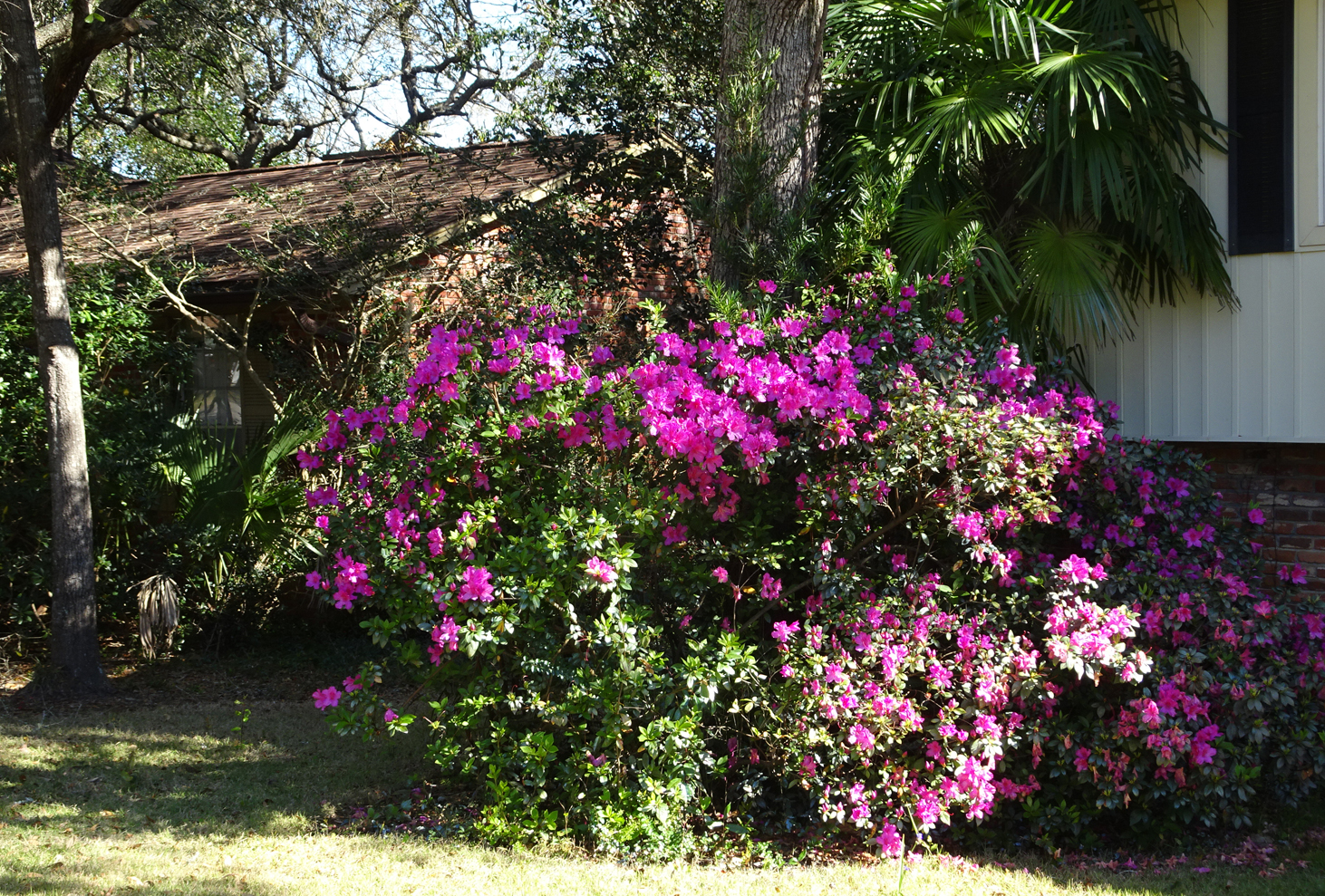
Despite the February date, azaleas are in full bloom around here - about 3 weeks earlier than normal.  It always amuses and entertains me to imagine how azaleas mirror the personalities of their owners.  This big, beautiful plant feels like a woman with her hair down, relaxing in the sunlight.

Across the street, however, an azalea hedge separating two houses has a much more "buttoned up" appearance, sacrificing blooms and density for formality and "neatness".

As I pondered the character-predicting capabilities of azalea shrubs, I heard a large bird calling loudly up above me in the tree canopy.  Frustrated by my rude intrusion as I stood stock still on the sidewalk just below her perch, a red-shouldered hawk squawked at me from a tall pine for several minutes before finally flying off, unwilling to tolerate my presence any longer.  As she flew, I mentally thanked her for allowing me to capture her picture, despite her irritation.
Continuing down the sidewalk, I couldn't pass up a picture of this evocative rope swing, taking advantage of a meandering sand live oak branch in someone's front yard.  I just wish there had been several small kids playing on it while I passed by!

Not too far away, another large oak was in obvious decline, being strangled by a rapacious English ivy vine scrambling up its trunk to compete for the light above, while its roots competed for water and nutrients below.

Even as I was aiming the camera, trying to get a good angle on the ivy vine and oak tree, I registered calls from the red-shouldered hawk again.  Looking up, over a house roof and into a back yard, I saw a huge nest with its raucous owner standing guard nearby.

I had known there was a pair of red-shouldered hawks nesting in the area, as I'd seen some of their mating displays from our backyard, but now I know where their nest is!  Even a short walk can uncover some pretty amazing discoveries.

"Hawk Street" ends in a cul-de-sac that borders the local golf course.  I couldn't resist a quick photo of these blooming azalea bushes along the golf course fence, framed by oak trunks and overhung with Spanish moss.

Continuing around the cul-de-sac had me heading back towards home.  As I walked past a quite neglected (but obviously once loved) front yard, I noticed this little concrete cherub.  Nestled down in a mix of variegated English ivy and fern fronds, he was a warm love note amidst the ragged remnants of the overgrown landscape.
As a contrast to the earlier "interior landscape" of the sand live oak tree, I snapped a quick picture looking up into a fairly young southern magnolia.  They are both native trees, but there is such a different quality of light, color and texture in their forms!

Hearing a variety of different bird calls, loudly rattled off in sequence, I wasn't too surprised when this mockingbird flew over to a hedge, then up onto the electric wires.  It was so nice of him to pose for me!

Across the street from the mockingbird, more "buttoned down" neighbors are obviously careful to keep their azaleas from looking too wild and crazy.  These shrubs are probably younger than the earlier hedge, in a sunnier location, and pruned more frequently, so there were more blooms and a thicker appearance overall.  Still, I prefer my azaleas to be free.

Rounding another corner, I was looking at a highly squared off azalea when I noticed the trunk of the southern magnolia shading it.  What causes this braided appearance?  Pruning up of the branches earlier in its life?

Speaking of pruning, why was it necessary to pollard this poor tree, looking like hell in the hell strip?  I didn't recognize the species from just the truncated remains of the branches and the bark alone, so I'll have to keep an eye on it and see what the leaves look like when the poor thing finally manages to push out a few.

As an aside, though, the bark on the trunk had obviously been a favorite place for yellow-bellied sapsuckers to feed over the years, bearing a textural pattern of holes that could almost be used to create a modern art piece.

Now I was completing my small neighborhood loop, looking at the streetscape, ornamented by sand live oak trees, with the light behind me.   Aren't these trees wonderful?  It was the presence of these trees that attracted our daughter to this neighborhood, 5 or 6 years ago.  (Then 2 years ago, she and her husband and our grandbabies attracted us to the same neighborhood!)

In the foreground of the photo above, you can see the soccer plinth and a stump in front of it.  That stump is the remnant of a large popcorn tree, an invasive species (in the Euphorbia family!) that was, thankfully, cut down a year ago.  The stump is beginning to sport an accent of frilly fungus as it starts to decompose, but it was the deep blue of the spiderwort blooms that caught my eye.  I'm a real sucker for blues of this hue.

As I approached the end of my walk, I couldn't resist capturing this quintessentially southern scene, again from the garden across the street from us.  Oak trees provide structure, high shade, and a catch-hold for graceful Spanish moss.  Underneath those picturesque giants, tall, dark green camellias and lower, rounded azaleas bloom brightly, skirted by fallen camellia petals and ferns.  Can't you just hear the whispered southern accents and the clinking of ice in tall drink glasses?

Thank you for coming on my winter walkout with me.  It's been fun to share my regular haunts with you - and I've loved seeing where everyone else is doing their winter walkouts, too.

As I finish, though, I have to wonder what it would be like for different people to walk the same route and share what caught their attention.  Wouldn't that be a fun way to compare and contrast how each of us sees the world differently?!  Another project for another time, I guess.  I hope you're enjoying the world around you, whatever season your weather is bringing these days, wherever you're planted.

Tuesday, April 12, 2016

The Surprising Lure of Open Ground

Why on Earth would I share a photo of such a nondescript area of our "new" backyard, here in Ft. Walton Beach, Florida?

To put it bluntly, I am sharing this photo because it is one of the most "happening" places in our yard.

Yeah, I wouldn't believe it either, if I didn't look out my kitchen window and see it for myself every day, regularly, throughout the entire daylight period.

I am still not sure what, exactly, attracts the birds to this particular area.  They don't dust bathe in the open sand.  There are no thriving ant colonies in the area or obvious signs of other insect life.  There is no pea gravel or other, slightly larger, gravel that could help in their crops.  Yet every day, over and over again, I see blue jays, red-bellied woodpeckers, mourning doves, mockingbirds, and cardinals come into this area, stay for a while, then fly off again.  Obviously something is attracting them.

By watching closely, though, I've figured out a bit of the mystery....

The red-bellied woodpeckers fly directly from the trunk of the laurel oak (on the left) or the pignut hickory (on the right) down to the ground, stay for 30 seconds or so, then fly back up.  Watching through the binoculars, I think they are generally picking up the laurel oak acorns that were thick on the ground last fall and through the winter. 

The acorns aren't nearly as common now as they were then, which is hardly surprising, but still the red-bellieds come.

The blue jays fly down from the branches of the surrounding trees.  They, too, seem to be going after the acorns, based on what I see through the binoculars.

On the other hand, the mockingbird perches on the hammock first, then flies to the ground.  He seems to scavenge a little longer than the jays or the woodpeckers and it's hard for me to see what he is finding.  I suspect insects or some other small invertebrates, but it could be seeds.  (I am speaking of this as a singular bird, since I tend to see one mockingbird at a time, but I strongly suspect that more than one visits the area.)

I haven't been able to see anything in the beaks of the cardinals or mourning dove that come in to feed either.  For these birds, I suspect the attraction is seed from the "weeds" that are easily as major a component of the area as any grass that remains from the last sodding.

So why share this area at all?  I guess because I want to point out that even seemingly barren, "waste" ground can be valuable to some wildlife.

When we first moved in, I saw this part of the backyard as an area that needed to be fixed, preferably sooner than later.  I just wasn't quite sure what I wanted to do with it.  Now I'm not so sure.  This patch attracts many more birds than nearby areas that have much healthier grass.  I do worry about erosion, though, since we get frequent rain and the land in the backyard slopes slightly.

For now I'm content to just wait and observe.  Funny how natural systems see worth in different ways than we humans do.

P.S.  That ugly, plastic, green flag?  I mark plants I don't recognize or that I may want to move when they have come up in the lawn.   That way, I remember to keep an eye on them and the plants don't get mowed before I decide what to do with them.  That particular flag is marking a dainty little sedge that I want to move somewhere more picturesque.

Thursday, April 09, 2015

Maintenance in the Native Plant Garden: Springtime Editing, Part 1

As I mentioned in my last post, one of the tasks that I find needs to be done each spring is editing.   When you invite animals (especially birds) into your gardens, you are going to get quite a few seeds planted, all of which will be encouraged to grow with a nice dollop of fertilizer.  Many of these will not be plants that you want growing, especially not where they've been planted.

Of course, too, native plants are designed to reproduce on their own...and if they are happy where you've planted them, they may well decide to "go forth and multiply".   Some species are notorious for this, while others reseed or spread only when the conditions are particularly perfect.

So, as the native plant gardener, you can keep things looking relatively tidy simply by removing excess plants once a year - and I find that early spring is the best time to transplant.  Why not take advantage of free plants?!

Personally, I fully understand the need to edit plants out...but I have a terribly hard time actually doing it, especially if I have to discard the plants I remove.  To be truthful, I've gone for years without editing, so my beds tend to get somewhat overgrown at times.  Of course, I like the full, cottage garden look, so this doesn't usually bother me too much, but if you like a more controlled look, editing out is a step that you won't want to skip.

So, on to the actual editing that I'm doing this spring.

Once I got the two areas of my front garden bed appropriately and fully cut back this morning, it was much easier to evaluate what needed to be removed or moved.

The Peach Blossom tulips are planted almost on top of a penstemon, which isn't really a problem as the tulips will die back shortly...but there was also a healthy looking young honeysuckle growing up beside them.  You can see it growing from the base of the plant tag in the photo above.  I DO NOT want a 10' honeysuckle shrub in this location, so that seedling had to go.  Given their invasive nature around here, I don't have any qualms about getting rid of honeysuckle seedlings.  For that reason, I don't like to pass along honeysuckles, either. 

For this honeysuckle seedling, a single stab with a dandelion remover to loosen the soil around its roots, followed by a strong yank, removed it, root and all.

In the center of this next photo is an area under the Callery pear that I've not paid much attention to in the past.  If you look carefully, you can see 3 "small," skinny, woody, hackberry saplings.  At the base of the white plant tag there is a clump of green that is actually a cluster of seedlings which includes a honeysuckle and several Callery pears.  There is another biggish honeysuckle seedling to the left of the plant tag, and there are dozens of Callery pear seedlings in the center of this spot, too.  ALL of these baby woody plants had to go, or this will become a thicket in next to no time.

In removing woody seedlings, the sooner you get to them, the better.  That's why an annual sweep is such a good thing.  For the hardy plants that survive on the Plains, the roots will go down deep and strong;  by the time even a year has passed, getting a woody seedling out of the ground is infinitely harder than removing it shortly after it has germinated.  Give one of these plants a couple years' growth and it's going to be hard to remove without utilizing Roundup, probably multiple times.

On the other hand, if you catch a young tree seedling shortly after it has germinated, all you need to do is give a slight tug and it slips out of the ground, root and all.  If you break off the stem at this stage, there's no problem of future growth, because the plant has no reserves yet in its roots.

It's all about the roots, 'bout the roots, no cutting....  (Confession time:  I found myself singing, "It's all about the roots, 'bout the roots, no cutting...." to the tune of "All About the Bass" for way more time than was rational today.  You're welcome for the earworm, by the way.)  Once a native prairie, woody plant is established, if you simply cut it off at ground level, it will just come back, stronger than before.  Prairie plants are like that.

In the spot above, I had to dig down and cut out the hackberry seedlings as far below the soil line as I could manage.  It remains to be seen if that was far enough down to kill the plants.  If not, I'll have to repeat the process or resort to Roundup.  The honeysuckles came out with strong tugs, roots and all.  I must have pulled out 50 pear seedlings - but they were easy, as the soil was moist (I watered) and they had just germinated this spring. 

This little hackberry seedling located right next to the walkway is one that I let get too big shortly after said walkway was put in, then cut out a year or two ago.  Obviously I didn't get down far enough on the roots when I originally tried to remove it, so I had to repeat the process today.  Hopefully today's butchering will do the trick.

I have a LOT of Callery pears germinating in my beds this year.  Callery pear, Prunus calleryana, is the official species of pear that I usually call "Bradford pear."  Bradford pear is actually a cultivar of Callery pear, but there are also many other varieties of Callery pear on the market these days. This is not a native species, but the tree came with the house and I haven't had the temerity to cut it down.  As pretty as it is in the spring, it reseeds ridiculously.  I consider it a real nuisance plant.

I've got more plant editing that I want/need to do in these beds, but I'm waiting for a friend to come over and get some of the plants when I take them out.  Yeah, I'm putting off the next stage of editing again....  I'll show you that stage next time - I promise!

Tuesday, March 17, 2015

Another Bird Deformity

It has amazed me how many bird deformities I've seen in our yard over the last 8 years.  Some I've shared on this blog.  Mainly beak deformities, but also color changes like the piebald cardinal I've seen this winter and the "yellow breasted" red-winged blackbird I saw several years ago.

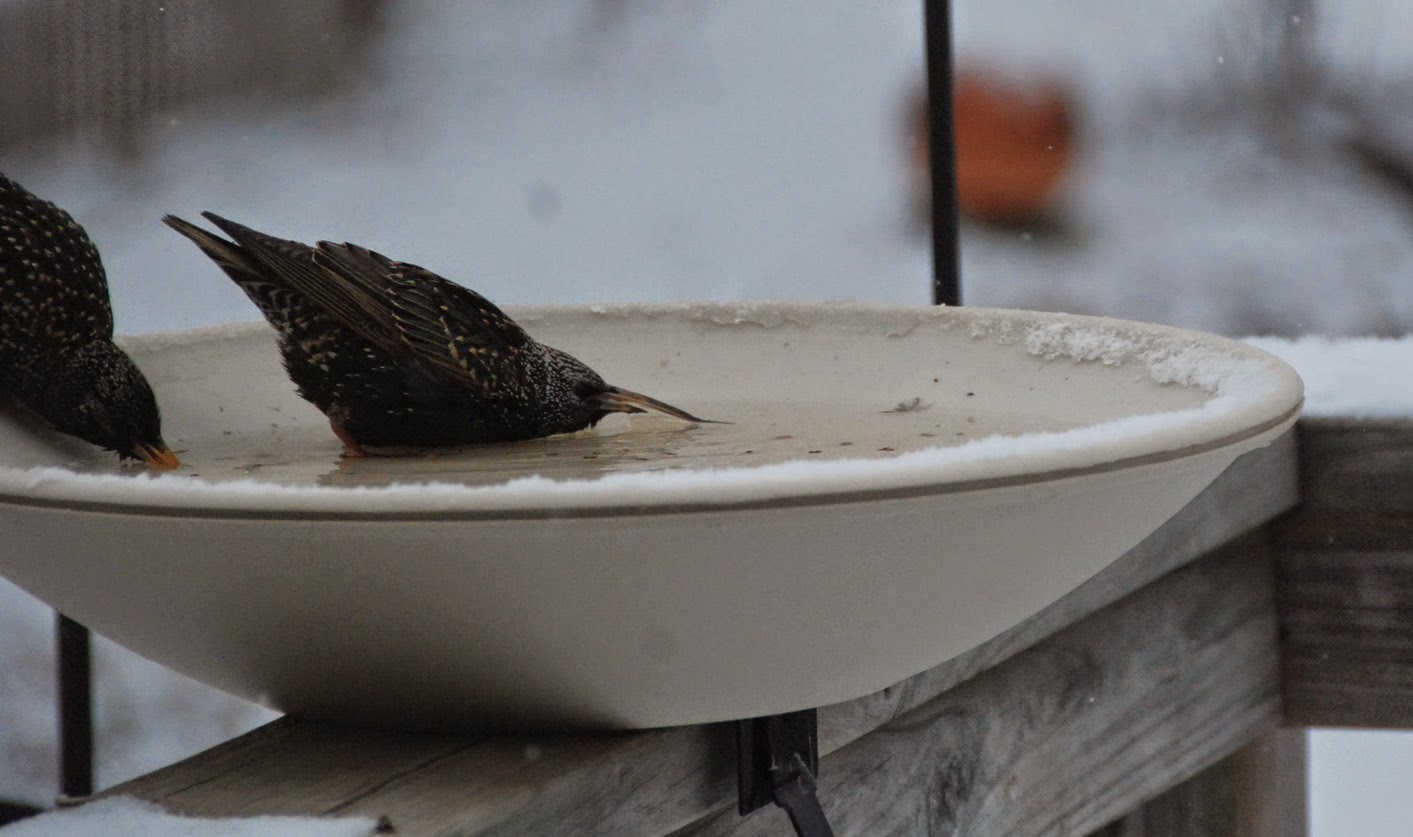
At the end of February, another beak deformity showed up.  This time it was a starling that I noticed drinking during a snowstorm.

I am presuming that this is a case of a beak malocclusion - which results in the upper mandible (in this case) not being automatically trimmed as it closes against the lower mandible.

As with so many genetic abnormalities, this one is not a good change from normal.  Note how wet the feathers down the front of this individual are?

That's because it has to drink by almost immersing itself in water and skewing its body sideways, as in this picture.  I presume it has to eat this way, too.

Compared to the "normal way" a starling would eat and drink, shown by the bird on the left, this deformed starling has to work much harder for both calories and water.  As the top mandible grows longer, it will get harder and harder for this individual to get what it needs.  It also can't be good for this bird to get this wet during cold weather.  Presumably, eventually, it will weaken and die, perhaps becoming food for a predator of some sort.

Seeing individuals like this always makes me sad...but, at the same time, I have to admire them for their bravery and persistence in the face of difficulty.  As beautiful as life is overall, sometimes it seems starkly hard and cruel.  I just try to remember how often things go right, rather than how awful it is when they go wrong....