Showing posts with label Seasons. Show all posts

Sunday, December 07, 2014

"We're Not in Kansas Any More!"

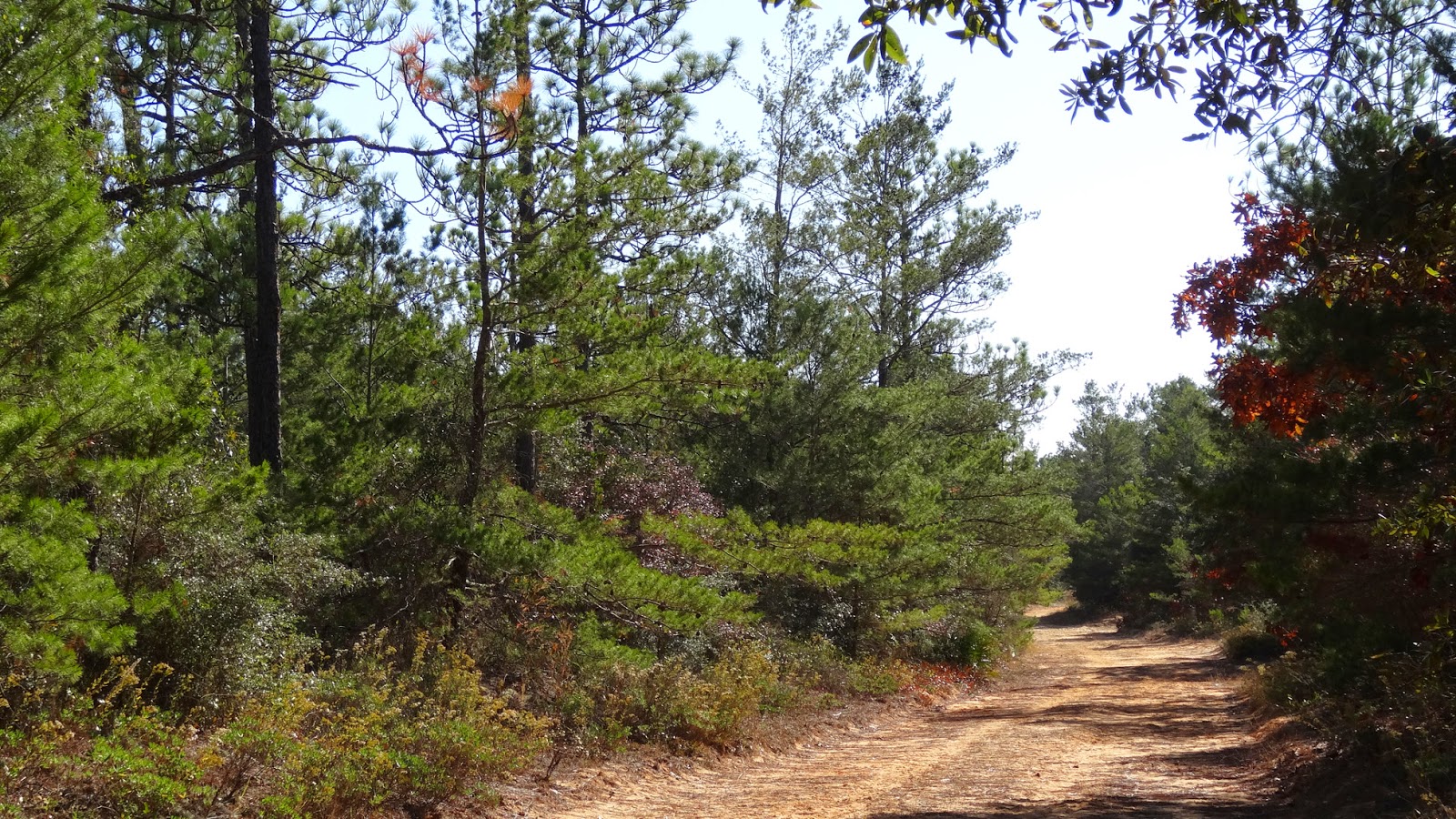
There's little like a vacation to stir up the blood and help you see new perspectives.  We've just returned from a 10 day trip to the Florida panhandle, where we celebrated Thanksgiving with our kids and began to get a picture of what the coming years might hold for us.  One of the many enjoyable activities while we were there was a relaxing walk through a recreational area on Eglin Air Force Base.  As winter really starts to descend here in Kansas and throughout much of the country, I thought it might be fun to share some of the plants I saw just a week ago, in a warmer clime....

While Greg, Jess, Sean, and "the girls" walked on ahead, intent on true exercise, I lingered behind to take photos along the old roadway.  Truthfully I was surprised by the variety of plants I saw.  Even more truthfully, I was surprised by how many species I remembered from my gardening days in Mobile!

As I started off down the trail, my first impression was of food.  Lots and lots of food...for birds and other animals.  Food seemed to be available everywhere I looked.

There were vividly red yaupon holly (Ilex vomitoria) berries crowding each other in the sunlight.

Along with the crimson yaupon berries were other berries, such as these deep blue, greenbrier (Smilax sp.) berries, and lots and lots of seeds.  Goldenrod (Solidago sp.) seedheads were particularly full of feathery goodness.

This feathery goldenrod plant joined with beautyberry (Callicarpa americana) berries to offer the local wildlife a feast.

As I walked and looked and took photos, the old phrase, "Toto, we're not in Kansas anymore!" kept echoing through my head.  No, it for sure wasn't Kansas.  Sometimes it amazes me how few plant species are found both along the Florida/Alabama coastline and up here in the prairie land.  Certainly there are genuses that are in both areas, but the species are quite separate.

Between Kansas and the Gulf Coast, the feel of the plant communities is very different too - which is hardly surprising.  Sporting a covering of pine needles and a diversity of moss and lichen on a heavily sandy soil, this view of the woodland floor is typical for the area we were visiting.

Towering over the rest of the vegetation were the longleaf pines (Pinus palustris).  Historically, these keystone plants formed massive open forests which predominated all along the southern coastal plains, from Virginia around the corner to Texas, until about 100-150 years ago.  First the majestic longleafs were tapped to make turpentine and cut to make ship masts, then later they were cut down to burn in steam engines as the country expanded.  Of course, their wood was also used in building as well.  The land that was cleared was either put into agriculture or replanted with faster growing slash or loblolly pines.  Within just a few decades, almost all of the longleaf forests were gone.  Nationwide, a University of Florida study done in 1997 found only 15 sites with virgin longleaf pine forest left, totalling about 1600 acres.

A typical understory plant throughout much of the area, saw palmetto (Serenoa repens), gives a vaguely tropical feel to the woodlands.  It is a true native (unlike most of the others palms and palm-like plants you see along the Gulf Coast) and it is very valuable for wildlife.

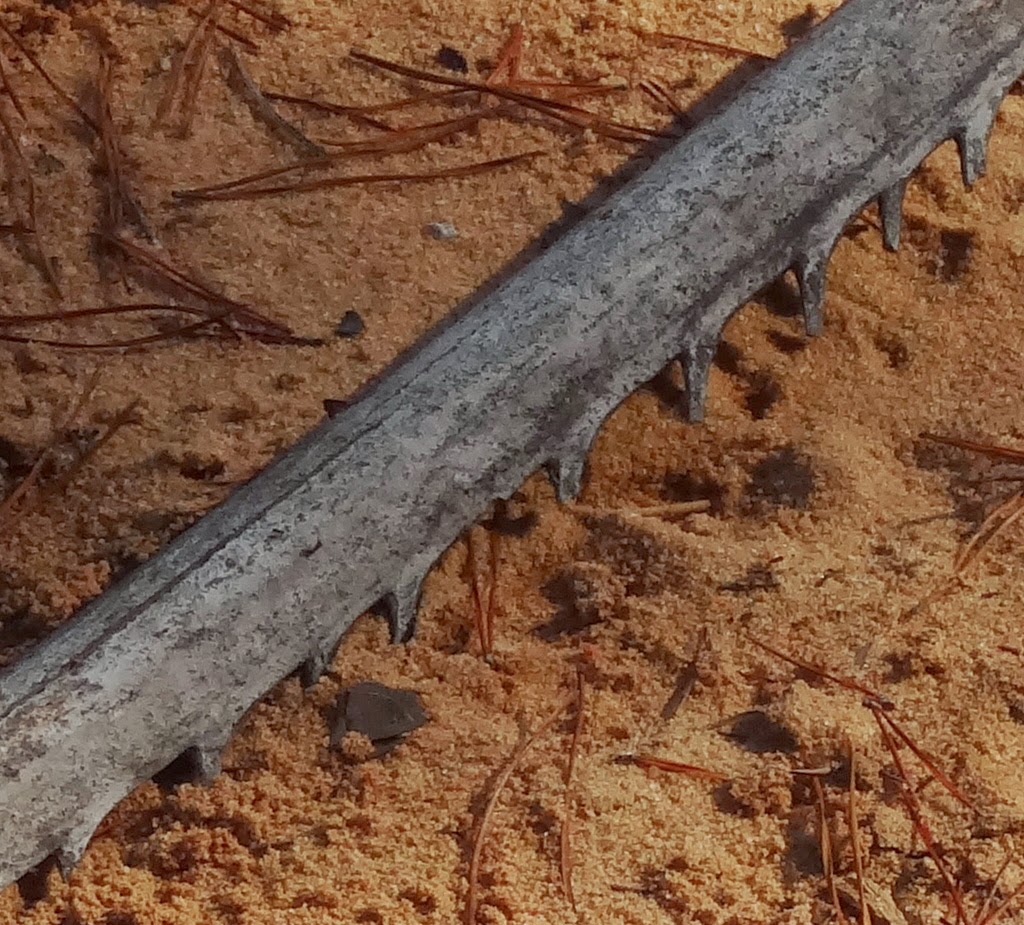
Here is a remnant of the "stem" of one of the big fan leaves found on saw palmetto.  You can see where the name "saw" comes from!   It makes me think of fossil dinosaur jaws whenever I see it.

Usually not considered a beneficial plant, there was a lot of greenbrier (Smilax sp.) in the understory along the path, too.  I actually like greenbrier for its wildlife versatility - the berries are great food for birds and other animals, while (as is typical for native plants) the leaves are larval food for caterpillars of several different moth species such as the turbulent phosphila and the ruby quaker.  Note:  the names are cool, but the adult moths are pretty cryptic, a.k.a. drab.   Still, they too are food for numerous other animals.  Many greenbrier vines are bristling with thorns and can serve as excellent shelter and nest protection for birds and other small animals.

This essentially thornless greenbrier had a few healthy berries to share, and you can see the parallel leaf veins that help identify it as a Smilax.

One find that surprised me was what I think was a nicely sized American holly (Ilex opaca).  While they are native to the area, I didn't see them very often when we lived in Mobile.

Scattered in small clusters amongst the broad leaves, the holly berries were bright red and looked great, but they didn't put on as much of a show for the camera as the yaupon berries did.  With its yellowish green leaves, American holly is widely used in crosses with other species, but isn't commonly found as a straight species in the nursery trade. 

Walking back along the trail, though, and thus seeing from a different direction with a different angle of light, the leaves of the holly do look much darker.

To eyes accustomed to fall further north, the woodlands still look very green, but signs of fall were everywhere.  While I've talked about the colorful berries and fluffy seedheads, there was also some fall color.  An excellent source of fall color in longleaf territory is sparkleberry, Vaccinium arboreum.  In the blueberry genus, sparkleberry has tiny blue berries that are snatched up by birds as soon as they ripen, which is earlier in the year, but their shiny leaves color beautifully and remain on the plant for a long time.  This individual was a beautiful maroon...

while across the path and down the way a bit, another sparkleberry went in for oranger and golder tones.

Speaking of orange and gold, there were a few yellow-gold blooms still gallantly blazing, although I don't know what they were, ...

and a male monarch was traveling the path with me, too.  He rested on a yaupon long enough to give me a "photographic opportunity" before continuing on his journey.  I wonder if he'll make it to Mexico or not?

There are 2 other plants that I want to highlight from this walk, but I think I'll separate them out into another post or two. 

Meanwhile, Greg, Sean, Jess, Gabby and Dahlia got done walking and have come looking for me - so I'll end this ramble.  Hope you enjoyed my glimpse of the south land in your chilly December!


Thursday, November 20, 2014

The Arrival of Winter - A Sign of the Season to Come?

Well, winter suddenly descended last week with a blast of strong wind that was followed a few days later by a thin blanket of snow.  This was enough of a shock to my system - I'm very thankful I don't live in south Buffalo, New York, right now!

While nothing too exciting has happened with this seasonal change, above and beyond earlier-than-usual cold weather with a couple inches of snow, it still seems like I ought to celebrate the arrival of winter with a brief post.  So here goes.

Since there was little transition between the relatively warm fall weather and a cold snap more typical of January than mid-November, quite a few trees and shrubs were caught with leaves in place.  Thankfully, we didn't get ice, so the leaves simply freeze-dried in place.  Some species, like cottonwood, have gone ahead and shed the remainder of their leaves.  Others, like the oaks, are still sporting a green coat.

This is the young Shumard oak that we planted shortly after we moved in.  I wonder how long the leaves will stay green this winter?

My aromatic asters were also still blooming when the cold hit.  Despite their late bloom cycle, this is the first year I've noticed any of their blooms getting caught by winter weather.  The purple is still obvious, 10 days after the cold originally hit.  How long will I have purple "blossoms" coloring the winter landscape?

After snapping a few pictures of the asters, I noted this grayish "growth" on the side of a basket sitting on the front porch.

Recognize it up close?  A praying mantis's egg case.  I'm actually rather surprised that I haven't found more of them, as I had many, many praying mantises in my gardens this year.  I feel rather lucky that all of the mantises I've seen have been the native Carolina mantis, rather than the interloper, the Chinese mantis.

In the back yard, I managed to catch a photo of a white-crowned sparrow hiding on the far side of a rose bush.  I was quite close, but evidently this little beauty felt safely hidden, because it made no move to flush while I stood there.


The most unusual sighting was the set of little tracks going across the driveway, between the redcedar hedge on the south side and the Rose of Sharon on the north side of the driveway.


With the obvious marks of the tail dragging, I'm quite sure it's a rodent of some sort.  Perhaps a hispid cotton rat.  I really don't know how to tell different rodent tracks apart, but I do know that I've got plenty of cotton rats around!

I didn't get out to take photos until 2 days after the snow fell, so I have no glorious shots of snow, quietly sifting out of the sky, or sitting heavily on the branches of the trees, but there was still enough snow around to document the start of winter.

Each year is so unique - I wonder what THIS winter will bring?  Is this early snow the sign of much more to come?  Or is this the only snow we'll get all season?  There's no way to know so, as always, we'll take the new season, day by day, week by week, month by month.  Suspense - natural style.

Tuesday, November 18, 2014

"Where is Your Wild?"

A meme on Facebook this morning showed a backpacker overlooking a beautiful vista of mountains while standing alone in an alpine meadow.  The caption read, "Where is your wild?"

Well, here is MY wild!

Our front tallgrass....

a patch of smooth milkweed in our yard....


one of the front gardens, needing some "manicuring," when we got back from vacation this summer...

and the draw, with the path into the back, last winter.


All of MY favorite "wild" is within the 10 acres that we live on.

All of us can nurture the wild locally in our cities and neighborhoods and yards.  We don't have to drive halfway across the country to some national park to experience "the wild";  we just have to cherish and value "the wild" that occurs right under our noses.


Where is YOUR wild?

Saturday, April 26, 2014

The Garden in the Third Part: Fitting In to the Greater World Around Us

Spring starts slowly on the prairie.  With the mid-continental weather tending towards extremes, plants are suitably cautious about putting forth too much green, too early.

As a gardener, I'm itching for green by mid February.  For ANY color, actually, other than brown and tan and and gray and cedar green.  I'm itching for gentle breezes and softness.  The prairie doesn't provide much of any of that in February.  In March, either, to be honest.

Feeding the birds helps.  Cardinals flash such vivid red that I can't help but feel cheered up as I watch them.  Songs start noticeably increasing by early March - and the return of the male red-winged blackbirds triumphantly declaring, "O-Ga-LEEEEE!" from every conceivable perch lets me know that spring truly is on its way.

Of course, giving in to the pull of non-native spring bulbs helps, too!

But I find a particular excitement stirring when I start seeing signs of spring in the native plant life.  On March 12th, this was my first real sign of spring in the native plants....

Do you see it?  Those fuzzy shoots pushing upwards?  Those are the shoots of pasqueflower (Pulsatilla patens).   The hairs help protect the leaves and stems and even the petals against cold temperatures, as does the plant's short stature, hugging the warm earth.  We're actually a bit far south to be in pasqueflower's native range, but I enjoy the fuzzy purple fluffiness of this diminutive charmer anyway.

By March 29th, the blooms were up and fully open.

Now, in late April, the seed heads have already formed and I'm enjoying their soft texture too.  How quickly the season of the pasqueflower passes.

But back to March 12th....  I leave my perennials uncut over the winter to provide seeds and shelter for the birds, overwintering sites for the insects, and protection for the soil from winter's harsh winds.  With spring definitely starting to arrive, I undertook one of the biggest projects of my native garden calendar year - cutting back last year's growth.

On March 12th, here's what the front flower bed looked like after the vagaries of winter this year.

After taking a quick series of photos, I put the camera down, picked the clippers up, and got to work.  After a relatively quiet winter spent sitting more than I probably should, I try not to become a "weekend warrior" with the attendant injuries of doing too much, too fast.  So I work at this first big task of the gardening year a bit at a time, hauling all of the debris off to the brush pile where overwintering insects can emerge at their leisure.  If I remember correctly, this bed alone produced about 15 compacted wheelbarrow loads of detritus.

A bit less than 2 weeks later, on March 29th, the front flower bed looked like this, my "mechanical burn" having cleared off the remnants of last year's exuberance, opening up the soil for the sun's warmth and for the emergence of this year's fresh, new growth....

There's not a lot more green yet, but there's a whole lot less brown!  It always amazes me to see how easy it is to brush away the layers of life that make up the prairie landscape.  In some ways, it is such a fragile world.

Meanwhile, in the back courtyard where shade simulates more of a prairie woodland environment, the woodland flowers were just beginning to emerge.  Well, actually, the Bloodroot (Sanguinaria canadensis) had already emerged and was almost done blooming.  Woodland plants are often small, easily overlooked among large, showy clumps of daffodils and bright, shining clusters of purple crocus.  I almost missed the bloodroot blossoms!

Just two days later, all of the petals were gone and the leaves had emerged more fully.  I really enjoy the bloodroot leaves, with their odd lobes, their gray green color, and their softly rounded shapes.

Bloodroot gets its name from its red sap, most easily seen in its roots.  The sap was used as a dye by some of the Native American tribes.  It is poisonous if ingested in sufficient quantities.  Like many woodland forbs, bloodroot leaves will go dormant in mid-summer, reducing the plant's need for water in traditionally dry times.

In another area of the back courtyard beds, two little rue anemones (Thalictrum thalictroides) were emerging.

Nearby, a clump of liverleaf (Hepatica americana) was pushing up out of the ground, flowers first.  The leaves come later - around 2 weeks later, in fact!

It always amazes me that so many of these woodland flowers essentially emerge with their flower buds opening at the same time - or even before - their leaves unfurl.  "Time's a-wasting, folks!  Got to get this seed production started NOW!"

I am going to have to stop here for now - it's late and I need to get to bed.  The upcoming week is going to be full and I'm not likely to be able to blog again for a while - but don't forget the native wildflowers!  I've only managed to bring you up to the end of March so far.  In the chronology of the spring garden, the daffodils and hyacinths have just started blooming, the purple crocuses are in their full glory, and the spinach is just starting to germinate in the glass light shade "cold frames".

We'll resume our springtime travels through time in the native plant garden when next we meet!  In the meantime, happy gardening!

Friday, April 25, 2014

The Garden in the First Part: Heirlooms and Memories

Early spring in Kansas is spring bulb time.  Little else can take the roller coaster weather and still be willing to "put it all out there" in the way of blooms and leaves.  This year seemed like a particularly beautiful spring for bulbs.

To me, spring started in mid February this year.  The first yellow crocus blooms shine out among my other photos on February 21st.....

Generally speaking, I prefer heirloom plant varieties for non-native plant species.  There's just something that nourishes my romantic spirit in thinking that I might be saving an old variety of plant, almost lost to horticulture, for future generations.

I have a few heirloom crocus varieties, but I can't say that I can tell a lot of difference between them and more modern varieties.   Greg has been very interested in scattering crocuses throughout the grass in the yard, which makes labeling an heirloom variety impossible, so crocuses are one species in which I have tended to just go with "cheap and cheerful" modern bulbs.

Heirloom or modern, crocuses seem to bloom in the same basic order:  yellow first, then white and finally purple. This cluster of 5 clumps illustrates that fairly well:  the yellow clumps (helped along by munching rabbits) are essentially done, the white clump is in full bloom, and the purple clumps (also rabbit-pruned) are just beginning to open fully. 

The entire process is slow but steady - the second photo was taken on March 20th, fully a month after the first photo.  Crocuses certainly brighten the late winter landscape for a long time...in what seems like a time period that lasts forever.

As the crocuses pass their peak, the daffodils begin.  Tete-a-Tete, a cute, perky, little, bright yellow daffodil is one of the first varieties to open.  I have my first daffodil photos on March 20th, the same day as the crocuses above.  By 9 days later, multiple daffodils have opened, as have the hellebores and the first of the hyacinths.  Looking across the landscape, though, things still seem pretty sere, even 2 days later on March 31st.

By April 4th there is a little more color, as the lilac leaves start to burst their buds and a few more flowers bloom.....

...and by April 10-11th there is much, much more color.  This was one small area of the courtyard bed on April 10th, showing 2 varieties of daffodils, my wine purple hellebore, blue hyacinths, deep pink hyacinths and grape hyacinths.

Taking a photo down the length of the bed shows a different angle to the same plants, just one day later.  It's rather amazing how different the bed looks from these 2 different angles.

Snow before dawn on April 14th literally dumped ice water on the party and dampened the colors, at least briefly.

Luckily the temperatures were just above freezing when the snow came down, so it actually did little damage.  We had a harder freeze the next night, after the insulating snow had all melted off, but even that didn't seem to harm too many plants.

By the 18th, the back courtyard bed was looking pretty spring-ish again.

I've been fighting a debilitating chest cold all this week, and the back courtyard bed has quieted down for now, so I haven't taken any photos of it in the last week.  If the weather cooperates, I'll try to get a shot in the morning.

Meanwhile, here are a few highlights from the spring bulbs and other non-native garden plants so far this spring....

Having specifically mentioned the Tete-a-Tete daffodils, it seems like I ought to include a photo of them!  This was taken on March 31st, but these cuties had started opening by March 20th and continued blooming for at least another week after this photo was taken.

I took this picture of my wine purple hellebore plant on March 29th, but I have a shot of its new leaves and flower buds just beginning to emerge on March 12th.  This plant put on a lot of growth in just over 2 weeks!

One of my favorite spring bulbs has always been grape hyacinth - the deep blue is SO satisfying!  When we first started planting bulbs the fall after we moved in, 7 1/2 years ago, I got the only grape hyacinths I could find and planted them, even though the photo didn't look quite right for the blooms that I remembered so vividly.  I was rather disappointed when they came up in the spring.  They looked like their photo.

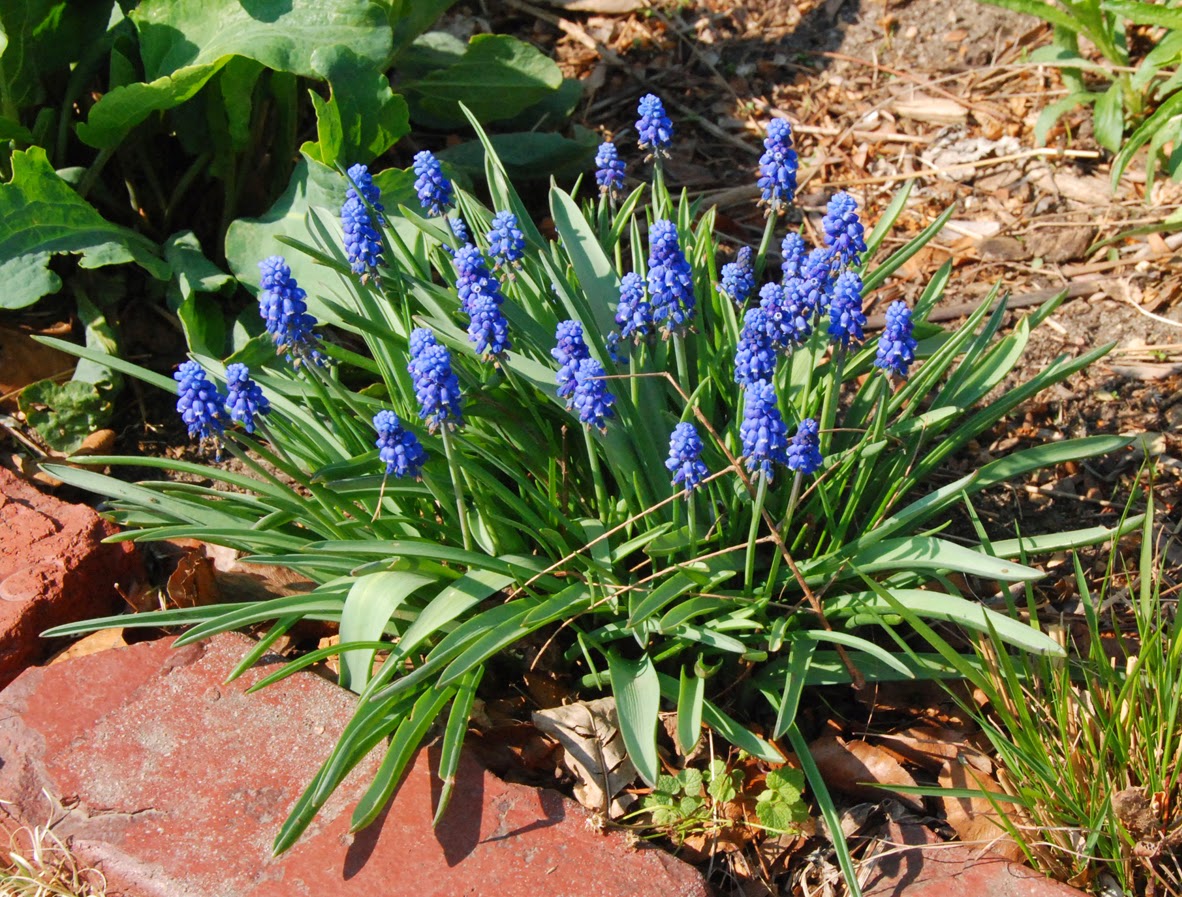
Well, I've since learned that "modern" grape hyacinths are Armenian Grape Hyacinths, Muscari armeniacum.  They don't seem to multiply like the old fashioned grape hyacinths do, which may be why modern growers and gardeners prefer them.  This is one "clump" of those modern grape hyacinths, 7 springs later, with spotted geranium (Geranium maculatum) coming up behind it.

Now, granted, I haven't given these grape hyacinths any special care, above and beyond what I've given to the rest of the bed.  No extra fertilizer.  No extra watering.  Still, I suspect I planted 7 bulbs originally in this group...and there are still 7 individual plants.

Thanks to Old House Gardens, I was able to find both heirloom Southern Grape Hyacinths and heirloom Northern Grape Hyacinths a year or two later.  I figured that one of those two species must be the plant I remembered.

I like both of the heirlooms better than the modern species.  Added to the official plant roster in 1629, this pictures the Southern Grape Hyacinth, Muscari neglectum.  It has the deep blue blooms that I love, but the foliage is rather limp and formless.  It also tends to reseed a fair amount, which I actually like, but others might not be so excited about.

My favorite of the three, though, is the Original or Northern Grape Hyacinth, Muscari botryoides.  It was first introduced to horticulture in 1576 (!), which just amazes me.  It creates full clusters of neat foliage with soul-satisfying blue blooms.  I truly don't understand why this plant isn't widely available any more - I'd love to have all my beds edged with it!

Moving on, my daffodils range from bright yellow to almost pure white, tall to short, early to late, single to incredibly double, fragrant to odorless - but I find it hard to remember which varieties I've planted and where they are in the beds.  I labeled them all when they were planted, but their labels have suffered the same fate as most, and I can't read or can't find most of them.  I have, though, kept all my old receipts, so I know I could figure it out...but it seems like too much trouble tonight.  If anyone is interested in more about the daffodils I'm growing, let me know and I can do a post about them, specifically - or at least about my favorites.

Last but not least in this lineup of highlights, I've got 2 different hyacinth varieties that I particularly love:  Dreadnought (1899) and Double Hollyhock (1936).
 
With a double bloom of an intense, luscious, deep blue, I've had Dreadnought in the ground for several years now, in an area where I do absolutely NO extra watering.  It has returned stronger each year.  This is Dreadnought Hyacinth on April 11th....
A newbie to our garden (planted last fall), Double Hollyhock Hyacinth has double blooms of intense, magenta pink which were just beginning to open up on April 11th....
This, then, is Double Hollyhock Hyacinth covered with snow on April 14th!

Luckily all of the plants recovered, suffering no lasting ill effects, as evidenced by this rather over-exposed photo from April 18th.

Enough now.  Bulbs are great fun, but it's time to wrap up this section and move on to the next part of our great garden experiment, the vegetable garden.  I'll meet you over there in a bit.