Early spring in Kansas is spring bulb time. Little else can take the roller coaster weather and still be willing to "put it all out there" in the way of blooms and leaves. This year seemed like a particularly beautiful spring for bulbs.
To me, spring started in mid February this year. The first yellow crocus blooms shine out among my other photos on February 21st.....
Generally speaking, I prefer heirloom plant varieties for non-native plant species. There's just something that nourishes my romantic spirit in thinking that I might be saving an old variety of plant, almost lost to horticulture, for future generations.
I have a few heirloom crocus varieties, but I can't say that I can tell a lot of difference between them and more modern varieties. Greg has been very interested in scattering crocuses throughout the grass in the yard, which makes labeling an heirloom variety impossible, so crocuses are one species in which I have tended to just go with "cheap and cheerful" modern bulbs.
Heirloom or modern, crocuses seem to bloom in the same basic order: yellow first, then white and finally purple. This cluster of 5 clumps illustrates that fairly well: the yellow clumps (helped along by munching rabbits) are essentially done, the white clump is in full bloom, and the purple clumps (also rabbit-pruned) are just beginning to open fully.
The entire process is slow but steady - the second photo was taken on March 20th, fully a month after the first photo. Crocuses certainly brighten the late winter landscape for a long time...in what seems like a time period that lasts forever.
As the crocuses pass their peak, the daffodils begin. Tete-a-Tete, a cute, perky, little, bright yellow daffodil is one of the first varieties to open. I have my first daffodil photos on March 20th, the same day as the crocuses above. By 9 days later, multiple daffodils have opened, as have the hellebores and the first of the hyacinths. Looking across the landscape, though, things still seem pretty sere, even 2 days later on March 31st.
By April 4th there is a little more color, as the lilac leaves start to burst their buds and a few more flowers bloom.....
...and by April 10-11th there is much, much more color. This was one small area of the courtyard bed on April 10th, showing 2 varieties of daffodils, my wine purple hellebore, blue hyacinths, deep pink hyacinths and grape hyacinths.
Taking a photo down the length of the bed shows a different angle to the same plants, just one day later. It's rather amazing how different the bed looks from these 2 different angles.
Snow before dawn on April 14th literally dumped ice water on the party and dampened the colors, at least briefly.
Luckily the temperatures were just above freezing when the snow came down, so it actually did little damage. We had a harder freeze the next night, after the insulating snow had all melted off, but even that didn't seem to harm too many plants.
By the 18th, the back courtyard bed was looking pretty spring-ish again.
I've been fighting a debilitating chest cold all this week, and the back courtyard bed has quieted down for now, so I haven't taken any photos of it in the last week. If the weather cooperates, I'll try to get a shot in the morning.
Meanwhile, here are a few highlights from the spring bulbs and other non-native garden plants so far this spring....
Having specifically mentioned the Tete-a-Tete daffodils, it seems like I ought to include a photo of them! This was taken on March 31st, but these cuties had started opening by March 20th and continued blooming for at least another week after this photo was taken.
I took this picture of my wine purple hellebore plant on March 29th, but I have a shot of its new leaves and flower buds just beginning to emerge on March 12th. This plant put on a lot of growth in just over 2 weeks!
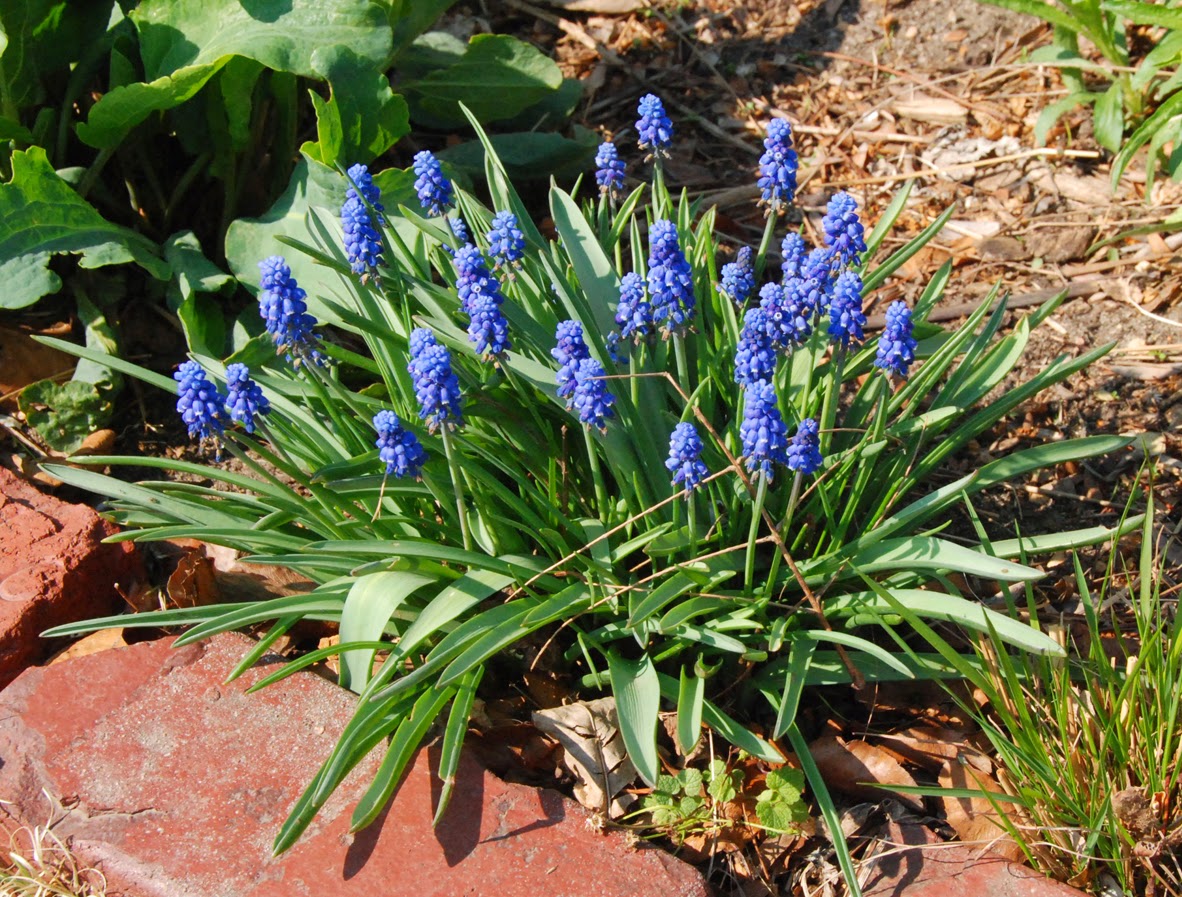
One of my favorite spring bulbs has always been grape hyacinth - the deep blue is SO satisfying! When we first started planting bulbs the fall after we moved in, 7 1/2 years ago, I got the only grape hyacinths I could find and planted them, even though the photo didn't look quite right for the blooms that I remembered so vividly. I was rather disappointed when they came up in the spring. They looked like their photo.
Well, I've since learned that "modern" grape hyacinths are Armenian Grape Hyacinths, Muscari armeniacum. They don't seem to multiply like the old fashioned grape hyacinths do, which may be why modern growers and gardeners prefer them. This is one "clump" of those modern grape hyacinths, 7 springs later, with spotted geranium (Geranium maculatum) coming up behind it.
Now, granted, I haven't given these grape hyacinths any special care, above and beyond what I've given to the rest of the bed. No extra fertilizer. No extra watering. Still, I suspect I planted 7 bulbs originally in this group...and there are still 7 individual plants.
Thanks to Old House Gardens, I was able to find both heirloom Southern Grape Hyacinths and heirloom Northern Grape Hyacinths a year or two later. I figured that one of those two species must be the plant I remembered.
I like both of the heirlooms better than the modern species. Added to the official plant roster in 1629, this pictures the Southern Grape Hyacinth, Muscari neglectum. It has the deep blue blooms that I love, but the foliage is rather limp and formless. It also tends to reseed a fair amount, which I actually like, but others might not be so excited about.
My favorite of the three, though, is the Original or Northern Grape Hyacinth, Muscari botryoides. It was first introduced to horticulture in 1576 (!), which just amazes me. It creates full clusters of neat foliage with soul-satisfying blue blooms. I truly don't understand why this plant isn't widely available any more - I'd love to have all my beds edged with it!
Moving on, my daffodils range from bright yellow to almost pure white, tall to short, early to late, single to incredibly double, fragrant to odorless - but I find it hard to remember which varieties I've planted and where they are in the beds. I labeled them all when they were planted, but their labels have suffered the same fate as most, and I can't read or can't find most of them. I have, though, kept all my old receipts, so I know I could figure it out...but it seems like too much trouble tonight. If anyone is interested in more about the daffodils I'm growing, let me know and I can do a post about them, specifically - or at least about my favorites.
Last but not least in this lineup of highlights, I've got 2 different hyacinth varieties that I particularly love: Dreadnought (1899) and Double Hollyhock (1936).
With a double bloom of an intense, luscious, deep blue, I've had Dreadnought in the ground for several years now, in an area where I do absolutely NO extra watering. It has returned stronger each year. This is Dreadnought Hyacinth on April 11th....
A newbie to our garden (planted last fall), Double Hollyhock Hyacinth has double blooms of intense, magenta pink which were just beginning to open up on April 11th....
This, then, is Double Hollyhock Hyacinth covered with snow on April 14th!
Luckily all of the plants recovered, suffering no lasting ill effects, as evidenced by this rather over-exposed photo from April 18th.
Enough now. Bulbs are great fun, but it's time to wrap up this section and move on to the next part of our great garden experiment, the vegetable garden. I'll meet you over there in a bit.
Showing posts with label Heirloom Plant Varieties. Show all posts
Friday, April 25, 2014
Three in One: Gardening for Different Purposes in One Landscape
I've been wanting to share posts of how great the garden is looking this spring, but I haven't been able to decide what to emphasize or what other gardeners might be interested in. After starting several posts that fizzled from a severe lack of focus, I realized that I actually have 3 separate gardens, all combined into one overarching landscape. It's easiest and most rational, then, to post about each garden separately.
However, I even get myself into trouble when I try to list the three separate types of gardens I have! Which is the most important or the biggest - and therefore entitled to be showcased first and talked about the most? Which is nearest and dearest to my heart? Yikes! I sure manage to create problematic mountains out of non-problematic molehills!
Okay, so here goes....
I'm going to start with my decorative/heirloom/memory gardens - these are plants that I inherited when we purchased our house, that I've rescued from gardens about to be lost, that I've chosen because they are heirloom varieties that appeal to me, that have been given to me, and so forth. These are not native plants - they hail from Japan, Turkey, China, and many other parts of the world. They are "traditional" garden plants. (Yes, I DO grow non-natives!)
Right now the heirloom garden plants are the showiest, probably because native prairie plants tend to green up late, knowing that the weather is likely to be fickle well through April.
Here, for example, is a portion of my back courtyard bed from about two weeks ago.....
The flowers that are making a splash in this photo are a beautiful hellebore, as well as heirloom daffodils and hyacinths. More on the specifics in the next post.
Next on my list is the vegetable garden. This is pretty straight-forward, although I do mix it up a bit by utilizing raised beds to raise some perennials and natives in until I know where I want to put them in the flower beds. Doing this not only helps me place things more rationally in the garden, but also brings in pollinators for the vegetables when the flowers bloom. Greg experimented with different kinds of cold frames over the winter this year, which makes the vegetable garden look significantly messier. The messy look has been well worth it, though because we've been reaping rewards as far as early greens and a head start on broccoli and cauliflower this spring.
Finally I end up at my beloved native plants. Yes, these are the plants I hold closest to my heart. Not only do they bring a lot of botanical beauty into the landscape, but they provide food and shelter for a myriad of animals that enliven the landscape with their presence and their activities.
I speak of the native plants as separate from the heirloom gardens and vegetable gardens, but in reality, I have all 3 combined throughout most of the garden. It just seems easier to talk about them separately, since I grow them for such different reasons.
So now I've set the framework - in my own mind at least - for a quick look at 3 different "gardens" around our yard this spring. Rather than make one exhaustively long post, I'm going to summarize what's been happening in 3 separate posts. It will be interesting to see which different "gardens" appeal to more people and why!
Monday, April 23, 2012
Helen Jane's rose
Helen Jane, the mother of one of my Clearwater friends, was the town's plant lady. She was the only florist for many, many years, but more than that, she truly loved plants - all plants, as far as I can tell, not just flowers. She came by this naturally, as her mother had always been fascinated by plants too.
About 3 or 4 years ago, Charlotte (my friend) had the sad duty of clearing out her parents' home before selling the house. She invited me over to rescue as many of the plants as I could before she put the house on the market.
Sadly, my flower beds were new and not very extensive at this point, so I was only able to take a small number of the plants available in this wonderful woman's yard.
As Charlotte went around the yard, pointing things out to me, she pointed out a large, overgrown rose bush. It was mid summer and the bush had long since quit blooming, but Charlotte said that this had been her mother's favorite rose. I obviously couldn't dig up the entire bush, so I tried digging up a start from a low-lying branch that had developed a few roots. I also weighted down another branch with a brick, after doing a partial cut across its diameter, then went back later to dig up the resulting start.
I don't remember which of my two attempts took, but one of them did and now, 4 years later, the shrub rose to the right of the obelisk is the result. (The one to the left is a Knock-Out.) Without the blossoms loading down the branches, this rose is actually much more rounded - taller, rather than shorter and wide.
It's a big, beautiful, vigorous rose that has received absolutely NO special care once it was obviously established, even last summer. There are very few thorns along the branches. It blooms once a year in the spring and, as you can see, it is truly loaded with highly fragrant, pink blossoms when it blooms. The blooms average just over 3" in diameter. I've had no problem with black spot or any other malady, specific to roses or otherwise.
For any rose people out there...do you have any idea what this rose might be? I call it Helen Jane's rose, after Charlotte's mother, but I would be interested in knowing its "real" name, if it has one.
Whatever its "real" name is, I will forever think of Charlotte's mother when I see (and smell) this rose. I just wish I'd had the opportunity to know this special woman.
Saturday, March 31, 2012
The Best of Springs, The Worst of Springs
Sorry for the bad paraphrase in the title, but it seems to perfectly capture my mixed feelings about this spring. All the area plants seem to be popping out much too early and much too quickly...yet I can't help but enjoy this gorgeous weather as well as the colorful, glorious blooms and fresh, green foliage that are so abundant everywhere!
Looking at this photo, shot towards the road, down our driveway, I feel like I can see both the best and worst of this spring. Or maybe I should say that I can see the best of this year and the effects of the worst of last year.
The Willem van Oranje (1933) tulips are absolutely stunning this year, as is the clump of daffodils (whose variety name I've forgotten) beside them. Both are heirlooms - I'll have to find my invoice from Old House Gardens several years ago to figure out the daffodil name, as the name plate I put beside the clump has weathered beyond legibility. (I've got to figure out a better way of marking my plant varieties!)
Anyway, back to my original thoughts....
Across the driveway from the bed housing the tulips and daffodils, overflowing the "frame" formed by the square of the metal crossbars of the old fence, are the remnants of a huge, wild clump of asparagus and a large, formerly gorgeous, dark pink rugosa rose. Both remnants need to be completely cut back. As far as I can tell, the asparagus completely succumbed last summer - I have not seen any sign of life yet this spring. The rugosa rose has a few little sprigs of green - basically 3 small shoots of growth - so it's not completely gone, but it will be years before it regains its former glory, if it ever does.
None of my "best" and "worst" plants in this post are native to south-central Kansas. In fact, none are native to the North American continent. Perhaps that explains the death of the asparagus and the near-death of the rose in last summer's heat and drought. Certainly I'm feeling horrible about my decision not to water the outlying beds last year, although I also don't see how I could have decided otherwise, given our reliance on a solitary well for both the house and the yard.
We've had weeks of 70 and 80 degree weather now. Tomorrow is only April 1st. What is the rest of the year going to bring us as far as temperatures and rainfall? Not having a crystal ball, I can't begin to predict...but I can hope. And, meanwhile, I can enjoy.
Oh, and the daffodils? Looking back to earlier years, the daffodils are a variety known as Conspicuus, introduced to the trade in 1869. They were considered to be "...one of the pioneering achievements of the Victorian daffodil renaissance" according to the Old House Gardens catalog description. They certainly are conspicuous this year!
Labels:
Heirloom Plant Varieties,
Seasons,
Spring Bulbs,
Weather
Saturday, February 25, 2012
Spring Crocus Shining
While I'm nervous about what an incredibly early spring this seems to be, I've decided that I might as well just go along for the ride - heaven only knows that I certainly can't slow it down!
The first yellow crocuses started peaking through several weeks ago and, by now, many of the whites and creams have joined them.
This bright-eyed clump of white crocuses is on the pathway up to our front door, nicely showcasing the arrival of early spring to any guests who happen to walk up. It's the Snowbunting crocus, and was first introduced to the nursery trade in 1914. (I really enjoy using heirloom varieties of many plants. They're not always the biggest, but I figure they're still around because they do well over time.)
Also heirlooms, this little group of shining yellow blooms is Cloth of Gold crocuses. They are REALLY heirlooms, having first been introduced to the nursery trade in 1587! These guys haven't been as prolific as the Snowbuntings, but then they are in a much more "wild" location and get absolutely no extra care or water of any sort. The soil in this location is a bit rockier and leaner too.
The third group I photographed are just assorted modern crocuses, but they are some of the ones that we have naturalized in the grass throughout the yard. They come up a little more strongly every year and it's a lot of fun to see the variety contained within their ranks.
If you are interested in checking into heirloom bulbs, I've been using Old House Gardens, which is based out of Michigan. I've been extremely pleased with their descriptions and information, their service, and (especially) their products. I've heard great things about Brent & Becky's Bulbs in Virginia, too, but I've never actually ordered from them. They have so many varieties that I get a little overwhelmed when I visit their site!
I've got some buds on a few of my smaller daffodils, 6" tall foliage on many others, tulip leaves looking strong and healthy, and even hyacinth leaves that are 3" tall. The next few weeks should be bright and beautiful!
Labels:
Heirloom Plant Varieties,
Seasons,
Spring Bulbs
Friday, March 19, 2010
Heirloom Crocuses
I'm starting to reap the benefits of last fall's frenzied rush to get my heirloom bulbs in the ground.


The first of the heirloom bulbs to bloom this spring were Snow Bunting crocus. Unfortunately, I don't have any good photos of those, as the rabbits ate the two biggest clumps just as they were getting showy and the dog (or an armadillo?) partially dug out the third clump. I think they'll all survive, but they sure aren't pretty subjects for photographing right now, due to no fault of their own.
The other two heirloom crocuses that are blooming are Cloth of Gold crocus (introduced to "the trade" around 1589) and the unfortunately named Negro Boy crocus (introduced in 1910). I bought all of these bulbs and many more from Old House Gardens Heirloom Flower Bulbs, if you get inspired to get some for yourself.
This dark purple beauty is the Negro Boy crocus. Note that the rabbits got to these guys too, but, fortunately for me, the flower buds were still buried deep in the crown when the leaves got so thoroughly trimmed. These beauties are quite large for crocus blooms, larger even than my modern mixed crocuses.

The golden "stars" to the left and below are Cloth of Gold crocuses; this variety dates from before 1600, so it was introduced to the European horticultural trade very early. The blooms are not quite as large as modern crocus blooms, but the crisp shape of their petals and bright gold coloring helps them shine out in the early spring landscape.


Being caught up in the romance of historical plant varieties that are in danger of being lost from modern gardens, I often give little notice to modern ones that are easily available. However, these purple crocuses that were in our yard when we bought our home 3+ years ago are absolutely stunning this year...so I want to share them too. Who knows? Someday they'll probably be the historical variety that's in danger of being lost.
I have one more heirloom crocus variety that hasn't opened its blooms yet, so I'll have to save it for another post. So far, though, I have to say that I'm very pleased with my foray into the world of heirloom bulbs.
Subscribe to:
Posts (Atom)