Labeling my walk this morning as a "winter walkout" seems like lying, but the calendar rules, so that's what I'll call it.
Leaving my front door, the first thing I noticed was this American flag. The flag is not, technically, in my yard, even though it's visible from my front door, so I don't think I'm breaking the winter walkout rules by including this vignette.
Since I see it every time I leave my house, this algae-stained and sadly weathered flag has become symbolic to me. The folks who display it are staunch conservatives; I'm sure they consider themselves to be displaying their patriotism. I, however, see many other layers of meaning in its treatment as well.
Passing by their garden this morning, along the sidewalk in front of their house, I noticed a red camellia bloom with multiple centers: colorful, perfectly imperfect, brightly shining for a few days...and then gone forever. How's that for reading meaning into the natural world?!
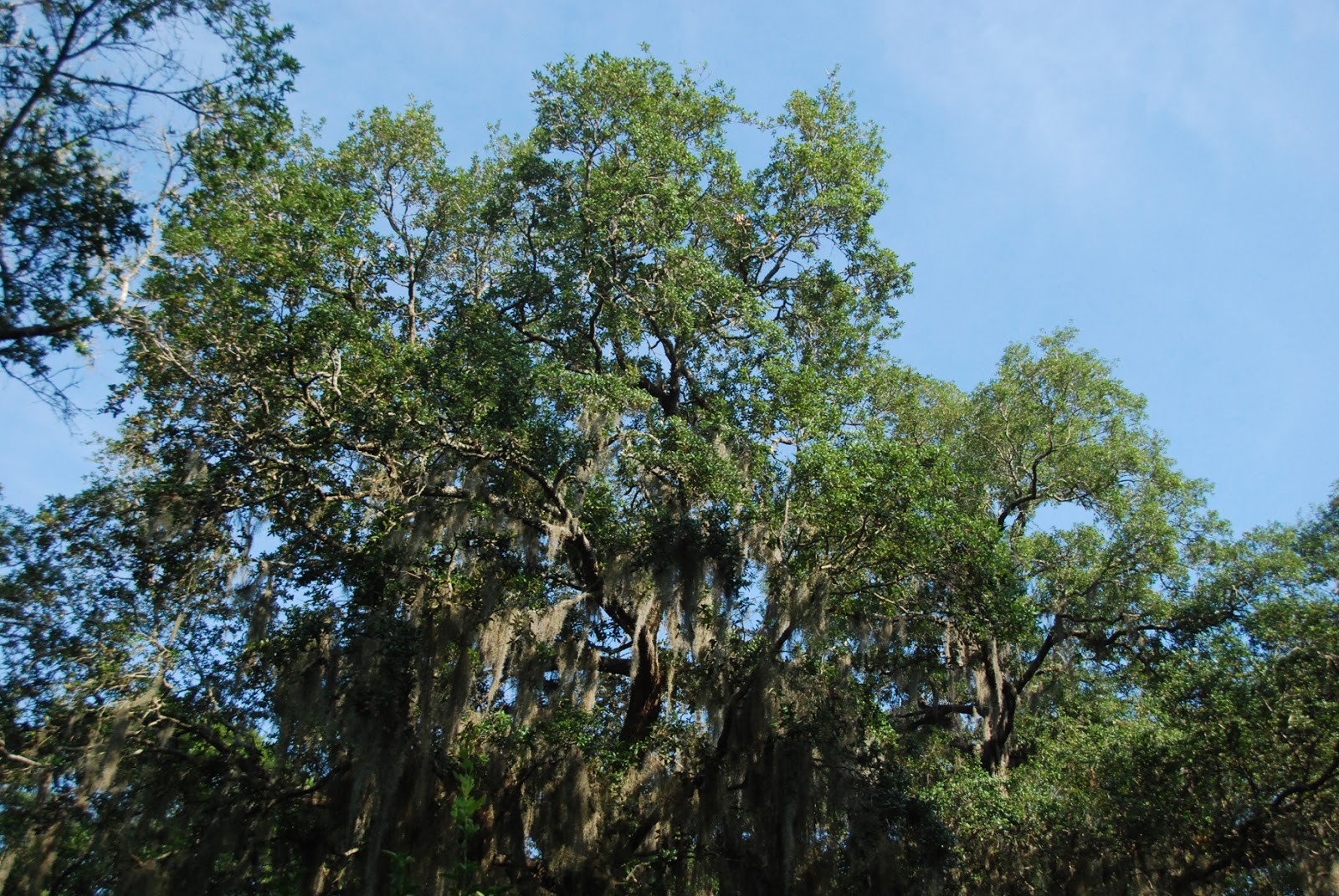
Looking up, Spanish moss draping from the trees silvered the sand live oak canopies, which were silhouetted against the crisp blue sky. It was truly a gorgeous morning!
Across the street, a painted concrete ball added a touch of whimsy to an otherwise classic, if rather off-kilter, driveway pillar.
Why a soccer ball? I have visions of sports-mad teenagers living in the house, but I have never actually seen any activity beyond a single parked pickup truck in the driveway.
As I passed under the sand live oaks whose finery of Spanish moss had caught my eye, I looked up into the interior of one of the trees, relishing the texture of the heavy, sinuous branches with their finely textured leaves against the sky.
Live oaks, sand live oaks, burr oaks, cottonwoods, prairie elms - I love statuesque, gnarly trees with character!
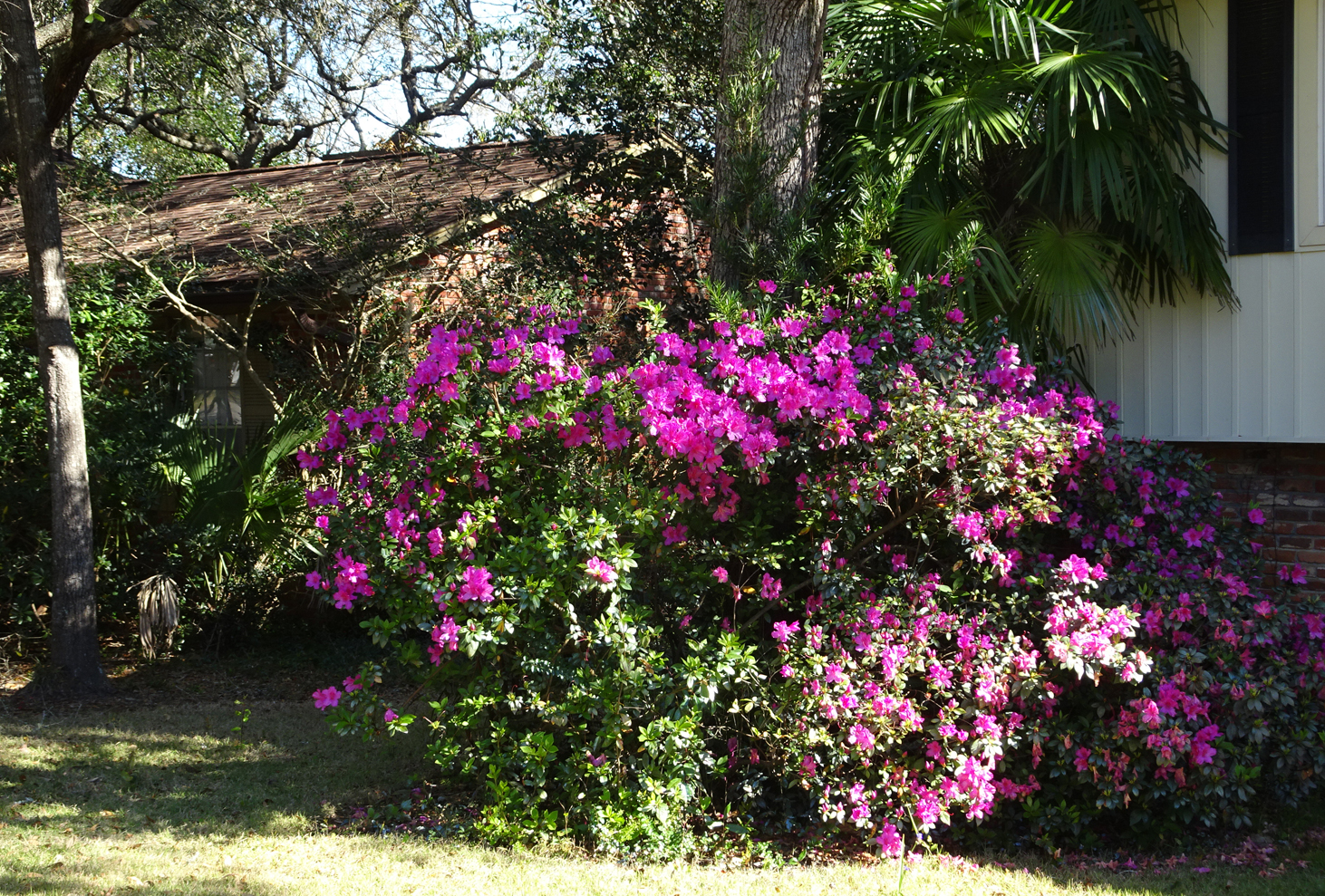
Despite the February date, azaleas are in full bloom around here - about 3 weeks earlier than normal. It always amuses and entertains me to imagine how azaleas mirror the personalities of their owners. This big, beautiful plant feels like a woman with her hair down, relaxing in the sunlight.
Across the street, however, an azalea hedge separating two houses has a much more "buttoned up" appearance, sacrificing blooms and density for formality and "neatness".
As I pondered the character-predicting capabilities of azalea shrubs, I heard a large bird calling loudly up above me in the tree canopy. Frustrated by my rude intrusion as I stood stock still on the sidewalk just below her perch, a red-shouldered hawk squawked at me from a tall pine for several minutes before finally flying off, unwilling to tolerate my presence any longer. As she flew, I mentally thanked her for allowing me to capture her picture, despite her irritation.
Continuing down the sidewalk, I couldn't pass up a picture of this evocative rope swing, taking advantage of a meandering sand live oak branch in someone's front yard. I just wish there had been several small kids playing on it while I passed by!
Not too far away, another large oak was in obvious decline, being strangled by a rapacious English ivy vine scrambling up its trunk to compete for the light above, while its roots competed for water and nutrients below.
Even as I was aiming the camera, trying to get a good angle on the ivy vine and oak tree, I registered calls from the red-shouldered hawk again. Looking up, over a house roof and into a back yard, I saw a huge nest with its raucous owner standing guard nearby.
I had known there was a pair of red-shouldered hawks nesting in the area, as I'd seen some of their mating displays from our backyard, but now I know where their nest is! Even a short walk can uncover some pretty amazing discoveries.
"Hawk Street" ends in a cul-de-sac that borders the local golf course. I couldn't resist a quick photo of these blooming azalea bushes along the golf course fence, framed by oak trunks and overhung with Spanish moss.
Continuing around the cul-de-sac had me heading back towards home. As I walked past a quite neglected (but obviously once loved) front yard, I noticed this little concrete cherub. Nestled down in a mix of variegated English ivy and fern fronds, he was a warm love note amidst the ragged remnants of the overgrown landscape.
As a contrast to the earlier "interior landscape" of the sand live oak tree, I snapped a quick picture looking up into a fairly young southern magnolia. They are both native trees, but there is such a different quality of light, color and texture in their forms!
Hearing a variety of different bird calls, loudly rattled off in sequence, I wasn't too surprised when this mockingbird flew over to a hedge, then up onto the electric wires. It was so nice of him to pose for me!
Across the street from the mockingbird, more "buttoned down" neighbors are obviously careful to keep their azaleas from looking too wild and crazy. These shrubs are probably younger than the earlier hedge, in a sunnier location, and pruned more frequently, so there were more blooms and a thicker appearance overall. Still, I prefer my azaleas to be free.
Rounding another corner, I was looking at a highly squared off azalea when I noticed the trunk of the southern magnolia shading it. What causes this braided appearance? Pruning up of the branches earlier in its life?
Speaking of pruning, why was it necessary to pollard this poor tree, looking like hell in the hell strip? I didn't recognize the species from just the truncated remains of the branches and the bark alone, so I'll have to keep an eye on it and see what the leaves look like when the poor thing finally manages to push out a few.
As an aside, though, the bark on the trunk had obviously been a favorite place for yellow-bellied sapsuckers to feed over the years, bearing a textural pattern of holes that could almost be used to create a modern art piece.
Now I was completing my small neighborhood loop, looking at the streetscape, ornamented by sand live oak trees, with the light behind me. Aren't these trees wonderful? It was the presence of these trees that attracted our daughter to this neighborhood, 5 or 6 years ago. (Then 2 years ago, she and her husband and our grandbabies attracted us to the same neighborhood!)
In the foreground of the photo above, you can see the soccer plinth and a stump in front of it. That stump is the remnant of a large popcorn tree, an invasive species (in the Euphorbia family!) that was, thankfully, cut down a year ago. The stump is beginning to sport an accent of frilly fungus as it starts to decompose, but it was the deep blue of the spiderwort blooms that caught my eye. I'm a real sucker for blues of this hue.
As I approached the end of my walk, I couldn't resist capturing this quintessentially southern scene, again from the garden across the street from us. Oak trees provide structure, high shade, and a catch-hold for graceful Spanish moss. Underneath those picturesque giants, tall, dark green camellias and lower, rounded azaleas bloom brightly, skirted by fallen camellia petals and ferns. Can't you just hear the whispered southern accents and the clinking of ice in tall drink glasses?
Thank you for coming on my winter walkout with me. It's been fun to share my regular haunts with you - and I've loved seeing where everyone else is doing their winter walkouts, too.
As I finish, though, I have to wonder what it would be like for different people to walk the same route and share what caught their attention. Wouldn't that be a fun way to compare and contrast how each of us sees the world differently?! Another project for another time, I guess. I hope you're enjoying the world around you, whatever season your weather is bringing these days, wherever you're planted.