Showing posts with label Reptiles. Show all posts

Thursday, February 16, 2017

Thoughts While Weeding

What do you think about while you weed?

As relaxing and enjoyable as I find it to weed, you'd think I'd be thinking elevated, beautiful thoughts that calmed my spirit and elevated my soul.

You would be grossly wrong.  A few days ago, I found myself "listening" to  my thoughts and here's what I heard:

1)  a series of theme songs running through my head from Winnie-the-Pooh, "I'm so rumbly, in my tumbly, time for something SWEET, to eat!"  and "Winnie-the-Pooh, Winnie-the-Pooh, scrubby little tubby all stuffed with fluff!  He's Winnie-the-Pooh, Winnie-the-Pooh, willy, little silly, old bear!" and "Up, do-own, up!  Up, do-own, up!  When I up, down, and touch the ground, it puts me in the mood.  Up, down, and touch the ground, in the mood for food!  I am short, round, and I have found, speaking poundage-wise, I improve my appetite, when I exercise!"

2) more somber thoughts about our family friend who, at 55, was diagnosed recently with a very malignant form of cancer,

3) and, of course, some political angst mixed in with the more pressing comical and tragic elements.

At other times as I weed, I find myself composing gardening blog posts.  Understand, please, that the vast majority of these garden-composed posts have long since escaped my mind by the time I actually sit down in front of the computer.  Nonetheless, I go on, mentally "writing."

As I weed, sometimes I dwell on transplanting that needs to be done or on other changes to my "landscape designs".  ("Landscape designs", in my garden, is a euphemism for the "plop 'em there" design pattern that I generally follow when I bring home a carload of fantastic plants that I've just discovered at my local nursery or plant sale.)

Most importantly, I think, I talk to the creatures that I see while I'm weeding, like this recently de-tailed ground skink,

this red-faced little southern toad I disturbed, buried in the soil,

or the red-shouldered hawk that haughtily surveyed the landscape while "hidden" right above me.

All of these guys joined me in the garden recently, even though it's still early February.  They are among the living creatures with whom Greg and I share our landscape, so it seems only polite (and politic) to discuss the changes I'm making with them when I see them.

What do you think about while you weed?

Sunday, September 14, 2014

Diversity!

Greg gave me a gift for Christmas last year - Access (the software program, which unfortunately doesn't automatically come with the home version of Office) so that I could begin to keep a coherent database of all the plants and animals that I've found on our 10 acres.

I have been slowly working on this project in the intervening months, and I'm far from done.  For the most part, I've been utilizing the photos I've taken over the years to remind me of what I've found and where I've found it.


For example, I saw this flower beetle (Batyle suturalis) on Black-Eyed Susan (Rudbeckia hirta) in the Back Five early in July this year; both species are now in my database.


The wonderful folks at BugGuide.net are probably quite sick of me, as I've been submitting quite a few photos for their help with identification - which has been wonderful and greatly appreciated.  I can usually get an unknown insect down to order and often to family, using my experience and (if necessary) Borror and DeLong's Introduction to the Study of Insects for its excellent keys .  Then I try, utilizing BugGuide's online guides, to get the insect down to genus and species, but without actual keys specifying what I'm looking for, it can be hard.  It's at this point that I will submit an image for help.


Other species are often easier.  For example, I've been birding for years, so I have a reasonable familiarity with bird species and I can trust my identifications and the species lists I've been keeping since we moved in.  (Besides, it is much easier to figure out which of 450+ possible species a bird is compared to figuring out which of thousands of possible species an insect is.)  Below, for example, is a red-winged blackbird watching a little blue heron, who hung out in our lagoon for several days in 2009.

There are a variety of books and online resources I go to for plant identifications:  Michael Haddock's book and website on Wildflowers and Grassses of Kansas.  Janet Bare's book, Wildflowers and Weeds of Kansas.  Stephen's book, Trees, Shrubs and Woody Vines in Kansas.  And many, many more.

I've recently purchased Bradley's book, Common Spiders of North America, to improve my ability to identify the spiders that I'm seeing.  BugGuide is also useful with spiders, and I have a few other guidebooks (although most are much less comprehensive than Bradley's).  Below is a male jumping spider (Phidippus clarus) which I photographed last summer hanging out on giant ragweed (Ambrosia trifida).

There are, obviously, many more references that I use to compile my species lists, but that isn't the point of this post.  Right now, according to my Access database, I have 201 plant species that I've found (or planted) on our 10 acres, 157 species of insects, 3 species of amphibians, 8 species of mammals, 1 species of snake, and 5 species of turtles.  (I have found quite a few more species of amphibians, mammals, snakes and turtles than that, but I haven't put them into my Access database yet.)  My yard list has 121 bird species so far.  That includes birds seen ON our property, as well as FROM our property (i.e. flying overhead during migration or seen from our property but physically on our neighbors' land).  I haven't started a list of spider species yet, but in looking in my photo organizer, I easily have at least a dozen different species.  Then there are the assorted invertebrates not covered by "insect" and "spider" catergories, species like prairie crayfish, roly-polies, and daddy longlegs.


Here is a boreal chorus frog (Pseudacris maculata) in the buffalo grass (Bouteloua dactyloides) of our front lawn last August.


So, in the 7 1/2 years we've lived here, I have documented (so far) 310 animal species and 201 plant species sharing our 10 acres with us.


Why am I posting about this right now?  Because in yesterday's Wichita Eagle, there was an article about Chisholm Creek Park in northeast Wichita.  The article was actually about algae in the lake there, but there was a brief aside saying that "[t]he park is home to 163 species of plants and 214 species of animals...."  Chisholm Creek Park is large - 282 acres, according to the website of the Great Plains Nature Center, which is located there.

I have documented about 25% more species of plant species and almost 50% more species of animals on our 10 acres than have been documented in the 282 acres of Chisholm Creek Park in the same county.

Does this mean that there really ARE that many more species on our little 10 acres than in Chisholm Creek Park?  No.  Absolutely not.  The species summary list on the Great Plains Nature Center site above does not give any number of species at all for invertebrates or grasses, for example, and their numbers for birds, mammals, reptiles and amphibians are all greater than the number I've observed on our property.  Chisholm Creek Park also has fish species, while we have no year-round water habitat except our lagoon.

I've just been more meticulous about recording (and identifying) the variety of species I've found here, particularly the species of insects and other invertebrates, than the folks in charge of that park have had the time or the inclination to do.  Still, it was definitely a psychological boost to realize just how diverse a piece of property we actually have!

Do you keep any sort of species list of what you've identified on your property?   If so, what sorts of insights or discoveries has that process given you?

Read more here: http://www.kansas.com/news/local/article2095022.html#storylink=cpy


Wednesday, May 02, 2012

Bits and Pieces on May 1st


It's May 1st.  My larkspur just started to bloom, while the lanceleafed coreopsis and Missouri evening primrose started blooming a couple days ago.  Helen Jane's rose is almost done.   Looking back to photos from last year, my flower gardens seem to be about 2-3 weeks ahead of spring, 2011.

I finished weeding out the backyard buffalo grass over the weekend.  We plugged it last summer, during the beginning of "the heat," and the plugs were still healthy and strong.  It looked better than the buffalo grass in the front, which we didn't get to until August, but it had some areas where a particularly vicious mix of little barley, undead Bermuda grass, and annual brome (Japanese, I think, but maybe downy) were attempting to completely take over.   Here is a photo, showing how much it has filled in...but how much it still needs to fill in, too.  Hopefully the predicted heat, combined with our recent rains, will take care of that, now that I've got the competition out of the way.


In the vegetable garden, the 2 Brandywine tomatoes that Greg took a chance on (planting in mid-March) are looking "full and fluffy" and have started to flower.  At least we should get a couple tomatoes this year!  The first 6 broccoli plants are ready to harvest...although the harvester is not ready to deal with them, yet!  The broccoli is a full month ahead of last year.


I've been trying to get out for walks along the trails this week, to see what's blooming.  The boys, of course, accompany me.  Blue, especially, enjoys a quick cool down in the pool of the draw every time we head back towards the house.


Once Blue has cooled himself down in this pool (which in MUCH less appealing than it looks in the above photo), he quite frankly reeks!  Being a young and energetic German shepherd, he is likely to wander off and get himself into trouble if I leave him out unattended.  So I rarely do so.  I've taken to hosing him down when we get back to the house, but it only helps to a certain degree.  Consequently every walk is now followed by a period of uncertainty in which I have to measure the total certainty of wet-stinky-dog-in-the-house versus the near certainty of young-idiot-dog-doing-something-like-visiting-the-neighbors'-horses-to-bark-at-them-in-the-hopes-of-getting-them-to-run.   In farm country, this latter behavior is grounds for rapid termination and therefore it's not to be taken lightly.  Usually near certainty wins out over total certainty before said dog is completely dry...so my house has taken on a definite eau de wet, muddy dog.  It is not a pleasant perfume, but Blue's enjoyment of his regular "bath" is so deep that I feel unwilling to deprive him of this relatively harmless ritual.  (And, truthfully, I'm not sure I could stop it, short of stopping the walks altogether.)


Moving on to a less odoriferous topic, I've seen my first snake of the season - a young garter snake in the back yard.  The dogs and cats didn't even notice it!  In fact, I was afraid Becker was going to lie down on top of it, but he ended up a foot away.  Then I had a hard time keeping Blue from stepping on it while he plagued his big brother, trying to get him to play a bit more actively.


(If you look carefully in the middle of the photo, you'll see a dark line leading away from the big shepherd - that's the snake, trying to "get the heck out of Dodge!")

This morning I saw my first hummingbird of the year, so I've put up the feeders and I'm hoping that we'll have a pair nest in the yard again this summer.  Since their nests are tiny and well camouflaged, I've never actually found one, but we've had a pair stay around all summer for the last several years, leading me to assume they are nesting somewhere nearby.

On a similar note, Greg reported that most of the nest boxes are occupied, including one that has a bluebird incubating eggs in it, but I'll have to post more about those later...after I've done a little more observing and maybe taken a couple photos.  The blooming and breeding season of 2012 is certainly off to a rip-roaring start this year - now I've got to see if I can possibly keep up!

Saturday, March 31, 2012

Turtle Time

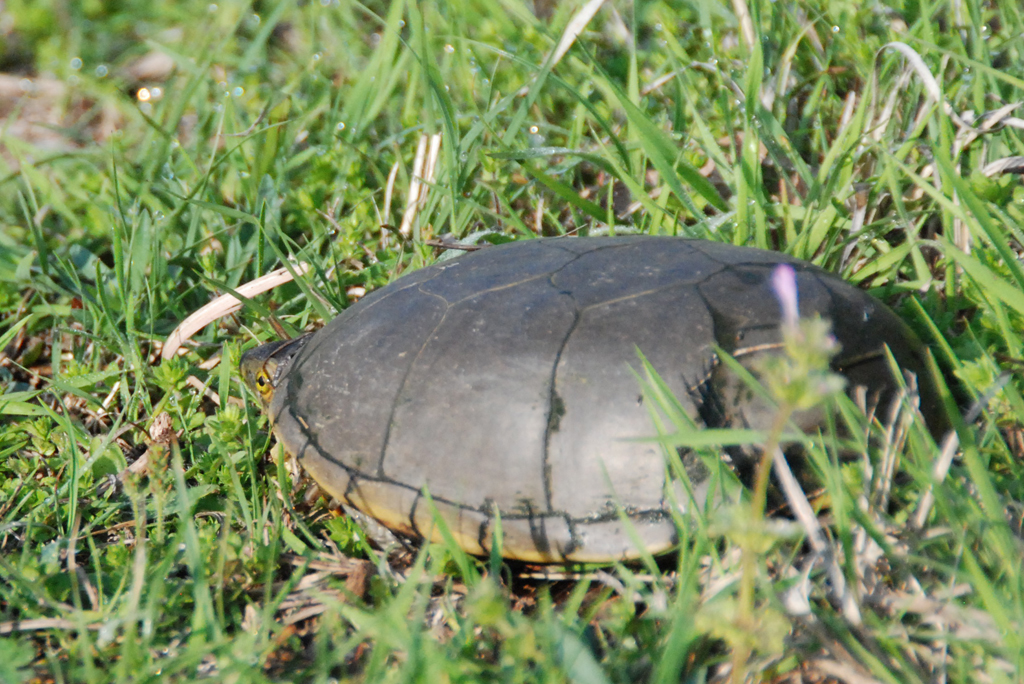
Yellow mud turtle, that is.  Kinosternon flavescens.

On Wednesday, March 28th, during the one leisurely walk that the boys and I have been able to take this week since getting back on Monday from my visit with Jess in Florida, we almost literally ran across this yellow mud turtle on the path. 


Although yellow mud turtles are not the most prepossessing of animals, I still enjoy my occasional sightings of this species.  I presume these guys hang out generally in our draw, the lagoon, and/or the neighbor's pond.  I usually see them when they venture further afield to look for "greener pastures," so to speak.

The boys saw this guy first.  ("Guy" is purely a guess, from his slightly concave plastron, or lower shell.)  Of course, Becker's and Blue's first instinct was to nose this odd creature to get a whiff of yellow mud turtle essence.  Needless to say, that made him immediately retreat into his shell.  Hence the first photo.

It took 4 patient minutes before I saw this fearless adventurer stick his nose out carefully to begin checking whether the dangerous dogs had left the area.  (They were on down-stay a few yards behind him.)


A minute later, he'd stuck his head further out and was craning his neck around to explore as widely as possible without actually moving his shell/body.  It always amazes me how long a turtle's neck is.  And how does he retract it so completely into what seems like a fully stuffed shell?!


A sneeze from one of the dogs caused him to quickly pull his head back into his shell briefly, but he came back out again in a short time and continued his quiet surveillance. 

It took 11 minutes from the time I first came upon him until he felt confident enough to extend his legs and continue on his journey.  Once he made up his mind, though, he started moving fast to "get the h--- out of Dodge!"...as they say.  My first shot as he started up was literally blurry!


Not the most socially adept of animals, it was only a short time until Mr. Mud Turtle had turned away and presented me with only this view of his retreating rear end.  A satisfactory end to a brief encounter with one of my fellow inhabitants here on the southern Kansas prairie.


Sunday, September 11, 2011

The Turtle Project

Since box turtle patterns are said to be as unique as fingerprints, I've decided to see how many different individual box turtles I can identify on our 10 acres.

My memory is that they range over about 5 acres and they are not strongly territorial, so more than one can be ranging over the same territory or overlapping it significantly.

To help me in identifying and remembering them, especially while I'm out walking and away from the computer, I'm breaking my normal rule of thumb and personalizing them with names, where those names make sense. Here are a couple males that I've tagged so far....

Sam Spade is named for the spade-like mark on the back of his shell, an enlargement of the dorsal line there. He's a big, colorful male that I've seen twice - in about the same 50' area - in the last couple weeks.


Don Quixote is named for the wounds on the back of his shell. He's smaller and not very colorful - at first I mistook him for a female, since his legs show little coloring. I'm guessing that the scars are from a run-in with a lawnmower. I found him last Thursday morning, down on the path in the draw.


The third male that I've found hasn't been named yet, as I haven't noticed anything strongly unique about him yet. He's very colorful and good sized, with less marking overall than the other two. I last saw him about a month ago.


Interestingly, all 3 of these males (and several females) have been in the Cedar Grove/Draw area. How far away will they travel from this central location? Will there be a seasonal pattern to their travel? Has the drought changed their patterns this year? Will I see the same individuals from year to year? Lots of fun questions to answer!

Friday, August 05, 2011

In the Eye of the Beholder....


On Wednesday morning, I took this quick snapshot of an ornate box turtle I saw in the cedar grove. The storms didn't come until that night, so it was still desperately dry. When conditions are that difficult, I do my best not to disturb my local land-mates any more than I have to, so I didn't pick this guy up or move in too close...and, at the time I took the photo, I couldn't tell whether this was a male or female, except that the red flush on the front leg made me strongly suspect that it was a male.


Imagine my delight when I downloaded the photos and saw this gorgeous red eye staring up at me! Definitely a male. He looks pretty fearsome, doesn't he?!

On Monday morning, I'd snapped a quick pair of photos of a different ornate box turtle out under the mulberry tree in the Back 5. They are not the best shots, but I was following my "don't disturb more than necessary" philosophy that day, too. I think this is a female, although I can't tell for sure since her head is pretty well hidden. What really struck me, though, was how differently the camera saw her shell patterns in the light of the sun and in the light of a passing shadow. I hadn't realized before how truly concealing the ornate box turtles' shell patterns are in sunlit grass. (The turtle didn't move at all between the two photos; only the lighting changed.)


The other fun realization these photographs have given me is that I can simply take pictures of each ornate box turtle I see on my perambulations and have a pretty good idea, eventually, of how many different individuals are living on our property. The shell patterns are distinctly and uniquely individual - so I won't even need to number them by crudely carving or painting in fingernail polish on their shells, as I've seen done in the past. Photography is great...and digital photography is even better!

Sunday, June 27, 2010

The Only Thing to Fear is Fear Itself

After many years of working as a naturalist, I've come to the conclusion that everyone has at least one animal phobia, sometimes more.

While I've wondered if some of this is innate, I've come to the conclusion that much of it is either learned (often from parents) or experiential. There is certainly room here for a great "Nature vs. Nurture" debate, though!


In my own case, I have a phobia about flying, buzzing insects. While it's entirely possible that I learned this from my mother, who also dislikes bees and wasps, she has told me a story that would also explain my intense fear and strong reaction. Apparently when I was quite young, I was playing hide and seek and I hid next to a wasp nest, resulting in a very painful sting right above my eye. That would certainly have done it!

The strangest phobia I've heard was an older adult woman who was extremely afraid of chickens. I was much younger when I learned of her fear and I questioned her about it, curious to understand. She related that when she was a toddler, her family would visit her grandparents' farm...and they raised chickens. The roosters would attack her, hence her fear, which still remained many, many years later. Very logical, when explained in those terms.

About 5 or 10 years later, when we raised chickens for a couple years, I got to experience the behavior of a couple testosterone-driven roosters myself. Talk about aggressive! A full size rooster attacking a toddler would be very frightening and could inflict some painful damage. No wonder the little tyke was scared! The roosters were somewhat intimidating, even to big, old, adult-sized me.

I'm not sure what the statistics are, but I would guess that snakes, spiders, and bees/wasps are close to a 3-way tie for first place in the "feared animal" slot. Other animal phobias I've heard about include bats, cattle, dogs, and horses.


So what to do about it? The best suggestion I've got is to learn as much as you can about your fear. Talk to your parents, if possible, and see if they know why you are scared of that animal. Learn as much as you can about the animal, or class of animals. Finally, try to steel yourself to watch your problem animal going about its daily life. You will probably never be completely comfortable around one, but if you can stop the automatic runaway panic mode, you'll be both less embarassed and less likely to inadvertently pass along your fear to the next generation.

Have I taken my own advice? Yep. I can now photograph bees and wasps without even quaking inside, and I tend to freeze rather than run away, wildly swatting, if one unexpectedly buzzes me. I've actually taught myself to rescue a wasp caught in the house by putting an empty jar over it, sliding a stiff piece of paper over the jar mouth to confine the wasp inside, and then releasing the wasp back outdoors. (It seems like a much better solution than breaking out the pane of glass by hitting the wasp with a shoe, like I did in my 4th floor, college dorm room "a few" years ago!)


The best part of all is that, as you learn, you'll realize that spiders, snakes, and many bees & wasps are great predators who are working to help keep problem insects and rodents out of your yard and away from your home. Good luck! (And I'd be quite curious to hear your favorite phobia stories too.)

Friday, June 25, 2010

Snakes Alive!

Sweat dripping off my brow (and lots of other anatomical parts), I tackled the mulching this morning. Beginning with the remains of the big pile of leaves that Prairiewolf had chopped for me last week, I trundled barrowload after barrowload to the garden bed I had cleared of crabgrass on Wednesday.

I was beginning to dig out the last section of leaves, the area closest to the snow fence that surrounds them so the Kansas winds don't distribute them before we do, when I felt something muscular moving as I removed a big double handful of chopped leaves. Looking down, I saw that I had uncovered a pretty good sized snake, buried within the leaf pile.

Assuming that I had uncovered a female in the process of laying eggs, I immediately covered her back up with leaves and moved to the other side of the pile, leaving about a quarter of the pile in place. Hopefully she forgave me my intrusion and continued her business. I'd dearly love to have more snakes helping to control my burgeoning vole population!

I would have loved to have more leaves to use (since I certainly have more bed surface to cover), but snake babies are much more important, so I switched to digging out the pile of wood chips we'd collected early last spring from the local yard waste dump site. I was on about my 4th load when I noticed several white ovals mixed in with the decomposing wood chips I'd just shoveled into the wheelbarrow - snake eggs! Amazingly, all 12 seemed undamaged, so I carefully put them back into the wood pile and reburied them, marking the section so that we wouldn't dig them up again.

The eggs were about 2" long and 1" in diameter, leathery, very white, and felt incredibly alive even though I couldn't feel any movement within them. They looked a lot like the 4 we found last year in a bag of decomposing leaves. I had placed those in a terrarium full of the leaves they had been in and waited several months until they hatched in September. They turned out to be ratsnakes which I released into the garden. (The photo below shows one of the young ratsnakes as it moved away from the block of leaves that had been its nursery in the terrarium.)


Having tried to appropriately take care of the living treasure that I'd uncovered, I turned back to shoveling. Amazingly, the very next shovelful of mulch I loaded contained more snake eggs - each egg about half the size of those in the first clutch and with a rougher, but still white and leathery, shell. This time I hadn't been as lucky in my scooping, having destroyed one egg with the shovel, but the other 6 were undamaged. Again I reburied them.


With several flower beds still needing coverage, I went back to loading mulch. Carefully. I actually changed from digging in with the shovel to hand digging out the mulch, but I didn't find any more eggs.

Now I'm trying to decide whether to leave the eggs where I placed them, or to put them in separate terrariums so that I can monitor their hatching, like I did last summer. I'd especially love to know which species laid the smaller eggs.

Whatever I choose to do, the good news is that all poisonous snakes in Kansas bear their young alive, an important fact that I learned as I researched the parent species' possibilities. By default, any snake eggs I find are from nonvenomous species. Let the snake egg incubation begin!

Wednesday, March 03, 2010

Life, Death, Love and Pets; or The Hawk and the Turtle

I've been a bad blogger. A very bad blogger. It's been almost 6 months since I last posted. For better or for worse, though, I'm back. The outside world is waking up, and so am I.

Yesterday was a curious combination of chained-to-my-chair frustration (putting together a presentation on a computer that wasn't quite working right) and yes-it's-really-spring excitement. I was working on my laptop at the kitchen table where I can watch the birdfeeders, since I was also doing a FeederWatch count for Cornell....

At one point when I looked up, all of the birds were gone. Not too unusual, actually, but this time when I scanned the yard, I noticed a big blob under the lilac bushes. It was a Cooper's hawk, and it was standing atop some poor, unfortunate sparrow-sort which it was holding in its talons!
The hawk looked around a bit, then proceeded to start ripping feathers off the head of the sparrow. I watched for a bit, then gave myself a dope slap and got my camera. Even with a 10X zoom, the hawk was a bit far away for a great photo, but I did the best I could, taking a large series of photos, almost all of which are about equally blurred. While I stood in the kitchen window and snapped away, the hawk would look around for a bit, then bend down to his task for a while, then stop to watch again. After 10 or 15 minutes, he flew away, taking his meal with him.

What hapless bird did he catch and consume? While I was first watching and trying to identify the hawk's prey through my binoculars, it looked perhaps like the head of an adult Harris sparrow - black with a pink beak. Later, after the hawk had flown, I went out to look at the feathers. The hawk had taken the body; the remaining feathers appeared to be slate gray and white. Just looking at the feathers, I would guess that it was a junco that got eaten. Even with photographic and physical evidence, I don't think I'll ever know.

An hour or so after the hawk incident, I idly noticed our hyperactive cat Ranger batting at something under the lilacs. It didn't appear to be a bird, so I didn't pay much attention at first, but then something clicked and I decided to go out and actually investigate. Lo and behold, it was a box turtle emerging from below ground!

The temperatures are still falling to around freezing every night and only getting up into the 40's during the day; I was amazed to see a turtle emerging already, but there he was. And if a turtle is emerging already, spring can't be too far away.

I'm not the most observant person in the world, but I'm learning to pay attention to my pets when they are nosing at something. They've made some great discoveries for me: an emerging cluster of garter snakes, a pair of box turtles mating, a below-ground egg nest that had been dug up and eaten. Now that the weather's warming up, it's time to be extra vigilant (at least about watching them!) again.

Sunday, September 20, 2009

They HAD To Exist....And We Proved That They Do!

Prairiewolf and I actually found a mythical creature the other day...and I have a photo to prove it.

All our lives, we have found adult box turtles, but we've never found a baby. We knew they had to exist, but after over 100 years between us, we'd never seen one and they were taking on mythical status.

No more. Driving down Tyler Road last week, we both saw this tiny little silhouette at about the same time. Prairiewolf screeched to a halt and backed up. Sure enough, it was a tiny little box turtle determinedly crossing the road from a plowed field to a large mowed yard. Since neither habitat was optimum, we picked the little guy up and brought him home, photograhing him quite a bit, before releasing him out back.
I thought this photo of Ranger checking him out was fun because it shows the baby's size so clearly. Ranger, by the way, is quite small for a full grown male cat. (Sorry my exposure is so lousy. I seriously need to learn to use PhotoShop Elements more efficiently.)


I felt a little worried as I walked off, after releasing him. He was so small and there were so many big things that could hurt or kill him. At least we tried to increase his chances by bringing him to a location that isn't plowed and where habitat is plentiful.

Hopefully we'll see him again, well on his way to adulthood, one of these days!