Sunday, February 26, 2017

Winter Walkout 2017

Labeling my walk this morning as a "winter walkout" seems like lying, but the calendar rules, so that's what I'll call it.

Leaving my front door, the first thing I noticed was this American flag.  The flag is not, technically, in my yard, even though it's visible from my front door, so I don't think I'm breaking the winter walkout rules by including this vignette.

Since I see it every time I leave my house, this algae-stained and sadly weathered flag has become symbolic to me.  The folks who display it are staunch conservatives; I'm sure they consider themselves to be displaying their patriotism.  I, however, see many other layers of meaning in its treatment as well.

Passing by their garden this morning, along the sidewalk in front of their house, I noticed a red camellia bloom with multiple centers:  colorful, perfectly imperfect, brightly shining for a few days...and then gone forever.  How's that for reading meaning into the natural world?!

Looking up, Spanish moss draping from the trees silvered the sand live oak canopies, which were silhouetted against the crisp blue sky.  It was truly a gorgeous morning!

Across the street, a painted concrete ball added a touch of whimsy to an otherwise classic, if rather off-kilter, driveway pillar.

Why a soccer ball?  I have visions of sports-mad teenagers living in the house, but I have never actually seen any activity beyond a single parked pickup truck in the driveway.

As I passed under the sand live oaks whose finery of Spanish moss had caught my eye, I looked up into the interior of one of the trees, relishing the texture of the heavy, sinuous branches with their finely textured leaves against the sky.

Live oaks, sand live oaks, burr oaks, cottonwoods, prairie elms - I love statuesque, gnarly trees with character!

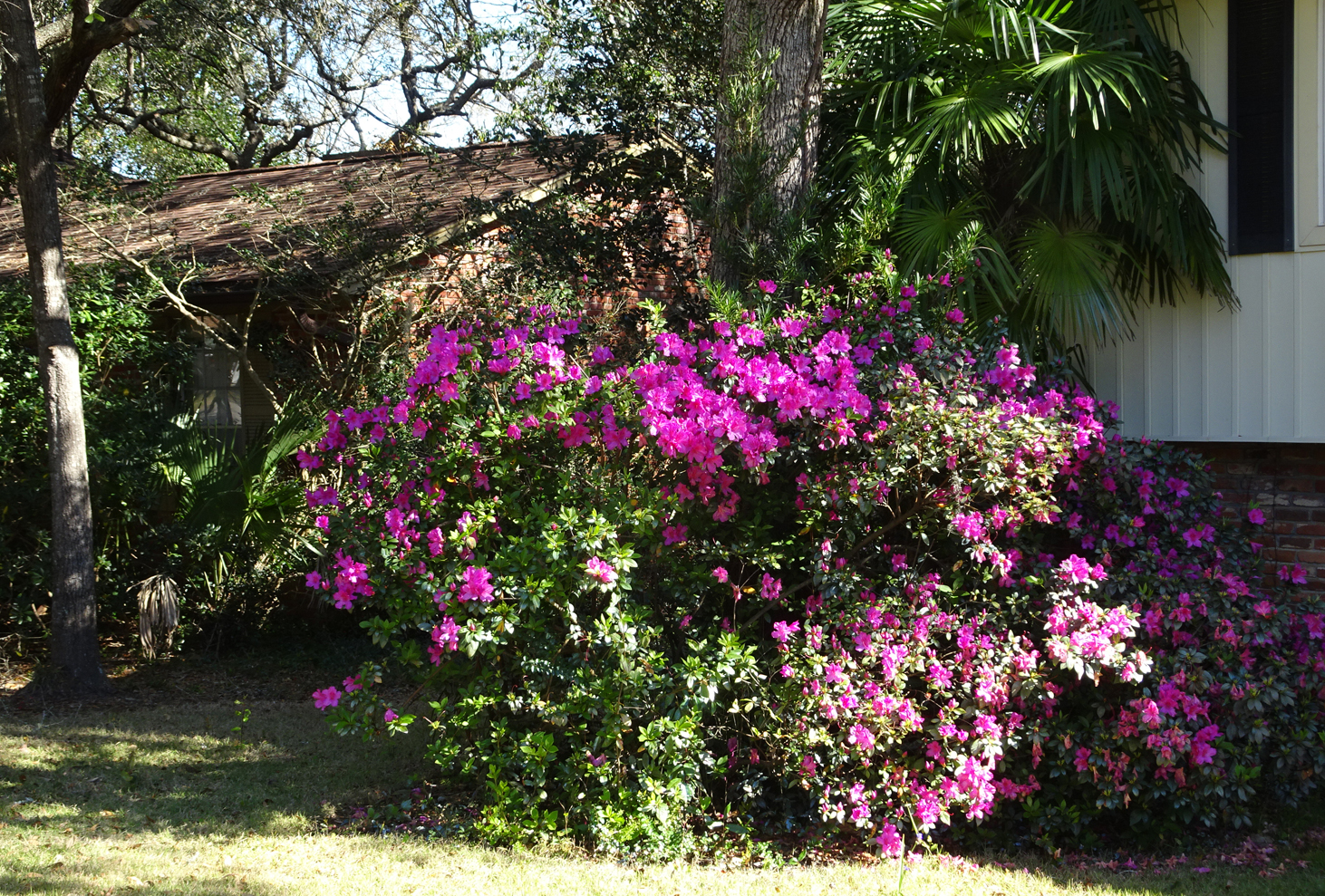
Despite the February date, azaleas are in full bloom around here - about 3 weeks earlier than normal.  It always amuses and entertains me to imagine how azaleas mirror the personalities of their owners.  This big, beautiful plant feels like a woman with her hair down, relaxing in the sunlight.

Across the street, however, an azalea hedge separating two houses has a much more "buttoned up" appearance, sacrificing blooms and density for formality and "neatness".

As I pondered the character-predicting capabilities of azalea shrubs, I heard a large bird calling loudly up above me in the tree canopy.  Frustrated by my rude intrusion as I stood stock still on the sidewalk just below her perch, a red-shouldered hawk squawked at me from a tall pine for several minutes before finally flying off, unwilling to tolerate my presence any longer.  As she flew, I mentally thanked her for allowing me to capture her picture, despite her irritation.
Continuing down the sidewalk, I couldn't pass up a picture of this evocative rope swing, taking advantage of a meandering sand live oak branch in someone's front yard.  I just wish there had been several small kids playing on it while I passed by!

Not too far away, another large oak was in obvious decline, being strangled by a rapacious English ivy vine scrambling up its trunk to compete for the light above, while its roots competed for water and nutrients below.

Even as I was aiming the camera, trying to get a good angle on the ivy vine and oak tree, I registered calls from the red-shouldered hawk again.  Looking up, over a house roof and into a back yard, I saw a huge nest with its raucous owner standing guard nearby.

I had known there was a pair of red-shouldered hawks nesting in the area, as I'd seen some of their mating displays from our backyard, but now I know where their nest is!  Even a short walk can uncover some pretty amazing discoveries.

"Hawk Street" ends in a cul-de-sac that borders the local golf course.  I couldn't resist a quick photo of these blooming azalea bushes along the golf course fence, framed by oak trunks and overhung with Spanish moss.

Continuing around the cul-de-sac had me heading back towards home.  As I walked past a quite neglected (but obviously once loved) front yard, I noticed this little concrete cherub.  Nestled down in a mix of variegated English ivy and fern fronds, he was a warm love note amidst the ragged remnants of the overgrown landscape.
As a contrast to the earlier "interior landscape" of the sand live oak tree, I snapped a quick picture looking up into a fairly young southern magnolia.  They are both native trees, but there is such a different quality of light, color and texture in their forms!

Hearing a variety of different bird calls, loudly rattled off in sequence, I wasn't too surprised when this mockingbird flew over to a hedge, then up onto the electric wires.  It was so nice of him to pose for me!

Across the street from the mockingbird, more "buttoned down" neighbors are obviously careful to keep their azaleas from looking too wild and crazy.  These shrubs are probably younger than the earlier hedge, in a sunnier location, and pruned more frequently, so there were more blooms and a thicker appearance overall.  Still, I prefer my azaleas to be free.

Rounding another corner, I was looking at a highly squared off azalea when I noticed the trunk of the southern magnolia shading it.  What causes this braided appearance?  Pruning up of the branches earlier in its life?

Speaking of pruning, why was it necessary to pollard this poor tree, looking like hell in the hell strip?  I didn't recognize the species from just the truncated remains of the branches and the bark alone, so I'll have to keep an eye on it and see what the leaves look like when the poor thing finally manages to push out a few.

As an aside, though, the bark on the trunk had obviously been a favorite place for yellow-bellied sapsuckers to feed over the years, bearing a textural pattern of holes that could almost be used to create a modern art piece.

Now I was completing my small neighborhood loop, looking at the streetscape, ornamented by sand live oak trees, with the light behind me.   Aren't these trees wonderful?  It was the presence of these trees that attracted our daughter to this neighborhood, 5 or 6 years ago.  (Then 2 years ago, she and her husband and our grandbabies attracted us to the same neighborhood!)

In the foreground of the photo above, you can see the soccer plinth and a stump in front of it.  That stump is the remnant of a large popcorn tree, an invasive species (in the Euphorbia family!) that was, thankfully, cut down a year ago.  The stump is beginning to sport an accent of frilly fungus as it starts to decompose, but it was the deep blue of the spiderwort blooms that caught my eye.  I'm a real sucker for blues of this hue.

As I approached the end of my walk, I couldn't resist capturing this quintessentially southern scene, again from the garden across the street from us.  Oak trees provide structure, high shade, and a catch-hold for graceful Spanish moss.  Underneath those picturesque giants, tall, dark green camellias and lower, rounded azaleas bloom brightly, skirted by fallen camellia petals and ferns.  Can't you just hear the whispered southern accents and the clinking of ice in tall drink glasses?

Thank you for coming on my winter walkout with me.  It's been fun to share my regular haunts with you - and I've loved seeing where everyone else is doing their winter walkouts, too.

As I finish, though, I have to wonder what it would be like for different people to walk the same route and share what caught their attention.  Wouldn't that be a fun way to compare and contrast how each of us sees the world differently?!  Another project for another time, I guess.  I hope you're enjoying the world around you, whatever season your weather is bringing these days, wherever you're planted.

Thursday, February 16, 2017

My Garden Shadow[s]

With many apologies to Robert Louis Stevenson,

"I have three "little" shadows that go in and out with me.
And what can be the use of them is more than I can see."

As I garden, I usually have a faithful entourage, albeit a rather hairy, sometimes smelly, one.  With the passing of our dear cat T.J., I am now sadly reduced to three "shadows", but what great companions they are - and how loved, warm and protected they make me feel!

Becker is the eldest...and the largest.  We got him shortly after Katrina, after my dear old girl Annie passed away.  The 7 week old pup that fit on my lap coming home grew up a little bit!  Ummmm, perhaps MORE than a little bit, topping out at close to 150 pounds "back in the day."  He's 11 1/2 now and beginning to slow down, but he's still as bright-eyed as ever.

Next in size is Blue, whom we adopted as a 16 month old "wild man" several years ago.  He'd been confined to a pen in the middle of his owner's backyard and he was quite vociferous about that indignity; I could hear him from blocks away when I went to meet him for the first time.  While kennel-bound, Blue apparently decided that it was his divine duty to keep the world safe from cats and squirrels, but the fence kept him from carrying out his appointed duties.  When I brought him home the first time, he hit the ground at a dead run, ears back and ruff up, to take out one of our cats.  I seriously questioned my sanity in bringing him home at that moment, but Blue learned quickly to accept our pack members.  He's a loving and important member of our family now.  Woe betide an unwary squirrel, however, or a cat that doesn't "belong."

Smallest of my garden guardians is Bella...but she is mighty in spirit!  Bella is another refugee, abandoned by her original owners when they moved.  At that point, Bella adopted our daughter, bringing along her 2 half-grown kittens.  When Jess tried to keep Bella inside, though, Bella made it quite clear that she is a free spirit and would not be confined.  Lo and behold, Bella ended up taking residence with "Mom and Dad', on our 10 acres in Kansas.  She's been a good sport about the move to a more populated area, but she still much prefers the out-of-doors, despite my open door policy.

(Note:  For the sake of the wildlife, I would  MUCH prefer that Bella - and all cats - be kept inside, but Bella has very strong opinions about that concept and makes herself abundantly plain about what she considers acceptable.  As often seems to happen, I have learned to compromise....)

I hope you have gardening companions every bit as loving and loyal as mine - and perhaps even a little less likely to break off or otherwise destroy a plant when they inadvertently step on it.  I try to keep an open mind, though, and think of the "pruning" that is occurring.  At any rate, I consider the occasional, accidental loss of a plant well worth the companionship.

Thoughts While Weeding

What do you think about while you weed?

As relaxing and enjoyable as I find it to weed, you'd think I'd be thinking elevated, beautiful thoughts that calmed my spirit and elevated my soul.

You would be grossly wrong.  A few days ago, I found myself "listening" to  my thoughts and here's what I heard:

1)  a series of theme songs running through my head from Winnie-the-Pooh, "I'm so rumbly, in my tumbly, time for something SWEET, to eat!"  and "Winnie-the-Pooh, Winnie-the-Pooh, scrubby little tubby all stuffed with fluff!  He's Winnie-the-Pooh, Winnie-the-Pooh, willy, little silly, old bear!" and "Up, do-own, up!  Up, do-own, up!  When I up, down, and touch the ground, it puts me in the mood.  Up, down, and touch the ground, in the mood for food!  I am short, round, and I have found, speaking poundage-wise, I improve my appetite, when I exercise!"

2) more somber thoughts about our family friend who, at 55, was diagnosed recently with a very malignant form of cancer,

3) and, of course, some political angst mixed in with the more pressing comical and tragic elements.

At other times as I weed, I find myself composing gardening blog posts.  Understand, please, that the vast majority of these garden-composed posts have long since escaped my mind by the time I actually sit down in front of the computer.  Nonetheless, I go on, mentally "writing."

As I weed, sometimes I dwell on transplanting that needs to be done or on other changes to my "landscape designs".  ("Landscape designs", in my garden, is a euphemism for the "plop 'em there" design pattern that I generally follow when I bring home a carload of fantastic plants that I've just discovered at my local nursery or plant sale.)

Most importantly, I think, I talk to the creatures that I see while I'm weeding, like this recently de-tailed ground skink,

this red-faced little southern toad I disturbed, buried in the soil,

or the red-shouldered hawk that haughtily surveyed the landscape while "hidden" right above me.

All of these guys joined me in the garden recently, even though it's still early February.  They are among the living creatures with whom Greg and I share our landscape, so it seems only polite (and politic) to discuss the changes I'm making with them when I see them.

What do you think about while you weed?

Sunday, October 30, 2016

Mysteries Solved: Three "New" Plants in the Garden

Just for the record, I HATE botanical keys.  You know the sort - those dichotomous keys where you spend more time in the glossary than you do looking at the specimen.  "Is this acute or attenuate?  What the hell does 'glandular' actually LOOK like?  Are these considered lobes or is this simply a wavy leaf edge?  Phyllaries?  What in the world is a phyllary?"  Heaven forbid your specimen isn't in the growth stage that the key is looking for!  The very first step in the most recent key I was using called for an examination of ribs on the seeds - but I've been waiting all summer for my plants to simply bloom, let alone for seed to set.  They are still weeks away from having ripe seeds!

Thankfully, there's the internet and friends and sheer doggedness.

I've actually been able to solve three identification mysteries recently, two of them at least partially through the use of dichotomous keys.  The first mystery I solved was what the slightly blurry, tall plant was on the right hand side in the foreground of the photo below....

This was a volunteer in the backyard which I noticed early last spring, although this photo was taken in early June.  I was hoping it was a goldenrod (Solidago sp.), rather than horseweed (Conyza canadensis).  The mystery plant kept growing taller and taller and taller, not heading out until sometime in September. When it finally bloomed, I was vindicated.  Definitely goldenrod. 

Definitely goldenrod.  It was much tougher to figure out WHICH goldenrod, though.  Using keys and photos, I was finally able to work it out:  I now have a locally sourced, pine barren goldenrod (Solidago fistulosa).  Because not all goldenrods are created equal and because pine barren goldenrod is notorious for its "vigorous spreading" via rhizomes, it's good to know the actual identity of this plant.  I'd been planning on moving it anyway, since it's too tall for its location - now I know I HAVE to relocate it to someplace where its expansive tendencies won't be a big problem.  Sounds like a lower terrace plant to me!

Just to the left of that first mystery plant was another mystery plant....

By early June this second plant was shorter than the first mystery plant, but still fairly tall.  It looked vaguely like an althea (Hibiscus syriacus), which does naturalize in this area, but that didn't seem quite right.  So I waited and waited and waited for this plant to bloom, too.  Meanwhile, the stems got woodier and woodier and the height got taller and taller.  Finally it, too, bloomed - just shortly after the pine barren goldenrod.

It's rather hard to see the plant in this photo from 10 days ago, but it's the upright plant in the middle of the goldenrod.  It's even harder to see the small, white blooms from this far away, but here they are, up close and with a syrphid fly on one of them....

With few close relatives to distinguish between, it was fairly easy to peg this plant as saltbush/eastern baccharis/groundsel bush (Baccharis halimifolia) once the blooms appeared.  Indeed, had I ever grown this plant before, I would probably have recognized it much sooner.  While I would have preferred a female plant, since the female blooms are much showier, I am still excited about having this pollinator magnet show up naturally.  The male blooms, above, are about 1/4" in diameter, to give you a sense of scale.  They are not showy, but the insects sure love them!

As the plant grew taller over the summer, I started planning to relocate it to the lower terrace along with the goldenrod.  However, several sources mentioned that saltbush makes a very pretty small tree, so I've changed my mind and decided to limb it up and use it to anchor the southern end of the bed that has grown up around these two mystery plants.

The third mystery plant has been nagging at me for identification almost since the day we moved into the house.  I noticed a rather pretty looking plant out near the lakeside deck a year ago in June and marked it so that it wouldn't get mown.

Last fall it bloomed with golden "daisy" flowers, after significant browning out on its lower stems.  Despite the brownout, the blooms were vibrant and showy.

Because of the blooms, last fall I was able to figure out that this was a goldenaster (Chrysopsis sp.), but I've been stymied about WHICH goldenaster.  There are several goldenaster species that only occur in this general area of the Florida panhandle, so there aren't many descriptions or photographs of those species available on the web.  Generally, the wildflower guides only showed one or two species out of the 6 or 7 that were possibilities.

We've had irrigation on the yard this summer and it has made a big difference with this plant.  While it browned out badly last summer without irrigation, this summer it has hardly browned out at all.  This plant has also probably tripled in size from last year to this, at least in reference to the number of stems and flower heads it has; it stays a wonderful 18" tall in height.

Drum roll, please!  I now know which species this is:  Godfrey's goldenaster (Chrysopsis godfreyi).  According to the USDA Plant Profiles database and the Atlas of Florida Plants, it is found in
5 or 6 counties in the panhandle of Florida and a little bit, somewhere in Alabama.  In other words, this is a fairly localized plant - which really excites me!  I am so glad that I protected it from mowing, particularly since it's turned out to be so attractive.

While this plant is nice from a distance, up close it's truly glowing....

Now that I know what a winner this plant is, I'm going to try to start some seeds...when at last I finally get some.  At least I don't have to worry about working through a dichotomous key on this one again - those ribbed or ribless seeds/reflexed phyllaries had me stymied for quite a while!


Sunday, October 23, 2016

Garden Pest Control, Goldenrod Style

Frustratingly, we are often gone during the time when the goldenrods are in full bloom.  I say "frustratingly" because I am fascinated by pollinators and by the interaction between plants and the insects that use them...and goldenrods are among the most highly utilized flowers in my gardens.  Only asters seem to attract more insects.

We only have 2 species of goldenrod in our yard so far.  One species, wreath goldenrod (Solidago caesia), I planted.  The second species, whose identity is more problematic, came in on its own.  When I looked at the USDA Plant Profiles site, there are 12 goldenrods said to be native to Okaloosa County, Florida.  I can eliminate two of those species based on growth habit, but I am still left with at least 10 possible species that might be "my" goldenrod.  That said, I'm not sure how important it is to know the exact identity as, to my knowledge, all goldenrods are spectacular pollinator plants.

Like most years, we were gone for 10 days during peak goldenrod bloom time this year, but I was able to get a few photos the day we left and, again, a day or two after we got back.  I don't have all the insects identified, but I thought I'd share some of the photos with you anyway.

As I listed the species I'd photographed nectaring on or otherwise using our goldenrods, I realized that goldenrods are marvelous predator attractants.  There were at least 6 different wasp species nectaring, most of whom feed their young on moth or other caterpillars.  (Note:  I am paranoid about wasps, but have never been bothered by a wasp feeding on a flower.  Generally only social wasps and bees are aggressive, and then only in defending their nests.)  There were other insect predators, too.

There were at least 4 different mason or potter wasps, all of whom feed their young on caterpillars:


Among these cute little solitary wasps, some (the mason wasps) utilize existing small holes to pack with paralyzed caterpillars and lay an egg upon, before closing up the opening with mud.  The holes in our bricks around the windows, where a prior owner had to board up the windows in preparation for a hurricane, are popular nesting spots for mason wasps.  Others of these wasps build free standing pots of mud which are filled with paralyzed caterpillars before an egg is laid and the pot is sealed.  Those are, not surprisingly, known as potter wasps.


Shown below, northern paper wasps can be very colorful.  This IS a social species and they build a classic "wasp nest" made of regurgitated wood fibers (paper).  Typical of social wasp species, paper wasps do defend their nest - but the individual wasps pay no attention to people when they are away from the nest, feeding on nectar.  Like the species above, this species hunts caterpillars but they hunt other insects, too, to feed their larvae.  They chew up their prey and feed their young on the protein rich regurgitated mix that results.


Thread-waisted wasps are odd looking creatures, but again they are great predators.  While the adult feeds on nectar at flowers, they feed their young on moth caterpillars.  Good protein for growing bodies!


Breaking the long line of caterpillar predators, there were also five-banded tiphiid wasps.  Tiphiid wasps lay each egg on a white grub in the soil (yes, THOSE white grubs).  When the egg hatches, the wasp larva burrows into the grub and slowly eats it from the inside, saving the most important organs for last, so that the grub remains alive and "fresh" until the bitter end.


Two other predatory insects that I found and photographed on the goldenrod were a pair of ladybugs (whose photo was so bad that I'm going to save my photographic reputation and not share it) and a milkweed assassin bug. 


Assassin bugs are indiscriminate predators and feed on many different kinds of insects.  I have to wonder how this brightly colored insect can get close enough to any other insect to capture it and eat it, but obviously they do.


There were common green bottle flies nectaring on the goldenrod, too.  These are one of the insect species whose larvae feed on carrion - and those larvae are also used by forensic scientists to date the age of corpses.  Obviously, the adults feed on flower nectar.


When you think of pollinators, you think of bees, right?  So far I haven't actually shared photos of any bees that were visiting the goldenrod, but there were, indeed, several different species of native bees that I saw.

In fact, bees were the most obvious insects feeding on the goldenrod blooms - at least in part because some of them were the biggest insects.  What is the first thing you notice in the photo above?  The two big eastern carpenter bees, of course.

Zooming in a little bit closer, you can see the righthand one in decent focus.  The left one, the one that is flying, is unfortunately out of focus, but I think you can still see the "bare" abdomen that is indicative of carpenter bees.  That big shiny black abdomen is the quickest and easiest way to separate carpenter bees from similarly sized and shaped bumblebees, whose abdomens are covered with hair.

There was one big black bee that also had a shiny abdomen.  I'd never seen one quite like it before, so I submitted the photos to BugGuide, where I was told it was also a carpenter bee....


.... a female southern carpenter bee (Xylocopa micans).  The males of this species have yellow or orangish hair on their thorax, similar to the eastern carpenter bee above, but they often seem to have green eyes... or at least that's what it seems like, looking at the images on BugGuide.

There was a male green metallic bee (Agapostemon splendens), a species I've seen on other flowers in the yard before.


There were also a couple of bees that I haven't identified yet.

I may need to ask for help from BugGuide to identify these, too.


If we'd been home during the peak goldenrod bloom time, I'm sure that I'd have more insect photos to share with you.  There were, for example, several butterflies that I'd see nectaring on the goldenrod, but they were always gone by the time I got outside with my camera.

All in all, though, I'm pretty happy with the 15 different species I observed using the goldenrods in our yard.  These pollinators will also be pollinating other flowers in the area...and over half of these species will also be controlling leaf-eating insect species in the yard as they raise their families.  That's pest control I LOVE to see happening!