Okay, this is a warning. I am going to sound a little "Woo-woo" in this post. I can't help that because sometimes that's just how I am.
So, with the appropriate warning out of the way, I have to confess that sometimes it seems as if certain animals consent to show themselves to me so that I can photograph them. How else to explain the chance to photograph the fly attacking the hornworm last week?
Or the funnel spider that sat at the entrance to its hole and just looked at me one morning last summer? That's very unusual behavior for a funnel spider.
How about last week, when the scissor grinder cicada (Tibicen pruinosus) flew to the stem of a sunflower, about 5 feet from where I was weeding in the vegetable garden, and started to loudly sing away, making sure I had the chance to put his song and his appearance together.
He even sat there singing while I stood up and photographed him!
Then there was the hanging thief robber fly (Diogmites sp.) that landed right in front of me to munch away on her wasp victim, while she dangled nonchalently from a single foot hanging onto the dry tip of an aster leaf.
Look how gently she seems to be cradling her prey.
I shouldn't forget the beautiful (and BIG) garter snake that posed prettily on the back path earlier this summer, obviously replete from a satisfying meal of (probably) cotton rat or baby rabbit.
I walk the paths with 2 large German shepherds and I make little or no attempt to be quiet or to keep the dogs on heel. That snake HAD to know we were coming!
Don't get me wrong - I am definitely not complaining. I absolutely love
getting glimpses into the lives of the animals that share our "little bit of Earth" with us. It's a privilege and an honor to share their
stories with a wider audience, too.
I'll leave you with one last animal story I was privileged to witness recently and with the related thought that it sparked in me.
I saw this David and Goliath story in my front garden just last week. How in the world did that little crab spider manage to catch - and especially hold onto - that huge swallowtail butterfly? The butterfly was obviously old - it's tattered wings hint of multiple adventures survived. Was the butterfly just too old to have the energy to get away this time? Or did it, somehow, know that its time was done and "consent" to become a meal for the little spider, passing along its energy to help the wheel of life spin just a little bit further around?
Do animals
"consent" to be eaten and to become part of the food chain? I've read
that the Native Americans always used to say thanks to the animals they
hunted for giving their lives to them for sustenance. Was that a
willing choice on the part of the animals? Or was that simply an acknowledgement, on the part of the Native Americans, that they were taking the lives of other animals to support their own?
Of course I have no answers to my questions and I know that I'm being fanciful, especially in imagining the animals' desire to have their stories shared on the internet, but thanks for reading this and letting me indulge in whimsy from time to time. I hope you'll always share the chance encounters you have with wildlife in your gardens - and the stories behind those encounters, too!
Showing posts with label Robber flies. Show all posts
Sunday, August 31, 2014
Monday, April 21, 2014
Lousy Photos Still Have Their Value
Having set myself the task, last year, of documenting all of the plants and animals that I can identify on our 10 acres, I have found myself overwhelmed with photos in short order now that spring has arrived.
It's MUCH easier to take photos of insects than it is to identify them. Just in case you wondered.
It's also much easier to take photos of insects than it is to take GOOD photos of insects - good photos being defined as photos where you have a snowball's chance of actually identifying the insect in question based on what you are seeing on the screen in front of you. I learned my basic insect identification skills the "good" old fashioned way, a.k.a. by capturing the insects and killing them, then identifying them at my leisure through the use of various magnifying devices and dichotomous keys.
I prefer trying to identify living insects in blurry photos, even if it means I won't get many of them actually identified. I'm just not into killing living beings of any sort, if I can avoid it. So here are a few of my so-so photos, some of which I've managed to identify and some of which are still mysteries to me....
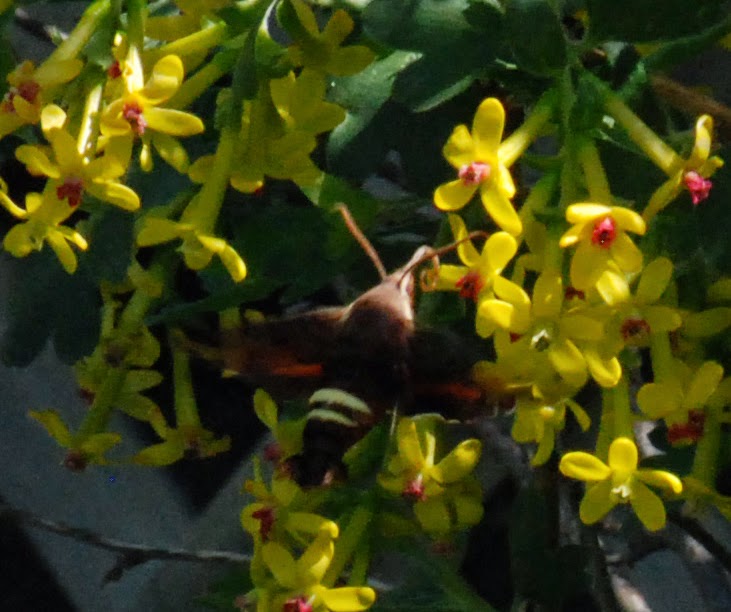
The clove currant (Ribes odoratum) is in sweet, full and glorious bloom right now. On Saturday, when I stopped by it, I noticed a dark hawk moth feeding. The wings blurred rusty brown as the moth moved from bloom to bloom, while the heavy abdomen had a tuft at its end and was encircled by 2 bright yellow bands. I'd never seen this particular hawk moth before, so I tried to take its picture, thinking I could identify it more accurately if I had a good photo. The blasted little beast was definitely camera shy and not very trusting of giant beings standing nearby with big black boxes stuck up near their face. It tended to keep to the far side of the plants, rather than venturing out into the open near to me.
Thank heavens for digital. Fifteen photos later, the moth flew away and I've not seen it since. When I checked out those 15 shots to see what I'd managed to capture, sadly this was the BEST image of the lot.
As lousy as this photo is, I was still able to use it to identify my "dark" hawk moth as a Nessus Sphinx Moth (Amphion floridensis). This species is supposedly one of the more commonly encountered day-flying moths, but I've never seen one before. The larvae/ caterpillars, which are a type of hornworm, feed on grape, Ampelopsis, and Capsicum (bell and hot pepper) plants, all of which are frequent in our yard.
Looking around under one of our green ash trees (Fraxinus pennsylvanica), I noticed some small, gnat-like creatures flying. When one came to rest within my sightline, I decided to snap its picture. Then I noticed a second one nearby. Snap. Snap. Snap. These little creatures were about 1/4" or 3/8" long, colored gray and sitting on gray bark. I have no idea why I thought I could get a good photo. Here's what I managed to capture, 26 photos later, ....
I didn't think this silhouette would show me much at first, but when I zoomed in, I noticed that the "big" fly had a small fly caught underneath it, held in a classic "I'm eating you" sort of position. When I showed it to Greg, he immediately thought the "big fly" was a robber fly of some sort. I can go with that.
Another shot of the same individual accidentally captured a second "big fly" just above it on the bark.
Do you see the 2 of them? The one in the bottom right of the photo is the one shown in silhouette above; the second one is in the top left of the photo. When I zoomed in on the second individual, it also seemed to have some sort of fly prey - with a yellow tipped abdomen - caught.
From the top, there's little evidence of "big fly #1" having prey captured beneath it, but the silhouette shot accidentally revealed the secret.
I haven't decided yet whether I'm going to try to submit these photos to Bug Guide or not - my feel is that they are not good enough for any sort of identification, but maybe I'll chance it anyway. I do think these are tiny robber flies and I'd love to see if anyone can tell me any more about them.
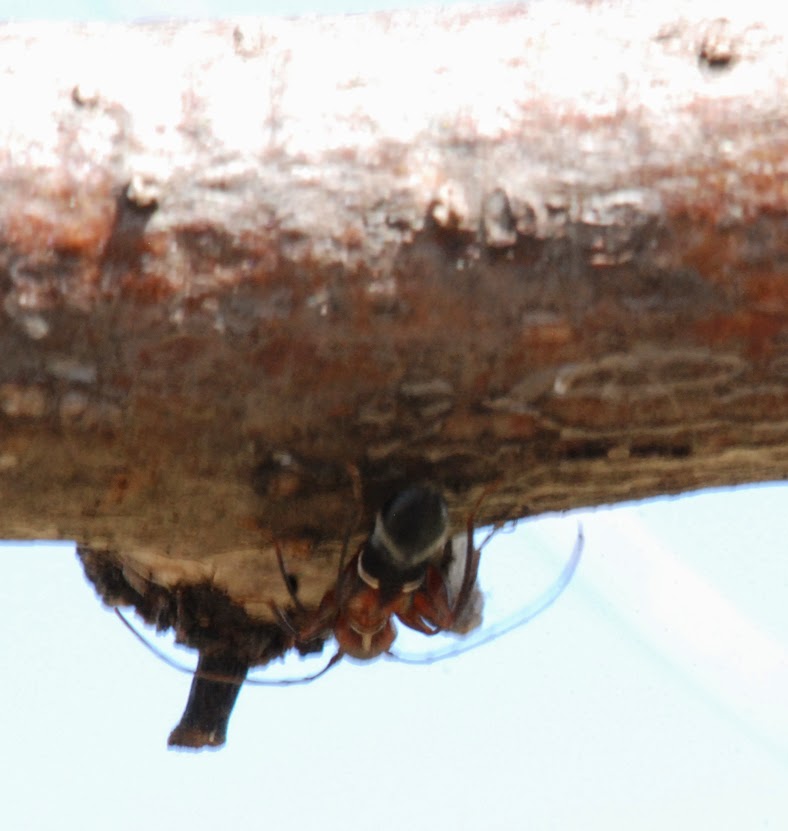
Another lousy picture that nonetheless taught me something new about the creatures in our yard was this one, taken Saturday of some sort of critter on the underside of a small honeylocust branch....
When I took the photo, I thought the mess of moving legs was perhaps an emerging wheel bug. As I took several more shots, I changed my mind to thinking I was looking at a brightly colored ant. As I took the very last picture, something clicked and made me think, "Beetle?" When I looked it up, sure enough, beetle was correct! This is an Antlike Longhorned Beetle (Euderces pini). The larvae of this beetle feed on dead wood in a variety of types of trees; the adults are typically seen nectaring at flowers. The adults mimic ants and are notoriously hard to photograph because they never quit moving. This is another insect that tops out around 3/8" long. As lousy as my photos of this creature are (and this is the best of the lot), I feel lucky that I got a couple shots that allowed me to identify it at all.
As you can tell, I've got a LO-O-O-ONG way to go before I get very decent at taking good insect photos, but I do have fun and I learn a lot, even at the level of (in)competence that I have attained. The natural world seems more wondrous every day.
It's MUCH easier to take photos of insects than it is to identify them. Just in case you wondered.
It's also much easier to take photos of insects than it is to take GOOD photos of insects - good photos being defined as photos where you have a snowball's chance of actually identifying the insect in question based on what you are seeing on the screen in front of you. I learned my basic insect identification skills the "good" old fashioned way, a.k.a. by capturing the insects and killing them, then identifying them at my leisure through the use of various magnifying devices and dichotomous keys.
I prefer trying to identify living insects in blurry photos, even if it means I won't get many of them actually identified. I'm just not into killing living beings of any sort, if I can avoid it. So here are a few of my so-so photos, some of which I've managed to identify and some of which are still mysteries to me....
The clove currant (Ribes odoratum) is in sweet, full and glorious bloom right now. On Saturday, when I stopped by it, I noticed a dark hawk moth feeding. The wings blurred rusty brown as the moth moved from bloom to bloom, while the heavy abdomen had a tuft at its end and was encircled by 2 bright yellow bands. I'd never seen this particular hawk moth before, so I tried to take its picture, thinking I could identify it more accurately if I had a good photo. The blasted little beast was definitely camera shy and not very trusting of giant beings standing nearby with big black boxes stuck up near their face. It tended to keep to the far side of the plants, rather than venturing out into the open near to me.
Thank heavens for digital. Fifteen photos later, the moth flew away and I've not seen it since. When I checked out those 15 shots to see what I'd managed to capture, sadly this was the BEST image of the lot.
As lousy as this photo is, I was still able to use it to identify my "dark" hawk moth as a Nessus Sphinx Moth (Amphion floridensis). This species is supposedly one of the more commonly encountered day-flying moths, but I've never seen one before. The larvae/ caterpillars, which are a type of hornworm, feed on grape, Ampelopsis, and Capsicum (bell and hot pepper) plants, all of which are frequent in our yard.
Looking around under one of our green ash trees (Fraxinus pennsylvanica), I noticed some small, gnat-like creatures flying. When one came to rest within my sightline, I decided to snap its picture. Then I noticed a second one nearby. Snap. Snap. Snap. These little creatures were about 1/4" or 3/8" long, colored gray and sitting on gray bark. I have no idea why I thought I could get a good photo. Here's what I managed to capture, 26 photos later, ....
I didn't think this silhouette would show me much at first, but when I zoomed in, I noticed that the "big" fly had a small fly caught underneath it, held in a classic "I'm eating you" sort of position. When I showed it to Greg, he immediately thought the "big fly" was a robber fly of some sort. I can go with that.
Another shot of the same individual accidentally captured a second "big fly" just above it on the bark.
Do you see the 2 of them? The one in the bottom right of the photo is the one shown in silhouette above; the second one is in the top left of the photo. When I zoomed in on the second individual, it also seemed to have some sort of fly prey - with a yellow tipped abdomen - caught.
From the top, there's little evidence of "big fly #1" having prey captured beneath it, but the silhouette shot accidentally revealed the secret.
I haven't decided yet whether I'm going to try to submit these photos to Bug Guide or not - my feel is that they are not good enough for any sort of identification, but maybe I'll chance it anyway. I do think these are tiny robber flies and I'd love to see if anyone can tell me any more about them.
Another lousy picture that nonetheless taught me something new about the creatures in our yard was this one, taken Saturday of some sort of critter on the underside of a small honeylocust branch....
When I took the photo, I thought the mess of moving legs was perhaps an emerging wheel bug. As I took several more shots, I changed my mind to thinking I was looking at a brightly colored ant. As I took the very last picture, something clicked and made me think, "Beetle?" When I looked it up, sure enough, beetle was correct! This is an Antlike Longhorned Beetle (Euderces pini). The larvae of this beetle feed on dead wood in a variety of types of trees; the adults are typically seen nectaring at flowers. The adults mimic ants and are notoriously hard to photograph because they never quit moving. This is another insect that tops out around 3/8" long. As lousy as my photos of this creature are (and this is the best of the lot), I feel lucky that I got a couple shots that allowed me to identify it at all.
As you can tell, I've got a LO-O-O-ONG way to go before I get very decent at taking good insect photos, but I do have fun and I learn a lot, even at the level of (in)competence that I have attained. The natural world seems more wondrous every day.
Labels:
beetles,
Biodiversity,
Flies,
Moths,
native plants,
Organic Gardening,
Photography,
Robber flies,
Trees,
Web of Life
Friday, August 30, 2013
A Hanging Thief Enjoys Dinner
Just walking around my yard and photographing the things that I notice is teaching me so much these days. I often don't realize what I'm seeing until I get inside, download the photos, and take a closer look. This post describes a case in point....
As I was looking over the asters in my front garden one evening in late July (and wishing this species bloomed before late September!), I noticed an odd insect "knot" down in a dark recess of leaves and stems. As I tried to get a little closer to figure out what I was actually seeing, the "insect knot" flew a foot or two sideways, into an area with much better light, resolving itself into a robber fly with something in its grasp. I dutifully took a couple photos, then moved on to find other interesting subjects around the yard.
On my way back into the house, about 30 minutes later, I snapped another photo or two, then went inside to upload my treasures and examine them more closely.
I was quite surprised to see the robber fly had actually captured a paper wasp and was holding onto it while hanging from an aster leaf with one foot. The wasp seemed easily as large, and probably heavier, than the robber fly. This seemed a little odd, so I went back out to take another look. Almost an entire hour had elapsed since I first saw the robber fly, but it was still in the same place, with the wasp still in its grasp and still hanging from one leg. I took another series of photos, but I was losing my light, so I went back inside and started to research.
It turns out that this wasn't just an individual, acrobatic robber fly with a taste for precarious eating experiences. This was a type of robber fly known as a hanging thief, so named precisely because the entire genus, Diogmites, eats their prey this way, dangling from one leg. Furthermore, hanging thieves (I LOVE this name) regularly eat wasps and bees, often catching and eating insects as much as twice as large as themselves. The only downside that I could find to their bizarre eating preferences was a tendency to snack on honeybees, especially if honeybees were the predominant Hymenopterans around. Needless to say, in this sort of situation, beekeepers wouldn't be particularly fond of hanging thieves that were hanging around.
Like all robber flies, hanging thieves have piercing mouthparts. Once they capture their prey, they inject saliva, filled with digestive enzymes, into the unfortunate insect, let the saliva liquify the insides of said insect, and suck their juicy meal back out.
This final photo is focused on the prey, the wasp, rather than on the predator, the robber fly.
This unfortunate wasp was a paper nest wasp, Polistes metricus. I have no idea where the nest is, but there should be plenty of siblings to help keep the nest well provisioned and thus to produce next year's queens. In general, paper nest wasps apparently prey primarily on caterpillars, which they chew up and feed to their larvae back at the nest. The adults eat nectar and are commonly found on flowers. As far as I can tell, the front of my victim's face is rusty brown, signifying that it is a female. The face of males is yellow and their antennae also curl at the tips; males cannot sting, as the stinger is a modified ovipositor (egg-layer).
The balance of nature is a complex thing. The caterpillars eat the plants. The paper nest wasps eat both the plants (nectar) and the caterpillars. The hanging thieves eat the paper nest wasps. Hanging thieves lay their eggs in the ground. It's not known for sure what their larvae eat, but they are presumed to be predaceous on other soil invertebrates.
Have you seen any hanging thieves around your garden?
As I was looking over the asters in my front garden one evening in late July (and wishing this species bloomed before late September!), I noticed an odd insect "knot" down in a dark recess of leaves and stems. As I tried to get a little closer to figure out what I was actually seeing, the "insect knot" flew a foot or two sideways, into an area with much better light, resolving itself into a robber fly with something in its grasp. I dutifully took a couple photos, then moved on to find other interesting subjects around the yard.
On my way back into the house, about 30 minutes later, I snapped another photo or two, then went inside to upload my treasures and examine them more closely.
I was quite surprised to see the robber fly had actually captured a paper wasp and was holding onto it while hanging from an aster leaf with one foot. The wasp seemed easily as large, and probably heavier, than the robber fly. This seemed a little odd, so I went back out to take another look. Almost an entire hour had elapsed since I first saw the robber fly, but it was still in the same place, with the wasp still in its grasp and still hanging from one leg. I took another series of photos, but I was losing my light, so I went back inside and started to research.
It turns out that this wasn't just an individual, acrobatic robber fly with a taste for precarious eating experiences. This was a type of robber fly known as a hanging thief, so named precisely because the entire genus, Diogmites, eats their prey this way, dangling from one leg. Furthermore, hanging thieves (I LOVE this name) regularly eat wasps and bees, often catching and eating insects as much as twice as large as themselves. The only downside that I could find to their bizarre eating preferences was a tendency to snack on honeybees, especially if honeybees were the predominant Hymenopterans around. Needless to say, in this sort of situation, beekeepers wouldn't be particularly fond of hanging thieves that were hanging around.
Like all robber flies, hanging thieves have piercing mouthparts. Once they capture their prey, they inject saliva, filled with digestive enzymes, into the unfortunate insect, let the saliva liquify the insides of said insect, and suck their juicy meal back out.
This final photo is focused on the prey, the wasp, rather than on the predator, the robber fly.
This unfortunate wasp was a paper nest wasp, Polistes metricus. I have no idea where the nest is, but there should be plenty of siblings to help keep the nest well provisioned and thus to produce next year's queens. In general, paper nest wasps apparently prey primarily on caterpillars, which they chew up and feed to their larvae back at the nest. The adults eat nectar and are commonly found on flowers. As far as I can tell, the front of my victim's face is rusty brown, signifying that it is a female. The face of males is yellow and their antennae also curl at the tips; males cannot sting, as the stinger is a modified ovipositor (egg-layer).
The balance of nature is a complex thing. The caterpillars eat the plants. The paper nest wasps eat both the plants (nectar) and the caterpillars. The hanging thieves eat the paper nest wasps. Hanging thieves lay their eggs in the ground. It's not known for sure what their larvae eat, but they are presumed to be predaceous on other soil invertebrates.
Have you seen any hanging thieves around your garden?
Wednesday, June 19, 2013
Robber Fly Chowing Down
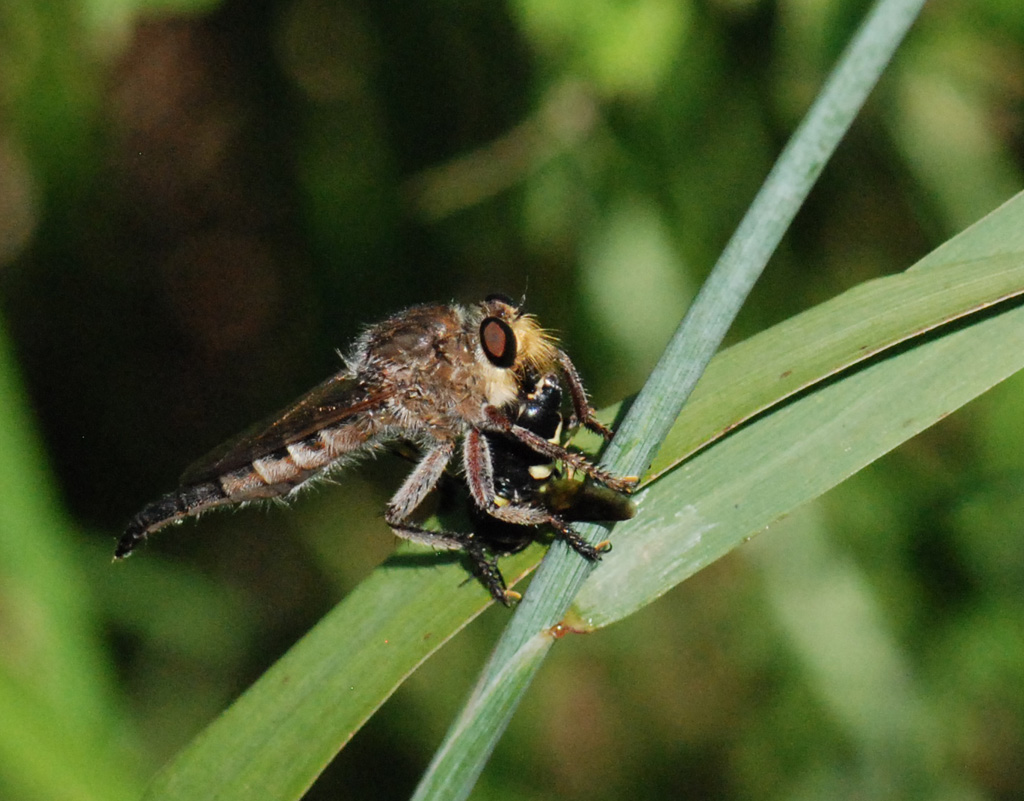
I just wanted to share this photo I caught of a robber fly chowing down on another insect. (Perhaps a syrphid fly?) When I first saw the robber fly and started taking its picture, I didn't realize it had prey in its grasp, but by the time I got close enough for this last shot, I knew it had something.
Robber flies are great predators! Another insect to welcome into your garden.
Labels:
Organic Gardening,
Predator-Prey,
Robber flies
Subscribe to:
Posts (Atom)