Showing posts with label Ragweed. Show all posts

Thursday, August 01, 2013

Spiders in Paradise

I've been seeing a lot of spiders in the last few weeks and many of them are new to me.  Spiders are wonderful predators in the garden, especially of insects, so I'm always happy to see them.  Of course, spiders also become prey for other animals, such as certain wasp species, as I talked about in a recent blog post.  The balance of a healthy garden community is a wonderful web of interrelationships!

For the most part, I have no idea how to identify spiders beyond the basics:  jumping spider, orb weaver, crab spider, and so forth.  So I'll share what I know - or think I know - about each spider and see if anyone can add any information for me!

Before I start, though, does anyone have a reference on spiders that they would recommend?  Bugguide.net has some information on spiders, as does Insects in Kansas, but I'm looking for a reference that would really concentrate on telling the different spider families apart, plus maybe identify some of the more common and widespread species.  I'd also like it to be primarily North American based, so that I don't get led astray with species that I wouldn't find around here.

Anyway, here are some of my "catches", in no particular order.

I think this Argiope spider (identified by the thicker zig-zag pattern in the web, known as a stabilimentum) is perhaps a young black and yellow garden spider (Argiope aurantia), those huge spiders often seen in late summer and autumn in vegetable and flower gardens, while it's still too young to have developed its adult coloring.  According to the Bugguide.net site, this more centralized stabilimentum pattern is typical of the juveniles of this species.  (The little white packet hanging below the spider is an insect, wrapped up for eating.)

Later the stabilimentum is woven in a linear pattern in this species, as shown in this web made by a slightly larger and more mature black and gold garden spider.

While the more mature black and gold garden spider was found in the vegetable garden, the juvenile black and yellow garden spider was on giant ragweed (Ambrosia trifida) in the draw, as was this next spider, a mother with her eggs and new spiderlings.

I have no idea what group to put this spider and her babies into.  Truthfully, I didn't really realize what I was looking at until I got back inside and downloaded the photos.  I just saw some lumps of spider silk attached to the upper surface of a leaf, with a small spider by them, and took a couple photos.  I was actually surprised to see that the little yellow lumps were spiderlings, presumably freshly hatched.

When I went back 4 days later and took another photo, Mom and the babies were gone, but at least one of the egg sacs was open that hadn't been open in the earlier photos, so I'm thinking even more spiderlings hatched after my first photos.  I'm also thinking that the cream colored, thicker strands to the left of the egg sacs may be some sort of fungus, but it's just a guess.

One group of spiders that I've had great fun seeing in the draw, among the giant ragweed plants, have been the jumping spiders.  These guys are incredibly alert and seemingly curious - they will turn to look at me for a bit until I stay too long or get too close, then they almost magically disappear over the edge of a leaf or down the stem.  This tan guy was just minding his own business when I took my first photo...

but he almost immediately realized I was looking at him and turned his head up to look at me.  I managed to get 3 more photos before he got nervous and disappeared.

This darker brown cutie was content to stare back at me until I started moving in a bit closer.  Then he, too, was gone in a flash.

I've seen several primarily black jumping spiders in the ragweed, with red or orange coloring on their abdomens.  I don't know if these are all different species, or different sexes and/or ages of the same species.  Here is the individual with the least amount of red/orange on the abdomen...

...and a bit of metallic blue-green on its mandibles, briefly visible in this side shot I was able to capture.

There were several other black jumping spiders with red on their abdomen, scurrying away from me so that I never could get a good shot of their face, but I think they were all the same species as this magnificent individual....

...who looked like he/she wanted to challenge me to a fight!  Notice how enlarged those extended front legs are.  Surely that will help me identify this spider down to the species level....

One last jumping that I've seen recently was this little guy hanging out on my Jerusalem artichoke (Helianthus ).  Here he/she is, peering at me to see if I was dangerous or not!

Of course there have been crab spiders in the flowers, too, like this one, hiding in a sunflower, with brown markings on its abdomen...

...and this white one that was on a purple coneflower...

...and this yellow one, without brown abdominal markings, on a Gaillardia bloom.

I have no idea if these are all the same species, or different species, and I have no good idea of how I'd go about deciding that.  So, for now, I'm (barely) content to just label them all as crab spiders.

I hope you're seeing some spiders in your gardens too.  They are a great sign that your gardens are healthy.  Those spiders will work 24/7 to make sure that your gardens stay that way!
 

Thursday, July 25, 2013

Walkabout Treasures: Beauty in the Beast(s) - Part 4

It's no wonder that I never get half the topics posted on my blog that I'd like to put up.  I've written 3 posts already, but I still haven't covered everything that I saw on ONE walkabout last Sunday morning!  Add to that the fact that I went on another walkabout this morning, and I'll never catch up!

Of course, if I don't get busy writing, I'll never catch up anyway....

For some reason, one particular species of dragonfly was out last Sunday morning.  I took photos of 4 different individual dragonflies:  I knew that two of them were the same, but the other two individuals looked different to me.  It turns out that all four of them were the same species, despite how dissimilar they were.

The species I was seeing is the widow skimmer, Libellula luctuosa.  The basic widow skimmer is typified by the female, with yellow "racing stripes" that join together on the thorax, and brown wing patches next to its body....

The young male looks much like her, with the addition of some bluish white clouding in the middle of its wings, like the individual below....

As the males age, their wings get more and more of the bluish white clouding in their clear areas, while their body starts getting whiter too.  This guy was definitely an oldster, in dragonfly terms.

Despite the lack of yellow stripes anywhere, this is the same species as the two individuals above.

I haven't blogged about it yet, but I've been seeing more injured or disabled insects this year than I normally do.  While I was walking through the draw, looking at the giant ragweed (which is simply alive with different insects), I came across this wheelbug.  I don't know if his wing abnormality is due to an injury or is due to something that went wrong as he matured and shed his exoskeleton.

Whatever has caused this abnormality, I can't imagine he is as capable of flying as normal wheelbugs.  Can he hunt well?  Who knows, but I doubt he hunts as well as he would if he wasn't dealing with his problematic wing.

Not far away from the distressed wheelbug, and looking just about as perfect as a grasshopper can look, this pretty green grasshopper was hanging onto a large sedge stem in the draw.  It looks a lot like the sunflower grasshopper I shared on my last blog post, but as I looked a little more carefully at it, I realized that it's not actually quite the same.  This green grasshopper has brown eyes, rather than black, and it has black and white markings on the side of its thorax - making it a snakeweed grasshopper, Hesperotettix viridis.

Reading about this species told me that it primarily feeds on broom snakeweed...which is fine, except that I don't recall identifying anything known as snakeweed on our property.

So I looked up broom snakeweed, Gutierrezia sarothrae.  It's known as an increaser in overgrazed pastures because it is unpalatable to livestock (and actually toxic to cattle and sheep).  I still don't recognize it from our property, but it's entirely possible that there is some in the area somewhere.

Oh, rather humorously, the snakeweed grasshopper is actually considered beneficial because of its preference for eating this "weedy" plant!

Just as I thought I'd seen about all the interesting insects I was going to see along the path in the draw, I came across this preying mantis nymph.

Last fall I found an egg laden female mantis not too far from where I found this little guy on Sunday - I wonder if this is her offspring!

As I came back out of the draw, I found another grasshopper that caught my eye because it was so dark.  In fact, I caught myself wondering if it was dying of some sort of infection - except that it acted perfectly healthy.  So I took a photo and looked it up.

I probably wouldn't have shared this grasshopper with you, except that I love its name!  Meet the prairie boopie grasshopper, Boopedon gracile....

"Boopie" is evidently a simple shortening of its genus, but I love the name anyway!  This is the male - the female is larger and colored green and brown; based on photos, she's nowhere near as exotic looking as the male.

Although I took several dozen more photos after I came out of the draw, I'm only going to share one more of them here.  I haven't tried to identify this little cutie, although I think it's a very young katydid (longhorned grasshopper) nymph of some sort.  The dried bud it's sitting on is lanceleaf coreopsis bud, to give you a sense of scale.

I love the exotic appearance of this tiny baby; it seems way too fragile to survive on its own, but survive it apparently does.

I have at least one more thing to share with you from last Sunday's walkabout, but it deserves it's own post, so that will be next on my agenda...assuming no intervening rant swells up that I just have to get off my chest!  While you are anxiously awaiting (LOL!), enjoy your garden - and happy insect hunting!

Saturday, October 20, 2012

Autumn Color - Even in Kansas!

I've been away.  First a drive down to the panhandle of Florida to deliver Dahlia to our daughter, then a 10 day trip to Vermont, New Hampshire and Massachusetts.  It's been enjoyable to get away and see how fall is treating some other areas of the country, but the timing also means that I've missed several weeks out of one of my favorite seasons here at home.

After seeing hillside after hillside after mountainside of beautiful fall foliage in New England, I was feeling a little down-in-the-mouth about coming home to autumn in south central Kansas.  However, to my delight, there was some beautiful foliage color here for me to see, too.


I missed whatever show the remnants of our Amur maples put on this fall, after the heat and drought of the second summer in a row.   At least two-thirds of them have died, which will definitely change the feel of our backyard next summer.  I'm not feeling too panicky about their loss, though - they had been planted much too close together and their roots sapped the vigor of anything I tried to grow underneath them.

However, I barely noticed the absence of the Amurs because the green ash next to the deck had turned the most stunning golden yellow that I've seen since living here!
 

A few of the redcedars had put on a spectacular berry... whoops!... cone crop this year.  Against a blue autumn sky, these are particularly stunning!


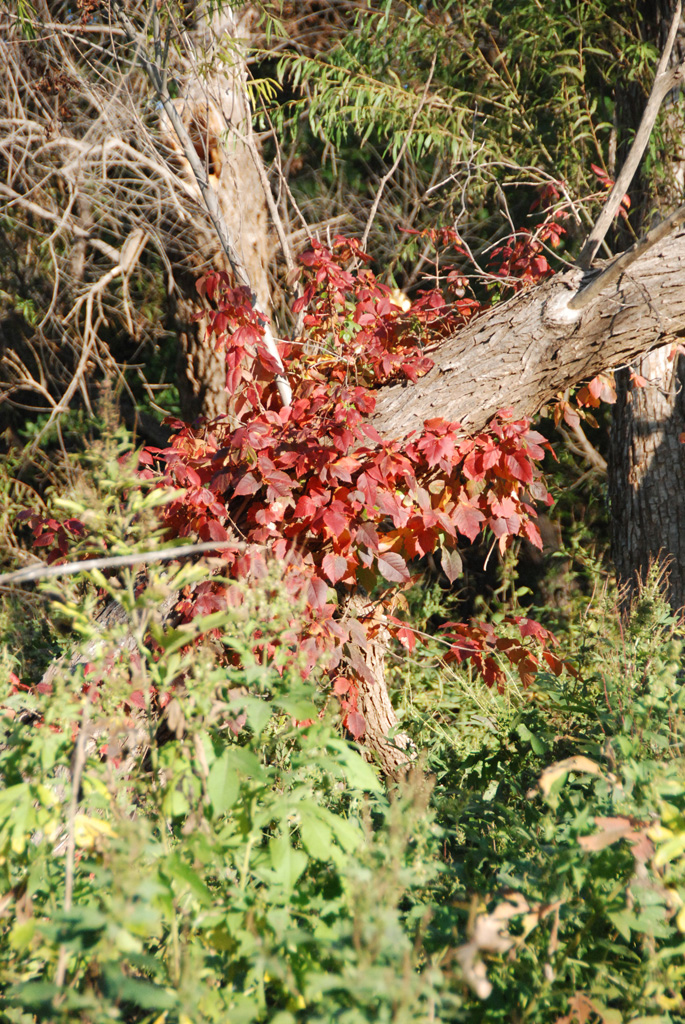
Even some of the giant ragweed plants decided that this was a fall to celebrate, and they donned a deep maroon to join in the seasonal spirit.  (Note that the male flowers along the spikes have dried and mostly fallen off, leaving the remnants of the female flowers at the base of the spike, with their nutritious seeds waiting to feed the incoming winter birds.)


Although I can't say that pokeberry is going to turn many heads, it's still providing a pop of bright magenta color as its foliage drops off and reveals the strong stems holding the remains of the fruit clusters up high.


And, of course, there's always poison ivy - one of our most reliable fall colorers here in Kansas.  As I looked over the trees in the draw on my first walk after getting home from New England, it was immediately obvious where there were still healthy poison ivy plants.  After years of Greg spraying carefully to set back the large, poison ivy shrub colonies that came with the property, it's mainly the vines that are left now, climbing high into the canopy.


Do be careful if you go out gathering leaves with the kids!


Friday, September 07, 2012

It's That Time Again....

What time, you ask?  Well, let me give you a couple visual cues....

What is all over this leaf surface? 

Rust?  No, but that's a good guess.  Try again.  Here's another photo of the same phenomenon, different leaf.

Some sort of tiny bug colony?  A fungus?  Yellow insect poop?  Nope.  Not even close.  Let me zoom out a bit....

Got it?  Yup.  It's ragweed time!  The goldenrod is coming into full bloom...in its usual perfect synchronization with ragweed.  All that yellow stuff?  Ragweed pollen!

Here's an even closer view....

Each of the tiny bells is a giant ragweed (Ambrosia trifida) blossom that's literally dripping pollen into the air.  Millions and billions and trillions of bits of ragweed genetics, floating around to irritate your nasal passages, if your body is so inclined.

Truthfully, I think ragweed blossoms are rather pretty, at least when examined up close.  They look a bit like miniature green foxglove spikes to me.  Here's a rather pretty giant ragweed bloom spike highlighted against the rough bark of a black willow trunk. 

I'd never really seen the family resemblance between giant ragweed and western ragweed until I looked at the bloom spikes.  Giant ragweed, getting up to 10' tall or more, with its broad, flat, widely lobed, deep green leaves.  Western ragweed (Ambrosia psilostachya), barely reaching knee height, sporting densely packed, sharply cut, grayish leaves. 

The flowers, though, tell all.  Here is a closeup of a western ragweed bloom spike....

And, then, a photo of the leaves below the bloom spike....

I have a lot of ragweed on our property, and I'm just fine with that.  In fact, this year I'm quite happy to know that it's doing well, since so many other plants are really struggling.  Why?  Because ragweed seed is one of the most nutritious seeds around, so I know I'll have at least some good, natural food available for the birds this winter.  The bluestem hasn't seeded.  The Indian grass hasn't seeded.  Heck, I haven't even seen any blue grama seed heads!  But there will be an abundant crop of ragweed seed to sustain my feathered friends through the cold months.

So, bloom on, Ambrosias!  Whatever your faults at this time of year, your winter wealth will be greatly welcome!