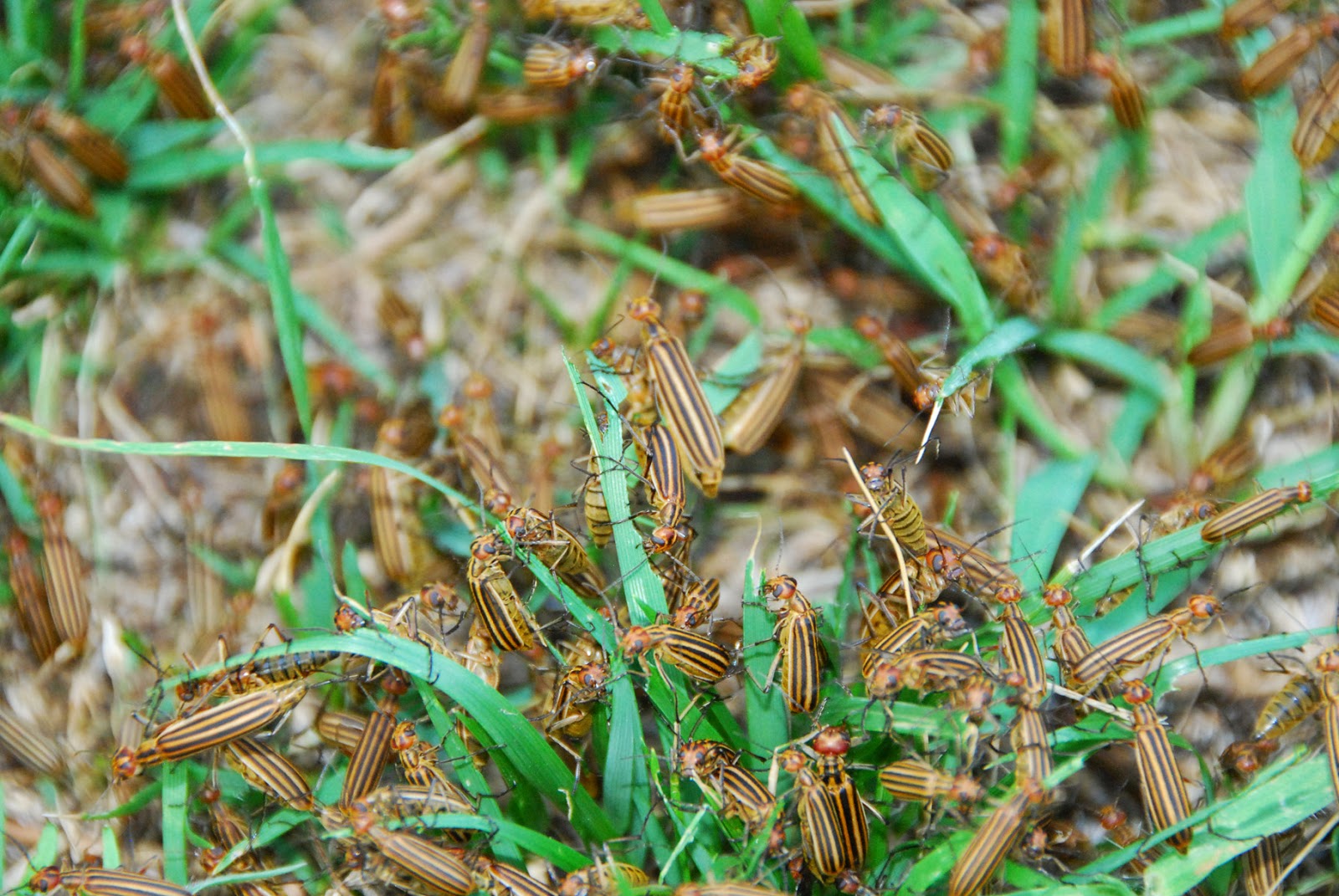
Probably the hardest lesson I've learned in gardening here is to tolerate the uglies caused by blister beetles.
Our vegetable garden was one of the first gardens we began after moving in during the spring of 2007. Having just spent 6 years in southern Alabama, where tomatoes didn't grow very well, we were aching for some sweet-tart, juicy, home-grown tomatoes - and therefore tomato seedlings were some of the first plants that went in.
The tomatoes did beautifully...except that they got pretty ragged looking in late summer, in large part because of all the blister beetles - both black and gray - that were munching on their leaves. Mind you, the plants were still producing huge numbers of tomatoes. There were more tomatoes than we could possibly eat or even give away. But, doggone it, the plants looked positively decrepit, with ratty leaves, covered in blister beetle poop...er, frass. How could I call myself a gardener with my tomato plants looking this bad?
So in I rushed, intrepid organic gardener to the rescue! Every morning I would fill an old peanut butter jar half full of water with dish soap in it and sally forth to fight the blister beetles. Carefully I inspected the leaves of the tomato plants and gently picked off the blister beetles, dropping them to their soapy deaths in my peanut butter jar. At first I wore gloves, worried about the defensive chemical, cantharidin, that blister beetles are known to secrete. It's cantharidin which will cause the blisters that earn this group of beetles their family name. Eventually, though, I shed the gloves and still had no problems. It wasn't uncommon for me to pick 50 or 100 blister beetles off my tomatoes each day. Best of all, I could simply flush the dead beetles down the toilet or even put them in the compost when I was done, since my "killing agent" was simply dish soap and water.
Faithfully I protected my tomato plants for several summers this way, culminating in 2011, when we came home from a trip in early June to find several huge masses of Three-Striped Blister Beetles engaged in orgies on our front lawn.
I'd not seen ONE of this blister beetle species in our yard before, let alone thousands of them. What should we do?! What if ALL of these guys started eating the plants around the yard?
Getting creative, I put my soapy water solution in a small shop vac and we vacuumed most of the striped blister beetles up. Whew. Disaster averted.
But, wait. No. Disaster NOT averted. It just wasn't the disaster I thought I was getting. Up until this point, we hadn't had any real issue with grasshopper populations, despite living in the country and being surrounded by tall grass and crop fields. Beginning in 2011 and continuing into the present, we've learned the benefit of blister beetles.
You see, blister beetle young (larvae) burrow through the soil and eat grasshopper eggs. For every adult blister beetle you see, 21-27 grasshopper eggs have NOT grown up into grasshoppers. And those 21-27 grasshoppers that haven't grown up also haven't produced any eggs or young of their own. While blister beetles eat leaves for a few weeks and make them look pretty ugly while they are munching, they don't generally eat a wide variety of plants and they don't even defoliate the ones they do lunch on. Grasshoppers, on the other hand, will eat almost anything, including bark, and they will eat it all down to nubs. The photo below shows what they did to our (shrub) althea one summer.....
Weather certainly played a role in our grasshopper outbreak, but I'm quite certain that our grasshoppers wouldn't have been as numerous if I hadn't been so zealous about controlling the blister beetle populations in our yard.
Blister beetles have now become almost a sacred animal around here. I welcome them to the yard when I see them, and I mentally encourage them to munch for a while. Happily, I've been seeing a few more blister beetles each year. I still don't see three-striped ones, though.
Meanwhile, last summer had wet spells. It turns out that, during rainy spells, grasshoppers get a fungus which causes them to climb to the top of plants, grasp the stem firmly,... and die. Our yard was full of these weird grasshopper mummies gruesomely hanging on to the tips of plants.
Between healthier blister beetle populations and grasshopper reproduction being down due to the zombie fungus last year, I'm hoping there will be fewer grasshoppers overall this summer than there have been in recent years.
I'm hoping, too, that the blister beetle populations will once again be healthy and that our tomato plants will look quite ragged by summer's end. From now on, the blister beetle "uglies" will be welcomed with open arms in our landscape!
Showing posts with label Tomatoes. Show all posts
Thursday, March 12, 2015
Thursday, August 28, 2014
The Fly and the Caterpillar: Not a Love Story
As I was doing a quick look-see in the vegetable garden yesterday, I heard a fly buzzing. Why a buzzing fly caught my attention, I really can't tell you, but it did. Perhaps it was because the noise was coming from the top of a tomato plant, which isn't normally fly country. Anyway, I stopped to see what was going on.
At first I didn't see anything, then a movement attracted my attention. Was that a smallish horn worm?
I kept looking, finally able to see the outline of the caterpillar against the underside of one of the tomato leaves tucked in a ways. Suddenly I saw a quick, dark movement and the caterpillar thrashed wildly. What was going on???
As I watched, it became obvious that a fly was attacking the hornworm. Every time the fly circled around and came near, the hornworm would move.... Trying to defend itself? Trying to attack the fly? Trying to keep the fly from landing? I couldn't really see what was going on, but I took a series of photos, hoping to capture something with my lens that my eyes couldn't see.
Here are the best shots from the encounter...
The hornworm when I first saw it.
The first view of the fly.
Another "fly by" by the fly. (Look carefully - you can see the fly's legs above the caterpillar; the body of the fly is mostly hidden by the tomato stem.)
The fly comes back for another go-around.
And another attack - Fly attack #4...
This one lasted a little longer and the fly seemed to land on the caterpillar's body, despite the hornworm's thrashing and attempts to defend itself.
Fly attack #5..... (You can just see the eyes of the fly coming into focus to the left of and slightly below the caterpillar.)
Fly attack #6...
Now there's fluid on the back of the caterpillar; the fly has definitely made contact.
Still the fly comes back again....
But this seems to be the end of the attack. A drop of "blood" on the back of the caterpillar remains, but the buzzing fly is gone.
According to my camera's time stamp, all of these photos were taken within a 2 minute window. I don't know how long the attack had been going on when I chanced upon it. Still, overall, the action didn't last that long.
I am assuming that the fly was a female and that she laid at least one egg in the caterpillar. Judging from the fly's hairy abdomen that I could see in the photos, this was probably a tachinid fly. If that's the case, the hornworm will go back to eating as if nothing has happened, but when it goes to pupate, the fly larva that has grown inside it will take over and kill the developing moth. The hornworm pupa will actually only produce one or more fly pupae, which will, in their turn, produce more tachinid flies to carry on the cycle.
I knew that tachinid flies were parasitoids of caterpillars, but this is the first time I've actually witnessed the interaction between the caterpillar and the fly. I see many, many tachinid flies in the garden, especially in the fall when they are feeding at my asters, so I knew this sort of event had to be occurring. Adult tachinid flies are pollen and nectar feeders...and good pollinators. Hornworms, while I think they are cool and interesting, are pests on tomato plants. This is natural predator control at its most basic.
Life is not particularly gentle, but it tends to balance itself when allowed to do so. Sometimes the variety of feeding strategies truly boggles my mind. What predatory insects have you seen in YOUR garden lately?
At first I didn't see anything, then a movement attracted my attention. Was that a smallish horn worm?
I kept looking, finally able to see the outline of the caterpillar against the underside of one of the tomato leaves tucked in a ways. Suddenly I saw a quick, dark movement and the caterpillar thrashed wildly. What was going on???
As I watched, it became obvious that a fly was attacking the hornworm. Every time the fly circled around and came near, the hornworm would move.... Trying to defend itself? Trying to attack the fly? Trying to keep the fly from landing? I couldn't really see what was going on, but I took a series of photos, hoping to capture something with my lens that my eyes couldn't see.
Here are the best shots from the encounter...
The hornworm when I first saw it.
The first view of the fly.
Another "fly by" by the fly. (Look carefully - you can see the fly's legs above the caterpillar; the body of the fly is mostly hidden by the tomato stem.)
The fly comes back for another go-around.
And another attack - Fly attack #4...
This one lasted a little longer and the fly seemed to land on the caterpillar's body, despite the hornworm's thrashing and attempts to defend itself.
Fly attack #5..... (You can just see the eyes of the fly coming into focus to the left of and slightly below the caterpillar.)
Fly attack #6...
Now there's fluid on the back of the caterpillar; the fly has definitely made contact.
Still the fly comes back again....
But this seems to be the end of the attack. A drop of "blood" on the back of the caterpillar remains, but the buzzing fly is gone.
According to my camera's time stamp, all of these photos were taken within a 2 minute window. I don't know how long the attack had been going on when I chanced upon it. Still, overall, the action didn't last that long.
I am assuming that the fly was a female and that she laid at least one egg in the caterpillar. Judging from the fly's hairy abdomen that I could see in the photos, this was probably a tachinid fly. If that's the case, the hornworm will go back to eating as if nothing has happened, but when it goes to pupate, the fly larva that has grown inside it will take over and kill the developing moth. The hornworm pupa will actually only produce one or more fly pupae, which will, in their turn, produce more tachinid flies to carry on the cycle.
I knew that tachinid flies were parasitoids of caterpillars, but this is the first time I've actually witnessed the interaction between the caterpillar and the fly. I see many, many tachinid flies in the garden, especially in the fall when they are feeding at my asters, so I knew this sort of event had to be occurring. Adult tachinid flies are pollen and nectar feeders...and good pollinators. Hornworms, while I think they are cool and interesting, are pests on tomato plants. This is natural predator control at its most basic.
Life is not particularly gentle, but it tends to balance itself when allowed to do so. Sometimes the variety of feeding strategies truly boggles my mind. What predatory insects have you seen in YOUR garden lately?
Monday, July 28, 2014
Death Comes For the Grasshopper(s)
Not surprisingly after 3 hot, dry years, there have been a lot of grasshoppers around this summer. Grasshoppers and hot, dry weather go together like bread goes with peanut butter and jelly. I've been noticing a few things that bode a little better for next year, though, and I'd like to share them with you.
The beginning of the summer started with literal hordes of grasshoppers, especially newly hatched nymphs. The photo above shows a phalanx of said nymphs on a soon-devoured broccoli leaf. It wasn't uncommon to have hundreds of tiny grasshoppers flying up with every step through grassy areas.
Now, towards the end of July, there are still a lot of grasshoppers, but the numbers seem to have declined a bit - dozens fly up at every step instead of hundreds. Sometimes only a few fly up. I haven't sprayed or made any effort to curb their numbers, so what has happened?
First of all, the weather has been cooler and wetter than during the last 3 or 4 summers. Cooler, wetter weather is good for plants, but bad for grasshoppers. Newly hatched grasshoppers can be killed by cool, wet weather. Truthfully, I'm not sure we were cool enough or wet enough for this to happen this year, but I'm mentioning it anyway. However, warm, wet weather can also have a negative effect on grasshopper populations....
During warm, wet weather, there is a naturally occurring fungus, Entomophthora grylli, which infects grasshoppers and causes them to climb to the top of vegetation and grasp the stem with their legs, then die. I've been seeing quite a few grasshoppers seemingly mummified like this. The best news is that, as these grasshoppers dry out, the fungal spores spread on the wind to other grasshoppers, infecting them as well.
So not only is there one less grasshopper reproducing for next year, but each one that dies like this has also potentially caused other grasshoppers in the area to die as well! Rather nightmarish...but effective.
Predators have been playing a role in decreasing grasshopper numbers, too. Just in my ramblings with camera in hand, I've caught shots of several wheel bugs eating grasshoppers.
I've got a large population of wheel bugs this year; after such an abundance of prey, I suspect I'll have an even larger population next year!
Spiders, too, eat grasshoppers. This photo of a black and yellow garden spider eating a grasshopper was actually taken last October, but I'm sure that the spiders I'm seeing this summer are taking out quite a few grasshoppers as well. (My garden spiders aren't this big yet, but they will be!)
Birds, not surprisingly, eat grasshoppers as well, although I haven't been lucky enough to get any photos of that happening. Bluebirds, quail, pheasant, meadowlarks, lark sparrows, and lots of other birds are known to eat grasshoppers.
I occasionally see great golden digger wasps around the yard, as in this rather out-of-focus photo from about a week ago, hunting (in this case) on Bradbury beebalm. If these beautiful, big wasps aren't feeding themselves with nectar and pollen on flowers, they are actively prowling for grasshoppers to sting and paralyze. Once the grasshopper is paralyzed, the female wasp takes it back to her nests as baby food to lay her eggs on.
The long and the short of it is that grasshoppers are grazers on plants, and a lot of animals eat them. With bison no longer freely roaming the prairie, I understand that grasshoppers are actually the primary herbivore for this important ecosystem! Because grasshoppers are so mobile, it's hard to kill them with insecticides. Ironically, it's much easier to kill the insects that prey on grasshoppers - so any time you spray an insecticide, even an organic one, you are probably helping to increase grasshopper populations, in the long run, by decreasing their predators.
Speaking of spraying insecticides and accidentally killing off insect predators, the last grasshopper predator I'm going to show you today fell victim to some actions Greg and I took several years ago before we knew any better. While we didn't actually spray, we did kill enough of these predators that their population declined around our yard and gardens for a few years, so we've actually had more grasshoppers than we would have had if we hadn't tried to solve a "problem" we were sure we had.
The first summer or two that we lived and gardened here, we started our vegetable garden. Despite the tall grass that we encouraged to grow on much of the property, we didn't see a large number of grasshoppers. Some, yes, but not enough to cause noticeable damage. Generally, our garden plants did superbly, although the tomatoes, in particular, attracted large numbers of black blister beetles. A few grey blister beetles came too. Not only were these insects a little creepy looking, but they ate the tomato leaves and made the tomato plants look really ugly. I still harvested more tomatoes than I could possibly use and there weren't enough blister beetles to defoliate the plants, but definitely there were enough to make the plants look ratty. So I started to handpick the blister beetles, dropping them in soapy water to kill them. Each morning I would do this, and it wasn't unusual for me to dispatch 50 or 100 each day. It definitely lessened their populations over the course of the summer.
Even after I learned that blister beetle larvae ate grasshopper eggs, I continued to handpick the blister beetles, reasoning that I was seeing plenty of blister beetles, so it shouldn't be a problem.
In June, 2011, we came back from a trip to San Antonio to find several masses of hundreds of striped blister beetles writhing on our front lawn, presumably in an ecstasy of mating. Our only thought was how to dispatch them as quickly as possible before they, too, started to eat the leaves of our tomatoes and other plants! So we put soapy water in our shop vac and vacuumed most of them up. Problem solved.
By later that same summer, I was seeing very few blister beetles...but hordes of grasshoppers. As you may remember, the summer of 2011 was horribly hot and dry. We had 53 days over 100 degrees F. and almost no rain. By late July of that year, our althea had been defoliated by the grasshopper hordes.
For every adult blister beetle you see, an average of 27 grasshoppers don't get born. What had we done?
For several years now, we've had so many grasshoppers that by early summer most of our vegetable garden is gone. Once the grasshoppers hatch out, they devour the spinach, kale, broccoli and cauliflower within days. Then the onion and garlic go. The asparagus stalks become dried brown sticks with all the green gnawed off. Over the course of the summer, all the iris leaves get whittled down to nubs. Thankfully, 2011 was the only year our althea were entirely defoliated, but their leaves have been severely chewed each summer since then.
This year I'm finally seeing black blister beetles on the tomatoes and a few other plants again. Mind you, I'm not seeing them in huge numbers, but they are there and they are reasonably common. This year I'm NOT picking them off and killing them. I'll share my tomato leaves so that, hopefully, the black blister beetle larvae will be feasting on grasshopper eggs over the winter!
The more I learn, the more I realize that I don't know very much. A blog post I read over the weekend was talking about tangleveined flies as a grasshopper predator. That's a new species I don't recognize, so now I want to learn more about them and see if I have any of those grasshopper predators in the yard.
There is an incredibly complex web of plants and animals that will generally keep each other in balance and keep the Earth healthy, if we leave enough of them alone to "do their thing." We humans, though, get pretty cocksure of ourselves and start killing plants and animals off, thinking we know a lot and can surely manage better than Mother Nature does.
We're not as smart as we think we are.
Hopefully my yard is getting back into balance a bit better again. Ah, the gardening spirit never fails, does it? Next year will be better.....
The beginning of the summer started with literal hordes of grasshoppers, especially newly hatched nymphs. The photo above shows a phalanx of said nymphs on a soon-devoured broccoli leaf. It wasn't uncommon to have hundreds of tiny grasshoppers flying up with every step through grassy areas.
Now, towards the end of July, there are still a lot of grasshoppers, but the numbers seem to have declined a bit - dozens fly up at every step instead of hundreds. Sometimes only a few fly up. I haven't sprayed or made any effort to curb their numbers, so what has happened?
First of all, the weather has been cooler and wetter than during the last 3 or 4 summers. Cooler, wetter weather is good for plants, but bad for grasshoppers. Newly hatched grasshoppers can be killed by cool, wet weather. Truthfully, I'm not sure we were cool enough or wet enough for this to happen this year, but I'm mentioning it anyway. However, warm, wet weather can also have a negative effect on grasshopper populations....
During warm, wet weather, there is a naturally occurring fungus, Entomophthora grylli, which infects grasshoppers and causes them to climb to the top of vegetation and grasp the stem with their legs, then die. I've been seeing quite a few grasshoppers seemingly mummified like this. The best news is that, as these grasshoppers dry out, the fungal spores spread on the wind to other grasshoppers, infecting them as well.
Predators have been playing a role in decreasing grasshopper numbers, too. Just in my ramblings with camera in hand, I've caught shots of several wheel bugs eating grasshoppers.
I've got a large population of wheel bugs this year; after such an abundance of prey, I suspect I'll have an even larger population next year!
Spiders, too, eat grasshoppers. This photo of a black and yellow garden spider eating a grasshopper was actually taken last October, but I'm sure that the spiders I'm seeing this summer are taking out quite a few grasshoppers as well. (My garden spiders aren't this big yet, but they will be!)
Birds, not surprisingly, eat grasshoppers as well, although I haven't been lucky enough to get any photos of that happening. Bluebirds, quail, pheasant, meadowlarks, lark sparrows, and lots of other birds are known to eat grasshoppers.
I occasionally see great golden digger wasps around the yard, as in this rather out-of-focus photo from about a week ago, hunting (in this case) on Bradbury beebalm. If these beautiful, big wasps aren't feeding themselves with nectar and pollen on flowers, they are actively prowling for grasshoppers to sting and paralyze. Once the grasshopper is paralyzed, the female wasp takes it back to her nests as baby food to lay her eggs on.
The long and the short of it is that grasshoppers are grazers on plants, and a lot of animals eat them. With bison no longer freely roaming the prairie, I understand that grasshoppers are actually the primary herbivore for this important ecosystem! Because grasshoppers are so mobile, it's hard to kill them with insecticides. Ironically, it's much easier to kill the insects that prey on grasshoppers - so any time you spray an insecticide, even an organic one, you are probably helping to increase grasshopper populations, in the long run, by decreasing their predators.
Speaking of spraying insecticides and accidentally killing off insect predators, the last grasshopper predator I'm going to show you today fell victim to some actions Greg and I took several years ago before we knew any better. While we didn't actually spray, we did kill enough of these predators that their population declined around our yard and gardens for a few years, so we've actually had more grasshoppers than we would have had if we hadn't tried to solve a "problem" we were sure we had.
The first summer or two that we lived and gardened here, we started our vegetable garden. Despite the tall grass that we encouraged to grow on much of the property, we didn't see a large number of grasshoppers. Some, yes, but not enough to cause noticeable damage. Generally, our garden plants did superbly, although the tomatoes, in particular, attracted large numbers of black blister beetles. A few grey blister beetles came too. Not only were these insects a little creepy looking, but they ate the tomato leaves and made the tomato plants look really ugly. I still harvested more tomatoes than I could possibly use and there weren't enough blister beetles to defoliate the plants, but definitely there were enough to make the plants look ratty. So I started to handpick the blister beetles, dropping them in soapy water to kill them. Each morning I would do this, and it wasn't unusual for me to dispatch 50 or 100 each day. It definitely lessened their populations over the course of the summer.
Even after I learned that blister beetle larvae ate grasshopper eggs, I continued to handpick the blister beetles, reasoning that I was seeing plenty of blister beetles, so it shouldn't be a problem.
In June, 2011, we came back from a trip to San Antonio to find several masses of hundreds of striped blister beetles writhing on our front lawn, presumably in an ecstasy of mating. Our only thought was how to dispatch them as quickly as possible before they, too, started to eat the leaves of our tomatoes and other plants! So we put soapy water in our shop vac and vacuumed most of them up. Problem solved.
By later that same summer, I was seeing very few blister beetles...but hordes of grasshoppers. As you may remember, the summer of 2011 was horribly hot and dry. We had 53 days over 100 degrees F. and almost no rain. By late July of that year, our althea had been defoliated by the grasshopper hordes.
For every adult blister beetle you see, an average of 27 grasshoppers don't get born. What had we done?
For several years now, we've had so many grasshoppers that by early summer most of our vegetable garden is gone. Once the grasshoppers hatch out, they devour the spinach, kale, broccoli and cauliflower within days. Then the onion and garlic go. The asparagus stalks become dried brown sticks with all the green gnawed off. Over the course of the summer, all the iris leaves get whittled down to nubs. Thankfully, 2011 was the only year our althea were entirely defoliated, but their leaves have been severely chewed each summer since then.
This year I'm finally seeing black blister beetles on the tomatoes and a few other plants again. Mind you, I'm not seeing them in huge numbers, but they are there and they are reasonably common. This year I'm NOT picking them off and killing them. I'll share my tomato leaves so that, hopefully, the black blister beetle larvae will be feasting on grasshopper eggs over the winter!
The more I learn, the more I realize that I don't know very much. A blog post I read over the weekend was talking about tangleveined flies as a grasshopper predator. That's a new species I don't recognize, so now I want to learn more about them and see if I have any of those grasshopper predators in the yard.
There is an incredibly complex web of plants and animals that will generally keep each other in balance and keep the Earth healthy, if we leave enough of them alone to "do their thing." We humans, though, get pretty cocksure of ourselves and start killing plants and animals off, thinking we know a lot and can surely manage better than Mother Nature does.
We're not as smart as we think we are.
Hopefully my yard is getting back into balance a bit better again. Ah, the gardening spirit never fails, does it? Next year will be better.....
Labels:
Blister beetles,
grasshoppers,
Organic Gardening,
Pests,
Tomatoes,
Vegetables,
Wasps,
Wheelbugs
Subscribe to:
Comments (Atom)